
Specs are compiled from manufacturer listings and verified buyer reviews and can change over time — please confirm the key details on the product page before buying.
You’re staring at thick, clumping dallisgrass that shrugs off ordinary sprays and sits right in your warm-season lawn where digging it out leaves a crater. The fix is a selective herbicide that kills the grassy weed without wrecking your turf, and all four picks here are labeled for dallisgrass, so you skip the guesswork and go straight to a solution.
I’m Rikta — the founder and writer behind Lawn Gear Lab. This guide is built by comparing the manufacturers’ published specifications and the patterns across verified customer reviews, so you get each pick’s real strengths and trade-offs instead of marketing spin.
You need a herbicide with a strong active ingredient and a reliable mix rate. The best herbicide for dallisgrass balances killing power against the risk of browning your good grass.
Our Picks at a Glance

How To Choose The Best Herbicide For Dallisgrass
Dallisgrass is a perennial grassy weed with a thick, fibrous crown, and standard broadleaf weed killers ignore it entirely. You need a selective grass herbicide that lists dallisgrass on its label and is safe for the specific turf you’re spraying.
Match the active ingredient to your turf
MSMA is the heavy-duty professional choice, widely used on golf courses and sod farms, and it delivers the kind of knockout results on established dallisgrass that homeowners rave about. Quinclorac is the more residential-friendly option — it controls younger dallisgrass and crabgrass with a lower risk of harming your lawn, though it may need a second application on mature clumps.
Decide between spot treatment and broadcast coverage
A 7.5-ounce bottle covers roughly 1,000 square feet of lawn, which is perfect for spot-spraying a few infested patches. If dallisgrass has spread across a whole yard, you need a larger jug or a concentrate that makes many gallons of spray — otherwise you’ll run out mid-application and the weed gets a head start.
Check the safety window for your grass type
Warm-season grasses like Bermuda and zoysia tolerate these herbicides best, but heat stress can increase the chance of yellowing. Cool-season grasses like fescue can be set back noticeably if you spray late in the season, so timing your application to the label’s temperature guidance matters as much as the product itself.
Quick Comparison
| Model | Best For | Active Ingredient | Bottle Volume | Coverage | Amazon |
|---|---|---|---|---|---|
| Target 6 Plus (MSMA)★ Best Overall | Heavy established infestations | MSMA 48.2% | 2.5 gallons | Selective grassy weeds | Amazon |
| Primesource Quinclorac | Small lawns, spot treatment | Quinclorac 18.92% | 7.5 fl oz | 1,000 sq ft | Amazon |
| Liquid Harvest Quinclorac | Fast results with residual control | Quinclorac 18.92% | 32 fl oz | Residual control | Amazon |
| Ornamec Over-The-Top | Protecting ornamental beds | Fluazifop (pre-mixed) | 1 quart | Over 400 plant species safe | Amazon |
In-Depth Reviews
1. Target 6 Plus (MSMA 48.2%) Turf Herbicide — 2.5 Gallon Jug
Our pick — over 4.5★ from 900+ verified ratings; the strongest balance of quality and price.
The professional-grade jug that knocks out entrenched dallisgrass clumps for good.
This is the heavy artillery for lawns where dallisgrass has taken over large patches. The active ingredient, MSMA at 48.2%, is the same chemistry trusted on golf courses, sod farms, and highway rights of way, and it’s labeled for dallisgrass, crabgrass, johnsongrass, and nutsedge — so one jug covers the whole grassy-weed rogues’ gallery. You get 320 fluid ounces in the 2.5-gallon jug, which is around ten times the volume of a standard 32-ounce concentrate, making it the obvious choice when you’re treating a whole yard rather than a single patch.
The proof of its power is in the owner reports: on a heavily infected Japanese zoysia lawn, it “knocked it out quite impressively.” That effectiveness is the thing owners praise most — by a wide margin, with 134 buyers singling out how well it works. The quality is the second most-discussed trait at 55 mentions, which tells you the consistency batch to batch holds up. One long-term owner reports buying a jug five years ago and still using it, which speaks to how concentrated and efficient the mix rate is at 2 ounces per gallon of water for general applications.
The honest trade-off is that this is not a gentle product. Multiple owners stress that if you don’t follow the label’s mix measurements exactly, it “will brown your grass really bad.” The discoloration is the most common negative — 12 owners flag it, and it’s a mixed verdict because temporary yellowing in Bermuda lawns is expected when the chemical is working. There’s also a real safety layer: you need to keep pets off the treated area for a few days after spraying, and the toxicity questions come up in 9 reviews. This is a product for someone who reads the label, respects the mix rate, and wants a definitive kill on a serious infestation.
The heavy hitter: For established dallisgrass across a large lawn, this is the most effective and economical route — the cost per ounce is dramatically lower than buying quart bottles, and it actually works where gentler sprays fail.
Respect the label: The mix rate is non-negotiable, and the pet-off-the-lawn window and potential for grass browning mean it suits a careful applicator, not a casual spray-and-forget user.
Reach for this if: you have a large warm-season lawn with widespread dallisgrass and you’re comfortable following precise mixing instructions.
Look elsewhere if: you only have a few scattered clumps or you need something gentle enough for a small ornamental garden bed.
2. Primesource Quinclorac 1.5 Select Liquid Crabgrass Killer — 7.5 fl oz
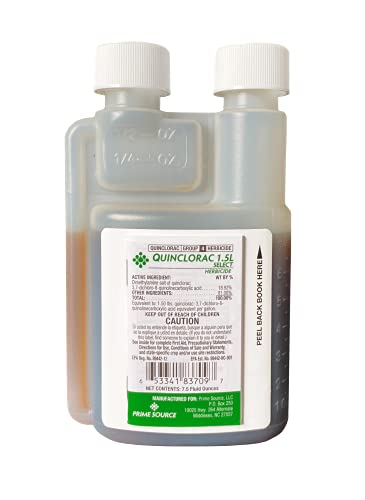
The small-bottle spot treatment that’s gentle enough for a do-it-yourselfer to trust.
If your dallisgrass problem is confined to a few patches rather than the whole yard, this 7.5-fluid-ounce bottle is sized exactly for that job. It’s a quinclorac herbicide at 18.92% concentration, and it’s labeled for residential turfgrass, golf courses, and sod farms — so it passes the all-important test of being officially sanctioned for the weed you’re fighting. The manufacturer claims up to 90 days of control, which means one good application buys you a whole season of relief rather than a two-week respite.
The owner feedback here is remarkably direct: buyers report that after spraying twice, “a lot of it will pull up my hand now and all of it is dying” — which is exactly what you want to hear about the stubborn root system of dallisgrass. The coverage is 1,000 square feet, which is the honest balance for a homeowner with a modest lawn or a targeted infestation. This bottle holds 7.5 fluid ounces, a fraction of the 320-fluid-ounce jug in our top pick, and that’s the entire point — you’re buying precision, not volume.
What buyers also report is that this is not a product to overuse. The guidance is a maximum of 2 treatments per year, with a warning that overuse causes weed resistance — the chemical stops working if you lean on it too hard. One lawn owner in North Georgia found it effective on crabgrass but noted it “severely set back” their Bermuda, likely because they sprayed late in the season during cool, dry conditions. That’s the recurring caution: it’s powerful, it works, but it can stress your good grass if you spray at the wrong time of year or at too strong a mix.
The precision tool: For spot-treating a handful of dallisgrass clumps on a small lawn, this is the most sensible dollar-per-job purchase — you’re not paying for 2.5 gallons you’ll never use.
The discipline it demands: Follow the two-treatments-per-year cap and avoid late-season sprays on stressed warm-season grass, or you’ll trade dallisgrass for a brown lawn.
Reach for this if: you’re a homeowner with a modest lawn and a contained dallisgrass problem you want to solve without a massive jug of concentrate.
Think twice if: your dallisgrass covers a large area — you’d run through this 1,000-square-foot bottle fast and pay more per application than the larger jug.
3. Liquid Harvest Pro Crabgrass & Grassy Weed Killer — 18.92% Quinclorac, 32 fl oz

The fast-acting quinclorac concentrate with residual power that keeps weeds from bouncing back.
This 32-fluid-ounce bottle splits the difference between the tiny 7.5-ounce spot spray and the massive 2.5-gallon jug — it’s a mid-size concentrate (holding 4.3x the liquid of the small bottle) for someone whose lawn falls between those extremes. The active ingredient is quinclorac at 18.92%, and the label explicitly lists dallisgrass among the grassy weeds it controls, alongside crabgrass, foxtail, and barnyardgrass. The selling point here is residual control: the manufacturer says the solution prevents weeds from reappearing, so you’re not just killing what’s visible but extending the protection window.
The speed is the headline feature that owners consistently report. Owners mention yellowing by day 3 and full death by day 5 after a proper application — that’s a noticeably faster visible result than most selective herbicides deliver. The trick, as several owners emphasize, is to mix it right and follow the label’s temperature and timing instructions. Those who followed the directions exactly reported discoloration the next day and yellow-brown grass by day 4, with their crabgrass dead or dying. It’s also positioned as safe for fescue and bluegrass, which widens its appeal beyond just warm-season lawns.
The honest caveat is that effectiveness gets a genuinely mixed reception — 59 owners discuss it, and the verdict is split rather than unanimous. Some report it “worked much better than I expected,” while others say it “has not produce the results expected” on established, widespread weeds. The pattern in the positive reports is consistent: it needs a surfactant mixed in for best results, and established dallisgrass clumps may demand a second application. Value for money is the other mixed point at 12 mentions, with some owners feeling the price is high for the results on stubborn infestations. This is a product for a patient applicator who reads instructions and reapplies as needed rather than expecting a one-shot miracle.
What wins people over
- Visible results fast — yellowing by day 3, dead by day 5 when mixed correctly
The limits to know
- Effectiveness is mixed on mature weeds — established clumps often need a follow-up application
Who it fits: a mid-size lawn owner who wants a faster visible kill than the small bottle offers and is willing to mix a surfactant for best results.
Who it doesn’t: someone expecting a single application to erase a years-old dallisgrass infestation — plan for a reappearance and a second pass.
4. Ornamec Over-The-Top Grass Herbicide — 1 Quart, Pre-Mixed

The ornamental-bed defender that stops dallisgrass without harming your prized shrubs and flowers.
This is the specialist’s pick for a very specific job: killing grassy weeds like dallisgrass and bermudagrass that invade flower beds, shrub lines, and landscape borders where you absolutely cannot afford to harm the ornamentals. The bottle is pre-mixed with Aqua-Zorb CA Surfactant, which means the absorption aid is already in the liquid — you don’t have to buy a separate additive for it to work properly. The manufacturer states it’s safe for over 400 ornamental plant species with over-the-top application, which is the reassurance a gardener needs before spraying anything near a prized hydrangea.
The speed claim is aggressive: the manufacturer claims it stops unwanted grass growth within 48 hours, with full control in 1-3 weeks. Owners who used it on bermudagrass report their target grass browning within 3 weeks, though some note regrowth in spring suggests the roots weren’t fully killed and repeated treatment is likely needed. The effectiveness is the trait owners praise most by a strong margin — 122 buyers highlight how well it kills the target grass, and the second most-praised quality at 12 mentions is that it doesn’t harm the good plants around it. The crowd favorite here has a solid 4.3-star average across around 360 ratings.
The catch is in the application feedback. A 32-ounce bottle (1 quart) is “not nearly enough for broadcast applications,” as several owners put it — this is a spot-treatment product, not a whole-lawn solution. Temperature matters too, with one owner noting that when spring jumped straight to 85 degrees, they could only get in the first round and missed the second. Browning results are mixed — some see their target grass brown and die cleanly, others report no browning at all, which suggests the weed may not have been fully hit. And one owner found it killed crabgrass and bermudagrass but “nothing else,” so it’s selective in the truest sense of the word.
The bed protector: For dalisgrass in ornamental beds, this is the safest choice — the pre-mixed surfactant and 400-species safety margin make it the clear pick where other herbicides would spray-and-pray.
The size reality: At 32 ounces with limited broadcast coverage, this suits a gardener with beds to protect, not someone trying to clean up an entire lawn.
Reach for this if: you’re protecting flower beds and shrubs from invasive dallisgrass and bermudagrass and want an over-the-top spray you don’t have to mix.
Look elsewhere if: you need to treat a large open lawn — you’d exhaust this quart bottle fast and pay a premium per square foot.
Understanding the Specs
MSMA vs Quinclorac
MSMA is the professional-grade organoarsenical herbicide used on golf courses and sod farms — it’s the most effective option for mature dallisgrass, but it demands precise mixing and has real safety considerations for pets. Quinclorac is a synthetic auxin herbicide that’s gentler on desirable turf and more forgiving for homeowners, though it often needs two applications on established dallisgrass. Your choice between them depends on how entrenched the weed is and how comfortable you are with a label that carries stronger precautions.
Bottle volume and coverage area
The math here is brutally simple: a 7.5-fluid-ounce bottle covers about 1,000 square feet, a 32-fluid-ounce bottle covers a mid-size lawn, and a 2.5-gallon jug (320 fluid ounces) is for serious infestations. Buying a tiny bottle for a whole yard means running out mid-spray and letting the weed recover. Buying a massive jug for a few patches means storing a powerful concentrate you’ll barely touch. Right-size the volume to the square footage you actually need to treat.
FAQ
Why won’t regular weed killer kill my dallisgrass?
How do I mix MSMA herbicide safely?
Is MSMA safe for my Bermuda or zoysia lawn?
How many times do I need to spray quinclorac on dallisgrass?
How fast does quinclorac kill dallisgrass?
Can I spray these herbicides in flower beds?
What is a surfactant and do I need one?
How long should I keep pets off the lawn after spraying?
Is it better to dig out dallisgrass or spray it?
When is the best time of year to spray dallisgrass?
Final Thoughts: The Verdict
For most people, the herbicide for dallisgrass winner is the Target 6 Plus (MSMA) because it’s the only pick that genuinely delivers a knockout on established dallisgrass clumps — and at 320 fluid ounces, it’s the economical route for a real infestation. If you want a gentler, easier spot treatment for a small lawn, grab the Primesource Quinclorac. And for protecting flower beds from invasive grassy weeds, the Ornamec Over-The-Top is the one to reach for.
How We Picked
We do not accept paid placement. Every pick is matched to a real buyer and a real use-case; we do not hands-on test units.
Sources & Methodology
Specifications: manufacturer listings and product documentation. Review insights: verified customer reviews, as of August 2026. Pricing: not shown on this page (it changes often); check the current price via the retailer link.
As an Amazon Associate, Lawn Gear Lab earns from qualifying purchases. This does not affect which products we feature.