
Specs are compiled from manufacturer listings and verified buyer reviews and can change over time — please confirm the key details on the product page before buying.
Spraying the wrong weed killer on a Bahia lawn is a fast way to end up with bare dirt where your grass used to be. The fix is choosing a selective formula—one that targets broadleaf weeds and sedges while leaving your Bahia grass standing tall. This guide breaks down the top contenders that are actually labeled safe for Bahia, so you can treat the weeds without nuking the lawn.
I’m Rikta — the founder and writer behind Lawn Gear Lab. This guide is built by comparing the manufacturers’ published specifications and the patterns across verified customer reviews, so you get each pick’s real strengths and trade-offs instead of marketing spin.
You’ll learn which weed killers are safe for Bahia grass, what the active ingredients do, and how to apply them for the best results. herbicide for bahia grass.
Our Picks at a Glance

How To Choose The Best Herbicide For Bahia Grass
Bahia grass is a tough, drought-resistant warm-season turf, but it is also picky about chemicals. The first thing to check on any jug is that the label lists “Bahia” or “Bahiagrass” as a safe species. If it is not on the label, do not risk it — a systemic herbicide that isn’t selective could wipe out your whole yard.
Match the chemical to the weed
Different weeds demand different active ingredients. For the classic broadleaf invaders like clover, dandelion, and spurge, look for a blend of MCPA, dicamba, fluroxypyr, or triclopyr. If your problem is nutsedge or sedge, you need a specialist like halosulfuron or sulfosulfuron. Buying a single product that claims to do everything often means it does none of it well.
Choose your format wisely
You have two main choices: a ready-to-spray (RTS) bottle that attaches to your garden hose, or a liquid concentrate you mix yourself in a pump sprayer. RTS bottles are easy and good for small patches, but they are less precise. Concentrates cost less per square foot and give you exact control over the mix, which is what you want for larger Bahia lawns.
Quick Comparison
| Model | Best For | Active Ingredients | Volume | Coverage | Amazon |
|---|---|---|---|---|---|
| Nufarm Change Up★ Best Overall | Broadleaf Weed Control | MCPA, fluroxypyr, dicamba | 32 oz | 1,000 sq ft | Amazon |
| Fertilome Weed Free Zone RTSBest Value | Fast-Acting Spray | Triclopyr + Clopyralid | 32 oz | Full | Amazon |
| Fertilome Weed-Out Nutsege | Sedge & Nutsedge | Halosulfuron | 16 oz | 5,800 sq ft | Amazon |
| Crabgrass Killer | Crabgrass in Warm Turf | Cinnamon | 2 lbs | 100-200 ft | Amazon |
| Monterey Spurge Power | Tough Broadleaf Weeds | MCPA, Triclopyr, Dicamba | 32 oz (2×16 oz) | 16,000 sq ft | Amazon |
| Fertilome Weed-Out 1 Gal | Large Lawns | Dicamba, Mecoprop-P, Trimec | 1 gallon | 8,000 sq ft/pint | Amazon |
| Atticus Sertay | Poa Annua & Sedge Control | Sulfosulfuron 75% | 1.25 oz | 12,500 sq ft | Amazon |
In‑Depth Reviews
1. Nufarm Change Up
Our pick — 4.5★ from 200+ verified ratings; the strongest balance of quality and price.
The broad-spectrum workhorse that takes on 200+ weeds without damaging your Bahia.
This is the pick for the lawn that has a little bit of everything. The active trio of MCPA (51.05%), fluroxypyr (6.0%), and dicamba (4.17%) is a proven combination against dandelion, plantain, oxalis, chickweed, and thistles — tough customers that ignore weaker formulas.
Buyers report that it erased a front-yard clover problem in a little over a week, and it is labeled explicitly for Bahiagrass, Bermudagrass, and St. Augustinegrass. It arrives as a 32 fluid ounce bottle weighing 2.1 pounds, and the use rate of.46 oz to 1.1 oz per 1,000 square feet means a little goes a long way.
The honest catch: this is not a spray-and-walk-away product. You will see where you missed because those spots stay green, and applying it right after a fresh cut weakens the effect since the chemical needs leaf surface to work its way down to the root.
What wins people over
- Controls more than 200 broadleaf weed species in one bottle
- Labeled safe for Bahia along with 9 other turf types
- Fast visible results, with clover gone in about a week
Keep in mind
- Requires full leaf coverage to reach the roots
- Not effective if sprayed on a freshly cut lawn
Reach for this if: you want a single selective bottle that handles a wide mix of broadleaf weeds on a mid-sized Bahia yard.
Look elsewhere if: your main problem is nutsedge or grassy weeds, because this formula is built for broadleafs.
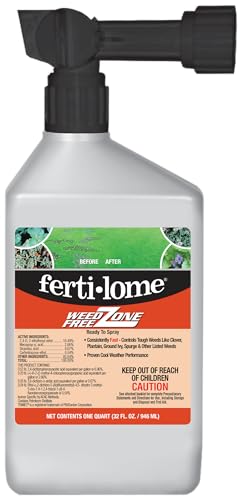
2. Fertilome Weed Free Zone RTS
The hose-end hero that gives you visible die-off in a single afternoon.
If you want to see the weeds start to turn brown the same day you spray, this is the formula. The triclopyr + clopyralid blend controls over 80 broadleaf weeds including clover, spurge, chickweed, and thistle, and it is labeled safe on Bahiagrass alongside Kentucky Bluegrass, Bermudagrass, and Zoysiagrass. This is the one you grab for a quick turnaround on a weekend.
It is a 32 fluid ounce ready-to-spray bottle — you attach your garden hose and go, no mixing required. Owners mention weeds discolored the very same day in one case and fully brown within about three days in another. The formula even shows injury within hours of application according to the maker, which is unusually fast for this category.
The trade-off is precision and hardware. The built-in sprayer has been the recurring weak point, with some bottles arriving with a defective sprayer that measures the mix wrong, so buying the concentrate version separately is the smarter move if you plan on repeat use.
Why it stands out: you see results faster than with other ready-to-spray options, and the customers note their grass bounced back to the best yard on the block.
The one caveat: the attached sprayer is hit-or-miss, so treat it as a disposable applicator rather than a long-term tool.
Best for: homeowners who want a no-mix, hose-attached spray that shows results fast on 80+ broadleaf species.
Think twice if: you have a huge lawn and need exact mixing control, since the sprayer can mis-measure the dose.
3. Monterey Spurge Power
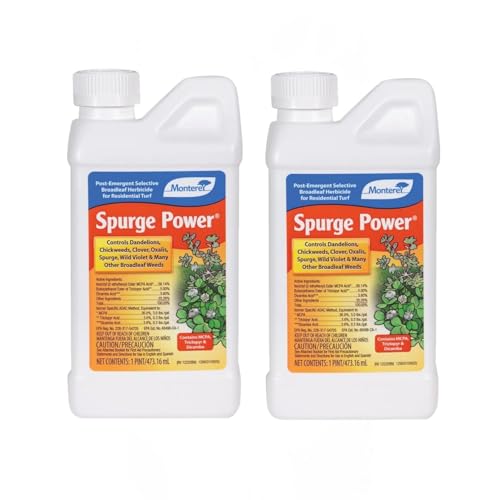
The specialist that finally beats wild violet and spurge after years of trying.
Some weeds just laugh at ordinary sprays. For those — wild violet, oxalis, spurge — this premium 2-pack brings a powerful 3-way formula combining MCPA, triclopyr, and dicamba. It is labeled safe for Bahia, Bermuda, and Zoysia, and it is best applied in spring or early fall while the weeds are actively growing.
You get two 16-ounce bottles, totaling 32 fluid ounces, which covers 16,000 square feet per set. Reviewers point out wiping out a neighborhood-wide spurge outbreak while the grass stayed fine. One tough case of wild violet took about three years of annual treatments to nearly eliminate, so expect persistence, not a quick fix.
This is the most positively-reviewed of the premium tier for effectiveness, but it is a concentrate, so you’ll need to mix it with water in a lawn sprayer and wear protective clothing. The review pages sum it up: “Best post emergent on the market.”
What owners rave about: effectiveness is the top praise, with visible results starting within a couple of days when mixed as directed.
Fair warning: wear disposable clothing during application, especially with children and pets around, since this is a potent mix.
Choose this for: stubborn, hard-to-control broadleafs like wild violet and spurge that cheaper sprays cannot touch.
skip it if: you only have light clover or dandelion pressure, where a mid-range formula would be overkill.
4. Fertilome Weed-Out 1 Gallon

The gallon jug that turns one pint into 8,000 square feet of weed-free turf.
For acreage, the math is simple: this one-gallon jug of triclopyr-based concentrate controls over 200 broadleaf weed species, and a single pint treats up to 8,000 square feet. That means one jug can cover roughly 64,000 square feet, which is a small pasture’s worth of Bahia. It is labeled for use on Bahia, Bermuda, Zoysia, Kentucky Bluegrass, and Fescue.
The active ingredients — dicamba, mecoprop-P, and trimec — make it a broad-spectrum generalist. Owners of large properties praise it as the exact same product their local nursery sold at a quart size for nearly the same money, making this gallon the far better deal per drop.
The catch is patience and a helper product. The label reviewers emphasize that you will want a surfactant (a spreader-sticker additive) so the weeds actually soak up enough herbicide, and you must accept that creeping Charlie can fight back and survive where other weeds die.
The value story: the per-square-foot cost is the lowest of any pick here, and it kills everything the label claims when applied with a surfactant.
Be ready for: a slower, patient timeline — fall applications of broadleaf killers work but take longer to show results.
Reach for this if: you measure your lawn in acres, not feet, and want one jug to last several seasons.
Look elsewhere if: you have a small patch of weeds, where a ready-to-spray bottle is simpler and you won’t need to store a gallon.
5. Fertilome Weed-Out Nutsedge Control
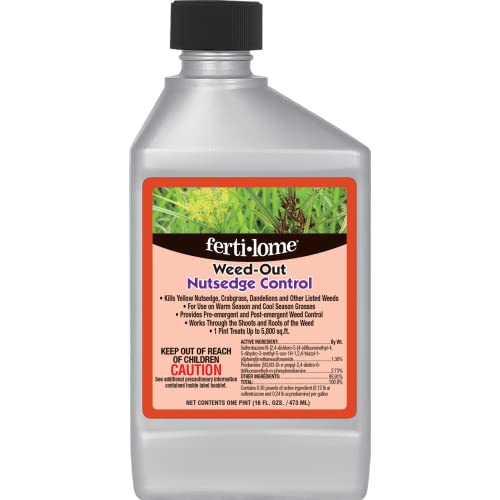
The narrow-spectrum specialist that chases nutsedge and annual bluegrass away for good.
Broadleaf killers will not touch nutsedge — it is a sedge with a different biology. This concentrate uses halosulfuron to hit sedges, broadleaf weeds, and annual grasses, and it works on both warm and cool-season lawns including Bahia, Bermuda, and Fescue. A single 16 fluid ounce pint of concentrate treats up to 5,800 square feet when mixed at the label rate.
Shoppers say it took care of nutsedge so thoroughly that most of it did not come back the next year — the kind of lasting result that earns the “best I have ever used” label. Another owner saw annual bluegrass (Poa annua) and stickers vanish, letting their sod grass thrive without fighting the POA for nutrients.
The honest limitation: this is a 16 oz bottle, exactly half the volume of the 32 oz Nufarm Change Up above, so it suits targeted spot-treating, not whole-yard broadcast spraying. One buyer chasing Poa annua in fescue found it had not worked yet, a reminder that sedge control can take multiple applications over time.
The standout result: nutsedge that died and largely stayed dead into the next growing season — the strongest longevity claim of any pick here.
The size caveat: half the volume of the top pick, making it a spot-treatment tool for problem patches rather than a lawn-wide spray.
Choose this for: a targeted nutsedge, sedge, or Poa annua problem in a Bahia lawn.
pass on it if: you only see broadleaf weeds like clover and dandelion, where a generalist is a better fit.
6. Atticus Sertay
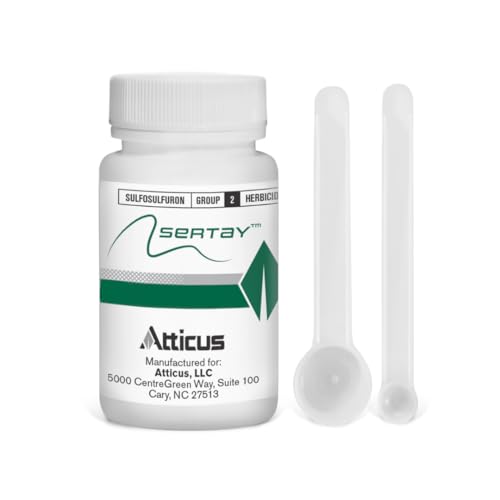
The tournament-grade granule that takes out Poa annua and Dallisgrass with surgical precision.
This is the serious tool for southern lawns dealing with grassy weeds and sedges that defy everything else. The 1.25 ounce bottle contains 75% sulfosulfuron — the same active ingredient as the leading brand used on golf course fairways and athletic fields — and it is labeled safe for bahiagrass, Bermudagrass, centipedegrass, and St. Augustinegrass among others.
One bottle covers 12,500 square feet, which is exceptional value for the price tier. It is a water-dispersible granule, not a liquid, so you mix it in a pump sprayer — never a hose-end sprayer. Buyers report Poa annua killed within one week when mixed at 2.5 scoops per 5 gallons with surfactant, and Dallisgrass cleared out in about 2 weeks.
The power comes with patience and precision. This is not a quick knockdown; the label says visible results take 3-4 weeks on Poa, and it should not be applied if rain is expected within two hours. It is also not sold in Alaska, the District of Columbia, or Vermont, so check your location before ordering.
The pro-level edge: the only pick here that doubles as an overseeding partner, suppressing invading cool-season grasses so you can plant perennial ryegrass in the fall.
The learning curve: you must measure by weight in grams or scoops, and wait patiently — results are slower than a broadleaf spray but far more thorough on grassy weeds.
Best for: the Bahia owner battling Poa annua, Dallisgrass, or nutsedge who wants a golf-course-grade result.
Look elsewhere if: you need a fast broadleaf knockdown, or you live in Alaska, Vermont, or DC where it cannot ship.
7. Crabgrass Killer Shaker Jar

The no-spray granular option that targets crabgrass without a tank or hose.
This is the odd one out in the lineup: instead of a liquid, it is a 2 pound shaker jar of powder you scatter by hand or spreader. It is explicitly labeled for use on St. Augustine, Common Bermuda, Bahia, and Centipede grasses, and it works post-emergent, meaning it kills weeds that are already up and growing.
The active ingredient is cinnamon, which makes it a less aggressive option than the synthetic chemistries elsewhere on this list. That gentleness is a double-edged sword — owners mention it took care of crabgrass with regular watering afterward, but others found it killed the centipede grass while leaving the crabgrass untouched. The bulk of the feedback is genuinely mixed, with the biggest single group (102 mentions) split on whether it works at all.
At 2 pounds it comes in right at the same weight as the 2.1 pound Nufarm Change Up above, but the two could not behave more differently in practice. The realistic use-case here is light, patchy crabgrass in a mostly-healthy Bahia lawn — not a severe infestation, where customers note you would need many jars and a lot of patience.
A word of caution: effectiveness is the most-mentioned aspect by far, and Amazon’s own summary marks it as genuinely mixed — some yards clear up beautifully, others see no change at all.
The fit note: the gentlest option here, which also means underpowered for heavy crabgrass pressure; a few owners found grass yellowing before it recovered.
Consider this if: you want a no-spray, no-mix granular you can scatter on a small Bahia patch and you have modest expectations.
Pass on it if: your crabgrass is widespread — the reviews suggest cutting it out and resodding beats buying several jars.
Understanding the Specs
Selective vs. Non-Selective
This is the single most important word on any label. A selective herbicide is formulated to kill certain weed types (broadleafs, sedges) while leaving your grass alone. Bahia grass is a warm-season turf, so you need a product that lists it as safe. Non-selective killers like glyphosate will destroy everything, including your lawn.
Active Ingredients Decoded
Look for the chemical names, not the brand names. MCPA and dicamba are the heavy hitters for broadleaf control. Triclopyr adds power against woody and hard-to-kill species. Halosulfuron and sulfosulfuron are your specialists for sedges and grassy weeds. A 3-way mix of MCPA, fluroxypyr, and dicamba covers the widest range of broadleafs.
FAQ
Will a regular weed killer damage my Bahia grass?
What is the difference between a selective and non-selective herbicide?
How do I kill nutsedge in Bahia without killing the grass?
Can I use these herbicides on a freshly mowed Bahia lawn?
What is a surfactant and why do I need it?
How much area will a 32 oz bottle of herbicide cover?
Is it better to use a ready-to-spray bottle or a concentrate?
When is the best time of year to apply herbicide to Bahia?
Will these herbicides harm my pets or children?
How long does it take to see results?
Final Thoughts: The Verdict
If you want one dependable pick, the winner is the Nufarm Change Up because it delivers the widest broadleaf control — over 200 species — in a single bottle that is explicitly safe for Bahia. If you want faster visible die-off with zero mixing, grab the Fertilome Weed Free Zone RTS. And for the stubborn sedge or Poa annua that other sprays ignore, the Atticus Sertay is the one to reach for.
How We Picked
We do not accept paid placement. Every pick is matched to a real buyer and a real use-case; we do not hands-on test units.
Sources & Methodology
Specifications: manufacturer listings and product documentation. Review insights: verified customer reviews, as of August 2026. Pricing: not shown on this page (it changes often); check the current price via the retailer link.
As an Amazon Associate, Lawn Gear Lab earns from qualifying purchases. This does not affect which products we feature.