
Specs are compiled from manufacturer listings and verified buyer reviews and can change over time — please confirm the key details on the product page before buying.
Hauling dirt, gravel, or mulch across a yard is the kind of back-breaking chore that makes you wish you had the right tool. The difference between a wobbly wheelbarrow that dumps its load on the first bump and a stable cart that rolls smoothly is everything — and a heavy-duty wheelbarrow is built exactly for that gap.
I’m Rikta — the founder and writer behind Lawn Gear Lab. This guide is built by comparing the manufacturers’ published specifications and the patterns across verified customer reviews, so you get each pick’s real strengths and trade-offs instead of marketing spin.
Whether you are moving topsoil for a new flower bed, hauling firewood for winter, or maintaining a large garden, the right heavy duty wheelbarrow spares your back and saves you time by matching capacity, tire type (air-filled versus solid), and frame strength to the actual job you do most often.
Quick Picks
- BILT HARD Poly Garden Dump Cart 1200 lbs — Best Overall
- Gorilla Carts Heavy-Duty Poly Yard Dump Cart — Top Towable
- Gorilla Carts Heavy Duty All Terrain Garden — Versatile Wagon
- True Temper Steel Wheelbarrow — Classic Steel
- Chore Warrior Electric Powered Wheelbarrow — Self-Propelled
- VEVOR Wheelbarrow Cart, 6 Cu. Ft. — Budget Single
- Giantex Dual-Wheel Garden Cart, 330 lbs — Stable Dual
How To Choose The Best Heavy Duty Wheelbarrow
Not every wheelbarrow that says “heavy duty” can actually survive a season of moving wet soil and sharp rocks. Focus on three things first: how much weight the tray and frame can take, the type of tires (because flat tires are the #1 annoyance), and whether the handle or dump mechanism suits your daily routine.
Match Capacity to Your Real Job
A 6-cubic-foot tray holds about three standard bags of mulch — fine for a weekend gardener. A 7-cubic-foot tray (like the ones on premium poly carts) gives you more room but also adds weight when full. Do not just look at cubic feet; check the manufacturer’s weight limit in pounds. If you move gravel or wet soil, stay at 330 lbs or more. For heavy landscaping, a 1,200-lb rating with a reinforced steel frame is the benchmark.
Tires: Flat-Free vs. Pneumatic
Air-filled (pneumatic) tires roll easier over bumpy ground and absorb shock, but they can puncture. Flat-free (solid foam) tires never go flat — you skip the repair hassle — but they ride stiffer and can be harder to push on soft soil. For rocky terrain or thorny brush, flat-free tires are the smarter choice. For smooth lawns and garden beds, pneumatic tires glide better.
Wheels and Stability
A single front wheel is the classic design — narrow enough for garden paths, but prone to tipping if you load it unevenly. Two wheels (dual-wheel or a two-wheel stance) add lateral stability so the cart stays upright on slopes. Four-wheel dump carts are the most stable of all, almost impossible to tip, but they are wider and less maneuverable in tight spaces.
Quick Comparison
| Model | Best For | Capacity | Weight Limit | Tire Type | Amazon |
|---|---|---|---|---|---|
| BILT HARD 4‑Wheel Dump Cart | Heavy loads, no flats | 7 Cu. Ft. | 1,200 lbs | Flat-Free (4) | Amazon |
| Gorilla Carts Poly Dump Cart GOR6PS | Tow‑behind + dump | 6 Cu. Ft. | 1,200 lbs | Pneumatic (4) | Amazon |
| Gorilla Carts All‑Terrain GOR1201B | Versatile folding wagon | 7 Cu. Ft. | 1,200 lbs | Pneumatic (4) | Amazon |
| True Temper Steel 6 Cu. Ft. | Traditional steel tray | 6 Cu. Ft. | — | Flat‑Free (1) | Amazon |
| VEVOR One‑Wheel Cart | Budget single‑wheel | 6 Cu. Ft. | 330 lbs | Pneumatic (1) | Amazon |
| Giantex Dual‑Wheel Cart | Stable small loads | 6 Cu. Ft. | 330 lbs | Pneumatic (2) | Amazon |
| Chore Warrior Electric | Powered uphill hauling | 6 Cu. Ft. | 350 lbs | Pneumatic (2) | Amazon |
In‑Depth Reviews
1. BILT HARD Poly Garden Dump Cart 1200 lbs
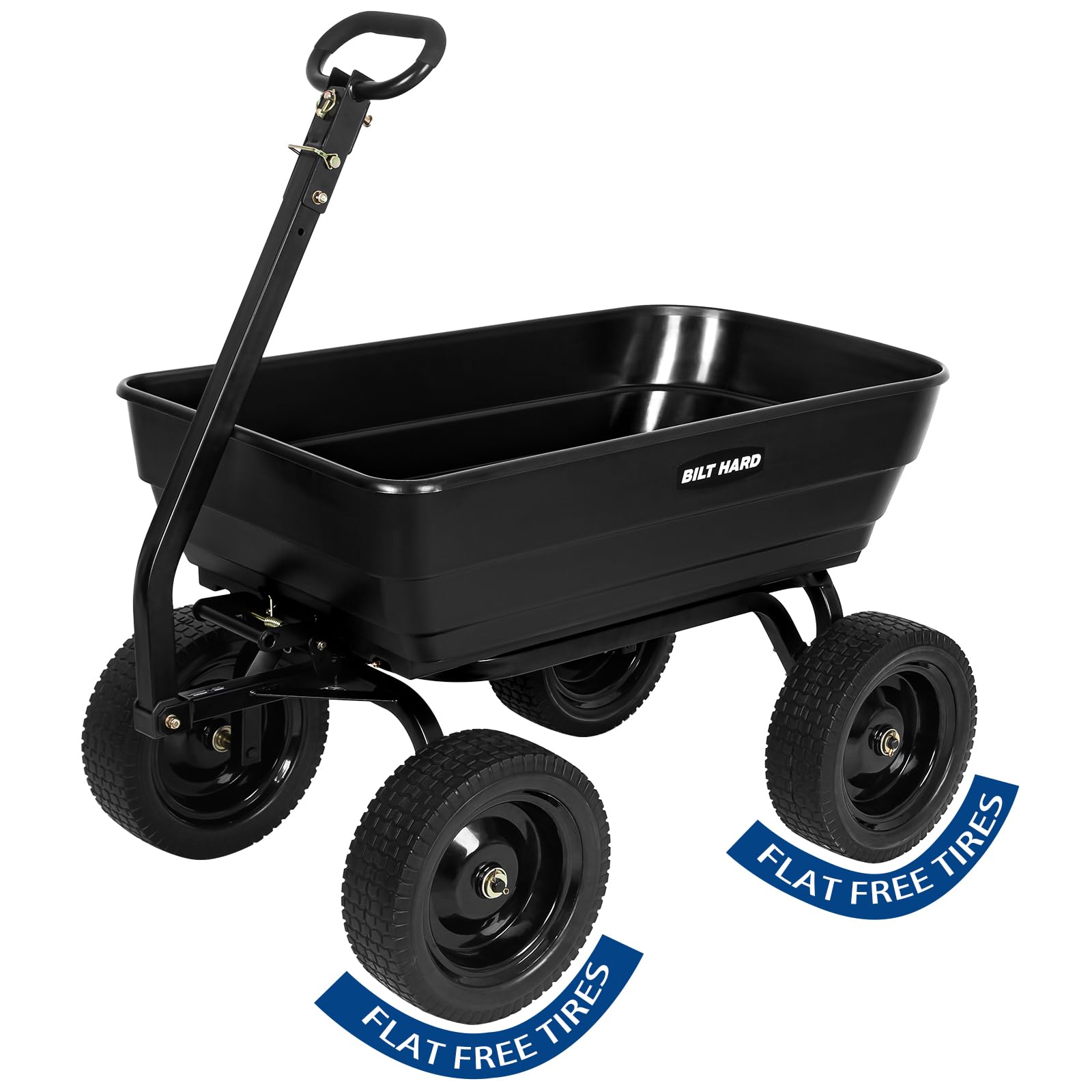
A four‑wheel dump cart that swallows 1,200 lbs and never worries about a puncture.
This cart carries 1,200 lbs versus the VEVOR single‑wheel cart’s 330 lbs — and it does it on four 13″ flat-free (solid foam) tires that never go flat. The 7-cubic-foot poly tray handles mulch, soil, and gravel, and the quick-release dump mechanism lets you empty it without lifting. The 2-in-1 convertible handle pulls by hand or hooks to a lawn tractor or ATV (all-terrain vehicle).
The steel frame is heavy (76 lbs) but built to survive harsh outdoor conditions without rusting. One reviewer noted, “I got inside to see how it did with some weight in it. 220lbs no problem,” confirming the frame’s real-world strength. Assembly takes about an hour with clear instructions.
Unlike the VEVOR at 36.6 lbs and 330 lbs, this cart demands more storage space at 50.4″ deep x 28.7″ wide x 25.2″ high — measure your shed first. The poly tray is not indestructible under extreme point loads, but for residential hauling, it is a workhorse.
What makes it a beast
- 1,200-lb weight limit — highest in this lineup
- Four flat-free tires eliminate puncture repairs
- Quick-release dump + 2-in-1 tow handle
What to watch for
- Heavy at 76 lbs — harder to lift into storage
- Poly tray not rated for sharp, jagged debris
Your heaviest hauler: If you move large volumes of dirt, gravel, or firewood and want zero flat-tire hassle, this 4‑wheel cart is the most capable pick.
Check the space: At 50.4″ long it needs a bigger shed or garage bay than traditional one-wheel designs.
2. Gorilla Carts Heavy-Duty Poly Yard Dump Cart GOR6PS

A tow‑behind cart with a solid poly bed that resists rust and dumps quickly.
With a 1,200-lb weight limit and 6-cubic-foot poly tray, this Gorilla Carts model is built for heavy hauling behind a lawn tractor or by hand. The patented quick-release dump mechanism lets you tip the load without touching it. The 54-lb steel frame weighs 54 lbs versus the BILT HARD’s 76 lbs, making it easier to maneuver when unhitched.
One long-term reviewer reported 13 years of abuse with a previous model, calling it “outstanding” and saying the new version has better wheels and added height. Assembly takes about an hour solo. The pneumatic (air-filled) 4-wheel setup rolls smoothly, but cotter pins can occasionally kick off during loading — a simple fix with a replacement cotter pin.
Unlike the BILT HARD cart with flat-free tires, the Gorilla uses air-filled pneumatic tires that can puncture on sharp terrain. The tray is rust-proof poly, which holds up better over time than the thin liner on the Gorilla GOR1201B folding wagon.
Why it stands out
- 1,200-lb capacity in a 54-lb frame
- Quick-release dump for fast unloading
- Towable 2-in-1 handle
Keep in mind
- Pneumatic tires need air and can puncture
- Cotter pins may loosen under heavy vibration
Best for yard tractors: If you have a riding mower or ATV and want a dump cart that tows behind, this poly cart delivers proven long-term value from a reviewer’s 13 years of use.
Better for flat terrain: Pneumatic tires roll nicer on lawns but are less puncture-proof than flat-free tires on rocky ground.
3. Gorilla Carts Heavy Duty All Terrain Garden Wheelbarrow GOR1201B

A folding wagon that transforms from a garden cart into a tow-behind hauler.
The GOR1201B offers 7 cubic feet of space and a 1,200-lb weight limit, but with a twist — the steel sides fold down flat, so you can load longer items like branches or lumber. It rolls on four pneumatic (air-filled) tires with an alloy steel frame, and the handle converts from push to tow in seconds. Buyers report “super easy to put together” and “very sturdy,” with one noting it handles multiple bags of mulch on a 2-acre lot.
The catch: the flat bed is a mesh surface topped with a thin plastic liner, not a solid tray. One reviewer pointed out the liner is “garbage” for fine materials like gravel. Air-filled wheels may leak over time, though replacements with solid tires are possible. At 65 lbs it is lighter than the BILT HARD cart but heavier than the VEVOR single-wheel option.
Unlike the poly tray on the Gorilla GOR6PS, this wagon’s mesh-and-liner bed is better suited for bulkier items than loose soil. The foldable sides give it an advantage for odd-shaped cargo the other carts cannot handle.
What makes it flexible
- Fold-down steel sides for oversized cargo
- Towable and pushable in one wagon
- 1,200-lb capacity on a 65-lb frame
Before you buy
- Mesh bed with thin liner — poor for gravel or sand
- Pneumatic tires require occasional air
Best for varied loads: If you carry both loose bags of soil AND long branches or tools, the foldable sides make this wagon far more flexible than a standard tub-style cart.
Not for fine materials: The thin liner means you will want a tarp or rubber mat if you haul sand or small stones.
4. True Temper Steel Wheelbarrow with Never Flat Tire, 6 Cu. Ft.

A traditional steel-tray wheelbarrow with a flat-free tire that never needs air.
The True Temper is the only steel-tray wheelbarrow in this list — a smooth curved tray at 6 cubic feet that dumps and spreads loads easily. The single flat-free (solid foam) tire (4 x 8 inches) eliminates punctures, unlike the pneumatic tires on the VEVOR or Giantex carts. Steel handles with comfort grips and a heavy-duty steel undercarriage give it the feel of a classic contractor-grade tool.
Buyers call it “solid and quality” and say it “will last a lifetime.” The single-wheel design is narrower than four-wheel carts, so it fits through standard gates and garden paths. The flat-free tire rides stiffer than pneumatic — one buyer mentioned “a little harder to push” — but you never deal with a flat.
Unlike the 4-wheel BILT HARD cart at 76 lbs, the True Temper is easier to pivot on job sites. The trade-off is stability: a single wheel can tip on uneven slopes if you load it unevenly. The 30-day warranty on missing parts is short compared to the 1-year warranty on the Gorilla GOR6PS.
Why it stands out
- Flat-free tire — absolutely no flats, ever
- smooth steel tray for rugged loads like stone
- Narrow profile fits through gates
Consider this
- Single wheel tips more easily on slopes
- Stiffer push on soft ground vs. pneumatic tires
For traditionalists: If you want a classic steel wheelbarrow that never gets a flat and fits through tight gaps, the True Temper is built to last.
Not for steep slopes: The single front wheel is less stable than dual- or four-wheel carts on hilly terrain.
5. Chore Warrior Electric Powered Wheelbarrow

A motorized wheelbarrow that powers itself up hills so you do not have to.
The Chore Warrior is the only powered model here. It uses a 500-watt brushless DC (direct current) motor — meaning less wear and more efficiency than a brushed motor — driving two 15-inch pneumatic (air-filled) tires for a self-propelled experience. The 24-volt rechargeable battery (two sealed 9Ah AGM (absorbent glass mat) batteries) lasts up to 8 hours and shows its charge level on an illuminated indicator. The 6-cubic-foot poly tray carries 350 lbs — enough for a serious landscaping day.
Buyers rave about the motor on inclines. One 81-year-old user said they moved 3 cubic yards of sand in 3 hours. Another noted “my wife does not ask for help” after getting one. The differential drive (two-wheel) makes turning easy. At 85 lbs assembled, it is the heaviest unit here, but the motor does the pushing.
The downsides include a price that sits well above all other picks. The forward/reverse button is hard to press with gloved hands, and there is no indicator showing which direction is selected. The motor can struggle over obstacles taller than 1.5 inches under a full load.
What makes it unique
- 500W motor hauls 350 lbs up inclines
- 8-hour battery life covers a full workday
- Differential two-wheel drive for easy turning
What to know
- Expensive — the highest-priced wheelbarrow here by a wide margin
- Heavy at 85 lbs; awkward to push when motor is off
- Forward/reverse button hard to operate with gloves
Best for hills & heavy users: If you have a steep property or physical limits that make manual hauling hard, the self-propelled motor more than earns its way.
Skip if on a budget: The price is in a different league than traditional wheelbarrows — only worth it if you truly need powered assistance.
6. VEVOR Wheelbarrow Cart, 6 Cu. Ft.
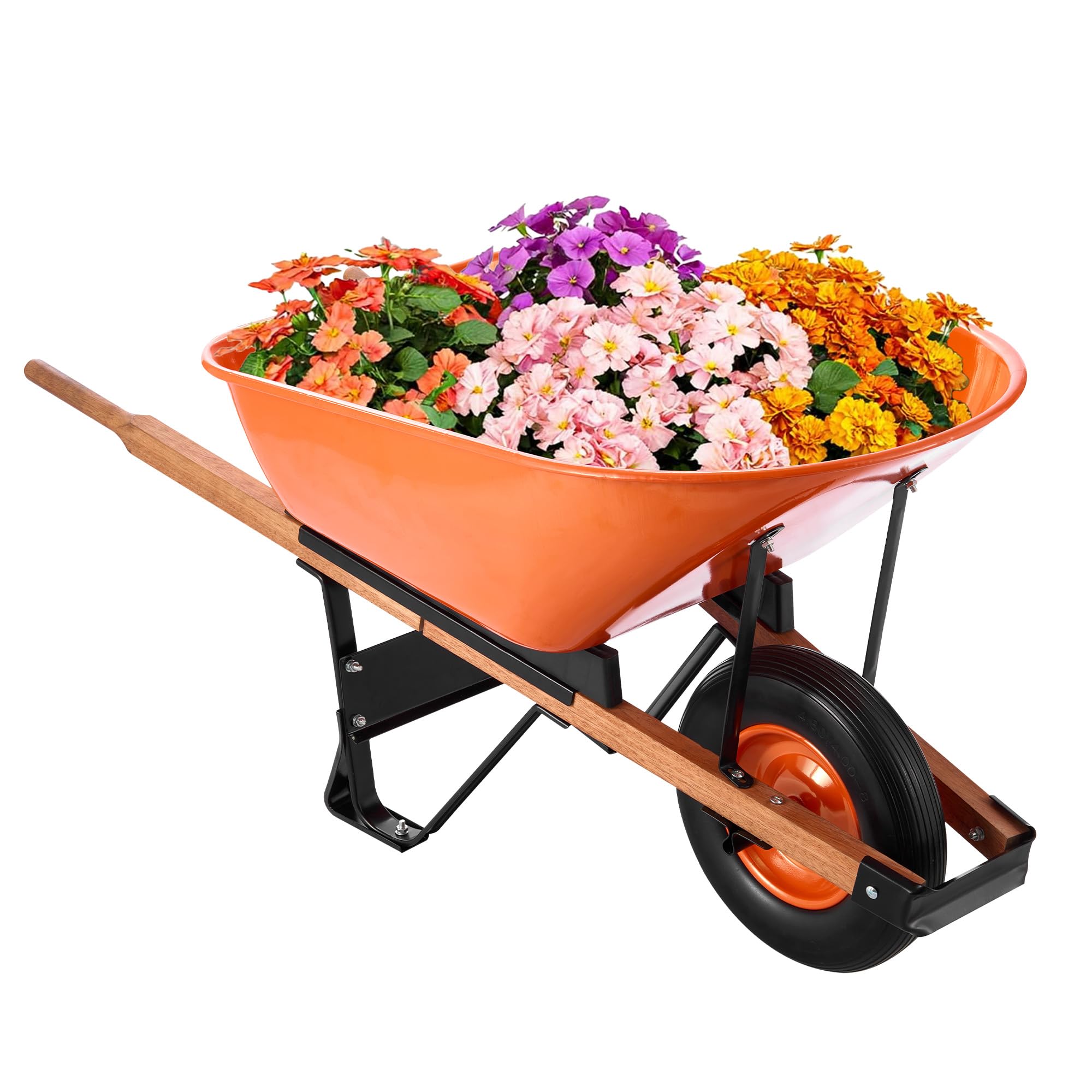
A lightweight single‑wheel cart that stays affordable for lighter homeowner jobs.
The VEVOR cart carries 330 lbs in a 6-cubic-foot tray — the same capacity as the Giantex but with one big wheel (16-inch wide track) instead of two. At 36.6 lbs, it is the lightest full-size wheelbarrow here, making it easy to lift into a truck bed or store overhead. Owners mention “good value” and say they used it “2-3x/week for 9 months” without issues.
Assembly requires a wrench and screwdriver but one buyer warned the wooden dowel handles can fracture under stress — they replaced them with metal rods. The pneumatic (air-filled) tire needs occasional air but provides a smooth roll on garden paths. The metal handle with plastic grips feels sturdy for the price.
Compared to the BILT HARD 4-wheel cart (1,200 lbs, 76 lbs), the VEVOR is 36.6 lbs versus the BILT HARD at 76 lbs, and carries 330 lbs versus 1,200 lbs. The 54.72″ depth is longer than the BILT HARD’s 50.4″ depth, so it takes up more shed space than expected.
Budget-friendly pluses
- Lightweight at 36.6 lbs — easy to move empty
- Large 16-inch wheel rolls smoothly on grass
- Affordable entry to a 6-cubic-foot cart
Watch out for
- Wooden handles may crack under heavy loads
- 330-lb limit is strictly homeowner-grade
- Pneumatic tire can puncture
Right for occasional use: If you only haul mulch a few times a season and want a lightweight cart you can hang on a hook, the VEVOR is a capable budget pick.
Not for daily work: The wooden handles and 330-lb limit mean it will not survive regular heavy landscaping abuse.
7. Giantex Dual-Wheel Garden Cart, 330 lbs
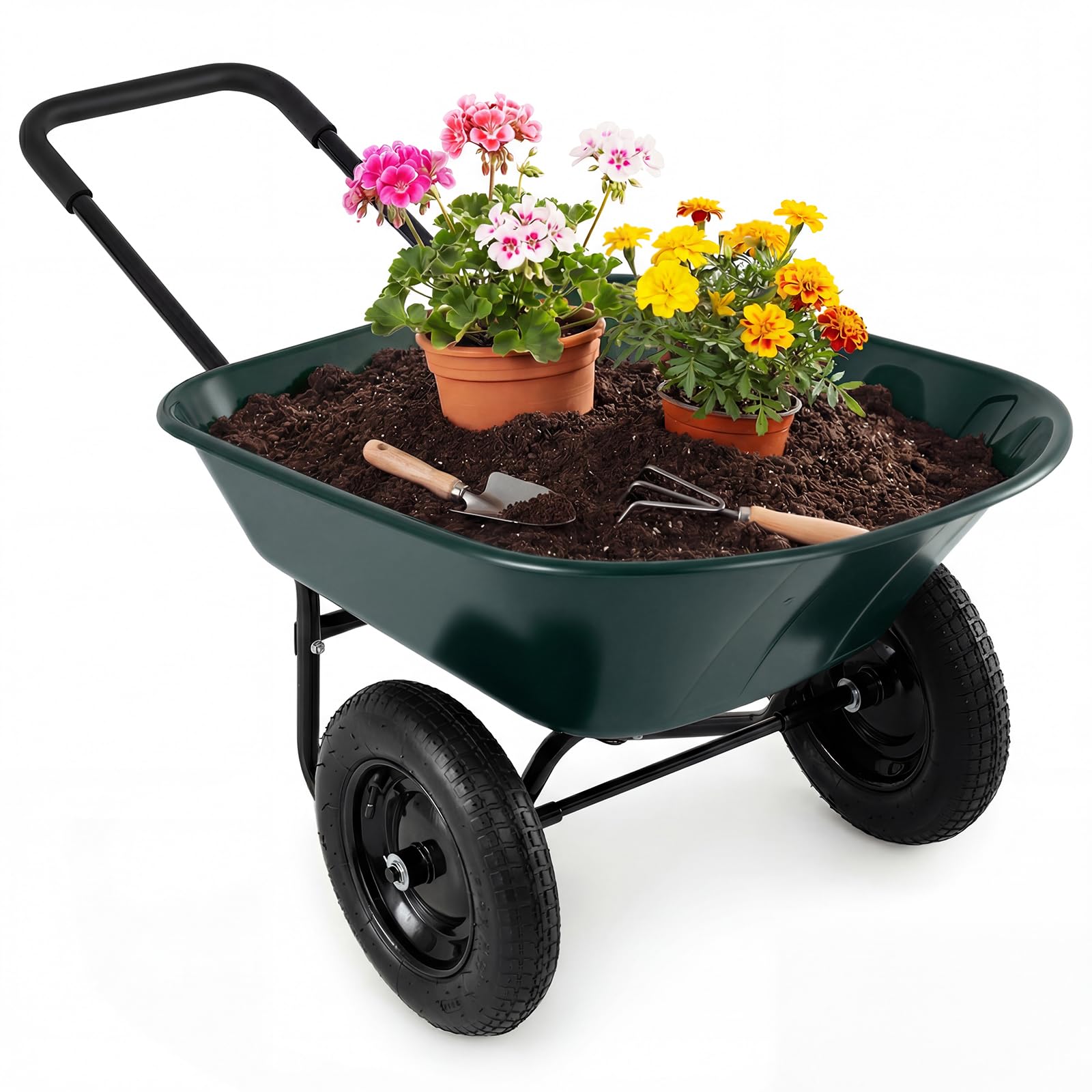
A dual‑wheel cart that stays stable without the bulk of a four‑wheel wagon.
The Giantex uses two 14-inch air-filled pneumatic wheels instead of one, which customers note makes it “very stable” — a direct advantage over the single-wheel VEVOR when you load soil or gravel. The 330-lb weight limit matches the VEVOR, but the dual-wheel stance reduces tipping on side slopes. The powder-coated steel frame resists rust, and the cushion-grip loop handle helps you push and dump comfortably.
At 6 cubic feet, the poly tray fits standard bags of mulch. One owner reported the small capacity (~4 cu ft in their experience) is good for hauling mortar, while another called it “perfect for the gardener with a small yard.” Assembly is straightforward, and at 54″ x 25″ x 26″ it fits through most doorways.
A key limitation: one customer observed a tire blew out without heavy use, suggesting the pneumatic tires could be a weak point. The lower height and looseness in the frame (noted by another reviewer) mean it is better suited for light-to-medium duty than the 1,200-lb carts above.
Dual-wheel benefits
- Two wheels provide excellent lateral stability
- Easy to assemble and light enough for most users
- Fits through standard doorways
Consider these
- Pneumatic tires can blow out unexpectedly
- Frame has some looseness at max load
Great for tight spaces: If you have a small shed and need a stable cart that will not tip on moderate slopes, the dual-wheel Giantex gives you confidence a single-wheel cannot match.
Top end is 330 lbs: For heavy daily landscaping, step up to a 1,200-lb-rated cart instead.
Understanding the Specs
Load Capacity (lbs)
This is the maximum weight the wheelbarrow can safely carry. Homeowner models hover around 300–330 lbs. Heavy-duty carts rated at 1,200 lbs use thicker steel frames and reinforced poly or steel trays. If you haul wet soil, gravel, or multiple bags of concrete, aim for 1,000+ lbs so you do not stress the axle or frame mid-job.
Tire Type: Flat-Free vs. Pneumatic
Flat-free tires are solid foam or rubber that never go flat — ideal for rocky yards, thorny brush, or jobs where you cannot stop for repairs. Pneumatic (air-filled) tires have air inside and give a softer ride over bumps, but they can puncture on sharp debris or roots. If you work on finished lawns, pneumatic tires roll easier; if you work on rough terrain, flat-free saves you headaches.
Tray Material and Design
Steel trays (like the True Temper) are tough against sharp rocks and heavy stone, but they can rust if left out. Poly trays (polyethylene, a durable plastic) resist rust and are lighter, but they can crack under extreme point loads. Some poly carts use a mesh base with a thin liner — fine for large items, not for sand or loose gravel. A smooth steel tray or a thick poly tub with a solid base is best for mixed use.
Number of Wheels and Stability
Single-wheel wheelbarrows are traditional and narrow, letting you roll through garden gates, but they tip easily on uneven ground. Dual-wheel designs add lateral stability without adding much width. Four-wheel dump carts are the most stable — nearly impossible to tip — but they need more storage space and are harder to turn in tight spots. Choose based on your terrain and storage constraints.
FAQ
How many cubic feet do I actually need in a wheelbarrow?
Can I use a heavy-duty wheelbarrow for concrete or mortar?
What is the difference between a wheelbarrow and a dump cart?
How do I prevent my wheelbarrow from rusting?
Can I tow these carts behind my lawn tractor or ATV?
Are flat-free tires harder to push than pneumatic tires?
How long does a heavy-duty wheelbarrow typically last?
Will a 4-wheel dump cart fit through a standard garden gate?
What does a 2-in-1 convertible handle do?
Can I leave the wheelbarrow outside in the rain?
Final Thoughts: The Verdict
For most people, the heavy duty wheelbarrow winner is the BILT HARD 4‑Wheel Dump Cart because it combines a 1,200-lb weight limit with four flat-free tires and a quick-release dump at a mid-range price that undercuts premium competitors. If you want a towable poly cart with a proven long-life reputation from a 13-year reviewer, grab the Gorilla Carts GOR6PS. And for anyone dealing with steep terrain or physical limitations, the Chore Warrior Electric is the only self-propelled option that hauls the load for you.
How We Picked
We do not accept paid placement. Every pick is matched to a real buyer and a real use-case; we do not hands-on test units.
Sources & Methodology
Specifications: manufacturer listings and product documentation. Review insights: verified customer reviews, as of July 2026. Pricing: not shown on this page (it changes often); check the current price via the retailer link.
As an Amazon Associate, Lawn Gear Lab earns from qualifying purchases. This does not affect which products we feature.