
Specs are compiled from manufacturer listings and verified buyer reviews and can change over time — please confirm the key details on the product page before buying.
Pruning shears look simple, but a cheap pair chews your hands, rusts in a season, and mashes branches instead of slicing them. The difference between a frustrating afternoon in the yard and a satisfying one often depends on a single spec: the blade material and the cutting geometry. You want shears that stay sharp through a full day of cutting, lock securely so you do not stab yourself walking between shrubs, and fit your hand without cramping after the fiftieth snip. The nine pairs here handle that — some are German anvil cutters for dry wood, others are Swiss or Japanese bypass blades for live growth.
I’m Rikta — the founder and writer behind Lawn Gear Lab. This guide is built by comparing the manufacturers’ published specifications and the patterns across verified customer reviews, so you get each pick’s real strengths and trade-offs instead of marketing spin.
A gardener who only needs one pair for the whole property wants a tool that handles both green shoots and dead hardwood without hesitation. That is the exact question these heavy duty pruning shears answer — each one built for a different type of branch, hand size, and daily abuse.
Our Picks at a Glance


How To Choose The Best Heavy Duty Pruning Shears
Most buyers pick pruning shears by handle color or price, then end up with a sore hand and a mangled branch. Three decisions separate a tool you pass to your grandkids from one you toss in the garage after two seasons.
Anvil versus bypass: which cutting geometry fits your garden?
Anvil shears have one blade that closes against a flat metal surface like a knife on a cutting board. That crushing action works well on dead, dry, or old wood because it does not require the blade to slide past anything. Bypass shears have two curved blades that slide past each other like scissors. That clean scissor slice reduces damage to living plant tissue, so the cut heals faster. If you prune mostly live growth — roses, green branches, fruit trees — stay with bypass. If you clear dead branches and dry thickets, anvil shears give you more leverage with less effort.
Blade steel and coating: what stays sharp longest
High-carbon steel holds a razor edge longer than stainless steel, but it rusts if you leave it dirty. Some manufacturers add a titanium coating or a sliding lacquer to reduce friction and block corrosion — the coating helps the blade glide through sap without sticking. Japanese SK5 steel is notably hard, often around 59 HRC (the Rockwell hardness scale that measures how well steel resists wear), which means you sharpen less often but need a diamond stone when you do. Cheaper stainless blades are softer and dull faster on woody stems.
Handle material and ergonomic fit for your hand size
Aluminum handles are lightweight — a pair around 8 to 9.6 ounces reduces fatigue across a long afternoon — but they transmit cold in early spring. Fiberglass composite handles are even lighter but can flex on thick branches. Wood handles absorb vibration and feel warm, though they add weight. The grip shape matters as much as the material: inward-curved lower handles keep your hand from opening wide during each cut, which reduces strain for medium-sized hands. Larger hands need a longer handle profile so your palm does not crowd the pivot. A non-slip rubber or vinyl coating helps when your hands are sweaty or damp.
Quick Comparison
| Model | Best For | Blade Type | Cut Capacity | Weight | Amazon |
|---|---|---|---|---|---|
| Original LÖWE Pro Anvil 1.104★ Best Overall | Heavy dry wood & daily abuse | Anvil | 22 mm | 290 g | Amazon |
| Haus & Garten EnduroPROBest Value | Daily live pruning & hand comfort | Bypass | 1 inch | 8.8 oz | Amazon |
| Corona BP 4250 MAXFORGEDTrail Ready | Trail clearing & rugged outdoor use | Bypass | 1 inch | 9.6 oz | Amazon |
| TONMA TP-1 Japanese | Precision cuts & small hands | Bypass | 1 inch | 244 g | Amazon |
| FELCO 160L | Large hands & light carry | Bypass | 1 inch | 7.8 oz | Amazon |
| Corona BP 6250 MAXFORGED | Felco-level performance at lower cost | Bypass | 1 inch | 9.6 oz | Amazon |
| Original LÖWE 10 Pro Anvil/Bypass | Professional orcharding & forestry | Anvil + Bypass geometry | 1.18 inch | 285 g | Amazon |
| Felco F 11 | Professional florist & daily pro use | Bypass | 25 mm | 8.8 oz | Amazon |
| ARS ARS-VS-8XZ | Small hands & fast one-hand operation | Parrot Beak | 22 mm | 220 g | Amazon |
In‑Depth Reviews
1. Original LÖWE Professional Anvil Pruner 1.104
Our pick — over 4.5★ from 950+ verified ratings; the strongest balance of quality and price.
The anvil that makes dead wood feel like wet cardboard — built in Germany to last decades.
If you mostly cut old, dry, or hardwood branches, this anvil design gives you a mechanical advantage that bypass shears cannot match. The blade is a long-lasting carbon steel coated with sliding lacquer, which means it resists rust and the sap slides off rather than gumming up the pivot. The cutting width is 22 millimeters (just under 7/8 inch), so smaller than some 1-inch bypass models, but the anvil crushing action means you use less hand force on each squeeze. As buyers report, it “cuts branches up to 1 inch with minimal effort” — the anvil platform supports the branch so the blade powers straight through.
Weighing in at 290 grams (about 10.2 ounces), it is not the lightest pair in this list, but the plastic handle fits medium to large hands with a one-finger safety lock that reviewers call smooth and intuitive. The handle material is plastic over what owners describe as a mostly steel internal construction, so there is no flex on thick cuts. The build quality earns the top praise from buyers — Quality is mentioned by 30 people as a standout, and Functionality comes second with 17. The crowd favorite rating sits at 4.8 across hundreds of owners, which is as good as it gets for a garden tool made in Germany.
What wins people over
- Anvil design crushes dry hardwood with less hand force than bypass models — owners mention it is like a hot knife through butter
- Sliding lacquer coating protects the carbon steel blade from rust and reduces friction through sappy cuts
- All parts are replaceable, so a broken spring or worn blade does not mean buying a whole new pair
The honest trade-offs
- 22 mm cutting capacity is smaller than the 1-inch limit on some bypass models here
- Plastic handle may feel less premium than the forged aluminum or wood options at the same price tier
- No included sheath — you will need a carry pouch or backpack for transport
Reach for this if: you clear dead wood, dry branches, or thickets regularly and want a German-made anvil shear that buyers consistently call the best they have ever used.
Look elsewhere if: you mostly prune live green growth — bypass shears produce cleaner cuts that heal faster on living plants.
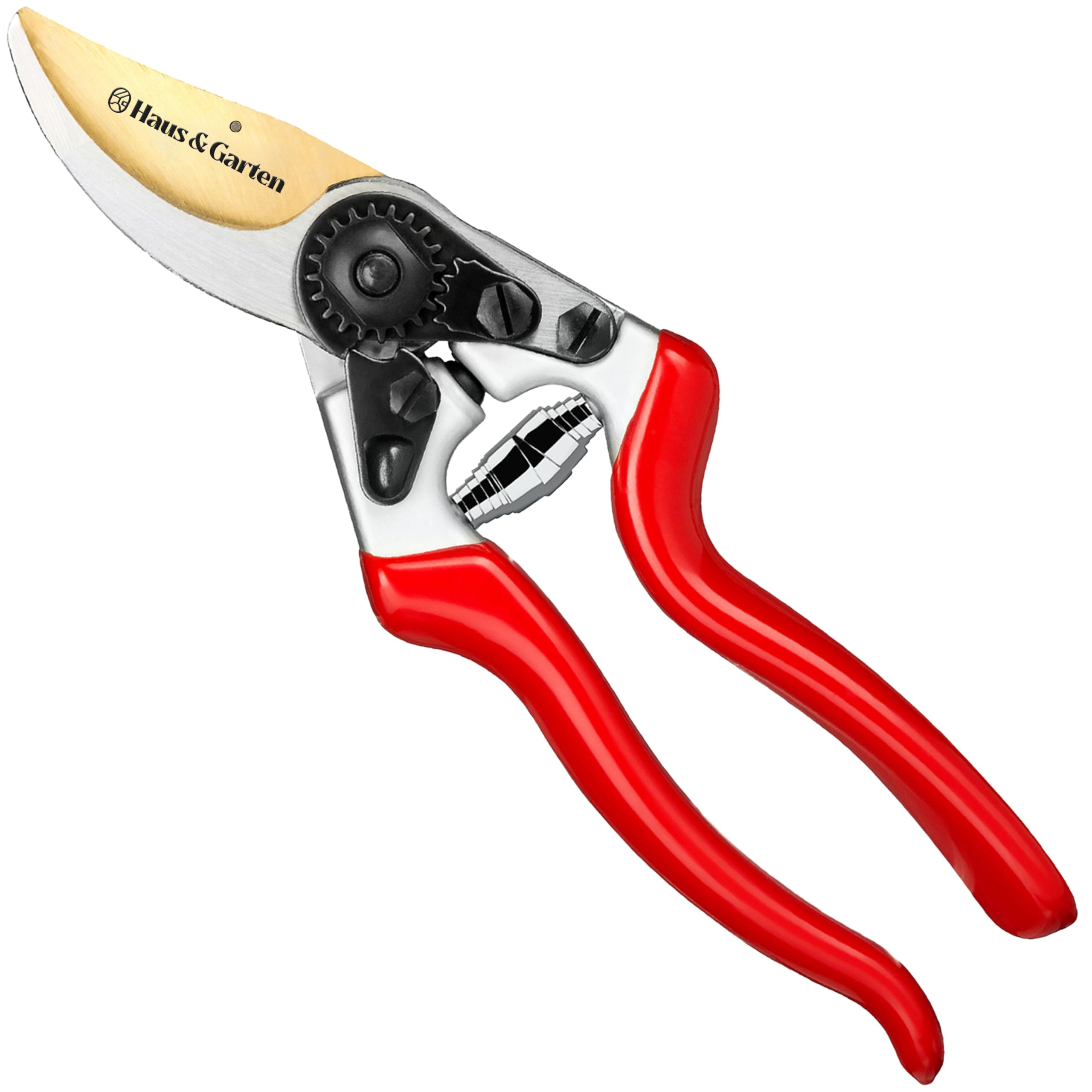
2. Haus & Garten EnduroPRO Ergonomic Bypass Pruners
A bypass shear that punches at twice its price — titanium coated and built with Japanese-grade steel.
This is the pair that makes you wonder why you ever paid more for a pruner. The blade uses Japanese-grade high-carbon steel with a titanium coating that reduces friction, prevents rust, and helps each cut stay clean. The cutting capacity is a full inch, so it handles live branches, woody stems, and green growth without needing the loppers. At 8.8 ounces, it is 0.8 ounces lighter than the Corona BP 4250 (9.6 oz), which matters when your hand is working through a hundred cuts. The anodized aluminum body and drop-forged handles are built to survive seasons, not years — owners say they are built like a tank.
What really stands out is the ergonomic design. The handle aligns your wrist to reduce strain, and the red anti-slip soft grips keep you secure even in damp conditions. Quality is the most-discussed aspect by a wide margin — 142 buyers single it out — and Sharpness follows with 82. The consensus from the review pages is blunt: “the best pruners that I have ever owned” and “they cut better than shears twice the price.” The one area where a few owners want more is the handle width — some with arthritic hands wish the grip were larger. For the 839 owners who gave this a 4.6 average, that is a minor note on an otherwise outstanding tool.
Standout spec: an 8.8-ounce bypass with a titanium-coated Japanese-grade steel blade that cuts a full inch — that spec-to-weight ratio beats anything near this price point.
Who it fits: the gardener who prunes live branches daily and wants a lightweight, sharp bypass shear that does not fatigue the hand.
Who might struggle: anyone with larger-than-average hands or arthritis — the grip profile is narrower than some premium models.
3. Corona Tools BP 4250 MAXFORGED Aluminum Bypass Pruner
The trail-clearing workhorse that a 71-year-old gardener trusts and a dirt-bike rider abuses weekly.
This is not a pruner you keep in the shed for light rose trimming. The BP 4250 is the pair you throw in a backpack for clearing dense woods, cutting dirt bike trails, or tackling overgrown shrubs that have not been touched in years. It cuts up to 1 inch, and the forged steel blade delivers smooth scissor-like cuts that minimize damage to living plants. The aluminum handles keep it at 9.6 ounces, so 0.8 oz heavier than the Haus & Garten above, but the extra weight comes with a noticeable increase in leverage on thick branches. As one owner put it: “I use these heavily for clearing dirt bike trails in dense woods so they get put through heavy usage weekly.”
The build quality is classic Corona — forged aluminum handles, non-slip red grips, and a built-in safety lock. The quality gets 26 mentions from buyers, and sharpness follows with 18. The lock, however, draws 8 mentions as a negative aspect. Several owners note that the locking mechanism slips and can pop open if you do not press it hard enough. It is a finicky detail on an otherwise rugged tool. The consensus is that these are professional-quality pruners that make quick work of thick branches, and the replaceable blade means your 9.6-ounce investment stretches across many seasons. The reviewer who has been gardening since his teens and is now 71 calls them “sharp and old school Corona quality” that he can pass to his grandkids.
The defining quote from the field: “They cut just as good now as they did brand new” — that is what weekly abuse in dense woods produces with this pair.
Best for: heavy outdoor use where you need a 1-inch cut capacity and do not mind checking the lock before each swing.
skip it if: you want a lock that never slips — this one requires a deliberate firm press to stay closed.
4. TONMA TP-1 8″ Pruning Shears

Japanese SK5 steel at 59 HRC — a hardness that keeps this bypass shear sharp longer than most.
The TONMA TP-1 is made of Japanese SK5 steel, which is not stainless steel — it is a high-carbon tool steel that reaches an unusually high 59 HRC on the Rockwell hardness scale. That hardness means the edge stays sharp for a very long time, but it also means you cannot sharpen it with a simple carbide pull-through; you need a diamond stone or wet stone. The blade is a bypass design with a serrated edge, and it cuts through branches up to 1 inch in diameter. Buyers who own it call the cut “smooth and precise” and note that it arrives “VERY sharp right out the box.”
The handles are aluminum with a full vinyl coating that many owners consider superior to partial rubber grips — it covers the entire handle for a secure hold even with sweaty hands. At 244 grams (about 8.6 ounces), it splits the difference between the heavier LÖWE and the lighter Felco options. The safety lock is a tight clip that stays put, unlike the finicky lock on some Corona models. A few experienced users point out that the opposing steel plate is thinner than ideal, so on large branches the bark can crush slightly rather than slice cleanly. For most home gardeners pruning fruit trees and rose bushes, that detail will not matter. The overall rating is 4.8, and the included lifetime service means the maker stands behind the steel.
One note of caution: because the blade uses SK5 high-carbon steel (not stainless), it needs occasional oiling to prevent rust — a quick wipe after use keeps it shining.
Reach for this if: you want a Japanese-made bypass shear with exceptionally hard steel that will not need frequent sharpening.
Pass on it if: you prefer a blade you can sharpen with any tool — SK5 at 59 HRC demands a diamond stone.
5. FELCO 160L Pruning Shears

Swiss-made at just 7.8 ounces — the lightest full-size pruner here, built for extended sessions.
FELCO designed the 160L specifically for people with larger hands. The long handle profile gives your palm room to breathe, and the fiberglass composite handles keep the weight at a feathery 7.8 ounces — nearly 2 ounces lighter than the Corona BP 4250. That weight difference is real when you are pruning for hours. The bypass blade uses hardened alloy steel with a convex edge, and the angled cutting head reduces wrist strain by letting you cut at a natural angle rather than twisting your arm. The non-slip handles and easy-to-use safety catch add control.
The catch is that fiberglass composite handles flex slightly on thicker tree branches. Buyers who tried it on raspberry canes and light garden work found it excellent, but those who pushed it into heavy-duty wood reported the handles flexing. One reviewer notes that the handles are “very lightweight in your pocket of belt” but recommends it as a medium-duty snip rather than a branch-breaking tool. FELCO backs every unit with a lifetime guarantee and all parts are replaceable, so if a blade dulls or a spring snaps, you fix it rather than throw it away. The 4.4 average across 365 reviews reflects that this is a specialized tool for a specific hand size and cutting range, not the most versatile pair in the list.
Where it shines
- 7.8 oz is the lightest full-size pruner reviewed — your hand notices the difference after 30 minutes
- Long handle design fits large hands comfortably without crowding the pivot
- Lifetime guarantee with replaceable parts — Swiss-made, sustainable, repairable
Where it pulls back
- Fiberglass handles flex on thick, woody branches — best for medium-duty garden snipping
- 1-inch cut capacity feels less confident than forged aluminum models when pushing the limit
Best for: large-handed gardeners who do light to medium pruning and want the lightest Swiss-made tool that can ride in a pocket.
Not ideal for: anyone who regularly cuts hardwood, old branches, or thick woody stems — look at the forged aluminum options.
6. Corona Tools BP 6250 MAXFORGED Aluminum Bypass Pruner
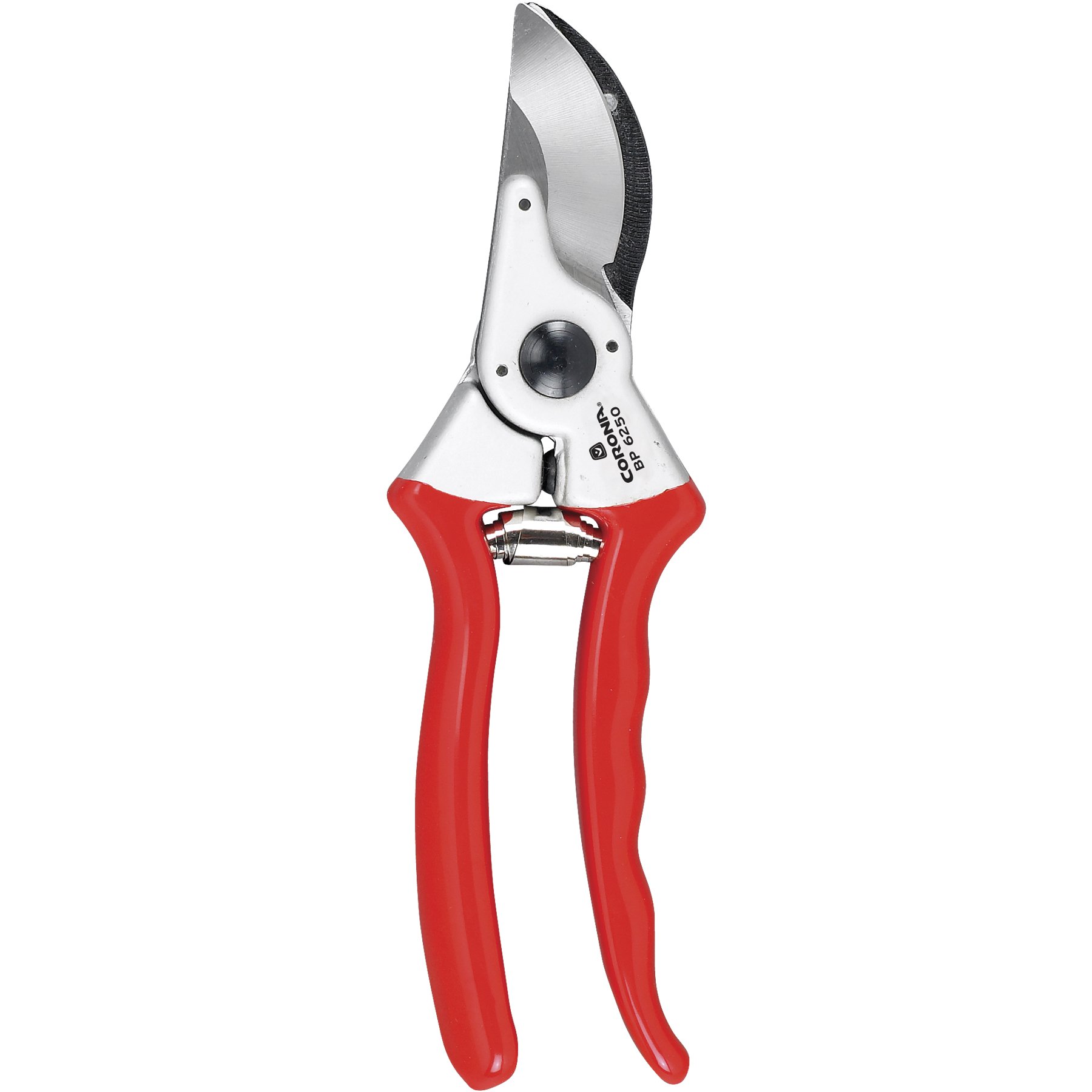
The Corona that Felco owners buy as a backup — same performance at a notably lower cost.
For years, Felco has been the gold standard in professional pruning shears, but the BP 6250 matches the Felco F-2 in hand feel and cutting function while costing significantly less. The blade is precision-honed forged carbon steel that cuts 1-inch branches easily, and the forged aluminum handles weigh 9.6 ounces — the same as the BP 4250 but with a few extra features: a wire cutting notch near the pivot, a shock-absorbing bumper, and a self-cleaning sap groove on the hook side. That sap groove keeps sticky residue from building up between the blade and the anvil, which means the cut stays clean even after hours on sappy trees. The volute spring (the coiled wire that opens the blades after each cut) is smooth and responsive.
Buyers who compared it directly to the Felco 2 report that the hand feel and cutting function are equal, but the lock on the Corona requires a more deliberate press — some units arrive with the locking mechanism tweaked slightly crooked, which means you check it before trusting it. One owner says: “Make sure your closure locks properly, we had to get replacement since the closure lock was tweaked a little crooked.” That is the most common complaint: the lock can slip if not fully engaged. For the price, the consensus is that this is the best quality-to-cost ratio in the list, with buyers calling it “an excellent pruner for the money” and noting that 4 hours of trimming produce no hand fatigue, even for arthritic hands. The replaceable blade and limited lifetime warranty add long-term value.
Direct comparison to the Felco F 11: customers note the Corona BP 6250 equals the Felco F-2 in performance at roughly half the price, with the trade-off being a finicky lock and Taiwanese assembly rather than Swiss.
Who it fits: anyone who wants Felco-level cutting performance and a 9.6-ounce lightweight build without paying the Swiss premium.
Watch out for: the locking mechanism — inspect it on arrival and make sure it clicks home fully before each use.
7. Original LÖWE 10 Professional Anvil Pruning Shears 10.107

German engineering that blends anvil crushing force with bypass cutting geometry — the hybrid for professional orcharding.
The LÖWE 10 is an unusual tool. It is an anvil shear that uses bypass geometry — meaning the blade slides past with a scissor motion while still closing against a flat anvil surface. That hybrid design lets it cut hard, dry wood up to 1.18 inches (30 mm) in diameter, which is the largest cutting capacity in this entire list. The blade is curved and coated with a corrosion-protected finish so it slides into tight branch formations without slipping. At 8.07 inches long and 285 grams (about 10.05 ounces), it feels solid in the hand, and the wood handles absorb vibration better than aluminum or plastic. The inward-curved lower handle means your hand does not need to open as wide for each cut, which reduces strain on medium-sized hands.
The professional crowd loves this pair. Buyers who work in orcharding and forestry say it cuts hard branches easily — “the first few times I cut a branch I thought I had missed it because it was so smooth and easy.” One owner who compares LÖWE with Felco and Corona says: “for pro performance and cost value for money, I like Lowe!” The wood handles take some getting used to if you have only used synthetic grips, but they warm up with use and feel less slippery than plastic. A few reviewers point out that these are expensive compared to competitors, but the quality justifies the spend: “very sharp and precise tool a pleasure to use, more expensive than competition but worth it, if you like nice tools.”
Unique advantage: the 1.18-inch cut capacity beats every other shear reviewed here by about 0.18 inches, making it the pick for larger dead branches that other pruners would require loppers for.
Reach for this if: you are a professional orchardist, forester, or a demanding home gardener who regularly cuts dead wood up to 1.18 inches thick and wants a tool that feels easy.
Think twice if: your pruning is mostly light green growth — the anvil crush is overkill for roses and small live branches.
8. Felco Pruning Shears (F 11)

Twenty-five years without sharpening — one florist’s experience with the Swiss-made Felco F 11.
The F 11 is the smaller, lighter sibling of the Felco 2, designed for people with smaller hands or for precision work where a bulky handle gets in the way. The blade length is 1.5 inches, the cut capacity is 25 millimeters (just under 1 inch), and the weight is 8.8 ounces with aluminum alloy handles and rubber cushion shock absorbers that reduce vibration. The blade is hardened alloy steel that shoppers say stays sharp for years.
The construction quality earns 46 mentions from buyers, and sharpness follows with 19. The replaceable blade system means you can swap out a dull blade for about half the cost of a new pair of cheaper shears. The downsides cluster around value and fit: 16 buyers describe value as mixed — the F 11 costs more upfront than most competitors — and 14 note that durability can vary if you abuse the tool. The F 11 is engineered for right-handed users (the handle is shaped for the right hand), so left-handed buyers need the Felco 13 model instead. The rubber cushion shock absorbers are a small detail that matters when you are cutting woody stems all day — they dampen the jolt that travels up your arm with each snip.
Why pros pay the premium
- 25-year blade life reported by a daily-use florist — the hardened alloy steel holds an edge longer than any other pair here
- All parts replaceable, including blades, springs, and cushions — a broken tool gets repaired, not replaced
- Rubber cushion shock absorbers reduce arm fatigue on repetitive cuts through woody stems
The premium trade-offs
- Right-handed only — left-handed gardeners must buy the separate Felco 13 model
- Higher initial cost than the Corona BP 6250 that delivers similar performance at roughly half the price
Ideal for: a right-handed gardener who wants the last pruner they will ever buy and values repairability over upfront savings.
Not for: left-handed users or anyone on a tight budget — the Corona BP 6250 gives comparable performance for significantly less.
9. ARS ARS-VS-8XZ Hand Pruner

Japanese-made with a squeeze-to-open lock — the ARS that people with small hands call the best ever.
The ARS-VS-8XZ is an 8-inch pruner designed for regular-sized hands, but buyers with smaller hands consistently call it the most comfortable pair they have ever owned. The parrot beak blade (a single bevel bypass design) cuts with a pinching motion that gives you extra control on smaller branches. The blade is high-carbon tool steel with hard chrome plating for rust and sap resistance — that chrome layer means you can leave it in damp conditions longer without corrosion. At 220 grams (about 7.8 ounces), it ties the FELCO 160L for the lightest weight in this review, but the die-cast aluminum handles feel stiffer than fiberglass. The unique locking mechanism uses a squeeze-to-open action — you squeeze the handles together to open up them rather than flipping a switch. It takes a few days to get used to, but buyers report it becomes second nature.
The cutting performance gets 34 mentions and quality gets 39 — both the top aspects by a significant margin. The mechanism is the dividing line: 16 buyers call it mixed. The lock is initially stiff and needs about two weeks of daily use to soften. For pruning fruit trees, rose canes, and general garden work, it is plenty — just do not expect it to handle thick dead branches. The 4.8 average across 333 reviews matches the highest rating in the list, and Made in Japan is stamped on the blade.
Small-hands verdict: the ARS is the lightest pair here at 220 g, with a unique squeeze-to-open lock that buyers find intuitive after a short break-in — ideal for smaller hands that struggle with bulky grip profiles.
Best for: gardeners with small to regular-sized hands who want a featherlight, Japanese-made bypass pruner with a clever locking system.
Consider something else if: you regularly cut branches near the 1-inch mark — the 22 mm capacity leaves less margin than the Haus & Garten or Corona models.
Understanding the Specs
Cutting Capacity
This is the maximum branch diameter the shear can cleanly cut. It is measured in millimeters or inches. A 22 mm capacity (about 7/8 inch) covers most rose canes, small tree branches, and shrub growth. A 1-inch (25 mm) capacity handles thicker live growth and light dead wood. The Original LÖWE 10 reaches 1.18 inches (30 mm) — the widest in this list — which lets you tackle larger dead hardwood branches that other pruners would require loppers for. Pushing a shear past its rated capacity dulls the blade faster and can damage the pivot joint, so match the capacity to the thickest branch you cut regularly.
Blade Steel and Hardness
The steel determines how long the edge stays sharp. High-carbon steel (used in the Corona, Felco, and ARS models) holds a razor edge longer than standard stainless but will rust if left wet. Japanese SK5 steel, like in the TONMA, is heat-treated to around 59 HRC (Rockwell Hardness Scale C) — a high number that means excellent edge retention but requires a diamond stone to resharpen. Titanium coatings (like on the Haus & Garten) reduce friction and resist rust, but the coating wears over time and does not affect the hardness of the underlying steel. Chrome plating on the ARS blade blocks rust and sap adhesion, which is helpful in humid climates.
Weight and Handle Ergonomics
Weight directly affects how fatigued your hand gets during long pruning sessions. The lightest pairs here hit 7.8 ounces (FELCO 160L and ARS-VS-8XZ), while the heavier LÖWE models are around 10.2 ounces. A difference of 2.4 ounces may not sound like much, but across several hundred cuts, the hand and forearm definitely feel it. Handle material matters too: forged aluminum provides strength without weight but feels cold; fiberglass composite is lighter but can flex on thick branches; wood absorbs vibration and feels warm but adds mass. The grip shape — inward-curved lower handles, full vinyl coating, or non-slip rubber inserts — determines whether the shear fits your specific hand size comfortably.
Anvil versus Bypass Geometry
This is the most misunderstood spec in gardening. Anvil shears have one blade that crushes the branch against a flat metal surface. They are better for dry, dead, or old wood because the crushing action does not require the blade to slide past the material — it just powers through. Bypass shears have two curved blades that slide past each other like scissors, producing a clean slice that leaves living plants with a smooth, healing-friendly cut. FELCO, Corona, Haus & Garten, TONMA, and ARS all use bypass designs. The Original LÖWE 1.104 uses a pure anvil, while the LÖWE 10 blends both approaches — bypass geometry over an anvil base — giving you the slice of bypass with the crushing force of an anvil. If you prune mostly live growth, choose bypass. If you clear dead wood, choose anvil.
FAQ
What is the difference between anvil and bypass pruning shears in everyday use?
How often do I need to sharpen heavy duty pruning shears?
Can I use anvil shears on live green branches?
What does “replaceable blade” mean and is it worth paying extra for it?
How do I know which size pruning shear fits my hand best?
Will these pruning shears cut through roots or should I use loppers?
How do I clean and store pruning shears to make them last?
Is a titanium coating actually useful or just marketing?
Can left-handed gardeners use any of these pruners effectively?
What is the typical lifespan of a quality pair of heavy duty pruning shears?
Final Thoughts: The Verdict
For most buyers, the heavy duty pruning shears winner is the Original LÖWE Professional Anvil Pruner 1.104 because it marries German build quality with a powerful anvil design that cuts dry hardwood with minimal effort, all backed by replaceable parts and a reputation that earns near-perfect ratings. If you want a lightweight bypass shear for daily live pruning, grab the Haus & Garten EnduroPRO — the titanium-coated Japanese-grade steel and 8.8-ounce frame deliver professional cuts at an accessible price. And for the largest cut capacity in the review — 1.18 inches — the Original LÖWE 10 Professional Anvil Shear is the one to reach for when your branches outgrow every other pruner in the shed.
How We Picked
We do not accept paid placement. Every pick is matched to a real buyer and a real use-case; we do not hands-on test units.
Sources & Methodology
Specifications: manufacturer listings and product documentation. Review insights: verified customer reviews, as of July 2026. Pricing: not shown on this page (it changes often); check the current price via the retailer link.
As an Amazon Associate, Lawn Gear Lab earns from qualifying purchases. This does not affect which products we feature.