
Specs are compiled from manufacturer listings and verified buyer reviews and can change over time — please confirm the key details on the product page before buying.
If you have tried growing seedlings in a chilly basement, a winter greenhouse, or even a corner of the house that just never seems to warm up, you already know the problem: plants stop growing when the air around them drops below their comfort zone. A regular grow light gives you photons, but it often skimps on the actual warmth that tropical plants, germinating seeds, and tender cuttings rely on to thrive. That is where a purpose-built heat source steps in — and the right pick keeps your soil warm without messing with your plants’ rest cycle.
I’m Rikta — the founder and writer behind Lawn Gear Lab. This guide is built by comparing the manufacturers’ published specifications and the patterns across verified customer reviews, so you get each pick’s real strengths and trade-offs instead of marketing spin.
Whether you are coaxing peppers to germinate, keeping orchids happy on a cold night, or simply extending your season by a few crucial weeks, finding the right heat bulb for plants means matching wattage (how much electrical power it turns into heat) to your space and choosing between a glowing red lamp or a completely dark ceramic emitter (a bulb that produces no visible light) for around-the-clock use.
Our Picks at a Glance


How To Choose The Best Heat Bulb For Plants
Choosing a heat bulb for plants depends on a few key factors that are different from buying a standard light bulb. You are not looking for brightness; you are shopping for radiant warmth that can travel through the air and warm the leaves and soil underneath. Get the wattage wrong, and you either create a desert-hot hotspot or a heater that barely raises the temperature at all. Get the type wrong — glass vs. ceramic — and you might accidentally keep your plants awake with unwanted light.
Wattage and Coverage Area
The wattage (measured in Watts, or W) determines how much heat the bulb can output. A 60W ceramic emitter is great for a small propagation dome or a single plant tent shelf measuring just a couple of feet across. A 100W to 150W bulb handles a larger space, like a 2×2-foot or 2×4-foot grow tent. If you are warming an entire small greenhouse, you might need 250W or even multiple units. The rule of thumb is that higher wattage equals more heat, but it also means more electricity use and a fixture that can handle that much power. Always check that your lamp holder (socket) is rated for the wattage you choose — a cheap fixture melting is a real risk.
Light vs. No Light: Ceramic or Glass?
This is the biggest fork in the road. Red-tinted glass heat lamps produce visible light along with infrared heat (invisible warmth). That light is fine if you are using the bulb during the day for basking animals or watching seedlings, but it can disrupt a plant’s rest cycle if left on at night. The clear or red bulbs are also fragile glass that can shatter if splashed with cold water. Ceramic heat emitters, on the other hand, produce absolutely no visible light. They look like a rough, dark plug and only glow faintly when red hot. Because they produce zero light, they are perfect for 24-hour operation — your plants or seedlings get consistent warmth without any photoperiod (day/night cycle) disruption. Ceramic bulbs are also more durable and crack-resistant in high-humidity environments.
Fixture and Safety Considerations
A heat bulb for plants gets very hot — surface temperatures can easily exceed 400°F. You must use a ceramic or porcelain socket (E26 base — the standard medium screw base in North America) designed to handle that heat. Plastic sockets will melt. Always position the bulb at least 12 to 18 inches away from any plant foliage, plastic trays, or wooden shelves. A wire cage guard around the bulb is a smart addition to prevent accidental contact. If you are plugging the heat bulb into a timer, make sure the timer is rated for the bulb’s wattage, as many cheap timers cannot handle a 250W resistive load.
Quick Comparison
| Model | Best For | Wattage | Bulb Type | Lifespan | Amazon |
|---|---|---|---|---|---|
| Fluker’s Ceramic Heat Emitter★ Best Overall | Long-term 24/7 use | 100W | Ceramic (no light) | 2-3 years continuous | Amazon |
| REPTI ZOO Red Heat Lamp 2-PackValue Two-Pack | Cost-effective two-pack | 75W each | Red glass (infrared) | 2000-3000 hours | Amazon |
| REPTI ZOO Ceramic 2-PackNight Heat Star | Nighttime warmth, dark operation | 60W each | Ceramic (no light) | 10,000 hours | Amazon |
| LUCKY HERP 75W Ceramic 2-Pack | Fast heating for small spaces | 75W each | Ceramic (no light) | 10,000 hours | Amazon |
| LUCKY HERP 50W Ceramic 2-Pack | Gentle heat for small seedlings | 50W each | Ceramic (no light) | 10,000 hours | Amazon |
| MIXJOY 250W Ceramic 2-Pack | Large greenhouse or shed | 250W each | Ceramic (no light) | 10,000 hours | Amazon |
| BULBMASTER R40 Infrared Heat Lamp | Targeted spot heating | 250W | Red glass (infrared) | 6,000 hours average | Amazon |
| Zoo Med Repticare 100W | Established brand, high humidity | 100W | Ceramic (no light) | — | Amazon |
In‑Depth Reviews
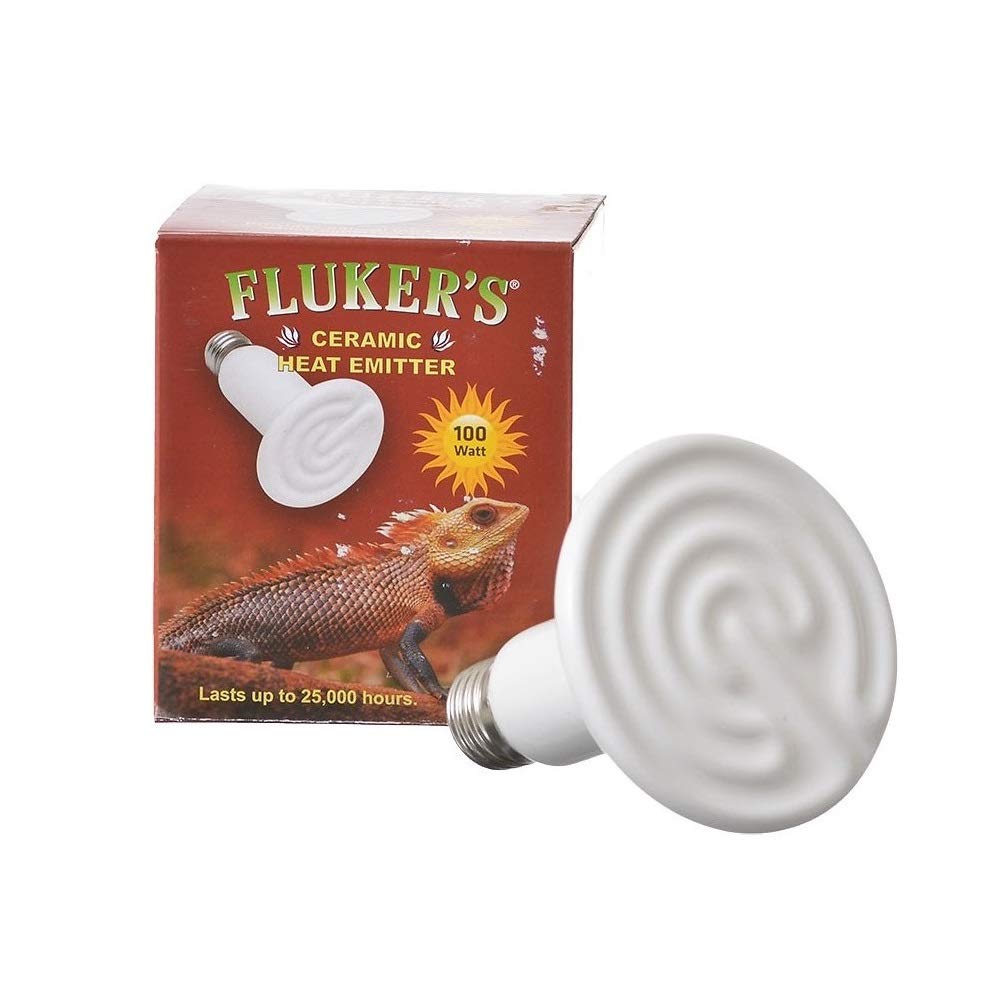
1. Fluker’s Ceramic Heat Emitter, 100 Watt
Our pick — over 4.5★ from 900+ verified ratings; the strongest balance of quality and price.
The 100W ceramic workhorse that keeps running for years without a single glimmer.
This Fluker’s 100W ceramic heat emitter gives you consistent warmth 24 hours a day with absolutely no visible light so your plants rest naturally at night, unlike a red glass bulb. It uses an A15 shape (a smaller, rounder bulb body) to direct infrared heat (invisible warmth) downward over a large area — ideal for a 2×2-foot seedling station. Buyers report the same bulb running continuously since 2014, with many still going strong in 2022. At 4.6 stars across over 900 owners, the durability is what buyers rave about — owners mention “Fluker’s lasts 2-3 years 24/7/365, more than double Zoo Med’s ~1 year.” The only recurring gripe is an occasional bulb that can bond with or melt into the lamp socket when it finally dies — a reminder to check the fit periodically and use a quality porcelain socket rated for 100W.
The long-distance runner: If you want a single bulb that will heat your germination station through multiple winters without breaking, this is the one. The unanimous owner sentiment is that it simply outlasts the competition.
Reach for this if: you need continuous, light-free warmth for seedlings, cuttings, or a small grow tent and do not want to think about replacing the bulb every season.
Think twice if: you need a lower wattage for a tiny space, or you are on a tight upfront budget — this costs slightly more than economy two-packs.
2. REPTI ZOO 75W Infrared Red Heat Lamp Bulb 2-Pack
A bright-red infrared source that delivers heat quickly, but does produce a soft glow.
If you are heating a greenhouse shelf during the day and do not mind a soft reddish glow, this two-pack is a solid budget-friendly entry. The 75-watt A19 bulbs (a standard bulb shape, about 27% bigger than Fluker’s A15) produce infrared heat that penetrates leaves and soil without drying the air like forced-air heaters do. Each bulb uses an E26 base (standard North American screw-in), so it fits any porcelain lamp holder. The maker claims a lifespan of 2000 to 3000 hours per bulb; with 12-hour nightly use, customers note each bulb lasting almost 23 months. However, the lifespan is also the most frequent complaint — over 40 owners flagged it as the top pain point, with some bulbs failing after a month. The 90-day replacement service is responsive if you get a dud. If you need absolute darkness at night for plants, the red glow is a dealbreaker — unlike the Fluker’s ceramic above, this one emits visible light.
What wins people over
- Two bulbs for a very low price per unit
- Effective infrared heat that warms plants rapidly
- Standard E26 base swaps into any household lamp holder
The trade-off you need to know
- Lifespan is the most frequent complaint — some bulbs fail after a month
- Produces a visible red glow, not suitable for 24-hour use if you want total darkness
Go for it if: you need a daytime heat boost for a propagation station or animal enclosure and want a spare bulb on hand.
Look elsewhere if: you need absolute darkness at night for plants, or you cannot risk a bulb failing mid-winter.
3. REPTI ZOO 2-Pack Ceramic Heat Emitter 60W
The fully dark ceramic two-pack that runs silently through the night without a photon.
The 60-watt ceramic emitter from REPTI ZOO delivers invisible warmth (infrared heat) with no light at all—perfect for keeping your plants warm overnight without disturbing their rest cycle. The ceramic material is crack-resistant and withstands the high humidity inside a glass terrarium or propagation dome. At 2.9 inches wide by 3.9 inches tall, it is slightly wider and shorter than a 75W glass bulb, so it fits in compact reflectors. The maker claims a 10,000-hour lifespan — about three times longer than standard glass heat lamps — and owners consistently praise the heat output as the top feature, with over 70 owners mentioning it. Unlike the red glass REPTI ZOO pick above, this one runs completely dark. One thing to watch: ceramic emitters are fragile if dropped, and a few owners received bulbs that arrived cracked. Handle them carefully during installation.
The dark-night specialist: Perfect for keeping a seedling tray warm overnight or providing a heat gradient in a plant cabinet without any light pollution.
Best for: anyone running a 24-hour heating schedule for germinating seeds, tropical plants, or reptiles who need heat without light.
skip it if: your space requires more than 60W to overcome ambient cold — this is for smaller setups up to roughly 2×2 feet.
4. LUCKY HERP 75W Ceramic Heat Emitter 2-Pack

A 75W ceramic that heats up in seconds and stays warm for years of regular use.
This LUCKY HERP emitter delivers a noticeable temperature rise within 10 seconds of turning it on, reaching full heat in about 4 minutes — a real advantage if you are spot-heating a plant station that cycles on and off with a thermostat. The 75-watt ceramic body is made of thick, high-purity ceramic, and reviewers point out the bulky shell feels more durable than thin glass bulbs. It fits a standard E26 base, works on 120 volts, and the maker claims a 10,000-hour lifespan. At 4.6 stars across a large owner base, build quality and durability earn consistent praise — owners note the ceramic construction feels “very durable” after a year of use. The one mixed note: some owners found the 75W heat output only slightly noticeable in larger, drafty spaces. This is best in an enclosure, small plant tent (think up to about 2×2 feet), or well-insulated propagation area. Do not use it with a plastic socket — the instructions are clear: you must use a good quality ceramic lamp holder.
Why owners recommend it
- Noticeable heat within 10 seconds of turning on
- Thick ceramic build feels sturdier than glass bulbs
- Two bulbs per pack for the price of one premium unit
The honest limitation
- 75W may not be enough for large, uninsulated spaces
- Some owners received units that were dusty or seemed used
Reach for this if: you want a fast-heating, dark ceramic for a small plant tent or propagation dome and like having a backup bulb on hand.
Look elsewhere if: you need to maintain warmth in a large, cold room — you will need a higher wattage.
5. LUCKY HERP 50W Ceramic Heat Emitter 2-Pack
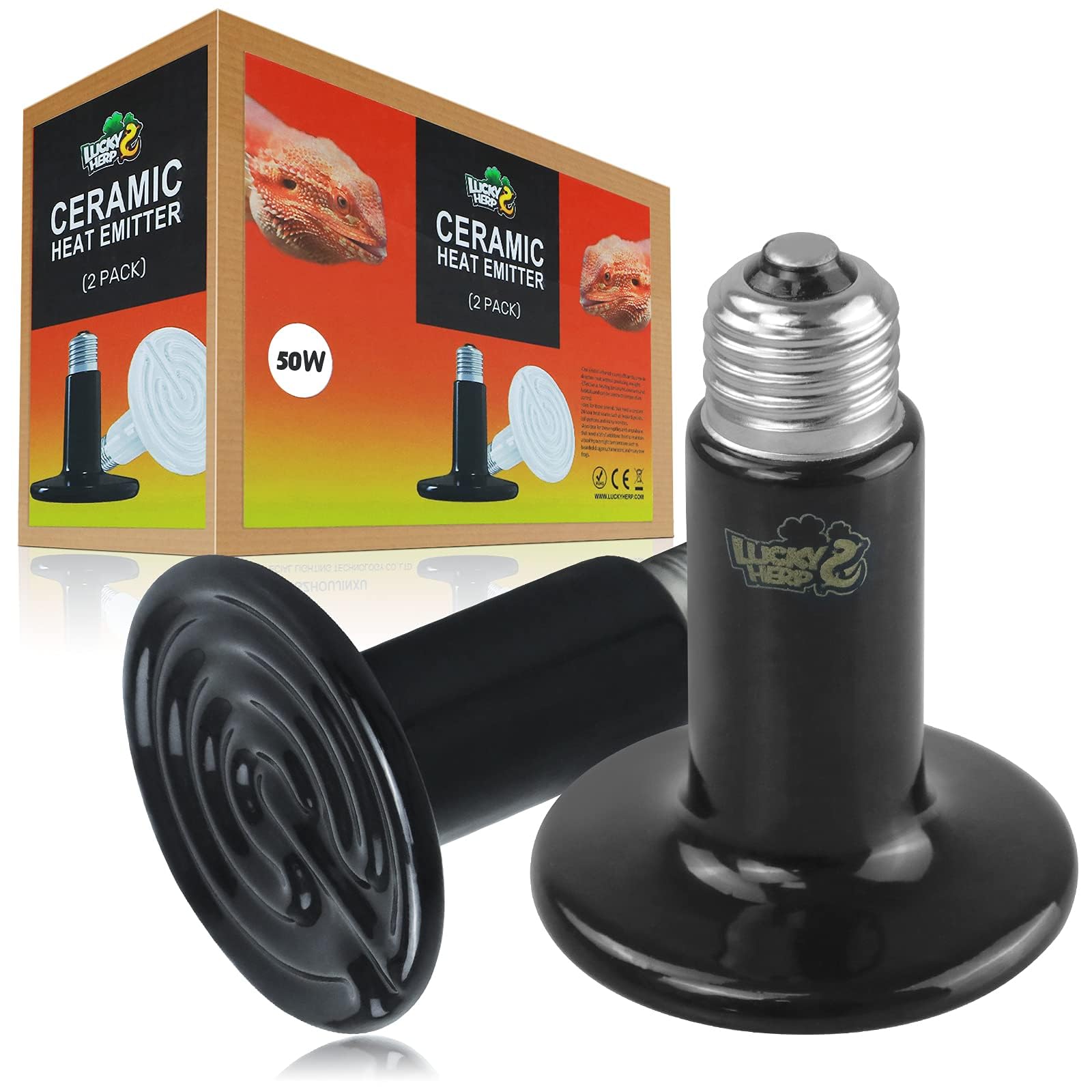
The low-wattage ceramic that raises a small enclosure by roughly 10 degrees without baking it.
For a very small propagation dome, a single plant shelf, or a 10-gallon terrarium, a 50W emitter adds gentle warmth without creating a scorching hotspot — unlike the larger 100W or 250W options that can overheat a tiny space. This LUCKY HERP two-pack uses the same fast-heating ceramic technology as the 75W version but with a lower power draw. The 3-inch wide emitter reaches full heat in about 4 minutes and operates completely silent and dark, making it a top choice for overnight heating of sensitive seedlings that need a steady, low-level temperature boost. Shoppers say that in a standard 10-gallon tank, the 50W bulb increases the temperature by roughly 10°F. The owner base gives this a solid 4.5-star rating, and heat output is the most frequently praised aspect. It is also a popular choice for unconventional uses like keeping RV water lines from freezing in winter. The mixed feedback: a few owners note the heat output feels modest in a larger, drafty space. This is the bulb to choose when you need a gentle, dependable heat source that consumes less power than the 60W or 100W options.
The low-power steady hand: Ideal for small, enclosed spaces where you want a predictable 5-10°F rise without the risk of overheating delicate plants.
Best for: small terrariums, propagation domes, and heating a single seedling shelf overnight.
pass on it if: your space is larger than about 1.5 square feet or your ambient room temperature regularly drops below 50°F.
6. MIXJOY 250W Ceramic Heat Emitter 2-Pack
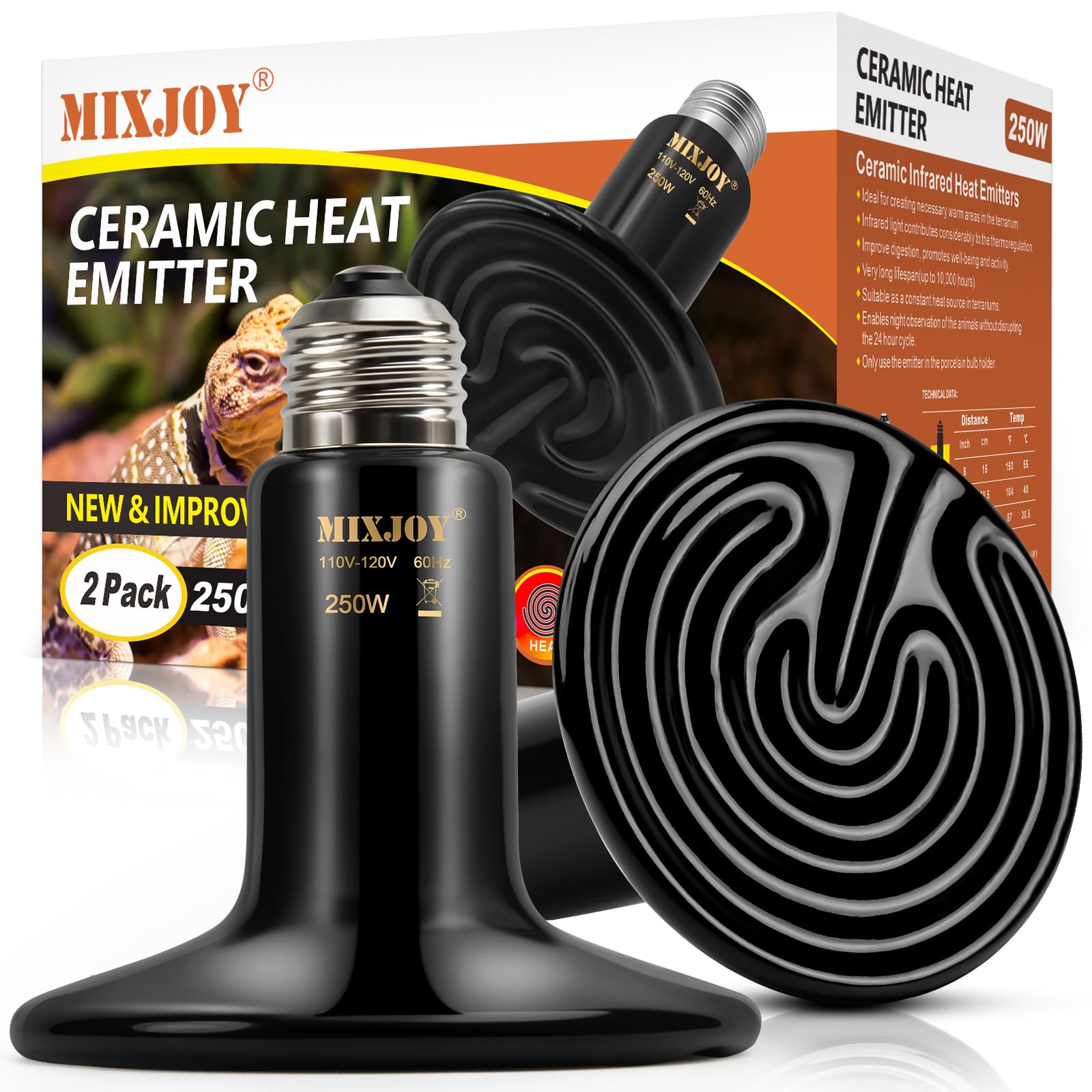
The 250W powerhouse that takes a shed from 25°F to 45°F in 15 minutes.
This MIXJOY 250W emitter is the heavy lifter — it puts out so much infrared heat that buyers report three of these lamps in a 100-square-foot shed with 10-foot ceilings maintained interior temperatures of 35-45°F when outdoor temperatures were 25°F. That is a 10-20°F boost you simply cannot get from a 60W or 75W bulb. The ceramic head heats up noticeably within 10 seconds and reaches optimal temperature in 3-5 minutes, according to the manufacturer. It runs on a standard E26 base but requires a lamp holder rated for 250W — no plastic sockets here. The two-pack is rated at 4.3 stars, and the heat output is the top mentioned feature. However, owners note a split on reliability: some units last for months or even two to three winters, while a few arrived broken or failed shortly after installation. The ceramic design is also shatterproof — a big plus if you are in a fish hatchery or a greenhouse where broken glass is a hazard. An accidental touch will cause a severe burn, so a wire cage guard is strongly recommended.
Why you would choose this
- Massive 250W output can heat a shed or large greenhouse
- Completely dark operation does not disrupt plant rest cycles
- Shatterproof ceramic is safe near water and moisture
The honest limitation
- Some owners reported receiving a defective unit from the start
- Requires a heavy-duty fixture rated for 250W to operate safely
Reach for this if: you have a large greenhouse, workshop, or shed and need to raise temperatures 15-20°F above outdoor freezing levels.
Think twice if: you need a bulb for a small tabletop tent — this 250W will create an oven in a confined space.
7. BULBMASTER R40 250W Red Infrared Heat Lamp

The classic R40 reflector lamp that directs heat where you point it — perfect for spot heating.
Unlike the ceramic emitters that radiate heat in a wide pattern, this BULBMASTER lamp uses a built-in red glass reflector (R40 shape — a wide, bowl-like bulb) to concentrate the 250-watt output in a single direction. That makes it excellent for spot-heating a specific plant or group of seedlings without wasting heat on the rest of the room — more efficient for targeted use than a bare ceramic emitter. It produces a warm, bright glow along with the infrared heat, which is useful during the day for a combined light-and-warmth effect. The bulb is rated for 6,000 average hours of use, and owners mention it being very effective for warming bathrooms, baby chicks, or livestock enclosures. At 4.4 stars across nearly 800 owners, heat output and reliability are the most praised aspects, with 40 and 35 owners respectively calling them out. The lifespan is the biggest complaint — 34 owners mention it as a negative, with many reporting the bulbs lasting only about 6 months before burning out. This is a high-output glass bulb that can shatter if splashed with cold water, unlike the ceramic options. Use it when you need to warm a specific spot — like a cold corner of a greenhouse or a single propagation tray — rather than a whole room.
The heat director: The R40 reflector shape pushes heat in one direction, making it more efficient for spot-heating than a bare ceramic emitter that radiates in all directions.
Best for: spot-heating a single shelf, a seedling tray, or a specific animal enclosure that also benefits from a bit of light.
it’s not for you if: you need 24-hour operation in darkness, or you need to heat a large open space evenly.
8. Zoo Med Repticare 100 Watt Ceramic Infrared Heat Emitter
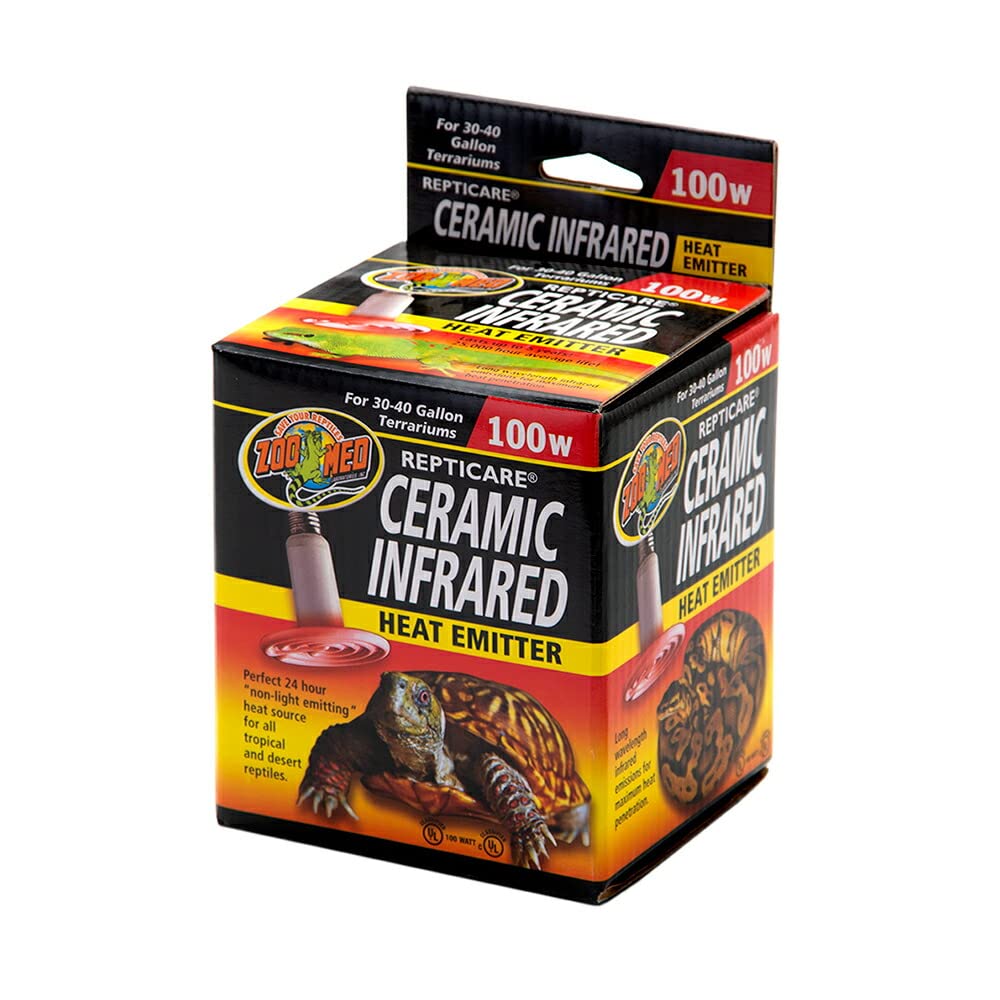
The American-made ceramic classic with a flat face that heats more efficiently than cone designs.
Zoo Med is one of the best-known names in reptile heating, and this 100-watt ceramic emitter brings that reputation for reliability. Its flat-face design differs from the conical shape of many other ceramic emitters, and the manufacturer states it is more efficient at directing heat downward — so it warms the top layer of soil or a basking area in a plant cabinet more directly. It is effective in high-humidity environments like glass terrariums, meaning it will stand up to a steamy propagation setup or greenhouse shelf. The manufacturer states it can increase the air temperature inside a terrarium by 10-20°F above the surrounding room temperature. At 4.6 stars across over 800 owners, owners praise it for providing even heat without altering light levels and for lasting longer than standard heat sources. The catch: owners who have compared it directly to the Fluker’s option above often note that Fluker’s lasts longer — some report Zoo Med units burn out in about one year of continuous use, shorter than the 2-3 years of Fluker’s. It is still a high-quality, Made-in-America product that does the job without issue for most users.
Why people trust it
- Flat face directs heat downward for better efficiency
- Proven brand with a large, satisfied owner base
- Rated for high-humidity environments
The honest comparison
- Some customers note it burns out quicker than the Fluker’s equivalent in continuous 24/7 use
- Premium pricing compared to two-packs from other brands
Reach for this if: you want a trusted American brand for a medium-sized plant cabinet, terrarium, or propagation station with good directional heat.
Look elsewhere if: you need the absolute longest lifespan in continuous operation — the Fluker’s option above edges it out on durability.
Understanding the Specs
Wattage (W)
Wattage tells you how much electrical power the bulb converts into heat. A 60W emitter is suited for a small propagation dome or a single shelf. A 100W bulb handles a 2×2-foot area well. For a full-size greenhouse or shed, you may need 250W. Matching the wattage to your space is crucial: too little and your plants stay cold, too much and you risk cooking them. Always check that your light fixture’s socket is rated for the bulb’s wattage — a plastic socket will melt on a 250W load.
Ceramic vs. Glass Heat Bulbs
A ceramic heat emitter produces zero visible light and lasts far longer than a glass bulb, often rated for 10,000 hours. Glass heat lamps (like red R40 bulbs) also produce infrared heat (invisible warmth), but they emit a visible glow that can disrupt a plant’s night cycle. Glass is also fragile and can shatter if splashed with cold water. For 24-hour plant heating, ceramic is almost always the better choice. For daytime-only spot heating, a glass reflector bulb can be more efficient because its built-in mirror directs heat in one direction.
Bulb Base: E26
Nearly all heat bulbs for plants use an E26 base (short for “Edison 26mm” — the standard medium screw base found in household lamps and light sockets in North America). It means you can use any standard porcelain, ceramic, or metal lamp holder. Never use a heat bulb with a plastic or paper-based socket — the heat will eventually melt the fitting. If you are plugging the bulb into a timer or a thermostat, make sure that device is also rated for the bulb’s wattage.
Infrared (IR) Heat
Heat bulbs work by emitting infrared radiation, which is the same invisible warmth you feel from the sun on a cold day. Infrared passes through the air and warms solid objects — like soil, leaves, and animal skin — without heating the air around them first. This is different from a space heater that warms the air. For plants, infrared heat is excellent because it directly warms the leaves and soil, encouraging transpiration (water movement through the plant) and root growth. It is also more efficient at keeping a localized area warm than heating the whole room.
FAQ
Can I use a reptile heat bulb for my plants?
How far should a heat bulb be from my plants?
How long do ceramic heat emitters last for plants?
Can I leave a heat bulb on 24 hours a day for my plants?
Will a heat bulb dry out my plant’s soil faster?
What socket do I need for a heat bulb?
Ceramic vs. glass heat bulb — which is better for plants?
Can I use a heat bulb to germinate seeds?
Is 250W too much for a small plant tent?
How do I safely control the temperature from a heat bulb?
Final Thoughts: The Verdict
For most growers, the best heat bulb for plants is the Fluker’s Ceramic Heat Emitter 100W because it delivers consistent, light-free warmth and owners repeatedly report it lasting 2 to 3 years in 24/7 use — outlasting competitors while keeping your seedlings, cuttings, and tropicals warm and dark. If you want a budget-friendly two-pack for a daytime propagation station, the REPTI ZOO 75W Red Heat Lamp 2-Pack is a solid pick. And for large greenhouses or cold sheds needing serious warmth, the MIXJOY 250W Ceramic Emitter 2-Pack is the one to reach for.
How We Picked
We do not accept paid placement. Every pick is matched to a real buyer and a real use-case; we do not hands-on test units.
Sources & Methodology
Specifications: manufacturer listings and product documentation. Review insights: verified customer reviews, as of July 2026. Pricing: not shown on this page (it changes often); check the current price via the retailer link.
As an Amazon Associate, Lawn Gear Lab earns from qualifying purchases. This does not affect which products we feature.