
Specs are compiled from manufacturer listings and verified buyer reviews and can change over time — please confirm the key details on the product page before buying.
If your lawn feels spongy underfoot, dries out too fast, or collects puddles after a rain, the soil beneath it is likely compacted — and that is starving the roots of the air and water they need. A handheld aerator is the simplest fix for small to medium lawns, but the core question is if you want spikes that merely poke holes or a coring tool that actually pulls out plugs of soil (small cylinders of dirt removed from the ground). That one difference changes everything about how well the job gets done.
I’m Rikta — the founder and writer behind Lawn Gear Lab. This guide is built by comparing the manufacturers’ published specifications and the patterns across verified customer reviews, so you get each pick’s real strengths and trade-offs instead of marketing spin.
You will find the best handheld aerator for your soil type and yard size by looking at spike length versus coring depth (how far the tine goes into the ground), the number of tines (the metal prongs or tubes that enter the soil), the overall weight and build, and the honest feedback from real buyers who have already put these tools to work.
Quick Picks
- Landzie – The Original Hollow Tine Lawn Aerator — Top Performer
- Lawn Aerator Tool (Xuperace / GD0001-02) — Best Overall
- Dolibest Lawn Coring Aerator — Best Value
- EEIEER Manual Lawn Aerator Tool — Smart Pick
- Manual Core Aerator Lawn Tool (LawnVigor) — Budget Champion
- Jardineer Lawn Aerator Tool — Coverage Pick
- Colwelt Lawn Aerator Tool 38inch — Deep Spike
How To Choose The Best Handheld Aerator
Choosing between a spike aerator and a core (plug) aerator is the first and most important decision. Spike aerators push solid tines into the ground, creating a hole but also compacting the soil around it — which can work against you in heavy clay. Core aerators use hollow tines (metal tubes open at the bottom, like a cookie cutter) to pull out a plug of soil, actually removing material so the soil has room to expand and breathe. For most lawns that get regular foot traffic, a core aerator is the better long-term choice for true soil health.
Spike Length and Thickness
Longer spikes mean you reach deeper into the root zone (the top 4 to 6 inches where grass roots grow). A spike that is 3.5 inches long versus 2.3 inches can make the difference between merely scratching the surface and actually relieving compaction at the depth where grass roots live. Thicker spikes, around 2/5 of an inch in diameter versus 1/5 of an inch, also create a larger channel for water and air to travel through.
Number of Tines
More tines per stamp mean you cover ground faster, but they also require more force to push into the soil. A tool with four tines can be efficient on moist, loamy soil, but three tines offer a better balance of speed and manageable effort if your ground is on the harder side. Some tools allow you to remove the middle tine to reduce resistance in tough spots.
Weight and Build Quality
A heavier tool, around 5.5 pounds, provides its own downward momentum, making it easier to sink tines into the ground. Lighter tools closer to 3.5 pounds are easier to carry and maneuver but may require more of your body weight to drive the tines in. Look for all-steel construction, powder-coated (a baked-on paint finish that resists rust) or stainless steel, to ensure the tool does not rust or bend after a few seasons.
Quick Comparison
| Model | Best For | Tine Type | Weight | Handle Height | Amazon |
|---|---|---|---|---|---|
| Landzie Hollow Tine Aerator | True plug removal, no clogs | 3 hollow tines | 5.6 lbs | 42.38 inches | Amazon |
| Lawn Aerator Tool (Xuperace) | Knee-friendly side-eject design | 3 hollow tines | 5.69 lbs | 42 inches | Amazon |
| Dolibest Lawn Coring Aerator | Small patches, 4 plugs per step | 4 hollow tines | 5.54 lbs | 33 inches (pkg) | Amazon |
| EEIEER Manual Lawn Aerator | Neat work with soil basket | 3 hollow tines | — | 38 inches | Amazon |
| Manual Core Aerator (LawnVigor) | Budget plug aerator | 3 hollow tines | 3.52 lbs | — | Amazon |
| Jardineer Spike Aerator | Quick spike aeration | 12 solid spikes | 5.02 lbs | 36 inches | Amazon |
| Colwelt Spike Aerator | Long, thick spikes for deep soil | 4 solid spikes | 4.31 lbs | 38 inches | Amazon |
In‑Depth Reviews
1. Landzie – The Original Hollow Tine Lawn Aerator Tool
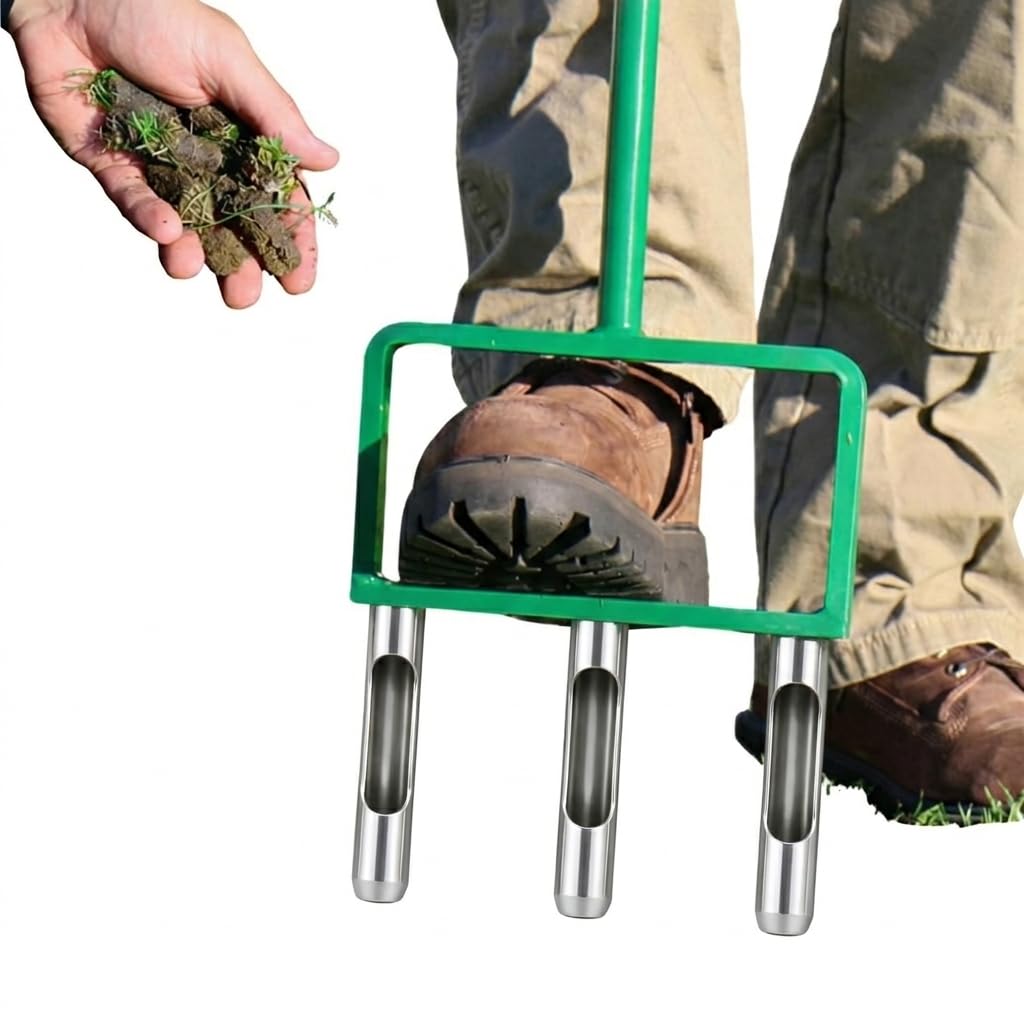
The premium plugger that arrives fully assembled and ready to pull cores.
The Landzie skips the assembly step entirely — the tines are already fitted to the frame, so you open the box and head straight outside. Its three stainless steel hollow tines are beveled (angled at the cutting edge) to help them stay clog-free, pushing old soil up and out with each new plunge rather than jamming inside the tube. At 5.6 pounds and 42.38 inches tall, this tool lets tall users stand upright without stooping, and the weight helps drive the tines home in moist soil.
Buyers report that the tool is very sturdy and works as described, but they also agree that soil must be damp for it to work properly — one reviewer noted that after a rain, the tool goes in smoothly to full depth, but on dry ground it is nearly impossible. Another owner, a 72-year-old, said they could use it for about an hour at a time as long as the dirt was moist, pacing themselves with music. The frame is powder-coated steel (a baked-on rust-resistant finish), and the stainless steel tines resist rust better than cheaper plated alternatives. This is a true plug aerator, unlike the Jardineer spike aerator which only pokes holes and compacts soil around them.
Clog-free design: The beveled tines really do push cores out cleanly — one buyer who checked their smartwatch during use said the tool never clogged and was very sturdy, even as their heart rate climbed. Owners mention that replacement tines are available from the same brand, extending the tool’s lifespan.
Reach for this if: You want a true core aerator that arrives ready to use, you value rust-resistant stainless steel tines, and you are willing to wait for damp soil to get the best results.
Look elsewhere if: Your soil is rock-hard year-round or you have a very large lawn — multiple owners described the manual effort as comparable to a cross-fit workout.
2. Lawn Aerator Tool (Xuperace / GD0001-02)
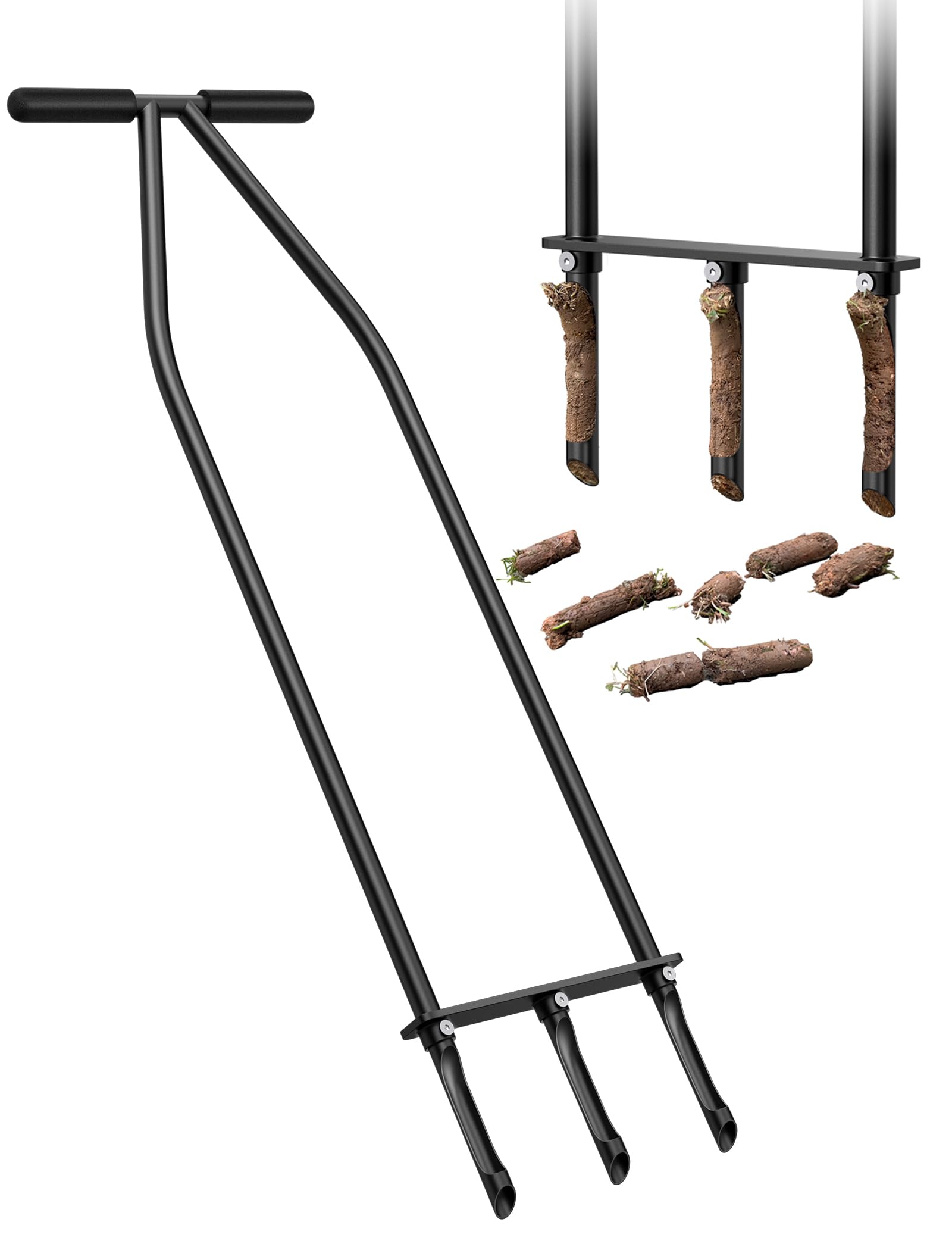
The core aerator that solves the clog problem with a side-eject ramp.
This tool from Xuperace tackles the most common frustration with plug aerators — soil getting stuck inside the tines. Instead of packing up and jamming, the soil plugs slide out the side of each tube through a cutout ramp. The three hollow tines are made from high-strength alloy steel (a mix of metals that resists bending) and are replaceable, connected to the frame with screws. At 5.69 pounds and 42 inches tall, it is the heaviest pick in the lineup, giving you more downward momentum with each stamp than the lighter 3.52-pound LawnVigor core aerator.
Buyers praise the non-clogging design, with one reviewer saying it saved them after two previous aerators drove them nuts. The open center of the footplate means your knee has free range of motion, making it easier to press down without banging your kneecap — a thoughtful touch that multiple owners called out. Like all aerators, this one works best on moist ground — one owner said after a rain it performed well, but trying it on dry ground was a different story. A few buyers mentioned the screws can work loose after the first use, so keeping the included Allen wrench (a small hex-shaped tool) nearby for a quick re-tighten is a good habit.
Why it works
- Side-eject tines keep soil from packing inside the tube
- Knee-friendly open footplate design
- Replaceable tines with screws for easy maintenance
One trade-off
- Screws may loosen after first use; requires re-tightening
- Price is about double that of competitive products, as one buyer mentioned
Best for: Homeowners who have had enough of jammed tines and want a smart, tested solution that actually ejects plugs.
skip it if: Budget is your top concern — a few reviewers commented that the price is significantly higher than other options on the market.
3. Dolibest Lawn Coring Aerator
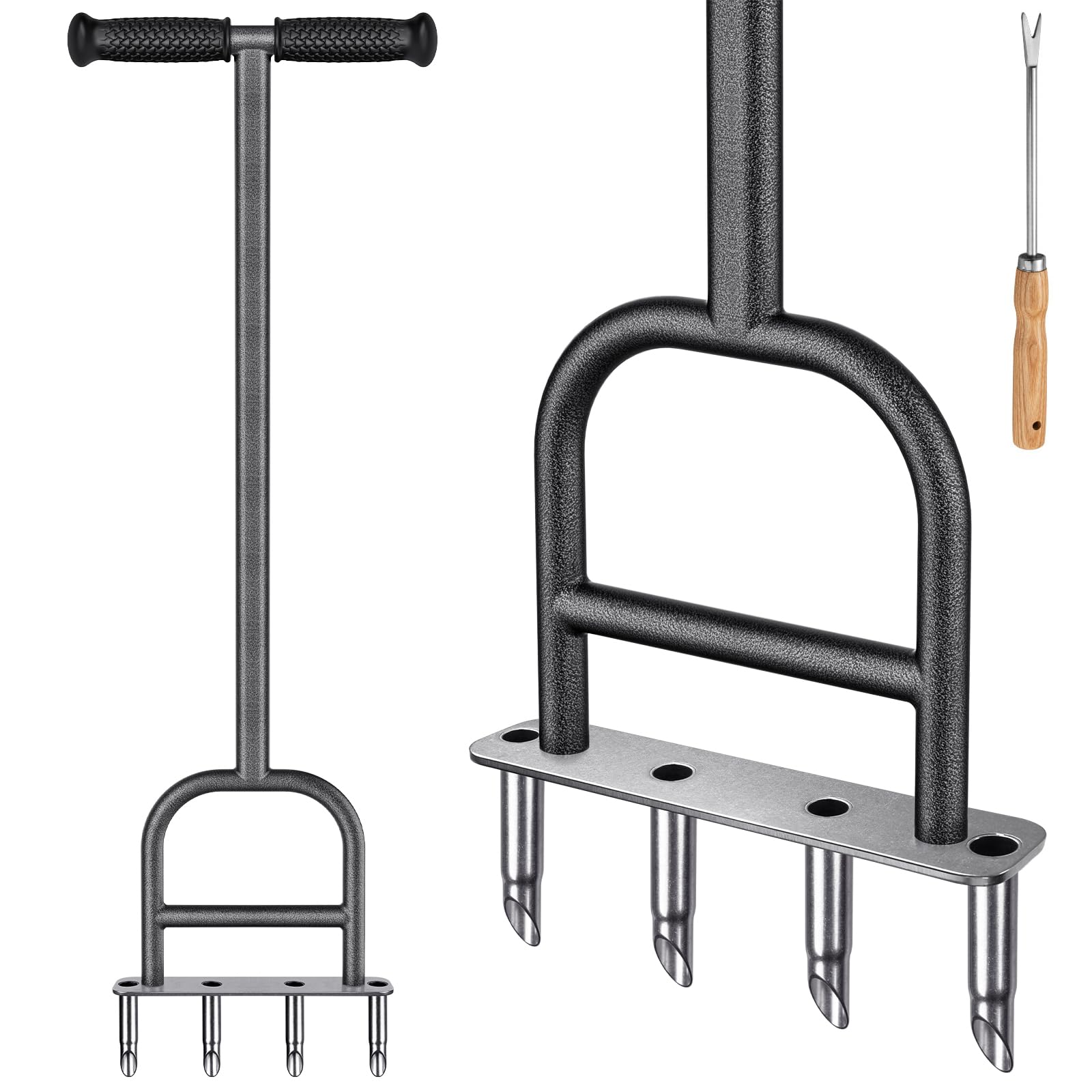
Four stainless steel tines pull wider plugs than most, but require more effort.
The Dolibest stands out for having four hollow tines instead of three — each 3.5 inches long and 0.5 inches in diameter — so you pull four plugs per stamp instead of three, covering ground faster. The bottom section is stainless steel, and the rest is steel with a black powder-coated finish (a baked-on paint that resists rust), so rust is not a concern. It also includes a 12-inch weeder handle tool that doubles as a cleaning rod and a transplanting trowel. A soft rubber grip on the main handle and a dedicated foot bar aim to keep your hands and shoes comfortable during longer sessions.
Buyers describe the tool as “very sturdy” with “single welded construction,” and one owner reported that “plugs feed out top of tubes and plug hole spacing is great.” That said, many owners found it takes some getting used to — one recommended rocking the tool left to right rather than trying to push all four tines in at once. The four-tine design means you need more downward force than a three-tine aerator, which can be a drawback in hard soil. A few reviewers also mentioned that the rounded foot platform could be flatter for better leverage, unlike some competing designs. The package dimensions are 33 x 11.5 x 2.5 inches, making it 2.1 times longer in its box than the LawnVigor core aerator, and at 5.54 pounds it is 57% heavier, giving it built-in momentum if your soil is soft enough.
Efficiency trade-off: Four plugs per step saves time, but that same feature demands more force. One reviewer summed it up: “Be patient. It works.” The tool is best on small to medium projects where you want solid core removal without spending a premium.
Ideal for: Gardeners with moist, loamy soil who want to extract four plugs at once and like having an included cleaning/weeding tool.
Not ideal for: Heavy clay or very compacted soil — the four-tine design makes it harder to push through, and some users found the rounded footplate reduced their leverage.
4. EEIEER Manual Lawn Aerator Tool

The aerator that catches soil cores so you do not have to rake them up.
The EEIEER adds a soil storage basket above the tines — a tray that catches the cores squeezed out during aeration so they are not scattered across your lawn. This is a smart convenience feature if you prefer a tidy finish without extra cleanup. The tool uses three hollow tines and has a patented one-piece bottom structure that the maker claims is more durable than welded designs. The inner wall of the aerator is thickened from 1.2mm to 2mm (a measure of metal thickness), a meaningful upgrade for longevity. A cleaning stick comes included to clear any clogs quickly.
Buyers appreciate the thoughtful design, with one calling the soil storage basket their favorite feature because it keeps things neat and prevents clumps from scattering. However, that same basket fills up quickly — one customer observed it requires a good dumping strategy close by, which slows progress. Another owner found that the foam handles feel like they might not last in the long run. The 38-inch handle height helps with back strain, landing between the shorter 36-inch Jardineer and the taller 42-inch Xuperace. Like most manual aerators, users recommend pre-soaking dry soil for the best results.
Clever additions
- Soil storage basket keeps lawn clean of scattered cores
- Thickened inner walls (2mm) for extra durability
- Included cleaning stick doubles as a weeding tool
Small drawbacks
- Basket fills up fast, requiring frequent dumping
- Foam handles may not be the most durable over time
Best for: Gardeners who care about lawn appearance and want to avoid the mess of scattered soil plugs after aeration.
Not for: Large lawns — the small basket will need constant emptying, which can break your rhythm.
5. Manual Core Aerator Lawn Tool (LawnVigor)
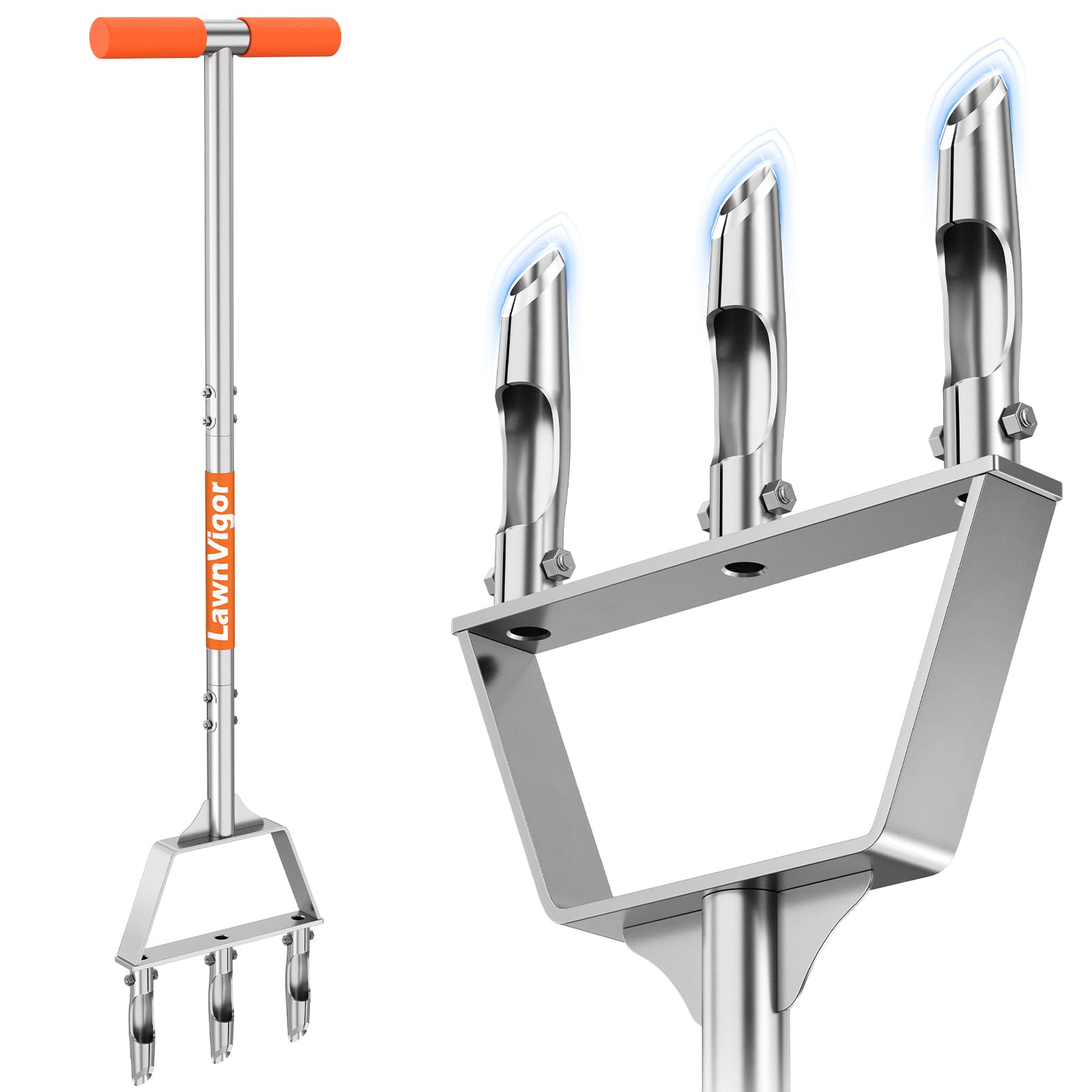
A lightweight plug aerator that punches above its weight for the price.
At just 3.52 pounds, the LawnVigor core aerator is the lightest hollow-tine option here — easy to carry and maneuver, but you will need to put more of your body weight into each stamp to sink the tines. It arrives semi-assembled with two handle pieces that connect in under five minutes, according to reviews. The three hollow tines are heat-treated (hardened through a heating process for strength) and are replaceable for long-term maintenance. The tool includes a white plastic insert in each tine — the manufacturer advises keeping these in place, as they help the soil plugs release cleanly.
Buyers praise how well this tool pulls plugs. One user highlighted, “The holes that release the dirt after each ‘punch’ is huge,” noting that unlike other aerators they had tried, they did not have to shake the dirt out manually. Another owner called it a “standout for compacted soil” and appreciated the wide T-handle with foam grips for leverage. A few caveats emerged: the handle covers can spin during use (one reviewer recommended adhesive to secure them), and the 3.52-pound weight means it is less effective on hard, dry ground — consistent with the manufacturer’s advice to water beforehand. The package dimensions are 15.67 x 10.91 x 2.91 inches, noticeably smaller than the Dolibest’s box, reflecting the shorter overall tool length.
Price-to-value read: This is the most affordable core aerator on the list, and it delivers real plug removal. The main compromise is weight — you supply more of the force — and the handle grip issue that a bit of adhesive solves. For small lawns or spot aeration, it is a solid entry point into core aerators.
Best for: Budget-conscious homeowners who want true plug aeration without spending premium money, and who have soft or recently watered soil.
pass on it if: You have heavy clay soil or a stubborn back — you may prefer a heavier tool that does more of the work for you.
6. Jardineer Lawn Aerator Tool
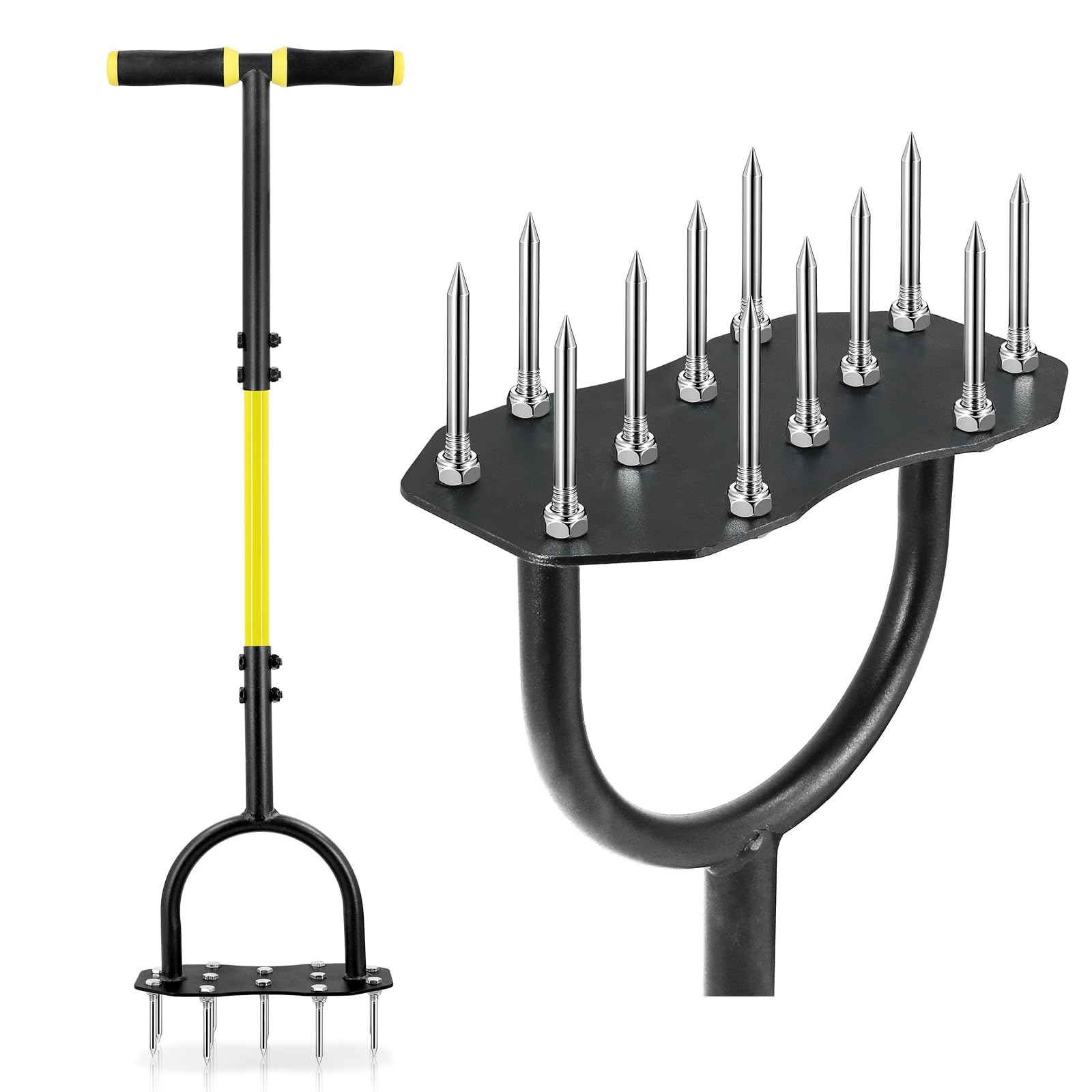
Twelve spikes at once for fast spike aeration on large patches.
The Jardineer is a spike aerator — it uses 12 solid, heat-treated steel spikes (hardened through a heating process) measuring 2.75 inches in length to poke holes into the soil rather than pull out plugs like the Xuperace does. This makes it faster to use across a wide area because you cover more ground with each stamp. The tool is pre-assembled, so you can start immediately, and it comes with a wrench and manual for quick installation of a detachable handle for storage. A rubber grip at the top and a powder-coated steel foot plate help reduce hand fatigue and bear your full weight.
The 36-inch handle height is aimed at reducing back strain, though at 5.02 pounds it is on the heavier side for a spike tool, offering good downward momentum. As a spike aerator, the primary trade-off is that it compacts soil around each hole rather than removing material, which can be counterproductive on clay-heavy lawns. The product dimensions are 15 x 11 x 5 inches, making it 37% shorter in one dimension compared to the taller Colwelt spike aerator. Buyers in reviews generally find it easy to use for quick seasonal aeration on small lawns and garden beds.
Speed over depth: 12 spikes versus the typical 4 is a significant time saver, but the 2.75-inch spike length is shorter than the Colwelt’s 3.5-inch spikes. This is a tool for regular maintenance aeration rather than breaking up deep compaction.
Ideal for: Homeowners with large lawns who want to aerate frequently for maintenance and value speed over maximum depth.
Not ideal for: Heavy clay soil or serious compaction — spike aeration does not remove soil and can make compaction worse in dense ground.
7. Colwelt Lawn Aerator Tool 38inch

The spike aerator with unusually long and thick spikes for deep soil penetration.
While most spike aerators use 2.3-inch spikes that are 1/5 of an inch in diameter, the Colwelt spikes are 3.5 inches long and 2/5 of an inch thick — roughly double the length and diameter. This creates bigger holes per plunge, letting water and air reach deeper into the root zone (the top 4 to 6 inches where grass roots live). The 38-inch total height helps you stay upright and avoids the back strain of stooping, and the cushioned T-handle adds grip comfort. The foot plate is 6 inches wide and 5.5 inches high, with an anti-slip surface (a textured finish that prevents your foot from sliding) designed to accommodate larger footwear.
The four solid spikes mean less ground coverage per stamp than the Jardineer’s 12 spikes, but each hole is substantially larger. The steel construction gives the tool a solid feel at 4.31 pounds, though it is lighter than the 5.02-pound Jardineer. As a spike aerator, it shares the same fundamental limitation: it compacts soil sideways rather than removing it. Customers note that, like all manual aerators, pre-soaking the lawn makes a significant difference — the manufacturer recommends watering thoroughly before use.
Deep punch, narrow coverage: The 3.5-inch spike length is exceptional for a spike tool, reaching deeper than many budget core aerators. The trade-off is that you move slower because you are using just four spikes versus twelve. This tool is best for spot-treating compacted areas rather than covering a whole yard.
Best for: Gardeners who need deep spike holes in compacted soil and want a taller handle to avoid bending, working on small patches rather than full lawns.
Look elsewhere if: You want a core aerator that removes plugs instead of pushing spikes into the ground — the compacting effect of spike aeration is still present here despite the extra length.
Understanding the Specs
Spike vs. Core Aerator
A spike aerator uses solid metal tines to poke holes into the ground. This is faster and cheaper, but it compacts the soil around each hole, which can make compaction worse in heavy clay over time. A core aerator uses hollow tubes (metal tubes open at the bottom) to cut and remove a plug of soil, creating space for roots to expand and water to drain. For long-term lawn health, core aeration is the preferred method — spike aeration is better for light, regular maintenance on already healthy soil.
Tine Length and Diameter
Longer tines reach deeper into the root zone (the top 4 to 6 inches where grass roots grow). A length of 3.5 inches is considered deep for a manual aerator, while 2.3 inches is standard for budget spike tools. Thicker tines, about 2/5 of an inch in diameter, create larger channels for air and water. Thicker also means more resistance when pushing into the ground, so there is a trade-off between hole size and ease of use.
Weight and Handle Height
Heavier tools (over 5 pounds) provide their own downward momentum, making them easier to sink into compacted soil. Lighter tools (under 4 pounds) are easier to carry and maneuver but require you to lean more of your body weight onto the footplate. Handle height matters for back strain — a tool around 38 to 42 inches tall lets a person of average height stand upright while working, whereas a shorter tool forces you to stoop.
Replaceable vs. Fixed Tines
Some aerators allow you to remove and replace the tines individually using screws. This is a valuable feature because tines dull or bend over time, and replacing them costs far less than buying a whole new tool. Fixed-tine designs are typically welded in place and cannot be serviced — if one tine breaks, the whole tool is done. Replaceable tines also let you remove the middle tine to reduce resistance in extra-hard ground.
FAQ
Should I water my lawn before using a handheld aerator?
How often should I aerate my lawn manually?
Is a spike aerator as good as a core aerator for my lawn?
What does “hollow tine” mean in an aerator?
Can I use a handheld aerator on clay soil?
How deep should the tines go for effective aeration?
What is the difference between a 3-tine and a 4-tine aerator?
Can I aerate after it rains?
Do I need to aerate my entire lawn or just problem areas?
How do I clean and store a manual aerator?
Final Thoughts: The Verdict
If you want one dependable pick, the best handheld aerator winner is the Lawn Aerator Tool (Xuperace) because its side-eject design solves the clogging problem that ruins other core aerators, and the knee-friendly footplate makes repetitive stamping more comfortable. If you want a premium tool that arrives fully assembled with stainless steel tines, grab the Landzie Hollow Tine Aerator. And for a budget-friendly way to start pulling plugs without spending much, the Manual Core Aerator (LawnVigor) delivers real core removal at a low entry price.
How We Picked
We do not accept paid placement. Every pick is matched to a real buyer and a real use-case; we do not hands-on test units.
Sources & Methodology
Specifications: manufacturer listings and product documentation. Review insights: verified customer reviews, as of July 2026. Pricing: not shown on this page (it changes often); check the current price via the retailer link.
As an Amazon Associate, Lawn Gear Lab earns from qualifying purchases. This does not affect which products we feature.