
Specs are compiled from manufacturer listings and verified buyer reviews and can change over time — please confirm the key details on the product page before buying.
A compacted lawn is a lawn that’s slowly suffocating. Your grass needs air, water, and food to reach its roots, but when the soil turns into a hard, baked crust, nothing gets through. Aerating by hand is the fix, but choosing the wrong tool means you either do back-breaking work that barely scratches the surface, or you get a cheap tool that bends on the second push. This guide cuts through the noise to find the hand aerator that makes the job easier, not harder.
I’m Rikta — the founder and writer behind Lawn Gear Lab. This guide is built by comparing the manufacturers’ published specifications and the patterns across verified customer reviews, so you get each pick’s real strengths and trade-offs instead of marketing spin.
If you have a small yard or tight corners, you can get a greener lawn without the back pain by choosing a hand lawn aerator tool that matches spike length, build quality, and your own willingness to sweat — and we have sorted through the options for you.
Our Picks at a Glance

How To Choose The Best Hand Lawn Aerator Tool
Picking the right hand aerator is not about flashy features. It is about matching the tool’s design to your soil type, the size of your yard, and how much manual labor you are actually willing to do. There are two main types: spike aerators and core (plug) aerators. Spikes just poke holes, which can sometimes compact the soil around the hole further. Core aerators remove a literal plug of dirt, which is the superior method for relieving true compaction. Your choice will depend on the job at hand.
Spike Aerators vs. Core Aerators
Spike aerators are simpler and cheaper. You push solid tines into the ground. The advantage is speed: you can cover ground fast on a small lawn, and there is no soil plug to clean up. The drawback is that in heavy clay, the act of pushing a spike in can actually press the soil tighter around the hole, partially defeating the purpose. Core aerators use hollow tubes to cut and extract a plug. This removes a volume of soil, giving roots a real pocket of space. It creates more mess (you leave little dirt piles), but it is the more effective treatment for genuinely compacted ground.
Spike Length and Thickness
Not all spikes are created equal. Many budget tools use tines that are about 2.3 inches long and very thin. For shallow soil, that is fine. But for hard-packed lawns, you want longer and thicker spikes. A spike that is 3.5 inches long and 0.4 inches in diameter will create a bigger hole and penetrate deeper, allowing water to reach the root zone rather than just moistening the top half-inch. Deeper holes also mean better air exchange for the root system.
Handle Height and Your Back
If you are spending half an hour stomping on a tool, you want to stand upright, not hunch. A handle that is too short forces you to bend, which strains your lower back. Look for a handle that is at least 36 inches tall, though 38 to 42 inches is even better for taller folks. A height-adjustable handle, if it fits your data, can be a lifesaver for households with multiple users of different heights.
Construction and Weight
Weight is a trade-off. A tool that is too light might bend under pressure, especially if you hit a rock or a thick root. A tool that is too heavy will exhaust you. the balance for a manual aerator is generally under 6 pounds. Look for solid steel construction (preferably powder-coated to resist rust). The welds and bolts are where cheap tools fail: the foot rest snaps off, or the tines bend after one season. Check the reviews for mentions of broken welds or bent spikes.
Quick Comparison
| Model | Best For | Type | Spike/Tine Details | Weight | Amazon |
|---|---|---|---|---|---|
| Manual Core Aerator (LawnVigor)★ Best Overall | Best Overall Core Aeration | Hollow Tine (3) | ~3 in. plugs | 3.52 lbs | Amazon |
| Jardineer Spike AeratorBest Spike Value | Best Spike for Small Yards | Solid Spike (12) | 2.75 in. length | 5.02 lbs | Amazon |
| Colwelt Spike AeratorPenetrator | Thickest Spikes for Tough Soil | Solid Spike (4) | 3.5 in. x 2/5 in. | 4.31 lbs | Amazon |
| Dolibest (4-Plug Corer) | Premium Multi-Plug Coring | Hollow Tine (4) | Stainless steel | 6.2 lbs (2.81 kg) | Amazon |
| Dolibest (4-Plug, No Tray) | Stainless Corer for Clay | Hollow Tine (4) | 3.5 in. x 0.5 in. | 5.54 lbs | Amazon |
| EEIEER Core Aerator | Built-in Soil Basket | Hollow Tine (3) | 4.3 in. pedal | — | Amazon |
| vanpein Core Aerator | Iron Tray Collector | Hollow Tine (3) | 2mm thick iron | 6.25 lbs | Amazon |
| BARAYSTUS Spike Aerator | Budget Spike Pick | Solid Spike (4) | Height adjustable | 3 lbs | Amazon |
| Landzie | Pro Grade, No Clog | Hollow Tine (3) | Stainless steel, 42 in. | 5.6 lbs | Amazon |
In‑Depth Reviews
1. Manual Core Aerator Lawn Tool – LawnVigor
Our pick — 4.5★ from 250+ verified ratings; the strongest balance of quality and price.
The core aerator that finally makes plugging a small lawn feel doable.
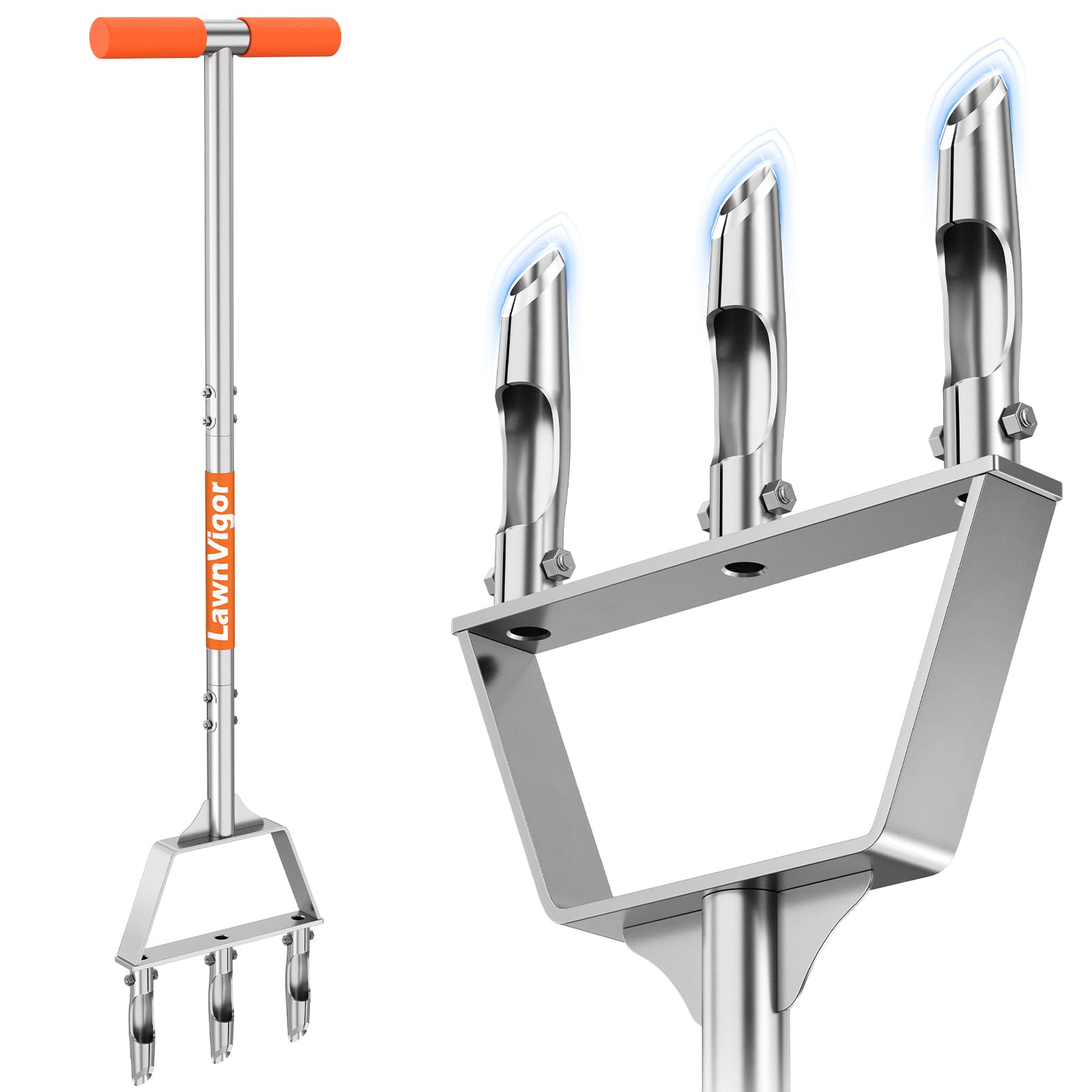
This is the tool that does the real work of aeration — pulling plugs, not just poking holes. The three heat-treated hollow tines dig in and extract soil cores roughly three inches long, which is exactly what your lawn’s roots need to breathe. The semi-assembled package means you can put it together in minutes with the included tools, and the powder-coated steel frame feels sturdy under pressure. The wide T-handle with foam grips gives you a comfortable hold even when the ground is tough.
Launching the plug after each plunge is where this tool shines. The large dirt-release holes let the soil pop out cleanly without you having to shake or bang the tool, a huge time saver over older designs. As buyers report, the core extraction is reliable in moist soil. The thing to plan for is the effort: manual aeration is a workout, and covering a large area in one session is tough. The foot bar provides leverage, but it still requires you to put your weight into it. This is perfect for small to medium yards and spot treatments in compacted areas.
The crowd has given this pick a solid 4.5-star average, and the consistent praise is for how well the tines actually pull and release plugs. It outperforms cheaper versions that clog after a few uses. The occasional minor note is that the handle covers can spin, but that is a small price for a tool that handles compacted Bermuda grass and heavy clay without complaint.
Why It Wins
- Heat-treated hollow tines extract real soil cores (~3 inches) rather than just poking holes.
- Large dirt-release openings prevent clogging and speed up the work.
- Foam-covered T-handle and sturdy foot bar provide good leverage and comfort.
The Honest Trade-Off
- Manual aeration is still a workout — not the tool for a full acre.
- Handle grip can spin on the bar; a dab of adhesive solves it.
Reach for this if: you want actual core removal for a small to medium lawn and dislike having to clean clogs.
Think twice if: you have a very large lawn and are not willing to spend multiple sessions on manual labor.
2. Jardineer Updated 36″ Spike Aerator
A dozen spikes that save time when you just need to punch through.
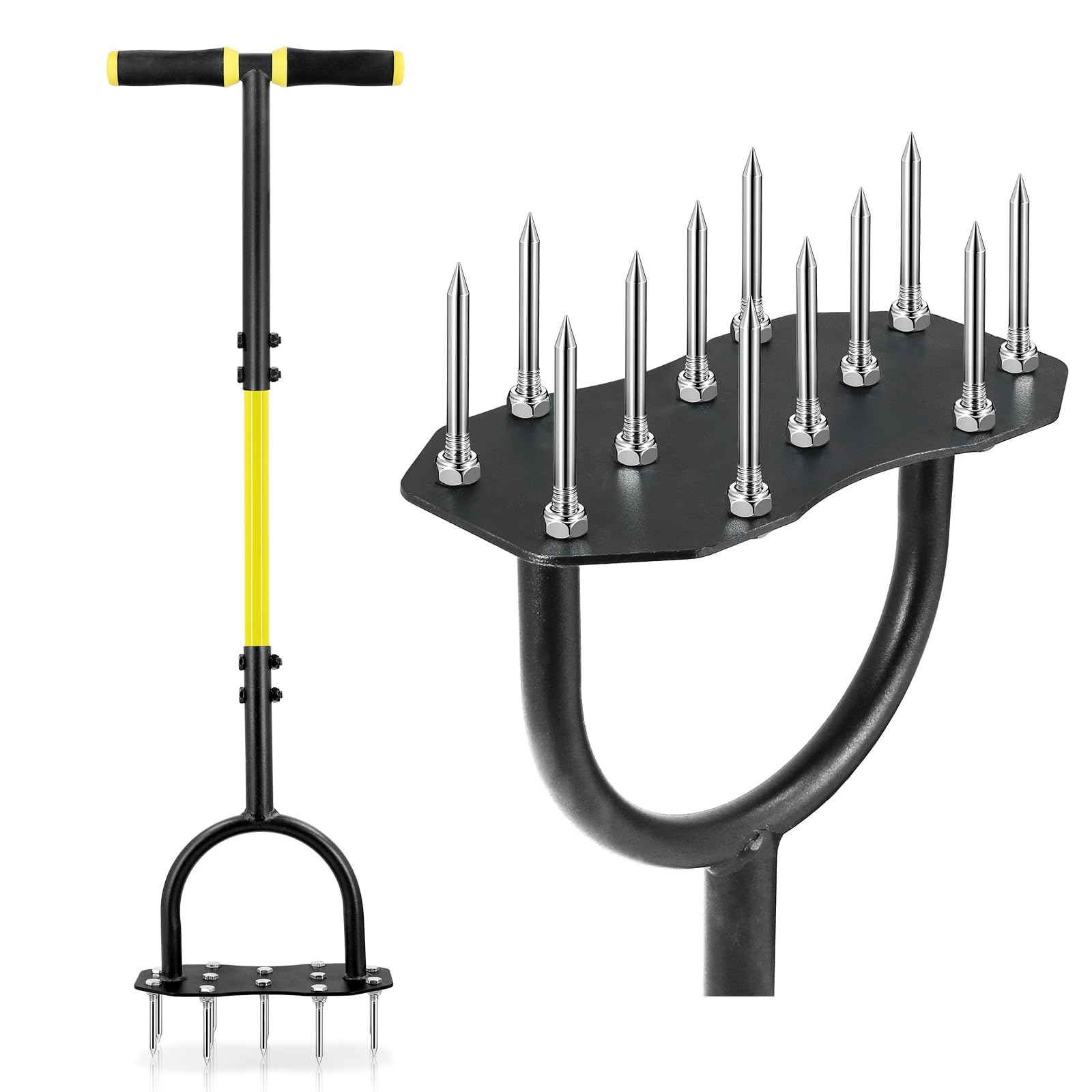
Where the top pick removes plugs, this one punches holes — and it does so twelve at a time. The herd of heat-treated steel nails is what makes the Jardineer a speed demon for spot treatments. The 36-inch height is decent for most users, and the comfortable rubber grip reduces hand fatigue during longer sessions. It arrives mostly assembled, which means you are making holes five minutes after opening the box. The foot plate is thick steel that will take your full weight without complaint.
The real-world experience is a mixed bag on durability. The spikes are plenty durable for normal soil, but as owners mention, they will bend if they hit a rock or a piece of buried plumbing. The included replacements are a safety net. The tool is also good for leveling and seeding small lawns after aeration. Some paint chipping is reported, but that is cosmetic. At 5.02 pounds, versus the LawnVigor’s 3.52 pounds, but the 12-spike pattern means you cover ground faster.
Why It Moves Fast
- 12 spikes punch a lot of holes per step, making it quick for small lawns.
- Pre-assembled with a strong foot plate for easy penetration.
- Rubber grip and 36-inch height help reduce back strain.
The Spike Risk
- Spikes can bend on rocks or hard debris; replacements are included but may run out.
- Paint chipping on the frame after use.
Choose it for: speed on a small yard with loamy or sandy soil where you want 12 holes per press.
Pass on it if: your yard is full of hidden rocks or roots — the spike bending reports are real.
3. Colwelt 38″ Heavy Duty Spike Aerator
The thickest spikes in the lineup, engineered for the hardest ground.
This is the spike aerator that laughs at dry, compacted clay. While other tools come with thin, 2.3-inch tines, the Colwelt boasts four spikes that are 3.5 inches long and a stout 2/5 of an inch in diameter. That extra thickness and length means each hole is bigger, letting water and air reach deeper. The 38-inch total height is another back-saver, especially for taller individuals. The foot plate is wide, measuring 6 inches across and 5.5 inches high, which accommodates large work boots and gives you a stable platform to apply your full weight.
The steel construction is heavy-duty at 4.31 pounds, but the trade-off is that it gives a solid feel without being exhausting. Customers note that a 1,000 square foot lawn takes about 90 minutes, which is reasonable for manual aeration. The cushioned T-handle provides extra comfort. The honest caveat is that this is a spike aerator, not a core aerator, so it does not remove soil plugs. It is best for moderately compacted soil where the goal is to create channels for water and air.
Why Size Matters
- Unusually thick and long spikes (3.5 in. long, 2/5 in. dia.) handle heavy compaction.
- 38-inch height and wide, non-slip foot plate reduce back strain and suit large shoes.
- Solid steel build is sturdy and resists rust.
Its Limit
- A spike aerator — does not remove soil cores, just pokes holes.
- Requires damp soil to penetrate easily; dry ground is a struggle.
Buy it for: heavily compacted soil where you need deep, wide holes to break the crust.
skip it if: you want the soil plug removal that only a hollow tine tool provides.
4. Dolibest 4-Plug Corer with Storage Tray
Four stainless steel tines and a tray that catches every plug.
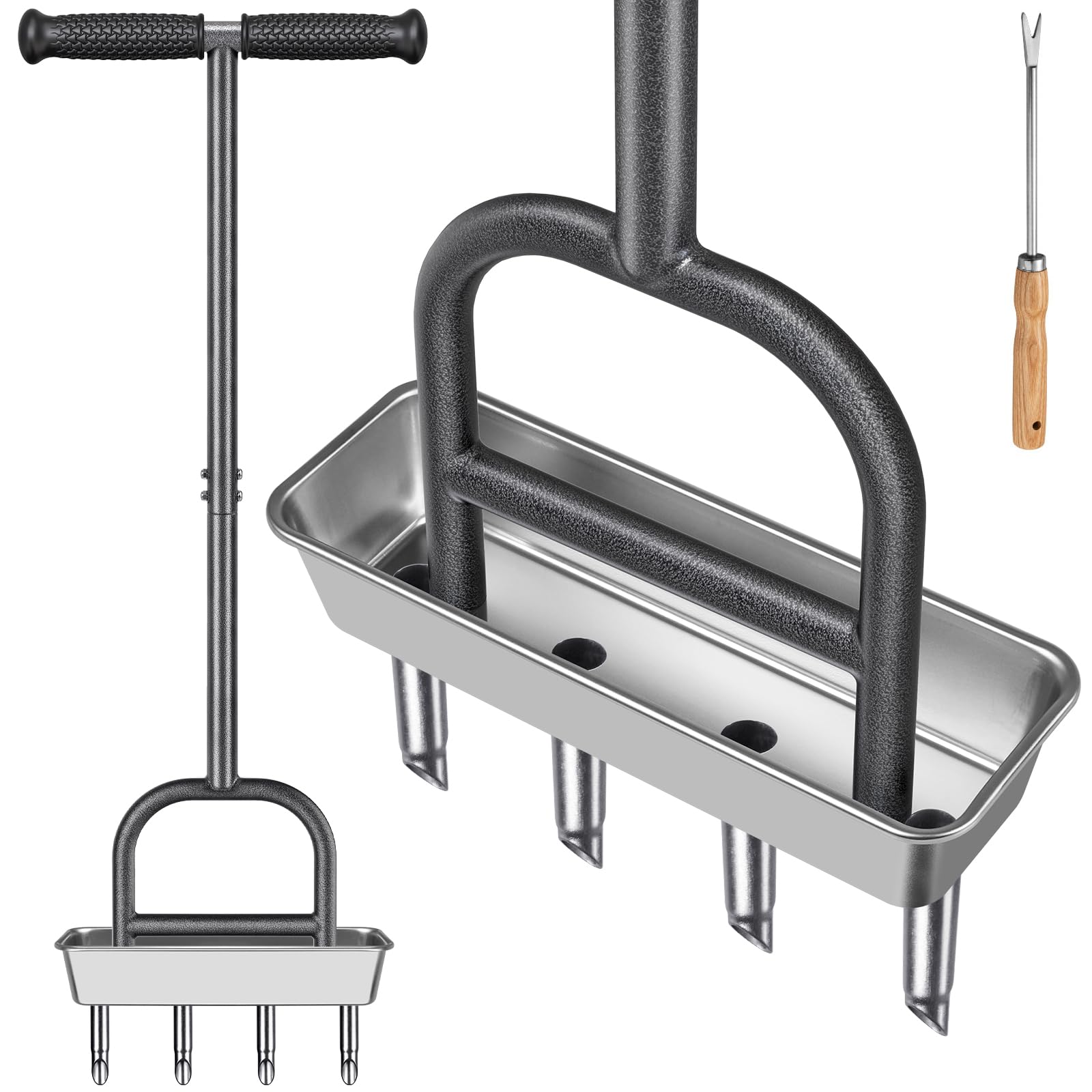
This premium pick solves one of the biggest annoyances of manual coring: the mess. The four SUS 304 stainless steel corer plugs are rust-proof and durable, and they feed extracted soil cores directly into a storage tray. No more bending over to pick up scattered plugs. The tool arrives in three parts and assembles in about two minutes. The soft rubber grip prevents blisters even during longer sessions, and the improve crossbar ensures your shoe does not interfere with the plug ejection.
The stainless steel construction is the star here. It will not rust or bend out of shape. The 12-inch weeding tool doubles as a cleaner for the tines. The honest review feedback is that the core collection feature works well, but soil can still get stuck in the spikes occasionally. It is also slow for large yards; this is a spot-treatment tool, not a whole-lawn solution. It is best for small area repairs or compacted patches. Reviewers point out it is a sturdy, well-made tool that does what it says.
Why It Cleans Up
- SUS 304 stainless tines and tray are rust-proof and very durable.
- Storage tray collects cores automatically; no raking or bending required.
- Soft rubber grip and easy, two-minute assembly.
The Downside
- Soil can still get stuck in the tines, requiring the included cleaning tool.
- Slow for large lawns; best for targeted patch aeration.
Get this if: you hate cleaning up scattered soil plugs and want a durable, rust-proof tool.
Look elsewhere if: you need to aerate a large area in a single session — this is for the detail work.
5. Dolibest 4-Corer Plug Aerator (No Tray)
A single-welded corer that takes on heavy clay without breaking a sweat.
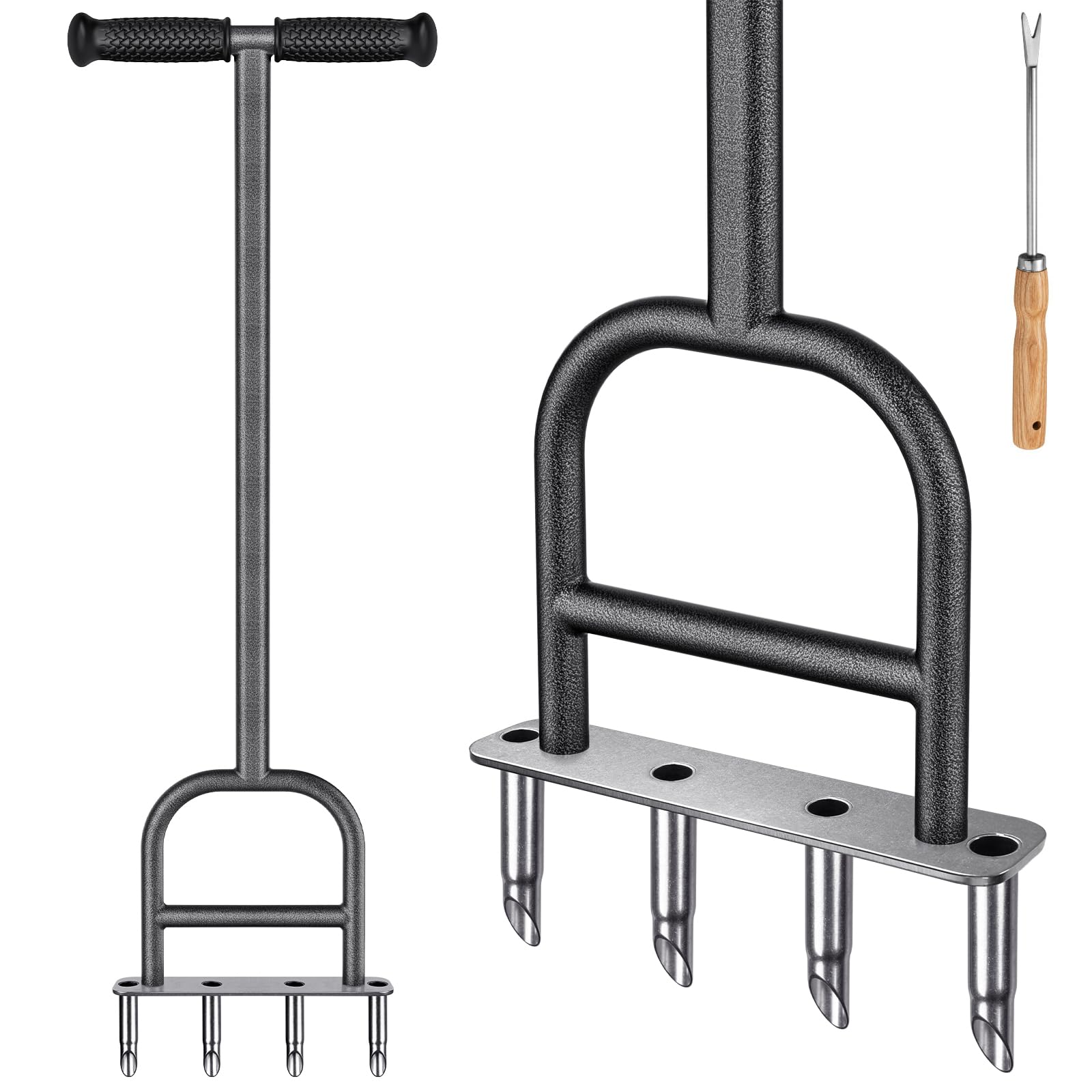
This is the stripped-down, no-nonsense version of the previous Dolibest pick. It drops the storage tray but keeps the heavy-duty SUS 304 stainless steel tines and the durable build. The four corer plugs are each 3.5 inches long and 0.5 inches in diameter, creating deep, narrow holes that are ideal for getting water and air to the root zone. The single-welded construction is a durability highlight — fewer joints mean fewer failure points. The soft rubber grip lives up to its promise, preventing blisters during extended use.
The honest feedback from owners is that it works even in tough clay, which is a high compliment for a manual tool. The catch is that it really demands moist soil. In dry clay, the tines will struggle to penetrate, and the cores may not eject cleanly. The foot bar is rounded, which reduces leverage compared to a flat plate. The included 12-inch weeder tool is handy for cleaning the tines. This is a great value pick for the gardener who wants core aeration without paying for extras.
Why It Is Tough
- Single-welded stainless steel construction is rugged and resists rust.
- Deep, 3.5-inch tines create real pockets for root growth.
- Soft rubber grip prevents hand fatigue.
The Moisture Catch
- Performs best in moist soil; dry clay will clog the tines.
- Rounded foot step provides less leverage than a flat plate.
Use this for: small to medium projects in heavy clay, especially when the soil is damp.
Think twice if: your soil is perpetually dry and rocky — you will struggle to get penetration.
6. EEIEER Manual Aerator with Soil Storage Basket

A clever storage basket keeps the mess off your lawn and in one place.
This is the tool that thinks about cleanup. The EEIEER aerator features a soil storage box attached to the tine assembly. As you push down and extract a core, the plug pops up into the container instead of falling on the grass. This is a huge time saver if you hate the scattered dirt look. The three sharp tines are made from high-density alloy, and the inner wall thickness has been upgraded from 1.2mm to 2mm for extra strength. The patented one-piece bottom structure is claimed to be more durable than welded designs.
At 38 inches, the handle is tall enough to prevent back strain. The 4.3-inch heightened pedal gives you a good spot for your boot. The included cleaning stick clears clogs. The mixed feedback from owners centers on the soil tray filling up quickly, meaning you have to stop and empty it often. Some users also report that the tray fills with dirt too fast. The tool is best for non-compacted, soft soil and smaller lawns up to about 3,000 square feet. In dry clay, the tines may clog.
The Neat Advantage
- Soil storage basket contains the plugs; no raking required.
- Thickened 2mm alloy walls for break-resistant durability.
- Included cleaning tool and 38-inch ergonomic handle.
The Reality Check
- Storage tray fills quickly, requiring frequent stops to empty.
- Tines can clog in dry or sandy soil; works best when damp.
Reach for it if: you want to avoid the mess of scattered soil plugs.
pass on it if: you have a large lawn and do not want to interrupt your rhythm to empty a small basket.
7. vanpein Lawn Aerator with Iron Soil Tray

A built-in iron tray catches the plug so you do not have to.
Another tool in the “keep the mess contained” category, the vanpein aerator uses a sturdy iron tray to collect soil cores. The idea is the same as the EEIEER: push down, extract the plug, and it lands in the tray. The build is solid, with 2mm thick iron construction. The 38-inch handle keeps you upright. The sharp tines are designed for minimal resistance. A cleaning tool is included to clear any clogs.
The honest truth from the owner experience is that this tool works well on heavy clay after a rain, but it has a significant clogging issue. In soil with a high proportion of clay, the cores can stick in the tubes every three to four uses, which defeats the purpose of aeration. The tray is a good idea, but it can be fiddly. The tool is best reserved for small areas where you are spot-treating. Some users report that the cores do not always eject neatly into the tray, requiring manual intervention.
Tray Perk
- Iron tray collects soil plugs automatically, reducing cleanup.
- Thickened 2mm iron construction is heavy-duty and durable.
- Flat foot base provides good leverage for penetration.
The Clog Reality
- Frequent clogging in clay soil — you will use the cleaning tool often.
- Tray can be finicky; plugs do not always eject cleanly.
Best for: small spot aeration where you want to contain the soil mess.
Not for: lawns with heavy clay soil — the clogging will frustrate you.
8. BARAYSTUS Height Adjustable Spike Aerator

The cheapest way to aerate, provided you keep your expectations small.
If you want to try aeration without spending much, the BARAYSTUS is the entry-level option. Its height-adjustable handle (37 or 40.5 inches) is a rare feature that suits households with multiple users. The four steel tines are solid spikes, and the foot bar gives you extra leverage for pushing them into the ground. At 3 pounds, it will not exhaust you — but shoppers say the lighter weight can cause it to bounce off hard soil, unlike the Landzie at 5.6 pounds.
The owner experience is a straightforward story: it works, but it is a workout. One reviewer noted covering 700 square feet in 40 minutes and called it “easy to use” but a “workout.” The tool is great for small areas under 1,000 square feet. The big warning is durability: the durability aspect is marked as mixed, with some owners reporting the head breaking off within six months. For the price, it is a good experiment, but do not expect it to last a decade. It is best for a few small trees or a tiny patch.
The Low-Barrier Start
- Height-adjustable handle (37/40.5 inches) fits different user heights.
- Very light at 3 pounds, easy to maneuver.
- Inexpensive entry into lawn aeration.
Where It Wears Out
- Mixed durability reports — some heads break off within months.
- Best reserved for very small lawns under 1,000 sq ft.
Try this if: you have a tiny lawn or a few compacted spots and want the lowest possible investment.
it’s not for you if: you intend to aerate more than a few hundred square feet over multiple seasons.
9. Landzie – Original Hollow Tine Aerator
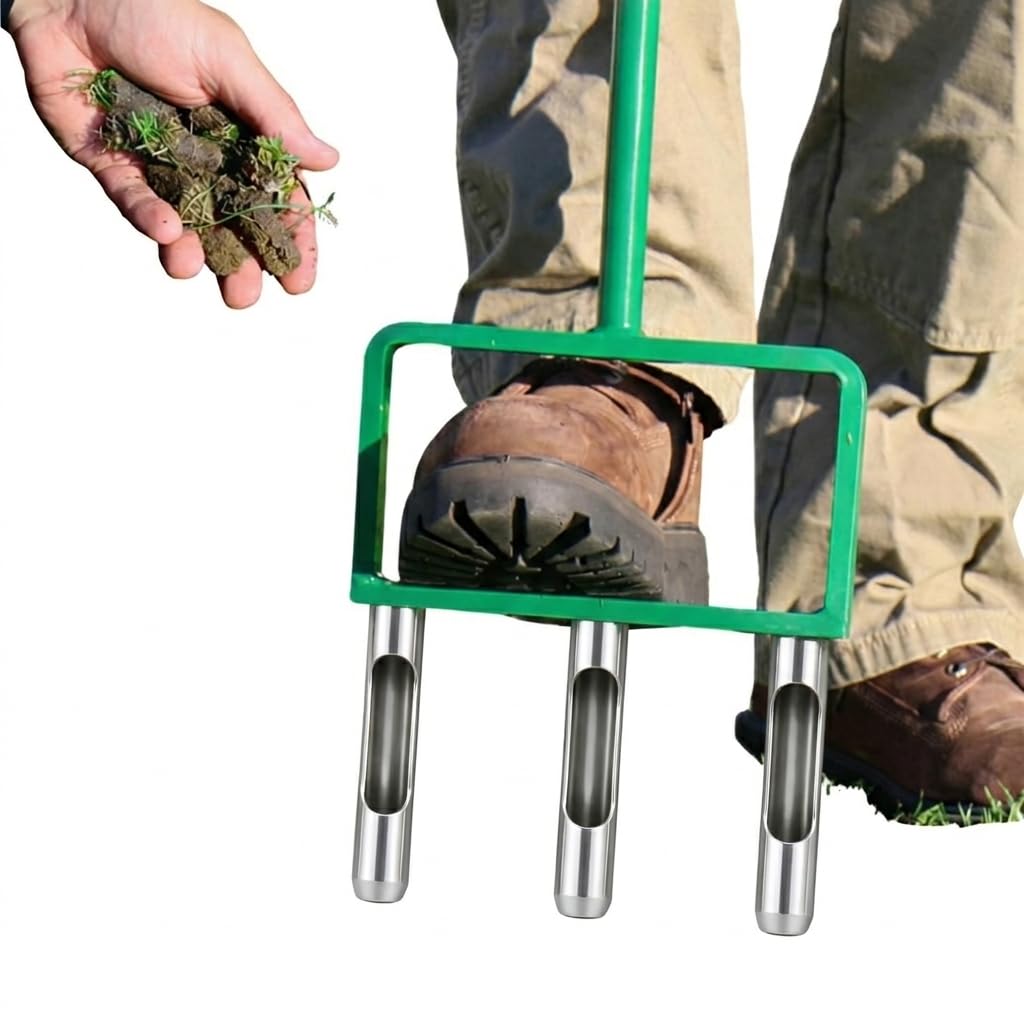
The no-assembly, stainless steel professional that treats aeration like cross-fit.
The Landzie is the aspirational tool that comes ready to use straight from the start — no hex wrenches, no screwdrivers. It features three stainless steel, beveled tines that the company claims are clog-free. The 42-inch handle is very tall for a hand aerator, which saves your back if you are tall. The tines are replaceable, and the frame is heavy-duty powder-coated steel. It carries a premium price tag and a name that professional landscapers know. look elsewhere if you only need a tool for a single season; the BARAYSTUS works well for occasional use.
The owner feedback is a mix of awe and exhaustion. It is described as “effective but physically demanding.” Buyers report that it produces 4-inch plugs and is self-cleaning when the soil is damp enough. A 2,200 square foot lawn took a dedicated owner 4 hours. The self-cleaning design is praised by many, but some report issues with plugs not ejecting properly in certain conditions. The foot bar can be slippery when wet. This is a buy-it-for-life tool if you are willing to put in the physical work, and its 4.3-star average across hundreds of reviews reflects that it meets high expectations for quality.
The Professional Edge
- No assembly required; ready to use from the start.
- Beveled stainless steel tines resist clogging and are replaceable.
- 42-inch handle is the tallest, best for back health.
The Cost of Quality
- Premium price is significantly higher than most manual aerators.
- Brutal physical work on anything larger than a postage stamp.
- Foot bar can be slippery when wet.
Buy it for: the satisfaction of a buy-it-for-life tool, if you are a dedicated lawn enthusiast ready for a workout.
Think twice if: you want to aerate a large area in a single session — the manual labor is intense.
Understanding the Specs
Hollow Tine vs. Solid Spike
A hollow tine is a metal tube that cuts a core of soil from the ground. You push it in, and a plug of dirt comes up inside the tube. This is true core aeration — it removes a small volume of soil, creating a physical void for roots to expand. A solid spike, on the other hand, just pushes the soil aside. For very compacted clay, a spike can actually compact the soil further around the hole. For general lawn maintenance on loamy soil, spikes are fine. For reviving a dead lawn, the hollow tine is the one you want.
Spike Length and Gauge
Spike length is measured in inches and tells you how deep the holes will be. Standard spikes are around 2.3 to 2.75 inches. Heavy-duty spikes can go up to 3.5 inches. The gauge (diameter) of the spike is equally important: a thicker spike (like 2/5 of an inch) creates a wider hole, allowing more water and air to flow. A thin spike makes a tiny hole that can seal up quickly. In the data, you will see the specification written as “3.5 in. length, 2/5 in. dia.” — the second number is the thickness.
Handle Height and Ergonomics
The total handle height determines how much you have to bend. A 36-inch handle suits a person of average height. A 38- to 42-inch handle is better for taller users and reduces lower back strain. The handle grip material also matters: a cushioned T-handle or a soft rubber grip prevents blisters during longer sessions. A non-slip foot bar or foot plate is also critical, as it allows you to transfer your full body weight into the tines without your boot slipping.
Soil Moisture is the Key
Every single tool in this guide works best when the soil is moist. Dry, hard soil is incredibly difficult to penetrate with a manual tool, regardless of how sharp the tines are. The consensus advice is to water your lawn 24 to 48 hours before you plan to aerate, or to do it the day after a good rain. For clay soil, a soil loosener applied after irrigation can significantly enhance core extraction. Ignoring this step is the number one reason manual aeration feels impossible.
FAQ
What is the difference between a spike aerator and a core aerator?
How often should I aerate my lawn with a hand tool?
Can I use a hand aerator on a large lawn?
How do I prevent the tines from clogging?
Do I need to water my lawn before using a hand aerator?
How long does a manual lawn aerator last?
What is the ideal spike length for a hand aerator?
Is a hand aerator better than a gas-powered one?
Will aeration fix brown patches in my lawn?
Do I need to remove the soil plugs after aerating?
Final Thoughts: The Verdict
For most people, the hand lawn aerator tool winner is the Manual Core Aerator by LawnVigor because it combines the effectiveness of true core aeration with a clog-free design at a fair price. If you want a spike aerator for speed on a small yard, grab the Jardineer and its 12-spike pattern. And for the ultra-hard ground that laughs at other tools, the Colwelt with its thick, 3.5-inch spikes is the one to reach for.
How We Picked
We do not accept paid placement. Every pick is matched to a real buyer and a real use-case; we do not hands-on test units.
Sources & Methodology
Specifications: manufacturer listings and product documentation. Review insights: verified customer reviews, as of July 2026. Pricing: not shown on this page (it changes often); check the current price via the retailer link.
As an Amazon Associate, Lawn Gear Lab earns from qualifying purchases. This does not affect which products we feature.