
Specs are compiled from manufacturer listings and verified buyer reviews and can change over time — please confirm the key details on the product page before buying.
A hand garden cultivator tool is the simplest way to break up soil, pull weeds, and mix in fertilizer without firing up a gas tiller. But picking the wrong one means bent tines, blistered hands, or a tool that just skims the surface instead of digging in. This guide cuts through the noise to find the cultivator that actually works with your soil and your grip.
I’m Rikta — the founder and writer behind Lawn Gear Lab. This guide is built by comparing the manufacturers’ published specifications and the patterns across verified customer reviews, so you get each pick’s real strengths and trade-offs instead of marketing spin.
From the lightweight stainless steel Garden Guru that slides into tight flower beds to the brute-force 3-tine Dewit that chews through clay, here is the definitive breakdown of the best hand garden cultivator tool choices for every type of gardener.
Our Picks at a Glance


How To Choose The Best Hand Garden Cultivator Tool
Not every cultivator fits every job. You need to match the tool to your soil type, the size of your garden, and how much time you plan to spend on your knees. Here are the three things that matter most.
Tine Count and Shape
A 3-tine cultivator concentrates force into fewer points, making it excellent for breaking through hard, compacted clay. A 5-tine or 6-tine claw spreads the work wider, so it covers more ground with each pull and is better for light weeding and fluffing mulch. Curved tines act like hooks to yank roots, while straight tines slice through soil.
Handle Length and Grip Comfort
Short handles (around 11 inches) give you precision in raised beds and tight spaces but require more bending. Longer handles (14 inches and up) reduce back strain by letting you work from a standing or slightly bent position. A padded or ergonomic grip matters if you have arthritis or plan to use the tool for hours.
Steel Quality and Rust Resistance
Heat-treated boron steel resists bending under heavy pressure. Stainless steel resists rust and stays sharp longer in damp soil. Carbon steel is strong but can rust if not dried after use. Alloy steel with a protective coating offers a good middle ground between strength and maintenance.
Quick Comparison
| Model | Best For | Tines | Handle Material | Weight | Amazon |
|---|---|---|---|---|---|
| Dewit Cultivator Hand Tiller★ Best Overall | Best Overall | 3 | Ash Wood (FSC-Certified) | 6.08 oz | Amazon |
| Garden Guru Hand RakePrecision Pick | Precision Beds | Stainless Steel Rake Head | Ergonomic Handle | 0.19 kg | Amazon |
| Nisaku Kumade Claw RakeCrafted Pick | Japanese Craftsmanship | 5 | Hardwood | 7.84 oz | Amazon |
| CobraHead Mini Weeder | Deep Taproots | Single Forged Blade | Recycled Plastic | 5 oz | Amazon |
| 15″ Gardeners Claw Rake | Value & Coverage | 6 | Wood | 0.29 kg | Amazon |
| WORKPRO 2-in-1 Hoe & Cultivator | Two Tools in One | 3 Tines + Hoe Blade | Beech Wood | 1 lb | Amazon |
| Altdorff Hand Tiller | Standing Reach | 4 Arrow-Tipped | Arc Handle with Rubber Grips | 3.5 lbs | Amazon |
| BARAYSTUS Rotary Cultivator | easy Soil Prep | 4 Star Wheels | Adjustable Aluminum Handle | 2.2 lbs | Amazon |
| Garden Weasel Rotary Cultivator | Standing Seedbed Prep | Rotating Star Wheels | Long Handle | 2.4 lbs | Amazon |
In‑Depth Reviews
1. Dewit Cultivator Hand Tiller
Our pick — over 4.5★ from 400+ verified ratings; the strongest balance of quality and price.
The 6-ounce claw that digs like a full-sized tiller, but fits in a raised bed.
The build quality here is what wins people over. The 3 tines are made from heat-treated boron steel, which stays sharp and resists bending even when you hit clay or tough roots. Customers describe it as “very sturdy” and note it will “pull out Bermuda grass” without the tines flexing. The FSC-certified ash wood handle is smooth and comfortable, and at just 6.08 ounces you barely notice it in your hand after an hour of weeding. It is more expensive than most 3-tine cultivators, but owners consistently say it is worth it for how long it lasts.
The 11.5-inch length gives you precise control in tight spaces, though the trade-off is more bending than you would get with a long-handled tool. The flexible handle design increases pulling power, so you can lever out deep roots without straining your wrist. The review crowd is nearly unanimous — quality is mentioned 96 times as the top aspect, and effectiveness follows at 60 mentions. Buyers report it is “my very favorite garden tool” and that it works “easily in clay and sand.”
Owners also praise its performance as a mini-hoe for mixing fertilizer into containers and raised beds. The 3-tine design concentrates force better than wider rakes, making it ideal for breaking new ground. The trade-off is that it covers less area per pass than a 6-tine claw, so you may need more passes on larger beds.
What Makes It a Winner
- Heat-treated boron steel resists bending and stays sharp for years.
- FSC-certified ash wood handle is both lightweight and strong.
- Flexible handle design increases pulling power without straining your wrist.
- Unanimous customer praise for quality — 96 positive mentions as the top aspect.
One Realistic Caveat
- At 11.5 inches it requires bending; owners with back issues may prefer a longer handle.
- Premium price compared to commodity 3-tine cultivators.
The confident pick: If you want one cultivator that will outlive your garden gloves and chew through any soil, this is it. The Dewit is the tool owners return to year after year.
Reach for it if: you work in raised beds, containers, or tight flower beds and want a tool that penetrates hard ground. Look elsewhere if: you need a wider coverage tool for large in-ground beds and prefer not to bend over.
2. Garden Guru Stainless Steel Hand Rake
The stainless steel hand rake that tucks between delicate plants without a scratch.
The close-set, solid stainless steel tines are what owners rave about most. Owners mention the “fingers or tines are solid and close together,” which lets this rake grab small pebbles, dead leaves, and mulch without dropping anything. It weighs just 0.19 kg, making it noticeably lighter than the 0.29 kg 15-inch Claw Rake from TOYPOPOR — a 53% weight difference that matters when you are reaching into tight corners all afternoon. The ergonomic grip is designed to relieve pressure on the palm and fingers, which owners confirm reduces fatigue during extended use.
Where this tool truly shines is maneuverability around smaller stems and delicate plants. You can work one-handed in flower beds without snapping stems. The stainless steel resists rust and is less likely to fracture or warp than cheaper steel options. It comes with a lifetime warranty and a 90-day satisfaction guarantee, plus Garden Guru offsets carbon emissions and donates 1% of sales to environmental causes. The biggest praise cluster is size at 73 mentions, and effectiveness at 54 — owners consistently say it fits exactly where other rakes cannot go.
For a garden rake this compact, it is surprisingly versatile. Owners use it for clearing leaves, removing mulch before planting, and even trimming around cemetery headstones. The trade-off is that the handle is short, so you will be working close to the ground. Some owners wish for a longer handle and a few more tines for broader coverage.
What It Does Best
- Stainless steel tines resist rust and stay unbent even on pebbles and hard objects.
- Ergonomic grip reduces hand and wrist fatigue during extended use.
- Lifetime warranty plus carbon-neutral production with environmental donations.
- At 0.19 kg, it is the lightest hand rake in this lineup — comfortable for one-handed work.
The Honest Limitation
- Short handle means more bending; not ideal for those with back pain.
- Limited width means more passes on larger garden beds compared to a 6-tine claw.
Reach for this if: you work in tight flower beds, around delicate plants, or need a precise hand rake for clearing small debris. It is the best pick for precision work.
The trade-off to know: if you are tackling large open soil beds, a wider claw or a long-handled tiller will save you more time and bending.
3. Nisaku Kumade Gohondume 5 Tine Claw Rake
Hand-forged by Japanese artisans, the 5-tine claw that feels like an extension of your hand.
This is not a mass-produced tool. Nisaku tools are made by Japanese artisans who have devoted a lifetime to metalwork, and you feel that the moment you pick it up. The 5 sharpened tines (an improvement over the standard 3) cultivate, loosen, and aerate compacted soil for healthier root growth. The cultivating width is 4.75 inches, and the head weighs 7.84 ounces — the front-heavy design helps the tines dig in without you pushing hard. Owners call it “the best hand-held cultivator you can buy” and say it “feels like an extension of my hand.”
The 6-inch hardwood handle is rugged and comfortable, though owners with larger hands note it is about 1 inch too short — it is better suited for small to normal-sized hands. The Japanese stainless steel tines are sharp and hold an edge through heavy use, cutting through hard dry dirt where other cultivators skip across the surface. The most-discussed aspect is quality at 57 mentions, then effectiveness at 51, then sturdiness at 38 — owners consistently praise its build and digging power.
It excels at scratching out tiny weeds and getting soil loosened for planting, especially in raised beds. The single downside that comes up most in reviews is handle length: several owners note it is too short for comfortable use by tall gardeners. If you have large hands or a bad back, this may not be your daily driver.
Why Gardeners Love It
- Japanese carbon stainless steel tines stay sharp and resist corrosion.
- 5 tines provide more cultivation coverage than a standard 3-tine tool.
- Front-heavy design helps the tines dig into compacted soil without extra effort.
- Hand-crafted by Japanese artisans — genuine quality that owners verify.
One Thing to Check
- Handle is short — owners with large hands or tall height may find it cramped.
- No cushion grip; some owners add their own for comfort.
Best for: gardeners who appreciate old-world craftsmanship and want a dense, front-heavy 5-tine tool that digs deep. It is the finest hand-crafted option here.
Consider another pick if: you have large hands or need a longer handle for standing work. The short hardwood handle is the defining ergonomic compromise.
4. CobraHead Mini Weeder & Cultivator

A single curved blade that slides under taproots while you stand, not kneel.
This is not a traditional cultivator. The CobraHead has a single tempered forged steel blade with a curved hook design that cuts through any soil. It works like a cross between a weeder and a cultivator — you hook the blade under a weed’s root crown and pull, and the root comes out whole. Owners say it outperforms spades, shovels, and other weeders, clearing overgrown beds and flagstone paths in a fraction of the time. It weighs just 5 ounces, so it disappears in your hand, and the recycled plastic handle is comfortable for both right and left-hand use.
The tool is made in Cambridge, Wisconsin, and comes with a one-year unconditional warranty. Quality is the most-praised aspect at 72 mentions, with weeding close behind at 48. Owners describe it as “the best tool I have ever used” and note it is “easier to get the roots of some weeds” compared to traditional cultivators. The curved head plows through any soil, making it effective for digging, edging, and planting in addition to weeding.
The mini size is perfect for medium hands and tight flower beds, but some owners find it “laughably small” for large-scale work. It is at its best in precision gardens, among perennials and bulbs, or in crevices between pavers. If you mostly pull deep-rooted weeds in tight spaces, this is the most effective tool in the lineup for that single job.
What It Excels At
- Single forged blade hooks under taproots for complete removal — no broken stems left behind.
- Weighs just 5 ounces, making it comfortable for one-handed use over long sessions.
- Made in the USA from tempered steel with a one-year unconditional warranty.
- Quality is the top praise aspect at 72 mentions; weeding effectiveness at 48.
The Honest Trade-Off
- Size is polarizing — owners either love the compact form or find it too small.
- Not a traditional cultivator; it is purpose-built for weeding, not broad soil turning.
Reach for it if: you fight deep taproots, need a precision weeder for tight spaces, and value American craftsmanship. It is the best weeder in this lineup by owner consensus.
skip it if: you need a wide cultivator for turning large beds. This is a surgical tool, not a broad raking claw.
5. 15″ Gardeners Claw Rake (TOYPOPOR)

Six military-grade steel tines on a wooden handle that covers ground fast while staying affordable.
This is the value king of the lineup. The 6-tine head made from military-grade alloy steel cuts a wide swath through soil, so you cover a bed faster than with a 3 or 5-tine tool. The 15-inch head width is the widest of any pick here, making it ideal for surface cultivation, removing dead moss, and scraping out light weeds. The wood handle is ergonomic with a double rivet that prevents the head from slipping off, and the hoop ring makes storage easy. It weighs 0.29 kg, which is roughly 53% heavier than the 0.19 kg Garden Guru — that extra metal gives you more momentum for digging but also more weight in your hand.
Owners say “the 6-tine hand rake excels at weeding, cultivating, and aerating soil with minimal effort.” Functionality is the most-praised aspect at 64 mentions, and quality follows at 63. The longer handle (15 inches overall) is appreciated by shorter gardeners who need extra reach. The tines come with plastic covers and are sharp from the start. Durability gets mixed feedback — most owners say it will last a long time, but a few report it breaking during heavy use.
The biggest strength of this rake is its value-to-coverage ratio. You get 6 sharp tines at a very accessible price point, making it a strong choice for budget-minded gardeners or those with large beds to cover. The trade-off is that some owners question the long-term durability of the steel under extreme stress, particularly in rocky soil.
Why It Is a Top Value
- 6 tines provide the widest coverage for fast soil cultivation.
- Ergonomic wood handle with double rivet prevents head separation.
- Hoop ring allows easy garage storage.
- Functionality is the top praise aspect at 64 mentions; quality at 63.
What to Monitor
- Durability gets mixed feedback — occasional reports of breakage under heavy use.
- Heavier than stainless steel options at 0.29 kg.
Best for: budget-conscious gardeners who need wide coverage for surface weeding, moss scraping, and aerating. It is the best value for the tine count.
Look elsewhere if: you plan to dig into rocky or extremely compacted soil where a heavier-duty steel head is necessary.
6. WORKPRO Hoe & Cultivator 2-in-1

Flip the handle to switch between a sharpened hoe blade and a 3-tine claw — two tools in one package.
This is a clever space-saving design. One end has a sharpened hoe blade for chopping through hardened soil, and the other end has a sturdy 3-tine rake for loosening soil and weeding. You flip the handle to switch tasks, eliminating the need to carry two separate tools. The head is made from premium metal with a protective plastic spray coating, and the hoe blade thickness is 0.17 inches — substantial enough for heavy work. The 14-inch beechwood handle is designed for easy wrist movement and reduced hand fatigue.
Owners call it “my favorite gardening tool” and note “weeds do not stand a chance.” Quality is the most-praised aspect at 45 mentions, and functionality follows at 42. The bright green handle is a practical touch — owners say it prevents losing the tool in the garden. It weighs just 1 lb and has a hanging hole for convenient storage. Assembly is straightforward: you insert the metal parts from the green handle end.
The value here is obvious: you get both a hoe and a cultivator at a single mid-range price. The trade-off is that build quality gets mixed feedback — some owners call it well-made while others find it poorly made. A few owners note the tool feels less sturdy than dedicated single-purpose tools. If you are space-constrained or want versatility from one tool, this is a solid choice.
The Advantage
- Two tools in one — hoe blade for breaking hard soil, 3 tines for weeding and loosening.
- Bright green handle prevents losing the tool in the garden.
- Easy assembly and lightweight at 1 lb.
- Good value for the dual functionality.
One Candid Note
- Build quality gets mixed feedback — some owners find it less durable than dedicated tools.
- 3 tines offer less coverage than wider claw rakes.
Reach for it if: you want a single tool that handles both hoeing and cultivating, or you have limited storage space. It is the only 2-in-1 in this lineup.
Consider a dedicated tool if: you prioritize maximum durability in rocky soil and prefer a simpler, one-piece construction.
7. Altdorff Hand Tiller

The 17.7-inch arc handle lets you twist your body instead of your wrist to drive sharp tines into compacted soil.
This is the only twist-tiller in the lineup. You push down and twist the arc handle, and the 4 arrow-tipped tines rotate into the ground like a corkscrew. The design uses your body’s leverage instead of just arm strength, which makes it noticeably easier to break up hard, compacted soil. The handle width is 17.7 inches, and the total length is roughly 30 inches — long enough to use with less bending than any short-handled cultivator. It weighs 3.5 pounds, which is the heaviest pick here, but the turning motion distributes the effort differently than a rake.
Effectiveness is the most-praised aspect at 59 mentions, and ease of use follows at 41. Owners say it “makes gardening easier and more enjoyable” and is “much easier than shoveling or hoeing.” Assembly takes a few minutes with 4 bolts and butterfly nuts. The thick rubber grips are comfortable, and the tool is ideal for raised beds, flower boxes, and hard-to-reach areas around shrubs. The manufacturer advises against trying to loosen rock or cement, which can damage the tines.
The mixed aspect here is durability and sturdiness — some owners find it slightly flimsier than expected for the price, particularly if used aggressively in very hard clay. The tool is best suited for sandy to medium soil. If you have a small garden and want to avoid gas-powered tillers, this is a solid manual alternative that saves fuel and electricity.
what separates it
- Twist-action design reduces wrist strain by using body leverage to drive tines into soil.
- 17.7-inch arc handle and long total length reduce bending compared to short cultivators.
- Effectiveness is the top praise aspect at 59 mentions; ease of use at 41.
- Easy assembly with bolts and butterfly nuts.
The Candid Trade-Off
- Heaviest pick at 3.5 pounds; not as portable as lightweight hand rakes.
- Durability and sturdiness receive mixed feedback — some owners find it less sturdy than expected.
- Not recommended for rocky or extremely hard clay soil.
Reach for it if: you want a standing-height twist tiller that saves your back and wrists for raised beds and loose-to-medium soil. It is a unique ergonomic option in this lineup.
Look elsewhere if: you need a tool for heavy clay or rocky ground, or prefer a traditional pull-action cultivator.
8. BARAYSTUS Rotary Cultivator
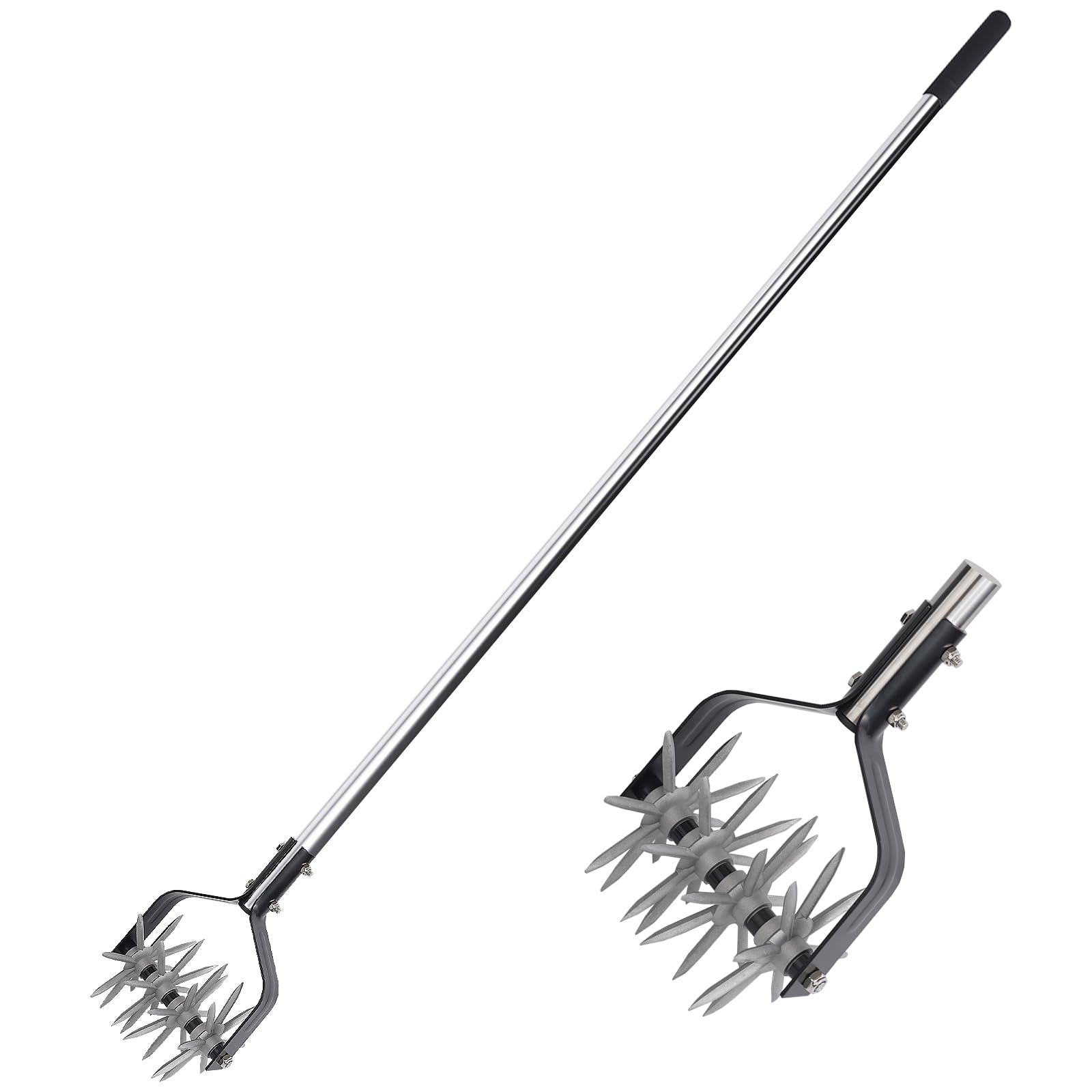
The star-shaped aluminum wheels roll across the soil, crushing clods into fine tilth with a simple push.
This is a different breed of cultivator. The unique star-shaped head has 4 aluminum wheels that rotate as you push, crushing soil into an extremely fine texture — perfect for seedbed preparation. The rotary mechanism makes it feel less like manual labor and more like rolling a lawn aerator. The handle is adjustable to three lengths: 29.7 inches, 43.7 inches, or 57 inches. This is a huge advantage over fixed-handle tools because you can set it for your height and avoid back strain. The whole tool weighs 2.2 pounds, so it is light enough to carry between beds.
Effectiveness is the most-praised aspect at 44 mentions, and durability follows at 38. Owners say it is “durable and easy to use” and “made my seed planting quick and easy.” The construction uses stainless steel and aluminum — rust-proof and wear-resistant. A few owners note it works best in soft to medium soil, requiring a couple of passes on firmer ground. A small number of buyers express concern that the aluminum spikes could crack under very hard use, suggesting hardened steel would be more durable.
This cultivator is ideal for anyone preparing seedbeds, mixing in compost, or aerating lawn patches. The rotary action covers ground faster than a fixed-tine cultivator, and the adjustable handle makes it the most back-friendly option here. The trade-off is that it is less effective at pulling deep-rooted weeds than a curved claw or a hook-style weeder.
Why It Is a Smart Choice
- Rotary star wheels crush soil to a fine tilth — ideal for seedbed preparation and reseeding.
- Handle adjusts to three lengths (29.7, 43.7, 57 inches) for comfortable standing use.
- Stainless steel and aluminum construction is rust-proof and lightweight at 2.2 pounds.
- Effectiveness is the top praise aspect at 44 mentions; durability at 38.
One Consideration
- Aluminum star wheels may struggle in very hard or rocky soil; some owners prefer steel.
- Not designed for deep weeding or root removal — it is a surface cultivation tool.
Reach for it if: you prepare seedbeds, reseed grass, or want a back-friendly rotary cultivator for a medium-sized garden. The adjustable handle is a standout feature.
pass on it if: your primary need is deep weeding or root removal — a fixed-tine claw or hook weeder would serve you better.
9. Garden Weasel Rotary Cultivator & Hand Tiller

The 2-in-1 rotary cultivator that combines a hoe and spade into one standing tool you push, not pull.
Garden Weasel is one of the world’s top-selling rotary cultivator brands, and this 2-in-1 design shows why. The rotating blade wheels break apart soil as you push, combining the tasks of a hoe and spade. At 55 inches tall and 2.4 pounds, it lets you work standing fully upright — no bending, no kneeling. The carbon steel construction is heavy-duty and rust-resistant, and it comes with a “no hassle” lifetime guarantee against defects in materials and workmanship. It is designed and assembled in the USA.
Performance is the most-praised aspect at 71 mentions, and quality follows at 36. Owners say it “cuts garden prep time in half” and “churns soil perfectly for seeding.” It works on a variety of soil types including clay. The tool is effective for aerating, weeding, cultivating, planting, and reseeding — making it a true all-in-one for standing work. A few owners note that fasteners can wiggle loose and that a wheel may occasionally need tightening, but these are minor maintenance issues for an otherwise heavy-duty tool.
This is the most expensive pick in the lineup, but it is also the most complete standing solution. If you have a medium to large garden and want to eliminate kneeling and bending entirely, the Garden Weasel is the best long-handled rotary option. The trade-off is that it is less effective for precision work in tight beds or around delicate plants compared to a handheld claw.
The Standing Advantage
- 55-inch handle lets you work fully upright with zero bending.
- Rotating blade wheels combine hoe and spade functions for efficient soil prep.
- Lifetime guarantee against defects — one of the strongest warranties here.
- Performance is the top praise aspect at 71 mentions; owners call it a “garden lifesaver.”
What to Watch
- Highest price in the lineup — a premium investment for serious gardeners.
- Fasteners can wiggle; occasional need to retighten a wheel.
- Less precise than handheld claws for tight beds and delicate plants.
Reach for it if: you have a medium to large garden, want to avoid bending and kneeling entirely, and need a heavy-duty standing tool for seedbed prep. It is the best long-handled rotary cultivator here.
Look elsewhere if: you work primarily in raised beds, containers, or tight flower beds where a compact handheld claw gives you more control.
Understanding the Specs
Heat-Treated Boron Steel vs Stainless Steel vs Carbon Steel
Heat-treated boron steel (used by Dewit) is the strongest option for heavy digging in compacted clay — it resists bending under force. Stainless steel (Garden Guru, Nisaku) is less likely to rust and stays sharp in damp soil, making it a low-maintenance choice for wet climates. Carbon steel (Garden Weasel) is durable and strong but requires drying after use to prevent rust. For most home gardeners, stainless steel offers the best balance of strength and care-free maintenance.
Tine Count: 3 vs 5 vs 6
Three tines concentrate force into fewer points, making them best for breaking hard ground and digging deep. Five tines (like the Nisaku) spread the work wider for a middle ground between penetration and coverage. Six tines (like the TOYPOPOR Claw Rake) cover the most ground per pull, making them ideal for surface weeding and aerating larger beds. The trade-off is that more tines mean less force per tine, so 6-tine tools can struggle in very hard soil.
FAQ
Can I use a hand cultivator on clay soil?
What is the difference between a cultivator and a tiller?
How do I prevent a wooden handle from cracking?
Is a long-handled or short-handled cultivator better for my back?
Can I use a hand cultivator to remove deep-rooted weeds?
How do I clean and maintain a hand cultivator?
Which hand cultivator is best for raised beds?
Can I sharpen the tines on my cultivator?
Final Thoughts: The Verdict
For the majority of shoppers, the best hand garden cultivator tool winner is the Dewit Cultivator Hand Tiller because its heat-treated boron steel construction, FSC-certified ash wood handle, and nearly unanimous positive reviews make it the most durable and effective choice for serious gardeners. If you want standing precision for weeding and deep taproot removal, grab the CobraHead Mini Weeder. And for the best value with wide coverage, the 15″ Gardeners Claw Rake (TOYPOPOR) delivers 6 sharp tines at a budget-friendly price.
How We Picked
We do not accept paid placement. Every pick is matched to a real buyer and a real use-case; we do not hands-on test units.
Sources & Methodology
Specifications: manufacturer listings and product documentation. Review insights: verified customer reviews, as of July 2026. Pricing: not shown on this page (it changes often); check the current price via the retailer link.
As an Amazon Associate, Lawn Gear Lab earns from qualifying purchases. This does not affect which products we feature.