
Specs are compiled from manufacturer listings and verified buyer reviews and can change over time — please confirm the key details on the product page before buying.
A rock-hard lawn is suffocating. If water pools on the surface, the grass feels spongy, or brown patches keep spreading, your soil needs air. A hand aerator is the simplest tool to fix this without dragging a heavy machine around. The trick is picking between a spike tool that merely pokes holes and a core (plug) tool that actually removes a chunk of soil — one helps; the other truly heals.
I’m Rikta — the founder and writer behind Lawn Gear Lab. This guide is built by comparing the manufacturers’ published specifications and the patterns across verified customer reviews, so you get each pick’s real strengths and trade-offs instead of marketing spin.
Whether your yard is a tiny patch or a half-acre project, the right tool changes the outcome. This breakdown of the best hand aerator models gives you a clear, honest look at which one actually fits your soil, your back, and your weekend schedule.
Quick Picks
- Dolibest Lawn Coring Aerator with Storage Tray — Best Overall
- Xuperace Core Aerator (Patent Design) — Knee-Saver
- Landzie Original Hollow Tine Aerator — Pro Grade
- Dolibest 4-Corer Plug Aerator — 4-Corer Value
- LawnVigor Manual Core Aerator — Deep Plugs
- Jardineer 36″ Spike Aerator — Budget Spike
- Colwelt 38″ Spike Aerator — Budget Spike
How To Choose The Best Hand Aerator
Grab the wrong tool and you will spend Saturday fighting the handle, stepping on a tiny foot plate, and still not breaking the soil. Here is the short version of what matters.
Spike vs. Core (Plug) — pick your poison
A spike aerator pushes solid tines into the ground, creating holes. It is quick and cheap, but it can actually compact the soil around the hole, which defeats the purpose on dense clay. A core aerator uses hollow tines to cut and lift a plug of soil (a core) out of the ground. That plug leaves a real channel for air and water. If your soil is hard or clay-heavy, you want core aeration. Spike tools work fine on loose loam or sandy soil.
Tine length and diameter
Deeper holes reach the grass’s root zone. Look for tines at least 3 inches long. Thicker-diameter tines (like 2/5 inch) create larger holes that hold more water after a rain. Thinner tines require less force to push in but do not open up the soil as much. Number of tines also matters: 2 or 3 tines are easier to press into hard ground; 4 tines cover more ground per step but need more downward force.
Handle height and foot plate
A tall handle (36 inches or more) lets you stand upright while working, saving your lower back. Look for a cushioned grip. A wide, anti-slip foot plate (at least 5 inches wide) lets you stomp with your full weight without missing. The crossbar on some core tools sits high enough that your shoe does not block the soil from ejecting out the top.
Material and build
Powder-coated steel resists rust. Stainless steel on the tines or bottom section is better for wet soil. Some tools arrive fully assembled, others need a few minutes with an included wrench. Read the reviews: buyers consistently mention bolts loosening over time — a sign to check and tighten periodically.
Quick Comparison
On smaller screens, swipe sideways to see the full table.
| Model | Best For | Type | Tine Length | Weight | Amazon |
|---|---|---|---|---|---|
| Dolibest (Storage Tray) | Mid-size lawns, plug collection | Core (4 tines) | 3.5 in | 6.2 lb (2.81 kg) | Amazon |
| Xuperace (Patent) | Heavy clay, knee-friendly | Core (3 tines) | — | 5.69 lb | Amazon |
| Landzie Original | Professional use, small areas | Core (3 tines) | — | 5.6 lb | Amazon |
| Dolibest 4-Corer | small-medium projects | Core (4 tines) | 3.5 in | 5.54 lb | Amazon |
| LawnVigor Manual Core | Compacted spots, deep cores | Core (3 tines) | 3 in | 3.52 lb | Amazon |
| Jardineer Spike | Small yards, occasional use | Spike (12 tines) | 2.75 in | 5.02 lb | Amazon |
| Colwelt Spike | Tight spots, budget | Spike (4 tines) | 3.5 in | 4.31 lb | Amazon |
In‑Depth Reviews
1. Dolibest Lawn Coring Aerator with Storage Tray
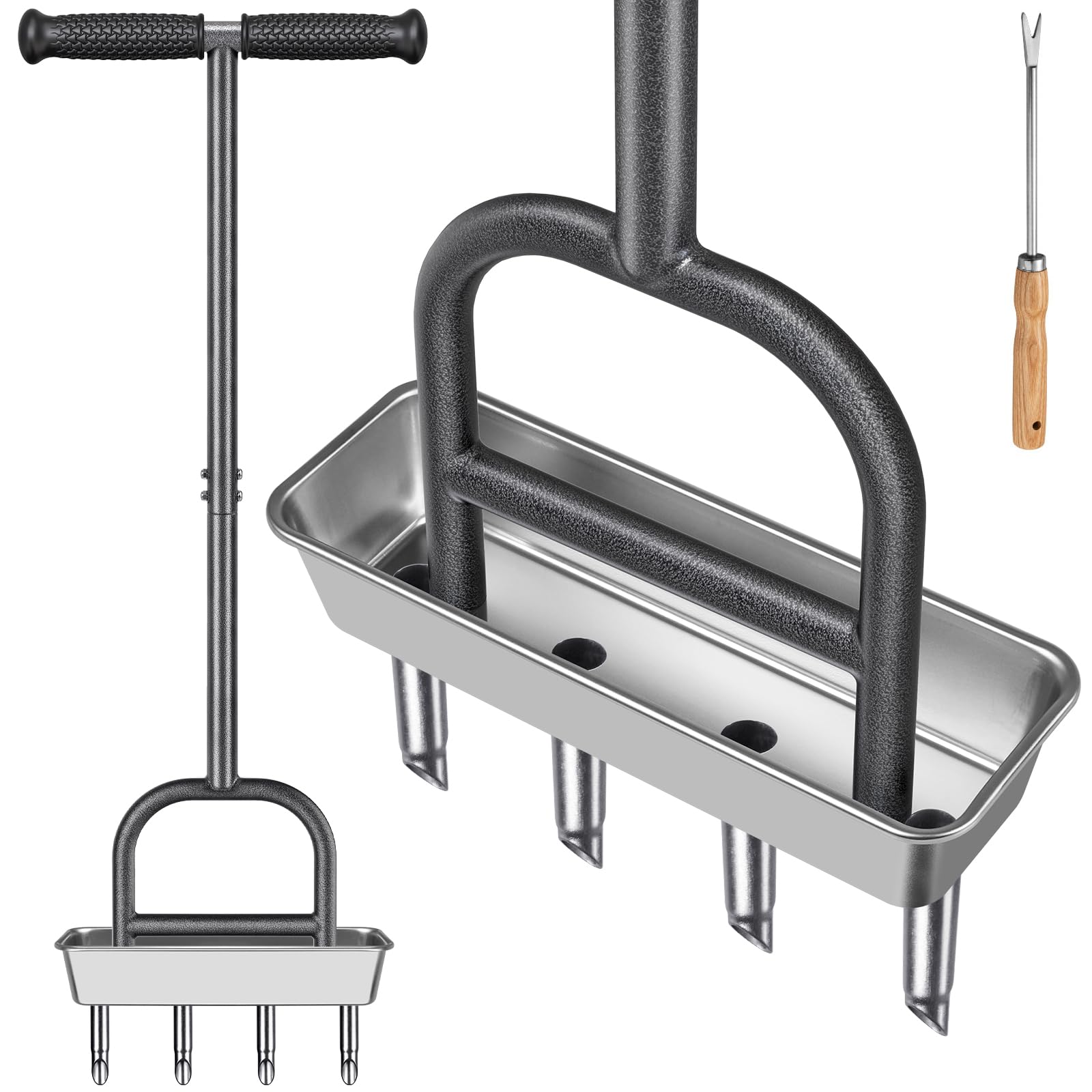
Four stainless steel corers that actually collect the mess they make.
If you hate chasing soil plugs across the lawn, this is your tool. The built-in SUS 304 stainless steel tray catches every core as it ejects out the top, saving you a raking step afterward. Four hollow plugs, each 3.5 inches long and half an inch in diameter, lift deep channels in one stomp — double the coverage per step of three-tine models. Buyers report it works beautifully for small to medium lawns and that it is the exact same product a big-box store sells for twice the price.
The trade-off is weight. At 6.2 pounds total (2.81 kg), it is noticeably heavier than the three-tine competitors, especially the 3.52-pound LawnVigor below. The elevated crossbar keeps your shoe from blocking core ejection, a thoughtful design choice. Assembly takes about two minutes with the included hand tool, which also doubles as a weeder.
One reviewer noted that on very wet soil the cores can clump inside the tray, but the 12-inch cleaning tool pokes them right out. The four tines require firm downward pressure — moist soil is non-negotiable.
Why it stands out
- Integrated stainless steel tray collects cores automatically
- Four 3.5″ corers remove more soil per step than three-tine models
- Soft rubber grip reduces hand fatigue
The real cost
- Heavier than most three-tine aerators at 6.2 pounds
- Cores may clump if soil is too wet
Grab it if: You have a small to medium lawn and hate cleaning up scattered soil plugs.
Look elsewhere if: Your soil is rock-hard clay — the four tines demand serious leg force.
2. Xuperace Core Aerator (Patent Design)
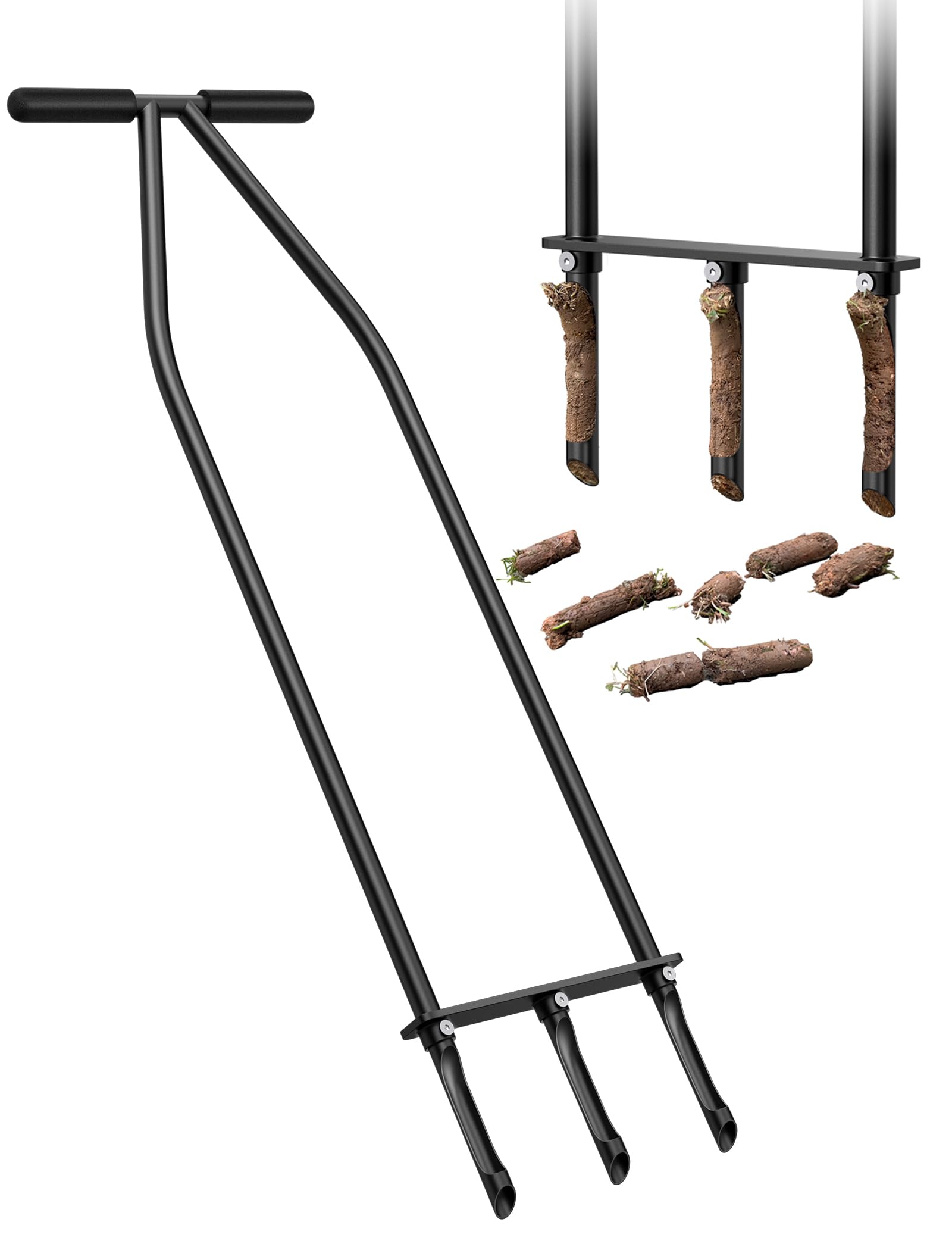
A cleverly shaped frame that stops clogging and spares your knee.
Standard core aerators have a crossbar that hits your knee right as you stomp down. The Xuperace opens the center so your leg moves freely — a detail owners of other tools notice immediately. The patented side-ejection design pushes soil plugs out through a ramp, so they rarely jam inside the tines. Buyers confirm the non-clogging mechanism works reliably when the soil is moist, and one 72-year-old reviewer reported using it comfortably for about an hour at a time.
The frame is made from high-strength alloy steel, and at 5.69 pounds it is close to the Dolibest in heft but feels lighter because of the open center. Assembly screws can loosen after the first use — the included Allen wrench is handy for a quick tighten. If you encounter a patch of extra-hard ground, you can remove the middle tine to reduce resistance.
One reviewer called it the “best aerator, seriously,” praising the curved design and large ported cutout that prevent cores from getting stuck.
Design wins
- Center opening lets your knee move naturally (no crossbar)
- Side-ejection ramp prevents tine clogging
- Replaceable tines; removable middle tine for hard soil
Minor gripes
- Screws loosen during first sessions — need re-tightening
- Cost is about double some basic core aerators
Choose this for: Persistent clay soil and anyone with knee sensitivity — the open frame changes the feel entirely.
skip it if: You only need a single-season tool; the premium price is for long-term durability.
3. Landzie Original Hollow Tine Aerator
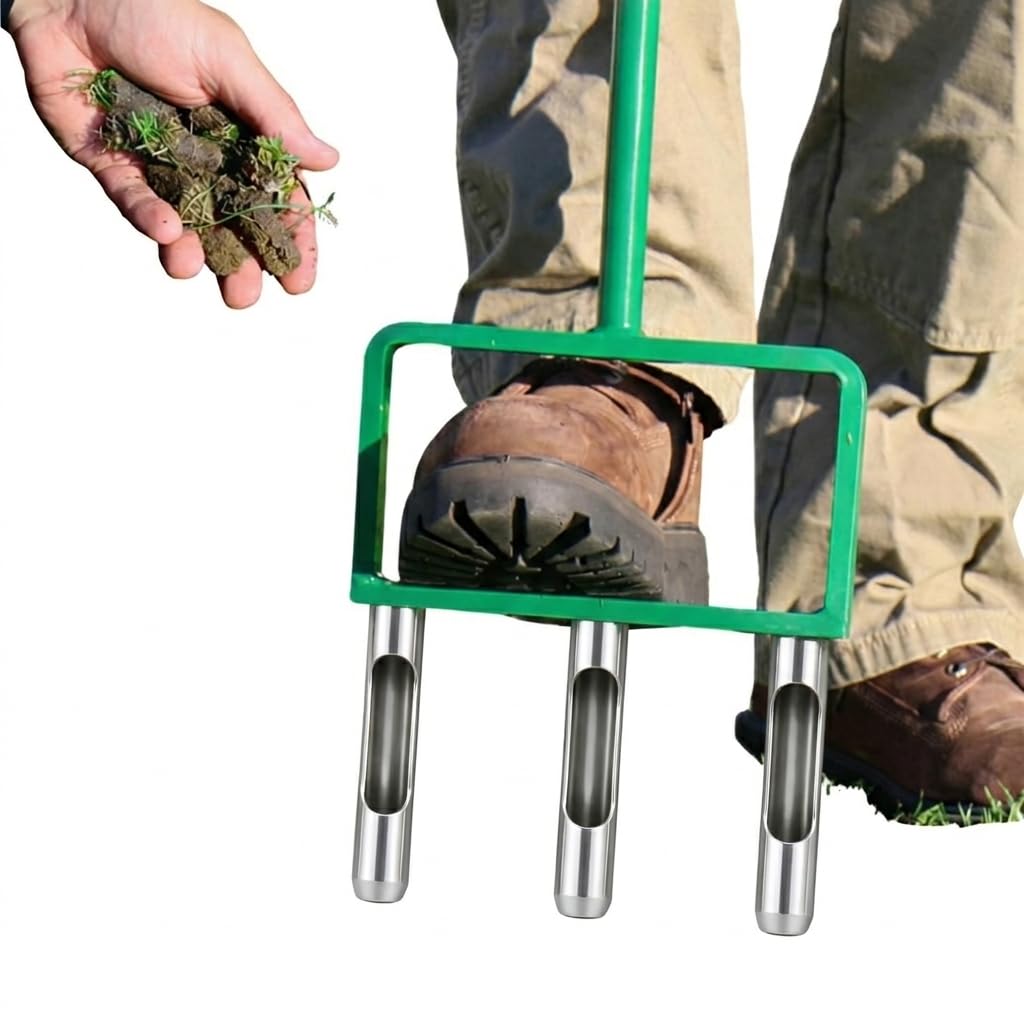
A ready-to-go core tool that landscapers trust but your knees will feel.
Landzie ships fully assembled — pull it from the start and start stomping. Three solid stainless steel tines cut clean cores and the beveled design pushes the old plug up and out with the next press, aiming for a clog-free experience. Buyers confirm the tines self-clean and stay sharp, making this a favorite for small lawns up to about 25 by 25 feet. One owner reported using it for 50-60 hours over a 3/4-acre lot and called it durable, though they noted the hollow tines need tightening every hour or two.
There is no mistaking this for easy work. Multiple reviews say a machine aerator is the better call for large, heavily compacted lawns. The Landzie requires moist ground — dry soil is nearly impossible to penetrate. At 42.38 inches tall, it suits taller users well, but users around 6 feet still found it physically demanding, resorting to a “pogo-stick” technique for leverage.
The foot bar can get slippery when wet, so wear boots with decent grip. Landzie also offers a refund guarantee and reportedly refunded one reviewer after they left a critical review — an unusual level of customer care. For a small lawn or targeted spot treatment, this is the gold standard in build quality.
What you pay for
- Ready to use from the start — zero assembly
- Stainless steel self-cleaning tines with beveled design
- Outstanding customer service and satisfaction guarantee
Where it struggles
- Brutal on large or rock-hard lawns
- Hollow tines loosen after extended use
- Foot bar slippery when wet
Ideal for: Small patches, flower beds, and anyone who wants professional build quality without assembly.
Not for: Lawns over 1,500 square feet — you will exhaust yourself before the job is half done.
4. Dolibest 4-Corer Plug Aerator
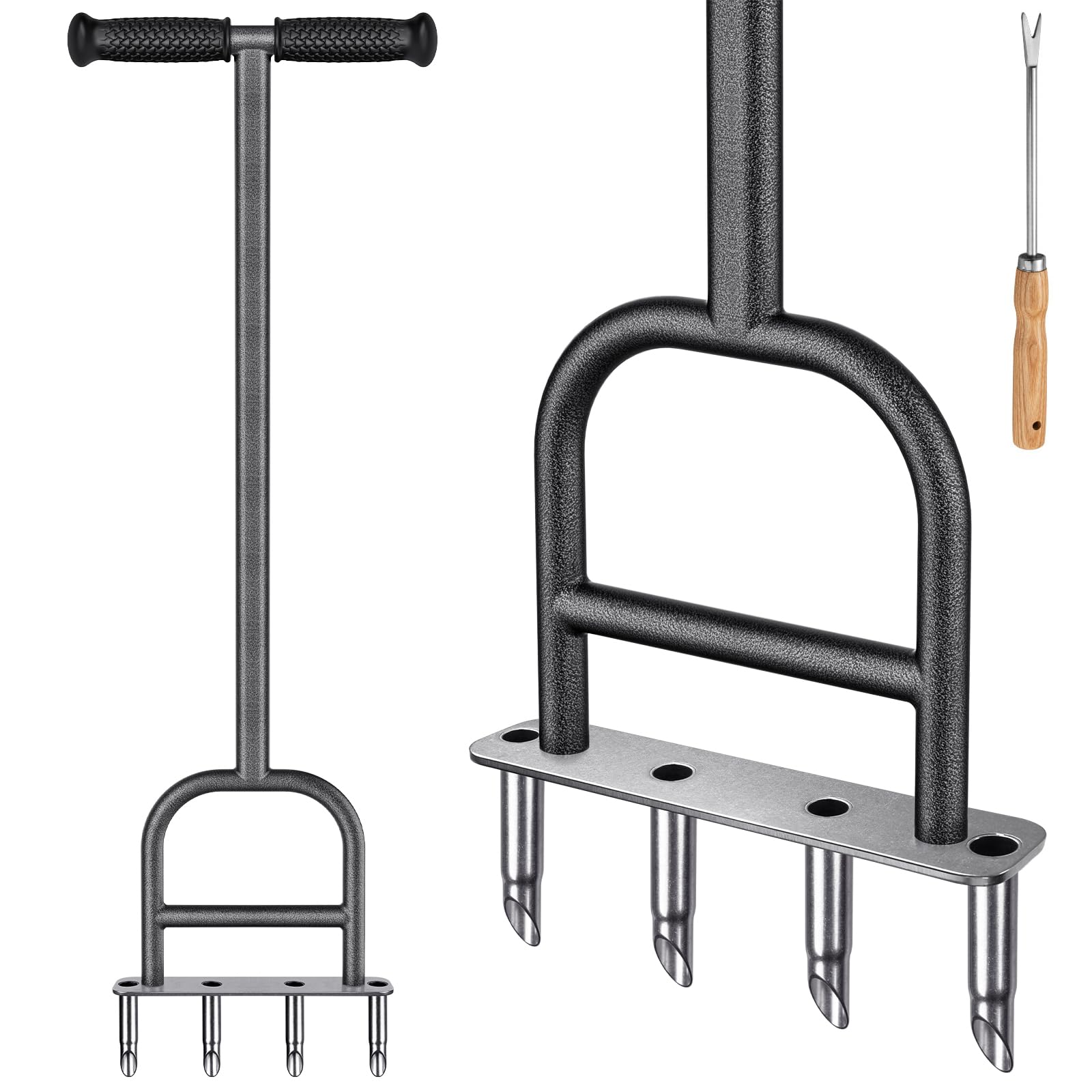
A rugged four-tine corer that takes four plugs per step but fights for depth.
This is the no-tray version of the top pick above — same four stainless steel corer plugs, each 3.5 inches long and half an inch in diameter, without the storage tray. Owners mention that cores eject decently and they only needed to clear the tool about 8 times in two hours of work. The soft rubber grip and elevated foot bar (to keep your shoe from smashing the ejected cores) are carried over from the tray version.
The catch is depth. One buyer mentioned that the rounded footstep reduces leverage, limiting penetration to about 2 inches in firm soil — shallower than the three-tine Corona tool they compared it to. If your soil is truly compacted, you may have to rock the tool side to side to get the full 3.5 inches into the ground. The 12-inch weeder handle that comes with it is genuinely useful for clearing clogs and for general weeding.
At 5.54 pounds, it is just slightly lighter than the tray version. Single welded construction gives it a very sturdy feel. You will definitely want to water the lawn beforehand — buyers emphasized that moist soil makes a dramatic difference.
Strong points
- Welded steel frame with stainless steel corers
- Four plugs per step for faster coverage
- Includes versatile 12-inch weeder/cleaner tool
Weak points
- Rounded foot plate limits leverage in hard soil
- Only reaches about 2 inches deep without rocking
Good fit for: Looser soil or lawns that just need a seasonal refresh — four plugs per step save time.
Avoid if: Your ground is hard-packed clay where every inch of depth is a fight.
5. LawnVigor Manual Core Aerator
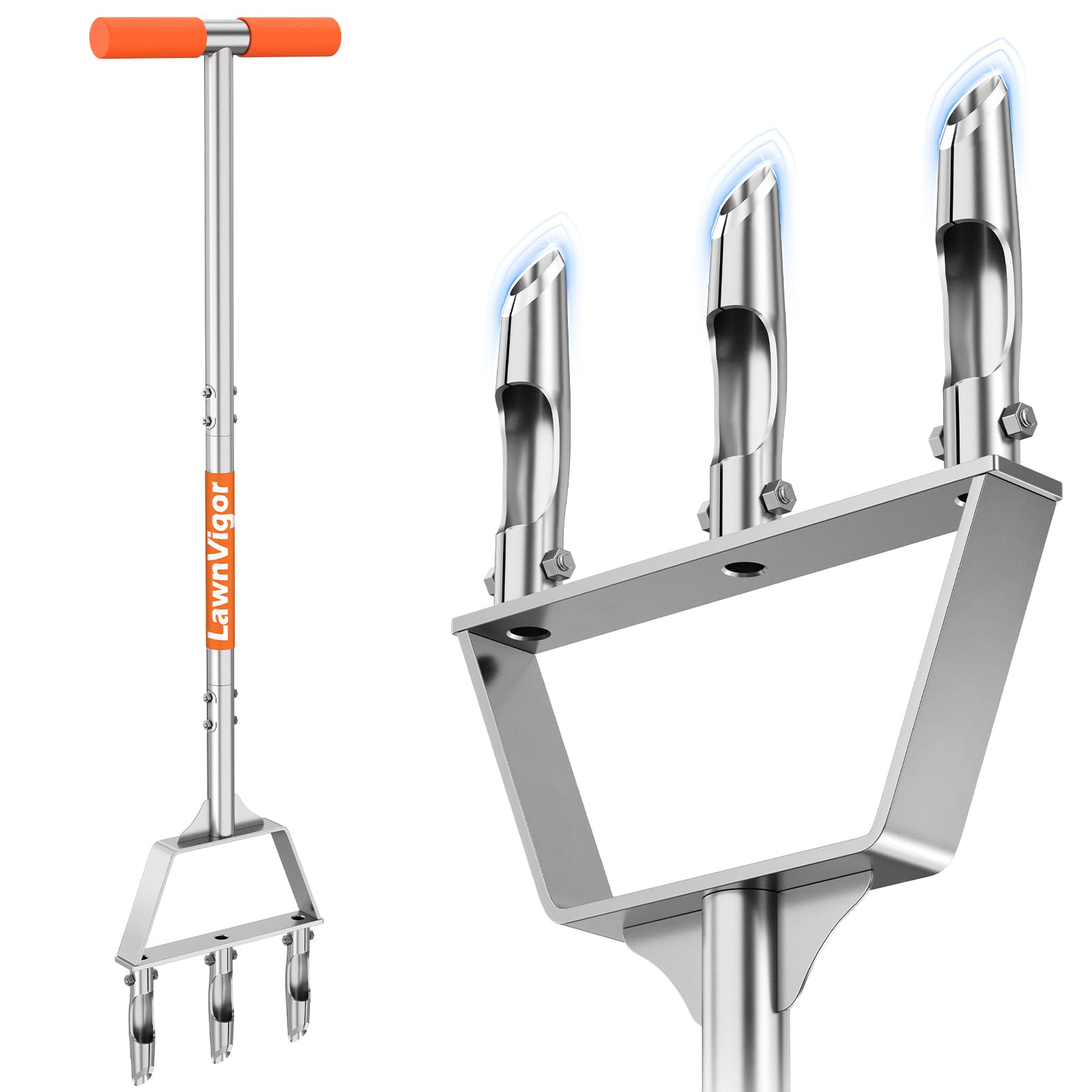
Three heat-treated tines that pull deep 3-inch cores and rarely jam.
If your quest is deep, clean soil plugs, the LawnVigor delivers. Heat-treated hollow tines cut through tough soil, and the reliable ejection mechanism keeps clogs to a minimum. One reviewer summed it up: “Pulls deep 3-inch cores on moist soil; reliable ejection mechanism rarely clogs.” The wide T-handle with comfortable foam grips and a foot bar that provides good leverage makes it physically easier than the four-tine models to push in.
The downsides are minor but real. The foot bar is functional but the bolts on each side stick out enough that one owner reported they clip the inside of your knees after a while. It also arrived semi-assembled — about a 5-minute setup, which is still faster than some. The white plastic inserts on the tines are important to keep in place; they help release the soil plugs.
Weighing only 3.52 pounds, it is far lighter than the Dolibest (5.54 lb) and even the Xuperace (5.69 lb). That makes it a great choice for anyone who wants to avoid wrestling a heavy tool around the yard. You will trade speed (fewer tines per step) for easier handling and consistently deep plugs.
Best features
- Heat-treated tines stay sharp; reliable plug ejection
- Light at 3.52 pounds — easy to carry and maneuver
- Replaceable hollow tines for long-term use
Known issues
- Side bolts can rub against your knees
- White plastic inserts may be lost if removed
Perfect for: Medium lawns with compacted spots — the deep 3-inch cores make a real difference.
Not ideal if: You are tall and need a longer reach; the 36-inch handle may feel short.
6. Jardineer 36″ Spike Aerator
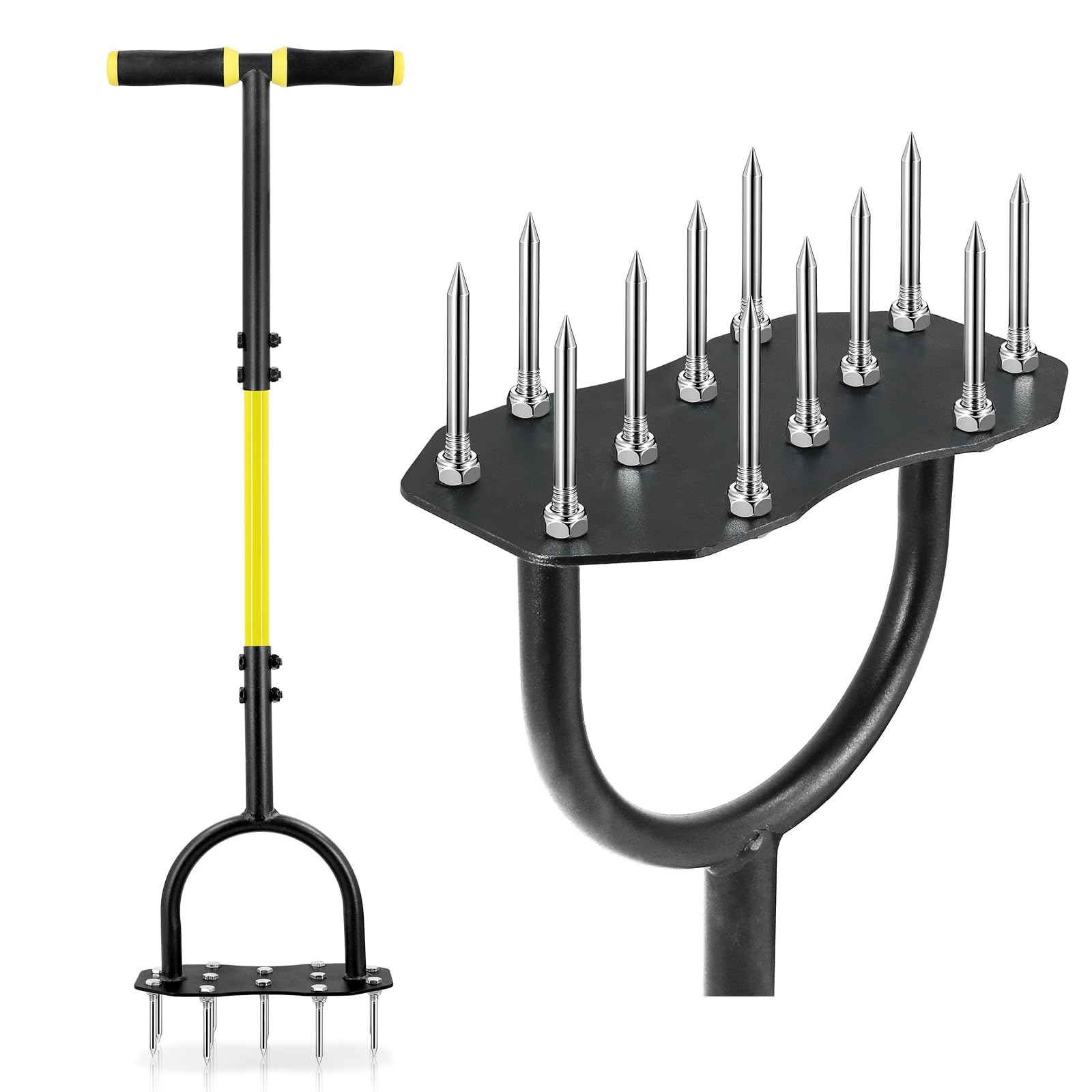
A dozen heat-treated spikes that blanket your lawn with holes fast.
The Jardineer is a classic spike aerator: 12 solid steel spikes, each 2.75 inches long, punch into the soil as you step. It is pre-assembled (you only need to attach the handle with the included wrench) and the 36-inch height plus cushioned rubber grip make it easy to use for an hour of weekend work. Customers note that after many uses none of the spikes have needed replacing, and the tool even comes with a couple of extras.
Because it is a spike tool, not a core tool, it works best on loamy or sandy soil. On hard clay, the spikes can push soil sideways, potentially compacting the edges of each hole — exactly the opposite of what aeration tries to achieve. One reviewer specifically warned it is “OK for small areas only” and noted it becomes a real workout on larger lawns. The thick steel foot plate takes your full weight well, but the tool’s 5.02 pounds add to the effort over time.
The Jardineer is a solid entry pick if you are not sure aeration is for you. It costs less than most core tools and covers ground quickly when the soil is soft. Just keep expectations in check for heavy compaction.
Why it sells
- 12 spikes cover a wide area per step
- Heat-treated steel; extra spikes included
- Pre-assembled for quick setup
Trade-offs
- Spikes can compact the soil around holes in clay
- Hard work on large lawns — buyer warns it is tiring
Go for it if: Your soil is naturally loose or sandy and you want fast, wide coverage.
Pass if: You have heavy clay or compacted soil — you need a core aerator
7. Colwelt 38″ Spike Aerator

Four oversized spikes that punch deep but cover less ground per step.
The Colwelt goes the opposite direction from the Jardineer: fewer spikes (4 instead of 12) but each one is thicker (2/5 inch diameter) and longer (3.5 inches). That means each hole is bigger and deeper, but you have to stomp more times to cover the same area. The wide foot plate is 6 inches across and 5.5 inches tall — large enough for any boot to plant firmly. One reviewer gave a practical tip: “Make sure to water your lawn for 15min before using the aerator.”
At 38 inches tall, it is the tallest spike tool on this list, which helps taller users avoid stooping. The cushioned T-handle provides extra grip. Buyers consistently say it feels very sturdy and well-built for the price, and it is particularly good for narrow areas like garden beds or between trees. The 4.31-pound weight is lighter than the Jardineer, making it easier to carry around.
The trade-off is coverage speed. Four spikes per step means more walking. Also, as a spike tool, it is not ideal for compacted clay — as one reviewer pointed out, you have to be able to step on it and pull up, which gets tiring. Assembly is quick with the included instructions and hardware.
What works
- Very thick (2/5″) and long (3.5″) spikes
- Wide, anti-slip foot plate for secure stomping
- Tall 38-inch handle for comfortable upright use
Consider this
- Only 4 spikes per step — slower coverage
- Not for heavy clay; spike tools may compact edges
Best for: Small lawns with loose soil or for spot-treating compacted patches in tight spaces.
Reconsider if: You need to cover a large area fast — the 12-spike Jardineer will finish sooner.
Understanding the Specs
Spike vs. Core Aeration
A spike aerator uses solid tines that push soil aside to create a hole. This works fine on loose soil but can compress the walls of the hole in clay, worsening compaction. A core aerator uses hollow tines that cut and lift a plug of soil out of the ground, leaving a true open channel. The data is clear: if you have compacted clay, choose a core aerator. Spike tools are lighter and cheaper, but they treat the symptom, not the cause.
Tine Length and Diameter
Tine length determines how deep the aeration reaches. Grass roots grow 3-6 inches deep, so 3-inch tines are the minimum for meaningful benefit. Longer tines (3.5 inches) reach deeper but require more downward force. Diameter affects hole size — thicker spikes (like the Colwelt’s 2/5-inch) create larger passages for water and air, but they also displace more soil, which can be harder in dense ground. The number of tines (2, 3, or 4) directly impacts how much ground you cover per step and how hard you have to lean into the tool.
FAQ
Should I use a spike or core hand aerator for my clay soil?
How deep do the tines need to be for effective aeration?
How often should I aerate my lawn with a hand tool?
Do I need to water before using a manual aerator?
Is a 4-tine core aerator better than a 3-tine one?
Will a hand aerator work on a large half-acre lawn?
How do I keep the hollow tines from clogging?
Can I aerate after it rains?
How do I store a manual aerator to prevent rust?
What does “replaceable hollow tines” mean?
Final Thoughts: The Verdict
For most people, the best hand aerator is the Dolibest with Storage Tray because its four stainless steel corers and built-in collection tray deliver deep, clean aeration without leaving plugs all over the lawn. If you want a knee-friendly design that handles heavy clay without clogging, grab the Xuperace Core Aerator. And for targeted use on a very small lawn where build quality matters most, the standout is the Landzie Original.
How We Picked
We do not accept paid placement, and we did not hands-on test every unit. Instead, we match each pick to a real buyer and use-case by comparing the manufacturers’ published specifications against the patterns in verified customer reviews — so you get each pick’s real strengths and trade-offs instead of marketing copy.
Sources & Methodology
Specifications: manufacturer listings and product documentation. Review insights: verified customer reviews, as of July 2026. Pricing: not shown on this page (it changes often); check the current price via the retailer link.
As an Amazon Associate, Lawn Gear Lab earns from qualifying purchases. This does not affect which products we feature.