
Specs are compiled from manufacturer listings and verified buyer reviews and can change over time — please confirm the key details on the product page before buying.
Picking a greenhouse light is less about brightness and more about whether that brightness actually reaches your plants’ lower leaves. You already know sunlight is fickle — a cloudy week can stall seedlings and leave fruiting plants sulking. The right grow light fills that gap, delivering consistent full-spectrum energy to your tomatoes, peppers, and lettuce.
I’m Rikta — the founder and writer behind Lawn Gear Lab. This guide is built by comparing the manufacturers’ published specifications and the patterns across verified customer reviews, so you get each pick’s real strengths and trade-offs instead of marketing spin.
Whether you are outfitting a shelf of seedlings or a commercial greenhouse bench, these picks cover the spectrum from ultra-thin panels to high-wattage bar lights — all chosen because they actually deliver on their PAR claims. This is your shortcut to the best grow lights in a greenhouse, picked by real-world results, not marketing wattage.
Our Picks at a Glance


How To Choose The Best Grow Lights In A Greenhouse
A greenhouse light must deliver usable PAR/PPFD to the canopy, run cool enough to avoid leaf scorch, and withstand damp, warm conditions. Here is what to look for.
Light Spectrum and Coverage
Full-spectrum lights blend warm and cool LEDs (roughly 3000K to 5000K) with specific red wavelengths around 660nm — that deep red spike is what drives flowering and fruiting. A light that covers your entire shelf or bench evenly prevents plants from stretching toward a single bright spot.
Wattage vs. Efficiency
A 150-watt light can outperform a 300-watt light if its diodes are more efficient and its lens design concentrates light where it matters. Look at the PPF (photosynthetic photon flux) in µmol/s — that number tells you how much usable light the fixture actually emits per second.
Dimmability and Timers
A dimmable light adjusts intensity for seedlings or bloom without needing a second fixture. An integrated timer automates the day cycle so you don’t have to unplug it manually.
Quick Comparison
| Model | Best For | Wattage | Coverage | Dimmable | Amazon |
|---|---|---|---|---|---|
| VIPARSPECTRA XS1500 Pro★ Best Overall | Best Overall | 150W | 3×3 ft veg / 2×2 ft flower | Yes (daisy chain) | Amazon |
| Barrina Panel (4-Pack)Compact Panels | Ultra-Thin Shelves | 40W (total) | Multiple shelves | Yes (8 levels) | Amazon |
| TYAGMAM T8 6-PackBench Boss | Large Benches | 150W (total, 6x25W) | Long shelves | No (on/off only) | Amazon |
| Spider Farmer SF600 | Seedlings & Veg | 72W | 2×4 ft | No | Amazon |
| Barrina T10 Vertical | Tall Plants | 42W | Vertical, 4-5.6 ft | No (mechanical timer) | Amazon |
| AC Infinity IONBEAM S16 | Inter-Canopy Fill | — | Supplemental (16″ bars) | Yes (10 levels + timer) | Amazon |
| VIVOSUN AeroLight AW200SE | Smart Integrated Airflow | 200W | 2×4 / 3×3 ft | Yes (app + controller) | Amazon |
| MARS HYDRO SP3000 | Large Tents / Benches | 300W | 4×2 ft (ideal) | Yes (daisy chain 50) | Amazon |
| Spider Farmer SE3000 | Premium App-Controlled | 300W | 3×3 ft | Yes (digital + app) | Amazon |
In‑Depth Reviews
1. VIPARSPECTRA XS1500 Pro
Our pick — over 4.5★ from 900+ verified ratings; the strongest balance of quality and price.
Balanced PAR that reaches every corner of the canopy without hot spots.
The XS1500 Pro uses optical lenses to focus light and hit a remarkably even PPFD distribution — buyers report readings of 747 at 50% power from 13 inches, with consistent outer-edge coverage that stops plants from stretching. That 150 watts draw replaces a traditional 250W HPS or MH fixture, running cooler and cheaper.
Its full-spectrum blend mixes white 3000K, 5000K, red 660nm, and IR 730nm LEDs, covering the whole growth cycle from seed-starting to flower. The dimming daisy-chain feature lets you link up to 20 units and control them from one knob — a serious time-saver in a larger greenhouse. Build quality stands out too: the aluminum heatsink handles heat well, and owners running it 12 hours straight say it stays cool to the touch.
The main trade-off is the lack of an on/off switch on the light itself — you will need an external timer to automate it. A few owners also note the 100W model from the same brand has a slightly warmer color tone they prefer. Still, for a 3×3 veg or 2×2 flower footprint, this is the most dialed-in mid-range light on the market.
Why owners love it
- Exceptional PAR levels and even distribution across the canopy.
- Daisy-chain control for up to 20 lights simplifies large setups.
- Runs cool even under 12-hour cycles at full power.
What to keep in mind
- No built-in on/off switch — needs a separate timer.
- Some prefer the warmer tone of the 100W sibling.
Reach for it if: you need a hard-working, even-coverage light for a 3×3 veg or 2×2 flower space and want the convenience of daisy-chaining multiple units.
Look elsewhere if: you absolutely need a built-in timer or on/off switch on the fixture itself.
2. Barrina Grow Lights Panel (4-Pack)
Four 0.35-inch-thin panels that disappear under shelves yet pump 40W of usable light.
At only 14.17 inches long and 0.35 inches thick, these Barrina panels are built for tight spaces — greenhouse shelves, cabinets, and DIY mini greenhouses. The four-pack covers multiple tiers, and each panel draws just 10W (40W total) while replacing 250W equivalent general plant lights. Over 95% of the light energy can be absorbed by plants, thanks to the tuned spectrum.
The built-in auto timer offers three cycle options — 3, 6, or 12 hours — and repeats the same schedule daily, so you can leave for a weekend and your seedlings stay on track. Eight dimmable levels (from 12.5% to 100%) and three spectrum modes (white only, pink only, or both) give you fine control over early growth stages. Owners mention the snap-in hangers and very sticky adhesive pads make installation a breeze, and the aluminum construction keeps heat manageable.
One honest note: the light has a distinctly pink cast even in the combined white+pink mode, which some find visually unappealing. The panels are also not linkable side-to-side for expansion — you buy the 4-pack to cover multiple spots, not one large area. For seedling shelves and propagation benches, though, these deliver reliable, low-profile power.
Biggest strengths
- Auto timer cycles (3/6/12H) repeat daily without replugging.
- Eight brightness levels and three spectrum modes fine-tune early growth.
- Ultra-slim profile fits under standard shelf spacing.
Honest drawbacks
- Pink cast in all modes may be visually distracting.
- Panels cannot be linked side-to-side; each works independently.
Pick these for: low-clearance shelf setups where you want automated timers and adjustable spectrum for seedlings and clones.
Skip them for: covering a single large bench — you are better off with a longer bar-style light.
3. TYAGMAM T8 2ft 6-Pack
Six 2-foot T8 strips that daisy-chain into one continuous run for long greenhouse benches.
Each T8 strip draws just 25 watts, but with six units totalling 150W the whole setup replaces a 900W equivalent traditional fixture. The included reflector boosts light efficiency by 30%, and the full-spectrum daylight (CRI 80) mimics sunlight across all growth stages.
Linkability is the key feature here — you can connect up to 6 lights in a series using the included clips and cable ties, running them from a single outlet. The 100% aluminum housing provides efficient heat dissipation, and the sunlight-white color temperature (around 5000K) is easy on the eyes during long hours in the greenhouse. At 23 inches long each, they fit standard 2-foot shelf spans perfectly.
The main caveat is that these are not dimmable — it is on/off only. A few owners also mention the connecting cables are short, so plan your mounting layout carefully. For the price of the 6-pack, you get solid coverage for multiple shelves or a long bench, and the simplicity means fewer things to break.
Who it suits best: greenhouse growers with long benches or multiple shelves who want a simple, linkable, no-fuss strip light at a very accessible price point. The heat management and even light spread win consistent praise from repeat buyers.
Great for: chaining together a full bench of seedlings or leafy greens without buying separate power supplies.
Not ideal for: anyone who needs adjustable brightness or spectrum tuning for flowering crops.
4. Spider Farmer SF600

A 72-watt workhorse that punches above its weight for early-stage growth.
The SF600 packs 384 LEDs into a 39.3-inch-long bar and delivers 11,000 lumens — enough to cover a full 2×4 ft area for seedlings and vegetative plants. At only 72 watts, it uses significantly less electricity than a fluorescent T5 setup, and owners mention plants showing roots within 4 days. The 120-degree beam angle spreads light wide, and the reflectors help concentrate it downward.
Spider Farmer’s sunlike full spectrum includes 660-665nm red and 730-740nm IR alongside warm white (2800-3000K) and blue (4800-5000K) — a combination that promotes germination, chlorophyll synthesis, and early flowering. Build quality is a consistent talking point: the aluminum body sheds heat well, and the 5-year warranty backs the 50,000-hour lifespan claim. Owners also love the plug-and-play installation and the ability to attach pulley ratchet hangers for height adjustment.
The brightness gets mixed reactions — some find it plenty for seedlings, others expect more punch for flowering. It is also not dimmable, so your only control is distance from the canopy. For a dedicated veg and propagation light, though, this is a reliable, affordable choice.
Standout features
- 384 diodes in a long bar create even coverage across a 2×4 ft space.
- 5-year warranty and 50,000-hour rated lifespan give long-term confidence.
- Anti-moisture and anti-vulcanization coating protect against greenhouse humidity.
Trade-offs
- No dimming — intensity is fixed.
- Brightness is adequate for veg but may feel low for heavy flowering.
Best for: seed-starting and vegetative growth in a 2×4 tent or shelf without needing dimming or high-intensity bloom power.
Think twice if: you plan to flower dense, heavy-yielding plants — you will want a higher-wattage fixture.
5. Barrina T10 Pro Vertical Grow Light

A freestanding tower that sends side-lighting into tall plants and wide shelves.
Most grow lights hang above the canopy, but tall plants like tomatoes, cannabis, or large ornamentals need light that reaches their middle and lower branches. The Barrina T10 Pro takes a different approach: it stands vertically on a disc base, extends from 4 feet to 5.6 feet, and uses T10 side-lighting to bathe the entire plant height in 42 watts of full-spectrum light. The 169 LEDs include 660nm red wavelength chips for flowering support, and the CRI of 88 makes leaf discoloration or pest spots easy to spot.
Owners consistently praise the brightness and sturdy stand — it does not wobble even when adjusted to full height. The mechanical timer is a simpler, more reliable alternative to digital timers (no programming required), and the foot switch lets you turn it on without bending down. Assembly takes minutes and requires no tools.
A small number of owners found the light intense enough to burn certain light-loving plants, so start with the light farther away and watch your leaves. A few also received units with minor bent parts, though replacements arrived quickly. If your greenhouse has tall plants that overhead lights cannot reach, this is a clever solution.
Why it stands out: the vertical design solves a real problem — lighting the lower canopy of tall plants. The mechanical timer and foot switch make it unusually convenient for daily use.
Great for: tall or trellised plants where overhead lights create shadow on lower branches. Also excellent for corner spaces that need a slim, freestanding light.
skip it if: your greenhouse setup is all low-profile trays — a panel or strip light will be more efficient.
6. AC Infinity IONBEAM S16

Four 16-inch bars that magnetically stick to your tent frame to light the shadowy middle of the canopy.
The IONBEAM S16 is not a primary grow light — it is a targeted supplement for the understory. Each bar uses Samsung LM301H EVO diodes rated at 3.14 µmol/J PPE, making them some of the most efficient LEDs available. The four bars together deliver up to 3,000 lumens of additional light that reaches areas your main fixture cannot, like the sides of bushy plants or the lower branches in a crowded tent.
Installation is the simplest on this list: magnetic mounting bars let you attach the lights to the steel frame of your grow tent or to the canvas using included steel strips. The digital controller (Controller 77) offers ten intensity levels and a programmable daily schedule with sunrise/sunset simulation. Customers note it takes under 15 minutes to set up and the minimal heat output means no extra cooling is needed.
One practical gripe: the connecting cables between bars are short, so you may need to buy extensions to reach where you want them. A few owners also found the magnets strong enough for tent poles but borderline for canvas attachment. If your canopy is dense and you want every bud site to fatten up, these bars are the missing piece.
What makes it special
- Samsung LM301H EVO diodes provide top-tier efficiency (3.14 µmol/J).
- Magnetic mounting to tent frame or canvas is clean and tool-free.
- Programmable controller with sunrise/sunset timing automates the day cycle.
Small frustrations
- Short interconnecting cables may require third-party extensions.
- Magnets are great on poles but less secure on canvas alone.
Add these when: your main light leaves shadowed lower branches and you want to boost bud sites without adding heat.
Pass on these if: you need a full-coverage primary light — this is strictly supplemental.
7. VIVOSUN AeroLight AW200SE
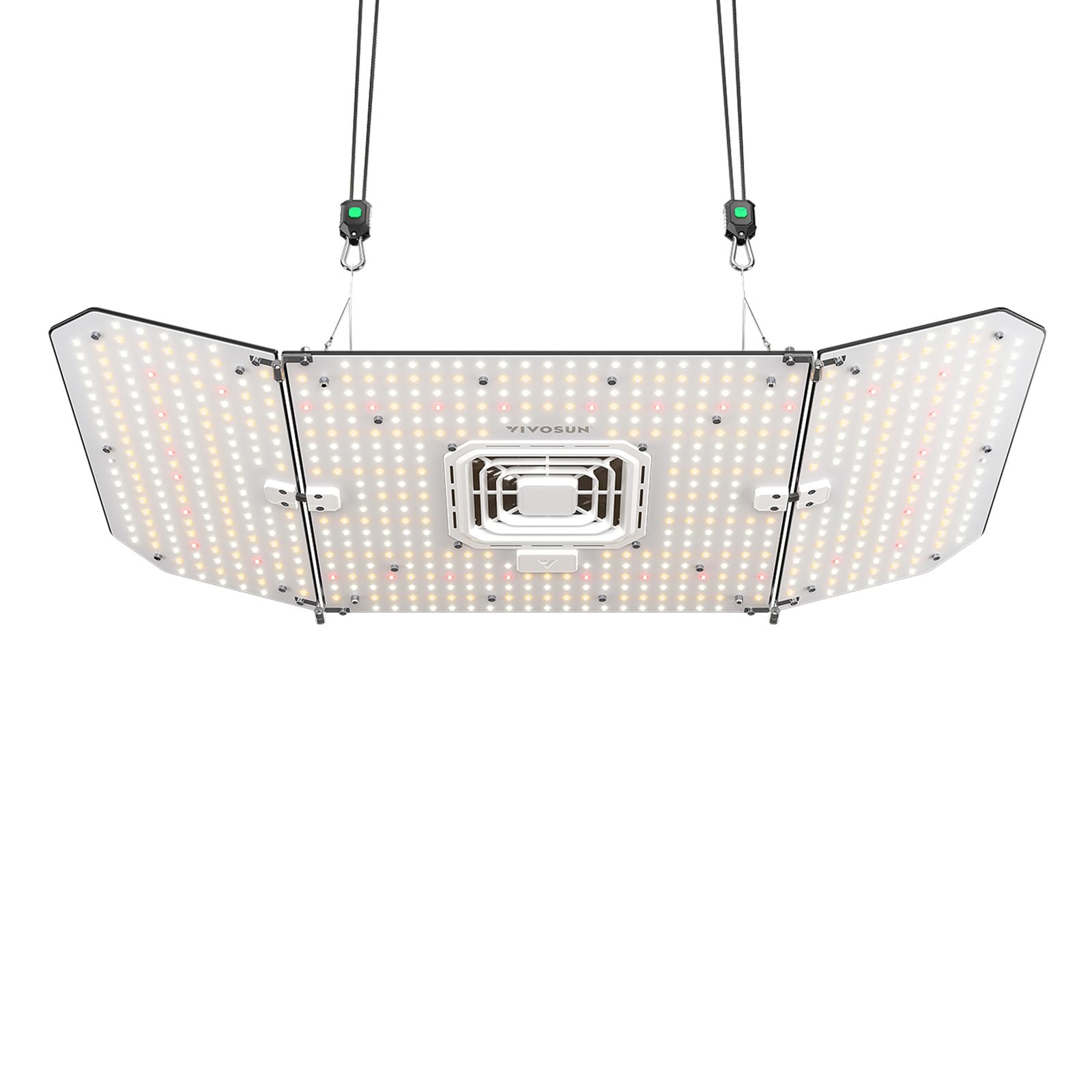
A 200-watt light with a built-in circulation fan that moves air straight through the canopy.
The AeroLight AW200SE is the only fixture on this list that integrates a fan directly into the light. A centrally located circulation fan pushes air down through the hollow light body and into the plant canopy — reaching spots oscillating fans miss. The 200-watt LED array delivers full-spectrum coverage (380nm-780nm with 660nm red plus 3000K and 5000K whites) suitable for 2×4 or 3×3 foot spaces.
The adjustable wings let you direct light coverage left and right, and the full app control (via the Vivosun GrowHub Controller, sold separately) lets you automate day/night schedules and even simulate natural wind with the fan. Owners running it in 3×3 tents say the coverage is even and the gentle airflow replaces a separate circulation fan. The aluminum heatsink and industrial-grade dual ball bearing fans keep noise low and lifespan above 50,000 hours.
The biggest catch is that the smart features require the separate GrowHub controller (E42, E42A, or E25) — the light works on its own with basic on/off and fan control, but to open up app programming you need that extra purchase. A few owners also noted missing screws for the H-brackets in the box. If you already use Vivosun’s ecosystem or want a light-fan combo to simplify your tent, this is a clever space-saver.
Why it is unique: the integrated fan eliminates the need for a separate circulation fan in smaller tents and delivers airflow directly to the canopy where it matters most.
Best for: growers who value simplicity — one fixture does light and airflow. Ideal for 3×3 to 4×4 tents.
Keep in mind: to use the app and full smart features, you must buy the Vivosun GrowHub controller separately.
8. MARS HYDRO SP3000
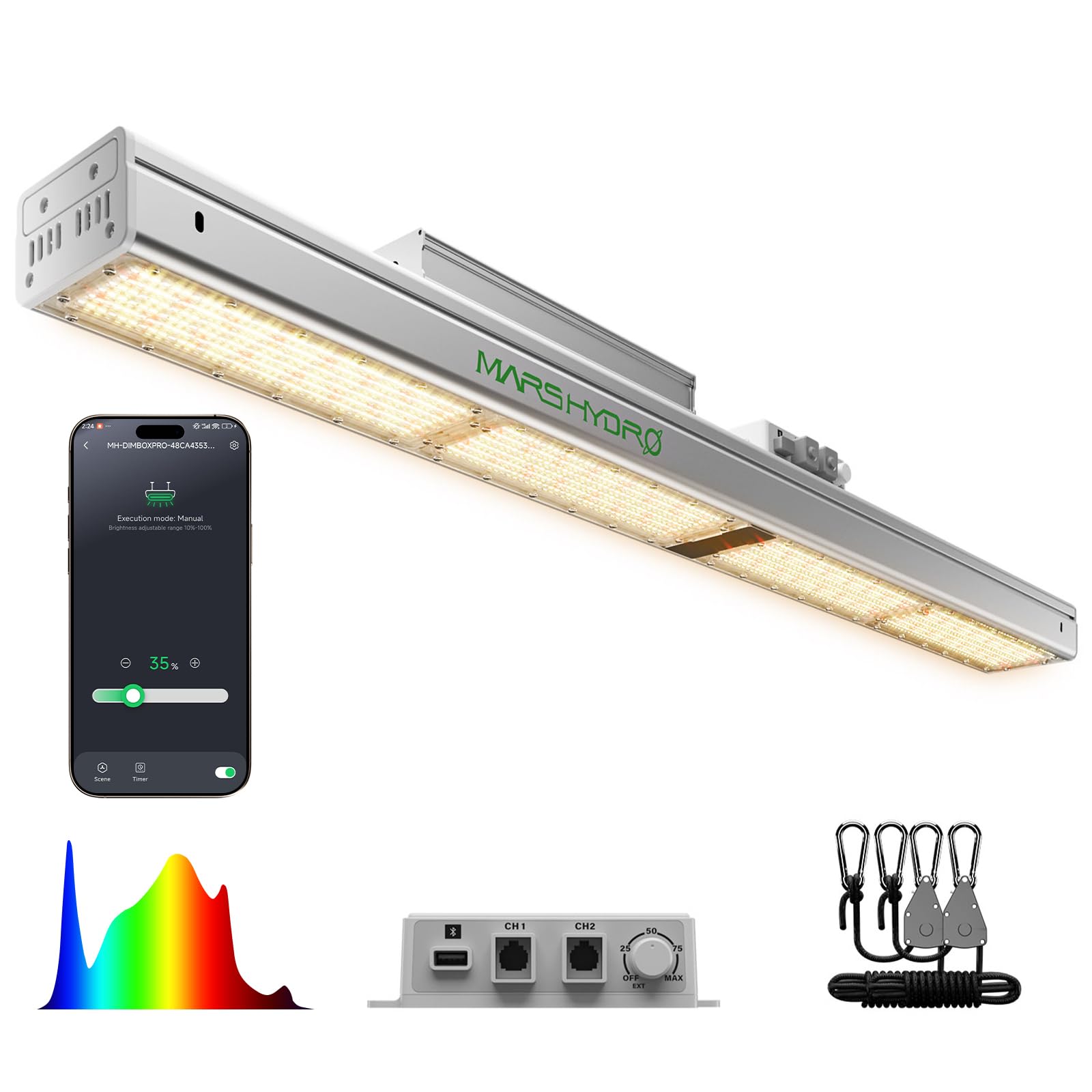
A 300-watt bar that blankets a 4×2 tent with 727 µmol/s of even, high-penetration light.
The SP3000 is built for serious production in a 4×2 footprint. It delivers a PPF of 727.2 µmol/s with an efficiency of 2.8 µmol/J, meaning more of that 300 watts turns into usable plant light rather than heat. The full spectrum combines 3000K warm white, 5000K white, and 660nm red to push germination rates and accelerate flowering. Owners consistently say the coverage is the most even they have seen in a 4×2 — no dim corners, no hot spots.
The daisy-chain dimming box links up to 50 lights for single-cord control — ideal for commercial benches. The aluminum lampshade and extra-thick heat sinks keep the fixture cool, and waterproof sealing technology means it can handle the humid greenhouse environment. You can also add the Iconconnect USB (sold separately) for Bluetooth/WiFi app control, giving you remote dimming and sunrise/sunset modes.
The light itself lacks a physical on/off switch and a dimmer knob from the start (Mars Hydro sent one free to an owner who asked). At 9.9 pounds, it is not the lightest fixture to hang. If you want the strongest 4×2 coverage available without stepping up to a 400W+ fixture, this is the one.
Why it leads
- 727.2 µmol/s PPF provides penetrating light that reaches lower leaves.
- Daisy-chain up to 50 lights from one cord for bench-scale setups.
- Waterproof sealing and thick heatsinks handle humid greenhouses.
Minor drawbacks
- No dimmer knob or on/off switch on the fixture itself.
- Heavy at 9.9 lbs — needs secure hanging hardware.
Choose this if: you are filling a 4×2 tent or commercial bench and want the highest PPF in this class with daisy-chain scalability.
Consider alternatives if: you need fixture-level controls without relying on an external dimmer box or app.
9. Spider Farmer SE3000
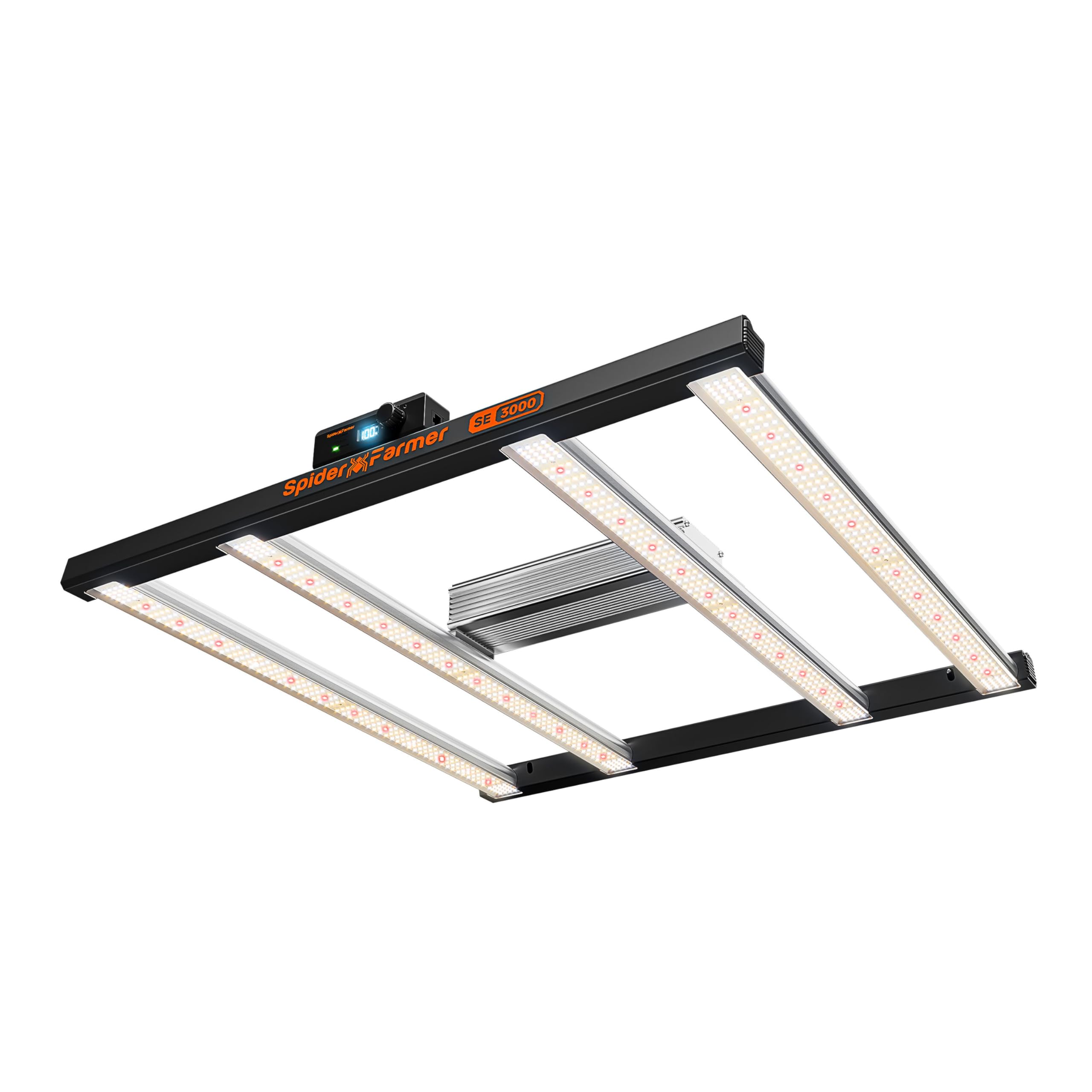
300 watts of Bridgelux diodes that push 826 µmol/s into a compact 3×3 footprint.
You get even light across your whole canopy with the SE3000, Spider Farmer’s app-controlled bar light designed for the 3×3 grow space. It uses premium Bridgelux LEDs to deliver 826 µmol/s (a measure of usable light for plants) at 300 watts, making it among the most efficient lights in this roundup. The bar-style design spreads PPFD (photosynthetic photon flux density, or how much usable light hits each leaf) uniformly across the canopy, minimizing edge drop-off. Reviewers point out exceptional results in 2.5×2.5 and 3×3 tents, with one noting a 25% yield improvement over cooler spectrum lights during flowering.
The tuned spectrum focuses on a plant-centric 437nm blue for root and foliage development, plus 50-55% deep red (660-665nm) for photosynthesis. The dimming box features a digital display for precise brightness control, and the Spider Farmer app adds remote scheduling, sunrise/sunset simulation, and brightness adjustments from anywhere. The driver can be mounted outside the tent, reducing heat inside the growing area — a detail owners consistently appreciate.
The main downsides are a short ballast cord that some find restrictive, and the ballast itself not being securely mountable — you will likely need extra ratcheting straps to hang it cleanly. At this price point, though, you get a light that competes with fixtures costing significantly more, backed by a 5-year warranty.
The value proposition: App control, high-efficiency Bridgelux diodes, and a digital dimming display in a 3×3-tune package. The removable driver is a thoughtful touch that keeps tent temperatures down.
Grab this for: a 3×3 tent where you want app-based automation, high efficiency, and the option to mount the driver outside the grow area.
Think twice if: you prefer a simpler, cord-free installation — the short ballast cord and loose ballast mounting may frustrate you.
Understanding the Specs
PPFD and PAR
PPFD (photosynthetic photon flux density) measures how many photosynthetically active photons hit a square meter each second. The higher the PPFD number, the more usable light your plants receive. A reading of 300-400 µmol/m²/s is plenty for seedlings and leafy greens; flowering plants often need 600-900 µmol/m²/s near the canopy top. Check the manufacturer’s PPFD map to see how even the light really is across your growing area.
Full Spectrum and Kelvin
Full-spectrum lights mix different color temperatures — typically warm white (3000K) and cool white (5000-6500K) — with specific red wavelengths around 660nm and sometimes IR at 730nm. This combination supports the whole growth cycle from seed-starting (blue-heavy) to flowering (red-heavy). You do not need to switch bulbs between stages; one full-spectrum fixture handles it all.
FAQ
How many hours per day should I run grow lights in a greenhouse?
What is the difference between PPF and PPFD?
Can I use indoor grow lights in a greenhouse?
Do I need a separate controller for app-based lights?
How close should I hang a 150W grow light to my plants?
What does “daisy chain” mean on a grow light?
Are bar-style grow lights better than panel lights?
How long do LED grow lights typically last?
Can I leave a grow light on 24 hours a day?
Will grow lights significantly increase my electricity bill?
Final Thoughts: The Verdict
For most buyers, the best grow lights in a greenhouse is the VIPARSPECTRA XS1500 Pro because it combines adjustable dimming, daisy-chain scalability, and genuinely even PAR distribution at a wattage that won’t overwhelm a typical greenhouse circuit. If you are outfitting a shelf of seedlings or want ultra-thin panels with an auto timer, the Barrina Panel 4-Pack is a versatile, low-profile alternative. And for large 4×2 production benches where you want the strongest coverage, the MARS HYDRO SP3000 delivers the highest PPF per watt in this lineup — just budget for the dimmer box if you need front-panel control.
How We Picked
We do not accept paid placement. Every pick is matched to a real buyer and a real use-case; we do not hands-on test units.
Sources & Methodology
Specifications: manufacturer listings and product documentation. Review insights: verified customer reviews, as of July 2026. Pricing: not shown on this page (it changes often); check the current price via the retailer link.
As an Amazon Associate, Lawn Gear Lab earns from qualifying purchases. This does not affect which products we feature.