
Specs are compiled from manufacturer listings and verified buyer reviews and can change over time — please confirm the key details on the product page before buying.
Potatoes are hungry for light — 12 to 16 hours of it every day. Give them weak garage bulbs and you get pale, leggy plants and a skimpy harvest. The right light pushes energy straight into the tubers, so a 5-gallon bucket under the stairs can out-produce a sunny raised bed. This guide cuts through the confusing specs — PPFD, spectrum, wattage — and points you to the fixture that actually delivers.
I’m Rikta — the founder and writer behind Lawn Gear Lab. This guide is built by comparing the manufacturers’ published specifications and the patterns across verified customer reviews, so you get each pick’s real strengths and trade-offs instead of marketing spin.
Whether you are starting seed potatoes in late winter, running a full indoor grow tent, or just supplementing a dim windowsill, you need a fixture that delivers the intensity and canopy penetration heavy feeders demand. This roundup covers the grow lights for potatoes that actually move the needle from spindly greens to dense, starchy tubers.
Our Picks at a Glance

How To Choose The Best Grow Lights For Potatoes
Potatoes need high light intensity (PPFD) across the full canopy for the entire veg-to-bulking cycle. A few critical features separate a fixture that produces golf-ball spuds from one that gives you fist-sized tubers.
Full Spectrum and the Red Boost
Look for a light that includes deep red (around 660nm) and far-red (around 730nm) diodes in addition to the standard cool white. Potatoes in the flowering/bulking phase respond strongly to that red spectrum — it encourages the plant to shift energy from leaf growth down into tuber formation. A light that is only “daylight” will keep the vine green but may not trigger heavy yields.
PPFD and Coverage Area
For potatoes, you want a PPFD (Photosynthetic Photon Flux Density — the number of usable light particles hitting a square meter every second) of at least 400 to 600 μmol/m²/s across the canopy at the recommended hanging height. A cheap blurple panel might claim “1000W equivalent”, but the spread is often narrow. Compare the actual footprint — a 2×2 ft coverage with high intensity beats a 3×3 ft coverage with weak, uneven light.
Dimming and Timer Functions
An auto on/off timer (3H, 4H, 12H, 16H cycles) is non-negotiable if you want consistent day/night schedules without touching the light. Dimmability lets you start seedlings under a gentler intensity and crank it to full power during tuber bulking without changing fixtures. A few models also daisy-chain together, which helps if you plan to expand your potato operation across a larger tent.
Quick Comparison
| Model | Best For | Power Draw | Coverage (Veg) | Dimming / Timer | Amazon |
|---|---|---|---|---|---|
| Spider Farmer SF1000★ Best Overall | Best Overall | 100W | 2×2 ft | Dimmable (knob) | Amazon |
| Kullsinss 4-Head Floor LampTall Plant Pick | Tall plants, shelf growing | Not specified | Adjustable | 3 modes / 4/8/12/16H timer | Amazon |
| Yehsence 10-in-1 TripodWide Coverage | Wide coverage | Not specified | Large (10 heads) | 4/8/12H auto timer | Amazon |
| TYAGMAM 4-Pack T8 | Seed starting, shelves | 180W total | 4 ft strips | Plug-and-play (chainable) | Amazon |
| Spider Farmer SF600 | Seedlings, small shelves | 72W | 2×4 ft | Plug-and-play | Amazon |
| GLOWRIUM 48W Dual-Head | Living rooms, tall houseplants | 48W | Dual heads (adjustable) | Stepless dimming / 3/9/12/16H timer | Amazon |
| GLOWRIUM White Dual-Head | Tall, decorative grow lamp | 48W | Up to 70.9 in tall | 6-level dimming / 3/9/12/16H timer | Amazon |
| VIPARSPECTRA XS1500 Pro | High intensity, larger tents | 150W | 3×3 ft / 2×2 ft flower | Dimmable (daisy chain) | Amazon |
| VIVOSUN AeroLight A100 | Grow tents with airflow | 100W | 2×2 / 2×4 ft | App/smart controller (sold separately) | Amazon |
In‑Depth Reviews
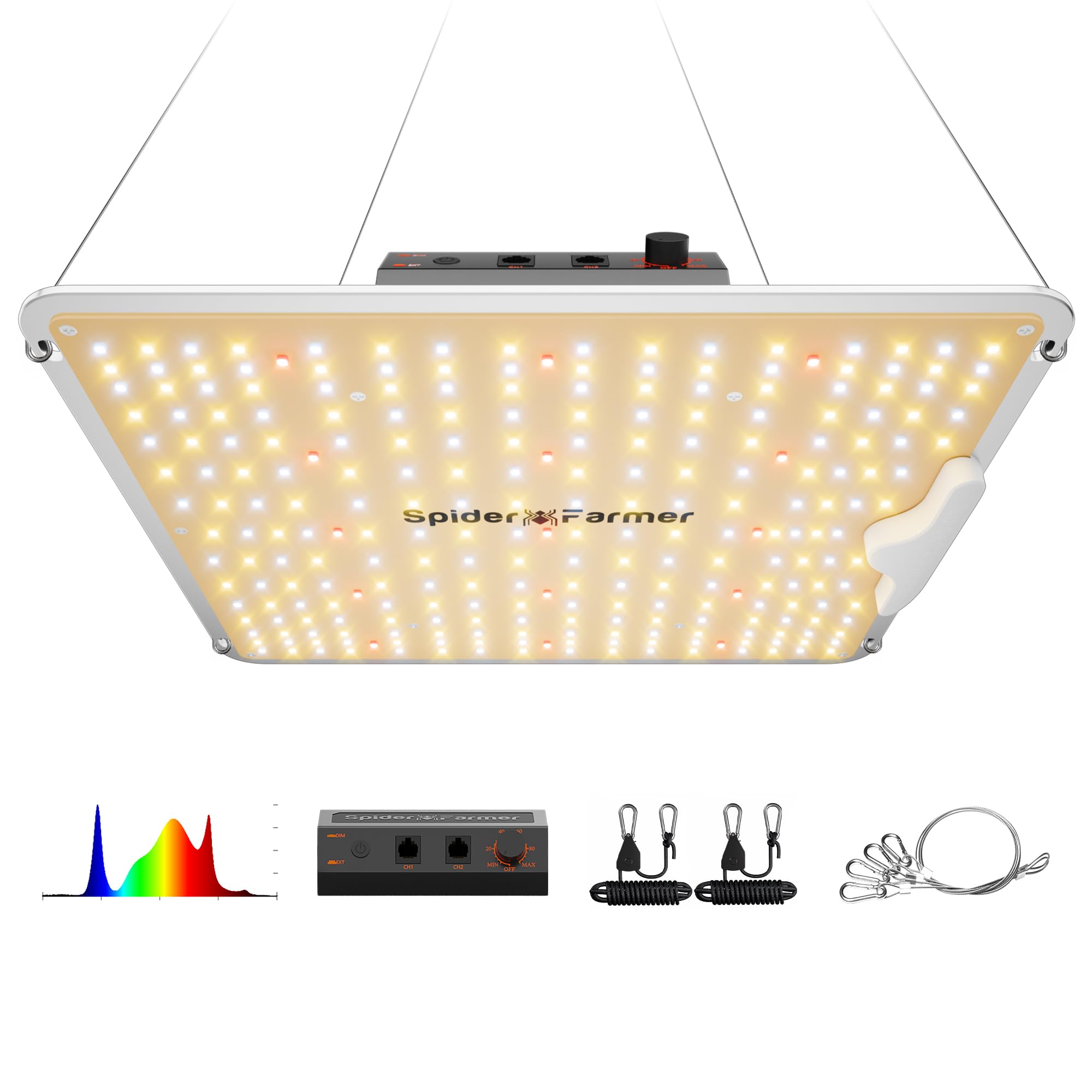
1. Spider Farmer SF1000 LED Grow Light
Our pick — over 4.5★ from 12,000+ verified ratings; the strongest balance of quality and price.
The dimmer knob that turns a 2×2 tent into a potato factory.
This 100W panel packs a punch that belies its 10.5 x 11.8-inch footprint. The new-gen diodes deliver a 2.5 µmol/J PPE (Photosynthetic Photon Efficacy — the light fixture’s efficiency in converting electricity into usable plant light) with a full spectrum that includes blue for leafy veg growth and a strong red/IR push (660nm and 760nm) for tuber bulking. The dimmer lets you start seedlings at gentle intensity and ramp to full power when the plants demand it — all without swapping fixtures. Buyers report running four of these across a 4×4 tent with zero complaints about build quality or light uniformity. The fanless, silent operation means no hum in a bedroom or living room setup.
The 5-year warranty (with local service centers in the US, CA, UK, EU, and AU) backs a well-made aluminum heat sink that keeps the unit cool. At 5.8 pounds it hangs securely from standard tent bars, and the daisy-chain compatibility means you can scale your potato garden without adding more wall outlets. One owner sums up the consensus: “I’ve bought 4 of these, no complaints at all.” The only true trade-off is coverage — this is a focused 2×2 ft panel, so a single unit alone will underwhelm in a 4×4 space unless you pair multiple together.
The fixture also delivers consistent full-spectrum performance across all growth stages. The 10000-lumen output is evenly distributed thanks to a refined diode layout that pushes more PPFD to the edges, not just the center. That even spread matters for potatoes — you want every plant in the tent to bulk at the same rate, not just the ones directly under the hot spot.
Why it wins the tent
- Dimmable intensity for stage-appropriate light
- Silent, fanless operation
- 5-year warranty with local service
Room for a second light
- Best in a 2×2 tent; one unit is not enough alone for a 4×4
Reach for it if: you have a 2×2 or 3×3 tent and want a single, dimmable fixture with proven reliability for the full potato lifecycle.
Think twice if: your growing space is a large 4×4 area — you will need two (or more) of these to cover the canopy evenly.
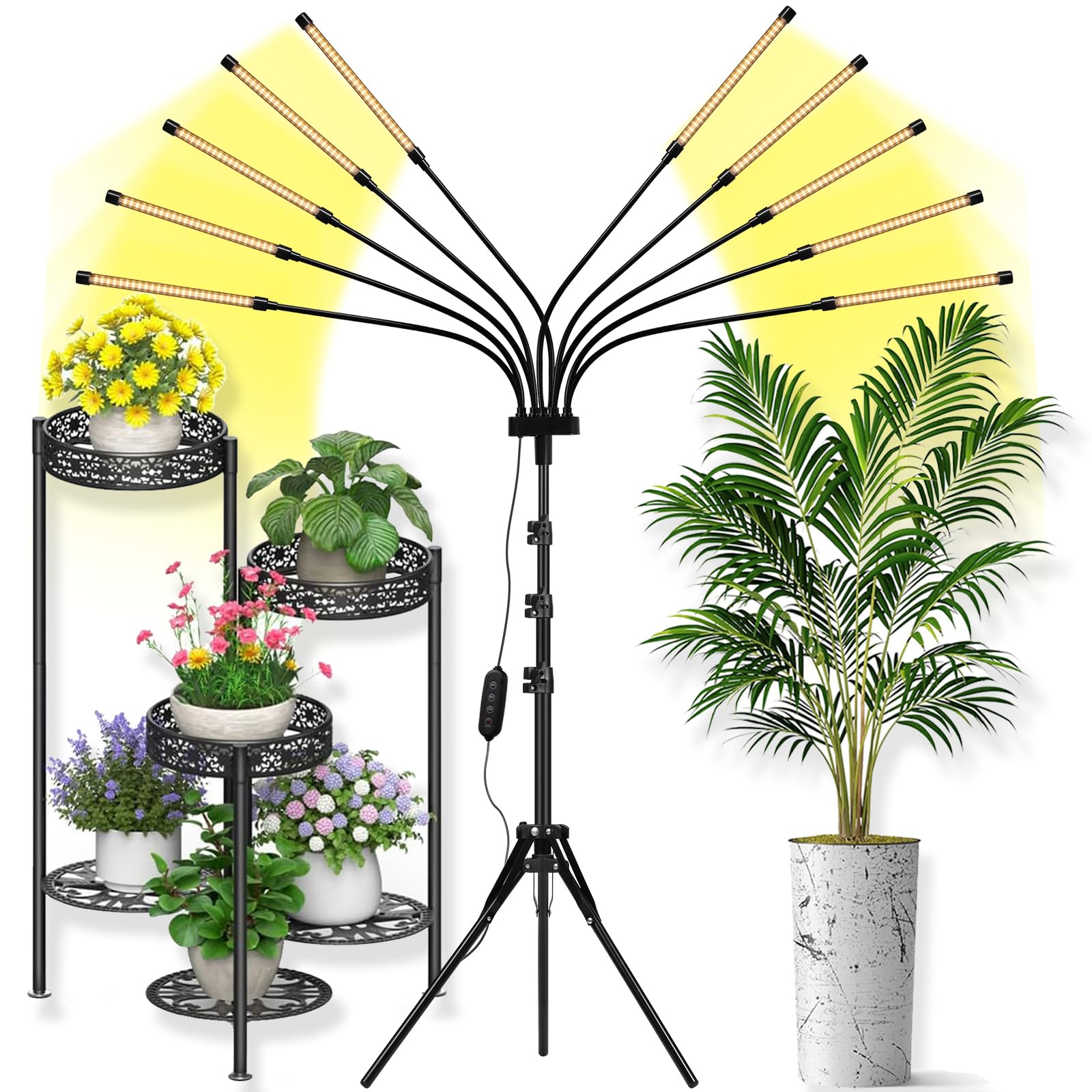
2. Kullsinss 4-Head Floor Grow Light
The floor lamp that turns a dark corner into a potato patch.
Potatoes in a grow bag on a floor? This 4-head floor lamp adjusts from 24 to 68.7 inches tall, so you can position the light directly over a row of potato bins. The 114 high-efficiency LEDs (3000K warm white, 6000K cool white, 460nm blue, and 660nm red) deliver a full spectrum that mimics natural light from germination to flower. The 360° goosenecks on each head mean you can aim light exactly where the canopy is thickest.
The smart controller is the star here: 3 color modes (white, warm white+red, and a mixed blend) plus 5 dimmable levels from 20% to 100%. The automatic timer — 4, 8, 12, or 16 hours — matches a potato’s long-day needs perfectly. Owners note the timer resets after a power outage, so you will need to re-set it if the power flickers, but the build quality and light intensity earn high marks across the board. The large 9-inch metal base is generally stable; a few buyers mention it can feel a little wobbly at full height unless you place a decorative book or object on the base panel as the instructions suggest.
Assembly takes minutes with no tools required, and the minimalist look — a sleek lampshade and metal base — blends into a living room better than a tent-based fixture. For a grow bag on the floor, you get the height flexibility and timer automation that make consistent light cycles possible.
Verdict from the grow room: one owner who tested it on tropicals and succulents reports improved plant health with the timer set to 12 hours and the dimmer at mid-level. The 4-head design covers a wide enough arc for a cluster of potato containers.
Who it fits: growers using floor grow bags or tall shelving who need a sleek, adjustable lamp with a reliable timer but no tent setup.
One real trade-off: the timer is not memory-backed after a power interruption, so you will need to re-program if the grid goes down.
3. Yehsence 10-in-1 Tripod Grow Light
Ten heads, 500 LEDs — blanket coverage for a potato patch.
This is the light to grab when you have a table full of potato starts or a wide shelf of grow bags. The 10 lamp heads each contain 50 LEDs and sit on 15-inch flexible goosenecks, so you can spread them out and point each directly at a different plant. The total fixture emits a balanced mix of blue (400–500nm) and red (600–750nm) that appears as soft white light to the eye — comfortable to work under and effective for photosynthesis.
The auto timer cycles in 4, 8, or 12-hour blocks and repeats daily once set, so your potatoes get the same light window every day without you touching the switch. The tripod stand is reinforced to handle the weight of 8+ heads securely, and the lamp shades use a flame-retardant material. Buyers on the review pages praise the setup speed: it takes about five minutes to assemble. The 500-LED output is intense enough to replace regular room lamps and promote noticeable new growth in a matter of days, as owners of orchids, holiday cacti, and general houseplants report.
The one area where this light earns straightforward praise is coverage — the 10-head design covers a large area that a single-panel light cannot match, making it a strong candidate for a potting bench or a greenhouse shelf full of potatoes.
What owners highlight
- 10 independently adjustable heads for custom coverage
- Natural white light, not harsh pink/purple
- Sturdy tripod base with reinforced support
What to note
- Plastic housing may not feel as premium as all-metal panels
Ideal for: a wide shelf of seed-starting trays or a row of potato grow bags where you need even distribution from multiple angles.
Think twice if: you need deep canopy penetration for dense foliar growth — the open-head design is better for surface coverage than punch-through.
4. TYAGMAM 4-Pack T8 LED Grow Lights

Four long strips that turn a wire shelf into a seed-starting station.
These 4-foot T8 bars are the classic solution for under-shelf potato seed starting. Each strip draws 45W (180W total for the pack) and delivers a full-spectrum pinkish light that mimics natural sunlight. The integrated reflector boosts efficiency by 20% — you get more usable light on the plants without extra wattage. The aluminum housing doubles as a heat sink, so the strips stay cool enough to run inches above seedlings without scorching them.
Installation is genuinely plug-and-play: use the included clips to mount them under a shelf, or use the hanging rings for a ceiling mount. They daisy-chain together with the 36-inch connecting cords, which means one outlet powers all four. A buyer who has been running them in a greenhouse for a year says the seedlings thrive and the lights run cool. Another owner chained them to a standard timer for automatic 16-hour cycles. The 5000K color temperature gives a bright, “daylight” tone that encourages compact growth rather than the leggy stretching you get from warm household bulbs.
For the price of a four-pack, you cover a long shelf or a 4×4 seedling area. The 1080W equivalence claim is marketing math — the real power draw is 180W — but the actual performance at that draw is solid for early-stage potato growth. These will not give you the deep canopy punch needed for bulking in a tent, but for getting seed potatoes to a strong, bushy start, they are tough to top.
The bottom line: a straightforward, low-cost way to light up a multi-shelf operation for seedlings and early veg growth. Not the choice for a full flowering cycle.
Best match for: anyone starting potatoes from seed or chitting on a shelving unit in a basement or spare room.
skip it if: you are running a full grow tent cycle through flower — you will want a higher-intensity panel like the SF1000 or XS1500 Pro.
5. Spider Farmer SF600 LED Grow Light

The slim bar that puts 72 watts to work on a shelf of seed potatoes.
This is the little brother to the SF1000 and it knows its lane. The SF600 draws only 72 watts but outputs 11,000 lumens from 384 LEDs — enough to cover a 2×4 ft area when hung for seedlings. The full spectrum includes 660-665nm red and 730-740nm far red, along with warm white and blue, giving you spectrum depth for both early leaf growth and the transition to flowering. The beam angle is a wide 120 degrees, which spreads the light evenly rather than creating a single hot spot.
Owners consistently use this light for micro-dwarf tomatoes, seedlings on wire shelves, and small 2×4 veg tents. They report that plants flower and fruit phenomenally — a strong sign that the spectrum is well-balanced. A buyer running three of these on a 16-hour timer notes satisfaction with the quality of growth. At 3 pounds and 39.3 inches long, it hangs easily from shelf brackets or tent bars with the included hardware. The 120-degree beam angle means you can keep it relatively close to the canopy without burning, which is helpful for tight shelf spaces.
The honest trade-off: at 72W, it is not the brightest light in the lineup. Some owners find it less intense than they expected for a full vegetative canopy on larger plants. It is perfect for a seedling stage and early veg, but for a full potato bulking cycle in a tent, the SF1000 or a higher-wattage panel is a better choice.
Where it shines
- Extremely low power draw for a 2×4 footprint
- Full spectrum for germination through early bloom
- Lightweight and easy to install
Where it falls short
- Moderate brightness; will not penetrate a dense, full-size potato canopy
Grab it for: a 2×4 veg tent, a seedling shelf, or a wire rack full of potato starts. It sips power and delivers results at close range.
Skip it for: a flowering/bulking cycle in a tent — you will want a higher PPFD panel.
6. GLOWRIUM 48W Dual-Head Floor Lamp
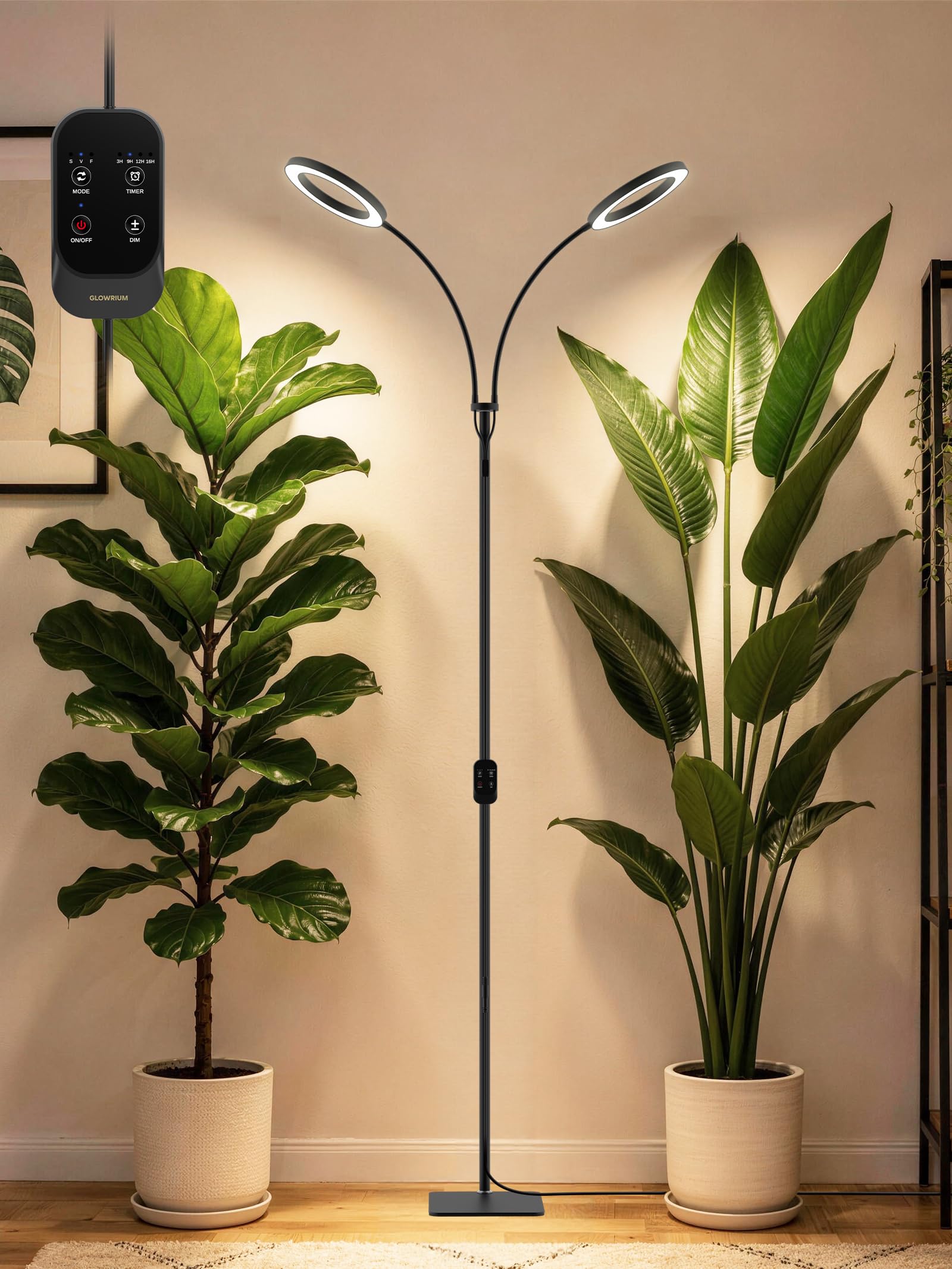
The lamp that grows cherry tomatoes indoors and still looks like furniture.
This dual-head floor lamp from GLOWRIUM packs a surprising punch for a decorative fixture. Each enlarged lamp head has a 360° flexible gooseneck, so you can aim one head at a tall potato plant and angle the second to cover a nearby container. The 48W output is driven by a safe 24V low-voltage system, which keeps heat low and operation stable. The 4-section pole extends up to 79 inches — enough to hover over a 5-foot plant.
The built-in timer offers cycles of 3, 9, 12, or 16 hours, and the stepless dimming lets you dial intensity from a soft glow to full power. The matte black finish and frosted diffuser give off a soft, high-efficiency light that doesn’t scream “grow tent.” Owners mention African violets blooming and fresh cherry tomatoes producing all winter — both signs that this light has the spectrum depth for fruiting crops like potatoes. The 10.83-inch aluminum base keeps the assembly stable, and assembly takes just a few minutes. The two-year warranty adds confidence for a long indoor season.
The honest downside: at 48W, this is not a replacement for a 100W+ panel in a tent. It is a supplementary light for a living room potato corner or a specimen plant, not a primary light for a dense canopy.
What owners love: one owner who runs it 16 hours a day notes the minimal electric bill increase. Another says their plants “perked up instantly.” The adjustable height earns consistent praise from those with tall houseplants.
Perfect for: a decorative floor lamp setup in a bright living room where you need supplemental light for a potato container or tall houseplant.
Not for: a full grow tent cycle where you depend on the light as the sole source.
7. GLOWRIUM White Dual-Head Tall Plant Light
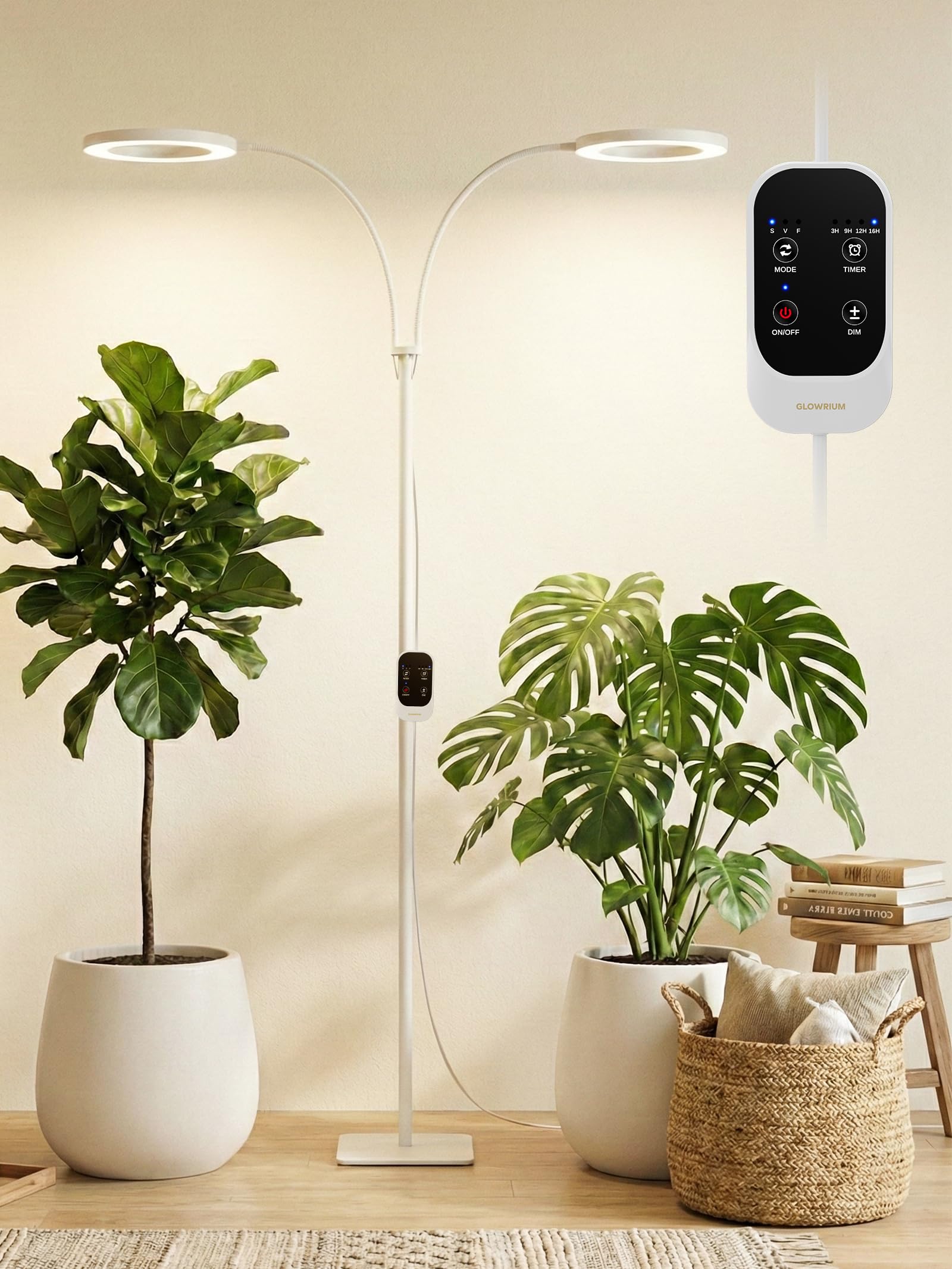
The 6-foot-tall tower that feeds your fiddle-leaf and your fingerlings.
GLOWRIUM’s white version of the dual-head lamp shares the same 48W platform but adds dedicated spectrum modes for Seedling, Vegetative, and Flowering stages — a rare feature in a decorative floor lamp. Each mode tunes the LED output to match the plant’s phase, giving your potatoes more red in the flower cycle without manual fiddling. The dual 7.87-inch heads each bend independently, so you can direct one beam at a tall potato plant and the other at lower foliage.
The PPFD at 6 inches reaches up to 280 μmol/m²/s, which is solid for close-range supplementary lighting. The 6-level dimming (10% to 100%) plus a press-and-hold stepless option gives precise control. The base is made of iron and weighs enough (5.29 lb for the base alone) to keep the assembly stable even at full 70.9-inch extension. Assembly takes about five minutes, and the lacquered finish is durable. The 50,000-hour lifespan means this fixture could serve a decade of potato seasons.
Owners consistently praise the build quality. The customers-say summary calls attention to the sturdy construction, stable base, and natural illumination that improves plant health. One buyer with a 5-foot 9-inch fiddle leaf fig saw visible health improvements within a month. The trade-off is the same as its black counterpart: 48W is supplementary power, not a tent-level primary source.
Standout features
- Dedicated S / V / F spectrum modes for each growth stage
- 50,000-hour LED lifespan
- Heavy, stable iron base
The caveat
- 48W total is best as a supplement, not a primary source for a large tent
Reach for this if: you want a tall, attractive lamp that automatically shifts spectrum for a potato plant in a large pot.
Look elsewhere if: you need high-intensity canopy penetration for a full grow tent.
8. VIPARSPECTRA XS1500 Pro LED Grow Light

The 150W panel that lays down 747 PAR at 13 inches for serious tuber weight.
This is the light you pick when you want measurable PAR numbers and a proven track record for root crops. The XS1500 Pro draws 150W (replacing a 250W HPS/MH in coverage but sips less power) and uses optical lenses to focus light with minimal loss, creating a uniform PPFD across the entire canopy. Customers note an excellent PAR reading of 747 μmol/m²/s at 13 inches with the dimmer at 50% — enough intensity to drive aggressive bulking in a 2×2 ft flowering footprint. The fixture covers a 3×3 ft veg area comfortably.
The full spectrum includes white 3000K, 5000K, deep red 660nm, and IR 730nm LEDs, giving you the red push potatoes need during the flowering/bulking stage. The daisy-chain feature lets you connect up to 20 units for unified dimming — overkill for a hobby potato grower but a clear sign of commercial-grade design. The included dimming cable gives exact brightness control, and the aluminum heatsink keeps the unit cool enough to run for 12-hour cycles without issue. At 2.55 kg (about 5.6 lb), it hangs securely from tent bars.
The only hiccup some owners note is the lack of a dedicated on/off switch on the unit — the dimmer acts as the power control, which takes a moment to get used to. But the brightness distribution, solid build, and consistent edge-to-edge lighting earn repeated praise. For potatoes in a 2×2 or 3×3 tent, this is a primary light that delivers.
The data speaks: one owner who tested it on tomatoes and beets confirms the adjustable intensity and even canopy coverage. Another notes the daisy-chain and brightness control as standouts for a multi-plant setup.
Choose this for: a high-yield 2×2 or 3×3 grow tent where you want maximum PPFD per watt for the bulking stage.
pass on it if: you need a light for a shelf or living room — this is purpose-built for a tent with hanging hardware.
9. VIVOSUN AeroLight A100 100W
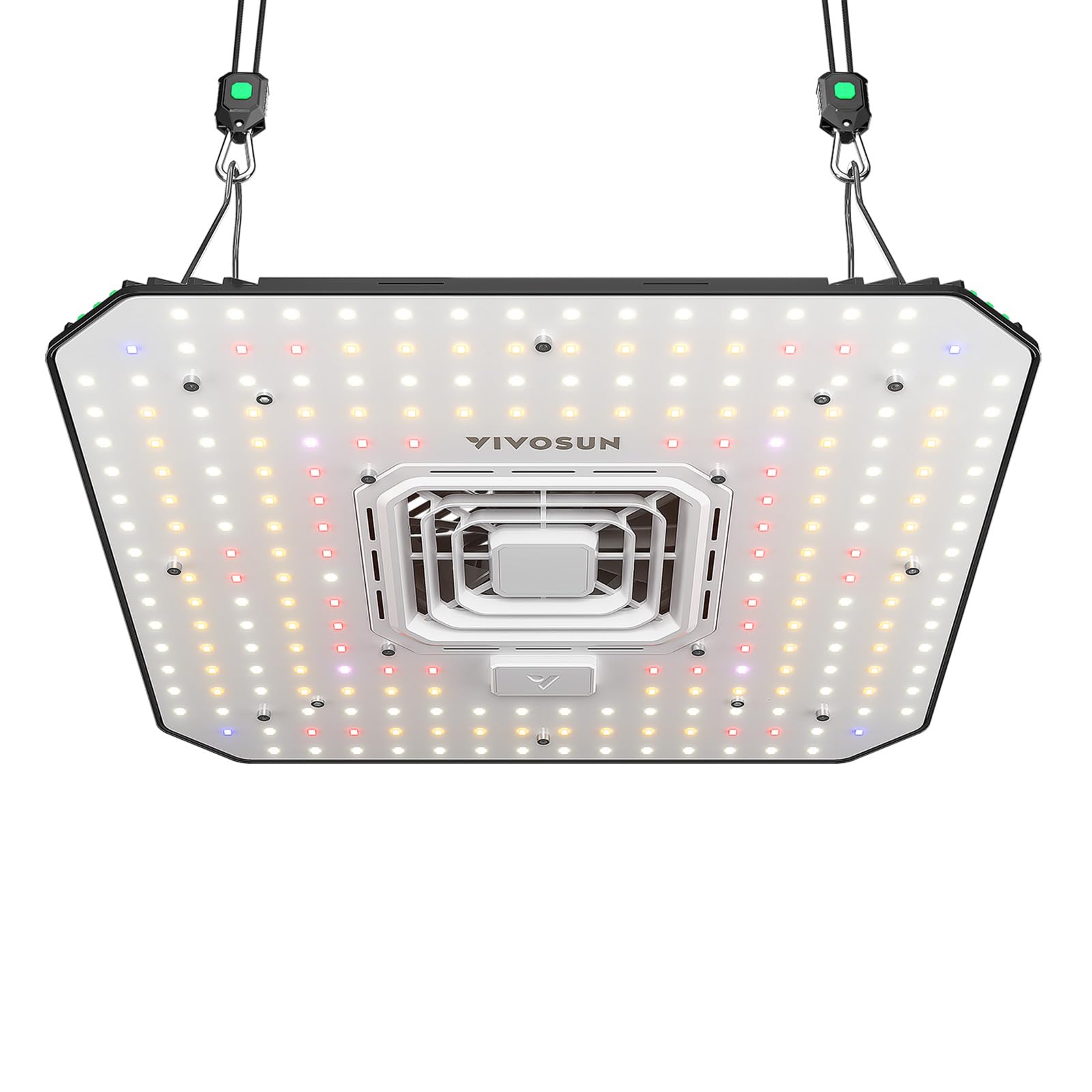
The hollow circle that blows air onto the canopy while blasting light down.
This is not just a light — it is an integrated circulation fan and LED panel in one ring-shaped unit. The A100 draws 100W and covers a 2×2 or 2×4 ft tent with full-spectrum lighting (390nm-730nm, 3000K and 5000K). The centrally located fan pushes air downward through the hollow center, reaching parts of the canopy a clip fan cannot. That airflow is crucial for potato plants in a dense tent — it strengthens stems and prevents stagnant humidity that invites mold.
The smart feature set is the headline. The AeroLight is compatible with the VIVOSUN GrowHub Controller (sold separately) and the VIVOSUN App, which lets you automate day/night schedules, dim the light, and even simulate natural weather patterns. If you do not buy the controller, the light runs at full power with basic on/off. Buyers point out this requirement as a notable expense — the controller is a separate purchase. However, those who use it report excellent results, with one owner calling it the best lighting purchase for a 4×4 tent.
The unit weighs 2.6 kg (about 5.7 lb) and measures 13 x 13 x 1.77 inches. The magnetic iron plate and hanging hooks make mounting simple. The industrial-grade fan with dual ball bearings runs quietly, and the aluminum alloy heatsink extends the lifespan. If you are building a VIVOSUN tent ecosystem and want a light that also moves air, this is a tidy integration.
The smart-grow advantage
- Built-in circulation fan for direct canopy airflow
- App control (with GrowHub) for automated cycles
- Hollow design circulates air efficiently through the fixture
What to know before buying
- Controller sold separately; without it, smart features are locked
- Some reviewers point out missing screws for the H-brackets
Ideal for: a VIVOSUN tent grower who wants a light and fan in one unit, with the option to automate via app.
Think twice if: you don’t want to buy the separate controller, or if you prefer a simpler plug-and-play panel with no app dependency.
Understanding the Specs
PPFD — Photosynthetic Photon Flux Density
PPFD measures the number of photons (individual light particles) in the 400-700nm range that land on a square meter every second. It is the real number that tells you how much usable light your potato plants are getting. A guide: 200-400 μmol/m²/s for seedlings, 400-600 for vegetative growth, and 600+ for flowering/bulking. Panel coverage area matters — a high PPFD in a tiny circle is worse than a moderate PPFD spread evenly across your canopy.
Daisy Chain vs. Single Unit
A daisy-chain function lets you connect multiple lights in series so one outlet and one controller manage them. This is a big deal if you have a 4×4 tent that needs two panels or a shelf with three strips. Without daisy-chaining, you either plug each into a separate outlet or use a power strip with separate dimming on each. Most premium panels (like the VIPARSPECTRA XS1500 Pro and Spider Farmer SF1000) offer this feature.
Timer Types and What They Do
Timers are essential for potatoes, which thrive on 12-16 hours of light. An analog plug-in timer works with any light, but a built-in timer on the fixture itself (offering 4/8/12/16H cycles) saves you the extra hardware. Some timers “remember” their schedule after a power outage; others reset and need re-programming. Look for a memory function if your area has frequent power blips.
Full Spectrum and Red Ratio
A “full spectrum” light includes wavelengths from blue (around 450nm) through red (around 660nm) to far-red (around 730nm). For potatoes, the red to far-red ratio is particularly important during the tuber bulking phase — it triggers the plant to send energy underground. Lights that explicitly list 660nm and 730nm diodes (like the Spider Farmer and VIPARSPECTRA models) are better suited for a full grow cycle than generic “daylight” LED strips.
FAQ
How many hours of light do potatoes need each day?
Can I use a regular LED shop light for growing potatoes?
What is PPFD and why does it matter for potatoes?
How close should I hang the grow light to potato plants?
Do I need a timer for my potato grow light?
Can I daisy chain multiple lights together for a bigger potato setup?
Will a 48W floor lamp grow potatoes from start to harvest?
How much electricity will a 150W grow light cost per month?
What is the difference between veg and bloom spectrum modes?
Do I need a grow tent for potato lights?
Final Thoughts: The Verdict
For most growers, the grow lights for potatoes winner is the Spider Farmer SF1000 because it packs a dimmable 100W punch into a silent, fanless panel with a 5-year warranty — and an army of 12,000+ owners back its reliability. If you want even higher intensity for a larger tent, grab the VIPARSPECTRA XS1500 Pro; the 747 μmol/m²/s PAR at 13 inches is proven data, not marketing hype. And for an open-shelf or living room setup where the light also needs to look good, the Kullsinss 4-Head Floor Lamp or the Yehsence 10-in-1 Tripod both offer the adjustable coverage and timer automation that potatoes demand.
How We Picked
We do not accept paid placement. Every pick is matched to a real buyer and a real use-case; we do not hands-on test units.
Sources & Methodology
Specifications: manufacturer listings and product documentation. Review insights: verified customer reviews, as of July 2026. Pricing: not shown on this page (it changes often); check the current price via the retailer link.
As an Amazon Associate, Lawn Gear Lab earns from qualifying purchases. This does not affect which products we feature.