
Specs are compiled from manufacturer listings and verified buyer reviews and can change over time — please confirm the key details on the product page before buying.
If your houseplants are looking leggy, pale, or just sad, the real problem is almost always not enough light. A good grow light fixes that by delivering the specific wavelengths plants need to photosynthesize, even in a dark corner or windowless office. The trick is picking one that puts out enough intensity for your specific plants without turning your home into a sci-fi set.
I’m Rikta — the founder and writer behind Lawn Gear Lab. This guide is built by comparing the manufacturers’ published specifications and the patterns across verified customer reviews, so you get each pick’s real strengths and trade-offs instead of marketing spin.
Whether you are nurturing a single succulent on your desk or setting up a shelf of start seeds, here is exactly what you need to know before choosing from the best grow lights for indoor plants available right now.
Quick Picks
- VIPARSPECTRA XS1500 Pro — Top Performer
- MARS HYDRO TS1000 — Best Value
- VIVOSUN LumaLight 200W — Smart & Large
- SANSI 4-Gooseneck Clip — Versatile Clip
- GLOWRIUM Floor Lamp — Floor Lamp
- JESLED 4FT Strip — Shelf Power
How To Choose The Best Grow Lights For Indoor Plants
Picking a grow light can feel overwhelming because there are so many shapes, sizes, and wattages. Focus on these three factors to narrow your options fast.
Light Spectrum — Full Spectrum vs. Blurple
Full-spectrum lights produce a white light that includes all wavelengths from 380nm to 800nm, which mimics natural sunlight. These are ideal for all growth stages — from seed starting to flowering — and look much nicer inside a living space. Some lights also include specific red (660nm) and infrared (730nm) LEDs to boost photosynthesis and flowering, which is a concrete spec to look for if you are growing fruiting plants.
Coverage Area and Intensity (PPFD)
Lumens measure how bright a light looks to your eyes, but PPFD (Photosynthetic Photon Flux Density) measures how many usable light particles reach your plant’s leaves. A spec sheet that lists PPFD values at specific distances (for example, 747 μmol/m²/s at 50% power and 13 inches) tells you far more about real plant performance than wattage alone. Match the light’s coverage footprint to the size of your grow area — a large panel is overkill for a single desk plant, and a tiny clip light will not cut it for a 4-foot shelf.
Dimmable Controls and Timers
A built-in auto timer that cycles on and off daily (common options are 3/9/12 or 4/8/12 hours) saves you from forgetting to turn the light off. Dimmability is critical for adjusting intensity as your plants move from the delicate seedling stage to high-demand flowering without scorching them. Look for a physical dimming knob or a smart app if you want to automate schedules.
Quick Comparison
| Model | Best For | Wattage | Dimensions (L x W x H) | Weight | Amazon |
|---|---|---|---|---|---|
| VIPARSPECTRA XS1500 Pro | Serious growers wanting premium PPFD | 150W | 14.2″ x 11.4″ x 3.1″ | 2.55 kg | Amazon |
| MARS HYDRO TS1000 | Tent growers wanting a proven quantum board | 150W | 14.2″ x 13.2″ x 1.4″ | 1.7 kg | Amazon |
| VIVOSUN LumaLight 200W | Large tent setups with app control | 200W | 23.5″ x 11.8″ x 2.95″ | 9 lbs | Amazon |
| SANSI 4-Gooseneck Clip | Desktops and multi-plant shelves | 40W (10W per head) | 8.46″ x 7.56″ x 5.51″ | 3.09 lbs | Amazon |
| GLOWRIUM Floor Lamp | Tall potted plants and living rooms | 20W | Adjustable to 63″ | — | Amazon |
| JESLED 4FT Strip | Greenhouse racks and long shelves | 96W (2 x 48W) | 47″ x 2″ x 2″ | — | Amazon |
In‑Depth Reviews
1. VIPARSPECTRA XS1500 Pro

A serious quantum board that delivers exceptionally uniform light across every corner of your grow area.
The XS1500 Pro uses optical lenses (small domes that focus the beam) to keep light on the canopy instead of spilling onto walls. At 150W, with a 120-degree beam angle, buyers report one measured 747 μmol/m²/s (a unit for usable plant light) at 50% power and 13 inches — meaning number plates stay readable at night. That makes this a strong fit for demanding plants like cherry tomatoes and super-hot peppers. The full spectrum includes white 3000K, 5000K, red 660nm, and IR 730nm LEDs, so it supports every growth stage from seed starting to flowering without needing a second light.
Unlike the MARS HYDRO TS1000, which uses a thin reflector panel, this VIPARSPECTRA relies on its lens design to achieve what the brand calls “the most uniform PPFD at all corners.” The dimming-and-daisy-chain feature lets you connect up to 20 units for unified control, and owners mention the adjustable intensity dial is easy to dial in for different growth stages. The catch: at 2.55 kg (about 5.6 lbs) it is noticeably heavier than the 1.7 kg TS1000, and some owners mention there is no built-in off switch, so you will want a separate timer.
What impresses
- Optical lenses deliver high PPFD with minimal light loss
- Daisy chain up to 20 units for large setups
- Full spectrum works for every growth stage
The trade-offs
- Heavier than similar 150W panels
- No built-in on/off switch; needs a timer
Grab it for: growers who want uniform, intense coverage with the flexibility to expand into a multi-light daisy chain setup.
Consider something else if: your setup is a single desktop pot — this panel is designed for a 2×2 or 3×3 tent and will overpower one plant.
2. MARS HYDRO TS1000

The workhorse quantum board with a patented reflector that squeezes more usable light from every watt.
This 150W light uses a patented white reflector hood with a 120-degree refraction angle to increase light utilization — more of the light actually reaches your plant leaves instead of bouncing around the tent. It packs 354 SMD LEDs (small surface-mount diodes) arranged dense in the middle and sparse on the sides, giving even coverage for a 2.5×2.5ft footprint (max 3x3ft). Reviewers report it runs completely silent since it is fanless, and one long-term owner noted that after 6+ months their plants produced “dense, potent fruit.”
One reviewer specifically mentioned the TS1000 was an “immediate improvement over King LED 1200w” and that their tomato plant grew significantly after just one night. At just 0.63 Amps and 150W consumption, it is designed to replace a 250W HPS (a high-pressure sodium lamp). The dimmable external driver allows adjustments from 0-100%, and you can daisy chain up to 50 lights together. On the downside, some owners found the assembly instructions unclear, and a few experienced a slight weight imbalance that causes the light to tilt — easily fixed with a small weighted box.
Why it stands out
- Patented reflector boosts light utilization
- Silent fanless cooling operation
- Proven track record for dense bud production
Keep in mind
- Some buyers reported a slight tilt from the start
- Assembly instructions could be clearer
Choose it if: you want a quiet, efficient panel with a strong community reputation and a design that wastes almost no light.
Think twice if: you need the ultra-uniform corner-to-corner PPFD that a lens-based system like the XS1500 Pro provides.
3. VIVOSUN LumaLight 200W
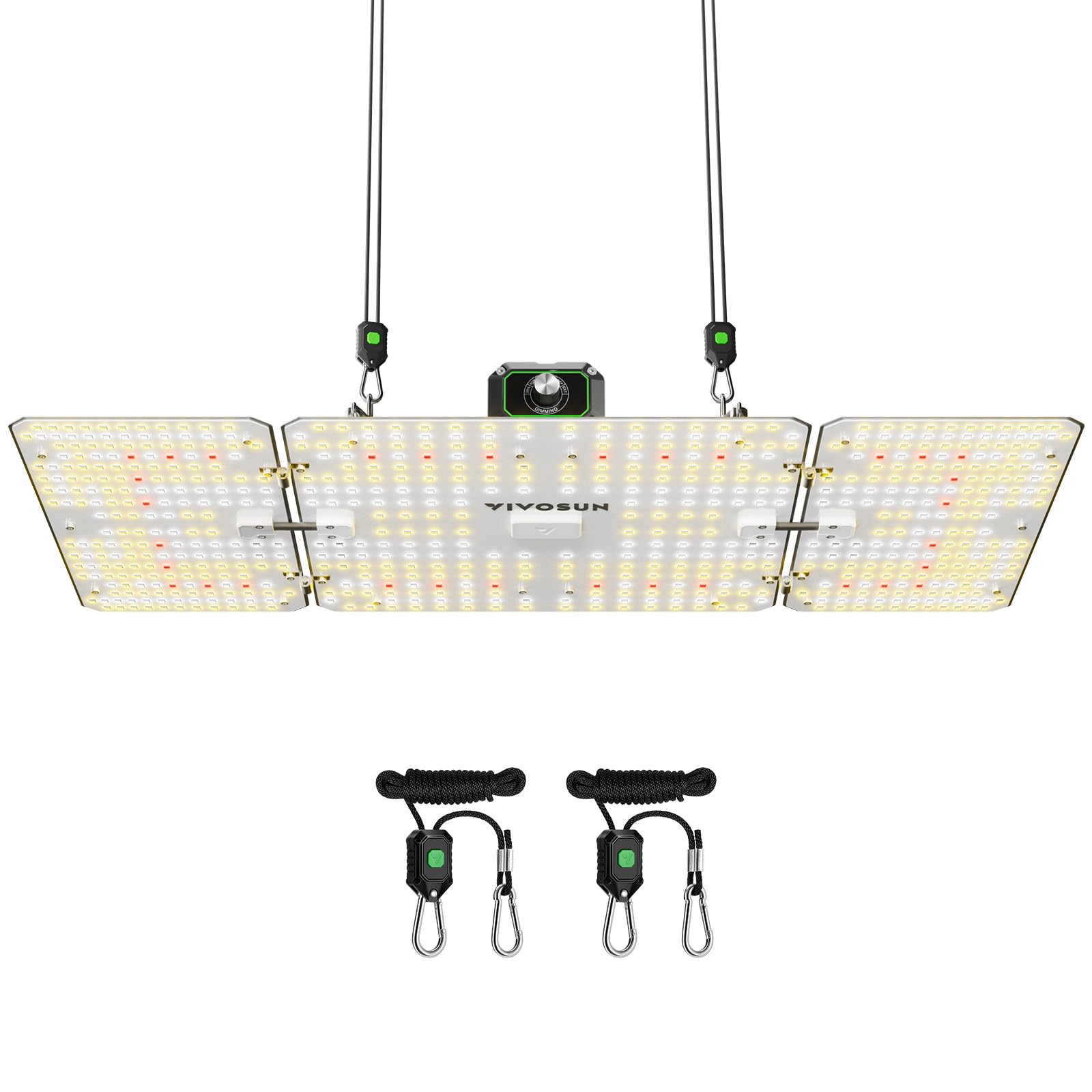
A high-wattage panel that scales with your tent and talks to an app for full schedule automation.
At 200W — the highest wattage in this list — the VIVOSUN LumaLight covers a 2×4 or 3×3 growing area. Its full spectrum includes white (3000K, 5000K), blue, red (660nm), and far-red (730nm) LEDs, which the manufacturer says speeds up flowering time. The dimming knob lets you choose between 25%, 50%, and 100% intensity, and when paired with the VIVOSUN GrowHub (sold separately), you can automate lighting schedules from your phone. One reviewer noted that even at 25% the light is “crazy bright,” so you will want to hang it high enough to avoid cooking seedlings.
An IP65 waterproof rating (sealed against dust and low-pressure water jets) means you can safely spray water and nutrients around it without worrying about damage — a huge advantage for humid greenhouse environments. The Q90 flux maintenance rate is rated up to 36,000 hours, so the light stays intense for years. However, several reviewers mention it raises tent temps noticeably, and at 9 pounds it is heavier than the 2.55 kg XS1500 Pro. One buyer with a 5-rack wire shelf found the light covers only a single 10×20 tray, which highlights the importance of checking your physical setup before buying this larger panel.
Strengths
- Highest wattage at 200W for larger tents
- IP65 waterproof for high-moisture environments
- Smart app control with GrowHub compatibility
Weak spots
- Raises tent temperature noticeably
- Overkill for small or open shelving setups
Best for: dedicated tent growers who want smart control and the ability to spray water freely around their lights.
Not great for: open wire shelving or small desktop grows where the beam pattern won’t reach multiple trays efficiently.
4. SANSI 4-Gooseneck Clip

Four adjustable goosenecks that let you target light exactly where each plant needs it most.
The SANSI clip light uses four separate 10W heads (for a total of 40W) on flexible goosenecks, so you can position a beam over each individual plant rather than blasting the whole shelf. It delivers 4000 lumens of full-spectrum light (380nm to 800nm), which customers note is “very bright” and effective for hoyas, monsteras, pothos, philos, alos, and anthuriums. The built-in timer cycles at 4, 8, or 12 hours on a 24-hour repeat, which makes it set-and-forget for your daily schedule. SANSI also offers free lifetime bulb replacements, so if a bulb burns out you do not replace the whole fixture.
There is a size difference to be aware of: the SANSI body measures 8.46″ x 7.56″ x 5.51″ — tiny compared to the JESLED strip at 47 inches. The clip itself is sturdy according to most reviews, but a few owners note the clips are weak for the weight and that the bulbs can get “very hot” (reviewers warn they can burn skin and scorch foliage if placed too close). Unlike the larger panel lights, this one has no dimming control — the timer is the only adjustment — so you are stuck with full brightness or off.
What works
- Individual goosenecks target light to each plant
- Lifetime free bulb replacements included
- Pleasant natural white light, not harsh purple
What doesn’t
- Bulbs run hot — can burn leaves if too close
- Clip is fixed, hard to attach to thin surfaces
- No dimming, only on/off via timer
Reach for it if: you have a desk, plant stand, or shelf with a few high-value plants that each need a direct beam of natural white light.
Look elsewhere if: your plants are in a high-humidity greenhouse or you need to cover a long shelf of seedlings with a single fixture.
5. GLOWRIUM Floor Lamp
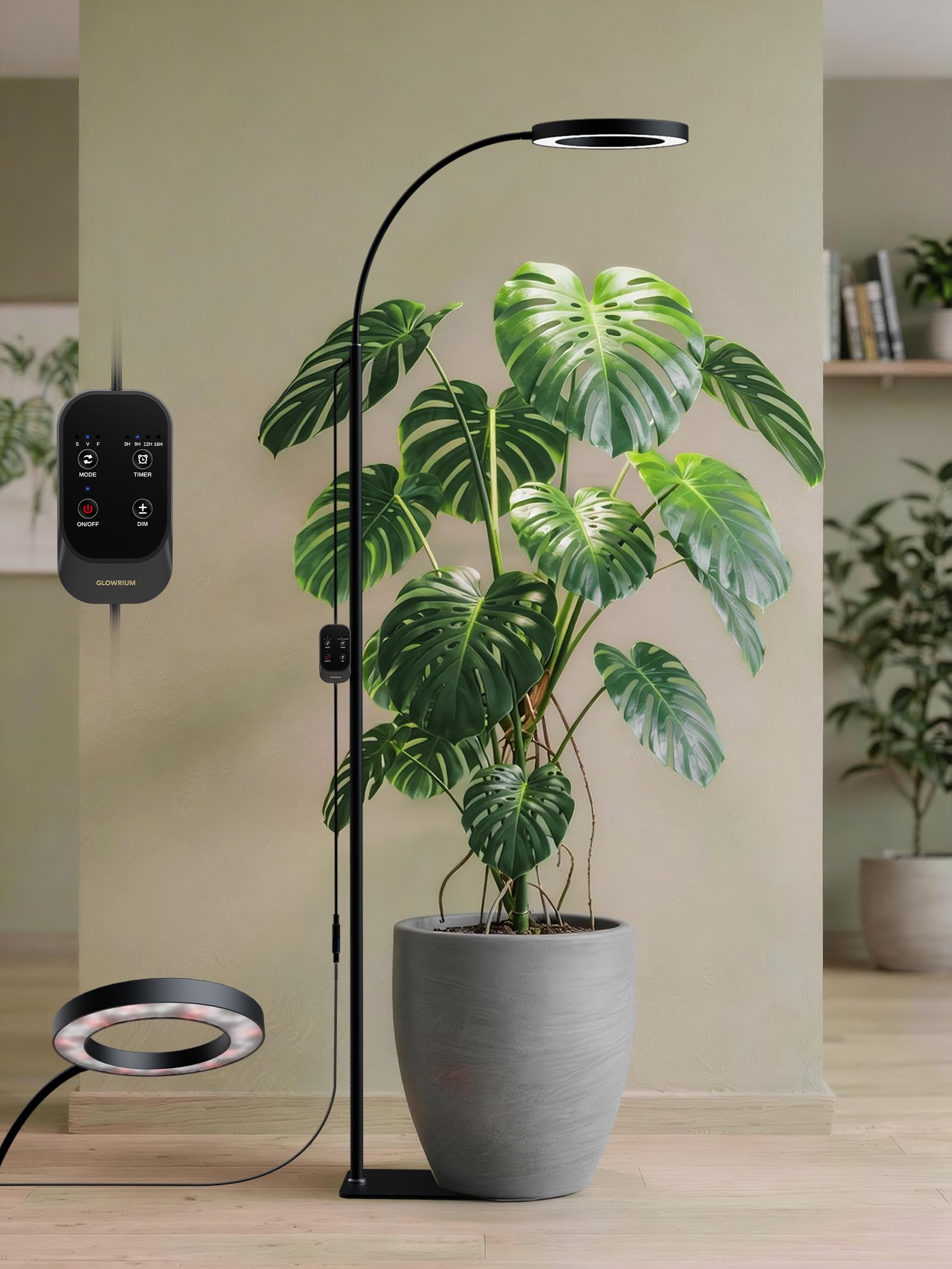
A stylish floor lamp that doubles as a grow light for your tallest living room plants.
The GLOWRIUM is designed to blend into your home decor while providing supplemental light — it uses just 20W (compare that to the 150W of the panels above), so it is not trying to replace intense grow tent fixtures. The three-section aluminum alloy stand adjusts to 32, 47, or 63 inches, making it ideal for large potted plants like fiddle-leaf figs or monsteras. One buyer mentioned that the lamp successfully supplemented a north-facing window and caused their dieffenbachia to flower — an uncommon event, which gives you a sense of how effective the light can be for a plant that needs a boost.
The lamp head rotates 360 degrees and offers three lighting modes: 3000K white plus 5000K white for rooting and germination; 5000K white plus red for flowering; and all three combined for the full growth cycle. It also has 6-level dimming (10% to 100%) and timer options for 3, 9, or 12 hours. At 20W it draws a fraction of the power of the MARS HYDRO TS1000, so you can run it all day without worrying about your electric bill. The small catch: the 20W output means it is best for supplementing natural light, not for growing full-crop plants from seed in a windowless room.
What sells it
- Adjustable up to 63 inches for tall plants
- Three light modes for different growth stages
- 13-foot cord reaches distant outlets
What limits it
- 20W is low power for light-hungry plants
- Best as a supplement to existing window light
Choose this when: you want a grow light that also functions as a reading lamp and fits neatly in your living room without looking industrial.
Pass on it if: you are trying to grow vegetables or high-light plants in a room with zero natural sunlight.
6. JESLED 4FT Strip
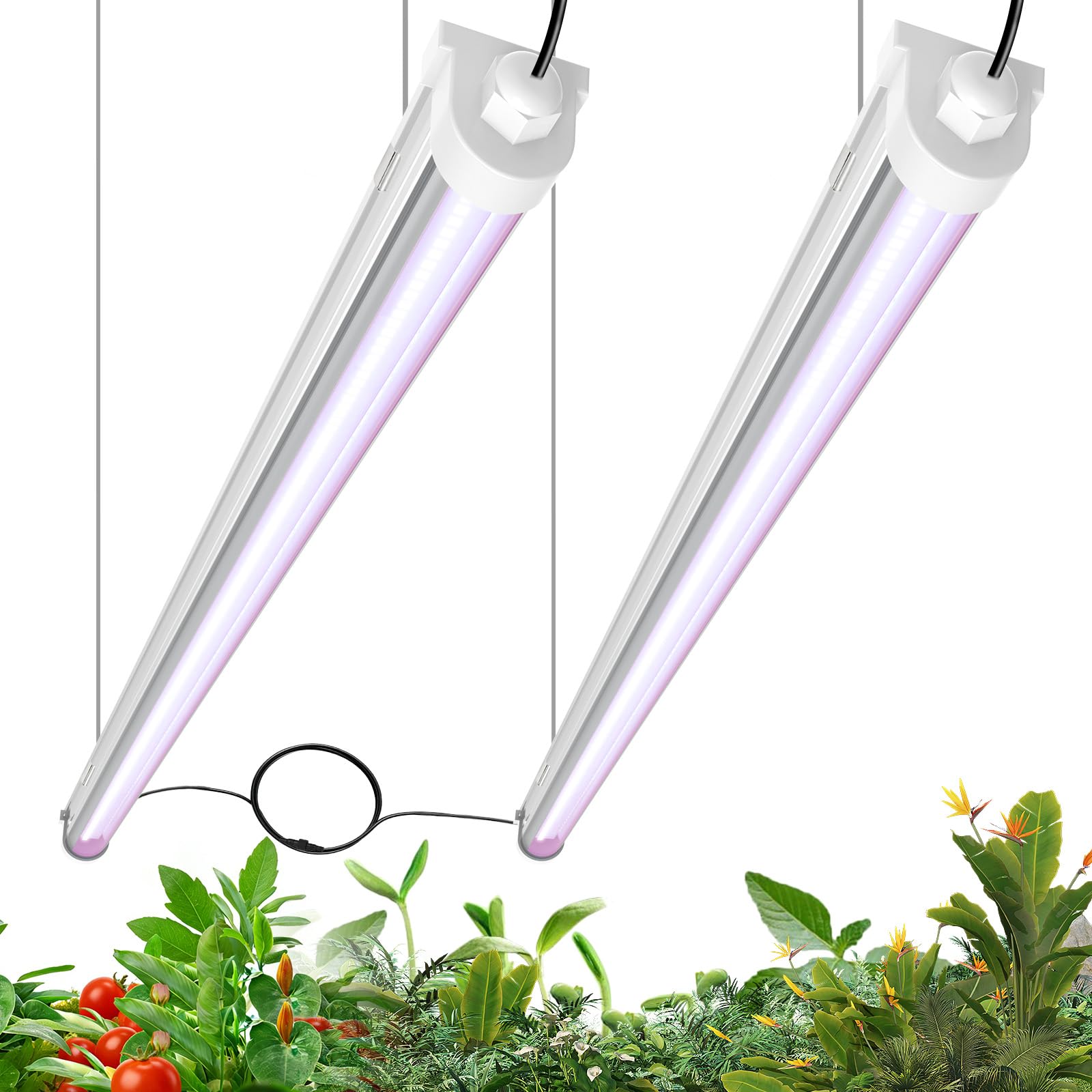
A long, waterproof strip built for greenhouse shelves and seedling racks that need even coverage.
At 47 inches long, the JESLED is the longest light in this roundup — it is a great fit for a 4-foot shelf or a multi-tier greenhouse stand. The 2-pack delivers 96W total (2 x 48W) with a pinkish-white full spectrum that includes a balanced red and blue ratio. One buyer from Michigan said the “powerful bright purple light keeps Florida plants happy” in their cold, dark climate. The IP65 waterproof rating is a key advantage here: this light survives high-humidity environments, so you can use it in a greenhouse or a propagation dome without worrying about moisture damage.
Installation is simple — you can hang it or surface-mount it with the included brackets and zip ties, and the separate power cord has an on/off switch. An integrated reflector design boosts PPFD output compared to a bare strip, according to the manufacturer. Coverage is excellent: one owner reported this light outperformed two other lights and three bulbs, growing carrots, peppers, radishes, kale, and lettuce successfully. The 47-inch length also makes it longer than the SANSI clip light, which is 8.46 inches long and only covers a desktop. The main trade-off is that the light is pinkish-white rather than pure white, which some people find less pleasant in a living space.
Why it wins for shelves
- 47-inch length covers entire shelf rows at once
- IP65 waterproof for humid greenhouse use
- Linkable plug-and-play design adds more strips easily
Things to consider
- Pinkish-white light color may not suit home decor
Get this for: a humidity-prone greenhouse, a seedling rack, or any long shelf where you want even, waterproof lighting across the whole row.
skip it if: you want a warm white lamp that blends into your furniture or you only need to light one or two small pots.
Understanding the Specs
Wattage and PPFD
Wattage measures how much electricity the light consumes, but PPFD (Photosynthetic Photon Flux Density) tells you how many usable light particles reach your plant’s leaves. A high-wattage light can be wasteful if the diode layout is poor. For example, the VIVOSUN at 200W uses a strategic layout to maintain balanced intensity from center to edge, while the VIPARSPECTRA uses optical lenses to concentrate 150W more effectively. Always check if the manufacturer publishes PPFD values at common hanging distances — that is the real number for plant growth.
Spectrum and Color Temperature
Full-spectrum lights (380nm-800nm) mimic natural sunlight and support all growth stages. Some lights also add specific red 660nm and infrared 730nm LEDs to boost flowering — both the VIPARSPECTRA and VIVOSUN include these. Color temperature, measured in Kelvin (K), describes how warm or cool the light looks to your eyes — 3000K is warm white, 5000K is daylight white — but for plants the specific wavelengths matter more than the overall color appearance. A light that looks white may still lack the deep red needed for flowering, so look for the specific nm wavelengths listed.
FAQ
Can I use any LED light bulb for my houseplants?
How far should I hang my grow light from the plants?
What does IP65 mean for a grow light?
How many hours a day should I run my grow light?
Is a 20W grow light enough for succulents?
Can I connect multiple grow lights together?
Do grow lights heat up the room?
What is the difference between a quantum board and a traditional LED grow light?
Can I leave my grow light on 24/7 for faster growth?
Which grow light is best for a small desktop setup?
Final Thoughts: The Verdict
If you want one dependable pick, the grow lights for indoor plants winner is the VIPARSPECTRA XS1500 Pro because its optical lens design delivers the highest PPFD uniformity per watt — a measurable advantage for serious growers. If you want a proven silent panel with a patented reflector, grab the MARS HYDRO TS1000. And for a large smart-enabled tent setup, the standout is the VIVOSUN LumaLight 200W with its app control and IP65 waterproofing.
How We Picked
We do not accept paid placement. Every pick is matched to a real buyer and a real use-case; we do not hands-on test units.
Sources & Methodology
Specifications: manufacturer listings and product documentation. Review insights: verified customer reviews, as of July 2026. Pricing: not shown on this page (it changes often); check the current price via the retailer link.
As an Amazon Associate, Lawn Gear Lab earns from qualifying purchases. This does not affect which products we feature.