
Specs are compiled from manufacturer listings and verified buyer reviews and can change over time — please confirm the key details on the product page before buying.
Pitcher plants are light gluttons. Give them weak window light and their traps turn pale and skinny, the vivid reds and purples fade, and those iconic pitchers simply stop forming. The right light is the difference between a scraggly houseplant and a carnivorous showstopper that traps bugs all winter.
I’m Rikta — the founder and writer behind Lawn Gear Lab. This guide is built by comparing the manufacturers’ published specifications and the patterns across verified customer reviews, so you get each pick’s real strengths and trade-offs instead of marketing spin.
You want a light that delivers enough intensity to trigger strong pitcher growth without scorching the leaves. That balance is exactly what this roundup of the best grow light for pitcher plant care is built to help you find.
Our Picks at a Glance


How To Choose The Best Grow Light For Pitcher Plant
Pitcher plants are high-light carnivores. Unlike a snake plant that tolerates a dim corner, a Nepenthes or Sarracenia needs direct, intense light to form those signature traps. The three specs below make or break success.
PPFD — The Intensity That Triggers Traps
PPFD (photosynthetic photon flux density) is the measure of usable light particles reaching your plant, and it is the single number that determines whether your pitcher plant grows or just survives. These plants evolved in bright, open conditions and typically need a PPFD of 300–600 μmol/s/m² to produce healthy pitchers. A light claiming high wattage but low PPFD will leave you with flat, green leaves and no traps. Look for lights that publish real PPFD measurements at typical canopy distances.
Full Spectrum With Deep Red
The broad daylight spectrum (3000K–5000K white LEDs) is the foundation. But what sets a truly effective carnivorous plant light apart is the inclusion of specific red wavelengths — 660nm (deep red) for photosynthesis and 730nm (far red) for the Emerson effect that boosts overall growth. Without these red peaks, your pitcher plant may survive but never develop the rich red coloration and vigorous trap size that makes these plants fascinating.
Coverage, Heat, and Timer
A single small clip-on bulb is rarely enough. Pitcher plants spread their leaves outward, so a panel or bar that casts a wide, even beam across the entire plant is critical. Heat is another hidden trap — lights that run hot can dry out the high humidity a Nepenthes needs. And since these plants need consistent 12–16 hour photoperiods year-round, a built-in timer that you set once and forget is a quality-of-life feature that pays off every single day.
Quick Comparison
| Model | Best For | Power Draw | PPFD / Intensity | Coverage | Amazon |
|---|---|---|---|---|---|
| VIPARSPECTRA XS1500 Pro★ Best Overall | Serious carnivorous plant setups | 150W | 747 μmol/s/m² at 13″ (50%) | 3×3 ft veg / 2×2 ft flower | Amazon |
| GLOWRIUM 24W Floor LampPremium Pick | Tall, mature Nepenthes | 24W | Full-spectrum, stepless dimming | 79″ height, gooseneck | Amazon |
| Barrina 20W Standing LightBest Design | Side-lit shelves and desktop plants | 20W | 75 LEDs, 660nm red chips | 2 ft vertical strip | Amazon |
| FECiDA Floor Lamp | Budget tall plant coverage | 25W | 2000 lumens, 208 LEDs | 40″–76″ adjustable | Amazon |
| TYAGMAM 2ft T8 Strips (4-Pack) | Multi-shelf greenhouse setups | 100W (4x25W) | 4000 lumens total | 23.6″ per strip, daisy chain | Amazon |
| SANSI Dual-Head Clip | Small desktop pots | 20W | 2000 lumens | Dual 7.7″ heads | Amazon |
| SANSI 5V Pot Clip (4-Pack) | Multiple tiny pots | 5W each | 35.78 μmol/s/㎡ at 6″ | 360° gooseneck | Amazon |
| Xuligron Halo 3-Pack | Affordable multi-plant coverage | USB-powered | 3 modes, 5 dimming levels | 360° gooseneck per head | Amazon |
In‑Depth Reviews
1. VIPARSPECTRA XS1500 Pro
Our pick — over 4.5★ from 900+ verified ratings; the strongest balance of quality and price.
The panel that turns a struggling Nepenthes into a trap factory.
The core of this light is its optical lens design, which focuses the beam to deliver real measurable intensity where it counts. Buyers report excellent PAR levels of 747 at 50% power from just 13 inches away — that is more than enough photosynthetic muscle to trigger vigorous pitcher formation across a full 2×2 foot canopy. The full spectrum includes white 3000K, 5000K, plus critical red 660nm and infrared 730nm, giving your carnivorous plant the exact wavelengths it would get from direct sun.
The dimming daisy chain is a standout feature. You can link up to 20 of these units together and control them all from a single dimmer, which matters if you ever expand into a greenhouse shelf or a 4×2 tent with two units. What wins people over is the consistent edge-to-edge light — no dim corners where leaves stretch and weaken. It is heavy at about 6 pounds, but the included ratchet hangers make positioning simple.
What the intensity buys you
- Real PPFD of 747 μmol/s/m² at just 13 inches and 50% power
- Daisy-chain up to 20 units for unified dimming across a whole shelf
- Runs cool even after 12 hours at full blast
The honest trade-offs
- No built-in timer; you will need a separate outlet timer for a consistent photoperiod
- At roughly 6 pounds, it is noticeably heavier than smaller clip-ons
Your move: Buy this if you are serious about pitcher plant health and want the kind of intensity that forces traps to form. You can low-maintenance with a simple timer.
Second thought: If you only have one small pot on a desk, the weight and footprint of this panel may be more than you need.
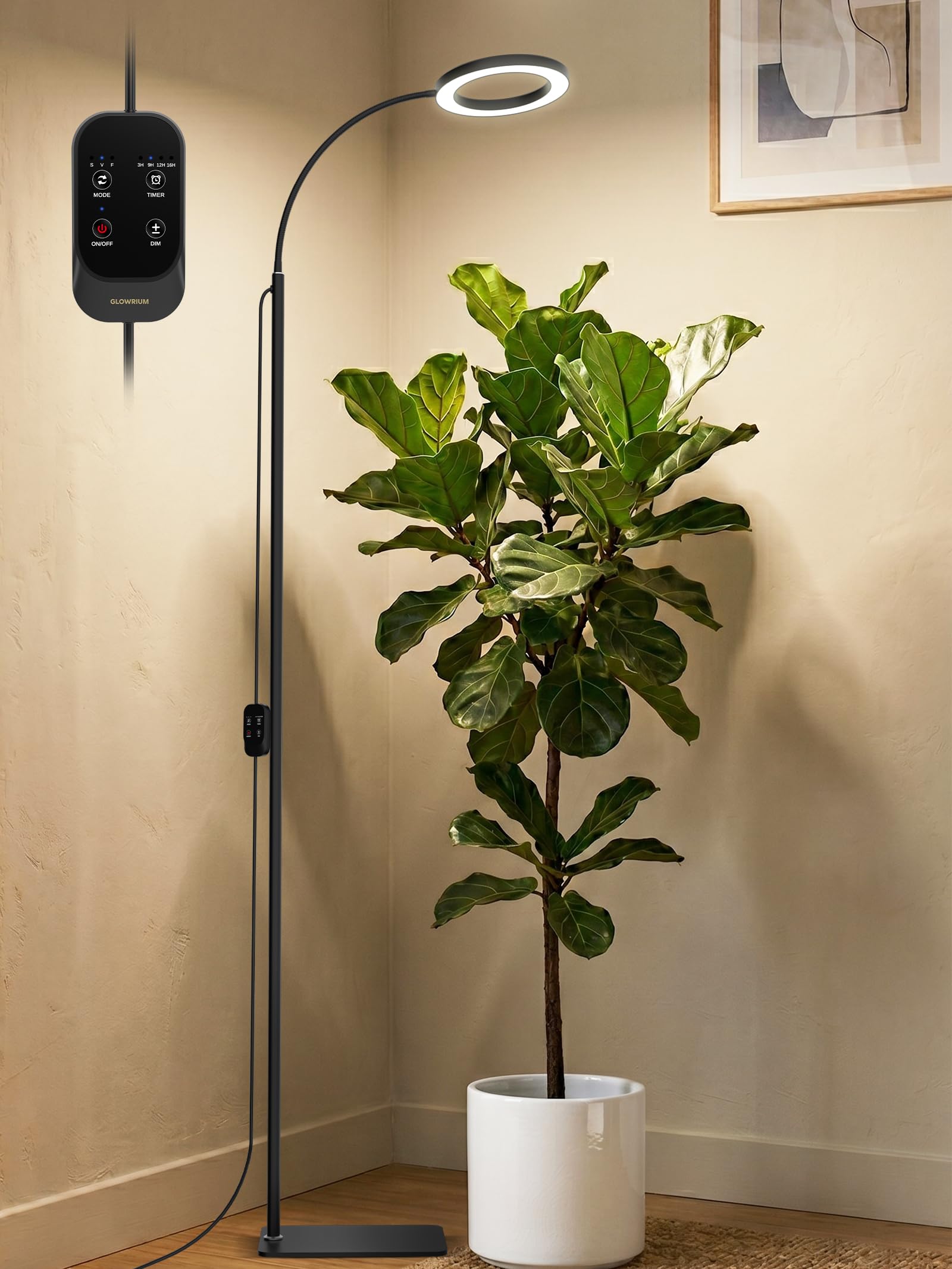
2. GLOWRIUM 24W Floor Lamp
The towering solution that reaches a mature Nepenthes without a grow tent.
This floor lamp extends up to 79 inches, making it the obvious pick for a tall, vining pitcher plant that has outgrown a shelf. The second thing you notice is the enlarged lamp head combined with a 360-degree flexible gooseneck, so you can aim the light exactly onto the upper traps without blasting your own eyes. It uses a safe 24-volt low-voltage system, a thoughtful detail for a unit that stays plugged in 16 hours a day.
The built-in timer gives you four automatic lighting cycles — 3, 9, 12, and 16 hours — so you dial in a photoperiod and leave for vacation without worry. Owners mention African violets blooming and cherry tomatoes fruiting all winter under this light, which confirms the spectrum has enough red energy to support flowering and, by extension, strong pitcher development. The consensus is that it simply makes plants “perk up instantly.”
Who this fits: If you have a tall, vining Nepenthes that is starting to look lanky, this floor lamp gets light up to the top traps without cluttering your space with a tent frame. The stepless dimming and smart timer cover all the convenience bases.
The limit: The round base is stable, but some owners find it needs a heavy pot on the base plate to keep it from tipping with a top-heavy plant.
Bottom line: A well-designed, adjustable floor lamp that delivers full-spectrum light at the perfect height for mature or tall pitcher plants — arguably the most elegant solution for a living room jungle.
Look elsewhere if: You need to cover a wide, low shelf of multiple dwarf plants; a panel or bar light covers a horizontal surface more evenly.
3. Barrina 20W Standing Grow Light
The vertical strip that lights your pitcher plant from the side, not above.
Most grow lights blast down from above, but pitcher plants often grow in a horizontal rosette or a climbing vine pattern that benefits from side illumination. The Barrina stands vertically and emits light sideways, hitting the lower and middle leaves that a ceiling panel would miss. It packs 75 LEDs including specific 660nm red wavelength chips, a critical addition for pushing the deep red pigmentation that makes a Sarracenia or Nepenthes look stunning.
The brightness is what owners praise most, and the 2-foot height with a non-slip base keeps it stable on a table or shelf. It is not dimmable and has no built-in timer — that is the main compromise at this price point. But for 20 watts of power and an ultralight footprint, the growth response customers note (Monstera “growing like weeds” is a common refrain) shows the 660nm spectrum is doing real work. Set it beside your pot and run it on an external timer for the best results.
The strength: A unique side-firing design that catches leaves a top-down light would miss, with a 2-year warranty backing it up. Excellent for a single desktop pitcher plant.
The missing piece: No timer and no dimming — you will need to supply your own schedule and accept a fixed 20W intensity.
Choose this if: Your pitcher plant sits on a desk or low shelf and you want light hitting every leaf angle. The sturdy base (owners note it is “heavy enough to prevent tipping”) adds confidence.
Pass if: You want a one-box solution with a timer; the FECiDA floor lamp or the GLOWRIUM floor lamp include scheduling.
4. FECiDA Floor Lamp Grow Light
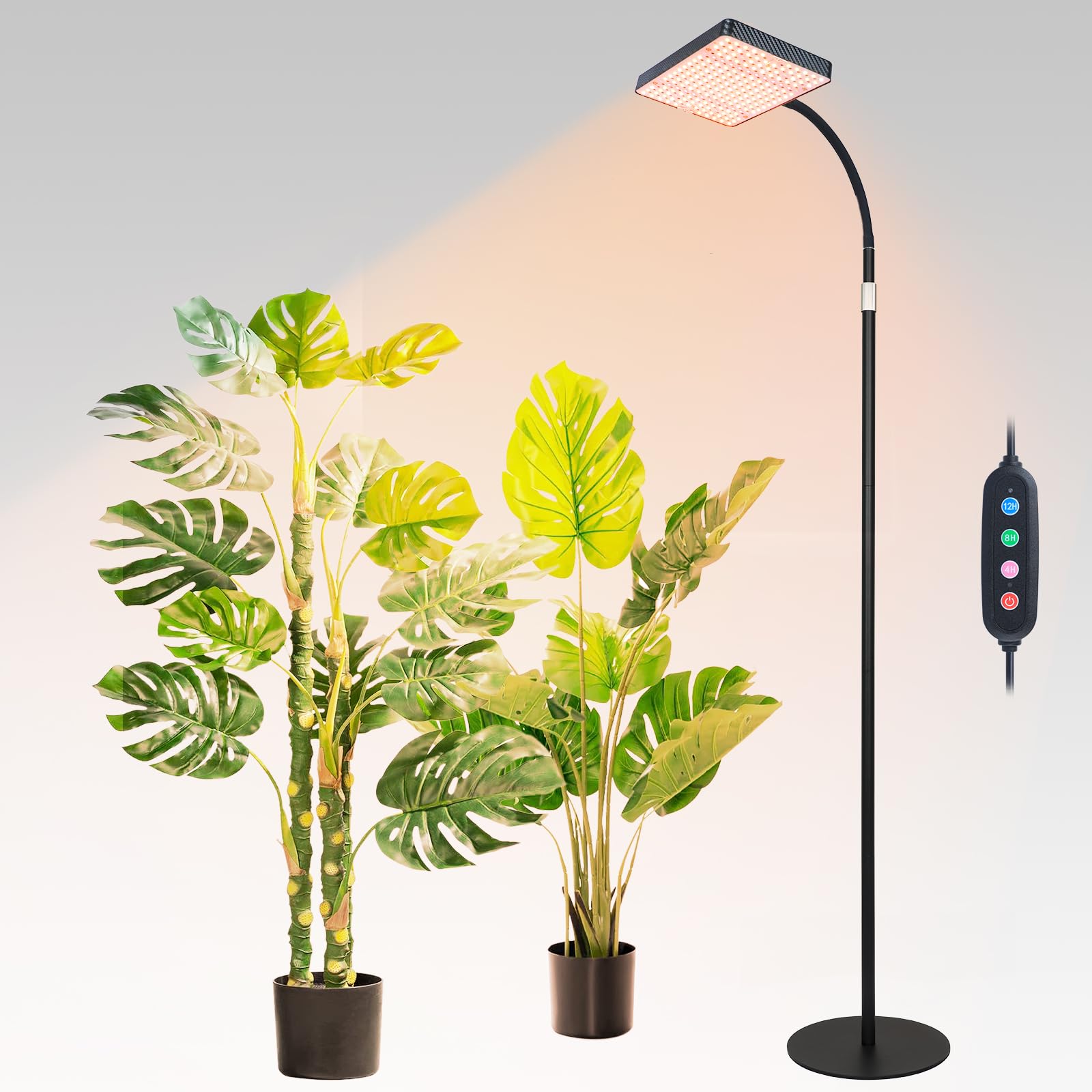
A tall, adjustable floor lamp that packs a surprising number of features for the money.
The FECiDA delivers 2000 lumens from 208 LEDs while drawing only 25 watts, and it adjusts from 40 inches to 76 inches tall, covering everything from a small pot on the floor to a tall trellis climber. The 5-mode timer — 4, 8, 12, 16, and 20 hours — is flexible enough to mimic the long summer days a Sarracenia craves. The daisy-chain function lets you link up to three units from a single wall outlet, a serious convenience if you have multiple tall specimens.
Reviewers point out it is “a standout for plants” and that plants are “thriving better than ever before.” The main trade-off is that the base is a bit narrow for a top-heavy plant; pairing it with a heavy decorative pot solves the stability concern. The timer also resets if the light is unplugged, so you will want to leave it plugged in permanently once you set the cycle.
Why it works: The 76-inch max height is enough for a floor-level Nepenthes vine, and the 5-timer options give you precise photoperiod control without a separate outlet timer. The value here is genuinely tough to top.
The catch: Stability is a mixed point — the base is aluminum and light, so the lamp can tip if bumped. Owners recommend setting it behind a pot or securing it with a plant on the base plate.
Grab it for: A first tall-plant light that won’t break the budget, with enough height and timer granularity to cover a large pitcher plant through all seasons.
Consider another if: You have a small desktop setup; this floor lamp’s tall pole is overkill for a single 6-inch pot on a shelf.
5. TYAGMAM 2ft T8 Strips (4-Pack)

Four linear strips that turn a wire shelf into a multi-tier carnivorous plant nursery.
Each 2-foot T8 bar draws 25 watts and outputs full-spectrum sunlight-replacement light with a reflector that boosts efficiency by 20%. The total system wattage of 100W (600W equivalent) is spread across four bars, so you can place one bar per shelf and light a whole collection of small pitcher plants at once. The daisy-chain capability lets you connect up to 8 units together, making this a scalable solution for a serious propagation rack.
Buyers consistently praise how “not hot” these run — critical for a high-humidity enclosure where heat buildup is a risk. They report seedlings “thrive” under the panels and that the installation is genuinely plug-and-play with included clips and cable ties. The expected PPFD at 11 inches ranges 67-82 per bar, which is modest for a single strip, but across four strips the cumulative coverage is outstanding for a 2×4 foot shelf area.
The big advantage: The 100% aluminum housing dissipates heat so well that you can run these on a shelf with a humidity dome and not cook your plants. The 4-pack value per strip is excellent.
Note: No built-in timer, so you will need an external outlet timer for all four. The individual strip intensity is moderate, so keep the light 11-12 inches from the leaves to maintain useful PPFD.
Best for: A multi-shelf seedling station or a greenhouse cabinet filled with dwarf pitcher plants. The low heat output alone makes this a safer choice than HID alternatives.
Not ideal for: A single large hanging plant that needs intense, focused light from one source.
6. SANSI Dual-Head Clip Grow Light

Two adjustable heads that bring strong full-spectrum light to a single desktop pitcher.
Each bulb in this dual-head clip emits a broad 380nm–800nm spectrum (essentially natural sunlight in a compact package), and the system totals 2000 lumens. The auto on/off timer with 4, 8, and 12-hour settings is based on a 24-hour cycle, so you set it once and it repeats daily — ideal for a consistent pitcher-plant photoperiod. The clip and gooseneck let you position the heads just above the growing crown without a bulky stand.
Reliability and quality are the aspects owners mention most, and the specific use-case of keeping plants alive in a dark garage comes up repeatedly — a strong proxy for a dim winter windowsill. The unit draws only 20W total. A few owners note the clips could be stronger for the weight of the heads, so check that your pot edge is thick enough to support both arms.
The good: The lifetime free bulb replacement offer from SANSI is rare at this price, and the full spectrum genuinely supports all growth stages. The dual heads let you cover a wider area than a single bulb.
The caution: The goosenecks can struggle to hold the bulbs in a precise position over time, and the overall 20W output is best for a single small-to-medium pot.
Reach for this if: You need an affordable, timer-equipped light for a single desktop pitcher plant and want the security of a lifetime bulb warranty.
Look elsewhere if: Your plant is large or you want to cover a wide shelf area; a panel or bar light is more appropriate.
7. SANSI 5V Pot Clip (4-Pack)
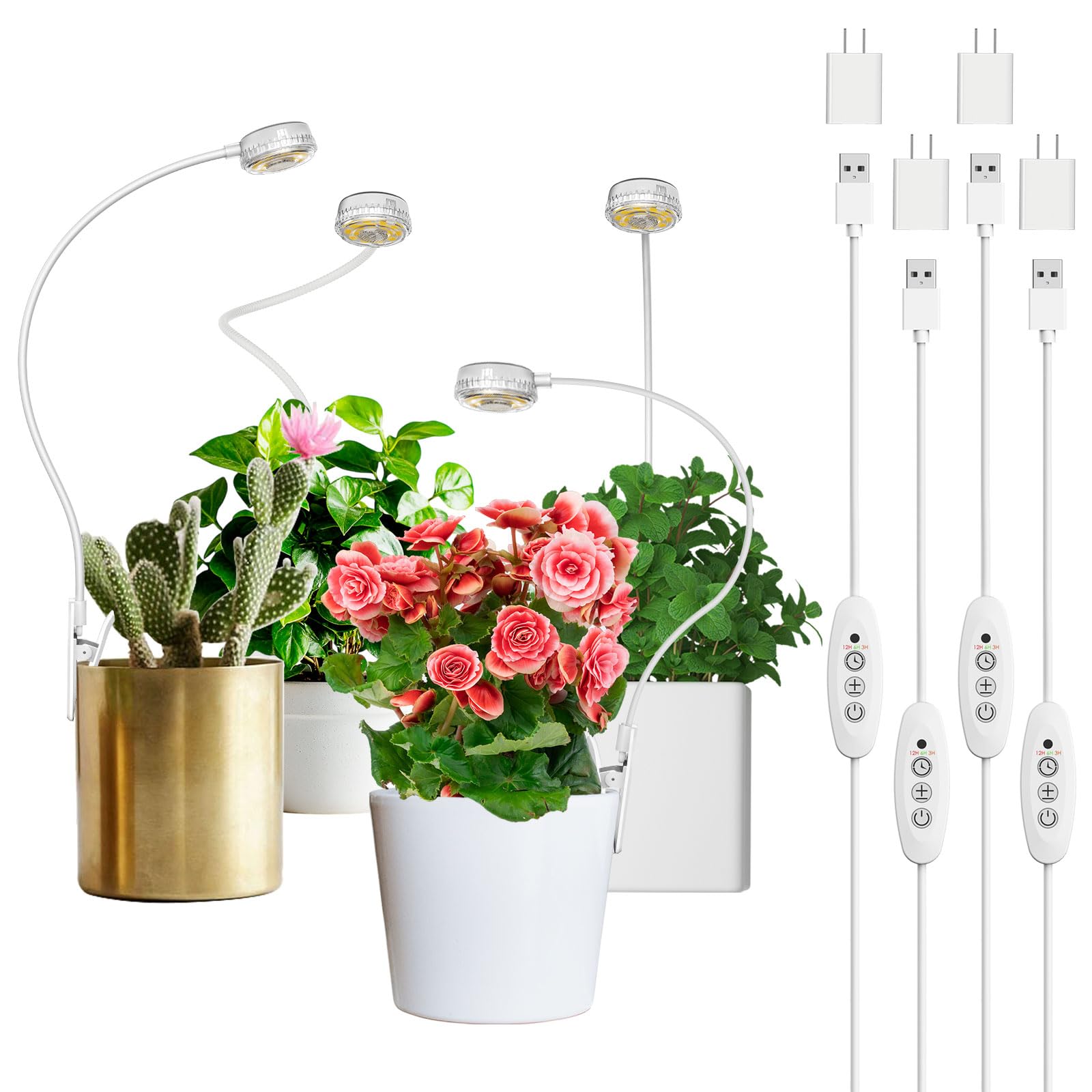
Four tiny but mighty clip-ons that each run off a USB port and a laptop.
Each of these 5-watt lights delivers 35.78 μmol/s/㎡ at 6 inches, which is remarkable for its size. The 5-volt low-voltage input means you can power them from a USB power bank or a laptop — no clunky wall wart needed — making this a true travel-friendly option for a desk or office.
The auto on/off timer and 4-level dimming (25%, 50%, 75%, and 100%) give you granular control over the intensity, which is useful for a species like a Highland Nepenthes that prefers slightly less intense light than lowland varieties. Owners say these are “absolutely perfect” for small pots and that plants double in size within weeks. The clip grip is a mixed point — a few owners find the clips flimsy for the secure hold needed on a heavy pot, so match them to thin-walled nursery pots for the best fit.
What stands out: The 2-year service and ETL safety certification on a multi-pack at this price is unusual. The natural 4000K color temperature is less harsh on the eyes than bluer grow lights.
The limitation: Each light is just 5W, so it is best for a single small pot or as a supplemental side-light for a larger setup. The cord length is also relatively short.
Choose this kit for: A collection of small pots on a desk, each with its own dedicated clip-on light. The USB power and compact size make it among the most flexible options for tight spaces.
skip it if: You need to penetrate the canopy of a large, bushy pitcher plant — the tiny head cannot produce enough intensity for a deep canopy.
8. Xuligron Halo 3-Pack
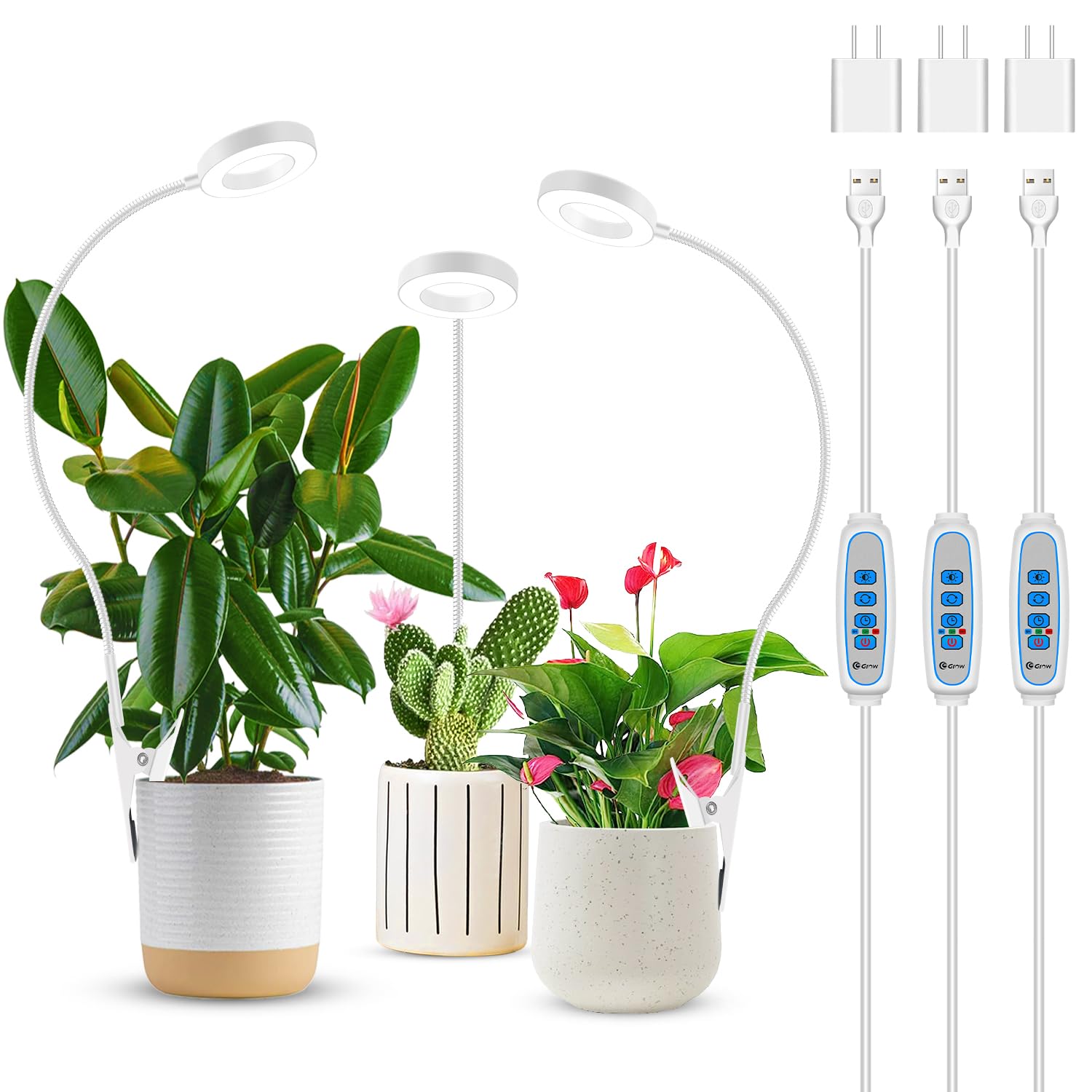
Three halo-shaped lights with versatile clip-or-stake installation for under thirty bucks.
Each unit includes red 660nm, warm 3500K, and white 5000K LEDs, covering the photosynthetic spectrum that drives healthy pitcher formation. The halo design is intentionally open in the center, letting you clip or stake the light directly over a pot so the light wraps around the plant rather than blasting from one side. The 3 lighting modes and 5-level dimming give you the flexibility to dial in exactly the right intensity for different growth stages.
Timer options of 6, 12, and 16 hours cover the full range a pitcher plant needs, and the 16-hour setting is especially useful for mimicking equatorial summer days. Lighting quality is the most praised aspect, and shoppers say drooping, yellowing plants reviving under these lights. Durability is mixed — some units have failed within three months — so treat these as an affordable entry point or a secondary system rather than a permanent primary light.
The value: Three lights with timer, dimming, and full spectrum for a very accessible price. The stake-in-soil installation option is unique and keeps the light low and stable.
What to watch: Build quality and a poor clip mechanism are the common complaints. These are light-duty; handle the goosenecks gently and they will last longer.
Best for: A beginner who wants to try a full-spectrum grow light on a few small pitcher plants without a large investment. The trio lets you light three separate pots right from the start.
Consider the Barrina or SANSI clip-on instead if: You want a more durable single unit that can run 16 hours daily for years. This is a solid starter kit, not a lifetime fixture.
Understanding the Specs
PPFD — the real intensity number
PPFD (photosynthetic photon flux density) measures the actual light particles a plant can use, in micromoles per square meter per second. This is the number that matters for pitcher plants because they need a high photon count — around 300–600 μmol/s/m² — to produce traps. Wattage alone tells you how much power the light draws, but not how much usable light reaches the leaves. A 150W panel with good optics (like the VIPARSPECTRA, which delivers 747 μmol/s/m² at 50% power) is far more effective than a 100W panel with poor LEDs. Look for published PPFD readings at a given distance, and keep the light close — 12 to 18 inches — to maintain intensity.
Daisy chain — more than a convenience
Daisy-chaining lets you connect multiple lights together on a single power cord and control them from one dimmer or switch. For a pitcher plant collection that spans a wide shelf or a 2×4 foot tent, this saves you a messy tangle of wall warts and makes the entire system respond to one timer. The VIPARSPECTRA supports up to 20 linked units, while the TYAGMAM strips connect up to 8. A daisy-chain system also centralizes the heat — the power supplies are outside the grow area — which matters for species that crave high humidity but not extra heat from multiple transformers.
Full spectrum vs red-only
A full-spectrum light emits white light across a broad range of wavelengths (3000K–5000K), mimicking the sun and making leaf colors look natural to the human eye. For pitcher plants, the specific peaks at 660nm (deep red) and 730nm (far red) are non-negotiable — they drive photosynthesis and the Emerson effect where red light boosts the efficiency of other wavelengths. A cheap “pink” blurple light (blue + red only) can grow plants, but it makes it impossible to spot pests or discoloration. Every light in this list uses white full-spectrum LEDs with added red chips, giving you both plant performance and a pleasant room appearance.
Timer and photoperiod
Pitcher plants need a consistent day length to stay in their growth cycle, typically 12 to 16 hours of light per day depending on the species. A built-in timer that you set once and forget saves you from having to remember to turn the light on and off every day, which is the number-one reason indoor carnivorous plants fail. The most useful timers offer at least four presets: 4-hour for a quick boost, 8-hour for low-light supplementary use, 12-hour for a standard day, and 16-hour for triggering vigorous summer growth. External outlet timers work fine, but a light with a built-in timer (like the GLOWRIUM or SANSI clip-on) keeps the setup clean and travel-ready.
FAQ
Can a clip-on grow light really support a pitcher plant?
How close should I place a grow light to the top of my pitcher plant?
Should I leave my grow light on 24 hours a day?
Is a 150W panel too powerful for a small desktop pitcher plant?
What is the difference between 660nm and 730nm light for pitcher plants?
Why are my pitcher plant leaves turning yellow under a grow light?
How often should I replace a grow light bulb for pitcher plants?
Do I need a separate UV light for pitcher plant color?
Can I use these lights for other tropical carnivorous plants too?
Final Thoughts: The Verdict
If you want one dependable pick, the best grow light for pitcher plant success is the VIPARSPECTRA XS1500 Pro because its 747 PPFD at half power and daisy-chain capability give you intensity and expandability that no other panel in its class matches. If you want a tall, elegant floor lamp that fits a living room aesthetic, grab the GLOWRIUM 24W Floor Lamp. And for a compact desktop setup with a reliable timer and lifetime bulb warranty, the SANSI Dual-Head Clip is the one to reach for. Pair any of these with a simple outlet timer, set the photoperiod to 14 hours, and your pitcher plant will reward you with vivid traps all year.
How We Picked
We do not accept paid placement. Every pick is matched to a real buyer and a real use-case; we do not hands-on test units.
Sources & Methodology
Specifications: manufacturer listings and product documentation. Review insights: verified customer reviews, as of July 2026. Pricing: not shown on this page (it changes often); check the current price via the retailer link.
As an Amazon Associate, Lawn Gear Lab earns from qualifying purchases. This does not affect which products we feature.