
Specs are compiled from manufacturer listings and verified buyer reviews and can change over time — please confirm the key details on the product page before buying.
Hibiscus is a light hog — get it wrong and you get leaves, not blooms. The trick is finding a grow light that delivers enough intensity and reach to support a plant that can climb six feet and demand 12-plus hours of strong rays daily. This guide cuts through the specs to land on the fixtures that actually keep hibiscus flowering indoors, through any season.
I’m Rikta — the founder and writer behind Lawn Gear Lab. This guide is built by comparing the manufacturers’ published specifications and the patterns across verified customer reviews, so you get each pick’s real strengths and trade-offs instead of marketing spin.
The goal is straightforward: match your hibiscus to a light that covers its height, delivers the right spectrum, and runs on a reliable timer so you are not stuck flipping a switch every morning. That is exactly what this roundup of the grow light for hibiscus options does — pairing each fixture to a specific growing scenario so you know which one fits your plant and your space.
Our Picks at a Glance
How To Choose The Best Grow Light For Hibiscus
Hibiscus is not a low-light plant. It needs high-intensity, full-spectrum light for at least 10 to 14 hours a day to push out those big, colorful blooms. A standard desk lamp will keep it alive, but it will not flower. The three specs below are the ones that separate a blooming hibiscus from a leafy green one under an indoor light.
True Wattage and Light Output
The actual power draw — measured in watts — tells you how much usable light the fixture produces. Hibiscus responds to high light levels, so look for a lamp drawing at least 20 to 25 real watts (not an “equivalent” wattage number). More wattage generally means more photons hitting the leaves.
Height Range and Coverage
A hibiscus can easily stretch several feet tall, and the light needs to reach the top of the canopy without being so close it burns the leaves. A fixture that adjusts from about 24 inches to at least 60 inches gives you room to grow with the plant. A wide lamp head or multiple heads also spreads the light over the full width of the bush.
Timer and Spectrum Control
Hibiscus needs consistent day length to trigger blooming. A built-in timer that cycles on and off each day — ideally with 4, 8, 12, 16, and 20-hour settings — removes the guesswork. Full-spectrum LEDs that include both blue (400–500nm) and red (600–750nm) wavelengths support leaf growth and flower development in one fixture.
Quick Comparison
| Model | Best For | Wattage | Height Range | Timer / Dimming | Amazon |
|---|---|---|---|---|---|
| FECiDA 2026 Floor Lamp★ Best Overall | Tall flowering hibiscus | 25W | 40″–76″ | 4/8/12/16/20H Timer | Amazon |
| 3Head Grow Light with StandWide Coverage | Multi-directional coverage | 27W | 24″–64″ | 4/8/12/16/20H Timer | Amazon |
| FRGROW 2026 TabletopCompact Power | Compact desk setups | 25W | 16″–24″ | 4/8/12/16/20H Timer | Amazon |
| Yehsence 10-in-1 | Wide, multi-plant arrays | — | Tripod + 15″ goosenecks | 4/8/12H Timer | Amazon |
| GLOWRIUM 20W Single Head | Stylish living-room use | 20W | 32″/47″/63″ | 3/9/12H Timer, 6-Level Dim | Amazon |
| GLOWRIUM 24W Single Head | Tall, single-stem hibiscus | 24W | 23″–79″ | 3/9/12/16H Timer, Stepless Dim | Amazon |
| GLOWRIUM 36W Double Head | Medium-to-large bush | 36W | 32″/47″/63″ | 3/9/12H Timer, 6-Level Dim | Amazon |
| GLOWRIUM 48W Dual Head | Maximum power for big plants | 48W | 23.5″–71″ | 3/9/12/16H Timer, Stepless Dim | Amazon |
In‑Depth Reviews
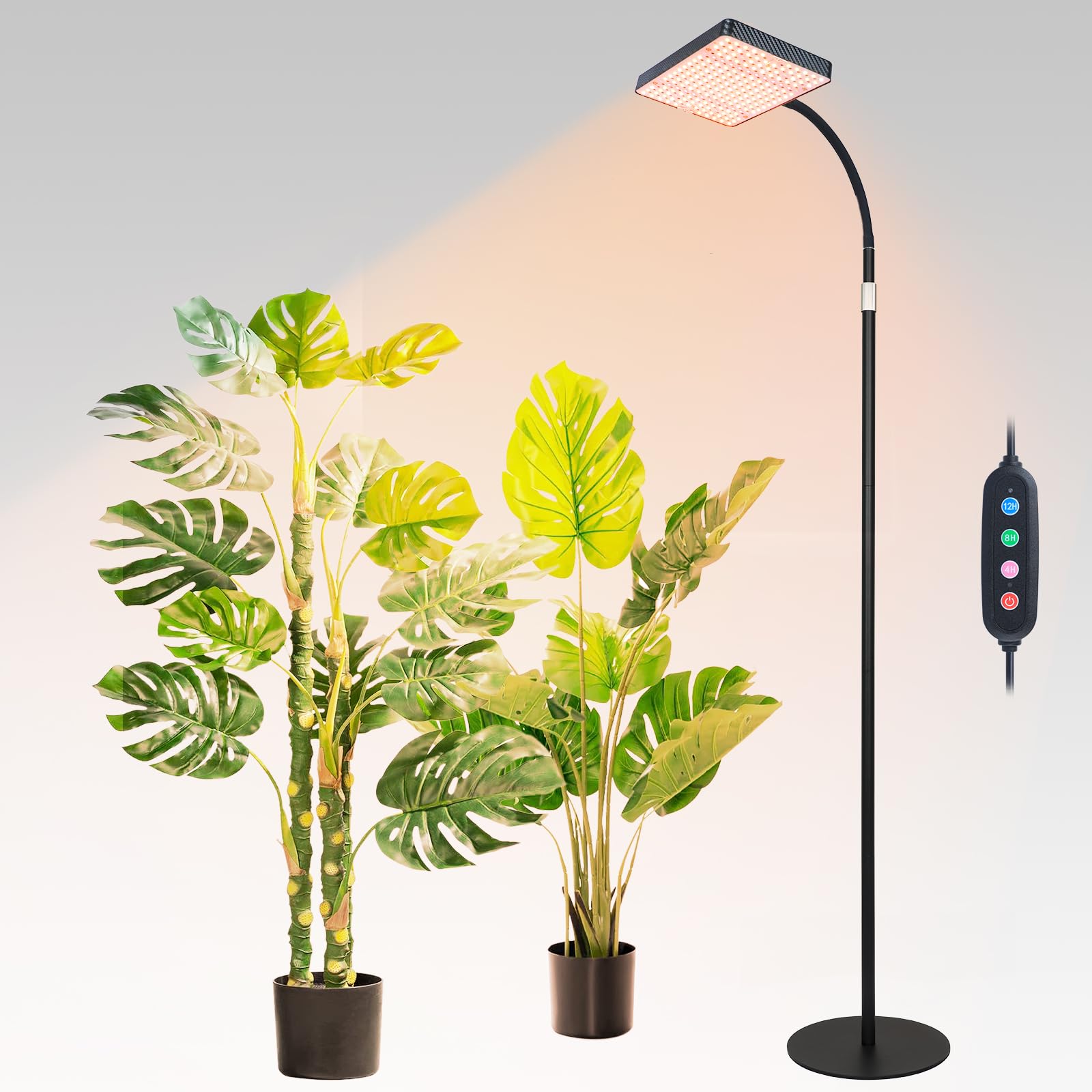
1. FECiDA 2026 Floor Lamp Grow Light
Our pick — over 4.5★ from 500+ verified ratings; the strongest balance of quality and price.
The tall-floor lamp that stretches high enough for a mature hibiscus without wobbling.
This is the fixture that rises from 40 inches to 76 inches — a 2.5x height range compared to a compact tabletop model — so even a six-foot hibiscus gets light from above, not from the side. It draws 25 real watts and pumps out 2000 lumens from 208 LEDs, which owners describe as “like a small sun” for an indoor jungle. The five-mode timer (4, 8, 12, 16, and 20 hours) cycles automatically every day; you set it once and it handles the rest.
The crowd favorite — 4.7 stars across 500-plus owners — who uniformly praise how well it drives plant growth. Functionality is the single most-praised thing here, with buyers reporting their plants “growing and thriving better than ever before” after switching to this lamp. It also daisy-chains up to three units off one wall outlet, handy if you are running multiple hibiscus plants in a row.
The trade-off: the light is harsh on the eyes because it includes UV and IR wavelengths. A few owners note that the centered pole limits where you can place the base. The base itself does not tip easily, but the lamp head is heavy enough that you want the pole fully seated. If your plant is under five feet and you prefer a softer room glow, look at a smaller option instead.
What wins owners over
- Full-spectrum 25W output that produces real growth, not just green light
- 40-to-76-inch range covers tall hibiscus from seedling to full bush
- Daisy-chain three units from one socket — built for a collection
The honest caveats
- Harsh UV/IR light makes it uncomfortable for a living-room reading lamp
- Centered pole limits placement flexibility around furniture
- Short power cable may require an extension cord in a large room
Best for: Anyone with a tall, flowering hibiscus who wants set-and-forget auto-timer operation and real wattage to drive blooms.
Think twice if: You need a soft-glowing room light — this one shines like a work light, not an accent lamp.
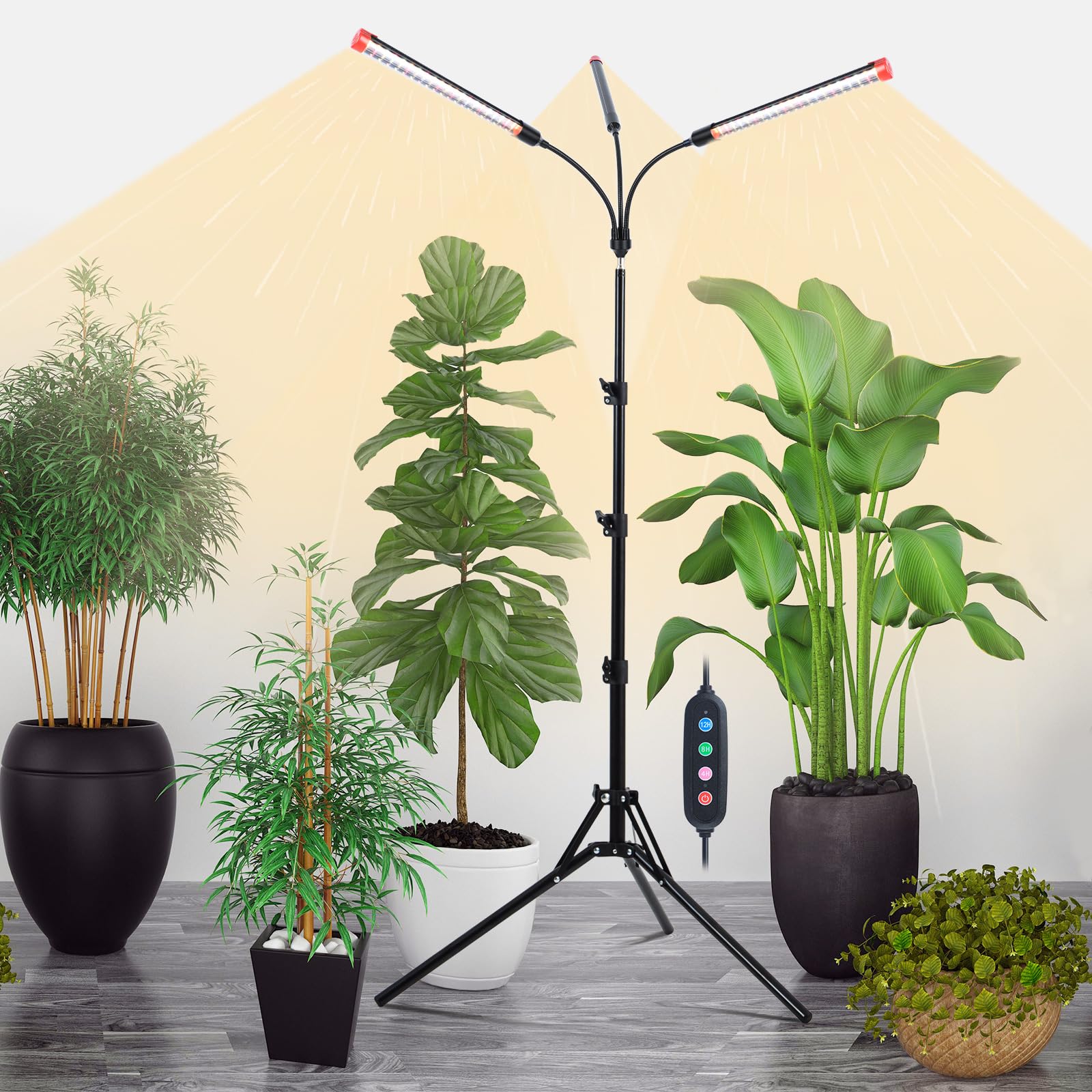
2. 3Head Grow Light with Stand
Three independently angled heads that wrap a hibiscus in light from every side.
Each head rotates on a 360-degree gooseneck, so you can aim one at the top canopy and two at the lower leaves — useful for a bushy hibiscus that grows outward as well as upward. The stand adjusts from 24 to 64 inches, and the full-spectrum LEDs mix 3000K and 5000K white with 660nm red wavelengths to support both leaf growth and bud formation.
Owners call it “the greatest buy I have made in years” and report that their indoor plants thrive on auto-pilot with the 4/8/12/16/20-hour timer cycle. The lack of a brightness adjustment does not bother most buyers because the default intensity already hits well. Assembly is straightforward, and the 60-degree spotlight design concentrates the beam rather than scattering it across the room.
The catch: buyers report the stand is not as sturdy as a heavier floor lamp — a bumped table or a top-heavy plant can shift it. And the 27-watt power draw is a mid-range level, so a very tall hibiscus may need the lamp placed closer than ideal. For a medium-sized hibiscus on a shelf or a low table, this triple-head arrangement is tough to top at this tier.
Where it shines: The three movable heads let you hit different parts of a spreading plant simultaneously, something a single-head lamp cannot do.
Who should pass: If your hibiscus is over five feet tall and you want a single, solid pole with no wobble, the FECiDA is a stronger fit.
Reach for this if: You have a wide, multi-stem hibiscus that benefits from three separate light angles.
Look elsewhere if: Stability is your top concern — the stand can feel light under a tall, heavy lamp.
3. FRGROW 2026 Tabletop Grow Light
A 25-watt desktop lamp that punches well above its tiny footprint.
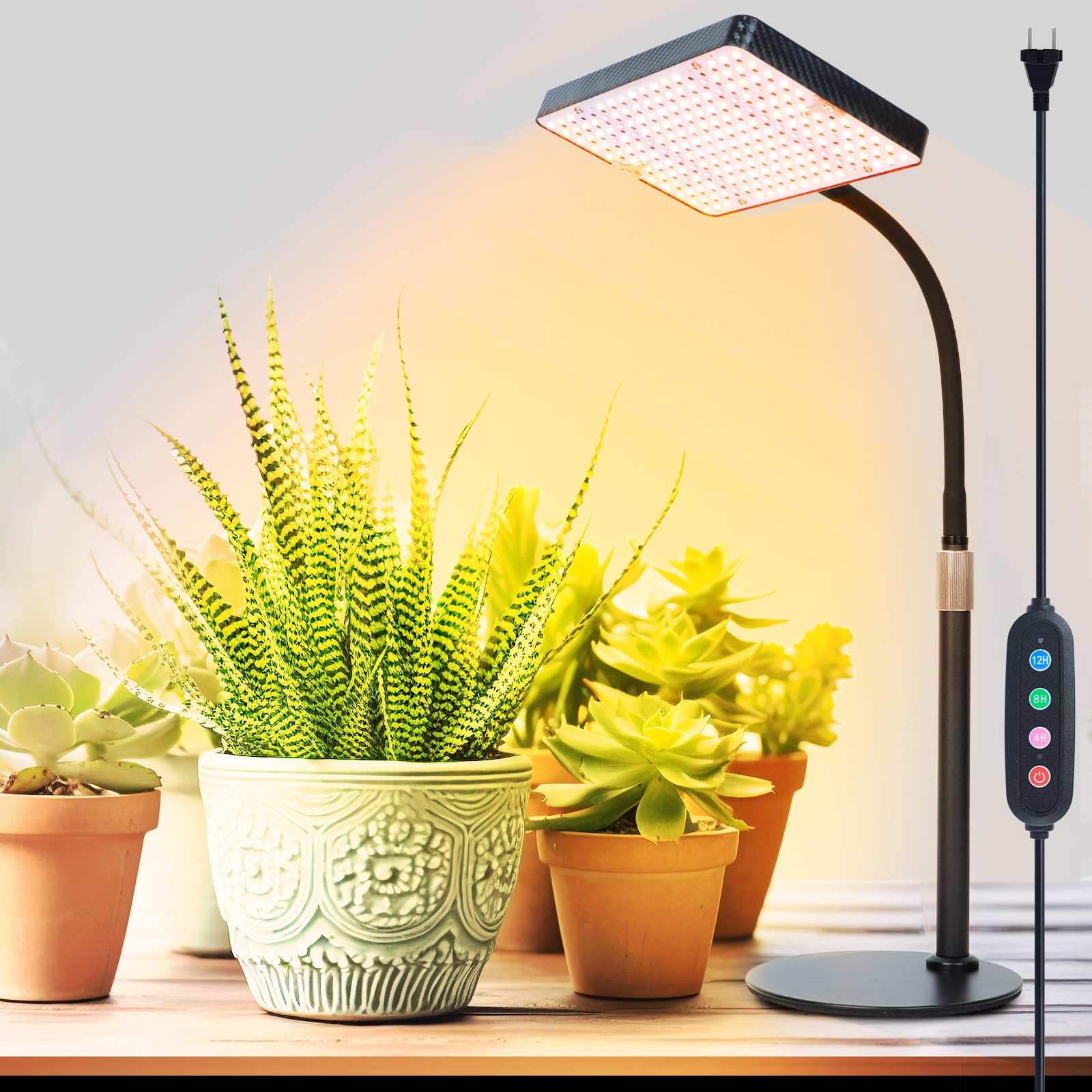
Do not let the tabletop form factor fool you. This FRGROW unit draws 25 real watts — the same as the full-size FECiDA floor lamp — but fits in an 8-by-5-inch base. It adjusts from 16 to 24 inches tall, which makes it ideal for a young hibiscus in a pot on a desk or a counter. The full-spectrum LEDs produce what owners call “bright enough like a small sun,” and the 4/8/12/16/20-hour timer lets you match a hibiscus’s long-day needs without touching any knobs.
Brightness is the most-praised aspect, and the adjustable gooseneck means you can point the compact head precisely where new growth is emerging. One owner noted their bonsai (a close relative to hibiscus in light needs) showed “greener leaves and better growth” within weeks. The sturdy metal base and daisy-chain function — connect up to three units from one outlet — make it easy to scale up a seedling setup into a full flowering station.
The limitation is obvious: 16 to 24 inches is too short for a mature hibiscus that has topped three feet. This light works best as a juvenile-phase fixture or for a small, compact variety kept in a pot on a table. The tabletop base is stable but light, so a bumped desk can shift the lamp angle. If your hibiscus is still under two feet, this is an efficient, no-waste choice.
The standout spec: 25 watts in a body barely larger than a can of soda — the highest power density in the compact class.
Who should skip: Anyone with a full-grown, five-foot hibiscus. The height range simply does not reach the canopy.
Ideal for: A desk-bound hibiscus seedling or a small compact variety that needs intense light without taking floor space.
Not for: A mature tall hibiscus — the lamp tops out at 24 inches.
4. Yehsence 10-in-1 Grow Light with Tripod Stand
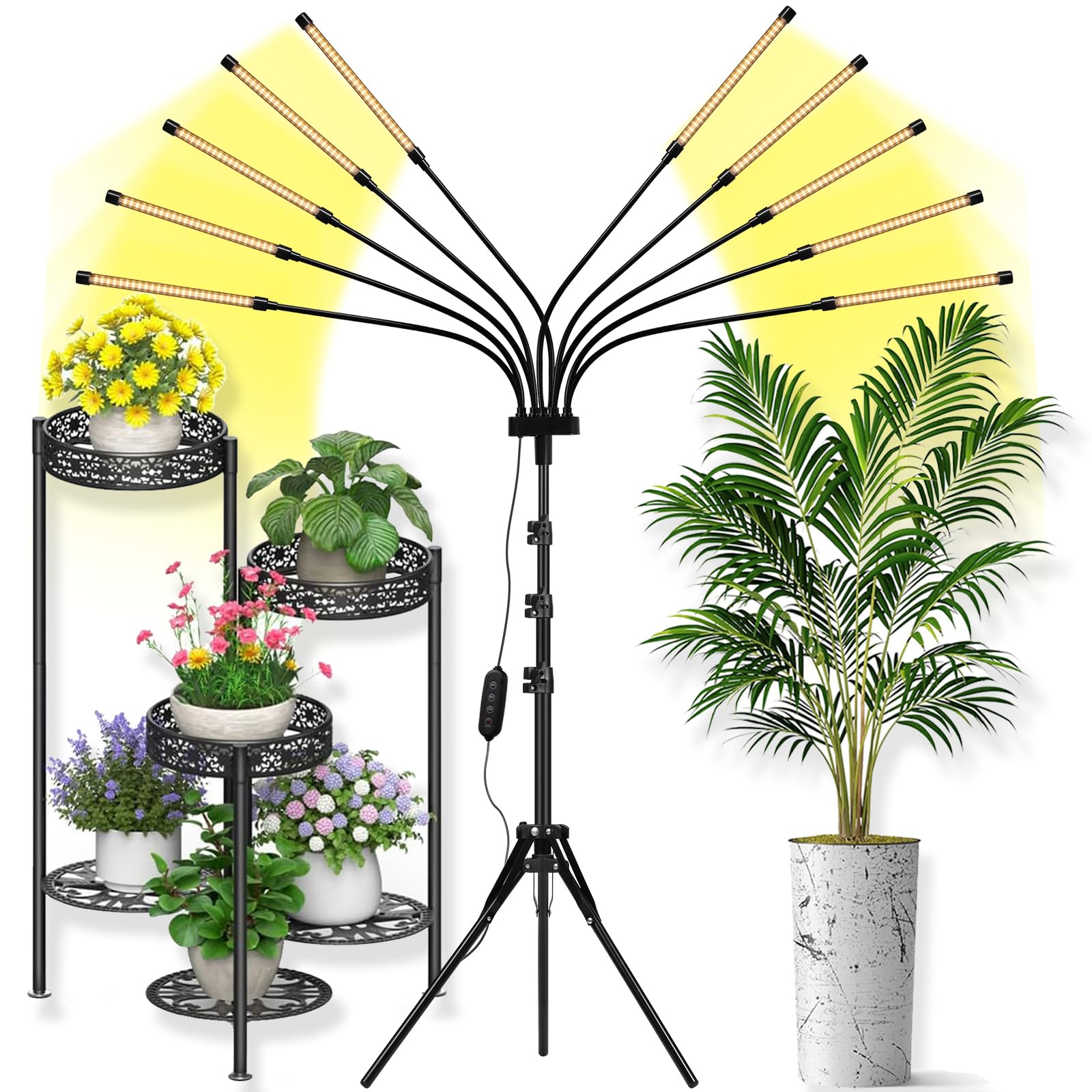
Ten individual heads on a tripod — the closest thing to a sun array for a whole hibiscus collection.
Each of the ten lamp heads packs 50 LEDs and a 15-inch flexible pipe, giving you the freedom to aim light at every branch of a large hibiscus bush. The full-spectrum output blends 400–500nm blue wavelengths and 600–750nm red wavelengths into a soft white light (3500 Kelvin, 95 CRI) that is comfortable to be around. The tripod stand is reinforced and described as “very stable” by owners, even with all ten heads extended at different angles.
The auto-timer offers 4, 8, or 12-hour cycles that repeat every 24 hours. Quality is the single most-discussed positive here — 61 mentions — and owners mention that their orchids, holiday cacti, and tropical plants respond with new growth and richer leaf color. The 3-pound weight and tripod footprint mean it fits in a corner or against a wall without dominating the room. The reinforced shade is made of flame-retardant material, adding a layer of safety for long-running daily cycles.
The catch: with ten heads all angled, the overall wattage is not stated in the data, so you cannot compare power draw directly to a single-head 27W light. Some owners wish each head had its own brightness control. The tripod, while stable, is slightly top-heavy when at full extension, so a curious pet or a bumped table can knock it off balance. This is the pick for someone growing several hibiscus plants or one very large, sprawling bush.
Where it dominates: Ten independently aimable heads let you cover a 360-degree plant canopy — no other fixture in this list can match the coverage.
The reality check: No per-head dimming and an unstated total wattage make it hard to gauge electricity use vs output.
Grab this for: A multi-plant hibiscus collection or a large, wide bush that needs light from all sides.
Pass if: You only have one small plant — the 10-head system is overkill and the tripod takes up floor space.
5. GLOWRIUM 20W Single Head Floor Plant Growing Lamp
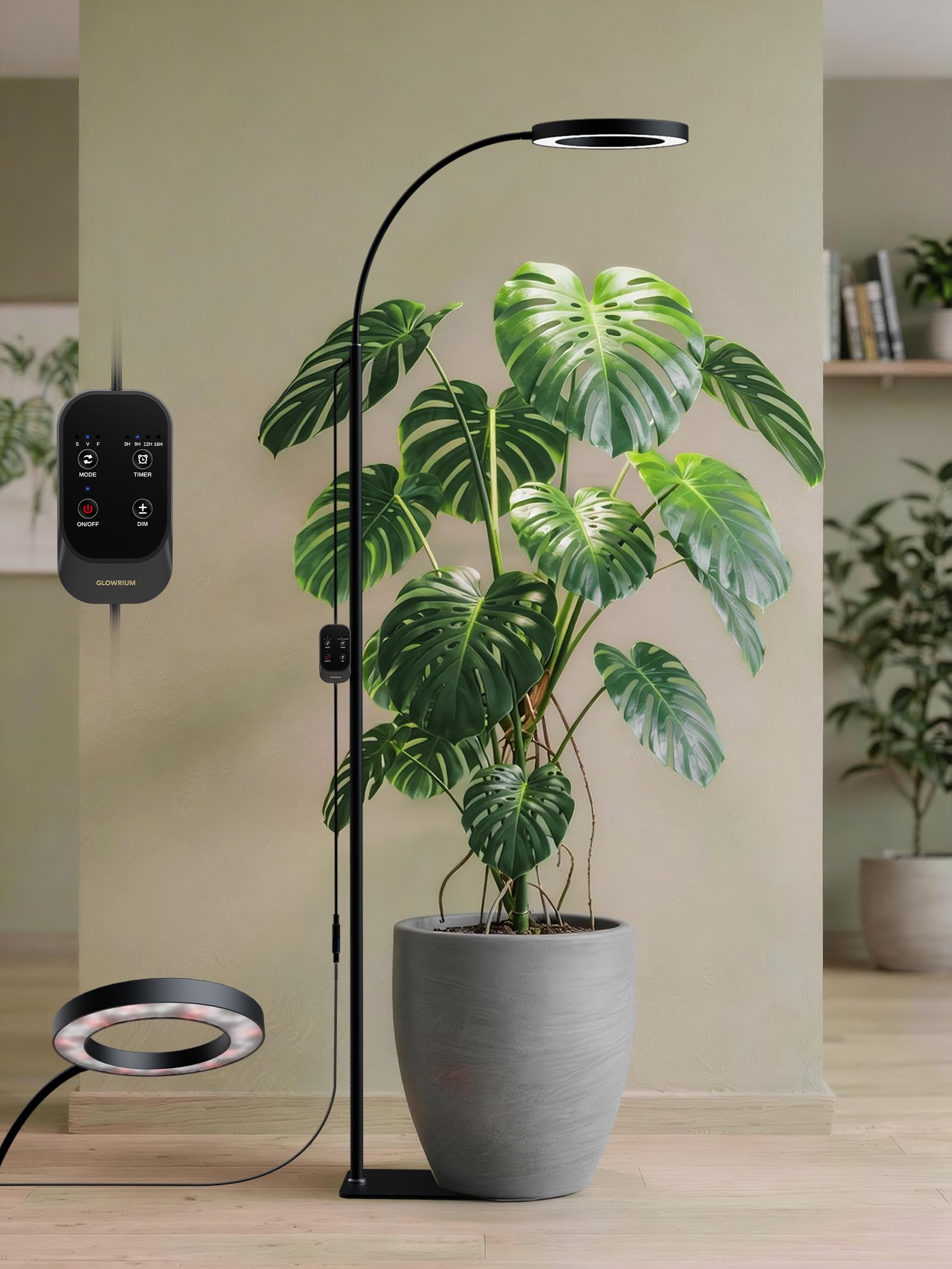
A sleek floor lamp that looks good in a living room while pushing real grow-light output.
The 20-watt power draw is lower than the 25W+ fixtures above, but the GLOWRIUM makes up for it with flexibility: three light modes (3000K warm white, 5000K cool white, and a red-LED blend for flowering), 6-level dimming from 10% to 100%, and a three-section aluminum pole that locks at 32, 47, or 63 inches. The 360-degree rotating head lets you tilt the beam exactly where the hibiscus canopy sits, and the 13-foot power cord means you can tuck the lamp far from any outlet.
Quality and ease of assembly get consistent praise from owners. The built-in 3/9/12-hour timer cycles automatically, and the 10.8-inch anti-slip base keeps the lamp planted even on hardwood floors. Owners call it “a better lamp than you would buy to read” and note their plants in dark corners are “doing much better” after a few weeks under this light. The aluminum heat sink keeps the LED cool enough for 12-hour daily runs.
The honest limit: 20 watts is modest for a large hibiscus that demands high light. If your plant is over three feet tall or you want aggressive flowering, stepping up to the 24W or 36W GLOWRIUM models below will deliver more punch. This is the pick for a medium-sized hibiscus in a room where aesthetics matter as much as light output — it doubles as a stylish reading lamp when the grow mode is off.
What stands out
- Three distinct light modes plus 10-to-100% dimming — rare flexibility for a floor lamp
- 63-inch max height with a 13-foot cord — fits almost any room layout
- Anti-slip 10.8-inch base that does not tip over on smooth floors
What holds it back
- 20-watt output is on the low side for a large, flowering hibiscus
- Single head limits coverage to one concentrated beam
Best for: A medium-sized hibiscus kept in a living area where the light needs to disappear into the decor.
Think twice if: You need brute-force light for a tall, bloom-heavy plant — go for a higher-wattage pick.
6. GLOWRIUM 24W Single Head Floor Lamp
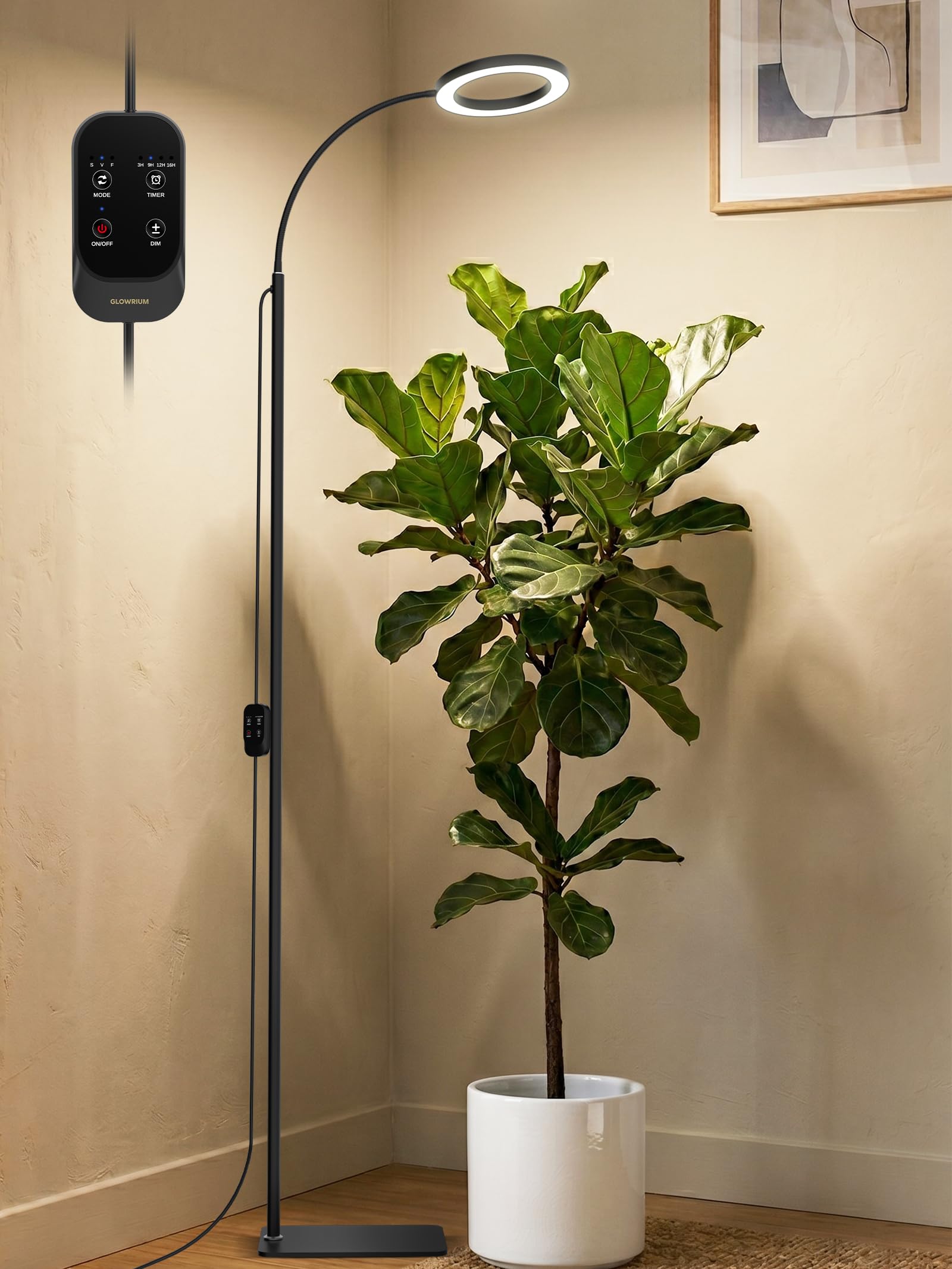
A 79-inch pole that keeps pace with a hibiscus as it stretches toward the ceiling.
The four-section pole extends from 23 inches to a full 79 inches — the tallest in this roundup — which means even a lanky, fast-growing hibiscus will never outgrow the lamp. The enlarged lamp head plus a 360-degree flexible gooseneck spreads the 24 watts of full-spectrum light where you need it. Stepless dimming and three light modes let you dial from a soft glow to high intensity without cycling through presets.
The timer runs 3, 9, 12, or 16-hour cycles — the 16-hour setting is key for a hibiscus that needs a long photoperiod to bloom. At 4.6 pounds and with a 10.83-inch aluminum base, the lamp is light enough to move between rooms but heavy enough that a bumped table will not knock it over. Customers note plants “perked up instantly” and call it the “best plant grow lights ever.” The 24V low-voltage system runs cool and safe for daily use.
The frosted diffuser softens the light, which is great for the eyes but reduces the focused intensity a hibiscus canopy would get from a bare-lens light. Some owners note the base needs a heavy pot sitting on it for full stability if the lamp is extended to its maximum height. At 24 watts, this is not the most powerful option, but the combination of extreme height range, timer flexibility, and stepless dimming makes it a top contender for a single tall hibiscus.
Where it excels
- 79-inch max height — no other pick here reaches higher
- 16-hour timer option matches the long day length hibiscus needs
- Frosted diffuser creates a soft, room-friendly light
The trade-off
- Frosted lens reduces direct canopy intensity vs a bare-lens lamp
- Base stability can be marginal at full 79-inch extension
Reach for this if: Your hibiscus is over five feet tall and you need a lamp that grows with it to the ceiling.
Look elsewhere if: You want maximum photon punch per watt — a bare-lens 27W fixture beats the diffused 24W on raw intensity.
7. GLOWRIUM 36W Double Head Floor Grow Light
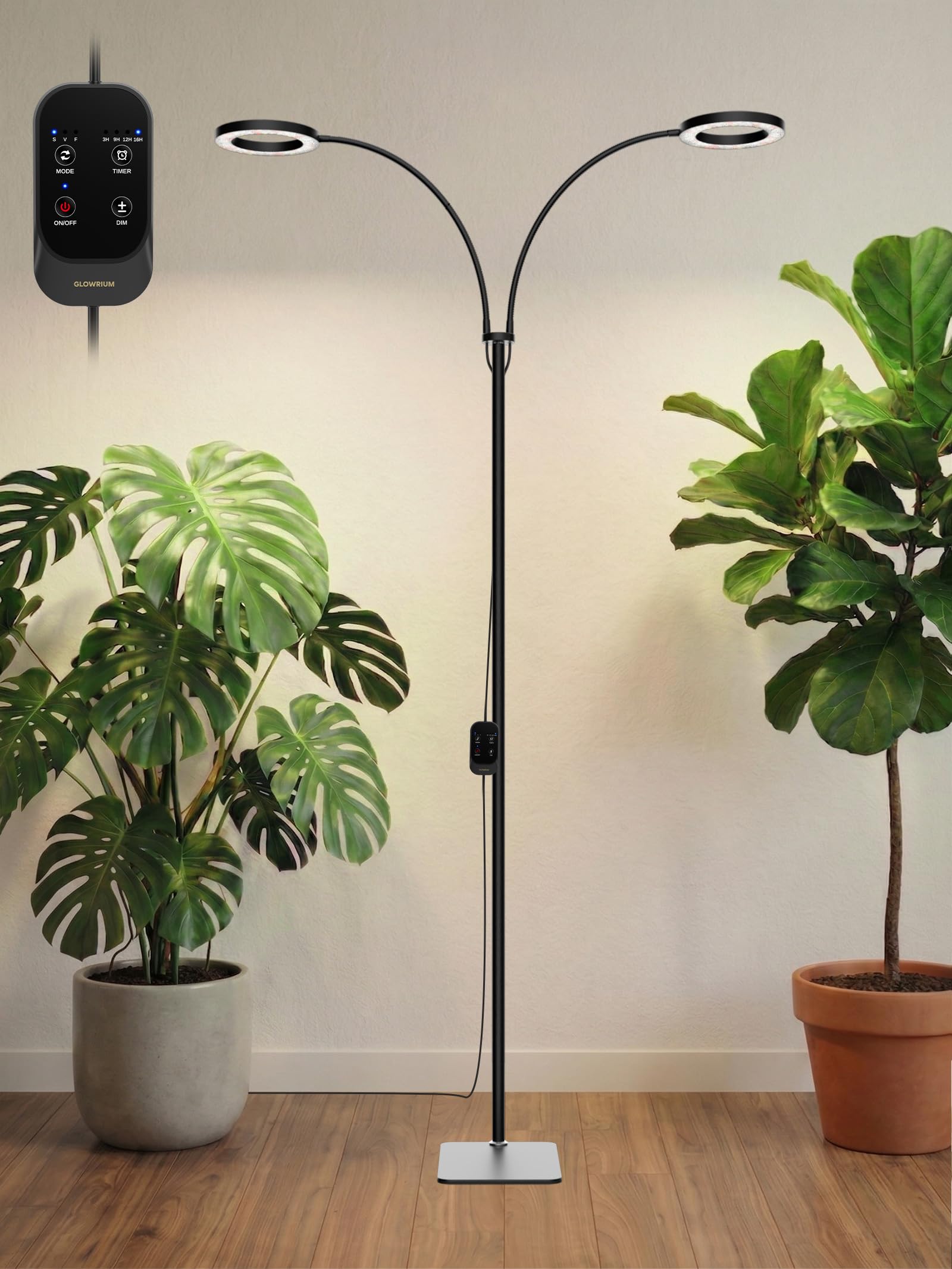
Two 18-watt heads that bathe a medium hibiscus in double the coverage zone.
This floor lamp splits 36 total watts across two independent lamp heads, each rotating 360 degrees to aim at different sides of a bushy hibiscus. The three-section pole locks at 32, 47, or 63 inches — not as tall as the 79-inch single-head model above, but enough for a medium-sized plant. The full-spectrum LEDs cover 380 to 780 nm, with three modes for germination, flowering, or full-cycle support. The 6-level dimming and 3/9/12-hour timer give you precise control without an app.
The 5.5-pound lamp sits on a heavy, non-slip 10.63-inch aluminum base. Owners say their plants began thriving in low-light homes after just a few days under this fixture, praising the timer and the 3-setting spectrum for blooming plants. The 13-foot power cord means you can position it in a corner far from an outlet, and the minimalist black-painted finish looks more like a designer lamp than a grow light.
The double head has a side effect: at 36W, this is the most powerful GLOWRIUM model in the list, but the light from each head is softer than a single-head 36W lamp because the wattage is split. For a hibiscus that is wide rather than tall, the two-beam spread is an advantage. For a single-stem, very tall hibiscus, the 24W single-head above may actually deliver more intensity at the canopy.
The smart trade: Two heads give you the option to aim one at the top growth and one at the lower leaves — ideal for a branching hibiscus.
What to note: 36W split across two heads means each puts out about 18W; the beam per head is gentler than a single 36W fixture.
Best for: A medium-height, wide hibiscus that benefits from two light angles, not just one overhead spot.
Not the pick if: You have a single tall, narrow plant — the 24W single-head or the 48W dual-head below fits better.
8. GLOWRIUM 48W Dual Head Tall Plant Grow Light
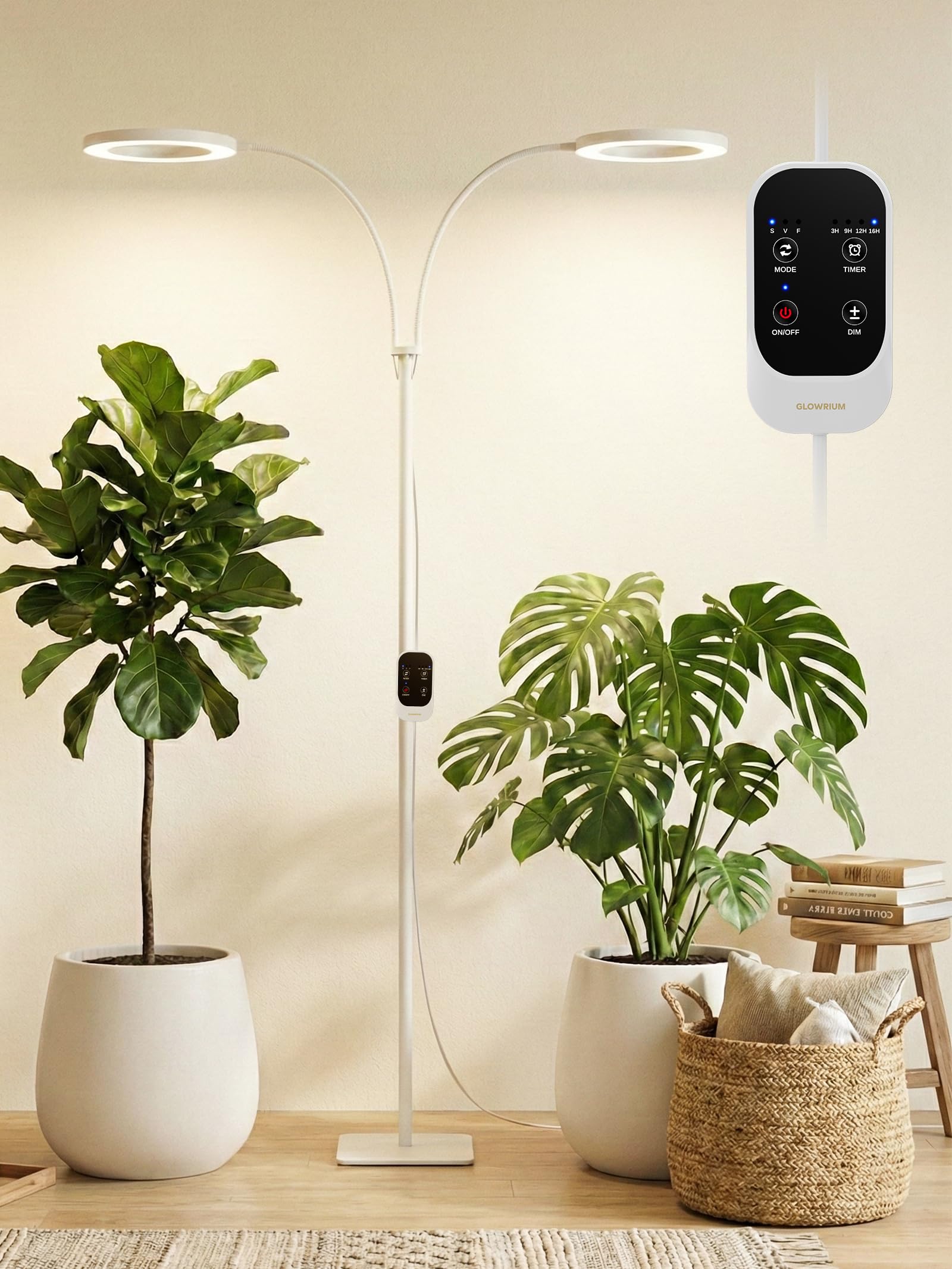
The 48-watt heavyweight that delivers more light per watt than anything else in this lineup.
At 48 watts and 268 high-efficiency LEDs, this dual-head lamp is the most powerful fixture in the guide. Each 7.87-inch lamp head has an independent 360-degree gooseneck, and the pole reaches 70.9 inches — tall enough for a fully grown hibiscus. The standout number is the tested PPFD output of up to 280 μmol/m²/s at a distance of 6 inches, which is the kind of intensity you normally associate with commercial propagation lights, not a home floor lamp.
The inline controller offers three dedicated spectrum modes (Seedling, Vegetative, Flowering), four timer cycles (3, 9, 12, 16 hours), and stepless dimming from 10% to 100%. The metal base weighs 5.29 pounds, and the entire assembly comes in at 6.2 pounds — heavy enough that the lamp stands solid on its own. Owners call it “high quality” and report their plants (including a 5-foot-9 fiddle leaf fig) show improved health and growth within weeks. Quality is the single most-discussed positive, with 33 mentions.
The dual heads are great for coverage but take up space. The lamp is also the heaviest in the lineup at 6.2 pounds, so moving it between rooms is less convenient than the lighter models. For a serious hibiscus grower with a large plant or multiple plants, this is the one that delivers the most photons per day.
Why it leads
- 48W actual draw — nearly double the power of the 25W fixtures
- 280 μmol/m²/s PPFD at 6 inches — proper flowering intensity
- Three dedicated spectrum modes for each growth phase
Where it is overkill
- Heavier and bulkier than any other pick — less portable
- Excess wattage for a small, single hibiscus in a compact pot
Grab this for: A large, flowering hibiscus or multiple plants where maximum light intensity is the priority.
skip it if: You have a small desk plant or a low-wattage approach — this lamp is built for serious growth, not casual maintenance.
Understanding the Specs
Wattage (Actual Power Draw)
This is the real amount of electricity the lamp uses, not an “equivalent” rating that compares it to an old incandescent bulb. A 25-watt LED grow light actually consumes 25 watts per hour. For a hibiscus, you want at least 20 to 25 real watts to get enough photon output for flowering. Higher wattage like 36W or 48W supports larger, more demanding plants and can penetrate deeper into a thick canopy.
Full Spectrum and PPFD
Full-spectrum LEDs emit light across a broad range of wavelengths, including the blue (400–500nm) and red (600–750nm) bands that plants use for photosynthesis and flowering. PPFD (Photosynthetic Photon Flux Density) measures how many usable photons hit a given area each second, expressed in μmol/m²/s. A reading of 200 μmol/m²/s or higher at the canopy level is strong enough to drive blooming in a high-light plant like hibiscus. The GLOWRIUM 48W, for example, is tested to reach 280 μmol/m²/s at 6 inches — that is flowering-level intensity.
FAQ
Can I use a standard LED bulb as a grow light for hibiscus?
How high should I hang the light above my hibiscus?
How many hours should the grow light run for a hibiscus each day?
What does the timer do on a grow light?
Will a 20-watt grow light be strong enough for my hibiscus?
What is the difference between a single-head and a multi-head grow light?
Can I leave a grow light on 24 hours a day for my hibiscus?
Do grow lights use a lot of electricity?
What does dimming do on a grow light?
How do I clean and maintain an LED grow light?
Final Thoughts: The Verdict
For the majority of shoppers, the grow light for hibiscus winner is the FECiDA 2026 Floor Lamp because it delivers 25 watts of full-spectrum power with a 40-to-76-inch height range, a five-mode auto timer, and a daisy-chain option — all at a price that undercuts the premium picks while outperforming the compact ones. If you want maximum intensity for a large flowering hibiscus, grab the GLOWRIUM 48W Dual Head. And for a compact desk-bound plant or seedling, the FRGROW 2026 Tabletop gives you 25 watts in a body that fits anywhere. The right light keeps your hibiscus blooming through every season — pick the one that matches your plant’s size and your room’s layout.
How We Picked
We do not accept paid placement. Every pick is matched to a real buyer and a real use-case; we do not hands-on test units.
Sources & Methodology
Specifications: manufacturer listings and product documentation. Review insights: verified customer reviews, as of July 2026. Pricing: not shown on this page (it changes often); check the current price via the retailer link.
As an Amazon Associate, Lawn Gear Lab earns from qualifying purchases. This does not affect which products we feature.