
Specs are compiled from manufacturer listings and verified buyer reviews and can change over time — please confirm the key details on the product page before buying.
Treating a yellowing hydrangea or a stunted vegetable patch with guesswork is frustrating. You dump in lime, then sulfur, then more water — and the plant still sulks. The shortcut out of that loop is a ground pH meter that tells you, in numbers, exactly what your soil needs right now. This guide covers nine models, from simple probe-style testers to Bluetooth-enabled kits that log data for you, so you can stop chasing symptoms and start fixing the root cause.
I’m Rikta — the founder and writer behind Lawn Gear Lab. This guide is built by comparing the manufacturers’ published specifications and the patterns across verified customer reviews, so you get each pick’s real strengths and trade-offs instead of marketing spin.
Below you will find the best ground ph meter options for every skill level and budget, broken down by the one spec that actually tells you if a meter is worth buying.
Our Picks at a Glance

How To Choose The Best Ground pH Meter
A pH meter that won’t hold calibration is worse than no meter at all — it will actively mislead you into adding the wrong amendments. Here is what actually separates the usable meters from the frustrating ones.
Probe type: dual-rod vs. single-electrode
The most common budget meters use two metal rods (a dual-probe design) that measure electrical resistance between them. They are simple and need no batteries, but they drift over time and can be thrown off by soil salts. Single-electrode meters use a glass bulb sensor, just like lab equipment, and deliver far more consistent results — but they require careful cleaning and occasional calibration.
Calibration: the make-or-break step
A meter that reads 7.0 in every patch of dirt is a meter you cannot trust. Look for meters that come with calibration powder or solution (typically pH 4.01, 7.0, and 10.01) so you can zero the sensor. More expensive meters offer three-point calibration, which covers acidic, neutral, and alkaline soil. Without this, you are essentially guessing.
Measurement range and resolution
Most garden soils fall between pH 5.0 and 8.0, but if you grow blueberries (which need acidic soil around 4.5–5.5) or fight alkaline clay, you need a meter that reads below 4.0 and above 9.0. Digital meters typically offer 0.1 pH resolution, while analog dials might only show half-step increments — fine for a rough check, less helpful for precision work.
Quick Comparison
| Model | Best For | pH Range | Probe Type | Calibration | Amazon |
|---|---|---|---|---|---|
| HSLGOVE 7-in-1★ Best Overall | All-in-one monitoring | Digital readout | Single metal rod | Not required | Amazon |
| Buladeke 7-in-1Top Performer | Backlit screen & EC/TDS | Digital readout | Single metal rod | Not required | Amazon |
| Tadeto TE027Precision Pick | Lab-grade accuracy | 0 – 14 | Single glass electrode | 3-point (powder incl.) | Amazon |
| Luster Leaf Rapitest | Quick digital check | 3.5 – 9.0 | Single metal rod | Not required | Amazon |
| Maxsolve 3-in-1 2-Pack | Multi-location monitoring | Analog dial | Dual metal rods | Not required | Amazon |
| Auduto 7-in-1 | Beginner-friendly data | Digital readout | Single metal rod | Not required | Amazon |
| YINMIK Digital pH | Precision & app logging | Digital readout | Single glass electrode | 3-point (powder incl.) | Amazon |
| Gain Express ZD-06 | Deep soil penetration | 3 – 8 | Dual metal rods | Manual adjustment | Amazon |
| Kelway PHD | Reliable no-battery analog | 5.0 – 7.0 | Single metal rod | Conditioning pads | Amazon |
In‑Depth Reviews
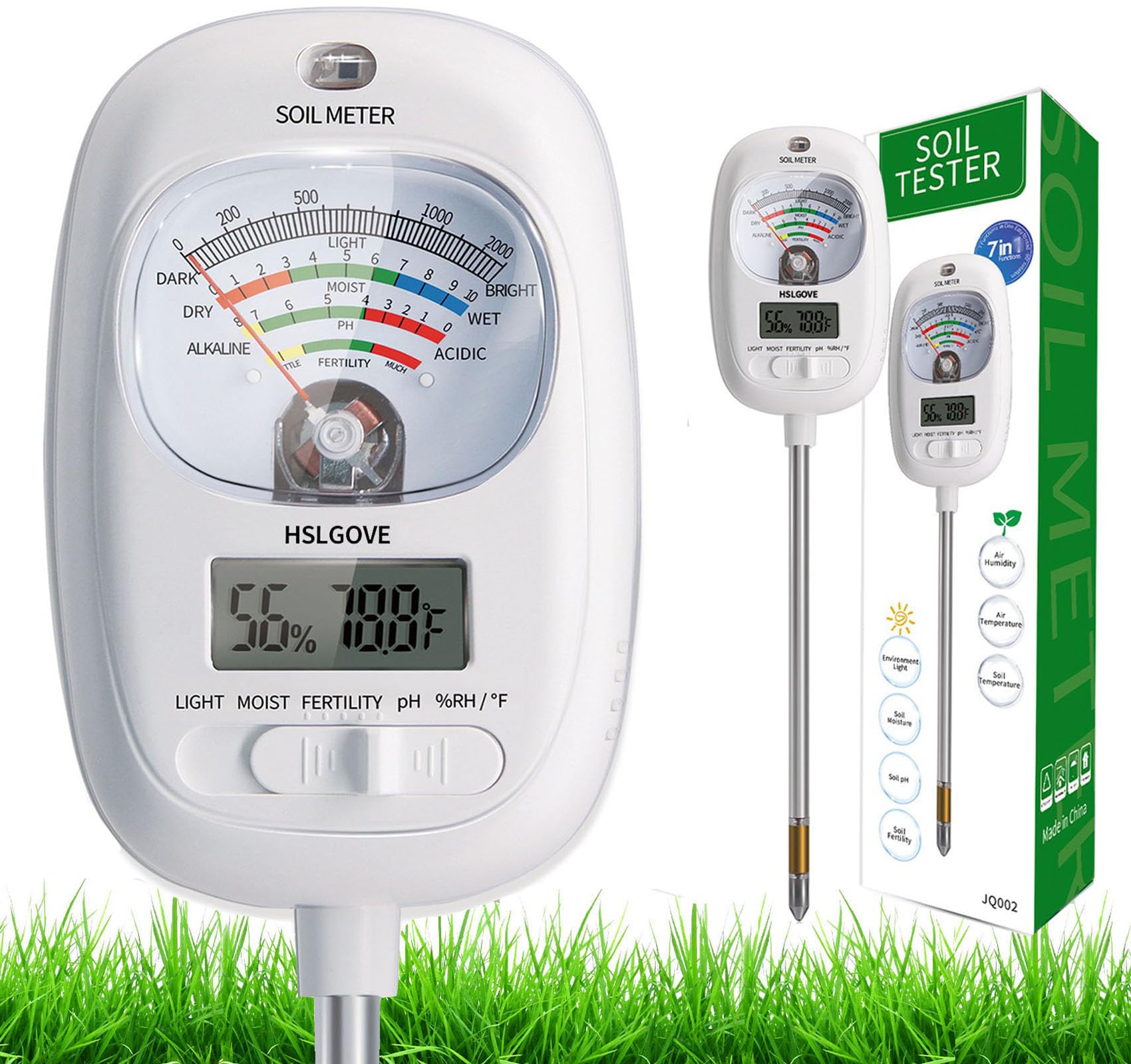
1. HSLGOVE Soil Test Kit, 7-in-One
Our pick — 4.5★ from 250+ verified ratings; the strongest balance of quality and price.
The seven-in-one that replaces a whole drawer of single-purpose gadgets.
This meter bundles moisture, pH, fertility, temperature (soil and air), humidity, and light into one ivory-white unit with two screens — a classic analog dial for moisture and pH plus an LCD for the environmental readouts. The single-probe design is gentler on roots than the dual-rod type, and at 4.8 ounces it is light enough to carry around the garden all morning. The LCD shows soil temperature, air temperature, and humidity, which is the extra context you need when deciding whether to water or wait.
What wins people over is the sheer breadth of data from one device. Functionality dominates the feedback — over fifty owners call it out as a practical tool that ends the guessing game around watering and fertilizing. The clear dual-screen display makes reading straightforward even for beginners. The trade-off is that this meter cannot be calibrated; it is a relative-read tool, not a lab instrument, so if your soil is extremely saline or you need pinpoint accuracy for a research plot, a dedicated pH electrode meter is a better fit.
Seven-in-one precision
- Seven metrics from one probe saves you from buying separate moisture, light, and pH meters.
- Dual-display design (analog + digital) means the LCD handles temperature and humidity while the dial stays on moisture or pH.
- Single metal probe disturbs less soil and fewer roots than a dual-rod style.
Calibration required often
- No calibration option — it reads relative levels rather than exact pH values.
- The LCD requires a button press to cycle through functions; not all data is visible at once.
Accurate readings: the gardener who wants a quick dashboard of soil health — moisture, pH, light, and temperature — without juggling four separate tools.
Frequent upkeep: you need a precise, lab-calibratable pH reading for scientific soil management.
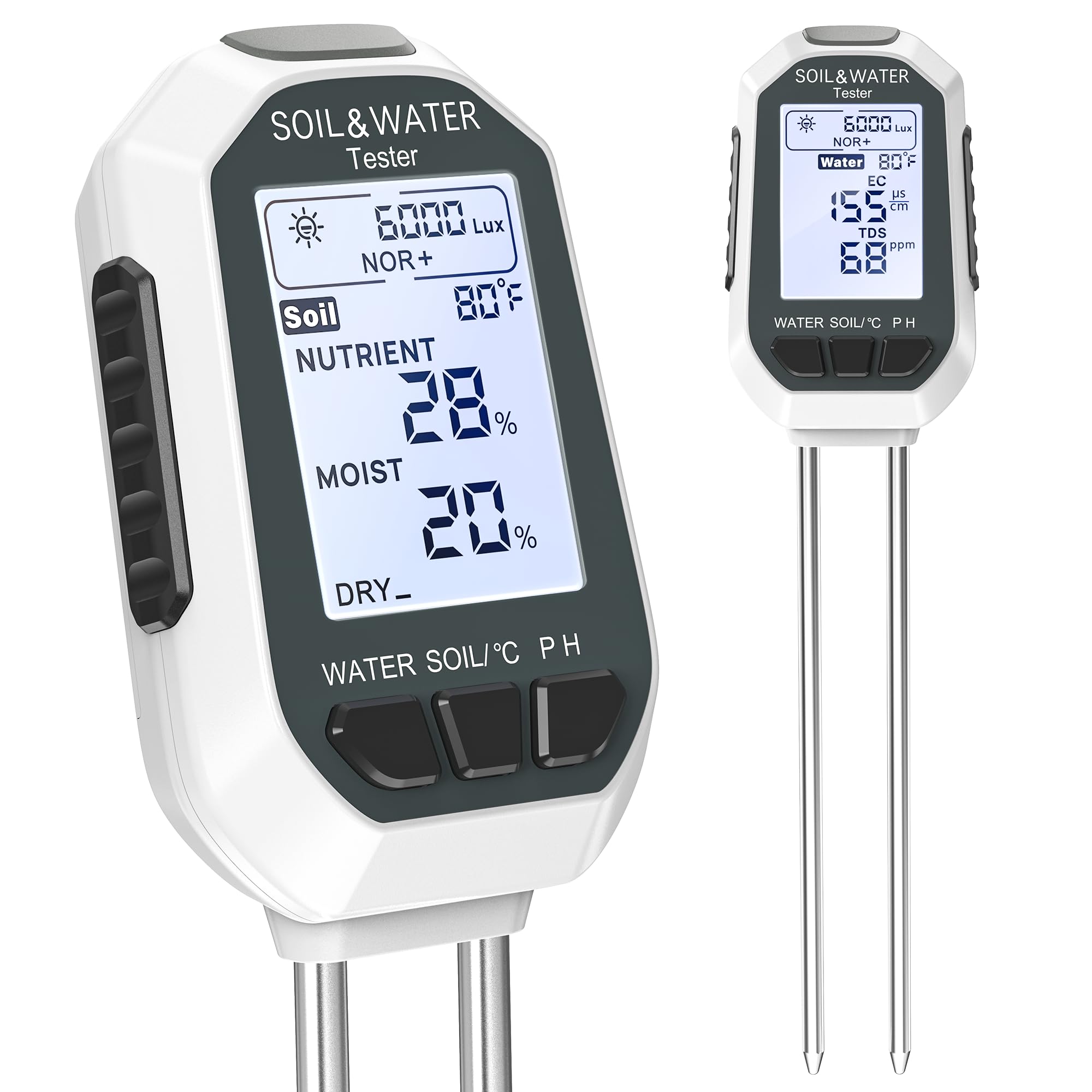
2. Buladeke 7-in-1 Digital Soil Tester Kit
A screen you can actually read in the dark, plus water-quality extras.
This tester covers pH, EC (electrical conductivity — a measure of how much nutrient salt is in the soil), TDS (total dissolved solids), fertility, temperature, moisture, and sunlight. The big differentiator is the large backlit LCD, which owners call out as the most-liked feature — no squinting at a tiny dial or trying to catch a reflection. It uses 4 AAA batteries (not included), a small hassle for the benefit of a consistently lit display. The probe inserts about 10 cm into the soil and delivers readings in about ten seconds.
Buyers report that the EC and TDS modes are useful for checking water quality for hydroponics or even aquariums. The temperature reading runs about 5°F warm according to some controlled tests, so treat the temperature function as a useful trend indicator rather than an exact thermometer. The screen quality gets consistent praise — eight owners highlight it specifically — and the ease of use makes it a practical choice for both indoor pots and outdoor beds.
Digital seven-in-one: the plant parent who wants a bright, easy-to-read display and appreciates having EC/TDS data for water without buying a separate pen.
3. Tadeto Soil pH Tester
Lab-style three-point calibration that actually covers the full pH spectrum.
This is a serious single-electrode glass-bulb meter that measures from 0 to 14 pH and uses a three-point calibration system (pH 4.01, 7.0, and 10.01) to ensure accuracy across acidic, neutral, and alkaline soils. The hard conical zinc alloy protective cap is not a flimsy cover — it is a screw-on shield that protects the glass sensor when you push through compacted soil. The LCD has a backlit screen plus a red alarm that lights up when the reading drops below pH 3.5 or climbs above pH 12, warning you of extreme conditions.
Accuracy and functionality are the standout qualities, with almost thirty owners praising its precision. The catch is that calibration requires careful handling — the included instruction manual is described as confusing by several buyers, and the calibration packets take some practice to use correctly. One buyer received a unit with a defective display and had to get a replacement, so check it immediately on arrival. For dedicated gardeners willing to learn the setup process, this meter rivals instruments costing several times as much.
Simple pH focus: the serious grower or homesteader who needs true pH readings they can trust for blueberries, acid-loving ornamentals, or alkaline soil remediation.
4. YINMIK Digital pH Meter for Soil

A Bluetooth-connected probe that logs pH data straight to your phone.
The YINMIK turns soil testing into a data-logging project. It connects via Bluetooth to a free app that records pH and temperature readings, time-stamps them, and lets you export the data to a spreadsheet. The stainless-steel dibber protects the glass pH electrode when you push into the ground — pull the dibber off and the same meter reads pH in water, so it works for checking your hydroponic nutrient solution or collected rainwater. The kit includes six packets of calibration powder, a brush for cleaning the delicate glass bulb, and three LR44 batteries.
Buyers confirm that once calibrated, the readings match lab tests within 0.1 pH, making it genuinely accurate for serious soil management. The tapered stainless-steel tip makes insertion easier than a bare glass probe. Reliability is the main concern — a few owners mention the Bluetooth connection failing after several months and the meter getting stuck on one value. The replaceable probe tip is a welcome feature if that happens. It also comes with calibration buffer powder for 6 uses, which is more than most kits provide.
pH precision: the data-driven gardener who wants to track pH trends over time and loves seeing charts instead of squinting at a dial.
Delicate sensor: you do not want to calibrate before every session — this meter demands that discipline to stay accurate.
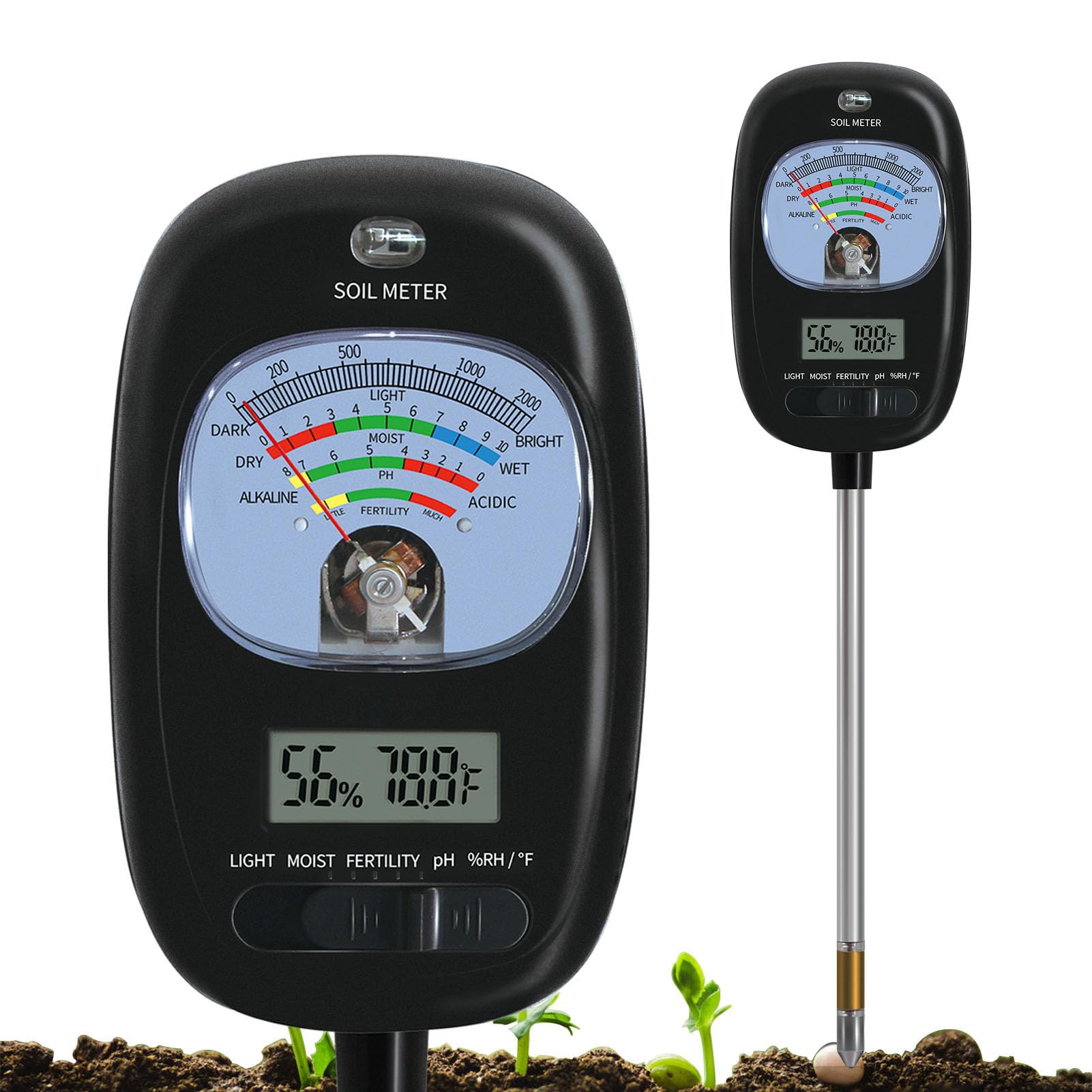
5. Auduto 7-in-1 Soil Test Kit
A patented dual-dial design that monitors air and soil in one glance.
Structurally similar to the HSLGOVE but with its own patented layout, this 7-in-1 meter combines a classic analog meter for moisture and pH with an LCD that displays soil temperature, air temperature, and humidity. The probes are made from corrosion-resistant metal and measure about 6.8 inches long, which is enough depth for medium to large potted plants. The kit is lightweight at 5.6 ounces and fits easily into a tool apron pocket.
Owners consistently describe it as a “lifesaver” for beginners because it removes the guesswork from watering and fertilizing. The clear LCD screen makes readings easy to understand without reading a manual. The manufacturer explicitly warns not to use it in sandy or loose soils, and to insert it to at least two-thirds of the probe depth. For patio gardeners and first-time plant owners, this is among the most straightforward all-in-one tools available.
Seven-in-one kit: you are new to soil testing and want one device that shows you moisture, pH, temperature, and light without needing to calibrate anything.
6. Kelway PHD Soil pH Meter

A dial-based workhorse that needs no power and no calibration beyond a conditioning pad.
The Kelway PHD is the opposite of the feature-packed digital meters — it does one thing (measure pH in the 5.0–7.0 range) with a simple dial and no electronics at all. It requires no batteries, no chemicals, and no distilled water; you press the probe into moist soil, wait about a minute, and read the dial. The build quality is noticeably solid, with over twenty owners calling out the construction as durable. Accuracy is the most-praised aspect, with nearly sixty owners reporting reliable readings that match professional soil tests.
The catch is the limited scale — this meter is designed for acidic to neutral soils, not alkaline conditions. Owners of alkaline clay or high-pH garden beds report that the needle never moves above 6.5. It also relies on special conditioning pads that you must use to prepare the probe, which adds a step that some buyers find tedious. For blueberry growers or anyone managing acidic soil, this is a classic, trustworthy tool. For alkaline soil managers, look at the Tadeto or YINMIK instead.
Vintage reliability: the gardener who prizes simplicity and wants a mechanical meter that will never have a dead battery or a firmware glitch.
No digital: anyone dealing with alkaline soil above pH 7.0 — this meter simply will not show it.
7. Gain Express ZD-06 Soil pH Meter

A nearly 12-inch probe that reaches deep into root zones where most meters can’t go.
At 295mm (about 11.6 inches), the electrode on the Gain Express is the longest in this roundup. That length lets you measure pH and moisture deep in raised beds, field soil, or around tree roots where surface readings would be misleading. The meter is self-powered — no batteries to replace — and uses the classic dual-probe system that measures electrical resistance. The dial shows pH from 3 to 8 and moisture as a percentage, so you can assess both variables in one insertion.
Buyers praise the build quality, calling it well-made and durable, with over fifty owners highlighting its sturdy construction. The long probe is particularly suited to vineyards, orchards, and commercial bed maintenance. Accuracy gets more mixed feedback — some find it remarkably consistent, while others report variability between readings. The numbers on the dial are very small, so reading glasses are a must. Periodic manual calibration is required to keep the readings reliable, and the operating range is limited to 5–50°C (41–122°F).
ZD-06 model: deep soil measurement in gardens, lawns, and agricultural beds where a standard 6-inch probe simply will not reach the root zone.
8. Maxsolve 3-in-1 2-Pack Soil Tester

Two meters for the price of one, covering moisture, light, and pH without any power.
This is the simplest and most affordable entry point in the list. The 3-in-1 meter measures moisture, light, and pH using dual metal probes that need no batteries — you insert them into damp soil and read the analog dial immediately. The 2-pack lets you keep one sensor in a potted plant and carry the other around the garden, or stash one indoors and one in the greenhouse. The probes are 3.68 ounces each and measure 10.24 inches tall, so they are compact enough for small pots.
The practical value of having two units is the reason most buyers choose this set. As owners put it: “It comes in a 2-pack so I can keep one in the garden and one inside.” Simplicity is the main draw — no setup, no calibration, no app pairing. The light meter function is the least reliable feature, with some buyers calling it non-functional. The pH readings from a dual-rod meter are rough estimates, not laboratory-grade data, but they are sufficient for noticing if your soil is trending acidic or alkaline.
Two-pack value: the casual houseplant owner who needs a quick gut-check on moisture and pH without any tech friction.
Simple tests: serious gardeners who need reliable pH data for soil amendment decisions — the analog scale is too coarse for precision work.
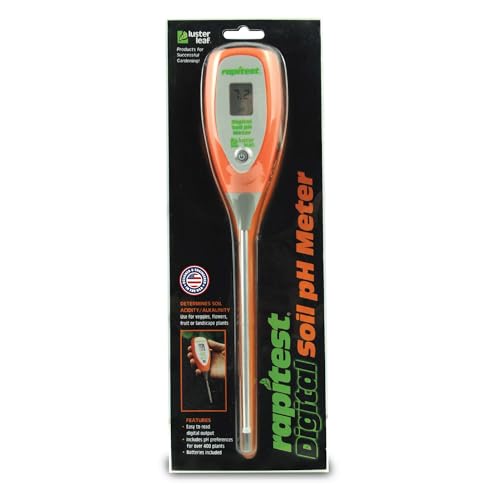
9. Luster Leaf Rapitest Digital Soil pH Meter
A lightweight digital meter that either works perfectly or reads 7.0 every time.
This is the most polarizing meter in the lineup. At 1.6 ounces, it is the lightest by a wide margin — the HSLGOVE weighs 4.8 ounces — and it gives you a digital readout of pH from 3.5 to 9.0 instantly. The concept is simple: push the probe into damp soil and the LCD shows a number. It is designed for soil only, not water. A printed plant pH preference list is included so you can see whether your hydrangeas need more acid or your tomatoes are happy.
The reliability is split. Some customers note it works flawlessly — one buyer tested two soil samples that both read 7.0, then added a small amount of vinegar and watched the reading drop in a controlled and predictable way. Others report the exact same stick-at-7.0 problem as a persistent defect, suggesting quality control is inconsistent. The probe needs to be kept clean and free of the aluminum-oxide layer that can form on the metal. For this reason, it’s a high-variance purchase — you may get a perfectly functional unit or a dud.
Rapitest digital: the budget buyer willing to roll the dice on a lightweight digital meter and prepared to return a defective unit.
Understanding the Specs
Dual-probe vs. single-electrode
The most visible difference between low-cost and high-end meters. Dual-probe meters (like the Maxsolve or Gain Express) use two metal rods that measure electrical resistance between them. They are simple, battery-free, and cheap, but soil salts, moisture content, and temperature all interfere with the reading. Single-electrode meters (like the Tadeto or YINMIK) use a glass bulb that responds to hydrogen ion activity — the same technology used in laboratory pH meters. They are more accurate but require careful cleaning, proper storage in a storage solution, and periodic calibration.
Calibration and why it matters
Calibration is the process of telling the meter what pH 4.01, 7.0, and 10.01 look like electrically. Without it, the meter is guessing based on factory settings that drift over time as the probe ages. Cheap dual-probe meters typically cannot be calibrated; you accept whatever reading they give and hope it is in the right ballpark. Single-electrode meters come with buffer powders or solutions; you dissolve the powder in distilled water, dip the probe, and set the meter to match the known value. Three-point calibration (acid, neutral, alkali) is the gold standard because it corrects the meter’s response across the entire measurement range.
pH range and resolution
Most garden soil falls between pH 5.0 and 8.0, but certain crops demand a broader view. Blueberries and azaleas need readings below 5.0, while alkaline soils in arid regions can climb above 8.0. The Kelway PHD only reads 5.0–7.0, so it is blind to both extremes. The Tadeto covers the full 0–14 range. Resolution matters, too — analog dials with half-step markings (like the Gain Express showing pH 3–8) only give you a rough idea, while digital meters with 0.1 resolution let you see whether your lime application actually moved the needle from 6.2 to 6.5.
FAQ
How deep should I insert a ground pH meter?
Why does my pH meter keep reading 7.0?
Can I test water with a ground pH meter?
How often should I calibrate my pH meter?
What is the difference between pH, EC, and TDS?
Will a pH meter work in dry soil?
How do I clean and store my pH meter?
What pH should my garden soil be for vegetables?
Can I leave a pH meter in the soil permanently?
Final Thoughts: The Verdict
The best ground ph meter for most gardeners is the HSLGOVE 7-in-1 because it gives you the broadest view of soil health — moisture, pH, fertility, and temperature — in one simple device that requires no calibration. If you need pinpoint accuracy for acidic soil management, grab the Tadeto TE027 with its three-point calibration and full 0–14 range. For the data-driven gardener who wants to log pH trends on a phone, the YINMIK is the one to reach for.
How We Picked
We do not accept paid placement. Every pick is matched to a real buyer and a real use-case; we do not hands-on test units.
Sources & Methodology
Specifications: manufacturer listings and product documentation. Review insights: verified customer reviews, as of July 2026. Pricing: not shown on this page (it changes often); check the current price via the retailer link.
As an Amazon Associate, Lawn Gear Lab earns from qualifying purchases. This does not affect which products we feature.