
Specs are compiled from manufacturer listings and verified buyer reviews and can change over time — please confirm the key details on the product page before buying.
Picking the wrong plastic sheeting for your greenhouse is a gamble with your plants’ survival through a single hard frost or a surprise hailstorm. You need a film that handles sun, snow load, and tearing during installation without turning into a brittle mess by mid-summer. The core difference depends on thickness measured in mils, UV stabilizers, and whether the sheet can shrug off a staple gun without splitting.
I’m Rikta — the founder and writer behind Lawn Gear Lab. This guide is built by comparing the manufacturers’ published specifications and the patterns across verified customer reviews, so you get each pick’s real strengths and trade-offs instead of marketing spin.
Every sheet here is a dedicated 6-mil or thicker polyethylene film built for a distinct greenhouse challenge — from snow-heavy hoop houses to blackout photoperiod control. Read on for the best greenhouse plastic sheeting that matches your frame, climate, and patience for installation.
Our Picks at a Glance

How To Choose The Best Greenhouse Plastic Sheeting
You want a single sheet that reflects UV, diffuses light, shrugs off a windy afternoon, and still lets you see your tomato seedlings without squinting. The right pick balances mil thickness, UV additives, and a design trait called “anti-drip” that stops water from forming magnifying-glass droplets on your leaves.
Mil thickness and mechanical strength
The heavy lifters here are 6-mil films. That number — 6 mil, or 0.006 inches — is the rugged standard for greenhouses because it resists punctures from hail and snags from a staple gun. A 6-mil sheet typically has a tensile strength around 26 MPa and a tear strength around 129 kN/m, though those numbers vary by manufacturer. Thinner 4-mil sheets save money but tear faster, while specialty 16-mil tarps are built as woven tarps with grommets for extreme wind zones.
UV resistance and lifespan
A film without a UV inhibitor turns brittle and cloudy within one growing season. You want a sheet labelled “UV resistant” or “UV stabilized,” often claiming three to four years of outdoor use. The additive slows the breakdown of the polymer chain, meaning the plastic stays flexible and transparent longer.
Anti-drip coating versus light transmission
Standard greenhouse film lets condensation form on the underside. When the sun hits those droplets, they act like tiny lenses and burn leaf tissue. An anti-drip coating makes water spread into a thin, continuous layer that runs down the walls instead of dripping. The trade-off is a slight haze — many buyers report the film appears “milky white” rather than perfectly clear — but the plant protection is worth the visual dim.
Quick Comparison
| Model | Best For | Mil Thickness | Light Transmission | Special Feature | Amazon |
|---|---|---|---|---|---|
| 24 x 25ft Chicarry★ Best Overall | Snow-heavy four-season greenhouses | 6 mil | High (milky white) | 5-Layer Co-Extrusion | Amazon |
| 10′ x 25′ PureSpace ArmorTop Performer | DIY painting and construction dual-use | 6 mil | Clear | Tear-proof polyethylene | Amazon |
| 12′ x 25′ InslatBudget Champion | Budget tunnel and hoop house covers | 6 mil | Optimum (milky white) | Anti-aging & anti-drip | Amazon |
| 10′ x 25′ Turboforce Black | Ground cover and vapor barriers | 6 mil | Black (blocks light) | UV-resistant vapor barrier | Amazon |
| 10 x 40 FT ToLanbbt | Long tunnels and row covers | 6 mil | Up to 90% transmission | Drip-proof design | Amazon |
| 20′ x 10′ Farm Plastic Supply Clear | Clear winter wraps with sunroom views | 6 mil | Clear (see through at 100 yards) | 4-Year UV resistance | Amazon |
| 24 x 25ft XLKIB | Five-layer protection against hail and 35mph winds | 6 mil | High (partial sunlight through) | 5-Layer Co-Extrusion | Amazon |
| 18X24FT Ansgery | High-wind zones needing a tarp with grommets | 16 mil | Clear daylight | Rust-proof grommets every 18 inches | Amazon |
| 32′ x 50′ Farm Plastic Supply Panda | Light-deprivation photoperiod growers | 6 mil | Blackout (100% blackout) | Dual black/white design | Amazon |
In‑Depth Reviews
1. 24 x 25ft Chicarry Greenhouse Plastic Sheeting
Our pick — over 4.5★ from 500+ verified ratings; the strongest balance of quality and price.
Snow load survivor that shrugs off ice and keeps its anti-drip promise.
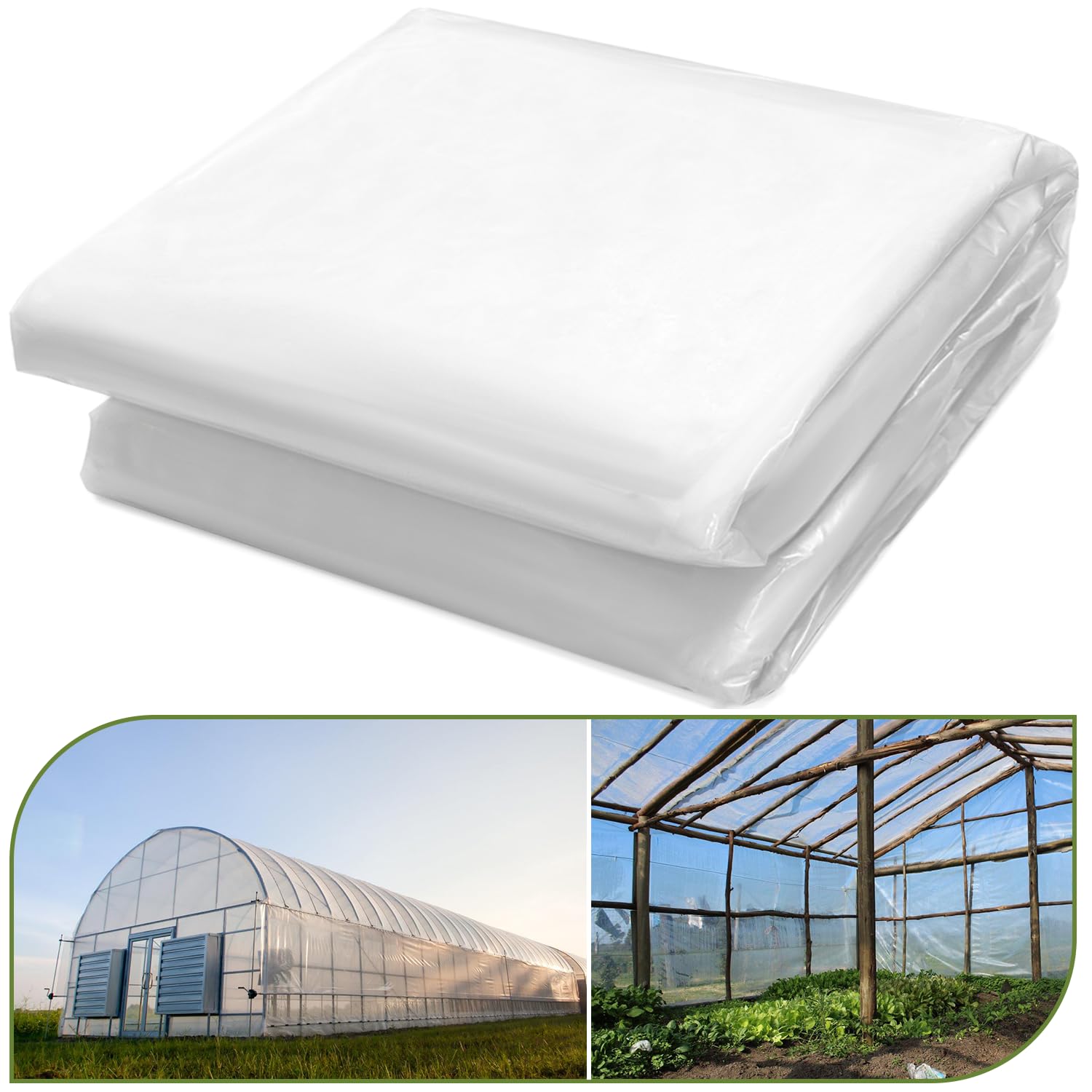
This Chicarry sheet uses a 5-layer co-extrusion technique that buys you mechanical strength and flexibility — critical when a few inches of snow and ice pile up on the roof for days after a storm. Owners mention exactly that: “Have held up through our fall and winter, even with a couple inches of snow/ice on top for several days after the 2026 storm.” The 6-mil polyethylene body includes an anti-drip additive that eliminates water droplets; instead of beading up and magnifying sunlight onto leaves, the water spreads into a continuous layer that runs down the walls. The downside of that coating is a slight “milky white” haze — the film isn’t fully transparent, but it still distributes sunlight evenly.
The thing buyers praise most is overall durability, which gets heavy emphasis in hundreds of reviews — many mention the film’s ability to hold up to wind and weather without tearing. Quality is the second-most-discussed positive, with owners calling it “nice heavy duty plastic” that’s “super sturdy and won’t easily tear.” The construction crowd loves it too: one buyer bought it for a garage paint room and was “totally totally impressed.” At a 2.4x coverage advantage over a basic 10′ x 25′ sheet — 24ft by 25ft vs 10ft by 25ft — this is the sheet to pick if your hoop house spans a wide gable and you hate having to splice two pieces together.
The main friction point is material consistency: some owners feel the actual thickness doesn’t match the advertised 6 mil. That is the most common mixed note across reviews, and it means you might want to measure it yourself before installing it on a very expensive, high-stakes structure. But for a standard backyard greenhouse that needs to last through wet winters, the crowd favorite status — backed by solid numbers across durability and quality — speaks volumes.
5-Layer Strength
- Durability is the most-praised aspect across hundreds of reviews.
- 5-layer co-extrusion gives superior tear resistance and flexibility in cold weather.
- Anti-drip coating protects leaves from magnified sunburn.
Milky Trade-off
- Anti-drip coating creates a milky haze rather than full clarity.
- A minority of owners question whether it meets the stated 6-mil thickness.
Best for most: The 5-layer film for a year-round four-season hoop house, with the density to handle snow loads that would shred thinner sheets.
Look elsewhere if: You need perfectly clear visibility through the walls — the anti-drip coating mutes that.
2. 10′ x 25′ PureSpace Armor Plastic Sheeting
UV-stabilized clear sheet that moonlights as a construction drop cloth.
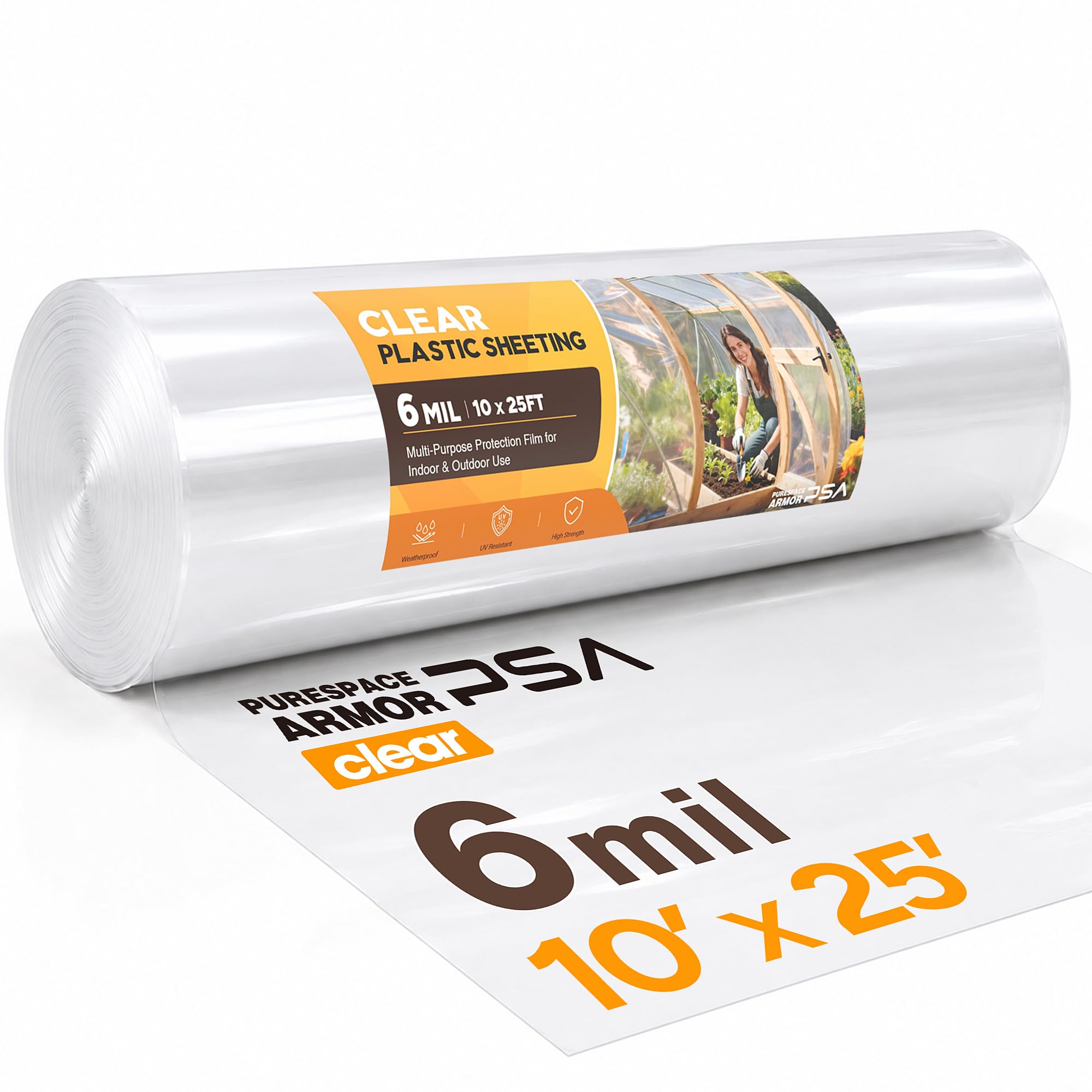
This PureSpace Armor sheet isn’t a one-trick greenhouse film — it is built as an all-purpose heavy-duty cover with a tear-proof polyethylene body. The 6-mil thickness handles UV rays, heavy rain, and frost for your greenhouse, but the same sheet can be thrown down as a painting drop cloth or over furniture during a move without a second thought. The “reusable and easy to clean” feedback from buyers reflects a film that wipes down and stores compactly between seasons.
The real standout is the UV resistance claim paired with tear-proof construction. This means you aren’t just blocking sunburn on your plants — you are also stopping the plastic from splitting when a branch whips against it in high wind. Some customers note using it as a floor protection sheet for equipment and “covering materials, greenhouse/outdoor use,” confirming its dual-life value. It is the smallest coverage option here at 10′ x 25′ (a 2.4x size gap compared to the 24′ x 25′ Chicarry), so it suits a smaller raised hoop or a cold frame better than a full-size commercial gable.
The lightest-weight pick in the lineup at just over 6 pounds — making it easy for one person to unfold and staple alone — and it packs down to a compact footprint for storage. If you need one roll that moves between the greenhouse and the workshop without complaining, this is it.
Workshop crossover: UV-stabilized 6-mil that moves between your greenhouse frame and your painting station without tearing. The compact 10′ x 25′ size is ideal for small hoops and cold frames.
Space trade-off: The 2.4x smaller coverage vs the top pick means you’ll need multiple pieces for a wide span.
Reach for this if: You want one heavy-duty sheet that handles greenhouse duty and construction drop-cloth jobs interchangeably.
Think twice if: Your greenhouse roof spans wider than 10 feet — you’ll need to seam two pieces together.
3. Inslat 6 Mil Greenhouse Plastic Film Sheeting Cover
Four-year UV-rated film with an anti-drip coating at a price that stays friendly.
Inslat’s clear 6-mil film at 12′ x 25′ hits a balance for width: it is wide enough to cover a standard 4×8 raised bed with a PVC arch without splicing, yet not so wide that it becomes a wrestling match to unfold alone. The material includes an anti-aging additive and an anti-drip treatment — that means the film is engineered to stay flexible for years while preventing condensation from forming magnifying drops that burn foliage. Buyers in hot climates report it “survived first winter in Tucson,” with one adding the “thickness is good, not flimsy” and that their “expected 4-year lifespan” made it worth the purchase.
The aspect buyers highlight most often is overall quality — the film gets consistent praise for being heavy-duty and well-constructed for the price. UV protection and value for money are strong follow-up positives. A note for clarity seekers: the film is not crisp; several owners describe it as “almost white-ish,” which is the anti-drip coating doing its job. One buyer who put it over a greenhouse says it “has held up very nicely” through wind and rain when stapled with an overlap to prevent tearing. Just keep in mind that a few reviewers point out a shorter-than-expected lifespan in extreme conditions, so seasonal removal during the hottest months is smart.
Solid value: 6-mil, anti-drip, four-year UV rating at a modest price. Best for a first greenhouse build where budget matters but you still want real features.
Clarity note: The film runs milky white rather than fully clear — fine for plant growth but not for show-worthy viewing.
Grab this for: A low-cost tunnel or hoop house where anti-drip protection matters and you don’t need perfect transparency.
Not ideal for: Anyone who wants the plastic to double as a clear window — the haze is real.
4. 6 Mil Black Plastic Sheeting Turboforce
Black 6-mil roll that kills weeds and doubles as a vapor barrier.
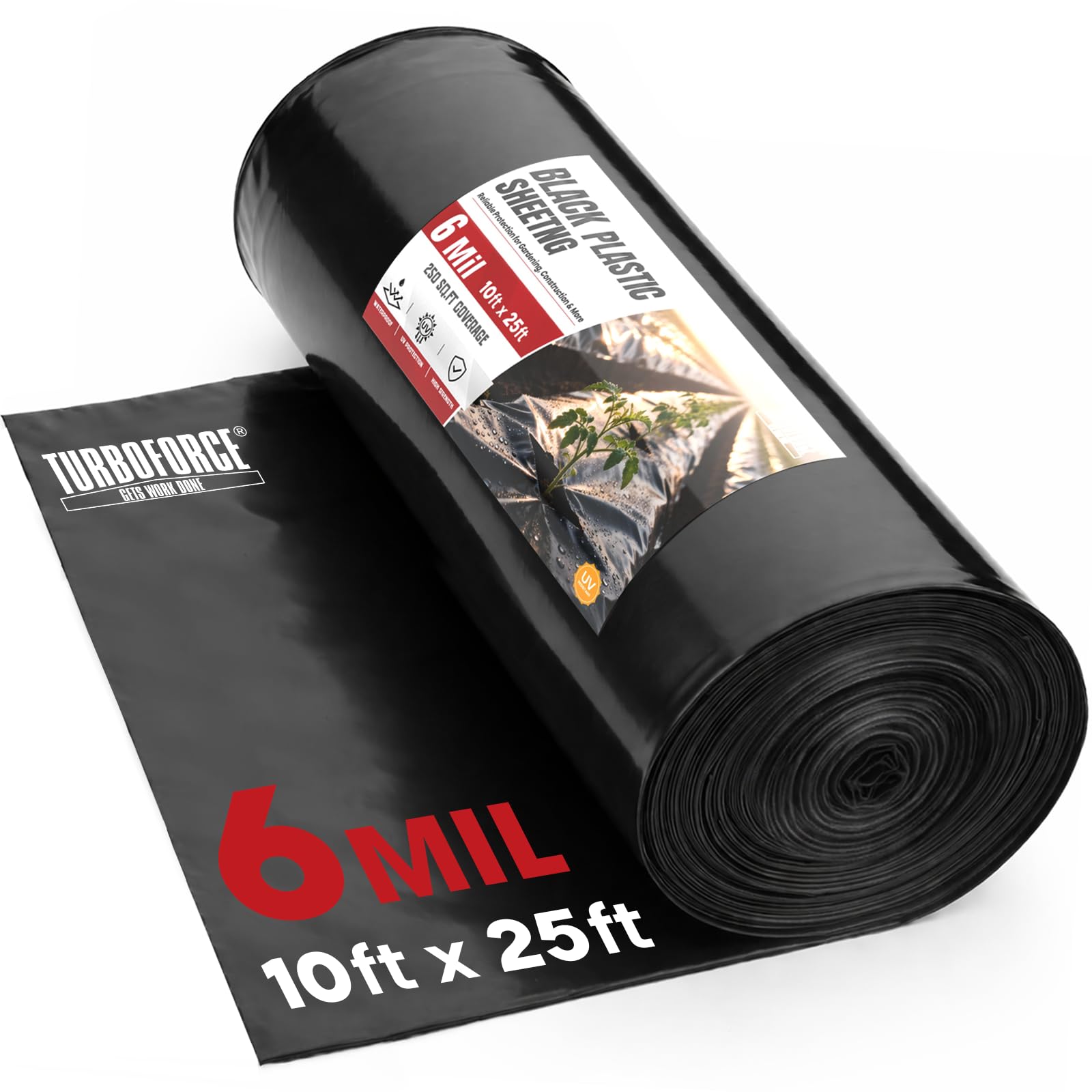
This is not a transparent film — it is a black polyethylene sheet designed for light blocking, weed solarization, and moisture vapor barriers. That makes it a specialist in your greenhouse toolkit rather than a replacement for clear roof covering. The 6-mil thickness is the same heavy-duty standard as the clear picks, but the black color absorbs heat for ground-level weed suppression and keeps light out of crawl spaces. Buyers have used it for everything from a rock garden base to a homemade slip-and-slide, calling it “great quality” and “easy to use.”
The key mechanical trait here is puncture resistance. One owner notes the “6 mil black sheeting provides a thick, puncture-resistant barrier for protecting equipment, floors, or as a weed/moisture block.” That is a direct claim from the review data — the material stays tough even when walked on or covered with heavy materials. It works as a basement vapor barrier or as a firewood cover, keeping moisture away from the stack. The 10′ x 25′ size covers 250 square feet, so it is a versatile single-roll solution for ground prep across a medium greenhouse footprint.
Just remember this is a specialty sheet — it blocks all light, so it won’t serve as a greenhouse roof or wall covering. Use it as an interior ground tarp or a weed barrier outside the frame.
Weed and moisture fighter: Black 6-mil for ground cover, vapor barriers, and solarization. Puncture-resistant and stays put.
Not a roof panel: Zero light transmission — this is strictly for floors and ground.
Best for: Blocking weeds under raised beds or laying a vapor barrier in your greenhouse floor.
Not for: Any application where sunlight needs to pass through to plants.
5. 10 x 40 FT ToLanbbt Clear Greenhouse Plastic Sheeting

Extended 40-foot roll that covers a long tunnel in one uninterrupted piece.
This ToLanbbt sheet stands out for its length — 40 feet — making it the match for long row covers or extended tunnel houses where you don’t want a seam in the middle. The 6-mil polyethylene film includes a drip-proof design: water droplets slide along the underside and run down two side channels rather than dripping directly onto leaves. That is a layer of protection for your plants that plain film doesn’t offer, particularly in spring and autumn when temperature swings create heavy condensation.
The manufacturer claims up to 90% light transmission — that number is right in the product data — which is excellent for seed germination and winter growth. The published tensile strength values (26 MPa longitudinal, 24 MPa transverse) and tear strength (129 kN/m longitudinal, 150 kN/m transverse) suggest this film handles tough weather without degrading. Buyers confirm the thickness holds up to rain and wind, though one noted “longevity depends on weather conditions” and that theirs “last less than 1 year” in a harsh climate. Others had a “durable” experience and plan to reuse the same sheet the following winter.
The weight hits 10 pounds, so it is more of a two-person lift than the lighter 6-pound options. And the clarity gets mixed feedback — “not very clear” is a recurring comment, but for growing purposes, the diffused light actually helps more than full transparency would.
Tunnel-Ready Length
- 40-foot length covers long rows in a single sheet without a splice.
- Drip-proof side channels prevent condensation from falling on leaves.
Murkier View
- “Not very clear” for those expecting window-grade transparency.
- Heavier to manage than shorter rolls at 10 pounds.
Right for: Extended raised rows or a 40-foot tunnel where smooth coverage saves installation hassle.
Skip if: You prioritize crisp sightlines over functional light diffusion.
6. Farm Plastic Supply 6 Mil Clear Plastic Sheeting

Clear-as-glass film that lets you see the neighbor’s fence at 100 yards.
Most greenhouse films trade a bit of clarity for an anti-drip coating, but this Farm Plastic Supply sheet is built for superior light transmission — shoppers say they can “see clearly at 100 yards” through it. That makes it the perfect winter wrap for a porch or sunroom where you actually want a view instead of a white haze. The 6-mil thickness is heavy enough for durability but keeps a slight stretch that helps it conform to frames without snapping.
Durability and quality are the two most praised aspects across many reviews, with frost protection also getting strong marks. One buyer used it as a pollen barrier on a porch and found it oversized by a foot in each dimension (enough to work with), and another used it as a moisture barrier under a rug and called it “thick, high-quality.” The 4-year UV resistance claim is backed by anti-aging additives in the polyethylene, which buyers report holds up through hot summers. A minor catch: some pieces arrive with branding printed on the plastic, which may annoy those who want an absolutely pristine appearance.
The 20′ x 10′ size is portrait-oriented — ten feet tall and twenty feet wide — making it ideal for a tall walk-in greenhouse or a side-panel winter wrap. It is a premium clear film that behaves more like heavy-duty glass than plastic.
Transparency star: Unusually clear 6-mil film — see-through at 100 yards. Best for a porch winter wrap or a greenhouse where you want a view.
Branding gripe: Some rolls have logos printed on the surface, which a few buyers found distracting.
Pick this for: A sunroom or winter porch enclosure where clarity matters as much as insulation.
Not for you if: You need anti-drip coating — this film prioritizes transparency over condensation control.
7. XLKIB 24 x 25ft Greenhouse Plastic Sheeting

Five-layer co-extruded film that stands up to hail and 35mph winds.
The XLKIB 24 x 25ft shares the same 5-layer co-extrusion technology as the Chicarry top pick, but the reviews here lean even harder into pure protective capability. One buyer called it “fantastic protection for my garden,” reporting it shielded plants from frost, hail, rain, and 35mph winds while enabling early planting and an extended season. That real-world confidence comes from the 6-mil polyethylene base that is “incredibly flexible” — it can take a beating without cracking.
Transparency wins the most praise, which is unusual for an anti-drip film. The data shows transparency as the top positive aspect, followed by durability. The anti-drip hydrophobic layer is described as a “specialized coating” that prevents water droplets from forming magnifying burns on leaves. Owners highlight that the material “feels strong and durable, not thin or flimsy like regular plastic sheeting.” It is priced slightly below the Chicarry despite the same layer count, making it a excellent value if you want that multi-layer ruggedness at a lower entry point.
The coverage is the same 24 x 25ft footprint, so it competes head-to-head with the Chicarry on dimensions. The slightly smaller review base means less consensus data than the top pick, but the buyer confidence in its storm-handling ability is loud and clear.
Storm shield: Five-layer construction that survived frost, hail, and 35mph winds according to buyers. Transparency is its most praised feature.
Lower review volume: Fewer reviews than the top pick, so the quality consensus is narrower.
Great alternative to the top pick: Same 5-layer tech at a slightly lower budget. Right for anyone with a specific hail or wind concern.
Consider the Chicarry if: You want a larger crowd consensus on durability.
8. Ansgery 16 Mil Clear Greenhouse Tarp

Thickest sheet at 16 mil with brass grommets every 18 inches for brute-force anchoring.
The Ansgery tarp is a completely different breed of greenhouse cover — it is a woven and double-coated polyethylene 3-layer tarp at a thick 16 mils, not a standard 6-mil film extrusion. The woven construction gives it a fabric-like feel, making it far more puncture-resistant than typical greenhouse plastic, while the double coating adds a waterproof barrier. The manufacturer claims one tarp “survived an 85 mph storm” — an extreme weather claim that backs up the grommet-and-rope design philosophy.
At 18X24FT, this is a large-format tarp designed for serious coverage. The edge has reinforced corners with rust-proof grommets centered every 18 inches. That spacing is tighter than typical tarps, which buyers find makes tying down easier. Durability is the most-praised aspect by a wide margin, with owners saying it works “perfect” for a chicken tractor that “sits outside year round” and is “going strong” after a full year with “no dry rot or tears anywhere.” Another buyer used it for a duck pen and specifically chose this over a “window clear version” because it “doesn’t feel like it is going to tear or come apart.”
The trade-off is weight: it is a heavy, stiff tarp, not a lightweight film you can drape loosely. And the manufacturer notes a real risk: if winds are extremely strong and the fixing method is wrong, “the grommets falling off” is possible. Proper tie-down is essential.
Woven Tank
- 16-mil woven tarp — far thicker than any 6-mil film on this list.
- Reinforced edges with grommets spaced every 18 inches for secure anchoring.
Not Lightweight
- Heavy and stiff — not a simple drape film for a small hoop.
- Grommets can pull out in extreme winds if not tied down properly.
Terrific for: A permanent chicken tractor or a greenhouse in a high-wind zone where you need brute-force coverage.
Not right for: A cheap low tunnel or a quick winter wrap — it is overbuilt and less flexible for temporary jobs.
9. Farm Plastic Supply Panda Film Light Deprivation Cover

Dual-sided black/white 6-mil sheet that blocks 100% of light for photoperiod control.
This is the oddball of the list, but it is essential for a specific grower: anyone running light-deprivation photoperiod schedules for crops like cannabis or flowers. The “Panda Film” name comes from the color scheme — one white reflective side and one black light-blocking side. The 6-mil thickness ensures it is tough enough for a frame, and the UV inhibitor prevents the white side from yellowing in direct sun. One buyer confirmed it offers “100% blackout, dual black-and-white design reflects heat and blocks light.”
Quality and light control are the two most-discussed positives across reviews — buyers specifically note it “works well in gardens,” “delivers high-quality plastic,” and “blocks 100% of light.” One grower noted it “saved their plants during a heat wave” when used as a shade because the white side reflects heat. The 32′ x 50′ size is generous enough to cover a large greenhouse wall or multiple smaller frames. A few owners find it “a little thinner than expected,” but most agree it “does the job” and is “pretty tough.”
At 50 pounds, this is a heavy roll — two people or a loading cart are needed to maneuver it. But for serious growers who need strict light control, it is the only option here purpose-built for that task.
Light control master: White side reflects heat, black side blocks 100% of light. 6-mil, UV-stabilized, and sized at a generous 32′ x 50′.
Weight penalty: At 50 pounds, it is a two-person deployment. A few owners note it feels slightly thinner than the 6-mil standard.
Essential for: Photoperiod growers who need blackout control or heat reflection during summer.
Overkill for: Anyone who just wants standard clear greenhouse sheeting for general plant protection.
Understanding the Specs
Mil thickness and tensile strength
The “mil” is a thousandth of an inch — 6 mil equals 0.006 inches. This is the standard thickness for greenhouse film because it offers enough rigidity to resist tearing from wind and hail while staying flexible enough for a staple gun. Some films list their tensile strength (a measure of how much pull the plastic can take before tearing) measured in MPa — 26 MPa is a common value for 6-mil sheets. Higher mil values like 16 mil belong to woven tarps that are far heavier and designed for permanent structures.
Anti-drip coating and light transmission
An anti-drip or “drip-proof” coating changes how condensation behaves on the underside of the film. Without the coating, water beads into droplets that act like lenses and burn leaves when sunlight hits them. The coating spreads condensation into a thin, continuous sheet that runs down the walls instead of falling. The trade-off is a slight haze — many films appear “milky white” rather than perfectly clear. Light transmission values given in the data (like “up to 90%”) tell you how much daylight passes through the film, which directly affects seed germination and crop growth.
UV inhibitors and lifespan
A UV stabilizer additive slows the chemical breakdown of polyethylene caused by direct sunlight. Without it, the plastic becomes brittle, hazy, and starts cracking within a single growing season. Films labelled “UV resistant” typically claim a lifespan of 3–4 years when installed correctly. Heavier woven tarps with grommets may survive longer in extreme weather, but any plastic exposed to UV will eventually fail — that four-year claim is a practical expectation, not a guarantee.
Co-extrusion layers and mechanical strength
Multi-layer co-extrusion (commonly 5 layers) is a manufacturing process that bonds several thin polymer layers together into a single film. Each layer contributes a specific property: one for tear resistance, another for flexibility, another for UV stability, and so on. The result is a sheet that is stronger and more reliable than a single-layer film of the same thickness — especially under snow load, ice, or storm winds. The Chicarry and XLKIB picks both use this technology.
FAQ
What does “6 mil” actually mean for greenhouse plastic?
Can I use regular clear plastic sheeting for a greenhouse?
How long does greenhouse plastic sheeting last outdoors?
What is the anti-drip coating for?
Does anti-drip film reduce light transmission?
Can I staple greenhouse plastic to a wooden frame?
What is the difference between clear and black greenhouse plastic?
Is thicker greenhouse plastic always better?
Can greenhouse plastic be reused next season?
Which greenhouse plastic resists tearing the best?
Final Thoughts: The Verdict
If you want one dependable pick, the best greenhouse plastic sheeting winner is the Chicarry 24 x 25ft because its 5-layer co-extrusion delivers the snow-load toughness and anti-drip protection that a four-season greenhouse demands, backed by a huge pool of satisfied owners. If you want a clear-as-glass winter wrap for a porch or sunroom with a view that cuts heat without blocking the scenery, grab the Farm Plastic Supply 20′ x 10′. And for photoperiod growers who need total blackout control with heat reflection, the Farm Plastic Supply Panda Film is the one to reach for.
How We Picked
We do not accept paid placement. Every pick is matched to a real buyer and a real use-case; we do not hands-on test units.
Sources & Methodology
Specifications: manufacturer listings and product documentation. Review insights: verified customer reviews, as of July 2026. Pricing: not shown on this page (it changes often); check the current price via the retailer link.
As an Amazon Associate, Lawn Gear Lab earns from qualifying purchases. This does not affect which products we feature.