
Specs are compiled from manufacturer listings and verified buyer reviews and can change over time — please confirm the key details on the product page before buying.
A cold soil is the single biggest reason your seeds rot instead of sprout. A greenhouse heat mat solves that by gently warming the root zone, tricking seeds into thinking spring has already arrived. The challenge is sorting the mats that deliver steady, even heat from the ones that run too hot, too cold, or quit mid-season.
I’m Rikta — the founder and writer behind Lawn Gear Lab. This guide is built by comparing the manufacturers’ published specifications and the patterns across verified customer reviews, so you get each pick’s real strengths and trade-offs instead of marketing spin.
The nine picks here cover every use case — from a 40-watt heavy lifter that handles two full trays to digital controller mats that take the guesswork out of temperature setting — and together they represent the most reliable best greenhouse heat mat options on the market today.
Our Picks at a Glance
How To Choose The Best Greenhouse Heat Mat
A greenhouse heat mat seems simple — plug it in, put a tray on top, wait for sprouts. But the details in wattage, build quality, and temperature control separate mats that get the job done for years from ones that frustrate you every spring. Here is what to watch for.
Wattage and Heating Coverage — Why the Big One Wins
The wattage directly determines how much heat the mat can push into your soil. A standard 10″ x 20.75″ mat runs on roughly 18 to 21 watts, which is fine for a single seed tray in a room-temperature space. But if you want to warm two standard 1020 trays at once, you need a mat around 20″ x 20.75″ that pulls 40 watts — that gives you 40 watts versus 18 watts. A low-wattage mat in a cold basement or unheated greenhouse will struggle to raise soil temperature enough to trigger germination.
Digital Thermostat vs. Simple Mat — Do You Need Control?
A basic mat runs at a fixed temperature (typically around 68-86°F). That works fine for general seed starting, but some crops or propagation tasks need a specific temperature you cannot get with an on/off mat. A built-in digital controller lets you dial in an exact temperature (like 78°F for peppers) and see the current mat temperature on an LED display. The trade-off is that some controllers can be finicky to set, and they add another electronic component that could fail. If you grow a wide variety of plants, a mat with a thermostat is worth the extra complexity. If you just start tomatoes and peppers each spring, a simple mat paired with a separate timer or external thermostat often serves you better.
Waterproof Rating and Material — The Humidity Reality
A greenhouse is damp. Water spills, trays drip, and humidity settles on every surface. A mat rated IP67 (the highest common rating for these mats) is fully sealed against dust and can handle being splashed, hosed off, or even briefly submerged. A mat rated IPX4 resists splashes but is not sealed against immersion. The outer material matters too — heavy-duty PVC with a PET film layer resists corrosion and cleans easily with a wipe. Cheaper PVC can become brittle under constant heat and moisture. If you plan to use the mat season after season, the IP67 rating and durable PVC construction are the two specs that predict long-term survival.
Quick Comparison
| Model | Best For | Wattage | Size | Controller | Amazon |
|---|---|---|---|---|---|
| VIVOSUN 20″★ Best Overall | Large tray coverage | 40W | 20″ x 20.75″ | No | Amazon |
| Seedling Heat Mat w/ControllerDigital Precision | Digital precision | 18W | 10″ x 20.75″ | Digital | Amazon |
| NAMOTEK 2-PackBest Value Pack | Multi-tray value | 18W | 10″ x 20″ | No | Amazon |
| LUXBIRD 2-Pack | IP67 waterproofing | 21W | 10″ x 20.75″ | No | Amazon |
| MARS HYDRO Thermostat Kit | Beginner thermostat | 20W | 10″ x 20.75″ | Digital | Amazon |
| AC Infinity SUNCORE H3 | Far-infrared even heat | — | 10″ x 20.75″ | Digital | Amazon |
| Durable 4-Pack | Multi-pack savings | 18W | 10″ x 20.75″ | No | Amazon |
| AC Infinity SUNCORE A3X2 | Dual mats, dial control | — | 10″ x 20.75″ (x2) | Dial | Amazon |
| VIVOSUN w/Controller | Large mat, digital control | — | 20″ x 20.75″ | Digital | Amazon |
In‑Depth Reviews
1. VIVOSUN Durable Waterproof Seedling Heat Mat 20″ x 20.75″
Our pick — over 4.5★ from 27,500+ verified ratings; the strongest balance of quality and price.
The 40-watt workhorse that covers two full trays and sprouted seeds for more than a year.
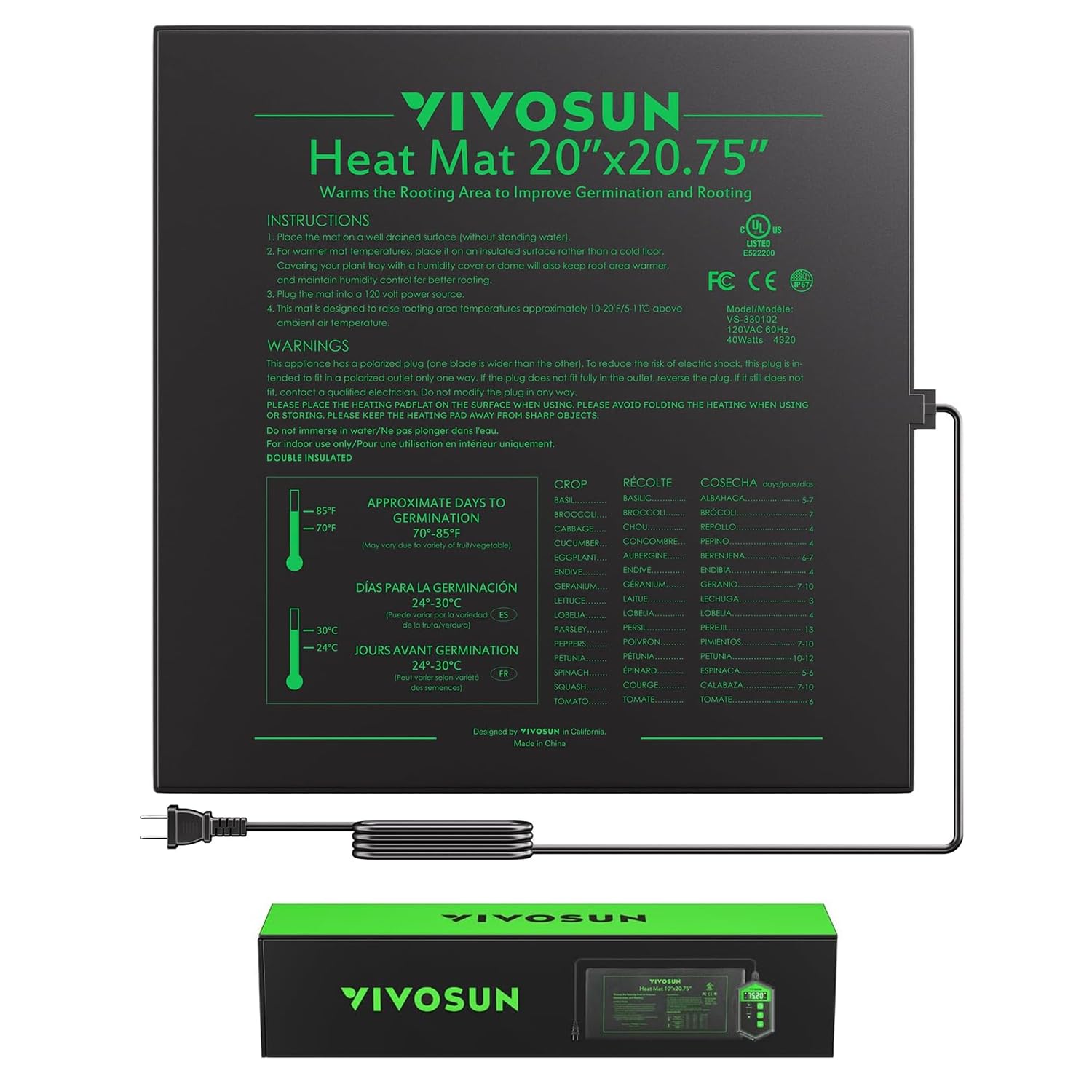
If you only buy one heat mat, make it this one. Its 40-watt output versus a standard 18-watt mat, and at 20″ x 20.75″ the heating surface is 20″ x 20.75″ versus the common 10″ x 20.75″ size. That means you can slide a pair of standard 1020 seedling trays side by side on a single mat — no daisy-chaining multiple pads.
Build quality is where this mat truly stands apart. It holds a UL and MET certification, carries an IP67 waterproof rating, and uses a flexible PVC material that one buyer described as: “Used weekly for 1.5+ years, still works like new.” The 5.9-foot power cord gives you decent reach on a greenhouse shelf, and the mat includes a carrying bag for rolling it up between seasons. It runs hot enough to heat up to 104°F at the surface (in a room around 68-77°F), so pair it with a separate thermostat if you need precise control for things like pepper propagation or kombucha brewing.
The main thing owners come back to again and again is sheer effectiveness — over 1,300 buyers specifically mention how well it works, and nearly 600 highlight the quality. A minority note that the mat runs warm, which is not a flaw but a reason to use a thermostat if you want a specific temperature. This mat is the crowd favorite with 4.6 stars across thousands of owners — and it earns that spot honestly.
Why it earns the top spot
- 40 watts versus standard 18W mats
- 20″ x 20.75″ size fits two standard 1020 trays side by side
- UL & MET certified with IP67 waterproof rating for safe, long-term use in humid greenhouses
- Far-infrared film heats evenly without hot spots or scorching delicate roots
The honest trade-off
- No built-in thermostat — you need a separate controller (or a simple timer) to set a specific temperature
- Adapter runs slightly warm according to some buyers, though not a safety concern
Reach for this if: you start seeds in quantity — two trays per mat keeps your setup simple and your electricity bill low.
Look elsewhere if: you need exact digital temperature control built right into the mat; this one works best with an external thermostat.
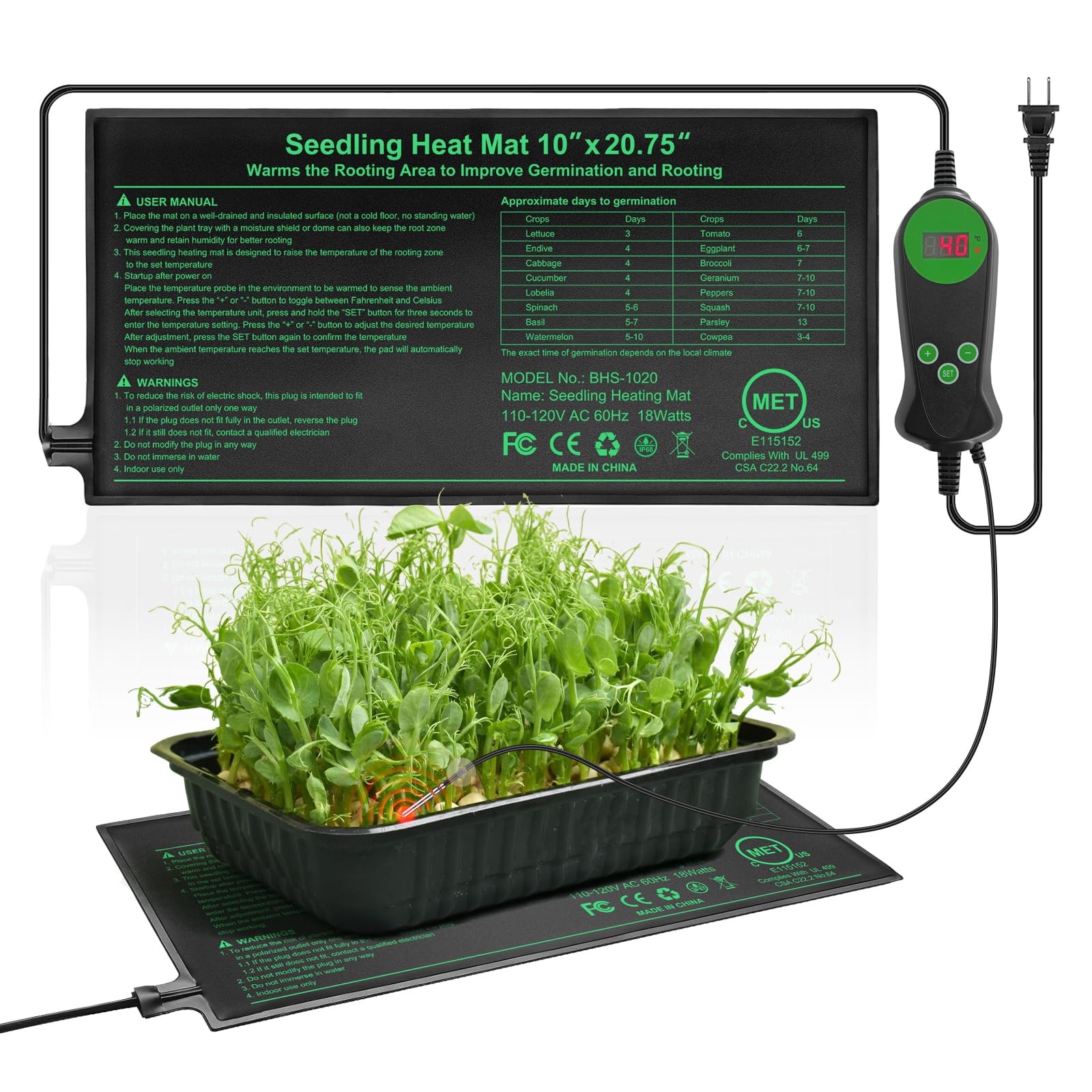
2. Seedling Heat Mat with Built-in Temperature Controller, 10″ x 20.75″
A digital display and thermostat built into the mat itself — no hunting for a separate controller.
This is for the grower who wants to see the exact temperature on a screen without buying a separate thermostat. The digital controller with its LED display lets you set a target temperature and monitor the mat’s real-time reading. It runs on 18 watts and measures 10″ x 20.75″, the standard size for a single seedling tray. The waterproof construction and built-in temperature probe are designed for safe indoor use on insulated surfaces.
The honest appraisal from owners is that the value is good — it gets seeds germinating — but the temperature control can be tricky. The most-discussed aspect is temperature control (37 mentions, rated mixed), and one buyer captured the common experience: “Trying to set the temperature gauge exactly what I want is quite difficult or impossible but other than that, it does get higher in temperature and it seems to do what I needed to do and that to get my seeds to germinate.” If you are the kind of person who sets a thermostat once and walks away, this works fine. If you adjust temperatures frequently between crops, the controller may frustrate you.
At 18 watts, this mat is suited for a single tray in a room-temperature room. In a cold basement or unheated greenhouse, the wattage may not be enough to raise soil temperature into the optimal germination zone. It is best for indoor seed starting on a counter or shelf where ambient temperature is already moderate.
Decisive verdict: A good entry point for digital control at a very accessible price. The controller does the job, but don’t expect fine-grained, instant accuracy. Works best for seedlings that germinate in a wide temperature range.
3. NAMOTEK 2 Pack Seedling Heat Mat, 10″ x 20″
Two mats for the price of one — and they survive the kind of abuse that kills lesser pads.
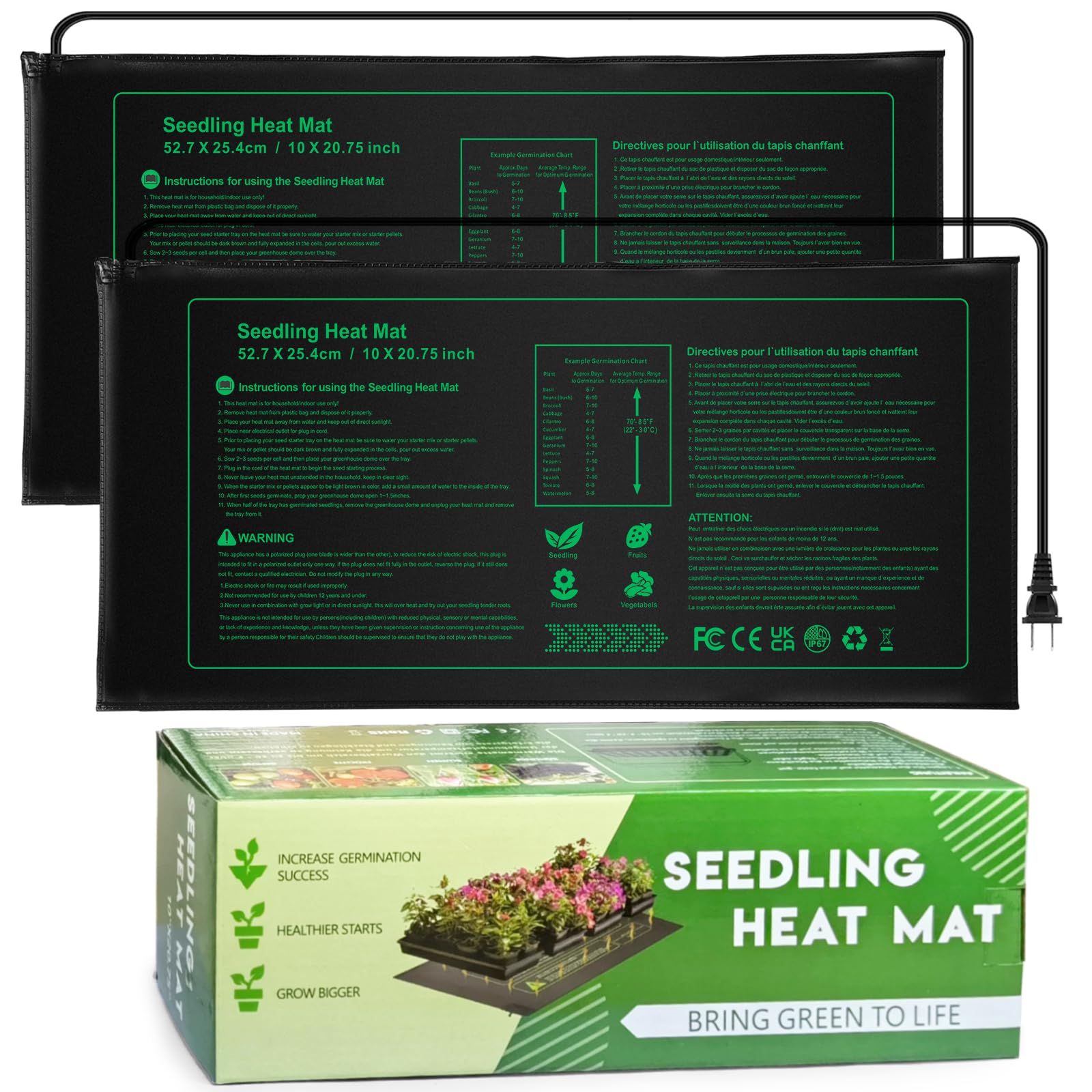
Budget-friendly does not have to mean fragile. The NAMOTEK 2-pack gives you two 18-watt, 10″ x 20″ mats that have proven themselves in real-world conditions. One owner summed it up: “Works after 10-11 months despite rough outdoor use.” That is a strong testament to the heavy-duty PVC material and the IPX4 waterproof rating (splash-resistant). The mats are easy to clean, roll up neatly for storage, and deliver the right amount of heat for standard seed germination without any complicated controls.
The trade-off is simplicity itself — there is no indicator light, no temperature gauge, and no controller. You plug them in and they heat. Some owners notice one mat feels slightly less warm than the other (common in multi-pack electronics), but both still get soil warm enough for germination. The 18-watt output is standard for this size: enough to raise soil temperature 10-20°F above ambient in a moderate room, but not enough for very cold basements. Stacking two mats (as one owner did) pushed soil to roughly 95°F, confirming they produce real heat.
If you start a lot of trays or just want a backup mat ready to go, the 2-pack pricing makes this among the most cost-effective entries on the list. It is one of the highest-rated picks at 4.6 stars across nearly a thousand owners, which is remarkable for a multi-pack at this price point.
The case for the 2-pack
- Two mats for the price of one — ideal for starting many trays or keeping a spare
- Proven durability — real buyers report it working after 10-11 months of rough outdoor use
- Heavy-duty PVC with IPX4 splash resistance handles greenhouse humidity
The honest limits
- No indicator light or temperature gauge — you get heat or you don’t
- Slight warmth variation between the two mats in some packs
Perfect for: the gardener who wants backup mats, starts trays in multiple locations, or simply wants the best per-mat value available.
Consider another if: you need per-mat temperature control or a single large surface for two trays.
4. LUXBIRD 2 Pack Seedling Heating Mat, 10″ x 20.75″
21 watts per mat with a full IP67 seal — dust and spills are not a concern here.
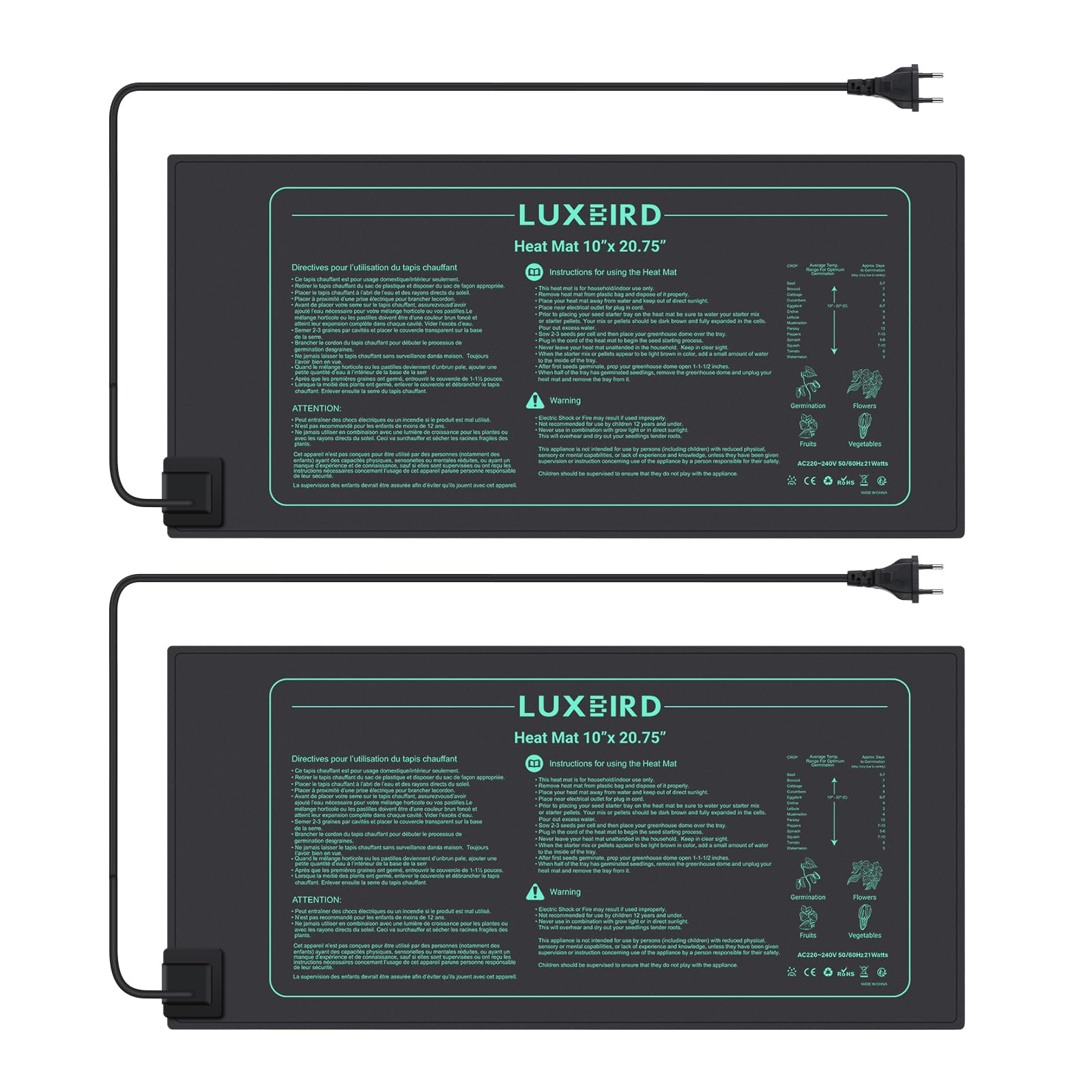
The LUXBIRD 2-pack matches the NAMOTEK on multi-mat value but pushes the waterproofing to the highest common standard: IP67. That means the mats are fully dust-tight and can survive being splashed, sprayed, or even briefly submerged — a real advantage if you tend to be heavy-handed with the watering can. Each mat is 10″ x 20.75″ and draws 21 watts, which is slightly more powerful than the typical 18-watt mats in this size class. The manufacturer states it raises root-zone temperature by 50-68°F above ambient, though in practice the consensus is that it provides consistent warmth rather than extreme heat.
Germination results are the headline here. Over 20 owners specifically cite germination success, and one reported an over 89% success rate. The mats are compatible with an external thermostat (like Inkbird) for those who want programmable temperature control. At 1.61 pounds per mat, they feel substantial without being heavy, and the PVC material is flexible enough to roll up for storage.
The catch is that some owners feel the mat does not get as hot as they expected — the temperature control aspect gets mixed marks (11 mentions). For heat-loving crops like tomatoes and peppers, the mat works best in a room that is already in the 60s or low 70s. In an unheated greenhouse, the 21 watts may not bridge a very cold gap. For indoor seed starting on a shelf, it is a reliable, easy-to-clean performer.
Verdict: The IP67 rating makes this the best choice for messy or humid environments. Add a separate thermostat and it becomes a precise, powerful duo. skip it if your growing area is very cold and you need the maximum possible heat output.
5. MARS HYDRO 10″ x 20.75″ Seedling Heat Mat with Thermostat Combo Set

A mat and a digital controller that work together from the start — no extra purchases needed.
If you want a thermostat but do not want to match a separate controller to your mat, the MARS HYDRO combo is the simplest way to get there. The kit pairs a 20-watt, 10″ x 20.75″ mat with a digital controller that lets you set a target temperature between 32-110°F. The three-button interface is straightforward, and the mat itself uses what the company calls infrared heating particles — a far-infrared heating film that the manufacturer claims achieves 97% thermal efficiency. The mat holds UL and FCC certifications and features an IP67 waterproof outer layer.
Owners mention excellent results with this combo. One grower noted that Ferocactus wislizeni seedlings were twice the size compared to their old mats at 28 days. Another sprouted peppers, herbs, and tomatoes in about a week. The digital thermostat draws praise for holding a steady temperature — one buyer set it and forgot it in a growing chamber. The consensus is that this combo works well for raising soil temperature from, say, 68-72°F up to around 77°F in a bin or propagation dome.
The honest limitation is that 20 watts is not enough for a large temperature rise. One owner noted, “It doesn’t seem to be able to get up to the temperature I want, but it does work in the lower range.” If you need to lift soil temperature by more than 10-15°F in a very cold space, a larger mat or higher wattage is needed. For standard indoor seed starting on a counter or wire shelf, this combo delivers reliable, controllable heat.
What makes it stand out
- Digital thermostat included — set a precise temperature without buying extra parts
- Three-button interface is beginner-friendly and easy to adjust
- Infrared heating film distributes heat evenly across the entire mat surface
- IP67 waterproof with UL and FCC certifications for safe, long-term use
Where it comes up short
- 20 watts may not raise soil temperature enough in a cold basement or unheated greenhouse
- Controller is limited to a moderate temperature lift — not for extreme cold
Choose this if: you want a one-box solution with a digital thermostat, especially for indoor seed starting on a shelf or counter.
Consider another if: your growing area stays below 60°F and you need a larger temperature boost.
6. AC Infinity SUNCORE H3, Seedling Mat 10” x 20.75” with Digital Controller

AC Infinity’s far-infrared film warms up fast and spreads heat evenly — no cold corners.
AC Infinity is known in the indoor gardening world for high-quality ventilation gear, and their SUNCORE H3 heat mat carries the same engineering DNA. The key feature here is the innovative far-infrared heating film, which the company says warms faster and distributes heat more evenly than traditional wire-based mats. The digital controller displays the mat’s real-time temperature, and you can adjust it to exact levels — no guesswork about whether the soil is warm enough.
The build quality is a clear step up. The mat uses IP67-rated quad-layer PVC that is flexible, resistant to wear and tear, and simple to wipe clean. At 0.09 inches thick and weighing about a pound, it lies flat under a tray without creating bumps. Owners describe it as well-made and easy to set up, with consistent temperature that speeds up germination. One buyer called it “a low-maintenance kinda thing.”
The caveat is that the digital version (the H3) has a known limitation in very cold climates. Some customers note it struggles to reach 80°F in a cold room and requires adding insulation (like plywood or bubble wrap) to achieve target temperatures. One reviewer who switched from a dial-knob version noted the digital controller seems less powerful for cold environments. If your growing area is an unheated basement in the winter, the dial-controlled A3 version from AC Infinity may serve you better. For a typical room-temperature greenhouse or indoor shelf, the H3 delivers excellent, even heat.
Final read: Top-shelf build and even heat distribution make this a premium choice for indoor seed starting. The digital controller is easy to use. In a cold room, plan on adding insulation under the mat to reach optimal germination temperatures.
7. Durable Seedling Heat Mat 10×20.75 inches 4 Pack, MET Certified
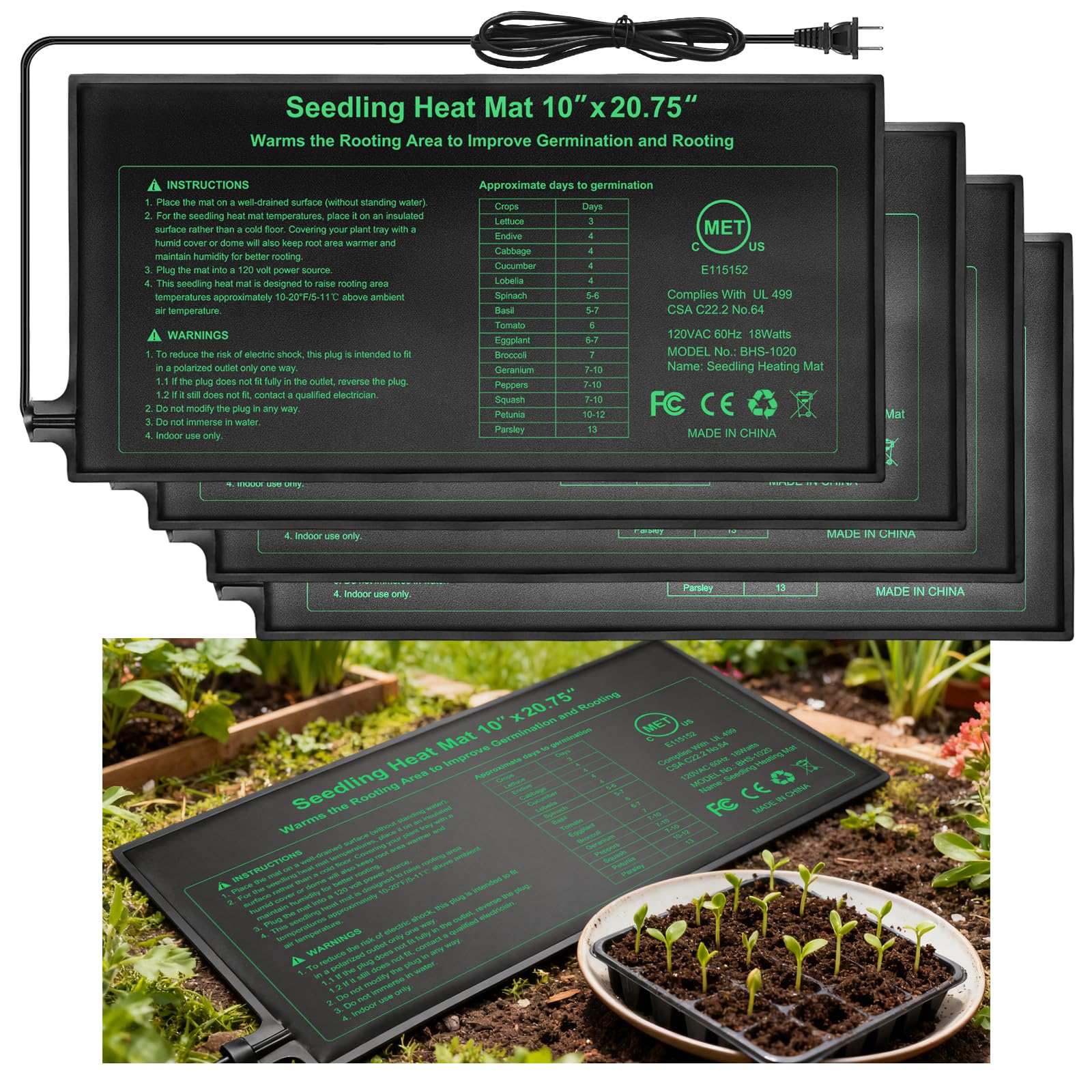
Four MET-certified mats for less than most single units — built for the big-start gardener.
When you need to start dozens of trays at once, the per-mat cost becomes the deciding factor. This 4-pack from RC SLL gives you four mats, each 10″ x 20.75″ and drawing 18 watts, all MET certified and rated IP67 waterproof. The heavy-duty PVC material is tear-resistant and easy to clean, and the multi-layer structure with reinforced heating wire is designed to deliver uniform heat without hot spots that could scorch roots. The target temperature range is 68-86°F — the balance for most vegetable and herb seeds.
Buyers consistently report faster germination with these mats. Several mention seeing a “dramatic difference” in sprout size between seeds on the mat versus off, and one noted seeds germinated 6 days faster than without heat. The value-for-money rating is strong — at this pack size, you are covering four standard trays for a fraction of what four individual mats would cost elsewhere. The mats also work for kombucha, wine fermentation, and reptile terrariums.
The honest trade-off is that these are simple, unregulated mats. There is no temperature control, and some owners note they barely feel warm to the touch — which is actually normal for a well-insulated mat running at 68-86°F, but can be surprising if you expect a hot surface. The temperature control aspect is rated negative by a small number of owners, so if you need precise heat, pair these with a separate thermostat. For bulk seed starting where you just need gentle bottom heat, this 4-pack is tough to top on value.
The case for the 4-pack
- Four mats in one box — the best value for starting many trays simultaneously
- MET certified with IP67 waterproof rating for safety and longevity
- Gentle, even heat accelerates germination without scorching roots
The honest limits
- No temperature control — mats run at a fixed range of 68-86°F
- Some owners find the mat surface barely warm to the touch (normal, but can be confusing)
Best for: serious seed starters who need multiple mats running at once and want the lowest per-mat cost.
Not ideal if: you need individual temperature control for each mat or grow in a very cold space that requires higher wattage.
8. AC Infinity SUNCORE A3X2, Dual Waterproof Seedling Mats w/ Heat Controller

Two large mats with a simple dial controller — infrared heat that covers a full shelf.
The A3X2 takes the AC Infinity far-infrared heating film and scales it to two mats with a single adjustable dial controller. Each mat measures 10″ x 20.75″, so you can run two trays side by side or place them in separate locations — both controlled from one knob. The dial gives you low, medium, and high settings (no soil probe needed), and the infrared film distributes heat evenly without creating hot spots. The quad-layer PVC is IP67-rated, flexible, and easy to wipe clean. Both UL and MET certifications are verifiable through public directories.
Owners love the versatility. The mats are large enough to fit two standard 1020 trays, and the adjustable heat output makes them useful beyond seeds — for fermenting sauces and kimchi, warming brine shrimp hatcheries, or proofing bread dough. One reviewer noted the medium setting warms up in about 10 minutes and stays at a comfortable, not scorching, temperature. The dual-mat format is especially useful for growers who want to stagger planting: one mat for peppers, one for tomatoes, each set to its own level if you pair with a second controller.
The main quibble from owners is that one mat can run slightly warmer than the other — a minor inconsistency that is common in multi-mat systems without per-mat probes. The dial controller (no digital display) means you adjust by feel rather than reading an exact temperature. That works fine for most seeds, but if you need precise digital readouts, the SUNCORE H3 (single mat with digital controller) or a separate thermostat is a better fit. At 4.5 stars with hundreds of ratings, this is a proven, heavy-duty system for the serious home grower.
Verdict: The A3X2 is the most practical dual-mat setup on the market — two trays, one controller, even heat. Use it for seeds, fermentation, or warming pet enclosures. The dial lacks a digital readout, so matching exact temperatures between two mats takes a little trial and error.
9. VIVOSUN 20″x20.75″ Seedling Heat Mat with Built-in Temperature Controller
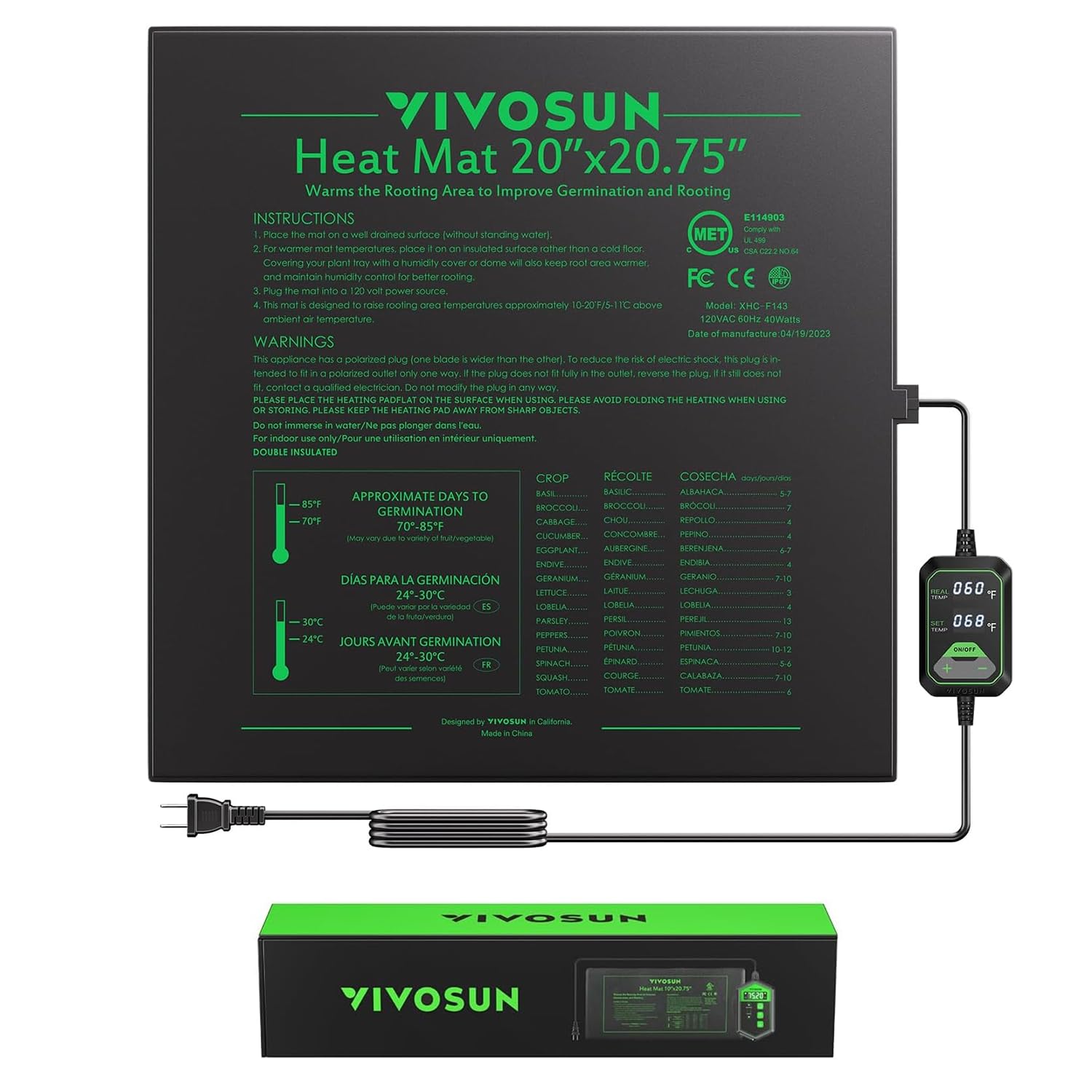
A large 20-inch mat with a built-in digital thermostat — two-tray coverage with exact temperature control.
This is the mat that bridges the gap between the simple big mat (Product 1) and the digital-controlled smaller mats. It gives you the large 20″ x 20.75″ surface that fits two standard 1020 trays, but adds a digital controller with a dual display showing both the set temperature and the mat’s actual reading. The far-infrared heating technology uses a reinforced heating film with double insulation to prevent root scorch, and the IP67 waterproof surface is safe to scrub clean. In a room around 68-77°F, it can reach up to 104°F on the surface in just a few minutes, with a maximum temperature setting of 122°F and built-in overheat protection.
The dual digital display is genuinely useful — you set the desired temperature for your specific crop (68-86°F for most seeds) and the controller works to maintain it. The three-button interface is simple to operate, and the mat is flexible enough to fold and store between seasons. Owners confirm it helps seeds germinate faster and appreciate the real-time temperature feedback on the display.
The honest reality is that the temperature control is not laboratory-grade precision. One owner noted the mat was “always slightly cooler than indicated by the display,” and another recommended using a separate probe thermometer inside the tray to verify actual soil temperature. A small number of units arrive with defects (the mat fails to heat), which is why the overall rating is 4.2 stars — lower than the simpler VIVOSUN mat without a controller. If you want the convenience of a built-in digital controller on a large mat and are comfortable double-checking the temperature with a separate probe, this is a capable setup. If you want dead-simple reliability, the non-controller version is the safer bet.
What you gain
- Large 20″ x 20.75″ mat with built-in digital thermostat — one unit covers two trays with temperature control
- Dual display shows set temp and actual mat temp in real-time
- Far-infrared film with overheat protection for safety
- IP67 rated for easy cleaning and durability
What to watch for
- Temperature reading may be slightly optimistic — use a separate probe for precision
- A small number of units arrive defective; test immediately upon arrival
Good for: the grower who wants one large mat with a built-in digital controller and is willing to verify soil temperature with a separate probe.
Consider the non-controller VIVOSUN if: absolute reliability and the highest owner satisfaction (4.6 stars) matter more than having a built-in thermostat.
Understanding the Specs
Wattage — The Real Heat Output
Think of wattage as the engine size of your heat mat. A typical 10″ x 20.75″ mat runs on 18 to 21 watts, which raises soil temperature about 10-20°F above the room. A 20″ x 20.75″ mat at 40 watts (like the VIVOSUN) delivers more than double the heat output, making it effective in a cold basement or unheated greenhouse. If your growing space stays below 65°F, go for the higher wattage — the lower-powered mats will struggle to push soil into the ideal 68-86°F zone.
IP Rating — Water and Dust Protection
The IP (Ingress Protection) rating tells you how sealed the mat is. IP67 is the gold standard here: the “6” means fully dust-tight, and the “7” means it can survive being submerged in up to a meter of water for 30 minutes. IPX4 is splash-resistant but not sealed against immersion. In a greenhouse where water spills are a daily reality, an IP67 mat can be wiped down or even rinsed off with a hose without damage. A lower rating means you need to be more careful about keeping the mat dry.
Far-Infrared vs. Wire Heating
Older heat mats use a resistive heating wire that runs back and forth under the surface — like an electric blanket. Newer mats use a far-infrared heating film (a thin, flexible sheet) that radiates heat more evenly across the entire surface. Infrared film also warms up faster and is less likely to develop hot spots that can scorch roots. Brands like AC Infinity and VIVOSUN use this technology in their premium mats. If you see “far-infrared” or “infrared heating particles” in the specs, you are getting the more advanced, even-heating design.
Digital Controller vs. Simple Mat — Which Do You Need?
A simple heat mat (no controller) runs at a fixed temperature range — typically 68-86°F. That works for the vast majority of vegetable and flower seeds. A mat with a built-in digital or dial controller lets you set an exact temperature, which matters for specific crops (peppers germinate best at 80-85°F, lettuce at 65-70°F) or propagation of temperature-sensitive plants. The trade-off is cost and complexity: controllers add a point of failure, and some digital displays are not perfectly accurate. If you grow a wide variety of plants, a controller is worth it. If you stick to basic spring vegetables, a simple mat is simpler and often more reliable.
FAQ
How hot should a greenhouse heat mat get?
Can I leave a heat mat on 24/7?
Do I need a thermostat for my heat mat?
Will a heat mat work in an unheated greenhouse?
Can I use a heat mat for things other than seeds?
How do I clean a heat mat?
How long do greenhouse heat mats last?
What size heat mat do I need?
Can I cut or trim a heat mat to fit a smaller tray?
What is the difference between UL certification and MET certification?
Final Thoughts: The Verdict
For most buyers, the best greenhouse heat mat winner is the VIVOSUN 20″ x 20.75″ because it delivers 40W versus 18W and fits two standard trays, all at a price that undercuts most single-mat competitors. If you want digital temperature control without buying extra parts, grab the MARS HYDRO Combo Set. And for multi-tray setups on the tightest budget, the Durable 4-Pack is the one to reach for.
How We Picked
We do not accept paid placement. Every pick is matched to a real buyer and a real use-case; we do not hands-on test units.
Sources & Methodology
Specifications: manufacturer listings and product documentation. Review insights: verified customer reviews, as of July 2026. Pricing: not shown on this page (it changes often); check the current price via the retailer link.
As an Amazon Associate, Lawn Gear Lab earns from qualifying purchases. This does not affect which products we feature.