
Specs are compiled from manufacturer listings and verified buyer reviews and can change over time — please confirm the key details on the product page before buying.
Keeping your plants alive through freezing months depends on one thing: a structure that traps heat without bending under snow. The wrong greenhouse lets cold leak in through thin panels, bows under a heavy storm, and turns your investment into a tangled mess by spring. This guide cuts through the choices to find the seven polycarbonate and wood greenhouses actually built to handle winter.
I’m Rikta — the founder and writer behind Lawn Gear Lab. This guide is built by comparing the manufacturers’ published specifications and the patterns across verified customer reviews, so you get each pick’s real strengths and trade-offs instead of marketing spin.
if you want a compact backyard setup or a full walk-in growing station, the right greenhouse for winter balances insulation, frame strength, and sensible ventilation — here is exactly how each contender measures up against real cold weather.
Quick Picks
- HOWE 8x10x7.5 FT Polycarbonate Greenhouse — Best Overall
- Backyard Discovery Bellerose 9′ x 6′ White Cedar Greenhouse — Premium All-in-One
- VEIKOU 6’x12’ Greenhouse for Outdoors — Dual-Vent Large
- HOOYEAH 6×8 FT Polycarbonate Greenhouse — Light & Capable
- WUKHG 6×7.5 FT Greenhouse for Outdoors — Mid-Size Solid
- Sylviera 6x4FT Greenhouse with Hygrometer — Compact Entry
- Sylviera 12×12 FT T-Shape Greenhouse — Massive T-Shape
How To Choose The Best Greenhouse For Winter
A winter greenhouse is a different animal from a summer shade house. You need panels thick enough to hold warmth overnight, a frame that stays square under snow, and ventilation that prevents your plants from cooking when the sun hits. Here are the three specs that define a true cold-weather greenhouse.
Polycarbonate Panel Thickness and Wall Construction
The single biggest factor in winter performance is how many layers of plastic separate your plants from the outside air. Twin-wall or multi-wall polycarbonate panels trap a pocket of air between layers — that dead air space is what keeps the interior warm. Thicker panels (4mm and up) provide noticeably better insulation than the thin single-wall sheets you see on cheap pop-up shelters. Look for at least 4mm double-wall polycarbonate; premium models use 6mm panels for even more thermal resistance.
Frame Material and Structural Anchoring
Aluminum is the standard for winter greenhouses because it does not rust and stays lightweight. But not all aluminum frames are equal — the heavy-duty extruded aluminum with reinforced corners handles snow loads and wind gusts far better than thin hollow tubing. Cedar wood frames offer natural decay resistance and a beautiful look but add significant weight. Every greenhouse, regardless of frame, needs to be anchored into the ground or onto a concrete foundation. High winds will pick up an unsecured greenhouse, so factor in ground stakes, concrete footings, or railroad ties.
Ventilation and Temperature Regulation
Winter greenhouses actually overheat on sunny days — one reviewer noted their greenhouse hit 100°F when it was 40°F outside, then dropped to outside temp by midnight. That temperature swing stresses plants. Adjustable roof vents let hot air escape during the day, and some models include a temperature-activated exhaust fan to keep things stable. A single small roof window is rarely enough for a larger greenhouse; two vents or a powered fan give you much better control.
Quick Comparison
| Model | Best For | Panel Thickness | Frame Material | Dimensions (L x W x H) | Amazon |
|---|---|---|---|---|---|
| HOWE 8x10x7.5 FT | Snow Load & Durability | 6mm | Aluminum | 113″ x 91″ x 89″ | Amazon |
| Backyard Discovery Bellerose | Premium All-in-One | 4-wall polycarbonate | Cedar Wood | 159″ x 82.25″ x 112.25″ | Amazon |
| VEIKOU 6’x12’ | Large Two-Vent Layout | 4mm | Aluminum | 142.2″ x 72″ x 76.6″ | Amazon |
| HOOYEAH 6×8 FT | Lightweight Value | Standard polycarbonate | Aluminum | 70.87″ x 95.55″ x 76.9″ | Amazon |
| WUKHG 6×7.5 FT | Mid-Size Walk-In | 5mm | Aluminum | 66.53″ x 88.18″ x 76.77″ | Amazon |
| Sylviera 6x4FT | Compact Entry-Level | 4mm | Aluminum | 67″ x 45″ x 77″ | Amazon |
| Sylviera 12×12 FT | Maximum Growing Space | 6mm | Aluminum | 143″ x 143″ x 84″ | Amazon |
In‑Depth Reviews
1. HOWE 8x10x7.5 FT Polycarbonate Greenhouse

The heavy-duty frame that laughs at snow load while keeping your plants warm.
Winter greenhouses live or die by their frame, and this one starts with a 1.5mm rust-resistant aluminum frame that is significantly sturdier than thinner budget alternatives. The 4 corner posts and 2 middle posts let you bury the structure deep into soil or concrete for real stability, and the official snow load capacity of 18 psf means you are not worrying every time a storm rolls in. The 6mm twin-wall polycarbonate panels are the thickest of any greenhouse in this lineup, providing noticeably better heat retention than the 4mm panels common on mid-range models.
Buyers report that the built-in drainage system with pipes at the 4 corners is a clever touch — it collects rainwater and can connect to a rain barrel, which cuts down on watering chores. The double swing doors and two roof vents give you good access and ventilation control, though owners mention the manual could use more orientation details (like which way the flange faces). Assembly is a project — 3 people and about 10 hours, according to the manufacturer — but owners say the parts are well-marked and the final structure feels solid. One reviewer in New Hampshire zone 5b mentioned a roof window flew off in wind and added a weight to slow the reaction; a small fix for an otherwise excellent winter house.
The catch is that the hardware uses metric threads (M6) with English-size heads (3/8″), which can be annoying if you need to swap out a bolt. And the instructions skip some small details about pre-loading bolts into T-slots. But if you want a greenhouse rated for real snow and wind — the wind rating is 60 mph — with the thermal insulation to keep your winter garden productive, this is the one to beat.
Frame Strength Champion: The 18 psf snow load capacity and 1.5mm aluminum frame make this the clear winner for harsh-winter climates.
Assembly Commitment: Expect a solid 10-hour build with 3 people; the parts quality is high but the instructions leave some decisions up to you.
Reach for this if: you get serious snow and want a greenhouse rated for 18 psf snow load with 6mm panels.
Look elsewhere if: you need quick weekend assembly or prefer all parts and instructions to be perfectly idiot-proof from the start.
2. Backyard Discovery Bellerose 9′ x 6′ White Cedar Greenhouse
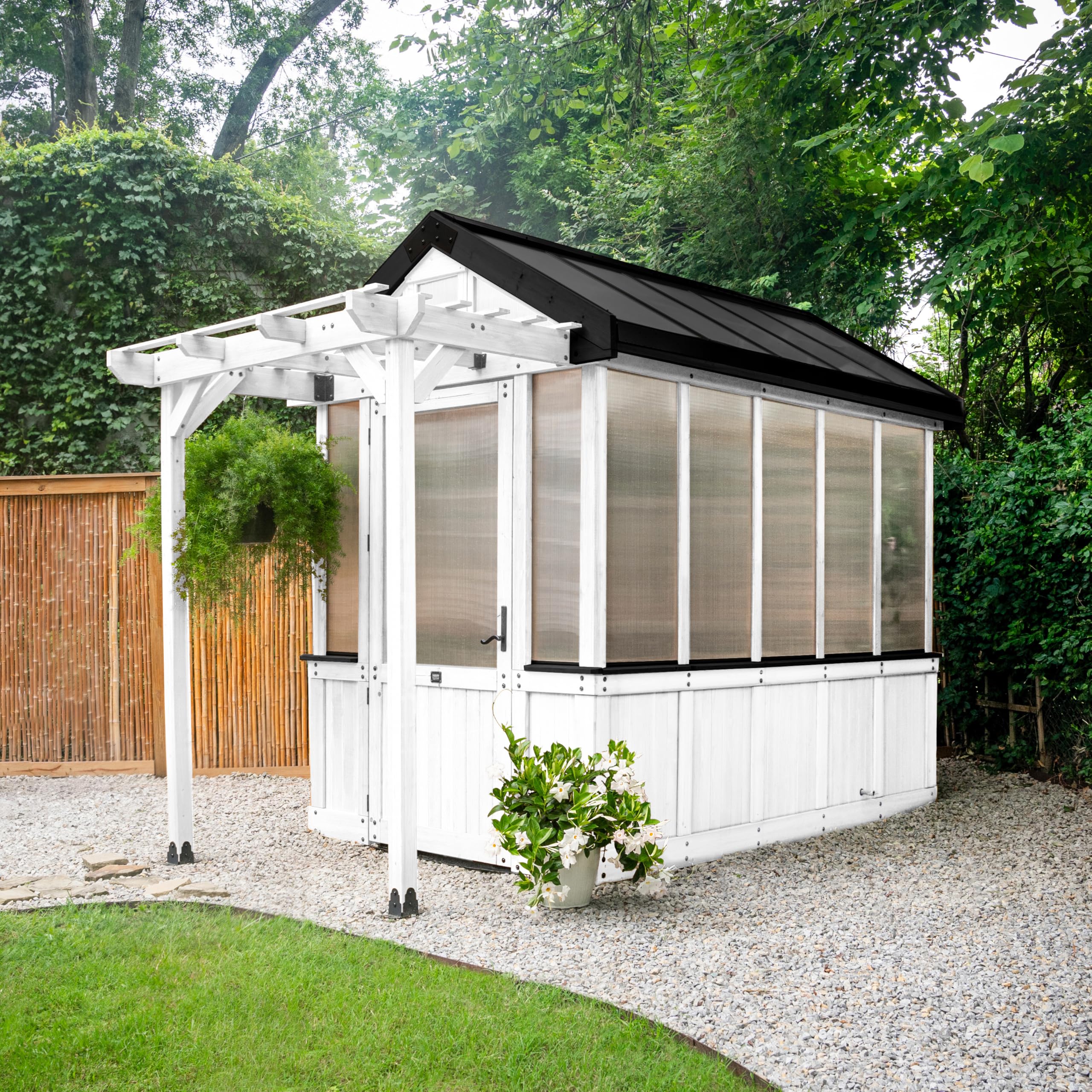
The cedar greenhouse that comes with power, water, and a pergola already figured out.
This is the most complete package you can buy — a 100% cedar wood frame with commercial-grade 4-wall polycarbonate roof and window panels that the manufacturer says improve heat retention by 30% over standard double-wall polycarbonate. The wood is naturally resistant to decay and comes pre-cut, pre-drilled, and pre-stained in white. The Pro-Tect tested rating proves it handles up to 3,700 pounds or 30 inches of snow load, plus winds up to 100 mph (as long as you anchor it per the manual). That is an extreme margin compared to the aluminum models in this list, and it directly answers the fear of collapse under a heavy winter storm.
Beyond the structure, this greenhouse has features no other model here matches: a temperature-activated exhaust fan, a built-in PowerPort with 3 electrical outlets and 3 USB ports, exterior and interior hose hook-ups, 54 square feet of interior space, 13 linear feet of lower staging shelves, 6 feet of upper shelves, and 4 plant hooks. One reviewer from northern Idaho said it kept the interior warm enough that they had greens all winter. The BILT app provides step-by-step interactive assembly instructions, which customers note are clear and accurate, though the 10 heavy boxes can be a delivery challenge — the unit weighs 798 pounds.
The honest downsides are the price and the build time. At nearly three grand, it is an investment. Assembly took one reviewer and their grandson a full week. The cedar wood is soft, so screws can strip if you over-torque them, and a few reviewers received warped boards (though the company replaced them quickly). If you want a ready-to-use greenhouse with integrated electricity and plumbing that looks beautiful and can handle serious winter weather, this is the one. For a simpler structure at a lower price, the aluminum-framed models above will serve you well.
What Justifies the Investment
- Rated for 3,700 lbs snow load and 100 mph winds
- Includes temperature-activated exhaust fan, power outlets, USB ports, and hose hook-ups
- 54 sq ft interior with built-in staging shelves and plant hooks
- BILT app guides assembly with interactive 3D instructions
What You Trade
- Weighs 798 pounds; delivery and placement are a serious logistics task
- Assembly takes a full week for two people
- Soft cedar wood can strip screws if you are not careful
Run to this if: you want the most feature-complete winter greenhouse with built-in power, water, and a snow load rating of 3,700 lbs.
Pass if: your budget or timeline can’t handle a premium price and a week-long build project.
3. VEIKOU 6’x12’ Greenhouse for Outdoors

A long 12-foot footprint with two roof vents for better temperature control.
At 142.2 inches long, this is the longest standard greenhouse in the lineup — great for gardeners who want rows of beds instead of a square or short rectangle. It uses a powder-coated deep gray aluminum frame that resists rust and dirt, and the 4mm twin-wall polycarbonate panels provide decent insulation for winter use. The big differentiator here is the upgraded roof vent system: two vents operated by a pole-less pulley mechanism, which lets you adjust airflow without fighting with manual props. That double vent is a meaningful advantage over the single-vent models — it helps prevent the midday overheating swing where a greenhouse hits 100°F when it is 40°F outside.
Reviewers point out that the frame seems sturdy in wind gusts up to 30 mph, though most recommend adding your own ground anchors or a tie-down kit because the structure can shift in winds over 15 mph without extra securing. The door is a swing style at 24.4 inches wide, which is narrower than the double-door models, so moving a wheelbarrow in and out is a squeeze. Assembly is described as doable but takes patience — one reviewer had slightly bent corners and had to expand some holes, and another mentioned the vent holders are ineffective, so they made wooden stops. The powder coating on the frame does look nice, and the overall cost is reasonable for a 12-foot winter greenhouse with good ventilation.
Length Advantage: At 142.2 inches long, this is the best pick for gardeners who want long planting rows.
Ventilation Edge: Two roof vents with a pulley system give you better hot-air release than single-vent models, which matters for winter sun days.
Grab this for: a long 12-foot growing space with dual vents and a powder-coated frame that looks sharp.
skip it if: you want a quick no-fuss assembly; this one demands careful work and some problem-solving.
4. HOOYEAH 6×8 FT Polycarbonate Greenhouse
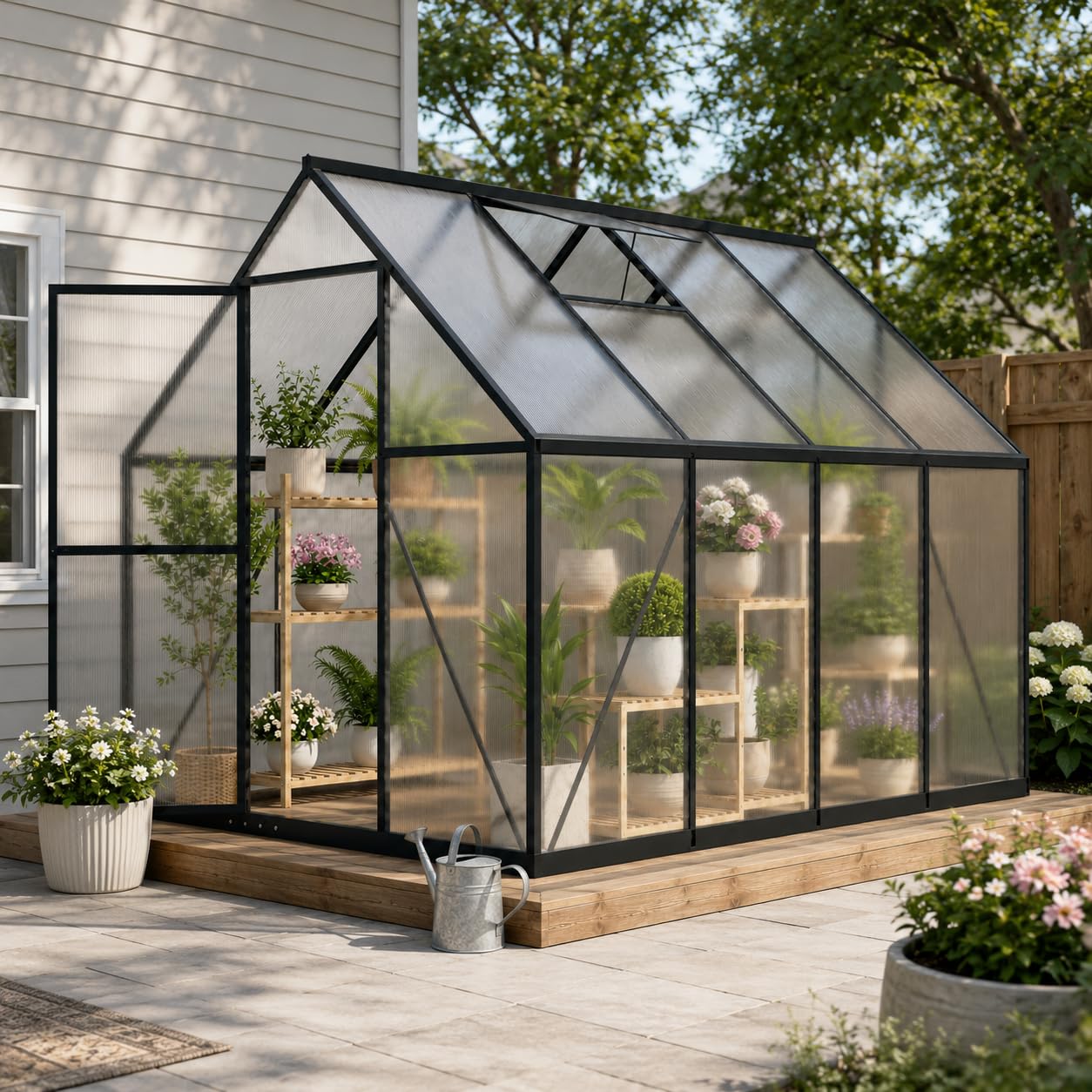
A walk-in greenhouse you can actually reposition — under 80 lbs and two-person portable.
If you are not ready to commit to a permanent foundation, this 6×8 foot greenhouse is light enough that shoppers say it can be easily moved by two people. That portability comes from a well-engineered aluminum frame and standard polycarbonate panels that keep the weight down while still providing UV protection and light diffusion. The semi-translucent milky white polycarbonate panels block harmful UV rays and soften the sunlight, which your seedlings will appreciate, but they are not fully transparent — so you lose a bit of the clear view that some gardeners prefer.
The reinforced aluminum frame includes an upgraded lock for the door, and the single adjustable roof vent helps with airflow. But buyers report the roof vent is insufficient for hot days and recommend adding solar fans for better circulation. The panels fit snugly, and several reviewers suggest caulking the glazing with silicone for wind resistance — a common theme across all these greenhouses. At 70.87 inches long and 76.9 inches tall, the interior is spacious enough for shelves and pots, though the manufacturer advises placing it in a partially wind-protected area near a fence or wall rather than in an open field. The unit count is 1.0, which contrasts sharply with the larger kits that arrive as hundreds of parts.
The Portability Perks
- Weighs under 80 lbs; two people can reposition it
- Aluminum frame with reinforced corners and upgraded lock
- Diffused sunlight from milky panels helps prevent leaf burn
Trade-Offs to Consider
- Single roof vent is not enough for hot sunny days; plan to add solar fans
- Panels are semi-translucent, not clear — reduced visibility into the greenhouse
- Needs partial wind protection; not suited for fully exposed spots
Ideal for: gardeners who might want to rearrange their backyard layout and need a greenhouse they can move.
Not for: anyone who expects a single-vent greenhouse to manage temperature without adding fans.
5. WUKHG 6×7.5 FT Greenhouse for Outdoors
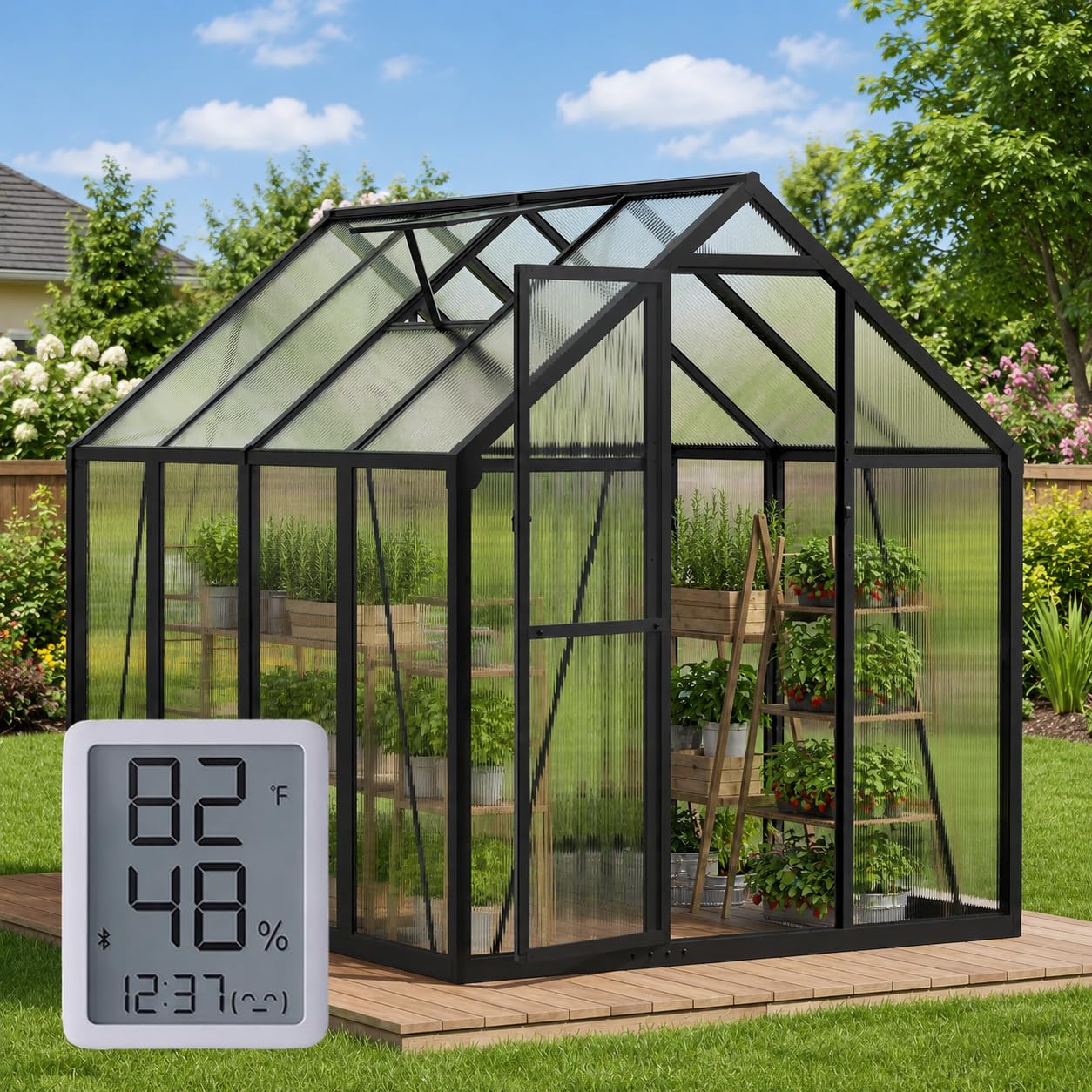
A solid 3-person build with surprisingly good heat retention and a built-in thermometer.
This 6×7.5 foot greenhouse uses 5mm polycarbonate panels — slightly thicker than the 4mm panels on most mid-range models, which gives it a small edge in insulation. The aluminum alloy frame is reinforced to handle strong winds, heavy rain, and blizzards, and the included electronic thermometer lets you monitor interior temperature at a glance. Owners mention that the greenhouse heats to 100°F when it is 40°F outside on a sunny winter day, which is proof of the heat retention of the thicker panels — but it also highlights the importance of the single roof vent, which may not release enough hot air on its own. The same reviewer noted it cools back to outside temperature by midnight, meaning it does not hold residual warmth overnight without supplemental heat.
The assembly is the main hurdle here. It is a 3-person job with many parts, and some customers note the mislabeling and unclear instructions made it harder than expected. One review mentioned the roof window blew out, and the door crosspiece was too short. The interior is roomy enough for a flexible plant collection, and the walk-in height at 76.77 inches means most people can stand upright. If you are willing to invest a weekend with friends and extra silicone sealant, this greenhouse delivers solid winter performance at a fair price.
Heat Retention Test: Hits 100°F at 40°F outside with the sun out — shows the 5mm panels work, but you need better ventilation or a fan.
Assembly Reality: Three people and a lot of patience required; mislabeled parts and unclear steps are common complaints.
Best suited for: the gardener with a helper or two who wants a mid-size greenhouse with good heat retention and does not mind a challenging build.
Think twice if: you are assembling solo, or you need a greenhouse that stays warm through the night without extra heat.
6. Sylviera 6x4FT Greenhouse with Hygrometer
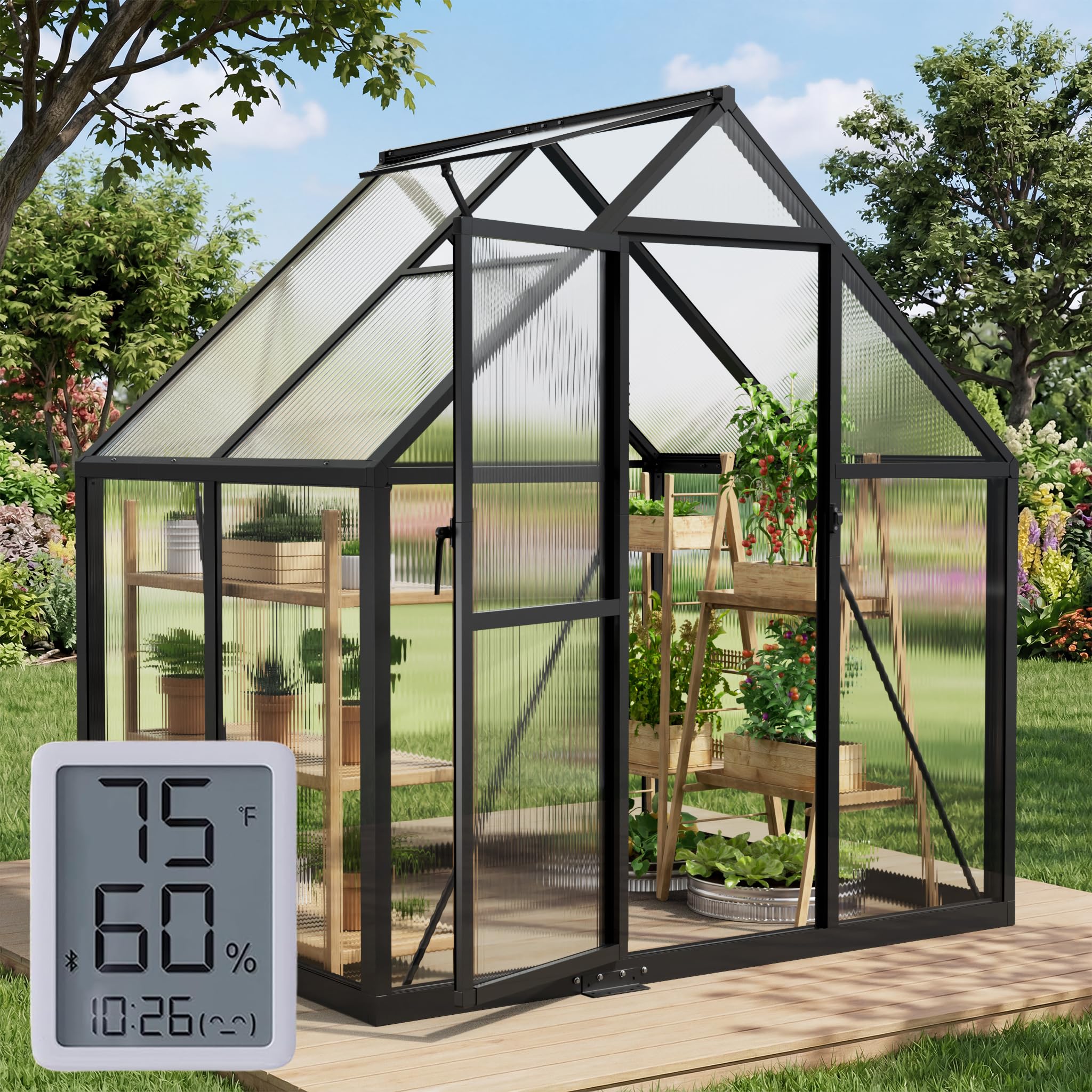
The smallest footprint here but with two vents and a built-in hygrometer for climate control.
At 67 inches long and 45 inches wide, this 6×4 greenhouse is the most compact pick — perfect for a small backyard or patio where space is tight. The 4mm double-wall polycarbonate panels and heavy-duty aluminum frame give it the same basic winter insulation as larger models, just in a smaller package. One feature that stands out for its size is the inclusion of two adjustable roof vents and a lockable door, giving you dual ventilation that some larger greenhouses lack. The built-in hygrometer (a device that measures humidity) helps you keep an eye on moisture levels, which is useful in winter when condensation can build up.
Buyers confirm the greenhouse is “sturdy” and maintains a stable temperature, withstanding wind and rain well. Assembly is manageable with two people over a few hours, though you will need to remove protective film from both sides of the polycarbonate panels before installation — a step the instructions apparently do not make clear. The 120-count unit count reflects the many small parts and panels in the kit. The compact footprint means you cannot fit many shelves, but for starting seeds or protecting a few valued plants through the winter, this is a budget-friendly entry point that still gives you proper aluminum framing and polycarbonate panels rather than flimsy plastic sheeting.
Small-Space Strengths
- Two adjustable roof vents provide good airflow for a compact greenhouse
- Includes a hygrometer to monitor humidity levels
- Aluminum frame and 4mm polycarbonate offer real winter protection
Size Limitations
- 45-inch width limits shelving and plant capacity
- Protective film must be removed from both sides of panels (not obvious from instructions)
- Smaller interior means less thermal mass to hold overnight heat
Choose this for: a small backyard that needs a real winter greenhouse without taking up much space.
Skip if: you need room for multiple shelves, large pots, or want to walk inside comfortably — this is a compact lean-to style.
7. Sylviera 12×12 FT T-Shape Greenhouse
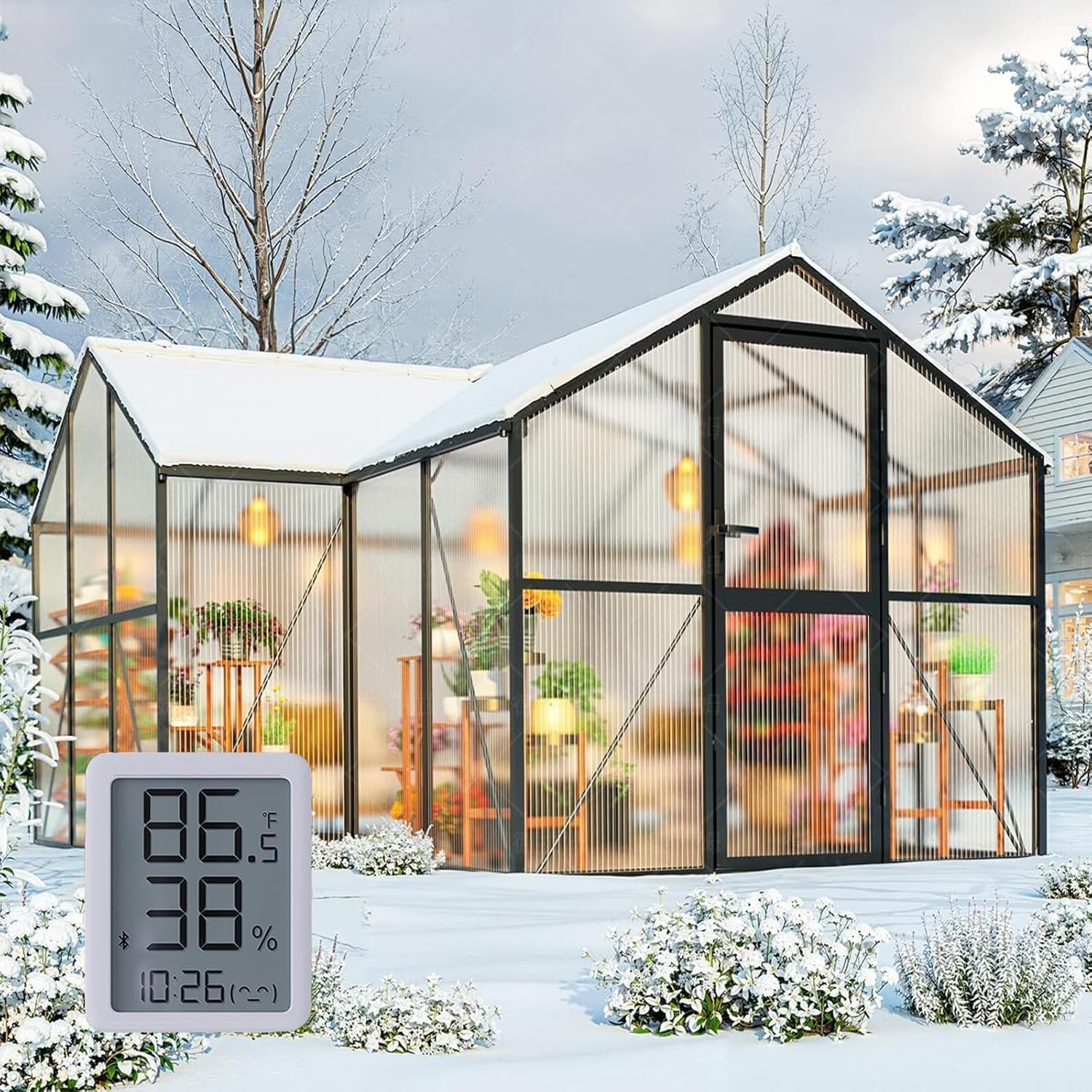
A 12-foot-square T-shape design with the thickest panels in the standard lineup.
If you have the ground space, this 12×12 greenhouse is enormous — 143 inches in both length and width, with an 84-inch peak height that gives you plenty of headroom. It uses 6mm thick double-wall polycarbonate panels that weigh 1100 grams each, providing UV resistance and serious insulation for cold weather. The T-shape layout is unusual and gives you a wider front area for working, which is a nice alternative to the standard rectangle. The reinforced aluminum alloy frame with strengthened corners is designed for tough outdoor conditions, and the two roof vents plus lockable door allow for decent airflow despite the large volume.
The sheer number of parts — the unit count is 489 — means assembly is a major project. Some reviewers point out that the panels feel cheap despite the thickness, and the instructions are not always clear (one buyer mentioned the roof panel instruction was missing, causing a collapse during assembly). Others found the build manageable with two people over a few hours, especially if they used locktight and silicone for extra durability. The T-shape also means you get more usable bench space along the front wall, but the odd shape can make standard shelving harder to fit. For a gardener with a large backyard and the patience for a complex build, this is a lot of growing space for the money.
Massive Footprint: 12×12 feet with 6mm panels gives you a huge well-insulated growing area for serious winter production.
Quality Caveat: Multiple buyers mention panels that feel flimsy and instructions that miss critical steps — budget extra time and materials for sealing and reinforcing.
Best for: the ambitious gardener with a large backyard who wants maximum volume and can handle a big assembly project.
Not for: someone looking for a straightforward weekend installation with premium panel quality.
Understanding the Specs
Polycarbonate Thickness and Wall Structure
Polycarbonate panels come in double-wall or multi-wall construction — basically two or more layers of plastic with air trapped between them. That air pocket is your main insulator. A 4mm panel is fine for mild winters, but 6mm panels (like on the HOWE and Sylviera 12×12) provide significantly more resistance to heat loss. The panel weight in grams per square meter (580g for standard 4mm, 1100g for the 6mm on the Sylviera 12×12) is a quick way to gauge density — heavier panels mean more plastic and better insulation.
Snow Load and Wind Ratings
Snow load is measured in pounds per square foot (psf) or total weight capacity. The HOWE greenhouse is rated at 18 psf; the Backyard Discovery Bellerose is tested to 3,700 pounds total or 30 inches of snow. Wind ratings (60 mph for the HOWE, 100 mph for the Bellerose) tell you how much wind the structure can survive, but only if it is properly anchored — a greenhouse sitting loose on grass will fly away in a fraction of that wind speed. Always plan for ground anchors, concrete footings, or a wooden base.
Ventilation: Vents and Fans
A sealed greenhouse on a sunny winter day can hit 100°F inside while it is freezing outside. That heat needs an escape route. Roof vents let hot air rise out naturally, but one small vent is rarely enough for a large greenhouse — the VEIKOU 6×12 has two vents with a pulley system, which is much more effective. Some greenhouses (like the Backyard Discovery Bellerose) include a temperature-activated exhaust fan that forces air out without relying on wind or gravity. If you live in a sunny winter climate, prioritize at least two vents or plan to add a solar fan.
Frame Materials: Aluminum vs Cedar Wood
Aluminum is lightweight, rust-proof, and the most common frame material. But not all aluminum is the same — extruded aluminum with 1.5mm wall thickness is much stronger than thin tubing. Cedar wood is naturally rot-resistant and looks beautiful, but it adds significant weight (the Bellerose weighs 798 pounds) and requires more maintenance. Aluminum needs anchoring; cedar needs a solid foundation. For most users, aluminum is the practical choice, but cedar offers a longer lifespan if properly cared for.
FAQ
Will a polycarbonate greenhouse keep plants above freezing in winter?
How thick should polycarbonate panels be for winter use?
Do I need to anchor a greenhouse to the ground?
Can I assemble a winter greenhouse alone?
Do winter greenhouses overheat on sunny days?
How much does a good winter greenhouse cost?
What is the difference between twin-wall and multi-wall polycarbonate?
How long does it take to assemble a greenhouse kit?
Can I use a greenhouse in snow without a heater?
Should I caulk or seal my greenhouse panels?
Final Thoughts: The Verdict
If you want one dependable pick, the greenhouse for winter winner is the HOWE 8x10x7.5 FT because it combines the thickest 6mm twin-wall panels with an 18 psf snow load rating and a tough 1.5mm aluminum frame — everything a cold-climate gardener needs in one package. If you want a build-it-once greenhouse with integrated power, water, and a stunning cedar frame that handles 3,700 pounds of snow, grab the Backyard Discovery Bellerose. And for a long 12-foot layout with two vents for better temperature control, the VEIKOU 6×12 offers the most ventilation flexibility in a walk-in design.
How We Picked
We do not accept paid placement. Every pick is matched to a real buyer and a real use-case; we do not hands-on test units.
Sources & Methodology
Specifications: manufacturer listings and product documentation. Review insights: verified customer reviews, as of July 2026. Pricing: not shown on this page (it changes often); check the current price via the retailer link.
As an Amazon Associate, Lawn Gear Lab earns from qualifying purchases. This does not affect which products we feature.