
Specs are compiled from manufacturer listings and verified buyer reviews and can change over time — please confirm the key details on the product page before buying.
You want a single bottle that tackles the whole yard without damaging the grass you actually want. The problem is that the wrong concentrate either does nothing to established weeds or scorches your lawn into a brown patch. The right one selectively targets broadleaf weeds and grassy invaders like crabgrass and nutsedge, killing them down to the root while your turf recovers.
I’m Rikta — the founder and writer behind Lawn Gear Lab. This guide is built by comparing the manufacturers’ published specifications and the patterns across verified customer reviews, so you get each pick’s real strengths and trade-offs instead of marketing spin.
To find the best option for your yard, you have to look beyond the brand name and compare the active ingredients, coverage area, and real-world results from thousands of owners. That is exactly what this review of the best grass weed killer concentrate does — it cuts through the labels to show you which bottle actually delivers a weed-free lawn.
Our Picks at a Glance
How To Choose The Best Grass Weed Killer Concentrate
Picking the right concentrate depends on matching the active ingredients to the specific weeds in your lawn and the grass type you want to protect. A product that wipes out crabgrass might also damage your St. Augustine if you are not careful.
Active Ingredients Matter Most
The ingredient list tells you what a concentrate can and cannot handle. Quinclorac excels against crabgrass and foxtail. 2,4-D is the go-to for broadleaf weeds like dandelion and clover. Products with a blend of three or four active ingredients (like MCPA, Dicamba, and Sulfentrazone) cover the widest range of weed types in a single pass. Check the label to confirm it lists your specific problem weeds.
Selective vs. Non-Selective
A selective herbicide kills certain plants while leaving your lawn grass unharmed. Non-selective killers (like Glyphosate) destroy everything they touch. For a healthy lawn, you almost always want a selective concentrate that targets broadleaf weeds and grassy weeds without damaging your Kentucky bluegrass, fescue, or Bermuda.
Coverage and Concentration
A 32-ounce bottle can treat anywhere from 5,000 to 6,000 square feet, while a gallon might cover 32,000 square feet or more. The coverage depends on the mix rate listed on the label. Bigger properties benefit from larger bottles, but even a small concentrate goes a long way if you mix it correctly.
Quick Comparison
| Model | Best For | Volume | Active Ingredients | Coverage | Amazon |
|---|---|---|---|---|---|
| Alligare 2,4-D LV6★ Best Overall | Large-area broadleaf control | 320 fl oz | 88.4% 2,4-D | Per-acre mix | Amazon |
| Fertilome Weed-OutBest Value | Crabgrass + broadleaf | 32 fl oz | Quinclorac + Triclopyr | 5,000 sq ft | Amazon |
| Image Crabgrass Nutsedge KillerNutsedge Specialist | Tough nutsedge & clover | 24 fl oz | Multi-ingredient blend | 6,000 sq ft | Amazon |
| Spectracide Large Plot | Large lawns (32,000+ sq ft) | 128 fl oz | Broadleaf formula | 32,000 sq ft (northern) | Amazon |
| Pro Crabgrass & Grassy Killer | Quinclorac spot treatment | 8 fl oz | 18.92% Quinclorac | Selective | Amazon |
| Roundup For Lawns2 (Northern) | Northern grass types with crabgrass | 32 fl oz | Quinclorac + MCPA + Dicamba | 5,000 sq ft | Amazon |
| Hi-Yield Grass Killer | Bermuda grass removal | 16 fl oz | Fluazifop-P-butyl | 28,800 sq ft | Amazon |
| Gordon’s Trimec Crabgrass Plus | Year-round broad spectrum | 128 fl oz | 3-way herbicide blend | 20,000 sq ft | Amazon |
| Fusilade II Selective Herbicide | Selective grass control in ornamentals | 32 fl oz | Herbicide + surfactant | 1,000 sq ft | Amazon |
In‑Depth Reviews
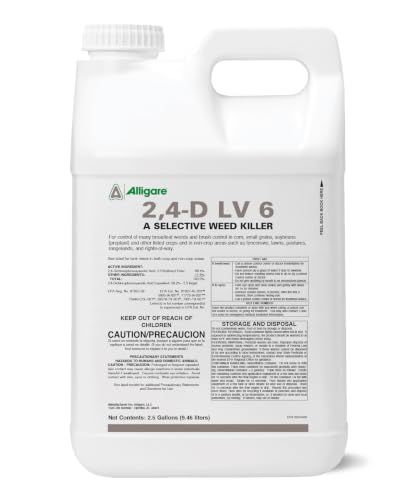
1. Alligare 2,4-D LV6 Selective Weed Killer Concentrate
Our pick — 4.5★ from 200+ verified ratings; the strongest balance of quality and price.
A 2.5-gallon jug built for total broadleaf annihilation across massive properties.
This is not a weekend warrior bottle. The Alligare 2,4-D LV6 packs 88.4% active 2,4-Dichlorophenoxyacetic acid — a serious concentration that buyers report “worked great killed weeds within few days.” It is designed for corn fields, soybean preplant, pastures, and rights-of-way, so a 2.5-gallon jug (320 fluid ounces) is overkill for a small suburban lawn. But if you have acreage, the price per square foot is tough to top. Unlike the 24-ounce bottles that require constant refills, this thing treats entire plots in one shot.
At 128 ounces, this bottle is 13.3 times the volume of smaller concentrates like the Image brand 24-ounce option. That matters when you are spraying large areas. The catch is that you cannot buy it in Texas or several other states (some owners mention the restriction), so check local availability before you commit. It is a crowd-pleaser with a 4.5-star score from 200+ owners — the thing everyone raves about is its effectiveness against tough brush like poison ivy and thistle.
Buyers who have ordered it multiple times say the same thing: follow the mixing instructions precisely or you will “fry your grass.” Mix it correctly, though, and your lawn stays green while the weeds wither.
Why Acreage Owners Love It
- Massive 320 fl oz volume at a competitive price per gallon — 13.3x more than a 24 oz bottle
- 88.4% 2,4-D active ingredient means fast, visible results on broadleaf weeds
- Versatile on crops, pastures, rangeland, and non-crop areas
The Real Trade-offs
- Not available for sale in every state (check the list before ordering)
- Too much concentrate for a typical 5,000 sq ft lawn — you will have leftovers for years
- Mixing mistakes can damage desirable grass quickly
Ideal for: Large properties, farms, and buyers who want the highest concentration of 2,4-D available in one jug.
Think twice if: You have a small city lawn or live in a restricted state like Texas — go with a smaller, locally-shippable concentrate.
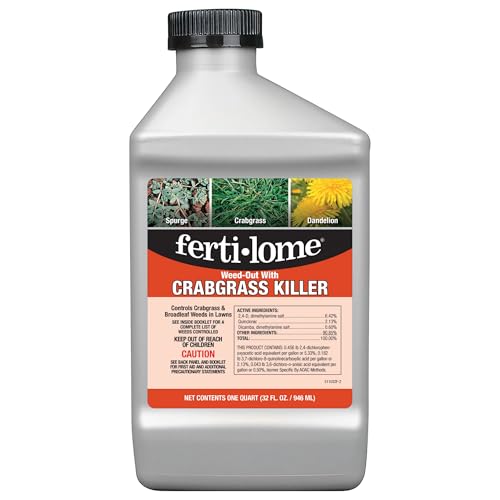
2. Fertilome (11032) Weed-Out with Crabgrass Killer Concentrate, 32 oz
A single 32-ounce bottle that goes after over 200 weed types including crabgrass.
The Fertilome Weed-Out uses a Quinclorac plus Triclopyr formula — a two-pronged attack that controls grassy weeds (crabgrass, foxtail) and broadleaf weeds (spurge, dandelions) in one step. A 32-ounce bottle treats up to 5,000 square feet, which suits a typical mid-sized lawn. Buyers confirm it “kills spurge and other weeds” and also kills crabgrass, though some note you may need to re-treat a few days later for the toughest patches. At 2 pounds, the bottle is lighter than the Spectracide gallon (9 pounds) but covers a smaller area — you trade volume for precision.
One recurring insight from owners: applying to Bermuda grass can cause temporary yellowing or discoloration. The label says full recovery is expected, but it is worth knowing if Bermuda is your primary turf. A few buyers had zero luck with crabgrass, calling it ineffective. The consensus leans positive — the active chemistry works, but success depends on catching weeds young and applying in spring or early summer as directed.
The value pitch is simple: you get two active ingredients in one bottle for a mid-range price, so you do not need separate products for crabgrass and broadleaf weeds. That saves both money and trips to the shed.
What Makes It a Bargain
- Two active ingredients (Quinclorac + Triclopyr) tackle both grassy and broadleaf weeds
- Treats up to 5,000 sq ft — ideal for average suburban lawns
- Compatible with Bermuda, Buffalo, Kentucky Bluegrass and more
Know Before You Spray
- May temporarily yellow Bermuda grass — full recovery expected but unsightly
- Mixed reviews on crabgrass: works for many, not for a subset of users
- Best results require application when weeds are small and actively growing
Reach for this if: You want one product for both crabgrass and broadleaf control at a fair price.
Look elsewhere if: You have a Bermuda lawn sensitive to discoloration or need a crabgrass-killer with zero risk of yellowing.
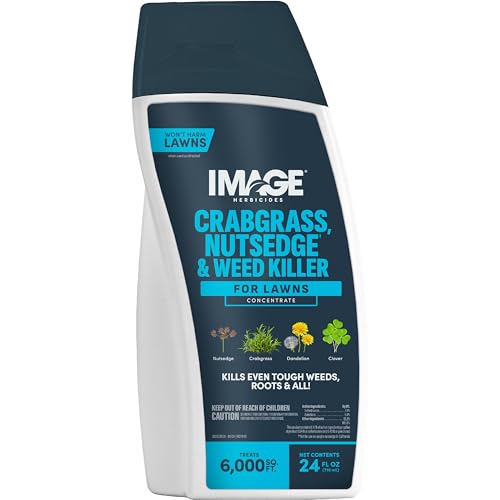
3. Image Crabgrass, Nutsedge, & Weed Killer for Lawns Concentrate, 24 fl oz
The go-to bottle when nutsedge and wild violets have taken over your lawn.
Image’s concentrate is built for the weeds that other killers ignore. It targets crabgrass, dandelion, nutsedge, and clover, and it starts working on contact. what separates it is that it kills tough weeds to the root without harming your lawn — customers note it “worked very well last season in getting rid of nutsedge, which I had a problem with.” The 24-fluid-ounce bottle treats up to 6,000 square feet, slightly more coverage than the Fertilome or Roundup Northern at 5,000 square feet. At 1.6 pounds, it is also the lightest bottle in the mid-range group — 5.6 times lighter than the Spectracide gallon (9 pounds).
The thing everyone raves about is that it kills wild violets and clover that other products cannot touch. Some owners note it requires multiple applications for crabgrass and torpedograss, and that one bottle does not go as far as it appears (the mix rate is 4 ounces per gallon, yielding only 6 gallons of spray solution). It also does not kill Bermuda grass, which is either a pro or a con depending on your lawn. A couple of buyers mention availability issues — it has gotten harder to find on Amazon and may be restricted in some states like Massachusetts due to chemical ingredients.
If nutsedge is your primary enemy, this concentrate is the most targeted option here. It is not the cheapest per gallon of mixed spray, but it solves problems that a generic 2,4-D blend leaves behind.
Its Superpower: Kills invasive wild violets and nutsedge where other concentrates fail — owners call it the only product that works on those stubborn weeds.
One Caveat: The 24 oz bottle only makes 6 gallons of spray solution, so the cost per gallon of mixed concentrate is higher than larger bottles. If you have a big yard, you may burn through it quickly.
Get this for: Nutsedge, wild violets, and clover problems that resist standard broadleaf killers.
Pass if: Your main issue is crabgrass on Zoysia — this product requires multiple applications and may not give you the clean kill you want.
4. Spectracide Large Plot Weed Stop for Lawns Concentrate, 1 Gallon

One gallon that covers up to 42,500 square feet without harming your lawn.
The Spectracide Large Plot Weed Stop is the volume champion among consumer-grade concentrates. A full 128-fluid-ounce gallon treats up to 32,000 square feet of Northern grasses or 42,500 square feet of Southern grasses — that is a massive area from a single bottle. It targets more than 200 types of broadleaf weeds including dandelion, chickweed, and clover. Reviewers point out it is “easy to mix, spreads well, covers large area” and that the results show in hours, not days.
At 9 pounds, this bottle is 5.6 times heavier than small concentrates like the Image 24-ounce bottle (1.6 pounds). The weight tells you it is serious chemistry. It claims to be rainproof in as little as 6 hours after application, so you do not have to worry about an afternoon shower washing it away. The honest downside from some owners: it is slow-acting on tough rosette weeds and foxtails, with some needing a third application. Value for money gets mixed marks in the reviews — it is a strong product, but a few find it not worth the price given the slow action on certain weeds.
For a large lawn owner, the math works: one gallon replaces several smaller bottles and the coverage is hard to argue with. Just manage expectations on the toughest perennial weeds.
What Large-Plot Buyers Love
- Gigantic coverage: up to 42,500 sq ft (Southern grasses) from a single gallon
- Rainproof in 6 hours — spray and walk away
- Kills over 200 listed weed types including dandelion and clover
Where It Falls Short
- Slow on tough weeds like foxtails and rosette weeds — may require multiple applications
- Effectiveness gets mixed marks from a subset of buyers
- 1-gallon jug is heavy (9 pounds) — requires a large sprayer to use efficiently
Choose this for: Large lawns where covering 32,000+ square feet in one go matters more than speed on stubborn weeds.
skip it if: You have a small yard and want fast knockdown on foxtails or mature, rosette-stage weeds.
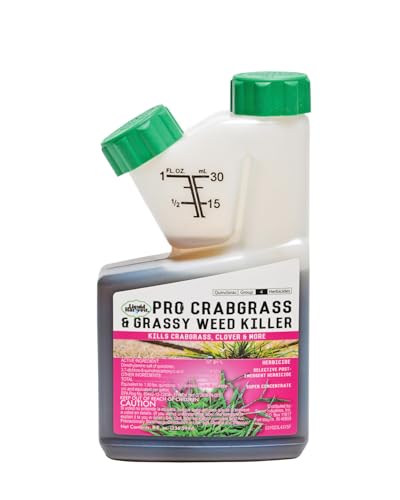
5. Pro Crabgrass & Grassy Weed Killer Concentrate, 8 fl oz
An 8-ounce bottle of pure Quinclorac that hits crabgrass like a hammer.
Do not let the small size fool you. This concentrate packs 18.92% Quinclorac, the same active ingredient found in professional-grade products like Drive XLR8. Because it is so concentrated, a single 8-ounce bottle goes a long way — you mix at 1.5 ounces per gallon per 1,000 square feet. Buyers who follow the instructions report visible results within days, with crabgrass dying in about 5 days. The formula is designed for spot treatment or broadcast applications, and it provides residual control that prevents weeds from reappearing.
The catch is that mixing precision matters enormously. Several owners note that you need to add a surfactant (a spreader-sticker that helps the liquid cling to leaves) or the product will not stick and will show little to no results. The label mentions it in small print, and skipping that step leads to frustration. Effectiveness gets mixed reviews across the board — it works brilliantly for some and not at all for others — often tracing back to whether the user added a surfactant and applied at the right growth stage.
This is a targeted tool. It goes after crabgrass, foxtail, barnyardgrass, and Dallisgrass, as well as broadleaf weeds like clover and dandelion. It is not the right choice if you need a general-purpose lawn spray for everything. But if crabgrass is your single biggest headache, this bottle offers the most concentrated Quinclorac punch in the lineup.
The Power: 18.92% Quinclorac concentrated into 8 fl oz — powerful enough to kill crabgrass in 5 days when mixed correctly with a surfactant.
The Fine Print: You absolutely must add a surfactant for the liquid to adhere to leaves. Skip that step, and the product evaporates without killing anything.
Best for: Targeted crabgrass elimination where a high-concentration Quinclorac spot treatment is needed.
Not for: Beginners who want a simple “spray and forget” solution — this demands careful mixing and the right surfactant.
6. Roundup For Lawns2 Concentrate (Northern) – 32 oz

The most popular pick for Northern lawn owners battling crabgrass and nutsedge.
Roundup For Lawns2 (Northern) is a household name for a reason. It blends four active ingredients (3.85% MCPA, 1.80% Quinclorac, 0.43% Dicamba, and 0.22% Sulfentrazone) to kill over 250 types of weeds including crabgrass, dandelion, clover, and yellow nutsedge. The 32-ounce bottle treats up to 5,000 square feet and is rainproof in as little as 3 hours — faster than the Spectracide gallon (6 hours). It starts working immediately on contact, so you see wilting within a day.
Buyers consistently report it kills bur clover in red fescue lawns without harming the fescue, and many call it the best product they have found for yellow nutsedge. The caveat: it is designed specifically for Northern grasses like Kentucky bluegrass, perennial ryegrass, fescue, and zoysiagrass. If you have a Southern lawn with St. Augustine, this is not your product. A few owners say it did not work on wild violets or on all types of crabgrass, so results vary by weed species. Some users recommend two applications at half rate spaced a week apart for the toughest crabgrass.
With nearly a thousand ratings and a 4.3-star score, this is the most-reviewed concentrate in the lineup. The volume of feedback means you get a well-understood product with few surprises.
Why It’s So Popular
- Four active ingredients target over 250 different weed types
- Rainproof in just 3 hours — forgiving of unpredictable weather
- Trusted brand with nearly a thousand ratings confirming its effectiveness
Limitations to Know
- Formulated for Northern grasses only — not for St. Augustine or Centipede lawns
- Does not kill all types of crabgrass; some strains require two applications
- Wild violets appear resistant even to stronger spot treatments
Grab this if: You have a Northern lawn (Kentucky bluegrass, fescue, ryegrass) and want a well-tested, fast-acting concentrate for a wide weed spectrum.
pass on it if: You have St. Augustine or Centipede grass, or if wild violets are your primary weed problem.
7. Hi-Yield 16 oz Grass Killer Concentrate
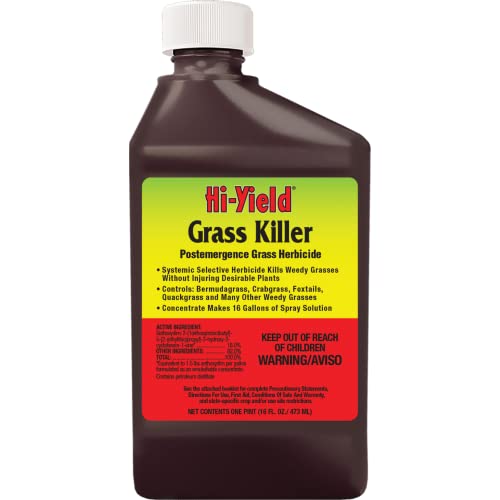
A selective spray that targets grass weeds around your flower beds and vegetables.
The Hi-Yield Grass Killer uses Fluazifop-P-butyl, a selective post-emergent herbicide that kills grassy weeds but leaves broadleaf ornamentals, trees, shrubs, and vegetables unharmed. Spray it on Bermuda grass or crabgrass sneaking into your garden beds, and it stops growth within two days of application. The 16-ounce bottle makes 16 gallons of spray solution and covers up to 28,800 square feet — a massive area for a small bottle. That coverage far exceeds what you get from a standard 32-ounce consumer concentrate, because the active ingredient is so concentrated.
Shoppers say it works well on Bermuda grass and crabgrass with very little damage to monkey grass (a common ornamental border plant). However, the effectiveness gets mixed reviews. Some owners applied it according to directions multiple times over two weeks and saw “no apparent effect on the grass.” The common thread in the negative reviews: you need to add a crop oil concentrate (a surfactant) to help the product stick to the grass blades. Without it, the liquid evaporates before it can penetrate the leaves. The product itself is on the expensive side for a 16-ounce bottle, and there are occasional reports of leakage during shipping that wastes the concentrate.
This is not a general lawn weed killer. It is a surgical tool for removing grass from areas where you want flowers or shrubs. If that is your exact need, the selectivity is a huge advantage over non-selective sprays that kill everything.
Why it stands out: Applied as a spot spray around vegetables, gardens, trees, and shrubs without damaging them — something few other grass killers can claim.
Key advice: You must use a crop oil surfactant for adhesion. Without it, the product often shows no results at all.
Ideal for: Removing Bermuda grass and crabgrass from flower beds and ornamental plantings without harming your shrubs.
Not for: Broadcasting over a lawn to kill broadleaf weeds — this only targets grassy weeds, and it requires a surfactant to function.
8. Gordon’s Trimec Crabgrass Plus Lawn Weed Killer Concentrate, 1 Gallon

A three-way herbicide blend that keeps your lawn clean for a full year.
Gordon’s Trimec is a cult favorite among lawn enthusiasts who want to spray once and forget about weeds for months. The 1-gallon (128-fluid-ounce) concentrate uses a 3-way herbicide blend that controls emerged grassy weeds like crabgrass, foxtail, and signalgrass, plus more than 200 common broadleaf weeds like dandelions and plantain. It covers up to 20,000 square feet, making it a strong middle ground between the 5,000-square-foot bottles and the massive Spectracide gallon. Buyers call it “one of the best herbicides around” and note it “keeps my lawn free of weeds and crabgrass until the following year.”
The formulation offers residual control — it keeps working after initial application to stop new weeds from sprouting. Owners who use it in a tow-behind sprayer for large lawns say it clears up unwanted weeds very effectively. Clover can be stubborn even for this product, and some users note it requires a surfactant and dye for best results. At 0.5 pounds listed weight (the empty bottle is very light), the actual weight of the filled jug is more substantial — the packaging seems understated. A few buyers wish it came in a 2.5-gallon jug for even better value on large properties.
The star rating sits at 4.4 with nearly 300 ratings, and the consensus is that it works better than Ortho and other big-box brands. If you want a proven annual treatment, this is the bottle to reach for.
The Gordon’s Advantage
- 3-way herbicide blend covers grassy weeds (crabgrass, foxtail) and 200+ broadleaf weeds
- Residual control keeps treated areas weed-free for months — some buyers report a full year
- 20,000 sq ft coverage from 1 gallon fits medium-to-large lawns
What to Watch For
- Clover can be hard to eliminate even with multiple applications
- Best results require adding a surfactant and dye, per experienced owner advice
- 1-gallon size may feel small for very large plots compared to the 2.5-gallon the brand sells elsewhere
Choose this for: A single annual treatment that keeps your lawn free of most weeds and crabgrass for a full season.
Pass if: Clover is your primary weed problem — even loyal users note it struggles against clover.
9. Fusilade II Selective Herbicide, 32 oz
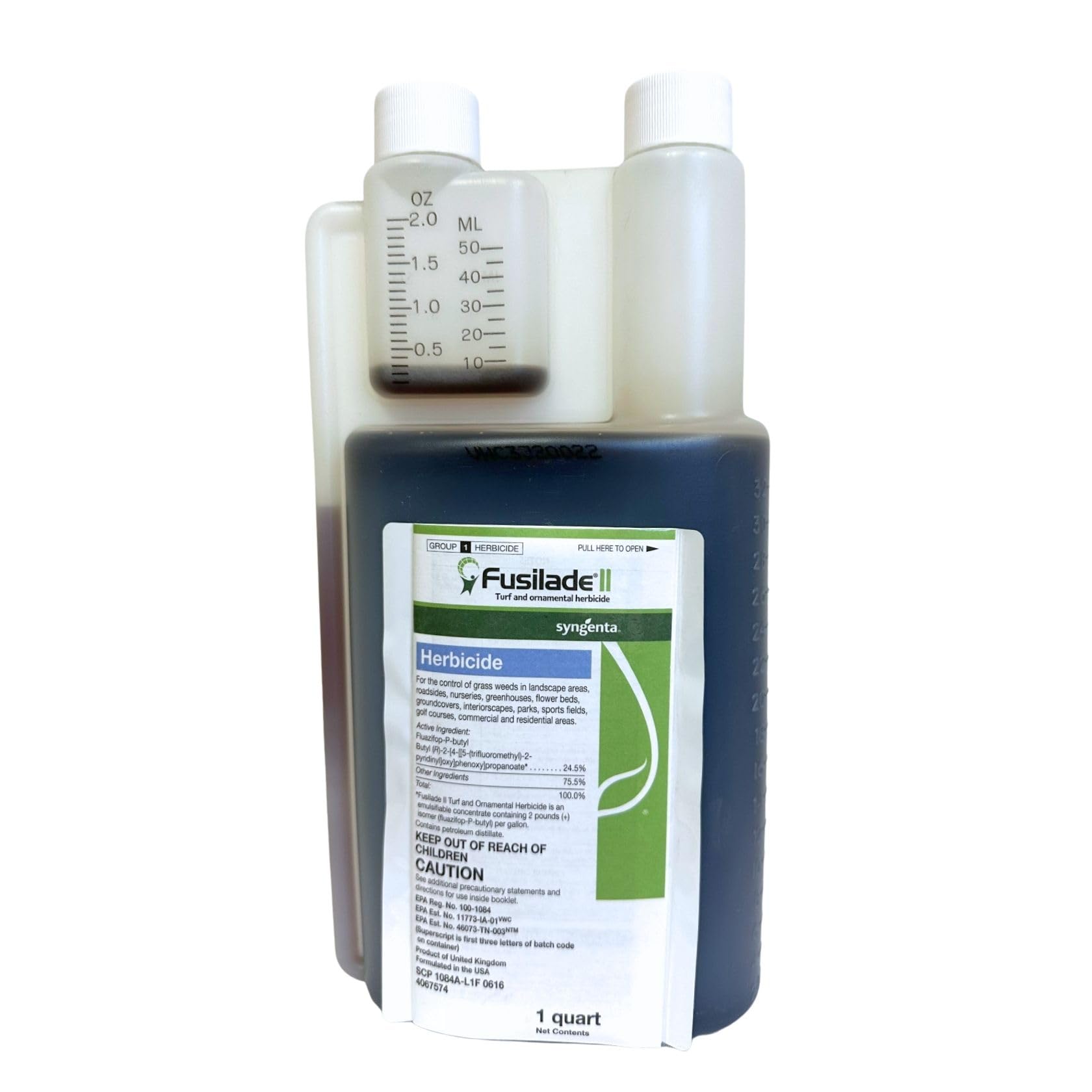
The Syngenta chemistry that kills Bermuda grass from within ornamental beds.
Fusilade II is a selective herbicide from Syngenta, a major name in professional turf management. It controls perennial and annual grass weeds in turf and landscaped areas without harming ornamental plants. You can apply it as a spot treatment or spray it over the top of flower beds to kill invading Bermuda grass, crabgrass, and foxtail. Buyers rave about its effectiveness — the #1 aspect mentioned by owners is that it works exactly as promised, with 94 positive mentions. The trade-off is that value for money is a mixed subject; it is an expensive concentrate per bottle, but a little goes a very long way.
The real-world stories from owners are instructional. Zoysia lawn owners in Nashville and Texas have dialed in specific mix rates (0.2 oz per gallon) that kill Bermuda grass without destroying their Zoysia. At the full label rate (0.6 oz per gallon), it can damage Zoysia lawns by 40-50%. That tells you this is a product that rewards careful experimentation. Owners advise using a non-ionic surfactant and testing a small area first. It is not a product for the casual weekend warrior — it is a precision tool for lawn enthusiasts who want to save their Zoysia from aggressive Bermuda invasion.
The 32-ounce quart covers about 1,000 square feet at standard rates, so it is not cheap per square foot. But if you are fighting a Bermuda grass takeover in a Zoysia or fescue lawn, this is the most effective chemical option available.
The specialist edge: Kills Bermuda grass in Zoysia and fescue lawns without damaging ornamental plants — a unique capability that few other concentrates offer.
The difficulty: Requires precise mixing ratios and a surfactant. Dialing in the right rate for your turf type takes patience and testing.
Get this for: Selective Bermuda grass removal from Zoysia or fescue lawns and ornamental flower beds.
Avoid if: You want a general-purpose, no-fuss lawn spray — this demands careful measurement and a willingness to experiment.
Understanding the Specs
Active Ingredient Concentration
The percentage of active chemistry (like 2,4-D at 88.4% or Quinclorac at 18.92%) determines how much punch each ounce carries. Higher concentration means you use less product per gallon of water, so a small bottle can cover a very large area. It also means the margin for error is smaller — mix too strong and you damage your lawn. Always follow the label’s mix rate exactly, not your instinct to “add a little extra for tough weeds.”
Selective vs Non-Selective
A selective herbicide kills specific weed types (broadleaf or grassy) while leaving your lawn grass unharmed. A non-selective product kills all vegetation it touches. Every product in this guide is selective, but the specific grasses it is safe for vary. Northern grass blends (fescue, Kentucky bluegrass, ryegrass) tolerate different active ingredients than Southern grasses (Bermuda, St. Augustine, Zoysia). Check the label for your grass type before spraying.
Coverage Area
The square footage a concentrate treats depends on the mix rate. A bottle stating “treats 5,000 sq ft” means the entire bottle mixed at the recommended dilution covers that area. Bigger bottles (gallons) can cover 20,000 to 42,500 square feet. For a quarter-acre lawn (about 10,890 sq ft), a 32-ounce bottle handles one application, while a gallon gives you two to four full treatments depending on the product.
Rainproof Time
How long after spraying before rain or irrigation stops washing the product away. Options range from 3 hours (Roundup For Lawns2) to 6 hours (Spectracide). The shorter the rainproof window, the more forgiving the product is for unpredictable weather. If you spray in the morning and it rains by lunch, you want a shorter rainproof window.
FAQ
Will a grass weed killer concentrate harm my existing lawn?
How long does it take to see results after spraying?
How many square feet does a typical 32-ounce bottle cover?
Can I use a Northern-formula concentrate on Southern grasses?
What is the difference between Quinclorac and 2,4-D?
Do I need to add a surfactant to make the concentrate work?
How soon after spraying can I let my kids or pets on the lawn?
Can I use a grass weed killer concentrate around vegetable gardens?
Why do some concentrates require a second application?
What does rainproof in “hours” mean on the label?
Final Thoughts: The Verdict
For most buyers, the best grass weed killer concentrate is the Alligare 2,4-D LV6 because its massive 320-ounce volume and 88.4% active ingredient deliver the highest value per square foot for broadleaf control on large properties. If you want a trusted crabgrass and nutsedge solution for a Northern lawn, grab the Roundup For Lawns2 (Northern). And for selective grass removal around flower beds and ornamentals, the Hi-Yield Grass Killer is the one to reach for.
How We Picked
We do not accept paid placement. Every pick is matched to a real buyer and a real use-case; we do not hands-on test units.
Sources & Methodology
Specifications: manufacturer listings and product documentation. Review insights: verified customer reviews, as of July 2026. Pricing: not shown on this page (it changes often); check the current price via the retailer link.
As an Amazon Associate, Lawn Gear Lab earns from qualifying purchases. This does not affect which products we feature.