
Specs are compiled from manufacturer listings and verified buyer reviews and can change over time — please confirm the key details on the product page before buying.
Thatch — that spongy layer of dead grass stems and roots between your soil and your living lawn — is the number one quiet killer of a green yard. If water beads up on the surface or your grass feels bouncy underfoot, you have too much of it, and a standard leaf rake just skims over the top. A dedicated grass thatch rake reaches below that mat and yanks it out without shredding the good grass, and picking the right one depends on steel quality, tine spacing, and handle length..
I’m Rikta — the founder and writer behind Lawn Gear Lab. This guide is built by comparing the manufacturers’ published specifications and the patterns across verified customer reviews, so you get each pick’s real strengths and trade-offs instead of marketing spin.
Whether you are prepping for a spring overseeding or salvaging a moss-choked lawn,, choosing the best grass thatch rake means finding a tool that combines sharp, durable tines with a handle long enough to save your back.
Our Picks at a Glance
How To Choose The Best Grass Thatch Rake
Not all thatch rakes dig the same. Three things separate a tool you will reach for every spring from one that bends on the first pass or leaves your lawn looking patchy.
Tine Material and Design — The Only Part That Touches Your Lawn
The tines do all the work. Manganese spring steel holds a sharp edge and springs back after hitting compacted soil, while plain carbon steel can bend under pressure. A curved semi-circular hook pulls the thatch up instead of stabbing straight down, which spares the living grass roots. Count the tines — anything from 19 to 21 pairs means fewer passes over the same spot.
Handle Length and Adjustability —
A short handle forces you to stoop.. Look for a rake that extends to at least 58 inches — 66 to 74 inches is better for taller users or for covering large lawns. Sectional handles let you dial in the exact length, and a cushioned grip near the end prevents blisters during a long session.
Head Width and Angle Adjustment — Cover Ground Without Wasting Energy
Wider heads clear more thatch per pull, but a 15-inch head is the balance for most yards. Angle adjustment matters more than you think: a steeper angle digs deep into a thick thatch layer, while a flatter one skims the surface for light debris. Dual-sided heads add a second function — one side for aggressive dethatching, the other for loosening soil or raking leaves.
Quick Comparison
| Model | Best For | Head Width | Handle Length | Weight | Amazon |
|---|---|---|---|---|---|
| YEELOR 66″ Adjustable★ Best Overall | Best Overall | 17 in | 66 in | 2.5 lbs | Amazon |
| EUIJOIP 70″ Heavy DutyPremium Pick | Premium Build | 15 in | 70 in | — | Amazon |
| BlumeTrec 74″ Thatch RakeBest Value | Maximum Reach | 15 in | 74 in | 2.1 kg | Amazon |
| Baraystus 15″ Dethatcher | Budget Champion | 15 in | 58.5 in | 3.3 lbs | Amazon |
| Walensee 15″ Dethatcher | Versatile Adjuster | 15 in | 40 – 70 in | 4.6 lbs | Amazon |
| YEELOR 15″ Adjustable Head | Deep Thatch Layers | 15 in | 58.5 in | 1.87 kg | Amazon |
| TCBWFY 15″ Dethatcher | Adjustable Width | 15 in | Long Handle | — | Amazon |
| Cogardenshower 15″ Heavy Duty | Tough Weed Removal | 15 in | 55 – 70 in | 2.06 kg | Amazon |
| Yofidra 70″ Manual Thatcher | Senior-Friendly Reach | 15 in | 70 in | 4 lbs | Amazon |
In‑Depth Reviews
1. YEELOR Thatch Rake with 66 Inch Adjustable Handle
Our pick — over 4.5★ from 250+ verified ratings; the strongest balance of quality and price.
A lightweight thatcher that still packs spring-steel punch.
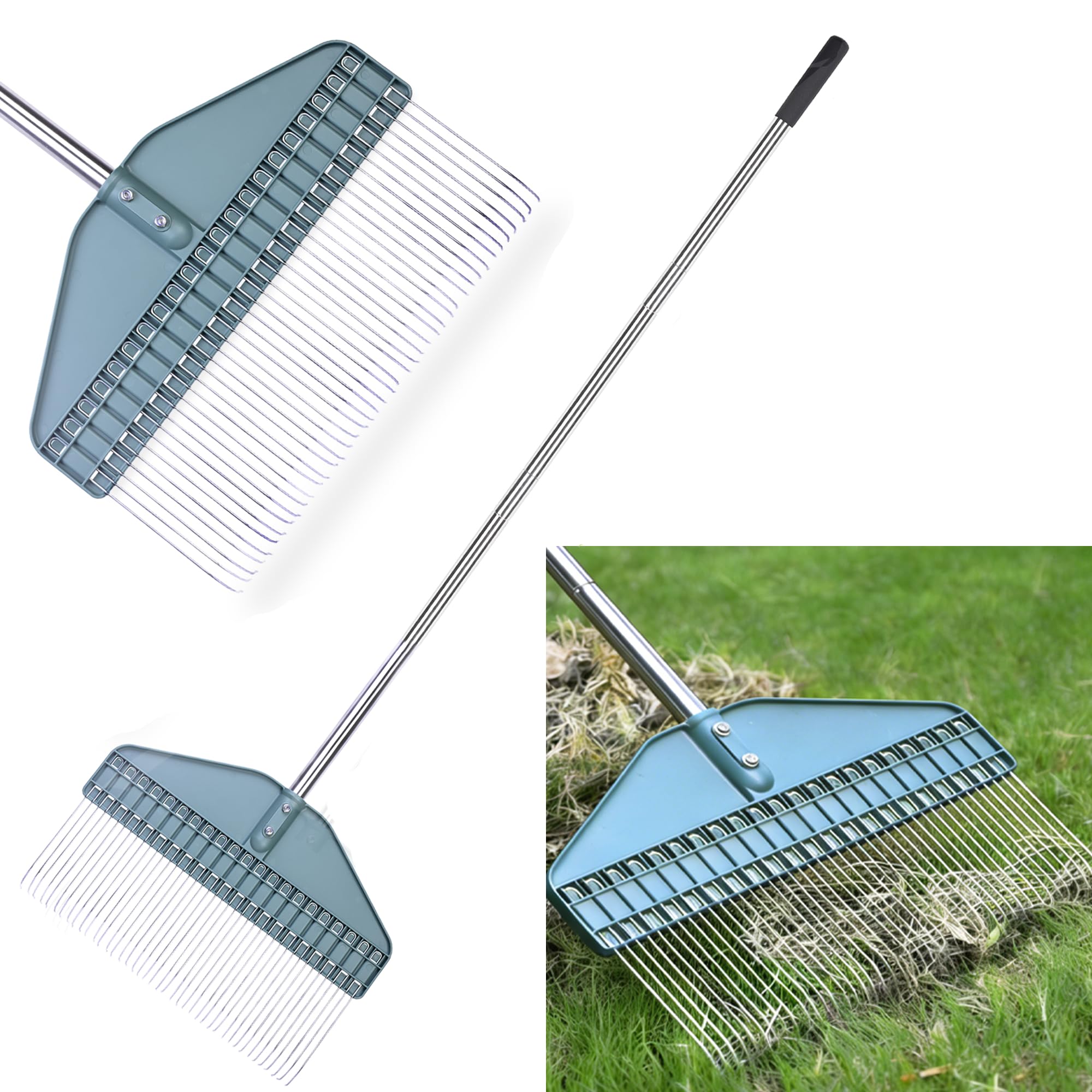
At just 2.5 pounds, this YEELOR is the featherweight champion of the list. Buyers report it “works great to get the dead grass out,” noting it is ready to use, very lightweight, but very sturdy. The 17-inch head is wider than the standard 15-inch head on the Baraystus or Walensee, which means fewer passes over the same patch of lawn.
The reinforced PP engineering plastic body is UV-resistant and built for long-lasting yard work, while the 21 pairs of manganese spring steel teeth provide excellent elasticity (the manufacturer claims it boosts cleaning efficiency by 45%). The stainless steel handle extends to 66 inches and uses two lock bolts for a more stable connection than the single-screw designs that loosen over time. The dual-screw reinforced rake head connections cut down on hand fatigue during a long afternoon.
The crowd favorite holds up at 4.6 stars across 200+ ratings, and the semi-circular hook tines are closely spaced so you lift thatch and pine needles with minimal downward pressure. The recurring feedback is that the handle is slightly heavy on one end, which actually helps ground contact — a minor quibble on an otherwise superb tool.
Why owners love it
- Widest head in this roundup at 17 inches — covers more ground per pull
- Weighs only 2.5 pounds but the spring steel tines stay straight
- 66-inch adjustable handle saves your back over full-yard sessions
A fair heads-up
- Tines are close together, which can clog on very thick, wet thatch
Reach for this if: you want the widest coverage, lightest weight, and most stable handle connection in one package.
Look elsewhere if: you have a massive lawn and want an even wider head — this 17-inch model still requires elbow grease.
2. EUIJOIP 70″ Heavy Duty Metal Dethatcher Rake
Serrated tines that take on ivy and crabgrass without bending.
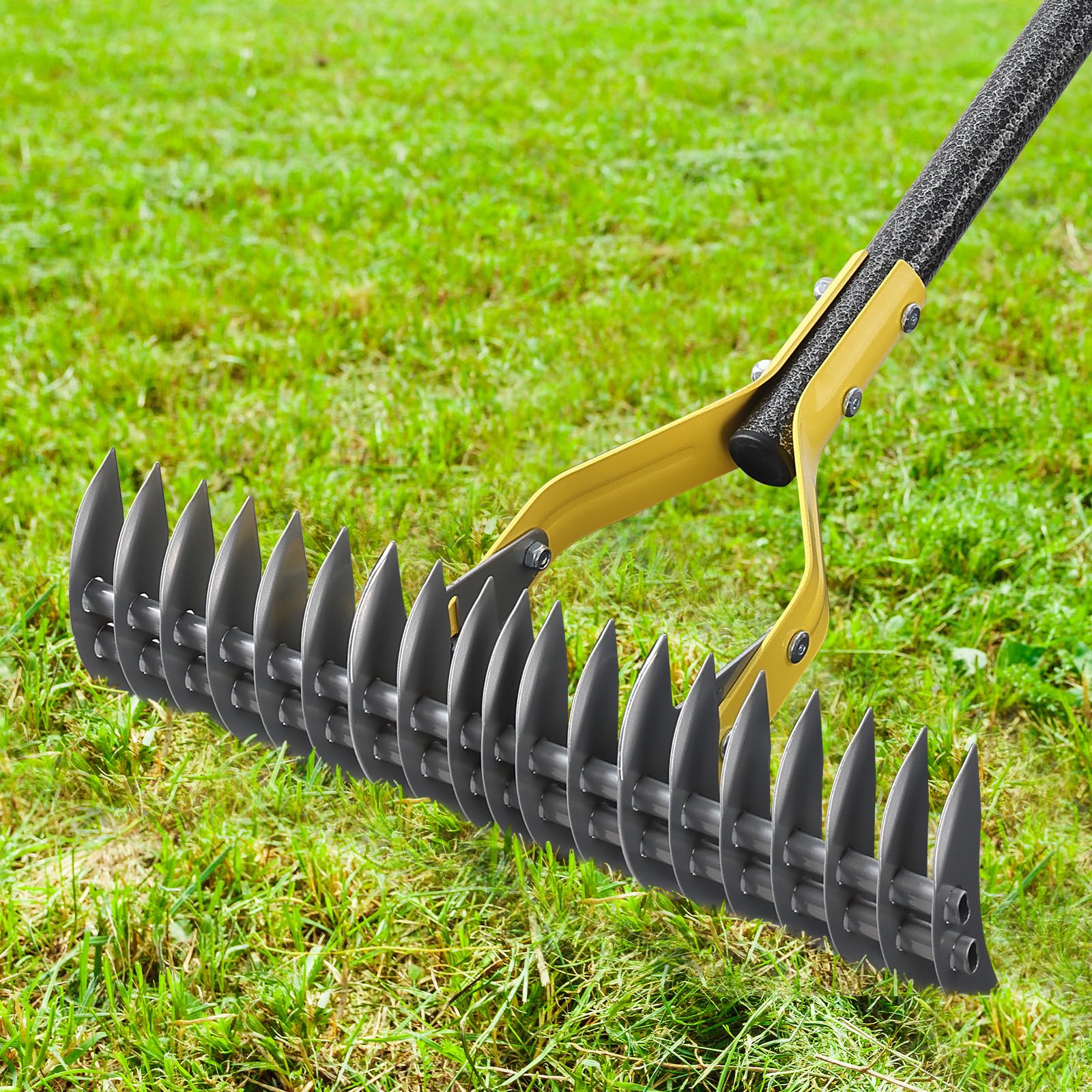
Side A’s long tines penetrate the soil to clear leaves, pine needles, and moss while loosening the earth. Flip it, and side B’s serrated tines remove dense thatch and stubborn weeds like creeping plantain and barnyard grass. The 15-inch head with adjustable angle lets you switch between deep dethatching and gentle surface skimming.
The dual center support rods stabilize the head so the tines apply even pressure across the width. Owners praise its quality and functionality — 9 out of 9 positive reviews call it sturdy and effective. The 1.1-inch diameter handle with a reinforced joint stays solid through aggressive use, and the maker offers a 9999-day after-sales guarantee, which is a wild vote of confidence.
A few owners note the tines can bend during heavy use on hard-packed soil. This is not a rake for casual skimming — it is a serious tool for serious thatch, and the sharp edges demand careful handling.
Best for thick, weedy lawns: the double-edged serrated tines handle ivy and crabgrass that would clog a standard thatch rake.
Who should pass: someone with a small, delicate lawn who just needs light maintenance — this one digs in hard.
3. BlumeTrec Thatch Rake with 74inch Handle
The longest handle in the list, paired with hardened manganese steel tines.
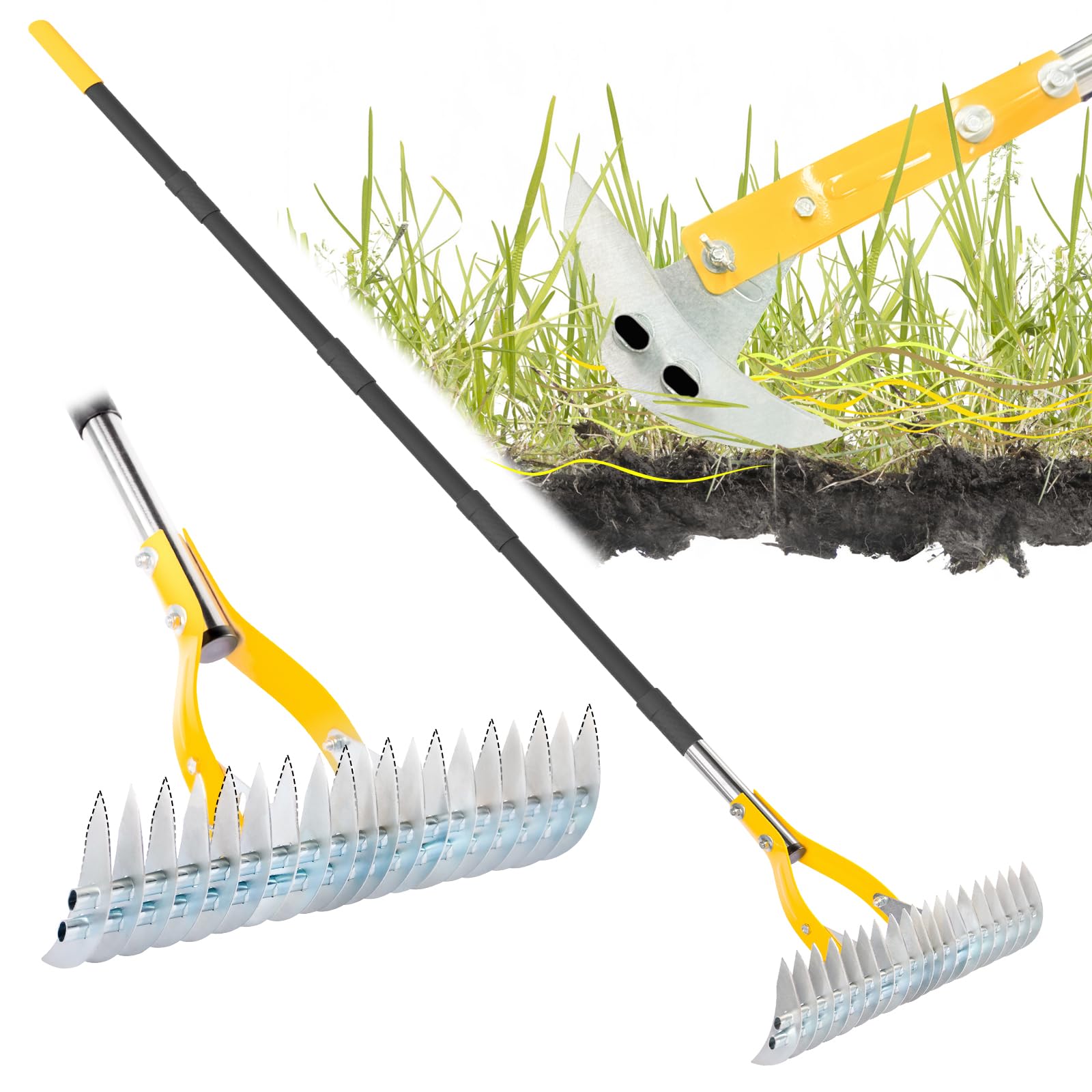
At 74 inches, this BlumeTrec is the tallest thatcher here — perfect for someone who hates stooping. The handle sections screw together to reach that full height, and you can leave sections off to shorten it. The head uses manganese steel that has been through a quenching treatment for hardness and wear resistance, with a powder-coated finish that fights rust.
The 19 curved tines on the 15-inch head pull up dead material without yanking healthy grass. Owners are impressed — “it grabs the thatch but not the grass — very effective,” as one puts it. The cushioned non-slip grip makes extended sessions more comfortable, and the detachable poles store flat in a shed. Buyers also note it works especially well in dry Florida soil and even better when the ground is wet.
The only trade-off is the weight — at 2.1 kg (about 4.6 lbs), it is noticeably heavier than the YEELOR, which can fatigue you on a big yard. But for the reach and the manganese steel durability, many owners consider it a fair swap.
Tall-owner highlights
- 74-inch maximum handle length reduces back strain dramatically
- Manganese steel head stays hard and resists rust
- Owners mention it clears thatch without pulling up healthy grass
One real downside
- At 2.1 kg it wears you out on large lawns
Grab this if: you are tall or just want to stand upright while dethatching the whole yard.
Pass if: you need the lightest possible tool for a small patch of lawn.
4. Walensee Thatch Rake for Lawn, 15-Inch Dethatcher

A triple-length handle that adapts from 40 to 70 inches.
This Walensee is the most adjustable in terms of handle reach — it configures to roughly 40, 55, or 70 inches, which is rare. The dual-sided head has 19 curved steel tines; one side lifts dead grass and the other loosens topsoil. The cushioned non-slip grip provides comfortable handling for extended use.
At 4.6 pounds, it is heavier than the YEELOR at 2.5 pounds. That weight gives it authority on compacted soil but will test your stamina on a big lawn. Owners appreciate the quality and functionality, with 81 positive mentions of functionality alone. One buyer filled a 96-gallon can with thatch from a St. Augustine lawn in a single session and wished for a wider model.
The recurring downside is durability — some customers note the detachable sections loosening after a season. An occasional owner found the tines bend under heavy pressure, so it works best on lawns that are not rock-hard.
Setting it apart
- Three handle lengths — rare adjustability for users of different heights
- Dual-sided head handles both dethatching and soil cultivation
- High-functionality rating from owners
The honest catch
- At 4.6 lbs it is a heavy pick — expect a workout
- Some reviewers point out tine bending on hard-packed ground
Best for: homeowners who share a rake across different family heights and want one tool for both thatch and soil work.
Skip if: you need something lightweight for a large yard or very compacted soil.
5. Yofidra 15″ Heavy Duty Metal Dethatcher Rake with 5FT Handle
Carbon steel tines at 3mm thickness that resist deformation.
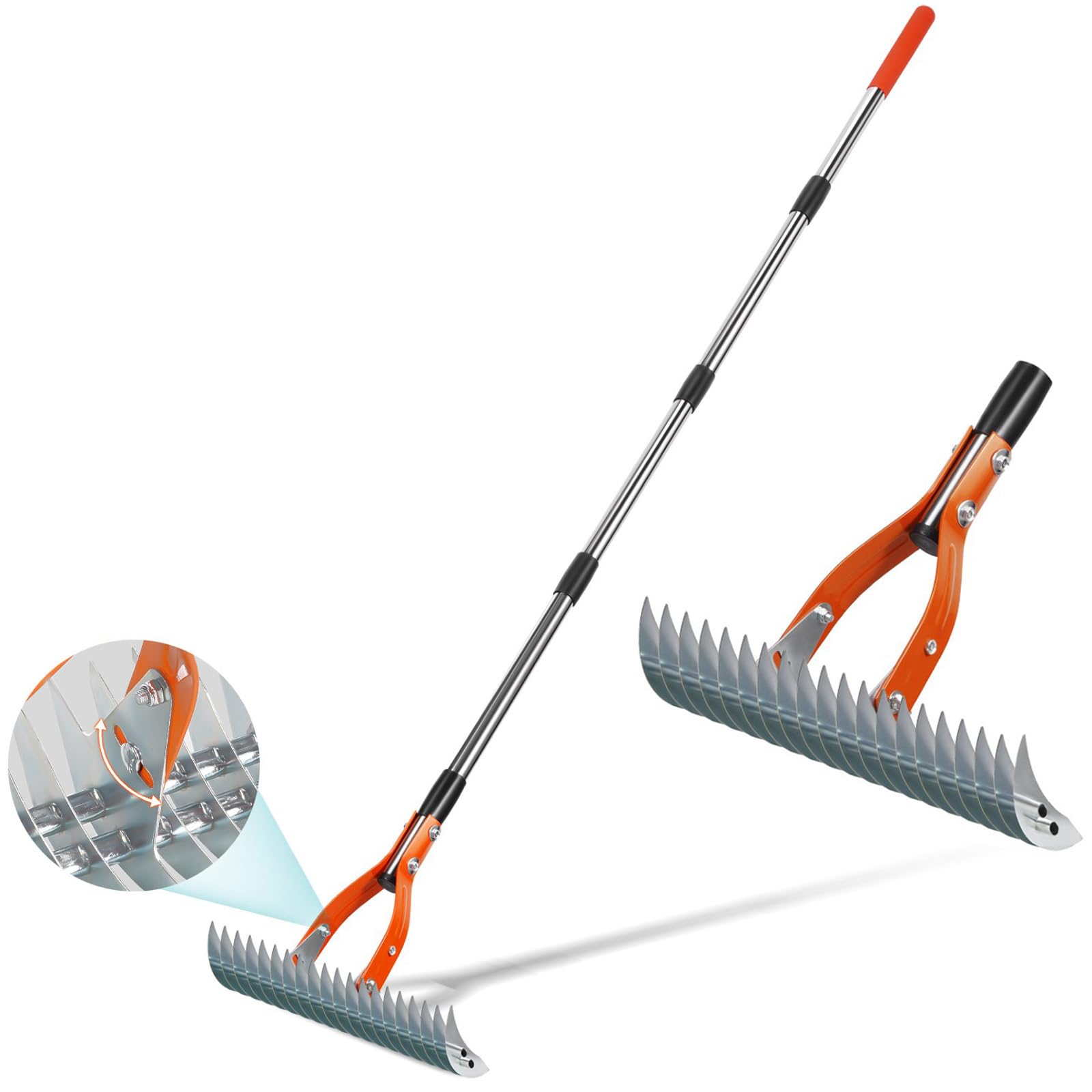
Most budget rakes use thin stamped steel that bends. The Yofidra uses 3mm-thick carbon steel with an anti-rust powder coating, so you do not get tine breakage or deformation on the first use. The head has 19 tines and an adjustable angle for different depths. At 4 pounds, it is mid-weight — heavier than the YEELOR but lighter than the Walensee.
The handle is made from aluminum sections that screw together (not the usual stainless, so it is lighter up top) and reaches a full 70 inches. Owners rave about the quality and ease of assembly, and one named it ‘Hal The Eviscerator’ after a particularly satisfying session. The hands-free debris removal feature — if it clogs, a simple shake clears it — is a thoughtful detail for leaf cleanup.
The main drawback is the head width — at 15 inches, owners with large lots wish it were wider. It is not ideal for a half-acre lawn, but for a standard suburban yard it is excellent.
Best bang for the buck on durability: the 3mm carbon steel tines outlast the thinner stamped tines on budget competitors.
Who might want more: anyone with a very large lawn who needs a wider head to cut down on passes.
6. TCBWFY Dethatcher Rake 15-Inch Lawn Thatching Rake
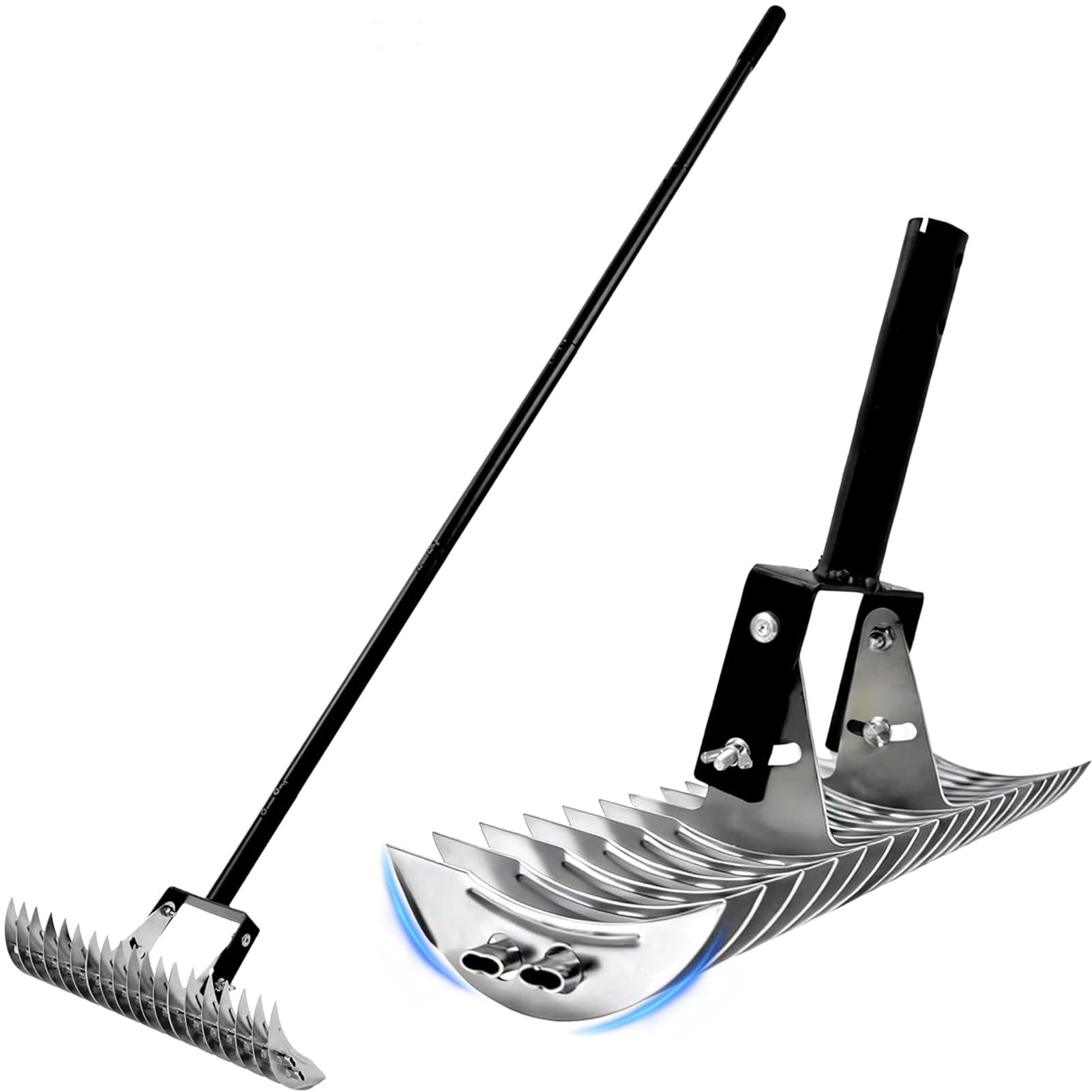
A chrome-plated head that adjusts both width and handle length.
This TCBWFY stands out because the tines themselves adjust in width — you can narrow the rake for tight flower beds or widen it for open lawn. The handle screws together in sections so you can leave one off for a shorter reach. Owners love the versatility — “I can make it narrow or wide,” one says. The chrome plating resists rust better than painted handles.
Quality is the most-mentioned positive aspect, with 62 owners calling it well-made. The adjustable head angle lets you customize the attack for different thatch thicknesses. It is lightweight enough for a weekend gardener and durable enough to handle pine cones and needles in the PNW.
Some owners find the overall size smaller than expected when the tines are fully closed. The metal is sturdy but not indestructible — an occasional owner reports a tine bending after catching a rock. Treat it as a versatile all-arounder, not a demolition tool.
Why it earns a spot
- Width-adjustable tines — narrow for beds, wide for lawns
- Chrome plated finish resists rust better than painted alternatives
- High quality rating from owners across 60+ mentions
The trade-off
- Not designed for heavy-duty abuse — tines can bend on rocks
- Adjustable sections can loosen during use if not tightened firmly
Reach for this if: you have flower beds and narrow spaces alongside your lawn — the adjustable width lets you switch between tight beds and open lawn..
Pass if: you need a brute-force tool for a large, rocky, or heavily compacted yard.
7. YEELOR Thatch Rake with 15‑inch Rake Head and Adjustable Steel Head
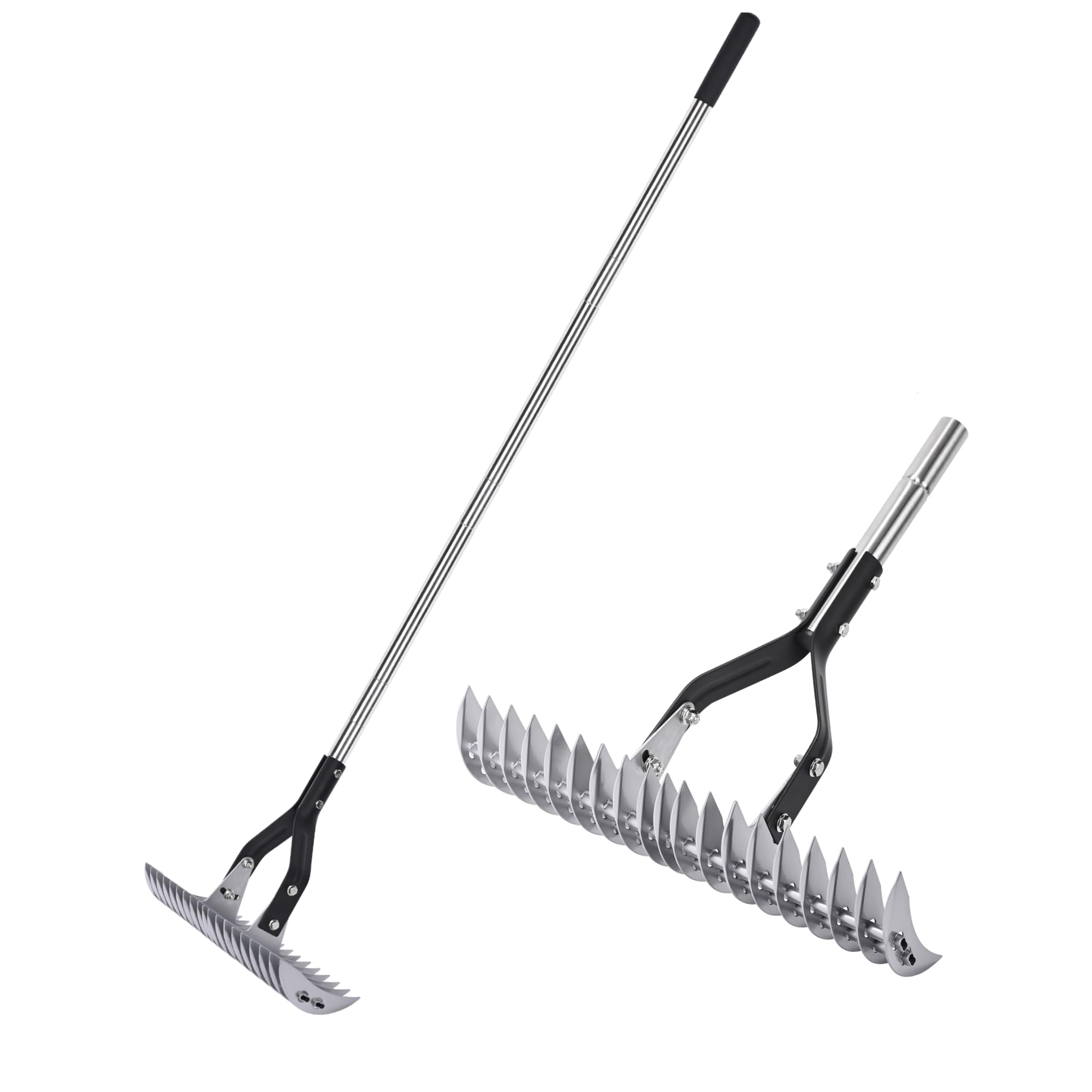
A dual-sided head with variable angle for thatch over half an inch thick.
This YEELOR variant is purpose-built for deep thatch. The head is dual-sided so both sides remove thatch, and the angle adjusts — a shallow angle for light cleaning and a deep angle for thatch layers exceeding 0.5 inches thick. The carbon steel head has a quenched, rust-resistant finish, and the stainless steel handle is fitted with a rubber non-slip grip at the end.
Owners praise its effectiveness — one filled a 50-gallon bag from a 15×6-foot section. Another says it is “much better suited” than a standard metal rake because the thin tines cut through thatch while leaving green grass intact. The head-to-pole connection uses a plastic lining to prevent loosening during repeated push-pull action.
The handle sections can spin loose during heavy use unless you tighten them firmly. A few owners find it heavier than expected at 1.87 kg, but the trade-off is stability during aggressive dethatching. This is not the rake for a quick once-over — it is designed for a serious spring rehab.
Best pick for a thatch layer exceeding half an inch: the adjustable angle goes deep enough to yank out thick buildup, and the dual-sided head doubles your working life.
Who should consider something lighter: anyone with a small, thin lawn that just needs light maintenance — this is a heavy hitter.
8. Cogardenshower Heavy Duty Thatch Rake with Dual-Action Blades
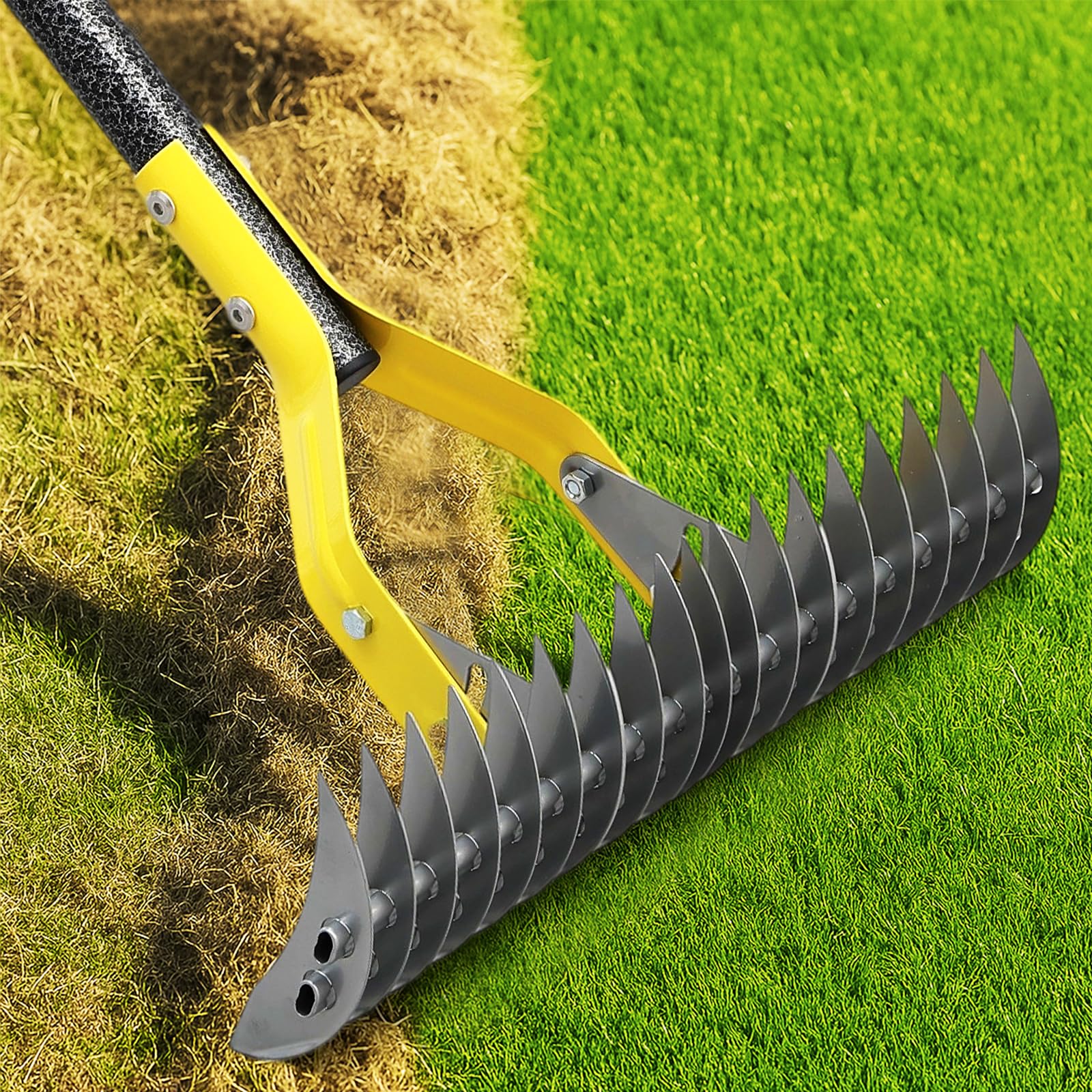
Sharp winged tines that cut ivy, crabgrass, and creeping charlie.
This rake has two personalities. Side A uses winged, sharp tines that cut through dense thatch and stubborn weeds like creeping charlie. Side B flips to long, curved tines for clearing leaves, pine needles, and loosening soil. The 1.1-inch diameter handle with reinforced joints stays solid, and the rust-resistant coating protects it from weather.
At 2.06 kg, it is on the heavier side, and the tines are sharp — owners warn to be careful. One owner with 6 months of use reports no problems: “good metal and not made cheap.” The head angle adjusts, and the handle extends from 55 to 70 inches.
The most common feedback is that it works great on small to medium lawns but is hard work on a big yard. A few owners wish the tines lined up more evenly, but they still find it effective for the job. The built-in hole at the end of the handle makes hanging storage easy.
What owners love
- Winged tines tackle ivy and creeping charlie that clog standard rakes
- 1.1-inch reinforced handle stays solid during aggressive work
- Rust-resistant coating holds up to outdoor storage
The caveat
- Sharp edges demand careful handling — not for casual use
- Heavy for long sessions on large lawns
Grab this if: your thatch problem includes stubborn weeds like creeping charlie or ivy that a standard rake slips over.
Skip if: you just need light thatch removal on a small, weed-free lawn.
9. BARAYSTUS Thatch Rake Dethatcher – 15-Inch Wide Lawn Rake

A budget-friendly thatcher that pulls up moss like a champion.
This Baraystus is the most affordable pick, and it earns its keep with a dual-sided head and adjustable angles — one side for cleaning dead grass, the other for loosening soil. The 19 curved carbon steel tines are heat-treated with a powder-coat anti-rust finish. Owners who tackled moss-heavy lawns report filling entire bins with debris.
At 3.3 pounds, it is lighter than the Walensee but heavier than the YEELOR. The handle reaches 58.5 inches and comes in four sections so you can choose your preferred length. Assembly is straightforward, and the adjustable head angles let you switch between digging and skimming.
The mixed durability feedback is real — one owner reports the handle broke within 20 minutes, though the tool worked well otherwise. Many owners deal with this by applying superglue to the bar joints to prevent loosening. If you are willing to spend five minutes with a tube of glue, this is exceptional value. For the best experience, consider the YEELOR at position 1 if you want a handle that stays tight without modification.
Why it wins on budget
- Dual-sided head with adjustable angles for both thatching and soil work
- Lightweight at 3.3 lbs — easy to maneuver
- Heat-treated carbon steel tines with rust-resistant coating
Where it cuts corners
- Handle sections can loosen and demand proactive tightening or glue
- Some shoppers say breakage within the first use
Best for: the buyer on a tight budget who is handy enough to apply thread-locker to the joints and wants a functional thatcher.
Get a different rake if: you want a tool that is 100% reliable from the start with no tinkering required.
Understanding the Specs
Tine Material: Manganese Steel vs Carbon Steel
Manganese spring steel is the premium choice because it flexes under pressure and snaps back to its original shape — it resists bending when you hit a rock or compacted soil. Carbon steel is more common and cheaper, but it can take a permanent bend if you lean into it too hard. Look for the words “heat-treated” or “quenched” in the data, which indicate the metal was hardened at the factory.
Adjustable Head Angle — Why It Matters
A thatch rake whose head angle you can change does two jobs. Set the head steep (closer to vertical) and the tines dig deep, pulling up thick thatch layers and weed roots. Flatten the head and the tines skim the surface, ideal for collecting leaves, pine needles, and loose debris without cutting into the soil. This one adjustment turns a single-purpose rake into a three-season tool.
Handle Length and Your Posture
The most common mistake is buying a rake too short. A handle that ends around waist height forces you to bend at the lower back on every pull. A handle that reaches at least 58 inches lets you stand nearly upright and use your arm and shoulder muscles instead. Taller users need 66 to 74 inches. A sectional handle is a bonus because it fits multiple users and stores compactly.
Weight: Lighter Is Not Always Better
Light rakes (under 3 pounds) reduce fatigue and are great for big yards, but they can bounce off hard-packed soil. Heavier rakes (4+ pounds) sink the tines deeper with less downward effort, which saves energy on compacted ground. The ideal weight depends on your soil condition — test a few passes in a dry patch if you can.
FAQ
Can a grass thatch rake damage my lawn if I use it wrong?
When is the best time of year to dethatch my lawn?
How thick should the thatch layer be before I need to rake it?
Is a dual-sided thatch rake worth the extra cost?
What is the difference between a thatch rake and a regular leaf rake?
How long does a manual thatch rake typically last?
Can I use a thatch rake to remove moss from my lawn?
What is the ideal tine spacing for a grass thatch rake?
Final Thoughts: The Verdict
After weighing the steel quality, handle adjustability, and real owner feedback across these nine picks, the best grass thatch rake is the YEELOR Thatch Rake with 66 Inch Adjustable Handle — it combines the widest head (17 inches), the lightest weight (2.5 pounds), and the most stable dual-screw connection in a single tool.. If you want a tall handle to stand upright and do not mind a little extra weight, the BlumeTrec 74″ Thatch Rake is a fantastic alternative for tall users.. And for the homeowner tackling thick, weedy patches, the EUIJOIP 70″ Heavy Duty Dethatcher brings serrated serrated tines that cut through ivy and crabgrass..