
Specs are compiled from manufacturer listings and verified buyer reviews and can change over time — please confirm the key details on the product page before buying.
You scratch out a bare patch, sow the seed, water it tenderly, and then one downpour or a gust of wind undoes everything in minutes. A grass seed straw blanket is the fix — a physical cover that locks seed to soil, holds moisture in, and rots away once the grass is tall enough to fend for itself. Some come as loose mulch with a natural glue built in, others as a ready-made mat you unroll like carpet. The choice depends on your slope, your patience for spreading, and how much rain your forecast brings.
I’m Rikta — the founder and writer behind Lawn Gear Lab. This guide is built by comparing the manufacturers’ published specifications and the patterns across verified customer reviews, so you get each pick’s real strengths and trade-offs instead of marketing spin.
Below, I break down the five strongest options for a grass seed straw blanket, from a loose bale with a built-in tackifier to a stitched erosion mat that survives monsoon-level storms, so you can pick the one that matches your exact yard and weather.
Our Picks at a Glance


How To Choose The Best Grass Seed Straw Blanket
Two distinct formats dominate the category, and picking the wrong one for your terrain is the fastest way to waste money. Loose straw with a tackifier (a natural bonding agent that makes the fibres cling together) is excellent for flat or gently sloping ground where you can spread it by hand and water it in. Rolled erosion-control blankets — stitched mats of wheat straw held between two layers of netting — are built for slopes, ditches, and areas with heavy runoff. Your soil angle and your local rain intensity should drive the decision.
Coverage Math: Don’t Guess
Every product lists a coverage area in square feet, but the number assumes an even, thin layer. If you pile it on thick, or if your patch is oddly shaped with waste around the edges, you will need more. A typical 2.5 cubic foot bale claims roughly 500 square feet at recommended depth. Measure your bare area with a tape measure — length multiplied by width — and buy at least one extra bale or roll for overlap and mistakes.
Weed Content: The Hidden Problem
Cheap straw bales sold for animal bedding are often loaded with weed seeds that will sprout alongside your grass. A purpose-made seeding blanket should say it is processed or sterilized to be weed free. Look for “99% weed free” or “processed straw” language in the product data to avoid spending your summer pulling invaders out of your new lawn.
Quick Comparison
| Model | Best For | Coverage | Format | Weight | Amazon |
|---|---|---|---|---|---|
| Seeding Straw with Tackifier★ Best Overall | Flat lawns & garden beds | 500 sq. ft. | Loose bale | 24.4 lb | Amazon |
| EZ-Straw Seeding MulchBest Value | Overseeding & wind-prone spots | 500 sq. ft. | Loose bale | 21 lb | Amazon |
| Farm Plastic Supply Erosion Blanket | Slopes & heavy rain | 225 sq. ft. | Rolled mat | 39 lb | Amazon |
| QuickGrass Pro Erosion Blanket | Hills & concentrated runoff | 125 sq. ft. | Rolled mat | 11 lb | Amazon |
| EZ Straw 2-Pack | Small patches & gardens | 250 sq. ft. each | Loose bale | 10.83 lb | Amazon |
In‑Depth Reviews
1. Seeding Straw with Tackifier, 2.5 CU FT Bale
Our pick — 4.5★ from 500+ verified ratings; the strongest balance of quality and price.
A loose bale that packs a built-in glue to hold seed in place through light weather.
If your yard is mostly flat, this is the simplest way to blanket a seeded area. The straw comes processed with a tackifier — a natural bonding agent that makes the fibres stick together once you water them in. That cling keeps the seed from washing out during a moderate rain and stops birds from scratching through to the seed bed. The 2.5 cubic foot bale covers up to 500 square feet, which means it handles a decent-sized patch or a full front lawn with some left over.
Buyers report that the straw arrives compacted in the box, which saves storage space and means you get a dense bale rather than a loose bag of air. The thing owners praise most is germination — the straw keeps the soil surface damp longer, so seed sprouts reliably without you having to run the sprinkler every few hours. Quality, seed quantity, and value for money all draw strong positive feedback, and the straw is 100% biodegradable, so you leave it in place and let it rot into the soil.
It is not a mat, so on a steep slope the loose straw can still shift before the tackifier grabs. The crowd favorite — 4.5 stars across 517 ratings — skews heavily toward homeowners on level ground reseeding bare patches or overseeding a thinning lawn.
Why owners reach for it
- Tackifier activates with water, locking straw and seed together
- Weed-free — buyers call it “best straw ever” specifically because it has no seeds
- Generous coverage stretches across 500 square feet per bale
The honest limitation
- Loses effectiveness on steep slopes before the tackifier sets
Reach for this if: you have flat or gently sloped ground and want a no-fuss biodegradable cover that lets seed germinate fast.
Look elsewhere if: you are covering a hillside or a drainage ditch where loose straw will slide before it bonds.
2. EZ-Straw Seeding Mulch with Tackifier, 2.5 CU FT Bale
A lighter, easier-to-spread bale that stays put in wind and germinates seed in five days.
This is the loose option for homeowners who found traditional baled straw too clumpy or too heavy to handle. At 21 pounds, it is noticeably lighter than the Gardener Select bale above (which is 24.4 pounds), and the straw is twice-cut and processed so it scatters in finer pieces that mat down more evenly. The tackifier is built in — when you dampen the spread straw and step on it, the fibres stick to each other and form a soft crust that birds cannot peck through.
The review pages sum it up: seed germinated in five days, and the blanket held up through several hard rainstorms without washing away. The best use case here is overseeding an existing lawn where you want a thin, even layer that won’t smother the grass underneath. The bale covers 500 square feet, the same as the Gardener Select, but the lighter weight makes it easier to carry from the driveway to the backyard. Buyers also highlight that this product is 99% weed free — processed agricultural straw without surprise invaders.
It is slightly messy to apply by hand in a breeze, and a few owners note that in really gusty spots the finer particles drift before you can wet them down. The 342 ratings average 4.5 stars, and the consensus is clear: this is the go-to for a mid-sized overseeding job where you want results in under a week.
What wins people over
- Grass sprouted in as little as five days with consistent watering
- Twice-cut straw spreads easily and mats down without clumping
- Held through multiple hard rainstorms, per owner reports
The trade-off
- Lightweight straw drifts in strong wind before the tackifier is activated
Buy it for: overseeding or reseeding flat areas where you want fast germination and a light, even blanket.
Think twice if: your site is regularly hit by wind strong enough to scatter loose material before you water it in.
3. Farm Plastic Supply – Erosion Control Blanket, 2′ x 112.5′

A stitched mat that rolled out like carpet and held seed through three days of rain.
This is the heavy artillery. Instead of loose straw, you get a 2-foot-wide by 112.5-foot-long roll of agricultural wheat straw that has been mechanically stitch-bonded between two layers of netting. The result behaves more like a fabric than a mulch — you unroll it over freshly seeded soil, pin it down, and the straw stays exactly where you put it regardless of slope or runoff. One real-world account: a buyer in rainy Georgia kept Fescue seed in place through three days of rain, and grass grew within a week.
At 39 pounds, the roll is noticeably heavier than the loose bales on this list — at 39 pounds versus the EZ-Straw 21 pounds. That weight comes from the density of the stitched mat. It is a two-person installation job on a long slope, but once it is down, it handles stormwater sheet flow and rainfall impact better than any loose product. The mat also retains moisture in the soil, which speeds up germination and reduces how often you need to water. Functionality is the top-cited positive aspect, and grass coverage draws the second-most mentions.
Not everything is perfect. The ease of use gets mixed feedback — the mat rolls out easily in one continuous piece, but if you need to cut small patches to fit around trees or garden beds, the straw can fall out of the cut edges (one owner lost roughly a quarter of the straw when cutting it into three short sections). Quality and straw quality both draw split reviews; the netting and straw assembly feels thinner to some than the product photography suggests. For a full hillside or a long ditch lining, this is the right tool. For a small patch with obstacles, a loose bale may be less frustration.
Where it dominates
- Withstood three consecutive days of rain without seed washout
- Stitch-bonded construction keeps straw locked under netting
- Covers a long run — 112.5 feet from a single roll
Where it frustrates
- Cutting into smaller pieces causes straw to shed from the edges
This one is for: slopes, ditch linings, and high-runoff zones where loose straw would wash away on the first rain.
skip it if: you need to snake around flower beds or cut many small sections — the mat loses integrity at each cut edge.
4. American Excelsior QuickGrass Pro Erosion Control Blanket, 2.5′ x 50′

A lighter, shorter rolled mat for smaller slopes and concentrated runoff spots.
At 11 pounds and 50 feet long, the QuickGrass Pro is a scaled-down version of the heavy rolled mats above. It uses a single plastic net to hold the natural straw fibres together, which makes it easier to carry and position by yourself. The roll is 2.5 feet wide instead of 2, so each pass covers a slightly wider strip of soil. It does not contain grass seed — the straw-and-net assembly is purely a physical barrier that stops erosion, holds moisture, and prevents birds from eating seed you have already sown.
The main job here is hillsides and areas of concentrated water flow. The straw debris degrades over time, so you leave it in place after the seed establishes. Some owners find it effective for unexpected secondary uses — one buyer repurposed it with bamboo canes as hanging strawberry baskets. For its core purpose, it stops soil erosion and complies with most stormwater management regulations, which matters if you are dealing with a permit or a homeowners association requirement.
The recurring complaint is that the straw is held in a fairly loose netting, and the roll can be messy to unroll. A few buyers found the straw arrived poorly packed with broken netting, though that seems tied to individual shipping rather than a design flaw. The water retention is also not as strong as a denser stitched blanket — the feedback suggests you need daily watering, and twice a day in dry weather, because the thinner mat lets moisture evaporate faster. The average rating sits at 4.0 across 362 reviews, with functionality praised most and ease of use getting mixed marks.
What stands out
- Easy to cut with household scissors for irregular shapes
- Single-person carry weight at 11 pounds
- Degrades naturally — no cleanup after grass establishes
What falls short
- Thin build dries out quickly; needs daily watering or more
Works best for: a small residential slope or a garden bed edge where you want a lightweight, cuttable erosion blanket.
Not ideal for: long, steep hills where a thin mat may not anchor enough soil moisture for seed germination.
5. EZ Straw Seeding Mulch with Tack, 1 cu. ft. Bale, 2 Pack
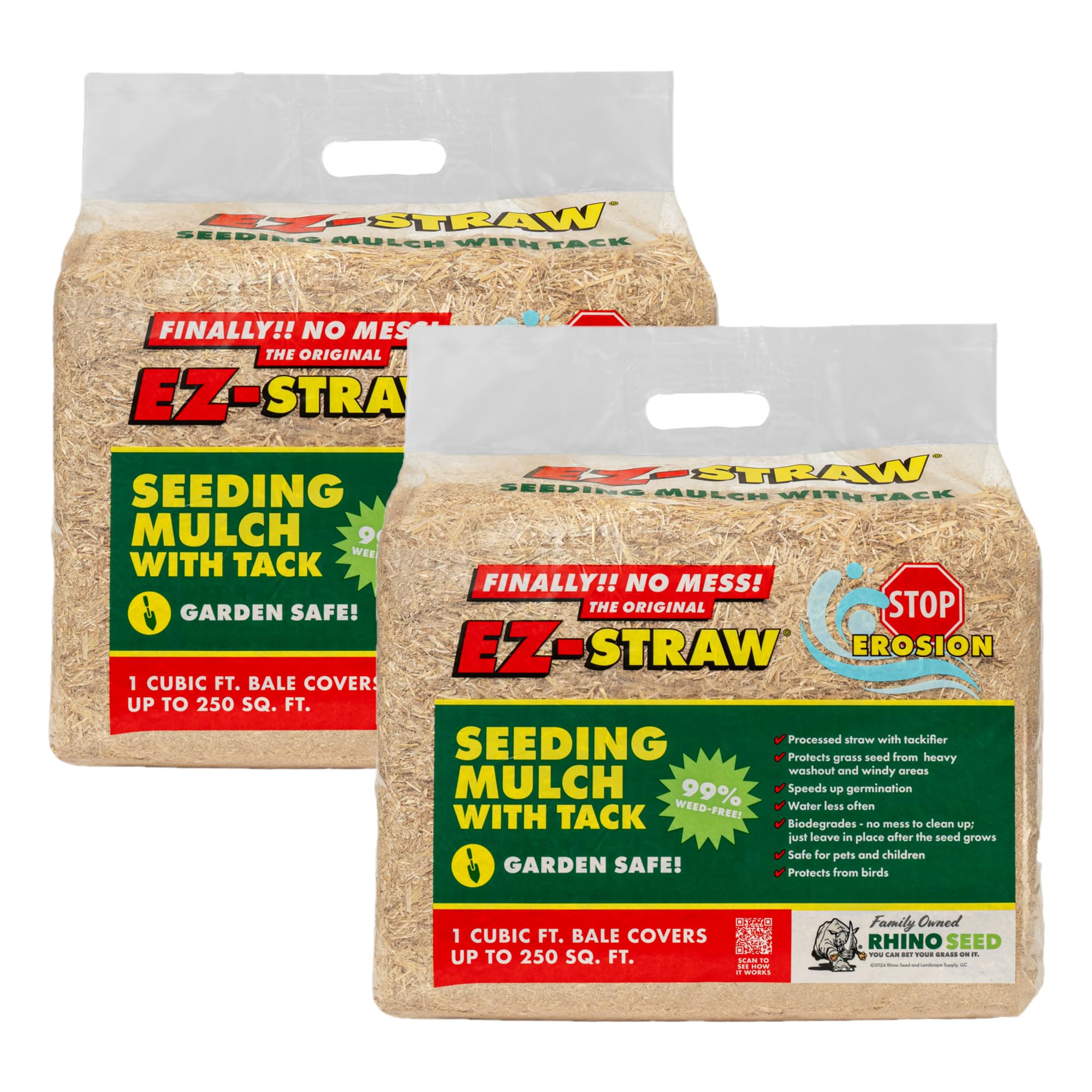
Two smaller bales that let you tackle separate patches or stagger your seeding project.
This is the same EZ Straw formula — processed agricultural straw with a natural tackifier — but split into two 1-cubic-foot bales. Each bale covers 250 square feet, so the pair gives you 500 square feet of total coverage, identical to the single 2.5-cubic-foot bale above. The advantage is flexibility: you can reseed a front patch today and a back patch next weekend, or take one bag to a community garden plot and keep the other at home.
The straw has a finer texture than raw bale straw, which means it spreads easily in small, even handfuls. It retains moisture well — that is the top-cited positive aspect, and owners note that the tackifier locks the straw to the ground after watering, keeping it from blowing into a neighbour’s yard. The built-in UV-protected bag also allows outdoor storage, which is convenient if your garage is already full of tools. The 4.5-star average across 100 ratings points to consistent satisfaction, though a minority find the per-unit cost higher than a bulk bale. The value-for-money aspect is marked as mixed in the feedback.
One real-world scenario: a buyer spread this over a garden area and found it kept critters from digging in the soil while also holding moisture around tomato and pepper plants. For a small lawn patch or a vegetable bed, this twin-pack gives you a tidy amount of material without committing to a full-size bale that might sit half-used for months. It is not the cheapest per square foot, but the usability and split format earn their keep.
Verdict at a glance: The twin-pack format suits small yards, gardeners, and anyone seeding in phases. The downside is that cost-conscious buyers may find the per-bag premium steeper than a single larger bale of the same straw.
Grab this for: a small lawn patch, raised beds, or two separate bare spots you want to seed at different times.
Pass if: you are covering a large uninterrupted area — a single 2.5-cubic-foot bale will cost less per square foot.
Understanding the Specs
Tackifier vs Netting
A tackifier is a natural bonding agent mixed into loose straw. When you water the spread straw, the tackifier activates and makes the fibres cling together like a loose fabric. This is ideal for flat ground. Netting, found in rolled erosion blankets, holds the straw mechanically — the material is stitched or sandwiched between plastic or jute nets. Netting is better for slopes because it does not rely on moisture to stay in place, but it is harder to cut and shape around obstacles.
Coverage Area and Depth
Coverage is always stated at a specific application depth, usually listed on the product. A 500 square foot rating at recommended depth assumes you spread the straw to the exact thin layer the manufacturer specifies. Spreading it thicker reduces coverage, while a thinner layer may leave gaps where seed can wash out. Always measure your bare soil area and add 10-15 percent for overlap and waste around the edges.
Biodegradable vs Degradable
Most purpose-made seeding blankets are labeled biodegradable or degradable. Biodegradable means micro-organisms can break the material down naturally into non-toxic components — the Gardener Select and EZ-Straw loose mulches are 100% biodegradable. Degradable often means the material breaks down from sun exposure or physical wear but may leave plastic netting behind. Check the product details: if a rolled blanket uses a plastic net, the net may need to be removed or will take longer to degrade in your soil.
Weed-Free Claim
Straw that has not been processed typically contains grain seeds that sprout alongside your grass seed. Processed straw blankets or bales that state they are “99% weed free” have been heat-treated or mechanically cleaned to remove most viable weed seeds. This is a critical spec if you are establishing a new lawn from seed — weed-free straw prevents you from fighting crabgrass and clover in the same season you are trying to grow turf.
FAQ
Do I remove the straw blanket after the grass grows?
Will a straw blanket work on a steep hillside?
How much straw blanket do I need for my lawn?
Can I use a straw blanket to cover vegetable garden soil?
How long does it take for the straw blanket to decompose?
Does a straw blanket keep birds away from grass seed?
Can I spread loose straw blanket by hand?
Is there a difference between a straw blanket and hay for seeding?
Will the plastic netting on a rolled blanket harm lawn equipment?
Can I walk on a straw blanket after I lay it?
Final Thoughts: The Verdict
For most homeowners reseeding a flat or gently sloped lawn, the grass seed straw blanket to buy is the Gardener Select Seeding Straw with Tackifier — it covers 500 square feet with a bonded straw that germinates fast and leaves zero cleanup. If you are fighting a heavy slope or predictable downpours, the Farm Plastic Supply Erosion Control Blanket is the only pick that buyers have proven to hold through three solid days of rain. And for a small yard or a garden patch that does not need a full-size bale, the EZ Straw 2-Pack gives you the same tackified straw in two manageable bags that fit a weekend project.
How We Picked
We do not accept paid placement. Every pick is matched to a real buyer and a real use-case; we do not hands-on test units.
Sources & Methodology
Specifications: manufacturer listings and product documentation. Review insights: verified customer reviews, as of July 2026. Pricing: not shown on this page (it changes often); check the current price via the retailer link.
As an Amazon Associate, Lawn Gear Lab earns from qualifying purchases. This does not affect which products we feature.