
Specs are compiled from manufacturer listings and verified buyer reviews and can change over time — please confirm the key details on the product page before buying.
You have prepped the soil, scattered the seed, and then a single heavy rain turns your hard work into a muddy mess running down the driveway. The one job of grass seed netting is to stop that — to hold every seed against the soil so it can actually germinate into something that looks like a lawn. This guide cuts through the options to find the netting that will actually anchor your seed, handle your slope, and eventually disappear so you are left with nothing but green.
I’m Rikta — the founder and writer behind Lawn Gear Lab. This guide is built by comparing the manufacturers’ published specifications and the patterns across verified customer reviews, so you get each pick’s real strengths and trade-offs instead of marketing spin.
Whether you are patching a bare spot or armoring a steep bank, the right best grass seed netting is the difference between a lush lawn and a wasted weekend of regrading mud.
Our Picks at a Glance


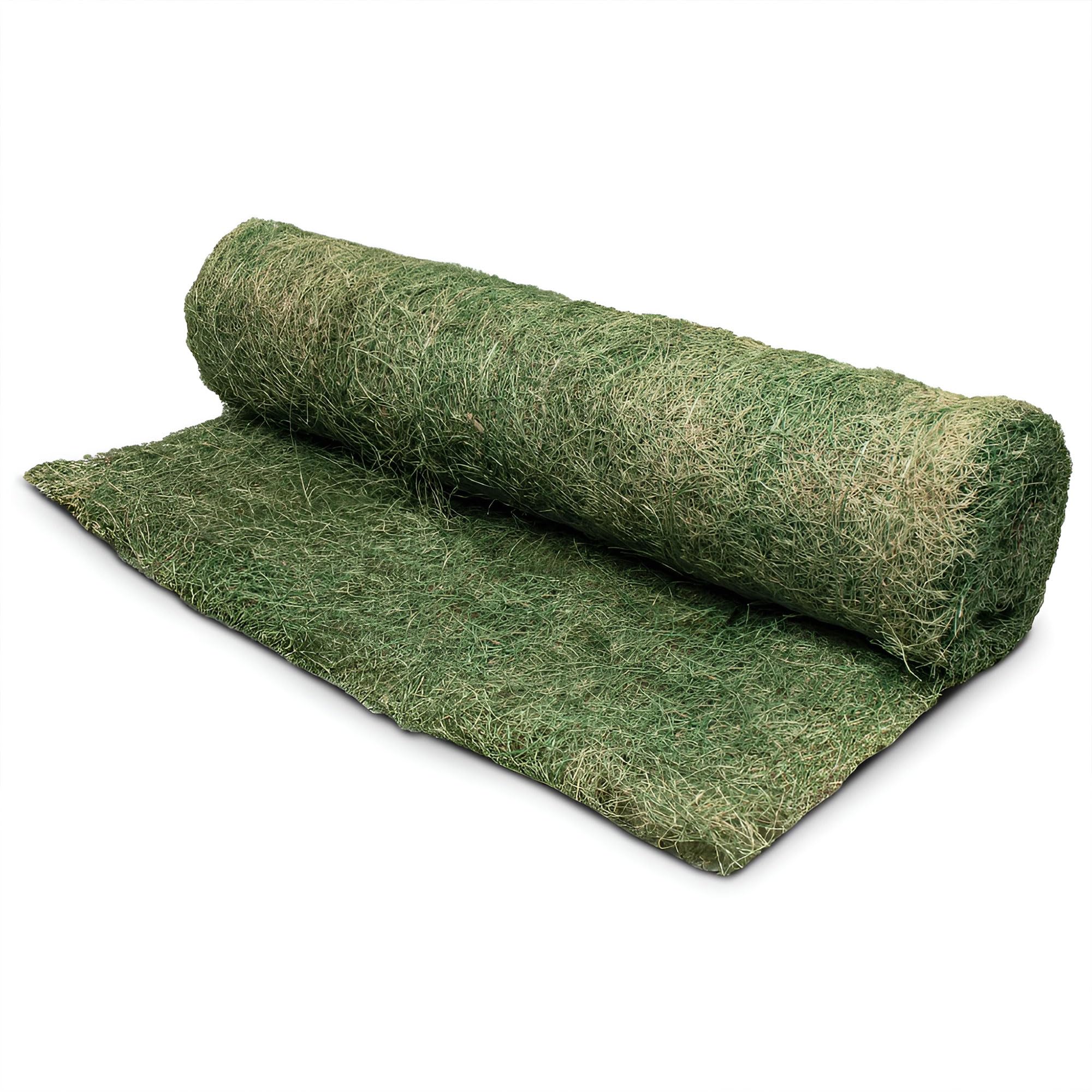
How To Choose The Best Grass Seed Netting
You need to match the netting to the steepness of your ground. Flat areas need a lightweight cover that stops birds and light rain. Slopes and channels need a heavy, tightly woven blanket that can survive a heavy downpour. You also need to decide if you want the netting to vanish on its own (biodegradable) or if you plan to pull it up after the grass establishes.
Material Type
Jute netting is thick, natural, and holds up to heavy rain on steep slopes — it will last a season or two before rotting. Straw blankets are lighter and work well for moderate slopes and flat reseeding, though the straw distribution can be uneven. Excelsior (curled aspen wood fiber) is dense, heavy, and excellent for ditches and steep banks where erosion pressure is high. Plastic netting is the most durable, often used for channels with fast water flow, but it will not biodegrade and must be removed or it can trap wildlife.
Coverage Area
Netting is sold by the square foot per roll. A standard 4-foot-wide by 50-foot-long roll covers 200 square feet. Smaller rolls like 50 to 60 square feet are designed for patching bare spots and small garden beds. Measure your project area roughly and add 10-15% for overlap at the seams — overlapping the edges by a few inches prevents water from finding a gap and washing out the seed underneath.
Biodegradability and Decomposition
True jute and excelsior fibers break down naturally over one to three seasons, feeding the soil as they go. Some “biodegradable” straw blankets use plastic netting on top that does not degrade nearly as fast — buyers report having to cut it out of established grass. If you want a no-removal solution, look for products that state both the fibers and the netting are biodegradable or photodegradable.
Quick Comparison
| Model | Best For | Coverage | Material | Weight | Amazon |
|---|---|---|---|---|---|
| AK Trading CO. Jute★ Best Overall | Steep slopes & heavy rain | 60 sq. ft. | Jute | Light | Amazon |
| Farm Plastic Supply StrawBest Value | Large slope & rain zones | 225 sq. ft. | Straw | 39 lb | Amazon |
| Dewitt Excelsior BlanketPremium Pick | Slopes & drainage areas | 450 sq. ft. | Aspen Wood Fiber | 40 lb | Amazon |
| Growtrax Biodegradable Mat | Quick patch & dog spots | 50 sq. ft. | Seed/Fertilizer/Mulch | Light | Amazon |
| Petramax Bermuda Mat | Southern lawns, heat tolerant | 54 sq. ft. | Bermuda Seed/Fiber | Light | Amazon |
| Dalen Grass Fast Cover | Flat reseeding, heat trap | ~167 sq. ft. | Straw-like fabric | 12.8 oz | Amazon |
| Jonathan Green SeedRoll | Cool-season bare spots | 50 sq. ft. | Seed/Fertilizer/Mulch | 16 oz | Amazon |
| EZ Straw Blanket | Fast germination on hills | 200 sq. ft. | Straw | Moderate | Amazon |
| Curlex II Fabric | Channels & steep banks | ~450 sq. ft. | Excelsior/Plastic Net | .73 lb/sq yd | Amazon |
In‑Depth Reviews
1. AK Trading CO. Jute Erosion Control Blanket
Our pick — 4.5★ from 200+ verified ratings; the strongest balance of quality and price.
The natural jute that survives heavy rain and holds bare soil on steep slopes.
When a product earns the label “premium quality” from a consensus of over 200 owners, you listen. The thing everyone raves about is the dense, high-grade jute material — 19 people single it out. This is not a flimsy paper blanket. It is a 48-inch-wide roll covering 60 square feet, built with a loose enough weave for grass to push through but tight enough to stop soil from washing. The reviews page sums it up: “Survived heavy rain, held bare soil.” If your property has a steep hillside that turns into a mudslide every time the clouds open, this is the netting that will dig in.
Functionality is the second-most-praised trait, with 18 owners calling it effective for erosion control on slopes and repaired culverts. A recurring note is that jute naturally starts to break down after two or three seasons — exactly as it should if your ground cover has established by then. Unlike some mats that use plastic netting you must later cut out, this one fully returns to the earth.
The trade-off is a mild kerosene smell that a few owners noticed fresh out of the roll, and the value-for-money opinion is mixed — nine owners feel it is “very expensive for what it is.” But with a rating that outpaces nearly every other pick here, the durability and erosion control are tough to match.
Natural jute fiber
- High-grade jute holds up to heavy rain and washout.
- Biodegradable — returns to soil in 2-3 seasons.
- Easy to cut, shape, and stake on irregular terrain.
Heavy roll weight
- A mild kerosene odor can be present on a fresh roll.
- Some owners find the price steep for a natural fiber blanket.
Steep slopes: You have a moderate to steep slope that sees heavy rain and you want a tough, all-natural blanket that disappears after the grass grabs hold.
Quick coverage: You need a pre-seeded mat for a quick flat-area patch — this is just the netting, not a seed roll.
2. Farm Plastic Supply Erosion Control Blanket
The big straw roll that survives monsoon winds and rain without the premium price tag.
This blanket gives you 225 square feet of coverage — a 2-foot-wide by 112.5-foot-long roll — making it a strong candidate for covering a large slope or a row of garden beds without buying multiple rolls. It is made from mechanically stitch-bonded agricultural wheat straw, a material that owners say holds seed through three days of rain in rainy Georgia. Functionality is the top positive aspect, with 28 owners calling it effective for spring seeding and erosion control.
Installation goes smoothly if you roll it out in one piece. Owners who needed to cut the blanket into smaller sections reported losing about 25% of the straw from the cut edges. The blanket is described as lighter and thinner than some photos suggest, but owners on dirt berms confirm it is “sturdy enough to withstand wind and rain” when used in full sheets. A two-person install is recommended for managing the length.
Grass coverage is the second-highest positive aspect (13 mentions), with reports of grass emerging within a week and even growth. The biggest complaints center on straw quality — 20 owners note the material is thin or that straw falls off cut edges, and 12 call the blanket thin. Ease of use gets mixed marks (25 mentions), so expect a bit of wrestling on install day.
Durable poly netting
- Massive 225 sq. ft. coverage is great value per square foot.
- Holds seed and soil through heavy, sustained rain.
- Easy to roll out and stays in place without complex anchoring.
Limited biodegradability
- Cutting the mat into small pieces causes straw to fall out.
- Thinner material than some owners expected.
Long-term control: Covering large sloped areas where you need rain protection and you can roll the blanket out in full strips uninterrupted.
Eco-sensitive areas: Your project requires cutting the blanket into many small, shaped patches — you will lose too much straw at the edges.
3. Dewitt Single Net Excelsior Blanket
The aspen excelsior blanket that turns a steep bank into a garden in one season.
This is the professional-grade option for serious erosion projects. The blanket is made from naturally curled aspen wood excelsior fibers distributed evenly to support soil retention on disturbed ground. At 4 feet by 112.5 feet, it covers 450 square feet — enough to armor a long drainage ditch or a substantial slope. Owners mention it prevents washout so effectively that they reduced watering from 20 minutes twice daily down to 15 minutes once daily. The fibers are designed to dissipate, meaning no removal needed after the grass establishes.
The crowd favorite aspect here is the product’s ability to handle difficult areas where nothing else has grown. Owners with slopes, stream banks, and tree-shaded zones say the thick but breathable fabric allowed grass to grow through within one week while keeping seeds locked in place. The green-dyed surface blends reasonably well into the landscape, a small aesthetic win compared to tan straw.
The main downside is that not every roll rolls out smoothly. A few owners reported that some rolls were factory-wound poorly, turning a five-minute job into a 45-minute wrestling match. The mesh can also be a trip hazard for people, though dogs navigate it fine. Some owners say the top netting did not biodegrade as fast as they hoped and required disposal in spring, which conflicts with the no-removal promise.
Moderate slopes: Large-scale slope stabilization, drainage channels, and roadside areas where you need dense fiber coverage and do not want to remove the blanket later.
High wind zones: Factory rolling is inconsistent — some rolls unroll perfectly, others require patience and cutting, so factor in extra install time.
4. Curlex II Erosion Control Fabric

The double-netted excelsior that meets ODOT specs and handles channels up to 9 fps.
When a project requires compliance with state Department of Transportation specifications, Curlex II is the go-to. It features extruded plastic netting on both sides for exceptional durability in high-water areas — recommended for slopes up to a 1.5:1 grade and channels with water flow up to 9 feet per second. Weighing just 0.73 lb per square yard, it is surprisingly lightweight for something built to survive a ditch during a flash flood. Grass growth is the top positive aspect (19 mentions), with owners reporting successful germination even through a five-week drought after installation.
Ease of use is the second-highest praise (17 mentions). Owners call it easy to roll out and install with biodegradable stakes, noting that it prevents mud from dogs’ paws and stops washing even on steep slopes. The green-dyed surface provides instant visibility during installation, a small but helpful feature when you are working on a long ditch line. One owner summed it up: “Blue Ribbon product” — outperforming pre-seeded rolls from big-box stores during a drought.
The biggest con is the price. At a premium relative to straw blankets, it is expensive. But owners repeatedly say it is “worth it” given the durability. The plastic netting is technically photodegradable, so it will break down over time outdoors, but it is not as fast as all-natural jute. Because it uses plastic netting on both sides, it is not the right pick for areas where you want zero residue.
Curlex II longevity
- Double-sided plastic netting handles high-flow channels and steep slopes.
- Lightweight design (.73 lb/sq yd) reduces labor strain during install.
- Grass growth praise (19 mentions) with drought tolerance proven in reviews.
Higher cost
- Premium price is the main hurdle over budget straw blankets.
- Plastic netting takes longer to degrade than all-natural jute or straw.
Heavy erosion: You need a tough, engineered blanket for a drainage channel or a construction-grade slope that must meet regulatory specs.
Small projects: A small backyard patch where a simple straw or jute roll will suffice and save you money.
5. Dalen Grass Fast Lawn Seeding Cover
The lightweight cover that traps heat and moisture for fast germination on flat ground.
Not every project needs a heavy-duty erosion blanket. If you are reseeding a flat patch or a gentle slope, the Dalen Grass Fast cover is a simpler, cheaper solution that focuses on speeding germination rather than stopping a mudslide. It is a lightweight (12.8 oz) fabric designed to trap heat and moisture, creating a greenhouse effect that gets seeds sprouting faster. The top positive aspect is effectiveness, with 9 owners confirming it works well for starting fescue in difficult spots and preventing grass seed from blowing away. Growth is the second-highest praise (6 mentions).
The big selling point is that it is reusable. Unlike jute or straw blankets that degrade, this fabric can be lifted, stored, and used again for the next seeding project. Owners recommend keeping it mildly wet until seeds sprout and placing small rocks or plastic spikes on the edges to stop the wind from lifting it. It works well for tough shade areas when paired with shade-specific seed.
There are two quirks to know before you buy. First, the fabric only lets water pass one way — if you lay it with the wrong side up, the covered area stays dry. A few owners learned this the hard way and fixed it by flipping the fabric over. Second, while effective for flat areas, it is not built for heavy rain on a steep bank like a jute or excelsior blanket is. Some owners in North Carolina reported no germination after four weeks when used on a challenging slope, finding plain straw mulch more reliable.
Grass establishment: You are seeding a flat or gently sloped area and want a reusable cover that speeds up germination without the bulk of a straw blanket.
Erosion only: Your site has a steep grade or heavy rain exposure — this fabric is too light for that job.
6. EZ Straw Grass Seed Germination Blanket
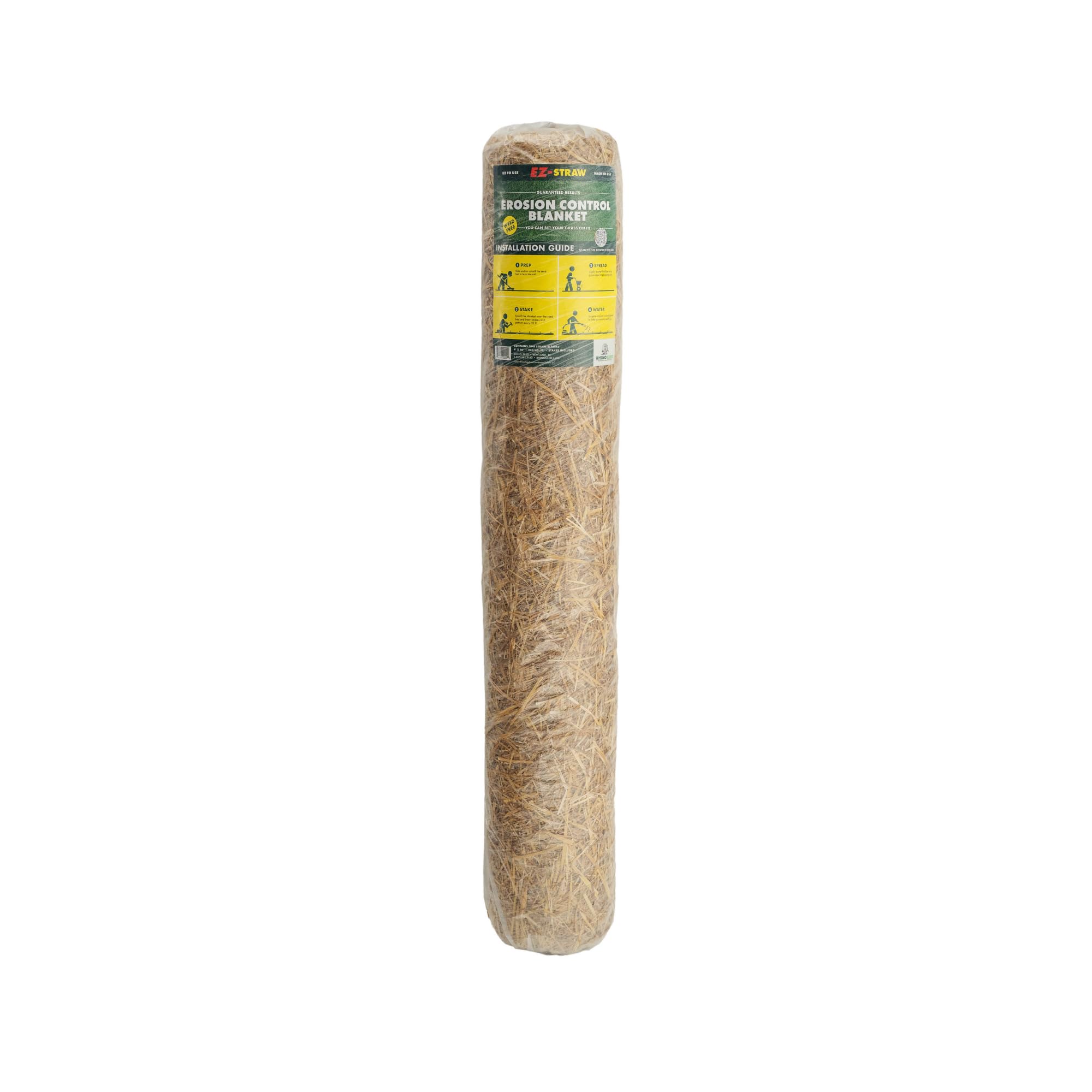
The straw blanket with included stakes that owners call the gold standard for hillside germination.
EZ Straw comes as a 4-foot by 50-foot roll covering 200 square feet, and it includes 15 biodegradable stakes right in the box — a small but welcome detail that saves a separate trip to the hardware store. The top positive aspect is germination, with 33 owners praising how well the blanket helps seeds sprout on banks and washout-prone areas. Grass growth is the second-highest positive, with 16 owners reporting that grass grows nicely through the straw layer. Owners recommend leaving the blanket in place permanently so the grass grows right over and through it.
Installation is best handled by two people, as the blanket can be difficult to unroll alone — the ease of unrolling gets mixed marks (28 mentions). Owners who unrolled it slowly with a partner had the best results. The included wooden stakes are functional, but the review consensus strongly recommends upgrading to steel garden staples for better holding power, especially on slopes. The straw is natural and biodegradable, feeding the soil as it breaks down.
The main quality complaint is that straw distribution per roll is inconsistent — 18 owners note that some sections have sparse straw coverage or large gaps. If you hit a bad roll, it can leave bare patches that do not protect the seed as effectively. A few owners also found that the plastic netting used to bind the straw does not biodegrade quickly and can snag grass when you try to remove it, requiring an hour of careful cutting.
Straw blanket
- Excellent germination rates on hills and washout zones (33 mentions).
- Comes with 15 stakes for quick, ready-to-use installation.
- Natural straw feeds the soil as it decomposes.
Seed may shift
- Straw thickness varies between rolls — some arrive sparse.
- Plastic netting can be a hassle to remove after grass establishes.
Gentle slopes: Hillside germination projects where you want a straightforward straw blanket with stakes included and you are not too picky about perfectly even straw density.
Steep terrain: Inconsistent straw coverage would bother you, or you need a blanket with zero plastic netting that will fully biodegrade.
7. Growtrax Biodegradable Grass Seed Mat
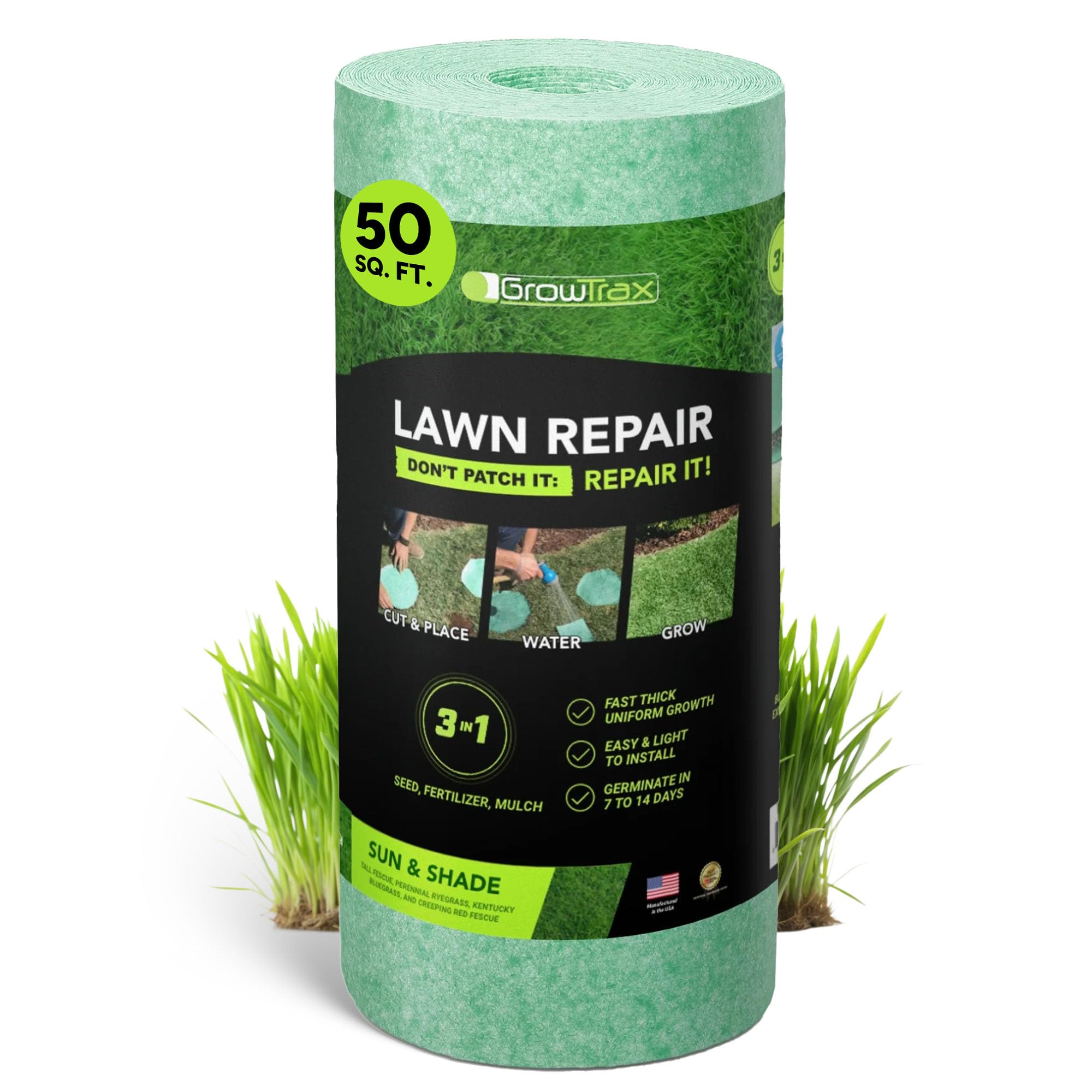
The all-in-one roll that includes seed, fertilizer, and mulch for a quick lawn patch.
Growtrax is the most-reviewed grass seed mat on this list with thousands of ratings, and it gets the job done by removing guesswork. Each 50-square-foot roll contains premium Oregon grass seed, starter fertilizer, and a biodegradable fabric that holds everything together. The colored mat makes it easy to see where you have watered, a small but real convenience. Owners who got it right report that sprouting took about 10 days, and by week 3, growth was fairly even. The mat is designed for full sun and light to semi-shade, with fine-bladed texture and medium to high drought resistance.
There is a split camp here. Some owners say it is the easiest grass repair they have ever done — roll it out, water it, and growth appears within a week. One detailed successful owner reported using it over a removed mulch area, staked it down with landscape staples, and ordered a second roll after seeing the results. Others, however, experienced total failure where the pad fell apart after three weeks of watering with no grass emerging at all. The “DID NOT WORK” reviews are emphatic and numerous, even when owners watered three times a day in sandy soil.
The honest summary is that this mat demands perfect conditions — consistent watering above 50 degrees Fahrenheit, no heavy rain during the first days, and proper soil preparation. If conditions are slightly off, the mat can disintegrate before the seed germinates. It is more tempermental than loose seed and straw, but owners who hit the balance are happy with the convenience.
Eco-friendly: A small, well-prepared patch in a temperate area where you can water precisely 3+ times a day for the first 3 weeks.
Fast results: Large areas, rainy seasons, or if you cannot commit to a strict daily watering schedule — the mat is sensitive to deviations.
8. Petramax ReadyRoll Bermuda Grass Seed Mat
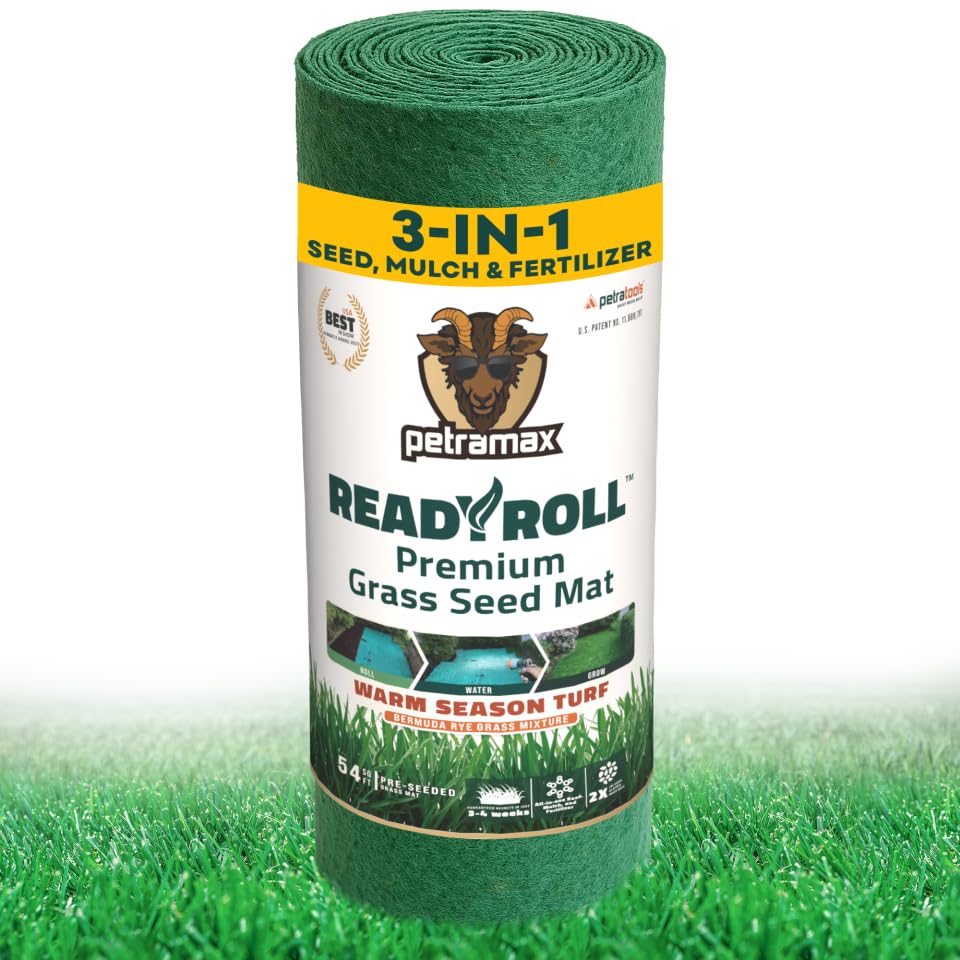
The 2X seed density mat that targets warm-season Southern lawns and heat-tolerant repair.
Petramax packs its mats with double the Bermuda grass seed compared to standard rolls, aiming for thicker, faster coverage on Southern lawns. It is a 3-in-1 roll combining Bermuda seed, mulch, and embedded starter fertilizer. The biodegradable fiber mesh clings to the ground to prevent washout on slopes, and the blend includes perennial rye and tall fescue for a mix that tolerates full sun and moderate watering. The style is called “Bermuda Turf” and is marketed for the Warm Season Green color.
The reviews here are sharply divided. A handful of owners in hot, sandy conditions (like sugar sand in Texas zone 8a) report that the mat “did the trick” after 2 weeks with proper soil prep and watering 3 times daily, praising the ease of use and cost-efficiency. One owner who struggled to get grass on sugar sand for years finally got a result with this mat. But across the broader owner set, the most-discussed aspect is poor germination — 10 customers note that no seeds sprouted despite careful watering and soil preparation. The cost-effectiveness is also called out negatively by 7 owners who see it as a waste of money.
The watering requirement is intense: the manufacturer specifies at least 3-4 times daily for the first 3 weeks, and the ground must stay constantly moist. That is a tough commitment in a Southern summer. An owner in zone 8a who got germination noted it happened only where the green fabric dissolved into the soil in shaded areas with less evaporation. If your soil prep or watering schedule falters, the Bermuda seeds may never leave the mat.
Southern lawns: You have a small, stubborn patch of sugar sand or bare soil in a warm-season zone and you can commit to watering 3-4 times daily for the first 3 weeks.
Northern climates: Your watering schedule is inconsistent or you need a cool-season grass blend for northern climates — this is Bermuda-seasoned material.
9. Jonathan Green Black Beauty SeedRoll

The Black Beauty mat for cool-season patches that need tall fescue, rye, and bluegrass.
Jonathan Green is a well-known name in cool-season grass, and the Black Beauty SeedRoll uses their Ultra grass seed — a blend of tall fescue, perennial rye, and Kentucky bluegrass. It is a 50-square-foot all-in-one mat designed for bare spots and slopes, recommended for application between mid-August to mid-October or mid-March through mid-May. The mat protects seed from birds and washout while warming the soil below and allowing light and water to penetrate. The maker claims it can produce dark green, drought-tolerant grass in 10 to 20 days in sunny or shady areas.
The 3-in-1 design (seed, starter fertilizer, and mulch) means you simply lay it over prepared soil, cut to shape with scissors, and water frequently. Some owners confirm this works: “Did the trick” reviews mention easy application with a delicate spray to keep it moist for a few days, with grass emerging well. One owner found it effective on a hillside, though noted the mat has not decomposed as quickly as the manufacturer’s video suggested.
The trouble is that failures are more common than successes in the owner data. The #1 most-discussed aspect is “grewability,” and it is squarely negative — 23 reviewers point out the mat failed to produce grass. Decomposition is also a negative theme (12 mentions), with owners noting the paper-like fabric tears up shortly after application without any seed growth behind it. If the soil has any compaction or the watering schedule is interrupted, the thin mat can disintegrate before germination occurs. The 16-ounce weight is light, and some owners feel the fabric is too weak to survive the 2-weeks-plus needed for cool-season seeds to establish.
Premium turf: Small, well-prepared patches in cool-season zones where you can water gently and consistently and want a trusted brand name in grass seed.
Budget projects: Your soil has compaction or you cannot water twice daily — the mat is fragile and failures spike when conditions are not perfect.
Understanding the Specs
Coverage Area (sq. ft.)
This is the total square footage the roll covers when laid flat. A 50 sq. ft. roll is about the size of a small patio. A 200 sq. ft. roll handles a modest hillside. For large projects, 450 sq. ft. rolls reduce the number of rolls you need to buy. Always order about 10% extra for overlap at the edges — skipping overlap leaves a channel for water to sneak under and wash out your seed.
Material Biodegradability
Jute and excelsior (aspen wood fiber) are fully natural and break down in 1-3 seasons, leaving no residue. Straw blankets may use plastic netting that takes years to degrade — look for “photodegradable” or “biodegradable netting” in the specs if you want zero cleanup. Mats that include seed and fertilizer are usually light paper or fabric; these dissolve faster if conditions are wet, which can be a problem if germination is delayed.
FAQ
Do I need to remove grass seed netting after the grass grows?
Can grass seed netting be used on a steep slope?
Is jute netting better than straw netting for erosion control?
How much grass seed netting do I need for my project?
Will grass seed netting keep birds from eating the seed?
Can I cut grass seed netting to fit irregular shapes?
How often do I need to water through grass seed netting?
What is the difference between a seed mat and an erosion blanket?
Will the plastic netting in some blankets harm wildlife?
Final Thoughts: The Verdict
For most buyers, the best grass seed netting winner is the AK Trading CO. Jute Erosion Control Blanket because it combines the highest owner rating in this list with proven heavy-rain performance on steep slopes and full biodegradability. If you want the biggest coverage per dollar for a large project, grab the Farm Plastic Supply Straw Blanket. And for a construction-grade channel or slope that needs to meet DOT specs, the Curlex II Fabric is the one to reach for.
How We Picked
We do not accept paid placement. Every pick is matched to a real buyer and a real use-case; we do not hands-on test units.
Sources & Methodology
Specifications: manufacturer listings and product documentation. Review insights: verified customer reviews, as of July 2026. Pricing: not shown on this page (it changes often); check the current price via the retailer link.
As an Amazon Associate, Lawn Gear Lab earns from qualifying purchases. This does not affect which products we feature.