
Specs are compiled from manufacturer listings and verified buyer reviews and can change over time — please confirm the key details on the product page before buying.
If your lawn looks tired and spongy underfoot, thatch (the layer of dead grass and roots) is likely smothering it. A grass rake, also called a dethatching rake, rips that layer out so water, air, and nutrients reach the soil. The best grass rake for most people is the Bully Tools 24-Tine Thatching Rake — its tempered steel tines (hardened metal fingers) stay straight under heavy thatch, and the overwelded head-to-handle joint (extra weld at the connection) keeps it from snapping apart season after season. But not all rakes dig deep enough, stay assembled, or last more than one season.
I’m Rikta — the founder and writer behind Lawn Gear Lab. This guide is built by comparing the manufacturers’ published specifications and the patterns across verified customer reviews, so you get each pick’s real strengths and trade-offs instead of marketing spin.
Here is the shortlist for the best grass rake money can buy right now.
Quick Picks
- Bully Tools 24-Tine Thatching Garden Rake — Top Performer
- Walensee Thatch Rake for Lawn — Best Versatility
- TCBWFY Dethatcher Rake — Compact Pick
- BARAYSTUS Thatch Rake Dethatcher — Budget Champion
How To Choose The Best Grass Rake
Picking a grass rake depends on how wide you want to work, how strong the tines are, and whether the handle fits your height. These three specs separate a quick, comfortable job from a frustrating afternoon.
Head Width and Tine Count
The wider the head, the more thatch you pull per pass. A 15-inch head is standard for most yards, but a 17-inch or larger head saves time on open lawns. More tines (19 or 24) also mean more contact points, so the rake grabs more dead grass in one stroke. The trade-off: a bigger, denser head is heavier to pull.
Handle Length and Adjustability
A longer handle reduces bending, which matters if you have back issues. Many rakes come in sections (40 to 70 inches) so you can dial in the length. A cushioned grip also helps during extended use. If the sections use twist-lock joints, check the reviews for loosening — that is a common weak point.
Tine Material and Construction
The tines do the digging. Carbon steel and hardened manganese steel hold up better than plain steel, especially if you hit compacted soil. A powder-coated finish resists rust, and an overwelded connection between the head and handle stops the rake from snapping apart at the joint — the most common failure on budget models.
Quick Comparison
On smaller screens, swipe sideways to see the full table.
| Model | Best For | Head Width | Handle Material | Item Weight | Amazon |
|---|---|---|---|---|---|
| Bully Tools 24-Tine Thatching Rake | Heavy duty / large yards | 24 tines, 23.5″ x 20″ | Fiberglass | 3.9 Pounds | Amazon |
| Walensee Thatch Rake | Versatile / adjustable length | 17 inches | Plastic | 4.6 Pounds | Amazon |
| TCBWFY Dethatcher Rake | Compact / narrow spaces | 15 inches | Metal | — | Amazon |
| BARAYSTUS Thatch Rake | Budget pick / light use | 15 inches | Stainless Steel | 3.3 Pounds | Amazon |
In‑Depth Reviews
1. Bully Tools 24-Tine Thatching Garden Rake

This rake’s 24 tempered steel tines (heat-hardened metal fingers) stay straight even when you pull thick, matted thatch so you clear a 23.5-inch-wide path per stroke.
You want a rake that does not bend or break when the thatch is thick. The Bully Tools delivers on that. Its 24 tempered steel tines — the brand claims they are up to 30% more durable than foreign competitors — form a head measuring 23.5 inches by 20 inches, so you clear a much wider path per stroke than a standard 15-inch rake head. The total tool length is 68 inches, and the fiberglass handle has a polyester-veil coating to prevent splintering, which means you hardly bend over at all. That makes a difference when you are pulling thick, matted thatch for an hour. By comparison, the BARAYSTUS (reviewed below) uses a 15-inch head, while the Bully Tools uses a 23.5-inch head.
Buyers report this rake is extremely durable. One wildland firefighter using it at 8,000 feet for fire mitigation praised it over big-box store options. Another reviewer cleared five to ten trashcan loads of debris without any damage, though they noted it gives a solid core workout. The overwelded head-to-handle connection (extra weld at the joint) is the key detail here — that joint is the typical failure point on lesser rakes, and Bully Tools reinforces it beyond standard construction.
At 3.9 pounds, it is heavier than the BARAYSTUS (3.3 lb), but that extra weight comes from tough materials. You get this rake for a large yard with deep thatch or even branches to collect. The only real complaint: buyers wish the handle were six to twelve inches longer to reduce back strain when pulling.
What earns it the top spot
- 24 tempered steel tines that resist bending even under heavy pressure
- Widest head on this list (23.5″ x 20″) for fast coverage on large lawns
- Overwelded head-to-handle connection is professionally reinforced
- Fiberglass handle with rubber grip reduces fatigue during long sessions
One real limitation
- Heavier than some alternatives (3.9 lb), which can tire arms if you have a very small yard
- Some buyers would prefer a six-to-twelve-inch longer handle for extra leverage
Reach for it if: your yard has thick thatch, branches, or heavy debris and you want a rake that will not snap or bend after one season.
Look elsewhere if: you have a small lawn or want the lightest possible tool for quick seasonal touch-ups.
2. Walensee Thatch Rake for Lawn

A 17-inch dual-sided head (19 curved steel tines for dethatching, reverse side for cultivating) saves you from buying a second tool, and the handle adjusts from 40 to 70 inches to fit your height.
You get two tools in one here — the 17-inch head packs 19 curved steel tines on one side for lifting dead grass, and the reverse side loosens topsoil so you can cultivate without buying a separate cultivator. Just flip the head over. The sectional stainless steel handle adjusts to roughly 40, 55, or 70 inches, so a taller person can stand upright while a shorter user can dial it down for better control. A cushioned non-slip grip helps during long sessions. The head is 17 inches versus the 15-inch BARAYSTUS, so you cover more ground per pass.
Owners mention it assembles in about seven minutes and works well on St. Augustine grass and Bermuda grass. One buyer filled a 96-gallon can with thatch and described the work as a solid arm and chest workout. At 4.6 pounds, it is the heaviest rake here — 4.6 pounds versus the BARAYSTUS at 3.3 pounds — but that weight comes from the hardened manganese steel head and the extra handle sections. The catch, buyers mention, is that the handle sections can unscrew during use and may need occasional tightening of the nylock nuts (threaded fasteners with a nylon insert to prevent loosening) to stay secure.
Where it shines: The adjustable handle length (up to 70 inches) makes it comfortable for users of different heights, and the dual-sided head saves you from buying a separate cultivating tool.
The honest downside: Heavier than most (4.6 lb), and the sectional handle may loosen mid-job if you do not tighten the connections firmly.
Grab it for: a mix of dethatching and light soil cultivation in a medium-sized yard, especially if multiple people of different heights will use it.
skip it if: you want the lightest possible tool or prefer a solid one-piece handle with zero chance of unscrewing.
3. TCBWFY Dethatcher Rake
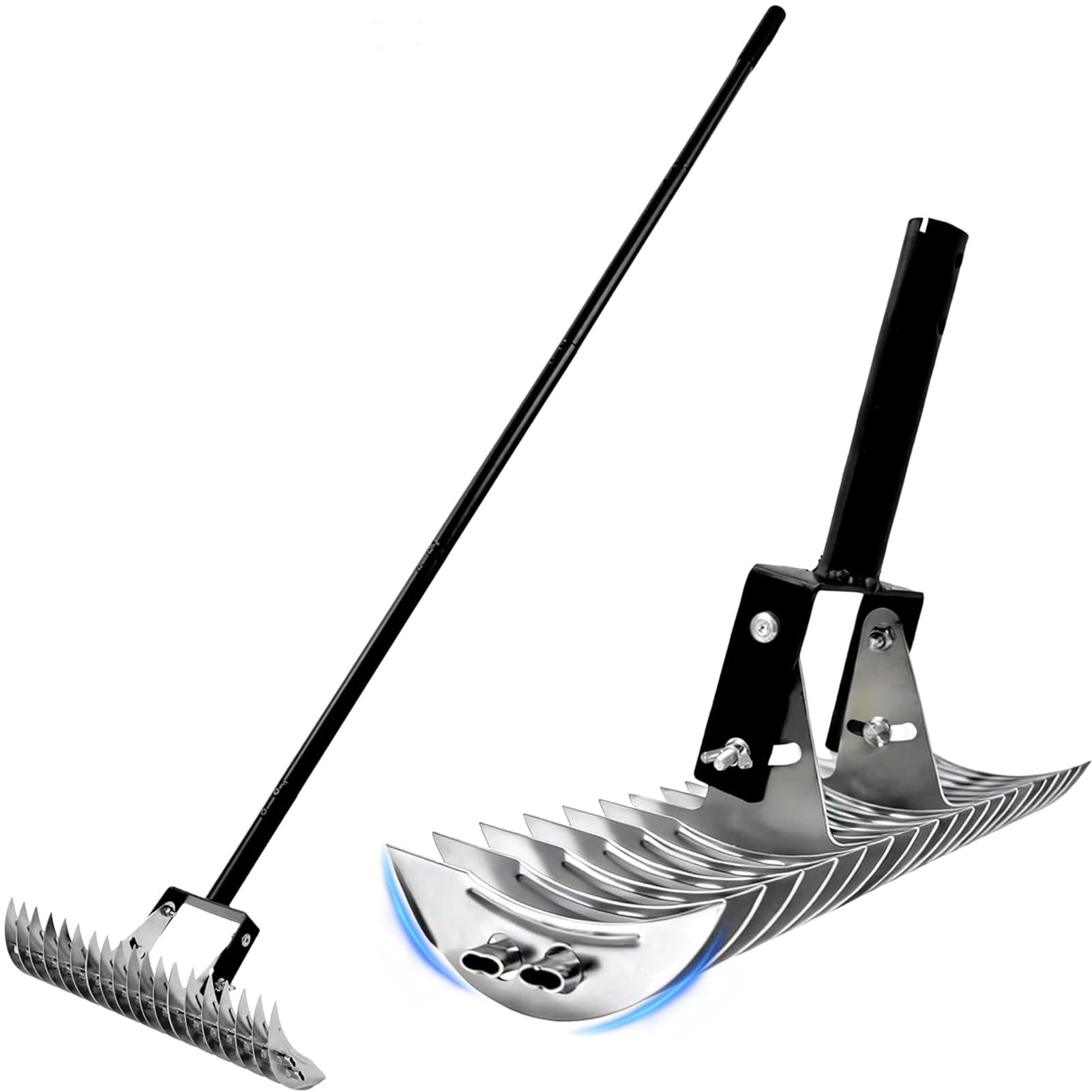
This rake’s adjustable width (a 15-inch head that narrows for tight spaces) and chrome-plated tines (rust-resistant steel coating) make it the pick for flower beds and narrow paths.
You get precise control with this rake. The 15-inch head is standard, but customers note the adjustable width is its standout feature — you can narrow it to fit between flower beds and expand it back to cover more ground on the open lawn. The head tines are built from rust-resistant steel with a chrome-plated finish, which reviewers point out feels more premium than painted-handle alternatives. The handle screws together in sections, so you can leave one off if you want a shorter reach. The head width matches the BARAYSTUS at 15 inches, but the chrome plating and adjustable width give it an edge for precision work.
Shoppers say this rake is durable, easy to assemble, and comfortable to use for tasks like removing wood mulch before replacing garden weed fabric. It is lighter in practice than the numbers suggest, though no exact weight is listed in the specs. One caveat: buyers mention it is smaller than expected for wide-open lawns, so it is better suited for small-to-medium yards and detailed garden beds. If you are comparing it to the Bully Tools, that 23.5-inch head is wider than the TCBWFY’s 15-inch head, so you would want the Bully Tools for a large open lawn.
Best for narrow work: The adjustable width and chrome-plated tines make it ideal for dethatching between plants and in tight flower beds without damaging surrounding growth.
Watch out for: The 15-inch head means slower coverage on large open lawns compared to a 17-inch or wider head.
Choose this if: you have flower beds, narrow paths, or detailed garden areas that a wider rake would tear through.
Pass if: you primarily need to clear a large, open yard quickly — a wider head saves more time.
4. BARAYSTUS Thatch Rake Dethatcher

At 3.3 pounds, this is the lightest rake here — but reviewers report the handle sections loosen and can break, so you get low weight at the cost of durability.
You save your arms with this rake. At just 3.3 pounds, it is the lightest in the lineup, making it the easiest to carry around the yard without getting tired. The 15-inch head has 19 curved carbon steel tines with a dual-sided design: one side pulls dead grass and thatch, the other side loosens soil and cultivates. The handle comes in four stainless steel sections, so you can adjust the overall length to anywhere from a short working stick to the full 58.5 inches. The head also adjusts to different angles for comfortable digging or skimming. It weighs 3.3 pounds versus the Walensee at 4.6 pounds, which makes a real difference during a long session.
Buyers report it works well for removing moss and thatch on smaller lawns, with one user calling it a “moss destroyer.” But there is a pattern in the reviews: buyers mention the connecting handle poles loosen during use, and one reviewer noted the “Handle broke within 20 minutes.” Another noted the metal teeth bent slightly after a single session. Some reviewers advised supergluing the bar joints to prevent loosening, which suggests this rake needs a little DIY love to hold together long-term.
The light-weight appeal
- At 3.3 lb, it is the lightest rake here, reducing arm fatigue during extended use
- Dual-sided head handles both dethatching and soil cultivation
- Adjustable head angle helps you dig or skim at a comfortable position
Durability concerns
- Connecting poles tend to loosen during use, requiring regular tightening or glue
- At least one buyer mentioned the handle broke within 20 minutes of use
- Metal tines bent slightly after a single session on compacted soil
Ideal for: a small lawn or light seasonal dethatching where you want the lightest tool possible and are comfortable doing a little reinforcement at the joints.
Not for: heavy, compacted thatch or any buyer who wants a tool that will stay tight from the start without modifications.
Understanding the Specs
Head Width and Tine Count
Head width, measured in inches, determines how much thatch you pull per stroke. A 15-inch head is standard for most residential yards, but a 17-inch head covers more ground each pass than a 15-inch head. Tine count (the number of curved metal fingers on the head) also matters — 19 tines grab more dead grass per pull than 15, while 24 tines (as on the Bully Tools rake) give you maximum contact. Tine material, like carbon steel or hardened manganese steel (a durable alloy), decides whether the tines stay straight or bend on compacted soil.
Handle Length and Material
Handle length is measured from the grip to the head. Standard lengths range from about 55 to 68 inches. A longer handle means less bending, which matters for your lower back during long sessions. Adjustable sectional handles let you dial in the length (often 40 to 70 inches) but can loosen over time. Handle material — stainless steel, fiberglass, or plastic — affects weight and durability. Fiberglass is strong and light, while plastic is the lightest but less durable. A cushioned or rubber grip helps reduce hand fatigue.
FAQ
What is the difference between a grass rake and a dethatcher rake?
How wide should the rake head be for my lawn?
How long does a grass rake last?
Can I use a grass rake on wet grass?
Why do some rakes have adjustable handles?
What is the best tine material for a grass rake?
Is a heavier grass rake better?
How do I maintain a grass rake?
Can a grass rake damage my lawn?
What does “overwelded” mean on a rake?
Final Thoughts: The Verdict
For the majority of shoppers, the best grass rake winner is the Bully Tools 24-Tine Thatching Rake because its 24 tempered steel tines withstand heavy thatch without bending, and the overwelded head-to-handle connection keeps it intact season after season. If you want a versatile dual-sided rake with an adjustable handle (40 to 70 inches) for different heights and tasks, grab the Walensee Thatch Rake. And for tight flower beds and narrow garden paths, the TCBWFY Dethatcher Rake delivers a compact, chrome-plated option that adjusts to the space.
How We Picked
We do not accept paid placement, and we did not hands-on test every unit. Instead, we match each pick to a real buyer and use-case by comparing the manufacturers’ published specifications against the patterns in verified customer reviews — so you get each pick’s real strengths and trade-offs instead of marketing copy.
Sources & Methodology
Specifications: manufacturer listings and product documentation. Review insights: verified customer reviews, as of July 2026. Pricing: not shown on this page (it changes often); check the current price via the retailer link.
As an Amazon Associate, Lawn Gear Lab earns from qualifying purchases. This does not affect which products we feature.