
Specs are compiled from manufacturer listings and verified buyer reviews and can change over time — please confirm the key details on the product page before buying.
Forget the weekend chore that eats your Saturday. A grass cutting robot turns that noisy, sweaty obligation into something your phone handles while you relax. But not all robotic mowers are equal — some struggle on a gentle hill, others get lost under a tree, and a few demand you bury a perimeter wire around your entire yard.
I’m Rikta — the founder and writer behind Lawn Gear Lab. This guide is built by comparing the manufacturers’ published specifications and the patterns across verified customer reviews, so you get each pick’s real strengths and trade-offs instead of marketing spin.
Whether your yard is a flat postage stamp or a sloped acre of tall fescue, the right machine saves you hours every week. Here are the picks that actually deliver on that promise, ranked by real-world performance for the best grass cutting robot buyer.
Our Picks at a Glance

How To Choose The Best Grass Cutting Robot
The first big fork in the road is navigation type. Perimeter-wire models are cheaper but require burying a cable around your whole lawn — a weekend project. Wire-free models use RTK satellites, LiDAR lasers, or stereo cameras to map your yard in minutes with no cable in sight. For most modern buyers, wire-free is the way to go.
Yard Size and Slope Matter Most
Every robot mower lists a maximum acreage. Respect it: a mower rated for 0.25 acres will run out of battery halfway through a half-acre yard. Slope rating (expressed in degrees or percentage) tells you how steep a hill it can climb before spinning out. If your yard has any kind of dip, 15-20% or more is a safe starting point.
Cutting Width and Obstacle Avoidance Affect Your Time
A wider cutting deck (8-17 inches) means fewer passes and faster mowing. Obstacle avoidance tech — from simple bump sensors to AI cameras that recognize 1,000+ objects — protects your sprinklers, kid toys, and pet from getting chewed up. The smarter the robot, the less babysitting you do.
Quick Comparison
| Model | Best For | Cutting Width | Slope Rating | Weight | Amazon |
|---|---|---|---|---|---|
| Segway Navimow X430★ Best Overall | Steep, complex acres | 17 inches | 84% (40°) | 63.7 lb | Amazon |
| ANTHBOT M9Budget Champion | Budget-friendly small yards | 7.9 inches | 45% | 21.6 lb | Amazon |
| Segway Navimow i110NReliable Performer | Reliable 1/4-acre workhorse | — | — | 24 lb | Amazon |
| MOVA LiDAX Ultra 1000 | Precise edge cutting | 8 inches | 45% | 30 lb | Amazon |
| Sunseeker X3 Plus | Reliable mid-size yards | 8 inches | 30% | 19.9 lb | Amazon |
| ECOVACS Goat O1000 | True LiDAR wire-free | 8.66 inches | — | — | Amazon |
| ANTHBOT Genie 3000 | Large, complex layouts | 7.9 inches | — | 46 lb | Amazon |
| ECOVACS Goat A2000 | Thick grass on 1/2 acre | 3.6 inches | — | — | Amazon |
In‑Depth Reviews
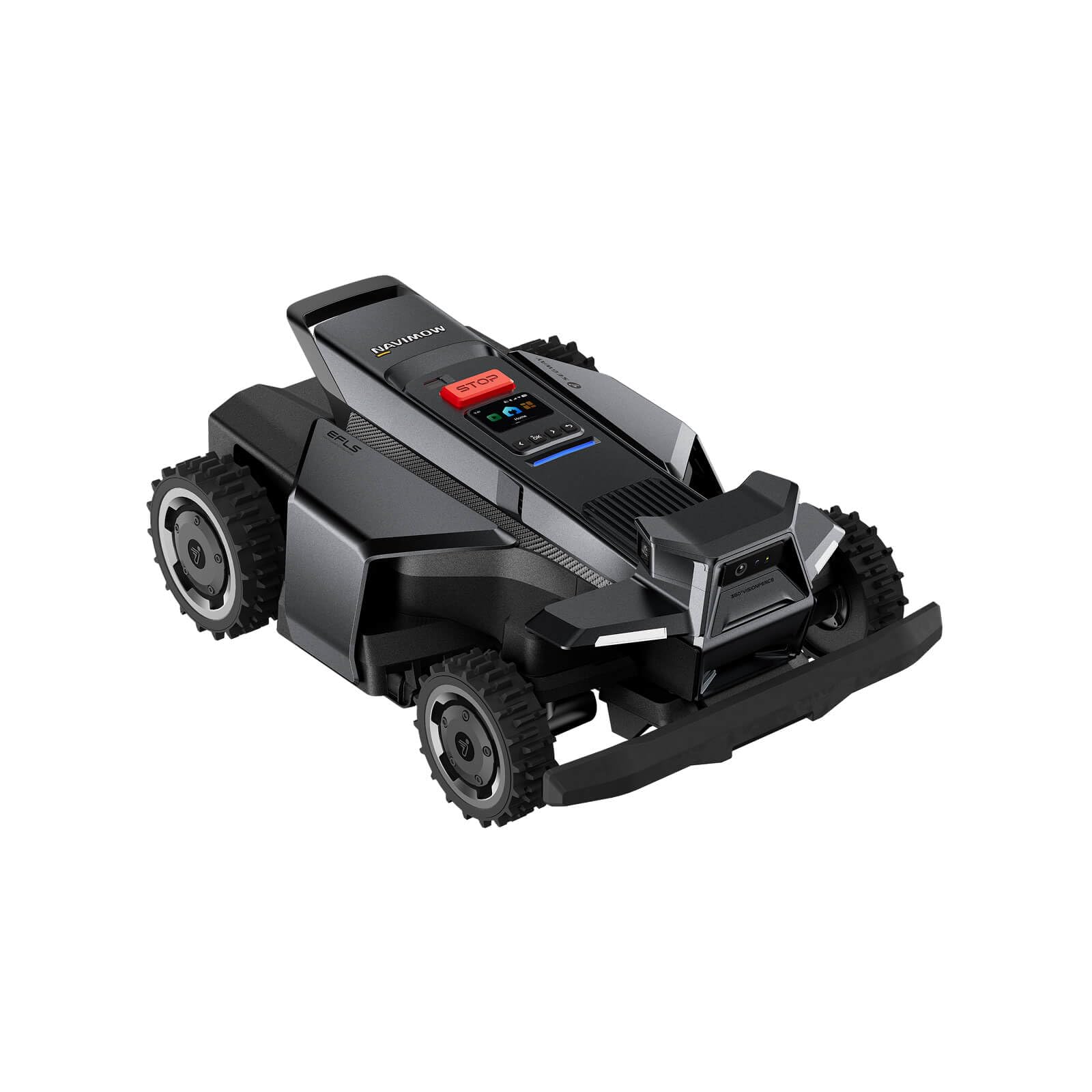
1. Segway Navimow X430
Our pick — over 4★ from 80+ verified ratings; the strongest balance of quality and price.
The 63.7-pound beast that climbs 40-degree slopes without breaking a sweat.
When your yard is a hill, most robot mowers give up. The Segway Navimow X430 laughs at them. Its ORV-tuned dual suspension and all-wheel drive tackle slopes up to 84% — that is a 40-degree incline — while clearing obstacles 2.8 inches tall. The cutting width is a massive 17 inches, and the dual 180W motors spin 12 blades across that whole swath, so tall, dense grass folds almost instantly. Buyers report the battery handles a half-acre well, needing an occasional zone split only on the steepest sections.
The real a neat extra is the AI obstacle avoidance: a 360° Vision system paired with EFLS tri-frequency RTK identifies over 200 obstacle types at centimeter-level accuracy. It doesn’t just bump into things — it sees a hose, a kid’s bike, or a sleeping dog and steers around them. Buyers praise the cut quality and low-maintenance reliability, though you still need a string trimmer for tight edge work.
What Owners Love
- Climbs extreme 84% slopes with zero scuffing
- 17-inch dual-blade cutting deck mows fast
- RTK + 360° vision avoids 200+ obstacle types
- Wire-free auto mapping in one tap
The Trade-Offs
- Heavy at 63.7 lb; tough to move manually
- App and mapping setup can be finicky
Reach for this if: your yard includes steep slopes, broad uneven terrain, and half-acre-plus lawns where other mowers give up.
Think twice if: your yard is small and flat — you pay a premium for all-wheel-drive power you won’t fully use.
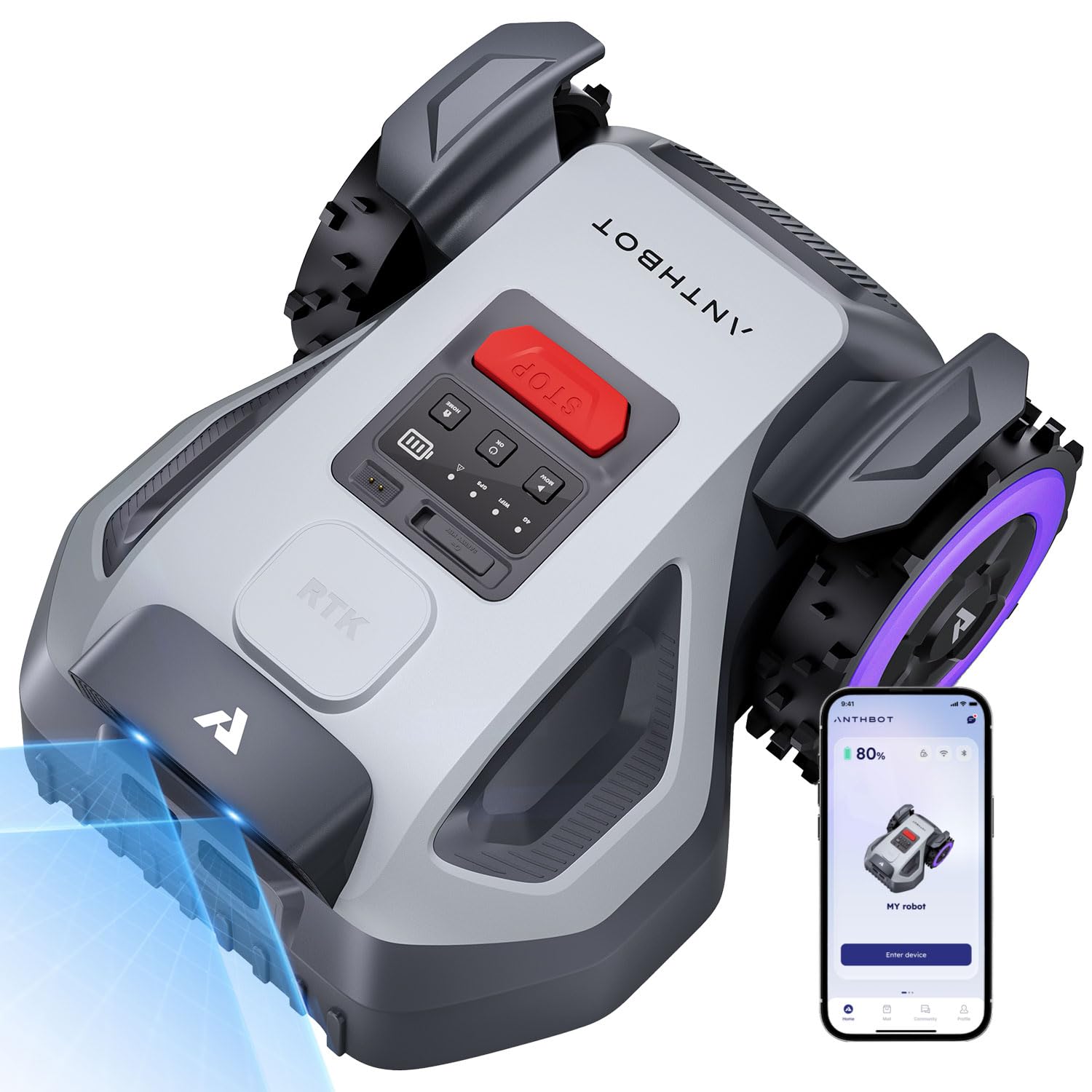
2. ANTHBOT M9
Wire-free RTK for a quarter acre at a price that shocks the competition.
The ANTHBOT M9, at just 21.6 pounds, is nearly three times lighter than the Segway X430. That makes it a breeze to carry around, but it also means a smaller 7.9-inch cutting width and a maximum yard rating of 0.3 acre. Do not let the “1/4 acre” sticker fool you — owners routinely report it handles about half an acre easily. The dual 150° HDR camera system identifies 1,000+ types of objects, from sprinklers to toys, and the RTK positioning delivers centimeter-level accuracy under open sky.
Setup is genuinely quick — about 20 minutes from the start for most owners — and the app lets you manage up to 30 work zones. The quiet 58 dB operation means neighbors won’t complain, and the auto-return and resume feature keeps it running until the job is done. The main caveat: a few owners mention unreliability after several weeks, including random stops mid-mow. For the price, it outperforms many pricier competitors on flat to moderately sloped yards.
Plain verdict: For a small to medium flat yard on a budget, the M9 delivers great value. The trade-off is occasional unreliability after extended use.
3. Segway Navimow i110N
The wire-free workhorse that 500+ owners trust for their quarter-acre.
For a standard suburban lot, the Segway i110N hits the balance. It navigates steadily under trees and through narrow passages by combining the same EFLS 2.0 RTK positioning (a satellite-based guidance system) as the bigger model with a vision sensor (a camera that sees obstacles). The 60-minute battery life covers a mapped yard, and the AI-powered Assist Mapping identifies lawn edges automatically — you tap a few buttons and it maps itself. Owners call it “reliable” — the top-praised aspect — and note it “does a very thorough job.”
The 140° camera detects 150+ obstacle types, and the avoidance is good enough that many customers note almost zero manual rescues after dialing in the map. On the downside, it is not happy on uneven terrain — dips and curbs can trap it, and some owners with sloped yards upgraded to the i210 AWD. The mapping process takes practice, and GPS signal strength matters a lot.
One-line take: An excellent entry-level wire-free mower for flat to gently sloped quarter-acre yards, but skip it if your lawn has significant elevation changes.
4. MOVA LiDAX Ultra 1000
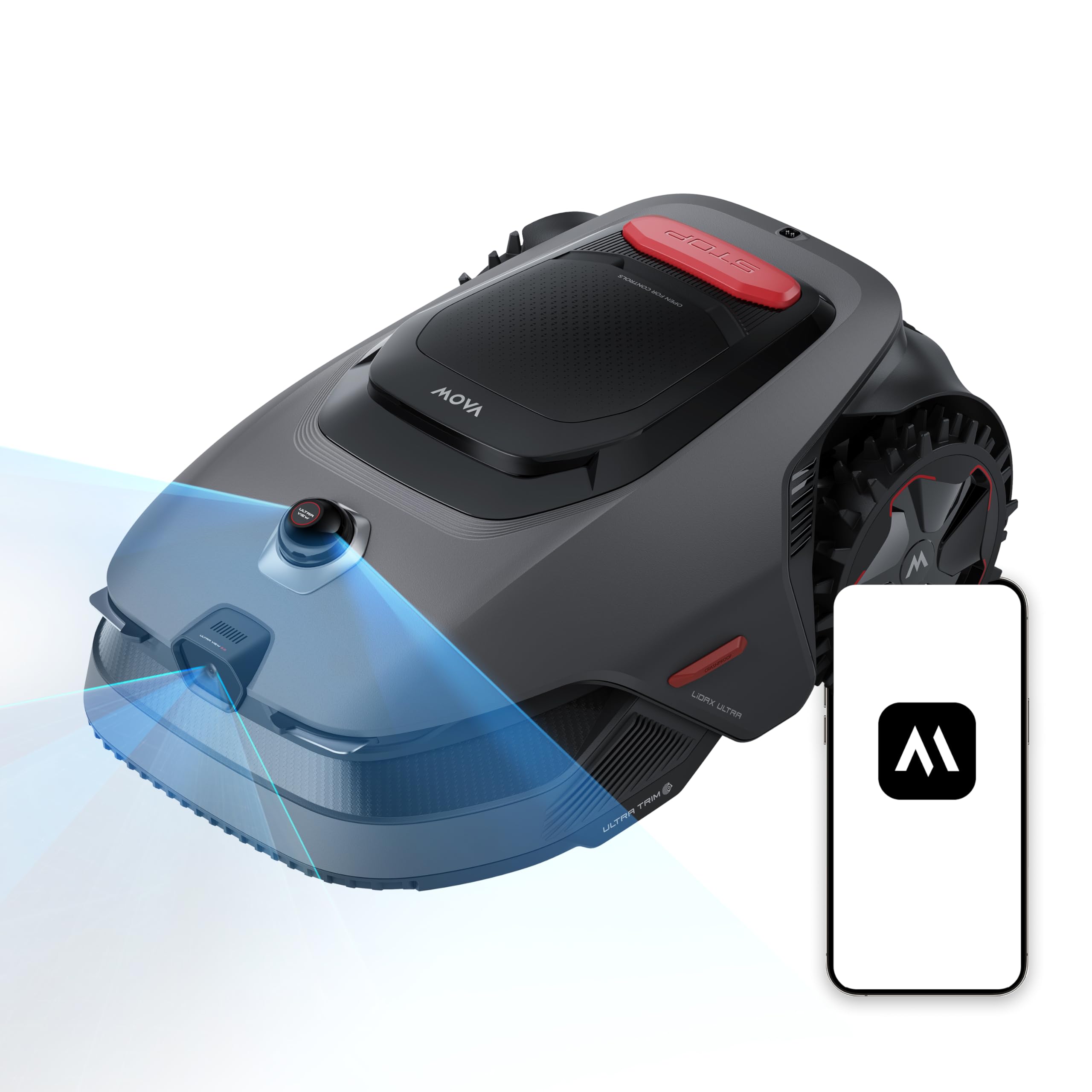
Zero perimeter wires and zero RTK stations — just pure LiDAR and AI vision.
The MOVA LiDAX Ultra 1000 ditches both perimeter wires and RTK reference stations. It uses a 360° 3D LiDAR and AI vision system to map your yard in 3D with centimeter accuracy, even in dim light or harsh sun. The standout feature is the UltraTrim 1.0 edge-cutting system: a movable disc that cuts within 2 inches of walls, hedges, and raised edges, reducing manual trimming drastically. The 8-inch cutting width and off-road rear-wheel drive handle 45% slopes and obstacles 1.6 inches tall.
Owners rave about the “top-notch cutting quality” and smooth app mapping. The dual-map support (up to 2 independent maps) is rare at this price — perfect for separate front and back yards. The catch is slope performance: the standard model gets stuck on steep inclines; you need the AWD version for serious hills. A few reviewers point out occasional positioning errors too, but the 3-year warranty offers confidence.
Who it fits: Buyers who want wire-free setup without an RTK station and prize edge precision. Avoid it if your yard has steep, sustained slopes.
5. Sunseeker X3 Plus
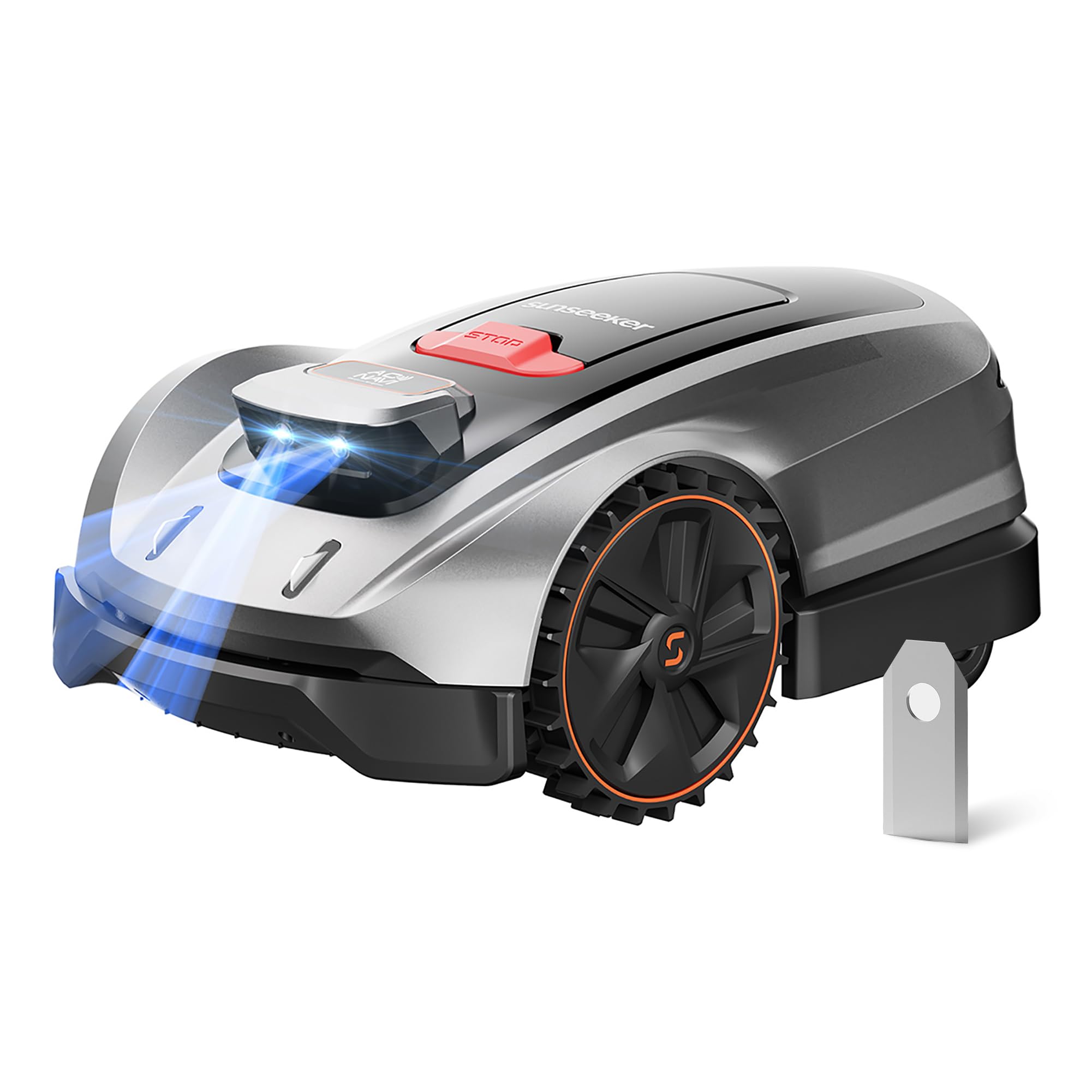
An 8-inch cutter that fits tight suburban yards and tight budgets.
The Sunseeker X3 Plus is built for the classic suburban lot — up to 0.3 acre with defined front, back, and side areas. The AONavi system combines RTK and VSLAM (visual mapping) to create a yard map and follow planned routes. It handles slopes up to 30% (17°) and uses an offset blade to ride on edges and cut closer to fences and walkways. The 8-inch floating cut adjusts from 1.6 to 3.2 inches, and the 60 dB noise level means it won’t wake the baby.
Owners praise its “clean, even results” and surprisingly quiet operation. The 2-year warranty with US-based support is a strong safety net. The major weakness is connectivity: several shoppers say “plan path failed” errors and connection drops that require a strong Wi-Fi signal near the yard. If your yard has a weak signal or you block certain data routes, the X3 Plus may cause headaches.
Best for: Suburban yards under 0.3 acre with reliable Wi-Fi coverage. pass on it if your yard has weak signal or you avoid cloud-dependent products.
6. ECOVACS Goat O1000 LiDAR PRO
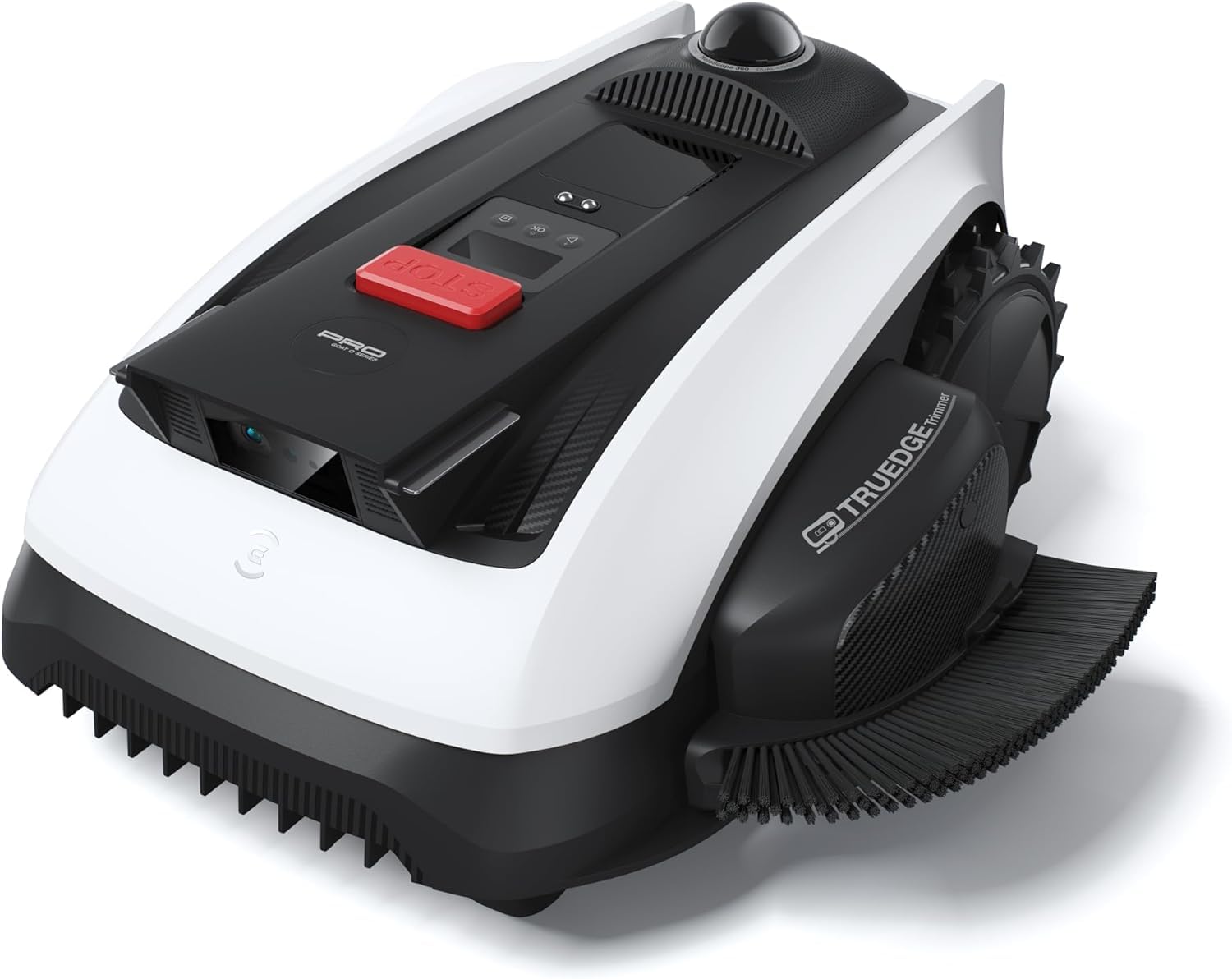
No wires, no RTK station — just 360° LiDAR that works under any tree.
The ECOVACS Goat O1000 LiDAR PRO uses a HoloScope 360° Dual-LiDAR system — no perimeter wire, no RTK antenna. This is a huge advantage if you have a dense tree canopy that blocks GPS signals. The LiDAR maps your yard in 2 cm precision even near fences and in shaded corners. The built-in TruEdge trimmer is the clincher: a string trimmer integrated into the robot so it edges along driveways and flower beds, reducing manual trimming to almost nothing.
Owners rave about the accurate LiDAR navigation and easy setup. The O1000 recognizes 200+ obstacle types and its super-narrow body passes through gaps as slim as 0.8 meters — ideal for side yards and complex layouts. The 8.66-inch cutting width and adjustable height (1.2 to 3.6 inches) handle Bermuda and fescue well. The caveat is that the TruEdge trimmer still leaves some complex corners for manual attention, and initial tuning takes some effort.
The edge it has: Perfect for shaded, complex small yards where GPS mowers lose signal. The built-in trimmer is a genuine time-saver.
7. ANTHBOT Genie 3000
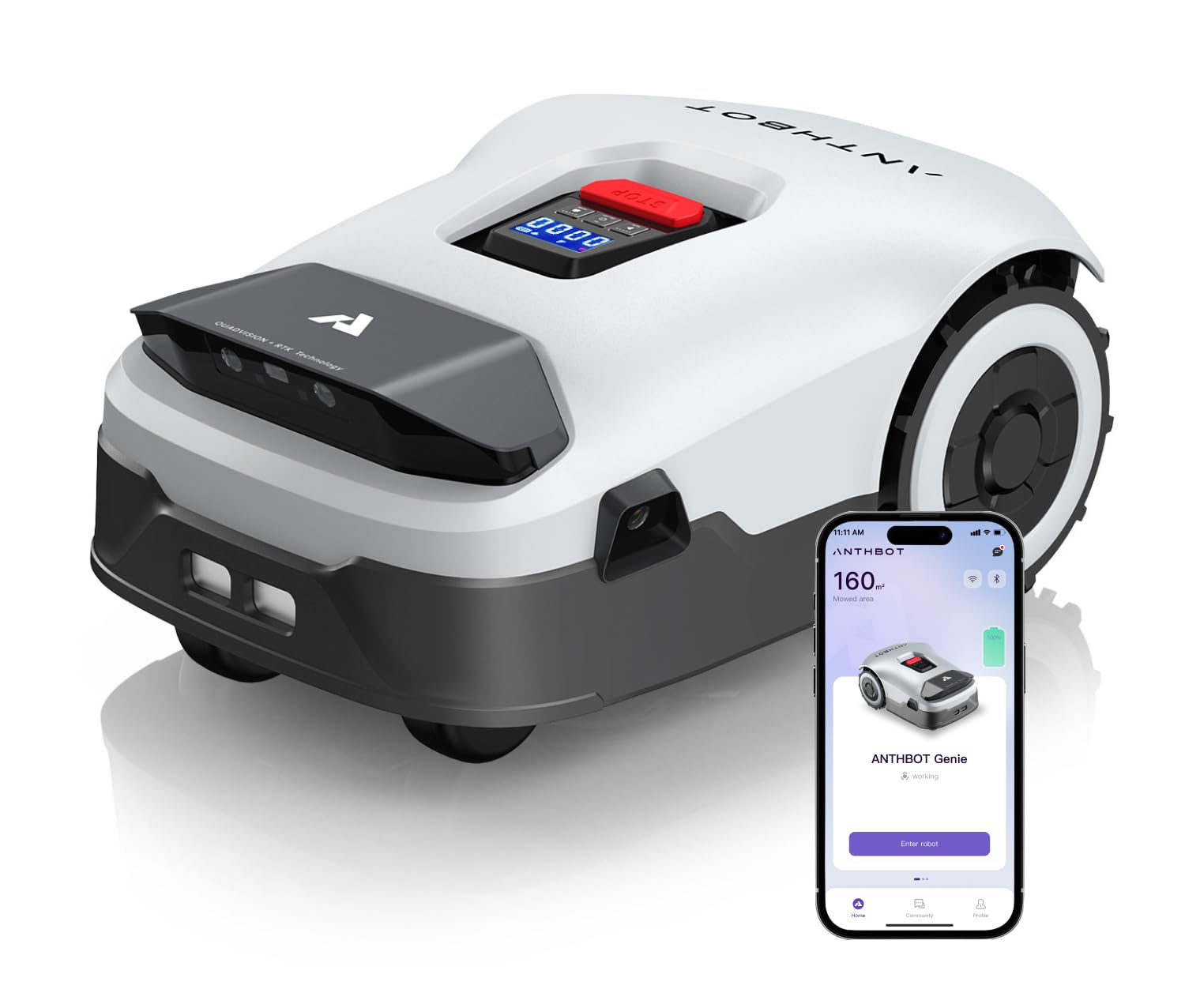
Four cameras and full-band RTK for 0.9 acres of complex lawn.
The ANTHBOT Genie 3000 uses a Full Band RTK positioning system paired with a 4-camera 300° field of view, enabling it to detect 1,000+ obstacle types. It handles 30+ mowing zones and maps automatically using AI boundary recognition. The 7.9-inch cutting width and adjustable height (1.18 to 2.76 inches) produce a clean, even cut. Owners say their lawn “looks perfect with short, even cut” after the Genie 3000 finishes its pattern.
The system supports no-go zones around pools and flower beds, and the app provides remote control and monitoring. Battery life is praised as “great,” and the mower handles uneven, complex lawns well. The downsides are notable: the mower does not edge — you still need a trimmer — and some buyers report frequent remapping needs and app limitations like no zone splitting. Long-term reliability has been a concern for a few buyers, with random charging failures after a year.
Who it’s for: Owners of large, complex yards who want advanced obstacle detection and many zones. The catch is the app is still maturing and edge trimming is not included.
8. ECOVACS Goat A2000 LiDAR PRO
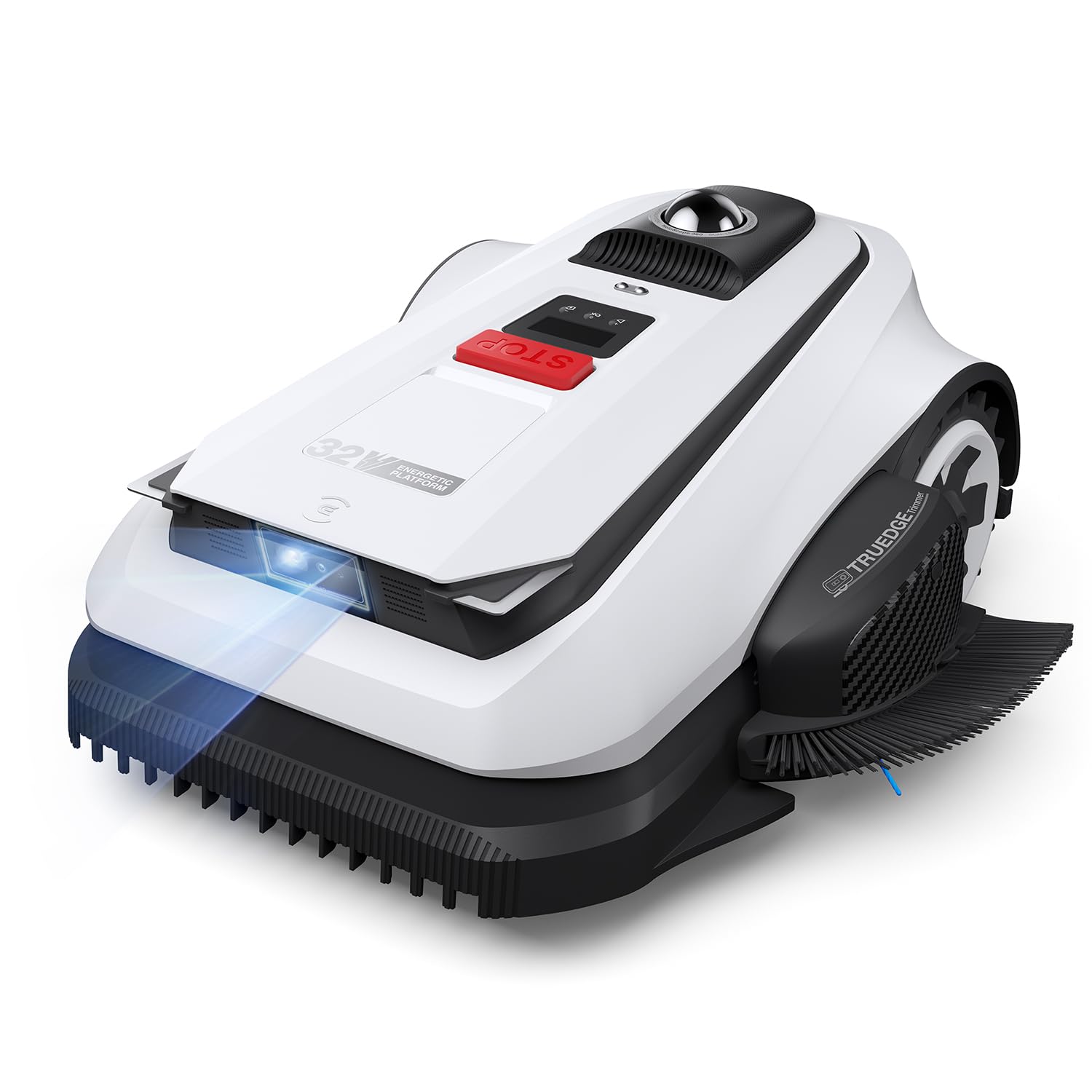
A 32-volt power plant built specifically for dense St. Augustine and Bermuda lawns.
The ECOVACS Goat A2000 LiDAR PRO brings a high-power 32V motor and dual-blade disc system designed for the thick, fast-growing grasses found in American lawns. It also has the same HoloScope 360° Dual-LiDAR system as the O1000, delivering 2 cm positioning without any perimeter wire or RTK antenna. The built-in TruEdge trimmer includes two rolls of trimming line, each covering about 3 km of edging — a massive reduction in manual trimming.
The 3.0Ah battery charges to full in about 50 minutes thanks to 113.4W fast charging, so downtime is minimal. It covers up to half an acre and handles uneven terrain well. Owners note it “cuts neatly around trees and walls” and produces “neat stripes.” The main trade-off: at 3.6 inches, the cutting width is surprisingly narrow — much of its time is spent going back and forth. The 2-wheel drive struggles on wet grass, and the edge trimmer disappoints some owners compared to the promise.
The power it packs: Best for thick, dense lawns (Bermuda, St. Augustine) on up to half an acre. The narrow cutting deck and wet-grass traction are the real trade-offs.
9. eufy Robot Lawn Mower E15
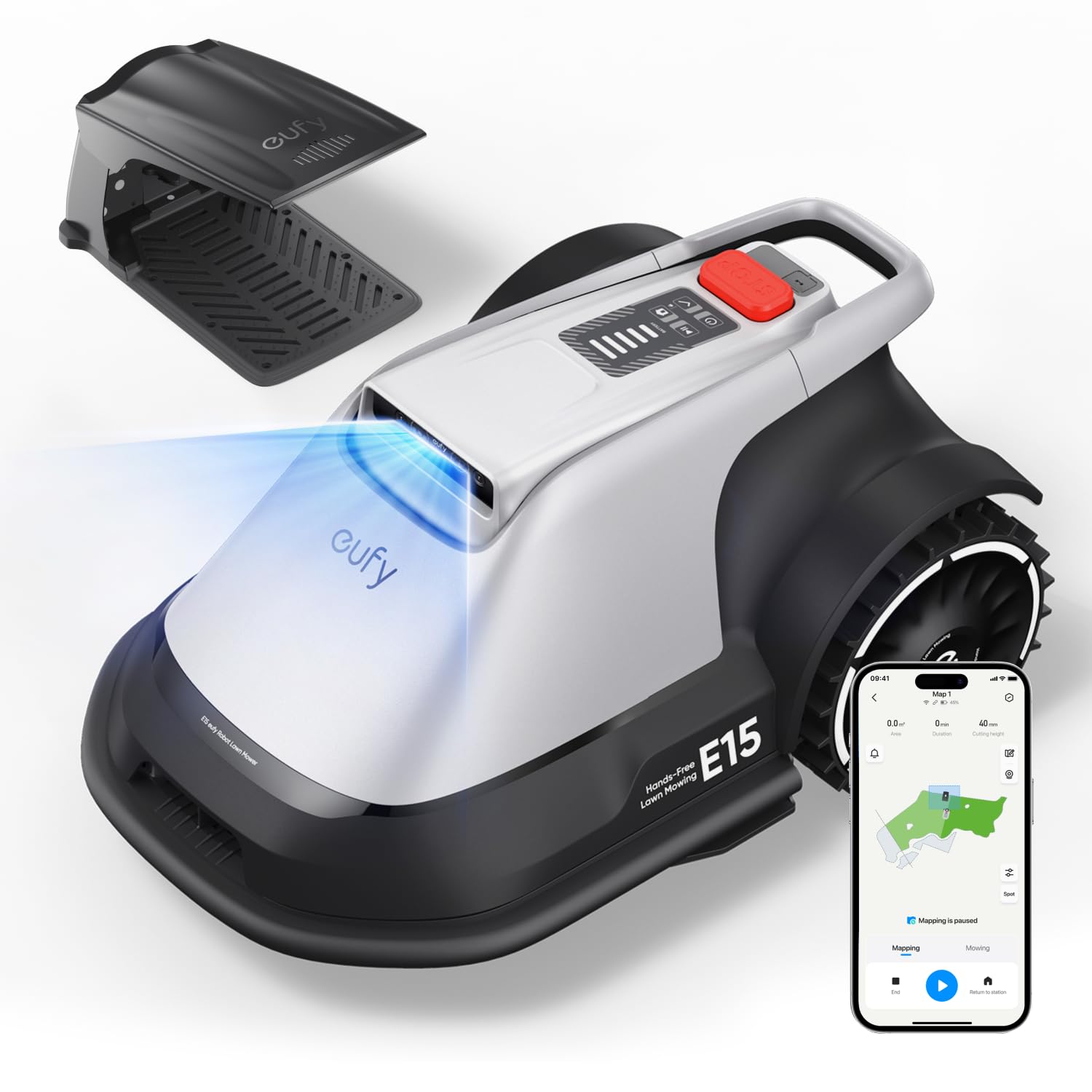
Stereo cameras and zero external hardware — the simplest wire-free setup you can get.
The eufy E15 uses pure vision navigation (V-FSD 1.0) — no RTK station, no perimeter wire, no LiDAR tower. Just stereo cameras and AI algorithms that see, map, and navigate your yard entirely on its own. The setup is as simple as placing the base on the lawn, opening the app, and letting the E15 learn the boundaries. Owners call it “a true standout for robotic mowing” and praise the “clean cut with stripes” it produces.
The E15 handles slopes up to 18 degrees and manages multi-zone mapping with custom exclusion areas and virtual walls. The AI 3D obstacle avoidance accurately detects low objects like rocks and toys and tall objects like trees and pool borders. The catch is the strict yard requirements: it is designed for lawns up to 0.2 acres with grass under 3.5 inches tall. It is not suitable for St. Augustine or dense Zoysia grass. Owners with sandy or patchy lawns report mapping failures and getting stuck in soft sand.
The pure simplicity: Ideal for small, firm, flat lawns up to 0.2 acres where you want the absolute easiest setup. it’s not for you if your grass is thick or your soil is sandy.
Understanding the Specs
Navigation: RTK vs LiDAR vs Vision
RTK (Real-Time Kinematic) uses a satellite base station for centimeter-level positioning. It is highly accurate but requires a clear view of the sky. LiDAR (Light Detection and Ranging) uses spinning lasers to map the yard in 3D — it works under trees and in shaded areas where GPS fails. Pure vision systems use stereo cameras to see the lawn like a human eye would; they need good daylight and firm turf to work reliably. Each has a place, and your yard’s tree cover and shape will decide the best fit.
Slope Rating and Traction
The slope rating tells you the maximum incline the robot can climb without losing traction. Measured in degrees or percentage (45% = about 24°), this spec directly determines whether the robot can handle the hill in your backyard. All-wheel-drive (AWD) models with dedicated suspension, like the Segway X430, handle extreme slopes up to 84%. Two-wheel-drive models with slick tires will struggle on wet grass or steep inclines. Always match the slope rating to your yard’s steepest section, not just the average grade.
FAQ
Do I really need to bury a perimeter wire?
Will a grass cutting robot handle the steep hill in my backyard?
How often will I need to trim edges manually?
Can a robot mower handle wet grass?
Is it safe for my dog around the robot mower?
What happens if the mower runs out of battery mid-mow?
Can I use one robot mower for my front and back yard?
How long does a robot mower last before needing replacement?
Will the robot mower chop up fallen leaves?
Do I need Wi-Fi coverage across my entire yard?
Final Thoughts: The Verdict
Across the board, the best grass cutting robot winner is the Segway Navimow X430 because it combines extreme slope-climbing power, a massive 17-inch cutting deck, and advanced obstacle avoidance to handle almost any yard you throw at it. If you want a more affordable wire-free option for a standard quarter-acre lot, grab the ANTHBOT M9. And for a thick grass specialist that trims its own edges, the ECOVACS Goat A2000 LiDAR PRO is the one to reach for. Your weekends just got a lot more free.
How We Picked
We do not accept paid placement. Every pick is matched to a real buyer and a real use-case; we do not hands-on test units.
Sources & Methodology
Specifications: manufacturer listings and product documentation. Review insights: verified customer reviews, as of July 2026. Pricing: not shown on this page (it changes often); check the current price via the retailer link.
As an Amazon Associate, Lawn Gear Lab earns from qualifying purchases. This does not affect which products we feature.