
Specs are compiled from manufacturer listings and verified buyer reviews and can change over time — please confirm the key details on the product page before buying.
There is clean and tidy, and then there is the war you wage against bindweed, crabgrass, and poison ivy every single weekend. Nailing the right spray means the difference between a one-and-done knockout and a bottle that just wets the leaves while the roots laugh underground. Nine contenders sit in the ring here, from the organic kitchen-cabinet soap to the heavy concentrate that makes 100 gallons of solution.
I’m Rikta — the founder and writer behind Lawn Gear Lab. This guide is built by comparing the manufacturers’ published specifications and the patterns across verified customer reviews, so you get each pick’s real strengths and trade-offs instead of marketing spin.
Knowing which chemistry matches your battlefield — whether that is an organic vegetable garden, a gravel driveway choked with thistle, or an acre of pasture brush — is the only way to stop spraying and start winning. This is your straight-talking, no-filler guide to the best grass and weed killer spray for your exact mess.
Our Picks at a Glance


How To Choose The Best Grass And Weed Killer Spray
The biggest mistake people make is grabbing a bottle before asking one question: “Do I want everything dead, or just the bad stuff?” A non-selective spray will torch your prized zoysia just as fast as it torches the dandelion. A selective spray targets broadleaf weeds while the grass lives. Everything else — active ingredient, concentration, speed, and rain-fast time — flows from that single choice.
Active Ingredient: The Muscle Inside the Bottle
Glyphosate is the old heavyweight; it moves through the plant to the root and takes one to two weeks for a full kill. Diquat dibromide works faster — often showing yellowing in hours — but it primarily kills leaf tissue, so deep-rooted perennials sometimes bounce back. Herbicidal soap (ammoniated fatty acids) is the gentlest option; it dehydrates weeds on contact and is OMRI-listed for organic use, but it rarely kills the root and demands thorough coverage.
Concentrate vs. Ready-to-Use: The Economics
A 32-ounce concentrate can make four to eight gallons of finished spray, while a ready-to-use 128-ounce bottle is exactly that — no mixing, but you paid to ship a lot of water. Concentrate makes sense for driveways, fence lines, and large patches. Ready-to-use wins for quick spot-spraying on a small yard where you do not want to drag out a tank sprayer.
Speed vs. Root Kill
Some sprays brag about visible results in three hours. That is usually a contact killer burning the top growth. The root may survive and resprout in a few weeks. Slower-acting systemic sprays (glyphosate-based) take longer to show signs but kill the entire plant. Match the timeline to your patience and the weed type.
Rain-fast Window
A heavy shower ten minutes after spraying can wash the chemical off and waste your morning. Check the rain-fast claim on the label: the fastest here is ten minutes (Roundup III), while organic soaps need three hours dry time.
Quick Comparison
| Model | Best For | Active Ingredient | Size | Type | Amazon |
|---|---|---|---|---|---|
| Southern Ag Crossbow★ Best Overall | Heavy brush & tough perennials | Garlon + 2,4-D | 128 oz (makes 96 gal) | Concentrate | Amazon |
| Bonide Captain Jack’s Deadweed BrewOrganic Champion | Organic gardening & food beds | Herbicidal soap | 128 oz RTU | Ready-to-Use | Amazon |
| Control Solutions Eraser ConcentrateBudget Powerhouse | Budget-friendly glyphosate | 41% Glyphosate | 32 oz concentrate | Concentrate | Amazon |
| Ortho WeedClear | Spot-treating lawn weeds | Selective herbicide | 1 gal RTU + wand | Ready-to-Use | Amazon |
| Roundup III Trigger | Quick spot spray on patios | Triclopyr + Diquat | 30 oz RTU | Ready-to-Use | Amazon |
| Spectracide Concentrate | Fast action on driveways | Diquat Dibromide | 32 oz concentrate | Concentrate | Amazon |
| Sunday Weed Warrior Kit | Pet-safe organic control | Ammoniated soap (22%) | 2 x 22 oz concentrate | Concentrate Kit | Amazon |
| Hi-Yield Killzall II | Large-acreage operations | 41% Glyphosate | 2.5 gal concentrate | Concentrate | Amazon |
| RM18 Fast-Acting | Massive-coverage spraying | Herbicide | 2.5 gal (makes 106 gal) | Concentrate | Amazon |
In‑Depth Reviews
1. Southern Ag Crossbow Specialty Herbicide, 128oz
Our pick — over 4.5★ from 800+ verified ratings; the strongest balance of quality and price.
The heavy artillery for English ivy, poison oak, and 8-foot weeds that normal sprays just annoy.
This is what you reach for when the property line has become a jungle of blackberry canes, wild grapevines, and saplings that appeared overnight. The active duo — Garlon and 2,4-D — is a selective broadleaf formula that spares grass but absolutely demolishes woody brush and perennial broadleaf weeds. A single 128-ounce bottle makes up to 96 gallons of spray solution, which translates to coverage across 2.23 acres. That is a lot of fence line.
Buyers report that it killed all vegetation — “ivy, vines, 8ft weeds, small trees, grass” — within 48 hours, with complete die-off in one week. The slow, systemic action is the point: you wait a few extra days, but the roots die too, so the same patch does not resurrect next month. The catch is the odor (strong, chemical) and the fact that soil type matters — some owners in rich black soil saw milder results, and rain within two days reduces effectiveness.
What wins people over most is the sheer effectiveness — it is the most-praised aspect by a wide margin, with 123 owners singling it out. The value-for-money ranks second, because one jug does what three or four bottles of consumer-grade spray cannot touch. If you need to clear a road edge, reclaim a pasture corner, or kill poison oak on a slope, this is the one. skip it if you want a grab-and-go trigger bottle for a few sidewalk cracks.
Where It Dominates
- Covers 2.23 acres from a single bottle — class-leading for large properties
- Systemic action kills tough perennials (ivy, blackberry, poison oak) to the root in one week
- Effective on English ivy and poison oak, which many sprays merely singe
Things to Know
- Strong chemical odor during application
- Results vary with soil type and rainfall timing
- Not for spot-spraying a small lawn patch
Reach for this if: you battle woody vines, thorny brush, or poison ivy across more than half an acre and need one jug to finish the job.
Think twice if: your battle is a few dandelions in an otherwise perfect lawn — a selective spot spray will be faster and less aggressive.
2. Bonide Captain Jack’s Deadweed Brew, 128 oz Ready-to-Use
The organic option that actually works on Pearlwort between your bricks.
This 128-ounce ready-to-use spray is OMRI-listed for organic gardening, meaning it is approved for use around vegetable beds, fruit trees, and edible plants without worrying about chemical residues. The active ingredient is an ammoniated soap of fatty acids — it works by dehydrating the weed’s leaves on contact. You see results in hours, not days, and once it dries it becomes waterproof, so a surprise shower does not undo your work. It is also effective at temperatures as low as 40 degrees Fahrenheit, giving you a longer spraying window in spring and fall.
The real-world feedback is split in an honest way. Many organic gardeners absolutely love it: one owner reports it is “effective on the very invasive Pearlwort, which tends to grow between bricks and spreads quickly,” and that they never felt comfortable using chemical sprays until this one. Another calls it a “guilt-free weed killer” that works quickly on stubborn thistle. But the effectiveness data is mixed — some owners had excellent results on the first bottle, then a second bottle seemed to do nothing. The sprayer nozzle on the bottle has also been a point of frustration for a few buyers.
The honest trade-off is that a contact-kill organic spray rarely kills the root, so deep-rooted perennials like dandelion or poison ivy will likely need re-application. This is a maintenance tool, not a scorched-earth weapon. Owners who treat it that way — a quick patrol of the driveway cracks every week — are the ones who swear by it.
The bottom line: Perfect for organic gardeners who want to spot-spray around food crops without chemical anxiety, but be prepared to repeat the application on tougher weeds.
Best for: the organic gardener who patrols daily and wants a safe option for Pearlwort, chickweed, and young annual weeds around vegetables.
Look elsewhere if: you need a one-shot root kill on established poison ivy, thistle, or blackberry brambles.
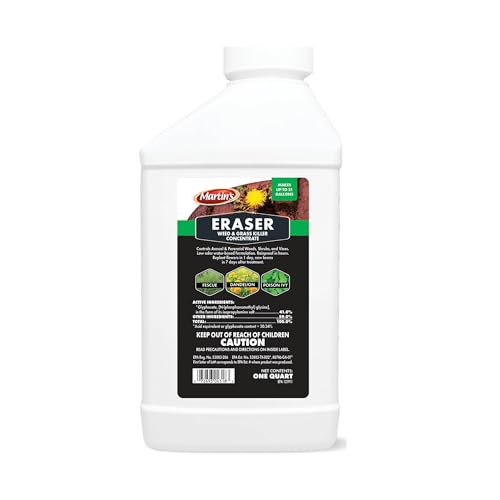
3. Control Solutions 82004318 1 Quart Eraser & Grass Killer Concentrate
The no-frills glyphosate concentrate that beats brand-name sprays on both price and power.
Do not let the small 32-ounce bottle fool you — this is a concentrate that you mix at a rate of 8 ounces per gallon of water, and a single quart makes four gallons of ready-to-use spray. The active ingredient is 41% glyphosate, the same chemistry used in commercial agriculture, but at a fraction of the price per gallon of the consumer brands. It is a water-based formula with a low odor and no residual soil activity, meaning it binds tightly to soil particles and will not leach into surrounding plant roots.
The most frequently repeated note from buyers is patience. This is not a three-hour spray. The review pages sum it up: “Kills all green plants 100% in 1-2 weeks.” You see no change for two days, then yellowing by day four, and die-off around day ten. Poison ivy sometimes needs a second application. But the cost efficiency is the headline — owners consistently call it a better value than Roundup, and with 78 positive mentions of effectiveness, the consensus is overwhelmingly positive. The 4.6-star average across a large pool of ratings confirms it is a crowd favorite.
The limitation is the small bottle size relative to the large properties it serves. For a 32-ounce concentrate, the 2-pound bottle feels physically small, but the math works out to a massive coverage if you are mixing it right. It is also slower than diquat-based sprays, so do not grab this if you want weeds gone by the weekend barbecue.
Why It Wins
- 41% glyphosate at a price that undercuts major brands
- Low odor and water-based — no harsh fumes during mixing
- No residual soil activity, so replanting is safe after the label wait
What to Expect
- Takes 7-14 days for full die-off; not an instant solution
- Small quart bottle requires a tank sprayer
- Poison ivy may need a follow-up spray
Grab this for: budget-conscious buyers who already own a sprayer and want the most glyphosate for their dollar.
pass on it if: you need visible results within 24 hours or want a ready-to-use trigger bottle for quick grabs.
4. Ortho WeedClear Lawn Weed Killer Ready-to-Use with Comfort Wand, 1 gal.

The selective spray that murders dandelions without murdering your Kentucky Bluegrass.
This is the opposite of the non-selective sprays above — Ortho WeedClear is a selective weed killer designed specifically for use on lawns. It targets dandelion, crabgrass, clover, chickweed, and creeping Charlie while leaving Bermudagrass, Fescues, Kentucky Bluegrass, Ryegrass, and Zoysiagrass unharmed when used as directed. The 1-gallon container comes with a battery-powered Comfort Wand, which means no pumping, no heavy backpack tank — just pull the trigger and spot-spray. The wand has two spray settings for precision targeting or a wider coverage.
The real-world results are impressive for a lawn-friendly product. Users report spotting dandelions after mowing and seeing the first signs of wilting within 24 hours, with the weeds completely flattened and dead in about two weeks. A single application eliminated roughly 85% of the visible weeds in one yard. The formula works down to the root, so the dead plant does not just fall over — it stays gone. The one consistent complaint is that crabgrass may need an extra application compared to broadleaf weeds, and a few owners found it slow on tough, established crabgrass patches.
This is the right tool for the homeowner who wants a lush lawn without spending every weekend hand-pulling weeds. The wand eliminates the pain of bending over, and the selective chemistry means you are not fighting a losing war against your own grass.
The verdict: The best pick for lawn perfectionists who want spot accuracy and grass-safe chemistry in one ready-to-use kit.
Perfect for: the homeowner who hates dandelions and clover but loves their turf grass.
Not for: gravel driveways, patios, or flower beds where you want everything dead — use a non-selective spray instead.
5. Roundup 5003410 Weed and Grass Killer III Ready-to-Use Trigger Spray, 30-Ounce

The foam-clinging weed killer that shows you exactly where you sprayed.
Roundup’s latest formulation swaps the old-school clear liquid for a foaming technology that stays on the leaf instead of dripping off. That makes it ideal for waxy-leaved weeds like poison ivy or Tree-of-Heaven suckers that bead up standard sprays and send them rolling onto the lawn. The active ingredients are triclopyr and diquat (not glyphosate in this version), and the label claims visible results in six hours with rainproof protection in just ten minutes — by far the fastest rain-fast window on this list.
The 30-ounce trigger bottle is perfect for quick spot treatment around patios, driveways, and fence lines. Buyers praise its ease of use: no mixing, no pump-up tank, just aim and squeeze. The foam is especially helpful for vertical spraying — it clings to stems and does not run off before the chemical can absorb. The honest catch is the small bottle size goes fast if you have a large area, and the spraying mechanism gets mixed feedback, with some units arriving with slight leaks during shipping and the stream described as a straight jet rather than a fan.
For small-scale battles — killing weeds in sidewalk cracks, trimming back Tree-of-Heaven sprouts, or spot-treating a poison ivy patch — this is the easiest tool on the list. It is not a value play for acreage, but for the garage shelf, it is tough to top the grab-and-go speed.
Standout Features
- Foam foam technology clings to leaves for better absorption
- Rainproof in just 10 minutes — spray right before a shower
- Visible results in 6 hours
Watch Out For
- 30-ounce bottle empties fast on larger patches
- Trigger sprayer can leak during shipping
- Straight-jet stream, not a fan spray
Reach for it when: you need a fast, precise spot-spray on poison ivy or tough weeds and want to see where you aimed.
it’s not for you if: you are covering a whole fence line or driveway — go with a concentrate and tank sprayer.
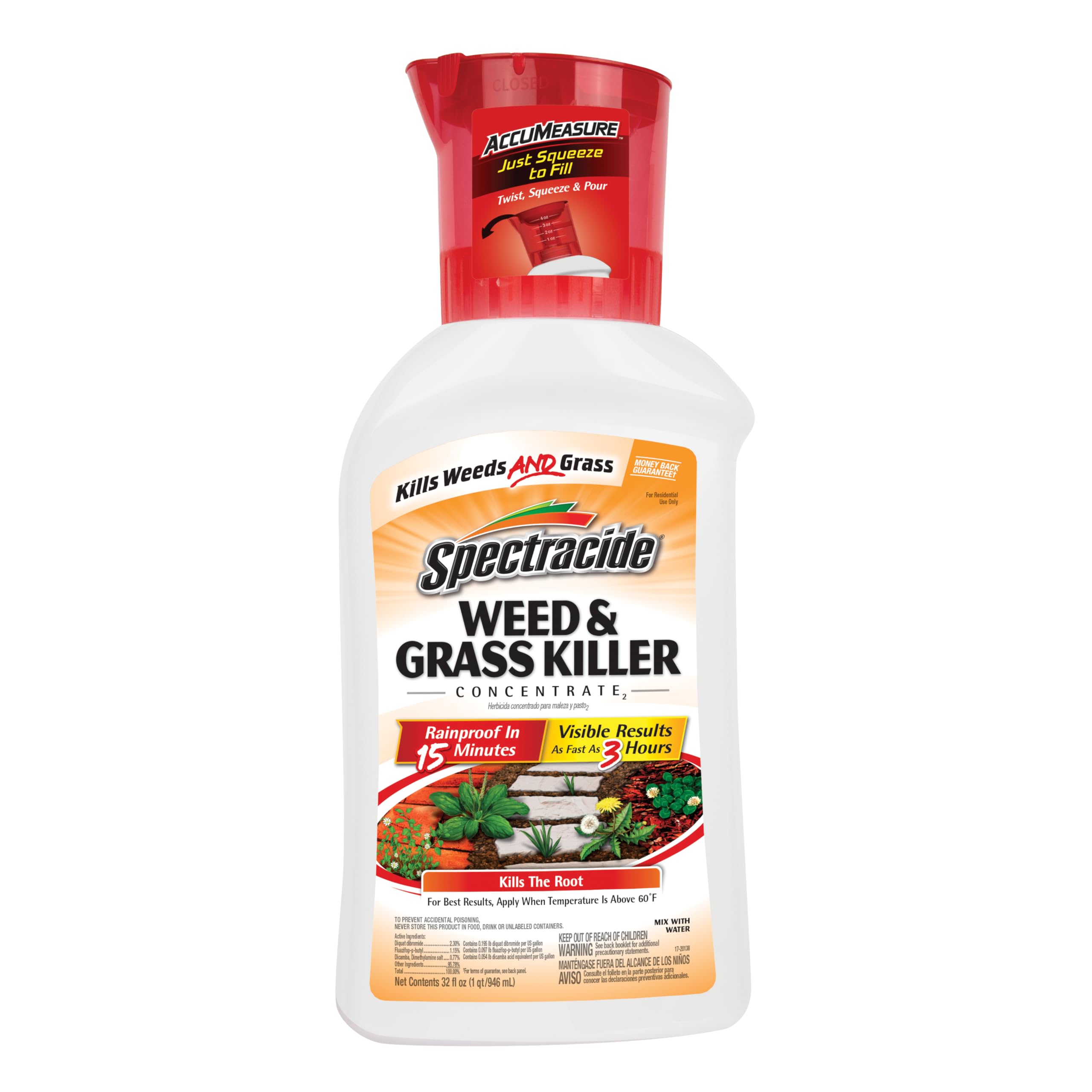
6. Spectracide Weed and Grass Killer Concentrate, 32 Ounces, With Accumeasure System
The diquat-based scorcher that turns weeds brown before lunch.
If you want visible results fast — and we mean three hours fast — Spectracide’s diquat dibromide formula is the speed king here. The active ingredient is a contact herbicide that disrupts the plant’s cell membranes on contact, causing rapid desiccation. It is a non-selective killer, meaning it obliterates anything green it touches, so use it on driveways, walkways, around fences, and in flower beds where you are okay with bare soil. The 32-ounce concentrate covers 1,350 square feet when mixed properly.
The Accumeasure cap is an interesting feature — you twist, squeeze, and pour the correct amount of concentrate directly into your sprayer without a measuring cup. Some owners find it genuinely convenient, others call it gimmicky and just use a regular lid. The core chemistry, however, gets high marks: 108 positive mentions of effectiveness place it among the most praised sprays on the list. Buyers regularly call it better than Roundup for raw killing speed, with one stating “it kills the weeds along my curb within a day.” The formula is also rainfast in 15 minutes, so a passing drizzle is not a disaster.
The trade-off is that diquat is a contact killer — it burns what it touches but does not travel systemically to the roots. Tough perennial weeds with deep root systems may resprout in a few weeks, requiring a follow-up application. For annual weeds and grass, it is a one-and-done.
The one-liner: The fastest-acting non-selective concentrate available, but be ready to re-spray on deep-rooted perennials.
Best for: homeowners who want weeds gone by the weekend and are happy with a contact kill on annual weeds and grass.
Not the best for: poison ivy or established blackberry brambles that need systemic root kill.
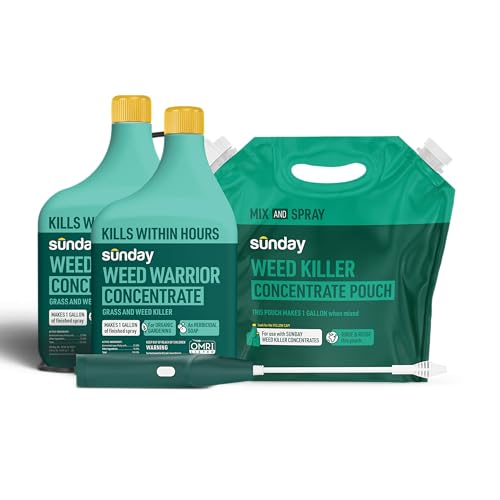
7. Sunday Weed Warrior Concentrate Kit, Organic Weed & Grass Killer
The organic kit that wilts weeds in 20 minutes and is safe for bees and chickens.
This is the most comprehensive organic solution on the list. The kit comes with two 22-ounce concentrate bottles, a reusable mixing pouch, and a battery-powered wand sprayer. Mixed together, the two concentrates make two full gallons of finished spray — more per bottle than typical ready-to-use options. The active ingredient is 22% ammoniated soap of fatty acids, an OMRI-listed herbicidal soap that dehydrates weeds on contact. It is non-selective, so it kills anything it touches, but it is also non-staining on concrete, brick, and asphalt.
The speed is genuinely impressive for an organic product: owners mention seeing weeds wilting within 20 minutes and full results within hours. The safety profile is the biggest selling point — it is safe around pets, chickens, and bees once it dries, which is why it gets so many positive mentions for safety (20 mentions, the highest single aspect). One owner called it “awesome” for use around their bee population and chickens. The honest catch is that effectiveness gets overwhelmingly mixed feedback — 159 mentions, and they are split. Some owners find it transforms their yard; others say it does not kill weeds at all. The hand pump sprayer and bag design also draw criticism for being tiring and awkward.
This is a niche pick: it is the best choice for the organic gardener who has pets and chickens and needs something safer than synthetic chemicals. But it demands realistic expectations — it is a contact-kill soap, not a systemic root killer, and it requires thorough leaf coverage and likely multiple passes on tough weeds.
What Makes It Special
- Pet, chicken, and bee safe once dry — the safest option here
- Kills weeds on contact in 20 minutes
- Makes 2 gallons of spray from the two concentrate bottles
What to Know
- Effectiveness is inconsistent — some yards respond well, others do not
- Hand pump sprayer is tiring to use for large areas
- Non-selective: it also kills grass and desired plants on contact
Choose this if: you have pets, chickens, or a bee-friendly garden and need an OMRI-listed spray for spot-treating driveway cracks and garden perimeters.
look elsewhere if: you need a guaranteed root kill on deep perennial weeds — go with glyphosate or diquat.
8. Hi-Yield (33701) Super Concentrate Killzall II, 2.5 gal

The farm-size jug of 41% glyphosate for operators who measure in gallons, not ounces.
When you are spraying fence lines from an ATV with a 16-gallon tank, the 2.5-gallon jug of Hi-Yield Killzall II is the right size. It is a super-concentrate containing 41% glyphosate — the same active ingredient as Roundup but at a more concentrated level and a fraction of the per-gallon cost. It reaches the roots in one to two hours and provides visible results in as little as three hours, making it faster-acting than many consumer glyphosate products. It controls annual and perennial grasses, broadleaf weeds, and woody brush species.
The buyers here are acreage operators and serious homesteaders. Reviews consistently praise the price-to-value ratio, calling it a great Roundup replacement that “kills what Roundup kills for a lot less.” One owner with a 16-gallon ATV sprayer uses it to keep his fence line clear. The effectiveness gets 48 positive mentions, and the consensus is that it works on all types of vegetation. The honest caution from experienced users is that mixing instructions are complex for different applications — you need to calculate the right rate for each target weed, and protective gear is mandatory because this is commercial-grade chemistry.
The 25.6-pound jug is not a casual purchase. You need a separate sprayer, and you need to store it responsibly. But for the person managing multiple acres, the cost-per-gallon of finished spray is unbeatable.
The takeaway: The right tool for the heavy job — big land, big weeds, big jug. Not for the weekend warrior with a single dandelion patch.
Best for: acreage owners, farmers, and property managers who spray large areas with a tank sprayer or ATV rig.
Not for: small yards or homeowners without a separate sprayer and storage space.
9. RM18 Fast-Acting Weed & Grass Killer Herbicide, 2.5-gallon

The 106-gallon yield concentrate that covers seven acres of weed devastation.
The RM18 is the coverage king. This 2.5-gallon jug of concentrate makes up to 106 gallons of ready-to-use spray solution, covering an astonishing 318,000 square feet — roughly seven acres. It is a fast-acting non-selective herbicide that shows visible results in 12 hours, with the manufacturer recommending application on warm, sunny days when weeds are actively growing. The rate is adjustable: use 3 fluid ounces per gallon of water for easy-to-kill small seedlings, or 6 fluid ounces per gallon for larger, tougher weeds.
Long-term users are loyal — one owner reports using it for about five years straight, noting that it does not harm trees when used correctly. Another says it keeps the area under propane tanks and inside large flower beds clear when sprayed every three months. The formula is strong: “This stuff kills. I killed a bunch of stuff I didn’t want to kill,” one buyer admits, which is a reminder that non-selective means exactly that. The effectiveness gets 39 positive mentions, but the value-for-money and duration aspects receive mixed feedback — some owners find it excellent value, others consider it expensive given that the price point is a significant investment.
This is the ultimate pick for the person who wants to buy one jug and not think about weed killer for spraying season. The 23.3-pound jug requires a serious sprayer and a serious commitment, but the coverage math works out to pennies per square foot.
The Big Numbers
- Makes 106 gallons of finished spray from one 2.5-gal jug
- Covers 318,000 sq ft — seven acres of fence lines and pastures
- Visible results in 12 hours on a warm day
Consider First
- Requires a large tank sprayer and careful mixing
- Non-selective — will kill any plant it hits
- Mixed reviews on overall value given the initial investment
Reach for this if: you manage multiple acres of pasture, fence lines, or rights-of-way and want one jug to cover the entire property.
steer clear if: you need a spot-spray for a suburban yard — the jug is heavy and the quantity is overkill.
Understanding the Specs
Selective vs. Non-Selective
This is the single most important label distinction. A selective herbicide (like the Ortho WeedClear or Southern Ag Crossbow) targets specific types of plants — usually broadleaf weeds — while leaving grass unharmed. A non-selective herbicide (like Roundup III or Spectracide) kills any green plant it touches. If you spray a non-selective over your lawn, you will have a brown spot. Always confirm the label before spraying.
Active Ingredient Chemistry
Glyphosate is a systemic herbicide that travels from the leaf to the root, killing the whole plant over one to two weeks. Diquat dibromide is a contact herbicide that kills the leaf tissue in hours, but the root can survive. Ammoniated soap of fatty acids (herbicidal soap) dehydrates the leaf on contact and is OMRI-listed for organic use, but it is the weakest on deep-rooted perennials. Choose based on if you want root kill (glyphosate), speed (diquat), or organic safety (soap).
Concentrate vs. Ready-to-Use (RTU)
Concentrate requires you to mix the chemical with water in a sprayer. The trade-off is lower cost per gallon of finished spray and less plastic waste. Ready-to-use comes pre-mixed in a bottle with a spray nozzle — no measuring, no tank, but you pay mostly for water and the convenience. For a small yard, RTU is fine. For a large property, concentrate is the only economical option.
Rain-fast Time
This is the amount of time after spraying that you need the product to stay dry before a rain or sprinkler will wash it off. The fastest here is the Roundup III at 10 minutes. Organic soaps like Sunday Weed Warrior need three hours. If you live in a rainy climate, a short rain-fast window is critical, or your spray is wasted the moment a cloud passes over.
FAQ
Can I spray grass and weed killer on my lawn without killing the grass?
How long does it take for a grass and weed killer spray to work?
What is the difference between a concentrate and ready-to-use spray?
Will the spray harm my pets or children after it has dried?
Can I use a grass and weed killer spray in my vegetable garden?
Why do some weeds come back after I spray them?
How much rain can a spray handle before it washes off?
Is glyphosate safe to use compared to other weed killers?
What is the best spray for killing poison ivy?
How do I get the right mix ratio with a concentrate spray?
Final Thoughts: The Verdict
If you want one dependable pick, the grass and weed killer spray winner is the Southern Ag Crossbow because it combines barn-burning effectiveness on tough brush and perennials with an unbeatable 2.23-acre coverage from a single jug, backed by a 4.7-star crowd consensus. If you want a selective spray that will not harm your lawn while killing dandelions and crabgrass, grab the Ortho WeedClear with Comfort Wand. And for the organic gardener who needs a pet-safe option for spot-spraying around vegetables, the Bonide Captain Jack’s Deadweed Brew is the one to reach for.
How We Picked
We do not accept paid placement. Every pick is matched to a real buyer and a real use-case; we do not hands-on test units.
Sources & Methodology
Specifications: manufacturer listings and product documentation. Review insights: verified customer reviews, as of July 2026. Pricing: not shown on this page (it changes often); check the current price via the retailer link.
As an Amazon Associate, Lawn Gear Lab earns from qualifying purchases. This does not affect which products we feature.