
Specs are compiled from manufacturer listings and verified buyer reviews and can change over time — please confirm the key details on the product page before buying.
The problem with most weed killers is simple: they kill everything. Spray a non-selective formula in your flower bed and you might save yourself from pulling crabgrass, only to watch your petunias and hydrangeas curl up and die alongside it. What you actually need is a selective herbicide — one that targets grassy weeds like crabgrass, bermudagrass, and fescues while leaving your ornamental plants, shrubs, and broadleaf flowers completely untouched. That narrow distinction is the difference between a garden that thrives and one that gets nuked.
I’m Rikta — the founder and writer behind Lawn Gear Lab. This guide is built by comparing the manufacturers’ published specifications and the patterns across verified customer reviews, so you get each pick’s real strengths and trade-offs instead of marketing spin.
Below, you will find the best options for keeping your flower beds weed-free without harming the plants you actually want. This is your complete buyer’s guide to picking the right grass and weed killer for flower beds.
Our Picks at a Glance

How To Choose The Best Grass And Weed Killer For Flower Beds
Choosing a weed killer for your flower beds is different from picking one for your lawn. You are not trying to remove all plants — you are trying to remove only the grassy weeds while keeping the flowers, shrubs, and ornamentals. Here are the key factors that make the difference between a clean bed and a dead one.
Selective vs. Non-Selective Herbicides
This is the single most important distinction. A non-selective herbicide like glyphosate kills every plant it touches. That is great for a patio crack or a gravel path, but devastating in a flower bed. A selective herbicide, on the other hand, contains an active ingredient like fluazifop that targets the biology of grassy weeds (monocots) while leaving broadleaf plants (dicots) unharmed. Every product on this list is selective — they are designed to kill crabgrass, bermudagrass, and fescues without harming your petunias, hostas, or hydrangeas.
Ready-to-Use vs. Concentrate
Ready-to-use sprays come in a bottle with a sprayer attached. You pull the trigger and go. They are convenient for small beds and spot treatments, but you pay for the water weight. Concentrates require you to mix the product with water in a separate sprayer. They cost less per treatment and cover far more square footage — the Hi-Yield concentrate covers 28,800 square feet, which is enough for a large garden or multiple applications over the season.
Application Speed and Patience
Selective herbicides are not instant. Most take 7 to 10 days to show visible results, and some tough grass varieties take 3 to 4 weeks to die completely. This is normal — the chemical needs time to travel from the leaf down to the root system. If you need immediate results, you will be disappointed. These products work, but they work slowly.
Quick Comparison
| Model | Best For | Active Ingredient | Coverage | Form | Amazon |
|---|---|---|---|---|---|
| Ortho Lands B-Gon★ Best Overall | Ornamental landscapes | Fluazifop | 4 x 24 oz bottles | Ready-to-Use | Amazon |
| Ortho Grass B Gon (2-pack) | Small flower beds | Fluazifop | 2 x 24 oz bottles | Ready-to-Use | Amazon |
| Agrisel GrassOut Max | Large areas / 50+ weeds | Fluazifop | 7,272–15,294 sq ft | Concentrate | Amazon |
| Hi-Yield Grass Killer | Bermuda / tough grasses | Fluazifop-P-butyl | 28,800 sq ft | Concentrate | Amazon |
In‑Depth Reviews
1. Ortho Lands B-Gon Grass Killer for Landscapes (4-Pack)
Our pick — over 4★ from 450+ verified ratings; the strongest balance of quality and price.
The crowd favorite that takes out turf without touching your ornamentals.
This is the four-pack version of the formula owners reach for when they need to be absolutely sure the flowers will survive. The active ingredient is fluazifop, a selective herbicide that targets grassy weeds without harming broadleaf plants — including ground covers, evergreens, shrubs, and shade trees. Each bottle holds 24 fluid ounces, giving you a total of 96 fluid ounces across the pack.
The downside is speed. Buyers report it works slowly — clover may not be affected at all, and some tough grass varieties require repeated sprays over several weeks. That patience pays off, though. As one owner put it: “I bought this to kill the grass that was growing in my dymondia silver carpet — without killing the dymondia itself. It worked great!” The formula is glyphosate-free, so there is no blanket soil sterilization.
Compared to the two-bottle Grass B Gon below, this pack holds exactly twice the volume (96 ounces vs 48 ounces), making it the better value for anyone with multiple beds or a full landscape perimeter. A very small number of buyers found it ineffective even after four weekly sprays, but the dominant pattern across owner reports is strong results on grassy weeds around delicate ornamentals.
What wins people over
- Glyphosate-free formula safe around ornamentals, ground covers, and shrubs
- Four ready-to-use bottles mean no mixing and a full season of spot treatment
- Buyers consistently praise its ability to kill grass without harming flowers
The honest trade-offs
- Works slowly — visible results can take several weeks on tough weeds
- Not effective on clover or all broadleaf weeds (it is a grass killer, not a total weed killer)
- An occasional report of poor results, typically on very established grass
Who this fits: Gardeners with ornamental beds, ground covers, and shrubs who want a no-mix, grab-and-spray solution that is proven safe around their desired plants.
Think twice if: You need fast results or want to kill broadleaf weeds — this targets grass only and works slowly.
2. Ortho Grass B Gon Garden Grass Killer (2-Pack)

A solid, lower-volume version of the same reliable formula.
This is essentially the same active chemistry as the Lands B-Gon above — fluazifop — but in a two-bottle pack rather than a four-bottle one. Each of the two bottles holds 24 fluid ounces, for a total of 48 fluid ounces. That makes it a good entry point if you have a couple of small flower beds rather than a whole landscape perimeter to treat. The formula remains selective, meaning it kills crabgrass, fescues, and bermudagrass without damaging your iris beds or shrubs. Buyers confirm it: “Used it on my Iris flower beds. Killed the grass but did not harm Irises.”
The biggest practical difference from the Lands B-Gon is the volume gap — 48 ounces here vs 96 ounces in the four-pack above, a direct 2x difference. If your garden is small, the two-pack keeps your upfront cost lower. But if you have multiple beds, the four-pack is the more economical route in the long run. The main complaint here is consistency: a few owners mention the product did nothing to their grass even after using the whole bottle. Leaking during shipping is also a recurring nuisance.
Something else worth noting: the customer consensus calls this product easy to use — it is ready to spray and waterproofs in about an hour. The flip side is that the overall effectiveness feedback is mixed, with roughly as many five-star “works great” reviews as one-star “did nothing” reviews. For the price, it is a low-risk try for a small bed, but it is not the most concentrated or fastest option on this list.
The standout traits
- Ready-to-use with no mixing required; waterproof in one hour
- Selective formula kills grassy weeds without harming flowers and shrubs
- Lower upfront cost makes it a low-commitment trial
What to keep in mind
- Effectiveness is inconsistent — some customers note zero results
- Bottles are prone to leaking during shipping if not well-packed
- Works slower than many expect; not an instant kill
Reach for this if: You have a small flower bed or two and want a simple spray-and-forget option to test whether a selective herbicide fits your routine.
Look elsewhere if: You need guaranteed results on tough grass or want maximum coverage per dollar — the concentrate options below go further.
3. Agrisel GrassOut Max Weed Killer
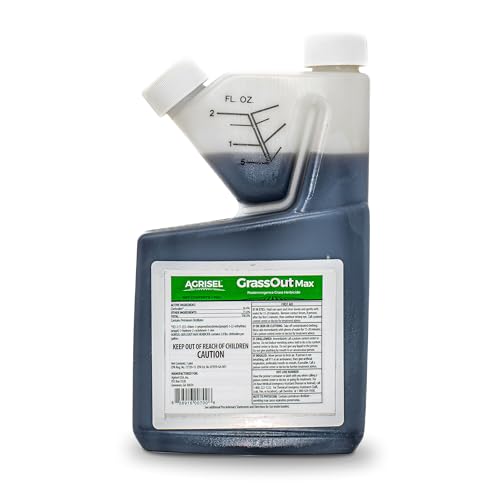
The high-coverage concentrate that targets over 50 types of grassy weeds.
This is where you shift from ready-to-use convenience to concentrate economics. A single 16-ounce bottle of GrassOut Max mixes at a rate of just 1.1 to 2.3 ounces per 1,000 square feet, covering between 7,272 and 15,294 square feet depending on dilution. That is a massive range compared to the Ortho ready-to-use bottles above — each of those covers roughly a single small bed, while this one can handle a whole property perimeter. Like the Ortho products, it uses a selective formula (fluazifop) that kills grassy weeds without harming broadleaf flowers and shrubs.
The trade-off is that this is a concentrate — you need a separate sprayer, and you need to measure and mix. The company’s “Tip and Pour” bottle design is meant to make that easier, but it is still not as grab-and-go as the Ortho spray bottles. Reviewers point out it takes 7 to 10 days for the grass to start dying, and tougher, taller grasses (1 to 2 feet) may need a bit longer. As one owner described it: “We sprayed the grasses and it took 7-10 days to start dying, and the grasses were 1-2 feet tall and it got them good, allowing our okra and squash to finally grow.”
The honest note is that effectiveness is the most-discussed aspect among buyers, and the consensus is mixed — some find it excellent on clover food plots or dense ground cover, while others call it ineffective in flower beds. The product is also EPA-approved, which adds a layer of regulatory confidence. If you are treating a large area and do not mind mixing, this delivers far more coverage per ounce than any ready-to-use option.
Where it excels: You get the most coverage per bottle of any concentrate here — 16 ounces treats up to 15,294 square feet, so it is a real value for a large garden or landscape. You need patience; the kill is not fast, but it is thorough on grass varieties up to 2 feet tall.
The one caution: Effectiveness varies by weed type and application timing. Some shoppers say it did nothing in their beds, so your results may depend on spraying at the right growth stage.
4. Hi-Yield Grass Killer (Fluazifop-P-butyl)
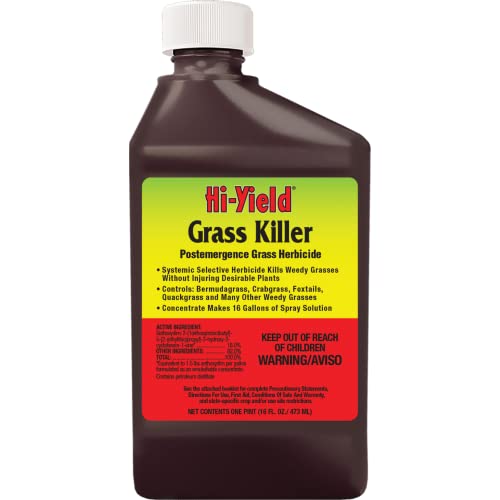
The most economical concentrate with the widest coverage of any pick here.
Hi-Yield takes the coverage crown by a wide margin. A single 16-ounce bottle makes 16 gallons of spray solution, covering up to 28,800 square feet. That is roughly two-thirds of an acre, or enough to treat a very large garden multiple times over a season. To put that in perspective, the Agrisel GrassOut Max covers at most 15,294 square feet — this Hi-Yield provides nearly double the coverage from the same-size bottle. The active ingredient is fluazifop-P-butyl, a slightly more refined version of the same selective chemistry used by Ortho and Agrisel.
The biggest knock is that results are uneven. Some buyers report it kills crabgrass with little damage to monkeygrass, and it handles bermudagrass effectively within days. Others say it did nothing after multiple applications over two weeks. A recurring note from experienced buyers is that this product really benefits from adding a crop oil surfactant — without it, the spray evaporates too quickly to penetrate the grass leaf effectively. The company does include instructions for use, but the need for crop oil is something many buyers learn the hard way.
The safety record around ornamentals is solid — owners mention it “kills tall fescue in gardens without harming vinca” — but the slow action (3-4 weeks on Japanese stiltgrass) and occasional total failure mean this is best for someone who already knows how to mix and apply concentrates. If you are new to herbicides, the ready-to-use Ortho options above are more forgiving.
The big advantages
- Massive 28,800 sq ft coverage from a single 16-ounce bottle — best value per square foot
- Selective post-emergent formula safe around vegetables, trees, shrubs, and ornamentals
- Stops grass growth within 2 days of application (visible dieback follows)
The honest limitations
- Results are inconsistent — some customers note zero effect after multiple sprays
- Works best with a crop oil surfactant, adding an extra purchase and step
- Leakage during shipping is a common complaint in reviews
Best for: Large properties, tough bermudagrass problems, and gardeners who are comfortable mixing concentrates and adding surfactants for maximum adhesion.
skip it if: You want a grab-and-spray solution or are trying selective herbicides for the first time — the ready-to-use options above are more predictable for beginners.
Understanding the Specs
Selective Herbicide (Fluazifop)
This is the active ingredient in every product on this list. It works by being absorbed through the leaves of grassy weeds and then traveling down to the root system, disrupting growth at the cellular level. Broadleaf plants like flowers, shrubs, and ornamentals have a different biochemistry that is not affected by fluazifop, so the chemical passes through them harmlessly. That is why you can spray it directly over your flower bed and only the grass dies.
Ready-to-Use vs. Concentrate
A ready-to-use spray comes premixed in a bottle with a trigger sprayer. You pull the trigger and apply it directly to the weed. It is convenient for small beds and spot treatments, but you are paying for the water that dilutes it. A concentrate is a small bottle of pure chemical that you mix with water in a garden sprayer. It costs less per treatment and covers much more area — the Hi-Yield concentrate covers 28,800 square feet versus roughly 100-200 square feet from a single ready-to-use bottle.
Post-Emergent Application
All of these products are post-emergent, meaning they kill weeds that have already sprouted and are actively growing. They do not prevent new weeds from germinating. If you want pre-emergent protection (stopping seeds from sprouting), you would need a different product like a pre-emergent granular applied in early spring. These sprays are for cleaning up existing grass invasions in your flower beds.
Coverage Area
Coverage is expressed in square feet for concentrates and in fluid ounces for ready-to-use sprays. A concentrate label saying “covers 28,800 square feet” means one full bottle, mixed at the recommended rate in water, can treat that entire area once. A ready-to-use bottle says “24 fluid ounces” — that is the total liquid you can spray, and it typically covers a few small to medium beds before it runs out.
FAQ
Can I spray a grass killer directly over my flowers?
How long does it take for a selective grass killer to work?
Will a grass killer for flower beds kill crabgrass?
Can I use this around my vegetable garden?
Do I need a sprayer for a concentrate herbicide?
What is the difference between fluazifop and fluazifop-P-butyl?
Is a ready-to-use spray or concentrate better for flower beds?
Can I use a grass killer on my lawn to kill crabgrass without harming the grass?
Why does my grass killer seem to not work on some weeds?
Is a grass killer safe for pets once it dries?
Final Thoughts: The Verdict
For most people, the grass and weed killer for flower beds winner is the Ortho Lands B-Gon because it combines a trusted selective formula with ready-to-use convenience, and the four-pack gives you enough volume for a full season of spot treatments. If you want the best coverage per dollar and are comfortable mixing concentrate, grab the Hi-Yield Grass Killer — its 28,800 square feet of coverage is class-leading. And for a low-cost trial on small beds, the Ortho Grass B Gon two-pack is the one to reach for.
How We Picked
We do not accept paid placement. Every pick is matched to a real buyer and a real use-case; we do not hands-on test units.
Sources & Methodology
Specifications: manufacturer listings and product documentation. Review insights: verified customer reviews, as of July 2026. Pricing: not shown on this page (it changes often); check the current price via the retailer link.
As an Amazon Associate, Lawn Gear Lab earns from qualifying purchases. This does not affect which products we feature.