
Specs are compiled from manufacturer listings and verified buyer reviews and can change over time — please confirm the key details on the product page before buying.
A lawn that feels spongy underfoot, collects puddles after a rain, or grows patchy is telling you the soil is too tight. Roots need air as much as they need water, and when the ground hardens, the grass starves. The fastest fix is a manual aerating tool — you push steel tubes or spikes into the earth, pull out a plug or punch a hole, and let the lawn breathe again. The trick is picking the right one: a spike tool punches holes, while a core (plug) tool actually removes a slug of soil, delivering deeper relief.
I’m Rikta — the founder and writer behind Lawn Gear Lab. This guide is built by comparing the manufacturers’ published specifications and the patterns across verified customer reviews, so you get each pick’s real strengths and trade-offs instead of marketing spin.
You want a lawn that breathes and drains, not one that stays hard and waterlogged. The right grass aerating tool punches holes into compacted soil so air, water, and nutrients reach the roots. This guide covers the top picks for different yards and budgets, from a quick spike fix to a full core-pulling revival.
Our Picks at a Glance

How To Choose The Best Grass Aerating Tool
Before you browse, understand that not every aerator works the same way. Your soil type and yard size should drive the decision.
Spike vs. Core (Hollow Tine)
A spike tool pushes solid steel rods into the ground, creating narrow holes. This is quick and good for mild compaction. A core tool uses hollow tubes that lift a plug of soil out of the ground, which lets air and water reach deeper. Core tools do more for improving root health, especially in heavy clay soil.
Handle Height and Footplate Size
A taller handle — around 36 to 42 inches — saves your back because you stand straighter. A wide, stable footplate lets you transfer your full weight into the soil without the tool tipping, and it accommodates any boot size comfortably.
Spike Length and Tine Count
Look for spikes at least 2.75 to 3.5 inches long for meaningful depth. More tines mean more holes per press, but they also demand more force. A 15-spike model covers ground faster, while a 3-tine core tool gives deeper, more effective plugs.
Quick Comparison
| Model | Best For | Type | Tine/Spike Depth | Handle Height | Amazon |
|---|---|---|---|---|---|
| Lawn Aerator Tool (Core Aerator)★ Best Overall | Deep plug pulling | Core (Hollow Tine) | 3 hollow tines | 42 in | Amazon |
| Colwelt 38in Spike AeratorBest Value Spike | Small yards, budget | Spike | 3.5 in | 38 in | Amazon |
| Jardineer 36in Spike AeratorHomeowner Favorite | Home gardeners | Spike | 2.75 in | 36 in | Amazon |
| 15-Spike Spring-Assist Aerator | Efficient coverage | Spike | 3 in | 38 in | Amazon |
| Manual Core Aerator (3 Tines) | Plug consistency | Core (Hollow Tine) | 3 hollow tines | ~34 in | Amazon |
| Dolibest 4-Corer Aerator | Multi-plug efficiency | Core (Hollow Tine) | 3.5 in | 33 in | Amazon |
| EEIEER with Soil Basket | Neat work area | Core (Hollow Tine) | 3 hollow tines | 38 in | Amazon |
| Seeutek 23in Rolling Aerator | Large area coverage | Spike (Rolling) | 2 in | 23 in | Amazon |
| Landzie The Original | Professional-grade plugging | Core (Hollow Tine) | 3 stainless steel tines | 42.38 in | Amazon |
In‑Depth Reviews
1. Lawn Aerator Tool, Core Aerator Lawn Tool with Alloy Steel Material
Our pick — over 4.5★ from 100+ verified ratings; the strongest balance of quality and price.
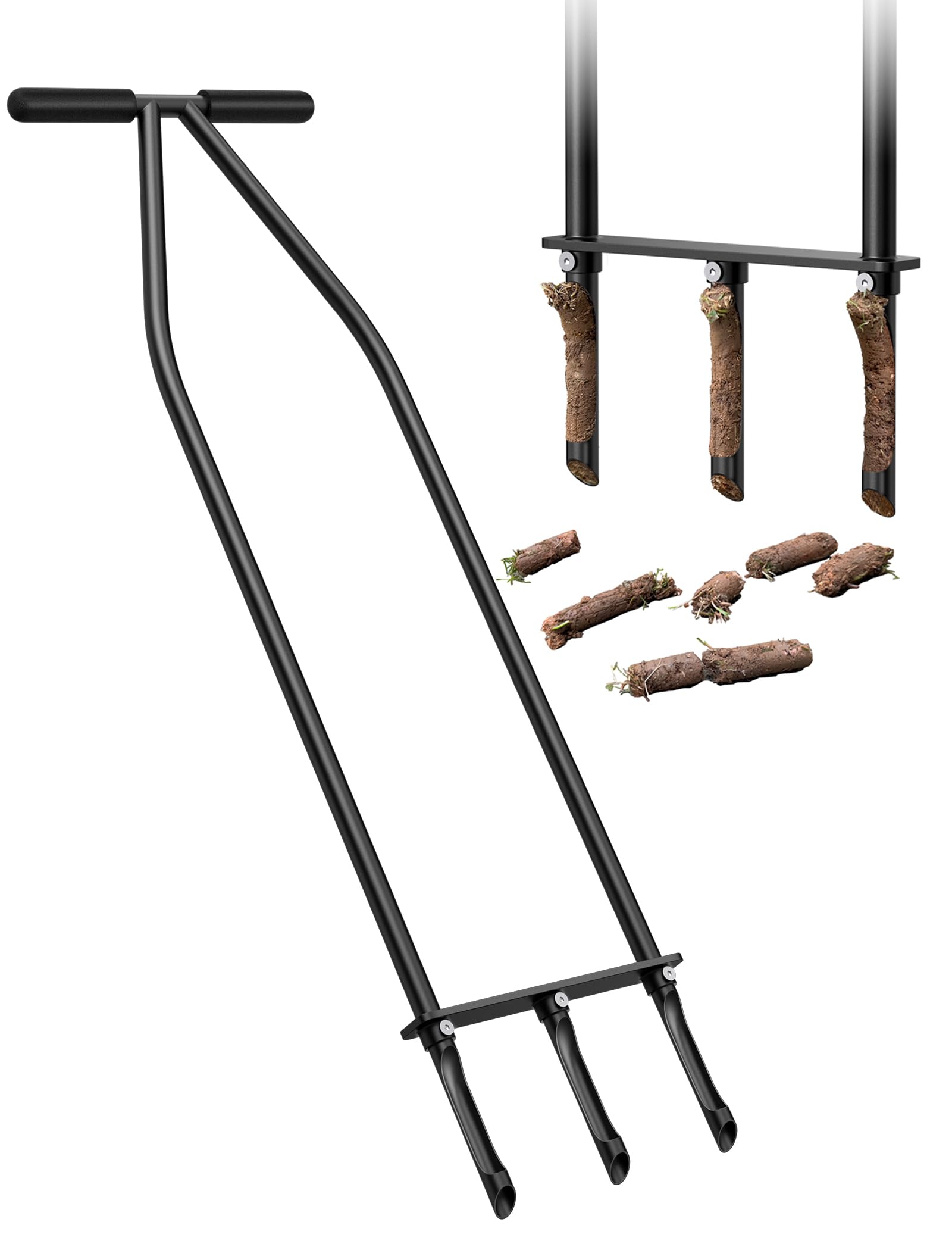
This core aerator unclogs itself — soil ejects sideways, not out the bottom.
The defining spec here is the patented design that forces soil plugs out the side of the tines instead of letting them jam. After thousands of tests the maker landed on a final tine shape, and the result is a tool that never needs shaking or poking to clear. You step on the footplate, it pulls a plug, and the soil slides out a ramp. That is a real time-saver when you are covering a yard, especially since each 42-inch press covers good ground.
Weighing 5.69 pounds and built from integrally-formed alloy steel, this is the heavier option among core aerators. Buyers specifically call out that the open-frame footplate spares your knee — one notes that the center bar on other brands caused knee issues, and this design eliminates that. The catch is this tool demands moist soil; in rock-hard dry ground it fights back. An owner also warns that the sharp tines need careful storage (they puncture skin easily).
At 42 x 11 x 1.9 inches, the dimensions give you a long reach and a stable base that stays planted during each press.
The Patented Advantage
- Self-ejecting plugs exit via a side ramp — zero clogging during use
- Open footplate frees your knee, letting you press without joint pain
- Replaceable hollow tines bolt on with screws for easy maintenance
The Honest Trade-Offs
- Hard, dry soil is tough to penetrate without pre-watering
- Sharp hollow tines are a puncture hazard — store the tool out of reach
- Heavier build (5.69 lb) is noticeable after extended work sessions
Reach for this if: you want a true core aerator that pulls real plugs and does not make you stop to unclog every ten presses — the side-eject design is a genuine upgrade over traditional manual pluggers.
Think twice if: your soil is consistently dry/hard clay; you will need to water it thoroughly first, and some owners still find the tool physically demanding on challenging ground.
2. Colwelt Lawn Aerator Tool 38inch, Heavy Duty Grass Spike Aerator
Thicker and longer spikes than the usual budget aerator — and the price stays low.
Where most entry-level spike aerators use 2.3-inch spikes that are 1/5-inch in diameter, this Colwelt tool bumps both measurements to 3.5 inches long and 2/5-inch thick. That extra length and girth means you create bigger holes with each plunge, which helps even with heavily compacted soil. The 38-inch total height keeps your back upright while you work, and at just 4.31 pounds it is noticeably lighter than the 5.69-pound core aerator above, which makes it less fatiguing for a long session.
Buyers report this tool is “easy to use and works well for a small area.” The cushioned T-handle and a 6-inch wide anti-slip footplate make the pressing motion feel stable. The most-discussed strength among owners is functionality — people who bought this were happy that it simply did the job without complication. One owner does note that you have to be able to step on it and pull up, which points to a physical requirement typical for all spike tools.
Compared to the Jardineer model below, this one has the edge in spike depth (3.5 vs 2.75 inches) and handles heavy compaction better.
Smart budget move: For around the cost of a fast-food dinner for two, you get a rust-resistant steel frame, a wide foot plate that fits large boots, and spikes that out-penetrate most competitors at this price tier.
Who should pass: If you want actual soil plugs removed (core aeration), this tool only makes holes — it does not pull cores, so for serious compaction your results will be less dramatic.
3. Jardineer Lawn Aerator Tool, Updated 36″ Spike Aerator
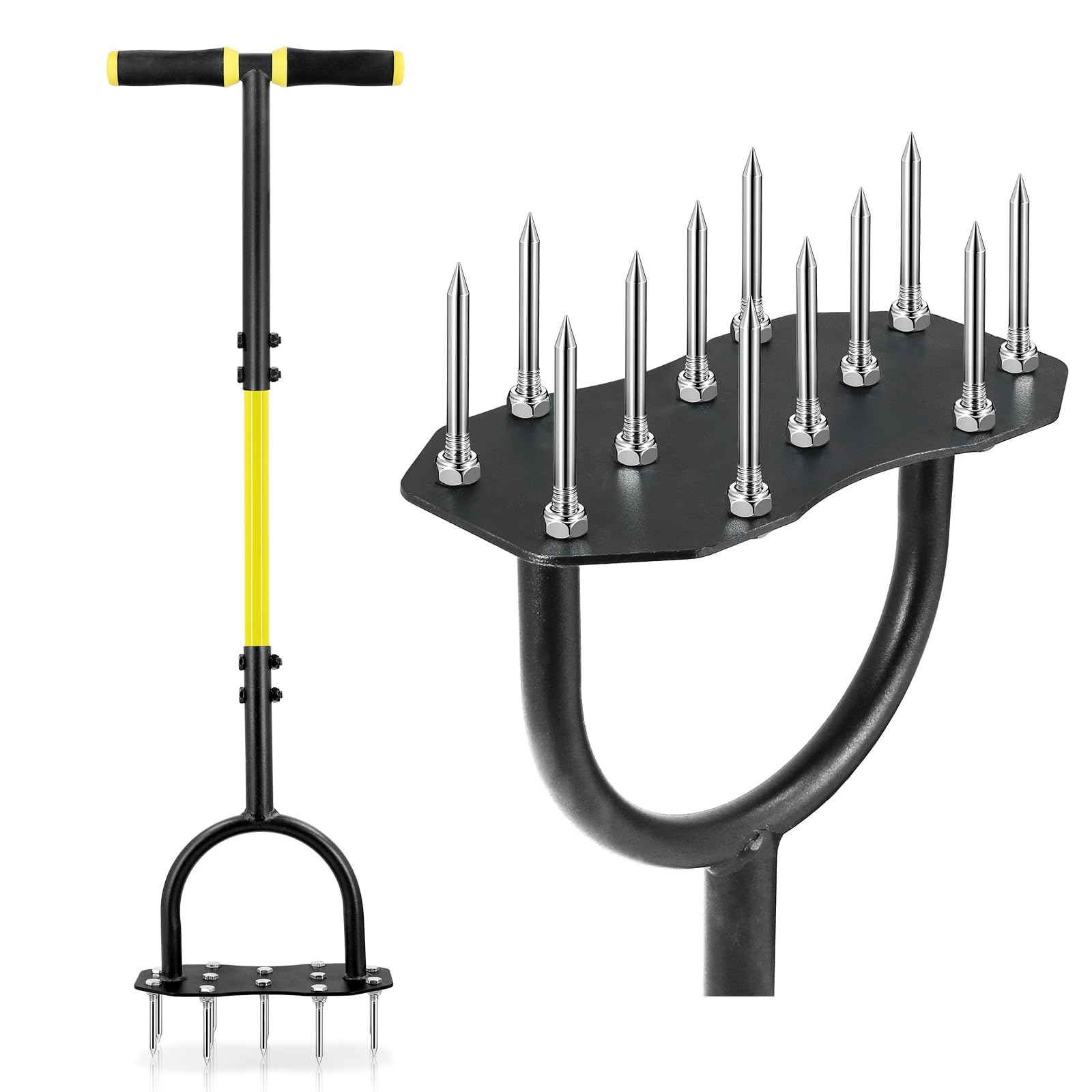
Twelve heat-treated spikes punch holes simultaneously, and it arrives almost ready to go.
Pre-assembled from the start — the aeration tool comes with only the handle needing a quick attachment. The 36-inch back-saving design plus a rubber grip on the handle reduces hand fatigue, and the thick steel foot plate takes your full weight without bending. Owners consistently call out the tool’s functionality as its best trait, with many noting it is “good for punching a bunch of little holes in your lawn.”
At 2.75 inches long, the spikes are shorter than the Colwelt’s 3.5-inch spikes. That difference matters in compact clay: the Jardineer spikes will still penetrate, but some owners mention bending when hitting rocks or buried plumbing. The manufacturer includes replacement spikes, which is a thoughtful touch. One owner notes the tool “may take a tiny bit of wiggles back and forth to get it in” with compact clay, but found it “was not hard at all.”
The main durability concern here is mixed reviews about the spikes bending. While many users report no issues after repeated use, others bent two spikes on the first use. Treat this tool carefully around hidden obstacles and it will serve well for regular home lawn maintenance.
What Owners Love
- Pre-assembled — attach the handle and you are done in minutes
- 12 spikes at once means fast coverage for a small yard
- Replaceable spikes included in the box reduce worry about breakage
The Mixed Bag
- Spikes can bend if they hit rocks or hard debris underground
- At 2.75 inches, the spikes are shorter than some competing tools
- Handles get dirty fast and the rubber grip dries slowly after washing
A solid choice for: the homeowner with a small to medium lawn who wants an inexpensive, simple spike tool for routine aeration — and doesn’t mind replacing a spike now and then.
Not ideal if: your lawn is overgrazed, rock-filled, or heavily compacted; the thinner spikes and shorter length may frustrate you, and you would be better served by the Colwelt or a core-pulling tool.
4. 15 Steel Spikes Lawn Aerator with Spring Assist
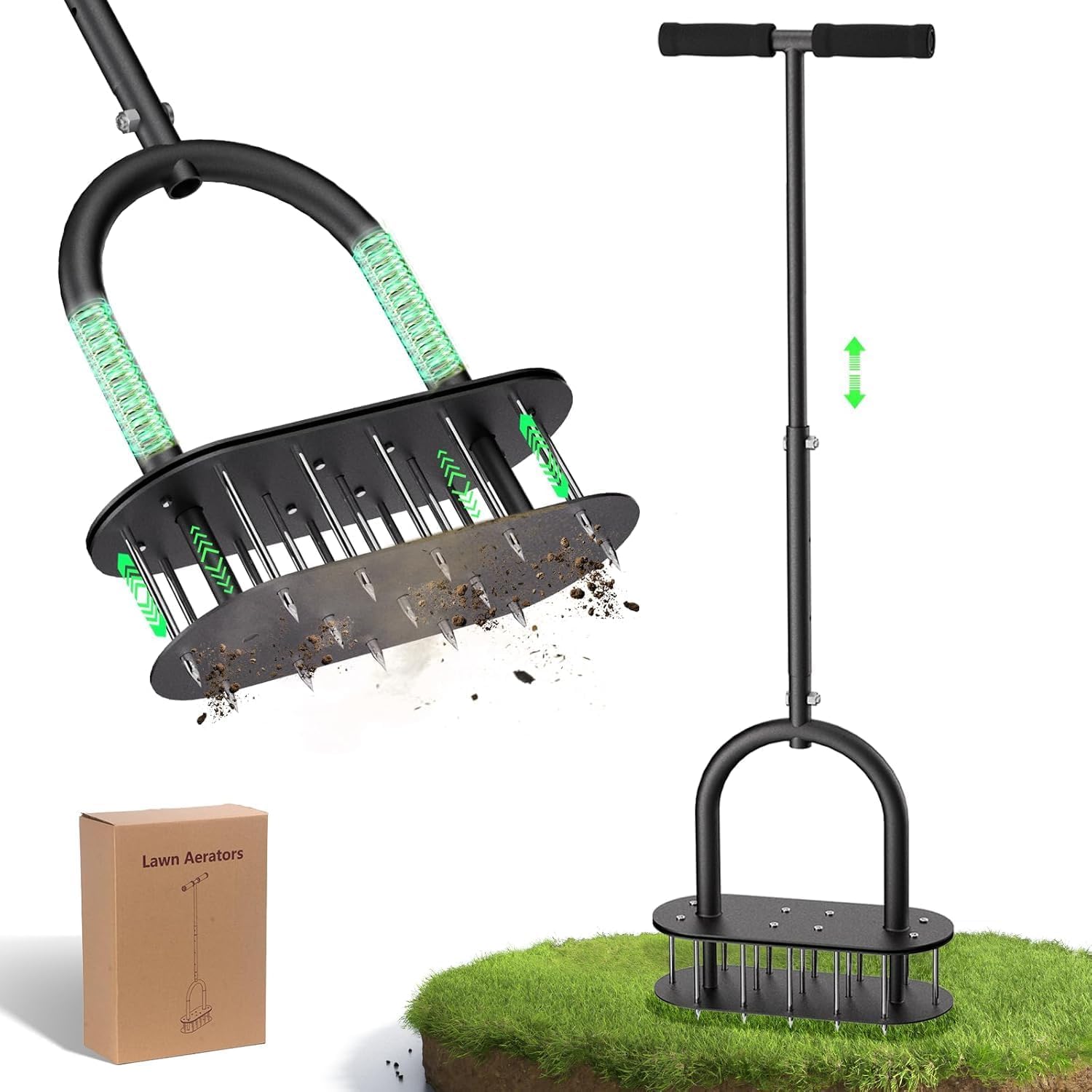
Fifteen spikes driven by a spring — one push, fifteen holes, less effort.
This aerator steps away from the classic step-pull rhythm by adding a spring that helps push the spikes down. Instead of only your body weight, the spring assists the motion, which is a real help in harder soil. The spikes are 3 inches long — a middle ground between the budget spike tools and the longer Colwelt spikes — and the 10.6-inch wide footplate keeps you balanced. At 5 pounds, it is light enough to carry around the yard without feeling like a chore.
Buyers confirm the simple 2-minute assembly is accurate, and many call the spring-loaded base a smart upgrade because it also cleans the spikes as they retract. One owner says the tool “penetrates easily and improves aeration” after a few uses, calling it “great value for money.” An important note: the spring needs correct orientation during assembly — if the concave interface on the tube connection base is installed backward, the tool won’t work. Check the photo instructions carefully.
The downsides are real: the spikes are thin by design (so they don’t roll up large chunks of dirt), but some owners wish they were thicker and longer. This is a speed tool, not a depth tool — ideal for quick maintenance aeration between deeper treatments.
Why It Works
- Spring assist reduces the physical strain of pressing into hard ground
- 15 spikes per press means fast coverage across medium lawns
- Rust-resistant baked enamel finish adds longevity
The Catch
- Spikes are thin and some owners prefer thicker, longer tines for deeper holes
- Assembly orientation is critical — get the concave base backward and the tool binds
- Not intended for deep core removal; this is purely a spike-punching tool
Best for: someone who wants a faster, less exhausting way to punch a lot of holes in a medium lawn — the spring makes a real difference when you have 5,000 square feet to cover.
skip it if: you need soil cores removed for deep root aeration; this tool only drives spikes, and the 3-inch depth is modest for heavy clay.
5. Manual Core Aerator Lawn Tool with 3 Hollow Tines (Orange)
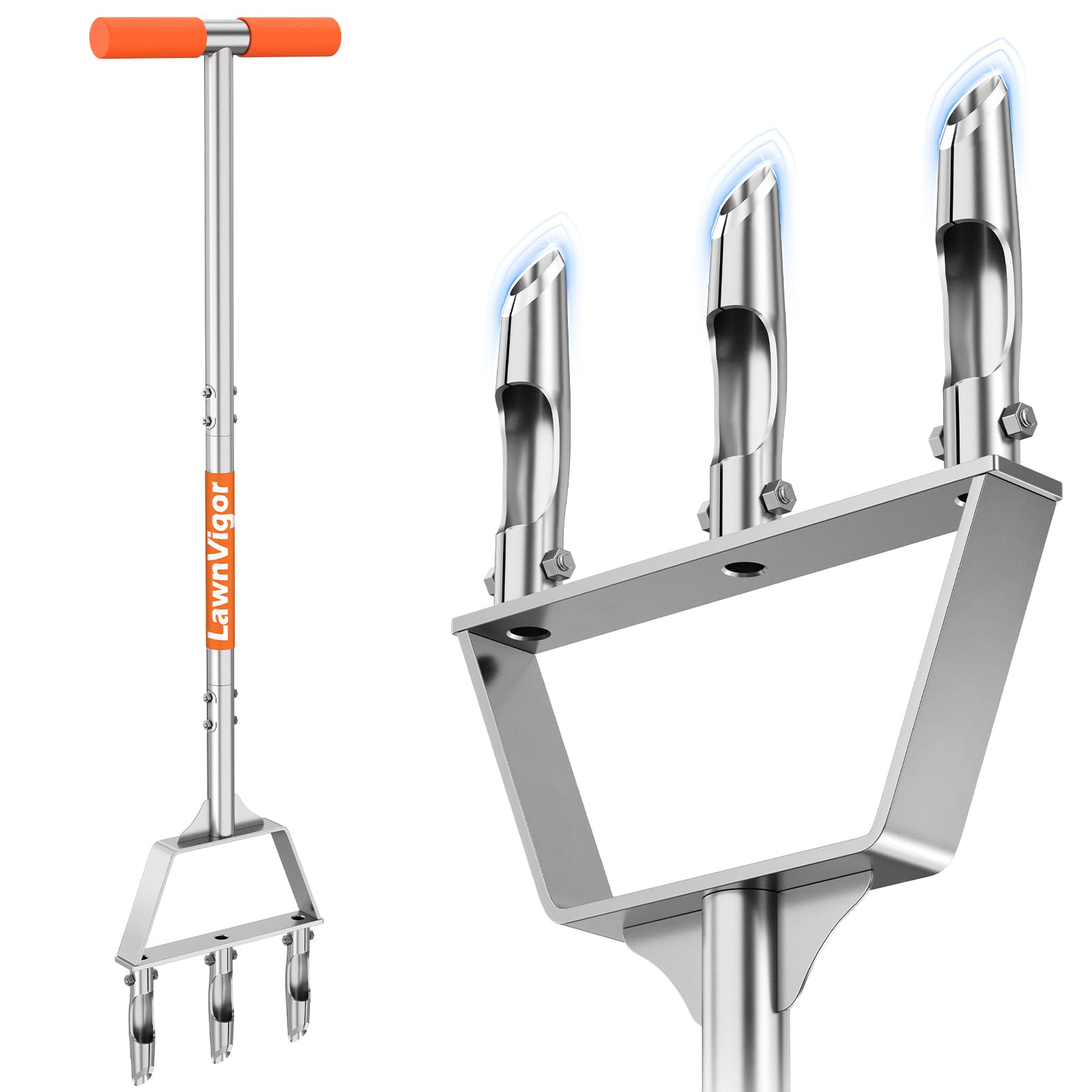
Three heat-treated tines that pull 3-inch plugs and refuse to clog.
The defining feature here is the non-clogging hollow-tine design. Large dirt-release holes at the top of each tube let the soil plug fly out instead of jamming inside the barrel. Customers note consistent plug extraction without shaking or poking, which is rare at this price tier. The semi-assembled setup takes a few minutes with the included tools, and the T-handle foam grips give solid purchase even with sweaty hands.
At 3.52 pounds, this is one of the lightest core aerators in the roundup — at 3.52 pounds versus the Landzie at 5.6 pounds. That makes it easier to carry and less fatiguing over a 1,000-square-foot lawn. Buyers call it “10x better than the first manual core aerator I purchased.” One owner who used it on compacted Bermuda grass said it delivered immediate results: the lawn felt softer and the soil was noticeably looser after a single session.
The honest trade-off is that this tool demands care. The manufacturer warns not to rock, twist, or pry it sideways when the tines are in the ground — that bends the hollow tubes. Also, the white plastic inserts inside the tines must stay in place; owners who removed them found plugs stuck. A few owners note that the foam handle grips can spin if they come loose; a dab of adhesive fixes it.
The Strong Points
- Non-clogging ejection system works reliably — no shaking or poking required
- Lightweight at 3.52 lbs makes it easy to handle for a full afternoon
- Heat-treated hollow tines stay sharp and penetrate tough soil
The Fine Print
- Do not rock or twist the tool while tines are in the ground — the tubes can bend
- The white plastic inserts inside tines must remain in place for proper ejection
- Foam grips on the T-handle can slip; some owners add a drop of glue
Grab this if: you want a lightweight, reliable core plugger for a small to medium lawn and can follow the care instructions (no rocking, keep the inserts in place).
Pass if: you are covering a very large yard (over 3,000 sq ft) — this is a small-area specialist, and the repetitive tine press will wear you out at scale.
6. Dolibest Lawn Coring Aerator, Stainless Steel 4 Corer Plug Aerator
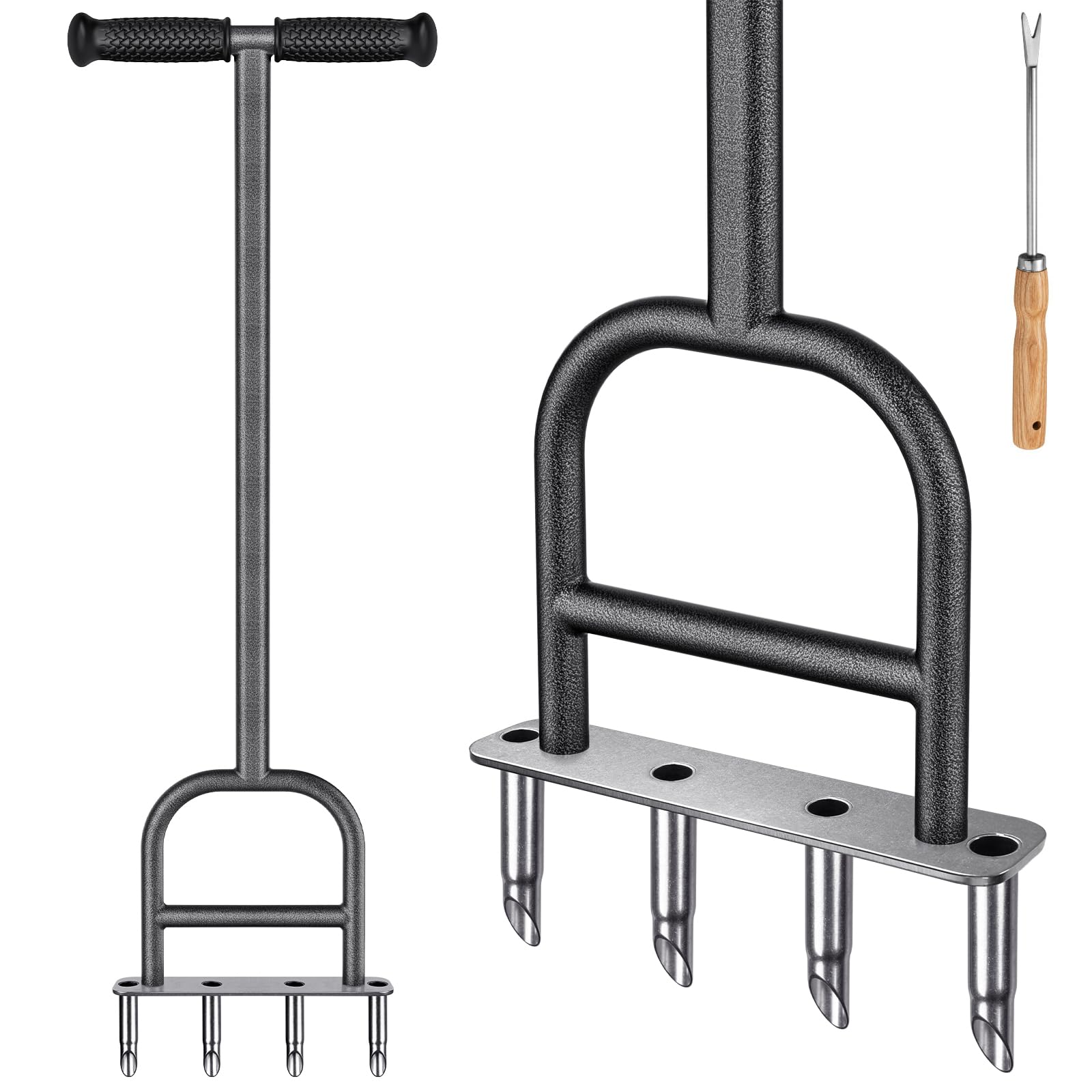
Four stainless steel corers that punch 3.5-inch deep plugs without rusting.
Most manual core aerators stop at three tines. This Dolibest tool goes to four, each one 3.5 inches long and half an inch in diameter. That means more plugs per press and faster coverage on a medium lawn. The stainless steel bottom and corer tubes are the key upgrade here — they resist rust and bending far better than painted mild steel. The tool weighs 5.54 pounds, putting it in the heavy class, but the single welded construction frame means it will not flex or break under stress.
Owners confirm it works “even in heavy clay,” which is the gold standard for a core tool. The foot bar is designed to keep your shoe away from the plug ejection path, so you do not crush the soil cores as they come out. However, the tool has a notable vulnerability: clogging. Reviewers point out that very wet soil causes frequent jams. One owner, who completed a large yard, had to clear the tines only eight times in two hours, which is decent. But another notes that the rounded foot step reduces leverage, limiting effective depth to about 2 inches instead of the full 3.5.
The included 12-inch weeder handle is a clever bonus for cleaning the tines and general garden work.
What Wins People Over
- Four tines per press accelerate work versus standard three-tine models
- Stainless steel tubes and bottom resist rust far better than painted steel
- Single welded construction is extremely sturdy, surviving hard use
Where It Struggles
- Clogging can be an issue in wet, sticky clay — moist but not soaked is the balance
- The rounded foot step reduces leverage for deeper penetration
- Four tines require more muscle than a three-tine tool
Choose this for: faster plugging on medium lawns where the extra tine saves time and the stainless durability justifies the price.
Avoid if: your soil stays soggy or you have a very small yard where the extra tine is unnecessary — the 3-tine manual core aerator above may be a better fit.
7. EEIEER Manual Lawn Aerator Tool with Soil Storage Basket

The upgrade that catches every soil plug so you do not have to rake afterward.
This is the only tool in the list with an integrated soil storage basket that collects the plugs as they eject. Instead of leaving a trail of dirt cores across your lawn, the frame holds them so you can dump the basket in one spot. It is a genuine convenience for anyone who hates the cleanup after core aeration. The 38-inch ergonomic handle reduces back strain, and the 4.3-inch improve foot pedal provides solid purchase for your boot.
The bottom uses a patented one-piece structure (not welded), which the maker says is less likely to break than conventional designs. The inner wall of the aerator is also thickened from 1.2mm to 2mm for extra durability. Owners find the build quality strong and note the tool “works well on pre-dampened ground.” The included cleaning stick is practical for clearing clogs and doubles as a weeding tool. However, this is not a tool for dry conditions — the soil storage basket can fill quickly, and cleaning it mid-job slows you down. Some owners at 5-foot-5 report the 38-inch handle causes back strain over extended use.
Compared to the Landzie below, this tool adds the basket convenience but shares the same physical demands — core aeration is never easy.
The Basket Advantage
- Soil storage basket catches every ejected plug — no post-aeration raking needed
- Patented one-piece bottom is stronger than welded alternatives
- Thickened 2mm wall reduces the chance of tine breakage
The Drawbacks
- Basket fills quickly and needs periodic emptying
- Clogging still occurs in damp soil despite the included cleaning stick
- Shorter users may find the handle causes back fatigue
Reach for it if: you want the tidiest possible core-aeration experience — the basket is a genuinely useful innovation that keeps your lawn presentable throughout the job.
Look elsewhere if: you are tall (over 5-foot-10) or your soil is consistently dry and hard, as this tool works best in moist conditions on smaller lawns.
8. Seeutek 23Inch Rolling Lawn Aerator

You push it like a lawn mower — rolling star-shaped spikes punch holes as you walk.
If the step-and-press rhythm of a manual core tool sounds exhausting, this rolling aerator offers a completely different motion. It weighs 24 pounds and uses 2-inch star-shaped spikes on a rotating drum. You push it across the lawn, and the spikes penetrate as the drum rolls. The height-adjustable padded T-bar handle is designed for a pushing motion, not a vertical press.
The key feature is the side filler hole on the drum, which accepts water or sand to increase weight and push the spikes deeper. One owner used an 8x16x2-inch concrete paving stone on top for extra weight. However, adding too much weight makes the tool extremely hard to push — it becomes “a strenuous workout” as one buyer put it. Owners recommend using it on a scalped (closely mowed) lawn for best results, since tall grass resists the rolling action. The laser-welded frame is solid, but assembly took one owner about an hour, and the instructions use small diagrams.
This is a niche tool: great for the person who wants to walk the yard rather than step-press, but limited by the need for additional weight and a well-prepared lawn surface.
The big appeal: You cover ground at walking speed without bending or pressing — the rolling action is gentler on your body than a manual step-press tool, and the adjustable height handle fits different user statures.
The real limitation: The 2-inch spike depth is shorter than any manual spike tool here, and you almost certainly need to add weight (sand, water, or a paver) to get meaningful penetration. Also, tall grass or thick thatch will stop the spikes from reaching soil.
9. Landzie – The Original Hollow Tine Lawn Aerator Tool
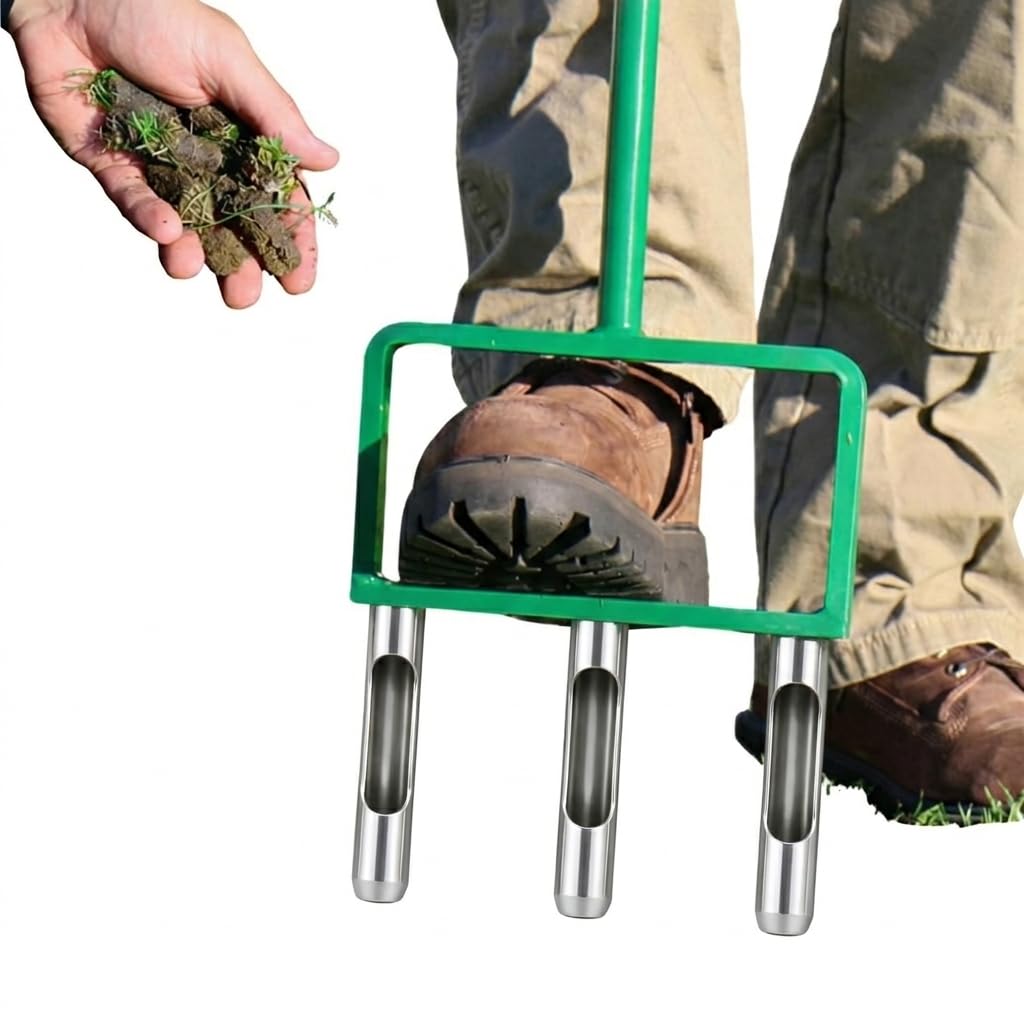
The original that arrives fully assembled with clog-free stainless steel tines.
Landzie built its reputation on a simple premise: a core aerator that never needs assembly and does not clog. The 42.38-inch handle is the tallest in the roundup, saving your back even if you are over six feet tall. The three stainless steel hollow tines are beveled on the inside to reduce friction, so soil plugs slide up and out instead of jamming. The maker claims the tines are “revolutionary clog-free,” and the majority of owners back that up — one notes that a full 2,200-square-foot job required zero cleaning of the tines.
At 5.6 pounds, it is the heaviest manual core tool here by a narrow margin (the first pick is 5.69 pounds). But the trade-off is a frame that owners say will “last many years.” The stainless steel bottom is a major advantage over painted steel — it does not rust, even when stored in a damp garage or shed. However, the honest reality check is that core aeration with any manual tool is intense physical work. One owner described it as “lawn care cross-fit” and reported a 2,200-square-foot lawn took four hours. The foot bar also comes up in reviews: it can be slippery when wet, so wear boots with good grip.
Spike length is not specified in inches, but the tines are a standard 3-core configuration and owners confirm they reach full depth in damp soil. The tines are replaceable (about for a set) and the tool includes a removal tool.
Why It Commands a Premium
- Stainless steel tines resist rust — this tool will outlast any painted-steel alternative
- Beveled inner tine design genuinely reduces clogging versus older core tools
- Arrives fully assembled and ready to use from the start
The Physical Reality
- Manual core aeration is labor-intensive — a moderate lawn can take several hours
- The foot bar becomes slippery in wet conditions; wear grippy boots
- Premium price tag compared to spike tools and non-stainless core tools
Choose this for: a lifetime tool that will not rust or clog — the stainless steel construction and no-assembly delivery make it the go-to for long-term lawn enthusiasts who accept that manual aeration is hard work.
pass on it if: your budget is tight or you only need a one-time treatment; a spike tool or the EEIEER basket model may serve your purpose at a lower price.
Understanding the Specs
Core (Hollow Tine) vs. Spike Aerator
A core aerator uses hollow tubes that cut and lift a plug of soil out of the ground. This removes compaction at the root zone and lets air, water, and nutrients reach deep. A spike aerator pushes solid rods into the ground, creating narrow holes that can actually compact the soil around the hole walls. Core tools are universally preferred for serious lawn health, but they demand more physical effort.
Spike/Tine Length and Material
Spikes should be at least 2.75 to 3.5 inches long to reach the root zone of most grass species. Stainless steel is the gold standard for rust resistance, but painted alloy steel can still last many years if kept dry. Heat-treated steel spikes are harder and resist bending when encountering underground rocks or buried debris.
Footplate Width and Handle Height
A wide footplate (6 inches or more) distributes your weight and keeps the tool stable during the press. Taller handles around 38 to 42 inches let you stand upright rather than hunching, which significantly reduces back fatigue during extended use. Adjustable-height handles are rare but helpful for households with multiple users of different heights.
Soil Preparation for Best Results
Every manual aerator works best on moist — not soaked — soil. Water your lawn thoroughly the day before or wait until a day after a good rain. Dry, hard soil can bend spikes, cause clogs in hollow tines, and make the tool nearly impossible to push deep enough. A simple pre-soak is the difference between a productive afternoon and a frustrating one.
FAQ
Will a spike aerator compact the soil around the holes?
How often should I aerate my lawn with a manual tool?
How long does it take to aerate a standard lawn manually?
What is the ideal soil moisture for using an aerator?
Can I use a manual aerator on a lawn with an underground sprinkler system?
Do I need to remove the soil plugs after core aeration?
How does a rolling aerator compare to a step-press core tool?
Are replaceable tines available for these tools?
Final Thoughts: The Verdict
The grass aerating tool that stands above the rest is the Lawn Aerator Tool with Alloy Steel because its self-ejecting side-ramp design eliminates the clogging frustration that plagues most manual core tools. If you want the best spike tool for smaller lawns, grab the Colwelt 38in Spike Aerator. And for a stainless lifetime tool that arrives ready to use from the start, the Landzie Original is the one to reach for.
How We Picked
We do not accept paid placement. Every pick is matched to a real buyer and a real use-case; we do not hands-on test units.
Sources & Methodology
Specifications: manufacturer listings and product documentation. Review insights: verified customer reviews, as of July 2026. Pricing: not shown on this page (it changes often); check the current price via the retailer link.
As an Amazon Associate, Lawn Gear Lab earns from qualifying purchases. This does not affect which products we feature.