
Specs are compiled from manufacturer listings and verified buyer reviews and can change over time — please confirm the key details on the product page before buying.
Getting a grapevine to pump out heavy, sweet clusters isn’t about luck — it’s about giving the roots the exact blend of nutrients they need at the right moment. The problem is that most all-purpose plant foods are built for leaves and flowers, not for coaxing fruit set and vine wood strength. You need a formulation that understands the unique demands of a fruiting vine, and the wrong bottle can mean plenty of foliage but hardly a handful of grapes.
I’m Rikta — the founder and writer behind Lawn Gear Lab. This guide is built by comparing the manufacturers’ published specifications and the patterns across verified customer reviews, so you get each pick’s real strengths and trade-offs instead of marketing spin.
Whether you are coaxing a single potted vine on a patio or managing a backyard row, knowing the difference between a granular slow-release and a fast-acting liquid makes or breaks your season. This is your complete guide to finding the best grape tree fertilizer that actually delivers fatter clusters and healthier vines.
Our Picks at a Glance
How To Choose The Best Grape Tree Fertilizer
Choosing the right plant food for vines depends on three main factors: the N-P-K ratio, the release speed, and if you want an organic or synthetic base. Here is what each one means for your grapevines.
N-P-K Ratio — What Your Vines Actually Need
The three numbers on a fertilizer bag stand for nitrogen, phosphorus, and potassium. Nitrogen pushes leaf and vine growth. Phosphorus supports root strength and fruit development. Potassium boosts overall plant health and disease resistance. For grapevines, a balanced ratio or one slightly higher in phosphorus — like a 1:1:1 or a 7:3:3 — is a solid choice. Too much nitrogen gives you a bushy vine with few grapes.
Granular vs. Liquid — Pick Your Application Style
Granular fertilizers (the dry pellets or powder you sprinkle and water in) release nutrients slowly over weeks or months. They are low-maintenance and reduce the risk of burning the roots. Liquid fertilizers, on the other hand, are absorbed almost immediately by the roots and leaves, making them a good pick for a quick mid-season boost or for stressed vines that need fast help. The trade-off is you have to mix and apply them more often.
Quick Comparison
| Model | Best For | N-P-K Ratio | Form | Feed Duration | Amazon |
|---|---|---|---|---|---|
| Miracle-Gro Shake ‘N Feed★ Best Overall | Citrus, avocado & mango trees | 8:2:10 | Granules | Up to 3 months | Amazon |
| TPS Grape FertilizerAlso Great | Fast vine recovery | N/A | Liquid | Every watering | Amazon |
| Soil Seed & Water Bacchus | Targeted grapevine feeding | N/A | Granules | Slow-release | Amazon |
| EB Stone Organic 7-3-3 | Organic berry & vine care | 7:3:3 | Granules | Slow-release | Amazon |
| Farmer’s Secret Fruit & Bloom Booster | Heavy bloom & fruit set | N/A | Liquid | Every 2-4 weeks | Amazon |
| Farmer’s Secret Fruit Tree Booster | Young & mature fruit trees | N/A | Liquid | Weekly | Amazon |
| Down To Earth 6-2-4 | Long-term organic orchard care | 6:2:4 | Granules | Slow-release | Amazon |
In‑Depth Reviews
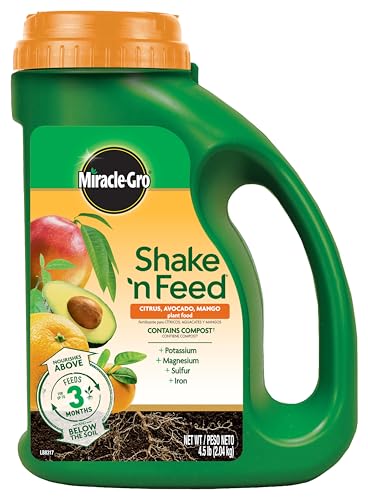
1. Miracle-Gro Shake ‘N Feed Citrus, Avocado, Mango Plant Food – 4.5 lbs.
Our pick — over 4.5★ from 4,500+ verified ratings; the strongest balance of quality and price.
The shake-and-feed giant that revived pale citrus trees in two weeks.
While this product is marketed primarily for citrus, avocado, and mango trees, its nutrient profile — potassium, magnesium, sulfur, and iron — addresses the common deficiencies that also plague grapevines, especially in container growing. The 8-2-10 ratio is heavier on potassium, which is excellent for fruit development and overall plant hardiness. Customers note that it revived pale, slow-growing Meyer lemon, Satsuma, and lime trees after winter, with leaves turning dark green and growth resuming within two weeks.
The application method is the standout feature here: you shake the granules evenly onto the soil within the spread of the branches, work it into the top 1-3 inches, and water. That is it for three months. For anyone managing multiple trees or vines, this convenience is a huge time saver. The formula also contains beneficial micronutrients to prevent the yellowing that often shows up in container plants.
Compared to the dedicated grape fertilizers above, this is a broader-spectrum tool. It is not grape-specific, so the N-P-K ratio is not tune for vines the way the TPS or EB Stone products are. However, for a gardener who has citrus trees alongside a grapevine, this one product can serve both.
The biggest praise: The “shake and feed” convenience paired with the micronutrient blend that fixes pale, nutrient-starved foliage fast. Owners call it a “great investment for plant health.”
A fair note: A few buyers mention the lid can be very hard to open on certain batches — not a product flaw, but worth knowing before you wrestle with it.
Best for: The multi-tree gardener who wants one slow-release granular that handles citrus, avocado, and even a grapevine without having to mix different formulas.
Not ideal if: You want a grape-specific N-P-K ratio and prefer an organic OMRI-listed product.
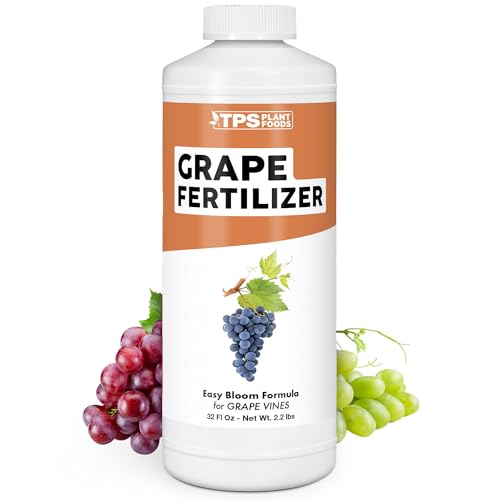
2. Grape Fertilizer – Liquid Plant Food for Bigger Harvests, Stronger Vines & Better Fruit Development, 32 oz
The liquid formula that puts the brakes on foliage and puts energy into fruit.
If you are working with a single vine in a pot or a small backyard row, this 32-ounce liquid from TPS Nutrients is the most direct way to get results. That makes it a strong contrast to nitrogen-heavy blends where you end up with a jungle of leaves and a handful of grapes.
Buyers report that a vine planted last year survived winter and then “grows fast with grapes” after regular feeding with this product. The recommended use is simple — mix with water in a standard watering can and apply. The bottle is made in the USA, and the concentrated nature means a quart lasts several applications. The crowd favorite status here is well earned: 4.6 stars across a solid base of owner feedback.
Compared to granular options like the EB Stone 7-3-3, this liquid feeds the plant immediately, which is useful if you spot a nutrient deficiency mid-season and want a quick correction. The trade-off is you have to stay on a schedule — owners mention the growth spurt slows when they skip a dose.
What wins people over: The balanced formula that puts fruit production ahead of leaf growth, backed by real owner stories of fast vine recovery and visible grape set.
A note on use: This is a liquid concentrate, so you mix it every time you water — it is not a sprinkle-and-forget granular. Perfect for someone who is hands-on with their vines.
Reach for this if: You want a fast-acting, grape-specific formula that delivers visible improvement in vine health and fruit development within days of application.
Look elsewhere if: You prefer a low-maintenance slow-release granular that only needs application every few months.
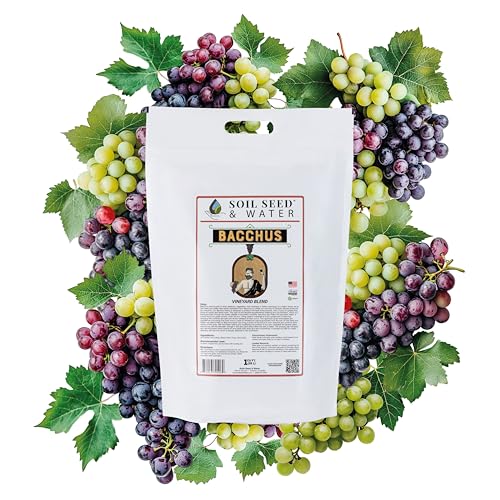
3. Soil Seed & Water Bacchus Organic Fertilizer for Grapevines – Concentrated Soil Amendment for Vineyards & Grape Fruit Production – OMRI Listed Organic Fertilizer
The organic granular that brought a nearly-dead vine back to heavy production.
This is the pick for the grower who values soil biology as much as the fruit itself. Soil Seed & Water’s Bacchus formula is an OMRI-listed organic concentrate designed to improve soil structure, aeration, and water retention while feeding the vine. Unlike synthetic salts that can degrade soil over time, this approach builds the ground your vine lives in.
The real-world results here are hard to ignore. Owners mention that the fertilizer revived a nearly dead Victoria Red grape vine in a pot, and that same vine produced many grapes last year with an even bigger harvest expected this season. Another owner says their vines have “never looked better” after spreading handfuls at the base and watering in. The consistency is described as dirt-like, not granular, which makes it easy to work into the soil.
Compared to the liquid TPS pick above, this one works slower but deeper — it is building long-term soil fertility, not just giving the roots a quick drink. The 1:4 mixing ratio (one part fertilizer to four parts water) is designed specifically for grapevines, making it among the most targeted products in this list.
The thing everyone raves about: The ability to revive struggling or neglected vines and push them into heavy fruit production within a single growing season. Owners are ordering repeat bottles.
One honest trade-off: Because it is a granular organic, results take a few weeks to become visible compared to a liquid feed. Plan ahead.
Best suited for: Organic gardeners who want to improve soil health long-term and are willing to wait for the slow-release benefits to kick in.
Not ideal if: You need an instant green-up or a fast rescue for a vine that is yellowing and stunted right now.
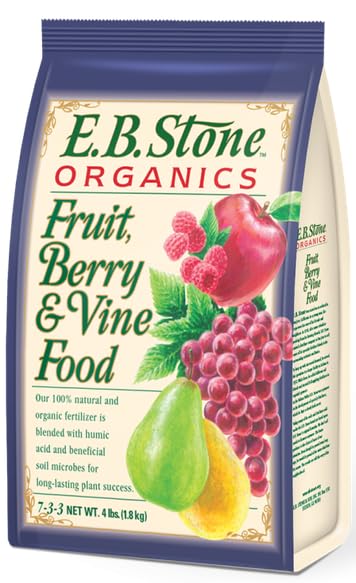
4. EB Stone Organic Fruit, Berry & Vine Food 7-3-3, 4 lbs.
An organic granular that makes your passion fruit vine go wild with fruit.
This 4-pound bag from EB Stone punches well above its weight class. The 7-3-3 ratio is rich in nitrogen to support lush foliage, with enough phosphate and potash to drive fruit production. It is formulated for fruit trees, berries, and fruiting vines, which makes it a versatile option if you have a mixed garden bed with grapes, blueberries, and a fig tree.
The owner feedback tells a clear story: one buyer reports that their “passion fruit vine went wild” with plenty of fruits after using this product. Another calls it “a must have for your vine.” The blend is made from select organic ingredients, so there are no harsh chemicals to worry about around kids or pets. The granules are easy to sprinkle at the base of the vine and water in.
Where this differs from the Bacchus product above is the higher nitrogen content (7 parts vs. 1 part). This is better for young vines that you are still building up before they fruit, or for varieties that need a bigger vegetative push in early spring. The trade-off mentioned by owners is a mild natural smell and the fact that a 4-pound bag may run out quickly if you have a large garden.
What owners love: The organic composition combined with the visible boost in vine vigor and fruit set — one reviewer says their plants “love this stuff.”
Keep in mind: The higher nitrogen means you want to stop using it once fruit is setting if you see too much leafy growth and not enough clusters.
Grab this for: A mixed berry and vine garden where you want one organic granular that handles everything from blackberries to table grapes.
skip it if: You are managing a mature fruit-heavy vine and want a low-nitrogen formula to boost grape production over foliage.
5. Farmer’s Secret Fruit & Bloom Booster Fertilizer – Super Concentrated – 32 oz

A super-concentrated liquid that turns a single teaspoon into two gallons of bloom fuel.
This 32-ounce bottle from Farmer’s Secret is built for one job: pushing flowers and fruit. The dilution rate is remarkably low — just one teaspoon per two gallons of water. That means a single bottle goes a very long way, making this among the most cost-effective options per application on this list. It works by strengthening the root system to increase nutrient uptake, which in turn supports heavier bloom sets and bigger fruit.
The owner feedback confirms the concentrated power works across the board. Reviewers point out that their flower and vegetable gardens “look good” and that a small amount mixed into the watering routine produced “big blooms and good harvest.” One owner had a silk floss tree that had not bloomed in two years — after application, the tree became stronger with greener leaves. For grapevines specifically, the root-strengthening approach is a solid fit for the early spring growth phase.
Compared to the TPS liquid (which is a balanced 1:1:1), this formula is more aggressive on bloom and fruit set. It is ideal for timed feeding during the flowering window. The trade-off is that it requires shaking before each use to prevent clumping, and you need to stay on a 2-to-4 week schedule.
The standout spec: The 1 teaspoon-to-2 gallon dilution rate means a single bottle delivers dozens of feeding sessions — tough to top for value per gallon.
Something to know: This is not a grape-specific blend; it works on all fruiting and flowering plants, so the formulation is broad-spectrum rather than tailored to vine needs.
Choose this if: You want a hyper-concentrated liquid that boost bloom and fruit set across your entire garden, not just the grapevines.
Think twice if: You prefer a dedicated grape formula with a specific N-P-K ratio and do not need the versatility for flowers and vegetables.
6. Farmer’s Secret Fruit Tree Booster Fertilizer (32 oz) – Super Concentrated and Phosphorus Rich

Weekly liquid feed that builds stronger branches and greener foliage from dormancy to fruit set.
This sibling product to the Bloom Booster is specifically formulated for the early growth cycle — the period right after dormancy breaks until fruit starts to bud. It is phosphorus-rich (you dilute one teaspoon per gallon of water), targeting root development and flower formation when the vine needs it most. For young grapevines in their first two seasons, the recommendation is up to five teaspoons per week; for mature vines, up to ten teaspoons per week.
Shoppers say that fruit trees treated with this product produce “tons of large, sweeter, juicier fruit” with leaves that are greener, shinier, and healthier. Another owner says their apple trees look healthy after bi-weekly feeding, even though the trees are still too young to fruit. The concentrated formula means a 32-ounce bottle goes a long way — one owner notes the value of the 128-ounce size for consistent results across a small orchard.
Where this beats the TPS liquid on specificity is the tailored dosage recommendations for tree age. TPS provides a general mix-and-water approach, while Farmer’s Secret gives you a weekly roadmap for the vine’s life stage. The downside is a single anecdote of bitter peaches from one owner, though the cause could not be tied directly to the fertilizer.
What stands out: The clear weekly dosage chart based on tree age (first two seasons vs. mature) takes the guesswork out of feeding.
One honest note: A small number of owners mentioned an occasional bitter fruit issue, though it is not clear if the fertilizer or another factor was responsible.
Grab this for: Young grapevines in their first two seasons where you want a weekly phosphorus boost to build a strong root system and wood structure.
pass on it if: You prefer an organic granular approach and want to build soil life rather than feed the roots directly every week.
7. Down To Earth All Natural Fertilizers Organic Fruit Tree – 6-2-4, 15 lb
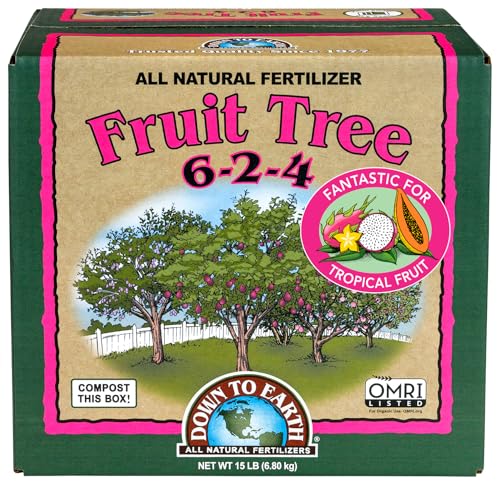
The bulk organic granular that revived a wind-uprooted crabapple tree over two years.
If you have multiple fruit trees or a serious home orchard, the 15-pound box from Down To Earth is the volume play that also delivers quality. The 6-2-4 ratio is a well-balanced fruit tree formula designed for apples, pears, plums, cherries, peaches, and tropical fruits including grapes. It is OMRI-listed organic, meaning it is free from synthetic chemicals, and the slow-release granular form feeds steadily through the entire growing season.
The owner stories here are compelling. One buyer reports that this fertilizer revived a struggling crabapple tree that had been uprooted by wind and had no berries or leaves. After two years of use, the tree now has healthy leaves, abundant berries, and stronger roots. Another owner says their mango tree has “more fruit than ever.” For grapevines, the high calcium content is a bonus — calcium supports cell wall structure in the fruit, which means firmer, better-traveling grapes.
This is the heaviest product on the list at 15 pounds, which makes it ideal for covering large areas but overkill for a single potted vine. Unlike the smaller bags from EB Stone or Soil Seed & Water, this one is built for multiple seasons of feeding.
The thing owners praise most: The long-term regenerative effect on trees that were stressed or damaged — the “revitalize from cold frost” feedback is repeated across multiple reviews.
A practical note: The 15-pound box is physically large and heavy. Make sure you have storage space before ordering.
Reach for this if: You have multiple fruit trees and vines in the ground and want a single bulk organic fertilizer that feeds everything through the season.
Not ideal if: You have a single container grapevine — the box will last you several years and the price per pound only makes sense at scale.
Understanding the Specs
N-P-K Ratio
These three numbers stand for nitrogen, phosphorus, and potassium — the primary nutrients every plant needs. For grapevines, a ratio that is not too heavy on nitrogen (the first number) is key because too much nitrogen pushes leafy growth at the expense of fruit. A balanced 1:1:1 or a formulation like 6-2-4 or 7-3-3 gives the vine what it needs for both foliage and fruit without tipping the scales.
Slow-Release vs. Liquid
Granular slow-release fertilizers break down gradually in the soil, feeding the vine over weeks or months with fewer applications. Liquid fertilizers are absorbed immediately by the roots and leaves, making them ideal for a quick boost or correcting a visible deficiency mid-season. The choice depends on how hands-on you want to be — set a granular and forget it for three months, or mix a liquid weekly for active control.
Organic vs. Synthetic
Organic fertilizers are derived from natural sources like bone meal, kelp, or compost. They improve soil structure and microbial life over time but release nutrients more slowly. Synthetic fertilizers deliver nutrients in a form plants can use immediately, but they do not build soil health and can burn roots if over-applied. The best grape tree fertilizer for organic growers will carry an OMRI-listed seal.
Coverage & Concentration
Coverage tells you how much area or how many plants a package can feed. A “Full” coverage product like the Down To Earth 6-2-4 is designed for large gardens and multiple trees. Concentration matters more for liquid products — a super-concentrated formula like Farmer’s Secret (1 teaspoon per 2 gallons) stretches further and costs less per feeding than a ready-to-use bottle.
FAQ
Can I use a citrus or avocado fertilizer on my grapevines?
How often should I fertilize my grapevines?
What is the best N-P-K ratio for grapevines?
Is it better to use liquid or granular fertilizer for grapes?
Can I burn my grapevines with too much fertilizer?
What does phosphorus do for grapevines?
Can I use these fertilizers on container-grown grapevines?
How long does a bag of granular fertilizer last for a single grapevine?
Final Thoughts: The Verdict
For most home growers, the best grape tree fertilizer winner is the TPS Grape Fertilizer because its 1:1:1 liquid formula is tailor-made for vines — it pushes fruit production without the nitrogen-heavy foliage explosion. If you want an organic granular that builds soil health and revives struggling vines, grab the Soil Seed & Water Bacchus. And for a bulk organic that feeds an entire orchard season after season, the Down To Earth 6-2-4 is the one to reach for.
How We Picked
We do not accept paid placement. Every pick is matched to a real buyer and a real use-case; we do not hands-on test units.
Sources & Methodology
Specifications: manufacturer listings and product documentation. Review insights: verified customer reviews, as of July 2026. Pricing: not shown on this page (it changes often); check the current price via the retailer link.
As an Amazon Associate, Lawn Gear Lab earns from qualifying purchases. This does not affect which products we feature.