
Specs are compiled from manufacturer listings and verified buyer reviews and can change over time — please confirm the key details on the product page before buying.
Throwing a handful of blue powder around a tree’s base is a gamble, not a plan. Granular tree fertilizer lets you feed the whole root zone at once — a single measured scoop delivers season-long nutrition without the mixing hassle or the risk of burning shallow roots. The real question isn’t whether to use it; it’s which bag matches what your specific tree actually needs, from a young citrus demanding steady citrus-building calcium to a mature oak that just needs a gentle annual top-up.
I’m Rikta — the founder and writer behind Lawn Gear Lab. This guide is built by comparing the manufacturers’ published specifications and the patterns across verified customer reviews, so you get each pick’s real strengths and trade-offs instead of marketing spin.
You will find nine specific granular fertilizers — each chosen for a different tree scenario — and a plain-language breakdown of the NPK ratio, release speed, and application method that matters most to your backyard trees. This is the complete guide to finding the best granular tree fertilizer for your yard, with real owner experience built into every pick.
Our Picks at a Glance


How To Choose The Best Granular Tree Fertilizer
Your tree can’t move to find better soil. You have to bring the food to it. Granular fertilizer is the most straightforward way to do that — one application in early spring and one in late fall covers a season’s needs. But not every bag of granules does the same job.
Match the NPK to the Goal
The three big numbers — nitrogen, phosphorus, potassium — are the tree’s primary fuels. A high-nitrogen formula (like 21-6-8) pushes out lush green leaves fast. A bloom-oriented ratio (10-15-9) nudges energy toward flowers and fruit. A balanced feed (6-2-4) builds strong roots and steady health across a whole year. You pick the number based on what you want to see: more shade, more blooms, or more fruit.
Slow Release Prevents Burn
The best granular fertilizers use a coating or a natural protein base to meter out nutrients over weeks. A tree’s feeder roots absorb at a steady pace — a sudden ammonia spike from a cheap fast-release product can scorch the root tips and yellow the leaves instead of greening them. Look for a controlled-release or organic-based formula if you value safety over speed.
Application Surface Area Matters
Dumping a pile of granules at the trunk is a waste. Tree roots spread far beyond the canopy edge. The most effective application broadcasts the granules evenly under the entire drip line — the circle where rain drips off the outermost branches. That is where the active feeder roots live. A bag that covers 1,000 square feet at the labeled rate is more than enough for a typical mature tree application.
Quick Comparison
| Model | Best For | NPK Ratio | Bag Size | Coverage | Amazon |
|---|---|---|---|---|---|
| Perfect Palm★ Best Overall | Palm Health | 7-14-40 | 7 lb | 14 palms | Amazon |
| Espoma Organic Tree-ToneAlso Great | All-Around Classic | 6-3-2 | 36 lb | Established trees | Amazon |
| Down To Earth Fruit TreeOrchard Pro | Backyard Orchard | 6-2-4 | 15 lb | Fruit trees | Amazon |
| Nelson NutriStar 21-6-8 | Quick Green-Up | 21-6-8 | 4 lb | Shrubs & trees | Amazon |
| Hi-Yield Grower’s Special | Budget Workhorse | 12-6-6 | 10 lb | Landscape beds | Amazon |
| Nelson NutriStar 10-15-9 | Flower Power | 10-15-9 | 2 lb | Flowering trees | Amazon |
| Organic Plant Magic | Organic All-Purpose | — | 4 lb | 1,000 sq ft | Amazon |
| CountryMax Urea | Nitrogen Specialist | 46-0-0 | 10 lb | Lawns & trees | Amazon |
| TPS Granular Lemon Tree | Citrus Care | — | 16 oz | Potted citrus | Amazon |
In‑Depth Reviews
1. Perfect Palm 7-14-40 with Measuring Scoop (7 lb)
Our pick — over 4.5★ from 500+ verified ratings; the strongest balance of quality and price.
A palm-specific blend that turns yellow fronds deep green without the guesswork.
Palm trees need a very different nutrient profile than a maple or an oak — and the 7-14-40 ratio here delivers sky-high potassium (the 40) to boost cold tolerance and drought resistance, plus dual forms of magnesium and iron that target the yellowing that so often plagues palms. The Smart Granule XCU 64% Control Release Technology meters nutrients over time, so you only apply a few times per year. The resealable pail keeps the granules dry, and the included measuring scoop makes the “scoop, sprinkle, water” routine genuinely easy.
Owner reports after a Florida freeze noted that trees treated with this fertilizer — alongside an antifungal crown treatment — recovered quickly and looked healthy, proof of the higher potassium levels. On the value front, one owner says it works great but finds it a bit expensive, while another counters that the 7 lb pail feeds 14 palms at a per-palm cost that feels reasonable. The greening effect is the headline: buyers report that the leaves “perk up” and stay green even through tough weather.
What makes it special
- Tailored NPK of 7-14-40 specifically for palm physiology
- Slow-release XCU technology means fewer applications per season
- Resealable pail and scoop simplify storage and application
The honest trade-off
- The per-pound price is high if you are fertilizing a large grove
- Only formulated for palms — not a general-purpose tree feed
Perfect for: Anyone with a few palms in their landscape who wants a no-mix, species-specific feed that visibly greens the fronds and builds cold hardiness.
Skip if: You have a mixed yard of maples, oaks, and evergreens — you need a general tree fertilizer, not a palm specialist.
2. Espoma Organic Tree-Tone 6-3-2 (36 lb)
The 36-pound classic that feeds an orchard without the chemical guilt.
This is the bag that makes you feel like a real tree steward. The 6-3-2 analysis delivers a gentle, organic feed that won’t burn roots even if you over-apply, and it is approved for organic gardening — no sludges, no toxic ingredients. The bulk of a 36-pound bag gives you enough to treat multiple large trees through the spring and fall cycles, and the exclusive Bio-tone formula includes beneficial microbes that keep the soil biology active long after the granules dissolve.
The feedback from owners is remarkably consistent. A customer using it on an organic farm reports healthier Apple, Pear and Peach trees with nice fruit year after year. Another owner described how an 80-year-old White Oak leafed out three weeks earlier than usual after a heavy application — 160 pounds total — proving this stuff works on venerable giants, not just young saplings. The natural smell is noticeable but fades quickly: the consensus is that it is a fair trade for a product free of synthetic additives. On the flip side, a few owners note the results take patience; one saw little change on fruit trees after two months, which is typical for an organic slow-release formula that works with the soil instead of against it.
What wins people over
- 36 lb bag lasts multiple seasons for a typical backyard
- Organic OMRI listing means it is safe around kids and pets
- Proven track record across shade trees, fruit trees, and ornamentals
The honest trade-off
- Results are slow — it works with soil biology, so instant green-up is not the goal
- The natural fertilizer smell is strong for the first day or two
Who it serves best: Anyone with a mix of shade and fruit trees who wants a single, organic, no-fuss fertilizer that builds long-term soil health.
Think twice if: You need a quick visual fix for a nitrogen-starved tree in mid-summer — the 6-3-2 ratio is gentle, not a slam-dunk.
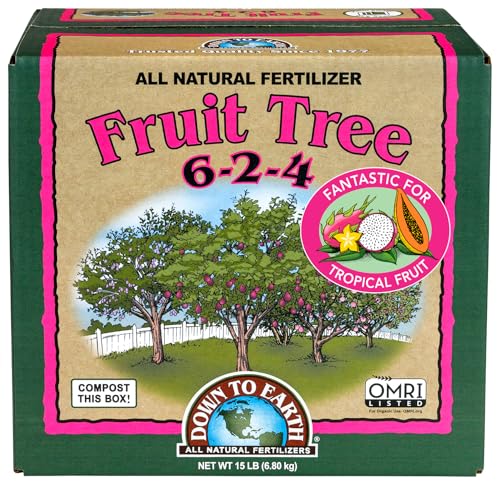
3. Down To Earth Organic Fruit Tree 6-2-4 (15 lb)
A measured organic feed that turns struggling trees into steady producers.
This formula dials in specifically on what fruit-bearing trees need — the 6-2-4 ratio leans into root development and fruit quality rather than forcing a leafy explosion. The high calcium content is a secret weapon against blossom-end rot in stone fruits and provides structural strength for the tree’s cell walls. In granular form, it blends into the topsoil quickly and doesn’t leave the harsh ammonia smell that some synthetic competitors produce.
Among the nearly 800 who have rated this, a fruit tree owner noted their figs and pomegranates love the stuff, and one customer with a crabapple tree that had been uprooted and refused to leaf out reported that after two years of using this fertilizer the tree now puts out healthy leaves and abundant berries. Another owner living in a cold-frost zone said the product helped revitalize trees after a hard winter, bringing them “back to life.” The main caution is the price-per-pound: it is an premium organic, so covering a large orchard gets expensive. But for a backyard collection of 3-5 fruit trees, the results speak clearly.
Why it earns its spot
- Organic OMRI certification for true organic growing
- High calcium supports fruit quality and disease resistance
- Steady slow-release nutrition that builds soil health over seasons
The honest trade-off
- 15 lb bag goes fast if you have more than half a dozen trees
- Premium pricing compared to synthetic alternatives
Best match: The organic gardener with a small orchard of apples, pears, peaches, or citrus who wants long-term tree health and great-tasting fruit.
Not ideal for: A quick leaf-green-up on shade trees — this is formulated for fruit production, not foliage speed.
4. Nelson NutriStar 21-6-8 for Trees, Shrubs, & Evergreens (4 lb)
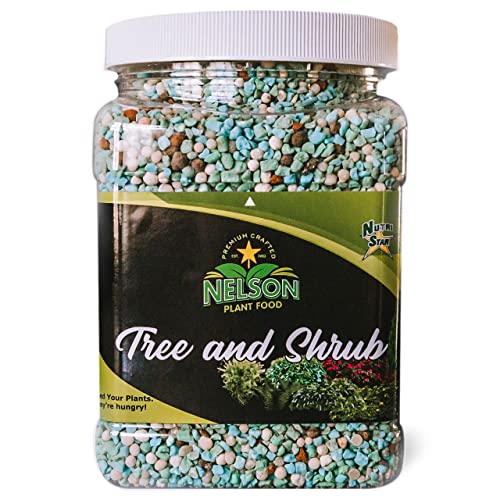
The high-nitrogen kick that brings back yellowing evergreens in days.
This is the fast-acting choice when a tree or shrub looks pale and weak. With 21% nitrogen and five different nitrogen sources releasing at different rates, it delivers an immediate visual green-up followed by sustained feeding for about 30 days. The formula covers a huge range of landscape plants: oaks, willows, maples, pines, hollies, boxwoods, viburnums, and more. It works on container-grown plants just as well as in-ground specimens.
An owner who applied it to 50 boxwoods that were “turning yellow/orange due to low nitrogen” reported that almost all the discoloration vanished in two days, and the shrubs gained immediate vigor. Another user described “anemic, yellow, dying plants turned into thriving, bright green, shiny shrubbery within two weeks” — a turn-around that prompted a visitor to stop and compliment the plants unprompted. The catch is the window: you need to reapply every 30 days during the growing season, so this is a more hands-on program than a single annual feed. But if you want to see a rapid, visible response from a struggling shrub or evergreen, this excels.
Why it gets results
- High 21-6-8 ratio produces fast, visible green-up on nitrogen-deficient plants
- Five nitrogen sources provide both immediate and sustained feeding
- Works on a massive range of trees, shrubs, and evergreens
The honest trade-off
- Needs monthly reapplication during the growing season
- Not a single-application solution for the whole year
Best suited to: The homeowner who has a few specific shrubs or evergreens that are looking sad and needs a quick, reliable fix.
Think twice if: You want an all-organic, slow-release “low-maintenance” approach — this is a synthetic blend that asks for monthly attention.
5. Hi-Yield Grower’s Special 12-6-6 (10 lb)
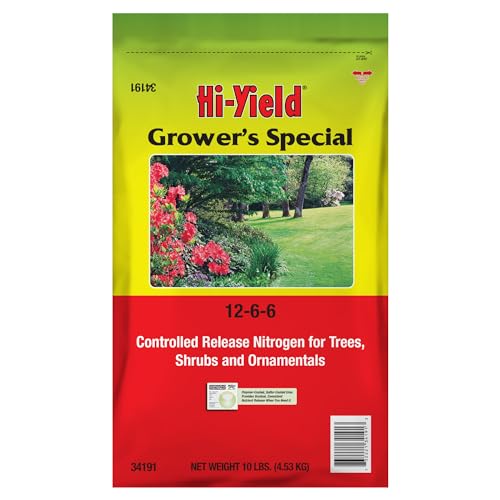
The reliable 10-pound bag that keeps magnolias full without emptying your wallet.
The 12-6-6 formula strikes a smart middle ground — high enough in nitrogen to push visible growth, but with slow-release nitrogen that reduces the risk of burn. The bag is labeled as an all-purpose plant food for trees, shrubs, and ornamentals, meaning you can use it around the whole landscape without juggling multiple products. The price per pound is the most attractive feature here, making it an easy choice for large properties where the application area is measured in hundreds of square feet.
One owner with a mixed landscape reported “noticeable growth and fullness” in their magnolias, and that the crepe myrtles looked full despite poor bloom that they chalked up to weather, not the product. The same owner noted minimal effect on Eaglesston Holly’s, which is a realistic outcome for any general-purpose fertilizer on specific plants. At only 10 pounds, the bag is smaller than the Espoma behemoth but still covers a typical yard’s trees and shrubs for the season. The main limit is the relatively simple formula: it lacks the extra micronutrients and soil biology boosters that premium organic blends include.
The best part
- Excellent value per pound for covering a large landscape
- Slow-release nitrogen minimizes the risk of fertilizer burn
- Simple to apply — 1 tsp per 6-inch pot for containers, broadcast for in-ground
The honest trade-off
- No organic certification or soil-building additives
- Some trees (like Eaglesston Holly) may not show a strong response
Who this fits: A practical gardener with a variety of landscape trees and shrubs who wants dependable results without the premium price tag.
Not for: The organic purist or someone dealing with a specific nutrient deficiency that needs a tailored ratio.
6. Nelson NutriStar 10-15-9 for Crape Myrtle & Flowering Trees (2 lb)
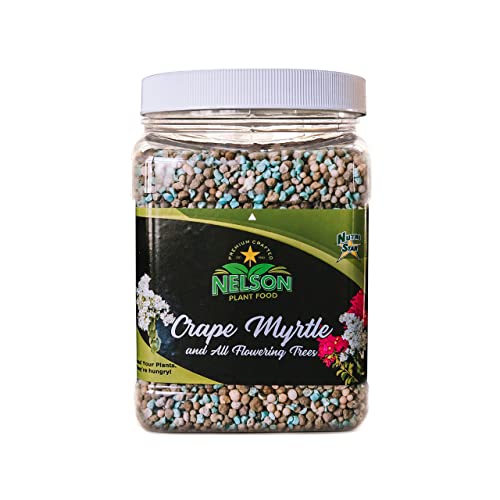
The phosphorus-heavy recipe that pushes a shy bloomer into a show-stopper.
When a tree has all the foliage it needs but refuses to flower, the missing piece is often phosphorus. This formula delivers 15% phosphate alongside sulfur, copper, iron, manganese, and zinc for essential flowering support. It is built specifically for crape myrtles, desert willows, orchid trees, and other ornamentals where the payoff is measured in petals. One application feeds for up to four months, taking you through the entire bloom cycle.
The most dramatic owner story is a customer who had “tried for years to get my orchid tree to bloom” — two weeks after applying this fertilizer, white blooms appeared. Another owner reports a 25-foot crepe myrtle that had struggled with foliage and flowers for years bounced back into full production. A master gardener actually recommended this product for that specific tree, which says something about its reputation in landscaping circles. The small 2-pound bag is the catch: at this price point, you pay for the sophisticated formula rather than bulk quantity. But for a beloved specimen tree, the results are hard to argue with.
Why it stands out
- High phosphorus and trace minerals trigger abundant blooms
- Four-month feed window means one spring application covers the season
- Proven track record with notoriously difficult flowering trees
The honest trade-off
- Expensive for the bag size; a full treatment for a large tree demands multiple containers
- Overkill if your tree is already blooming well
The right fit: A homeowner with a single high-value flowering tree (crape myrtle, orchid tree, mimosa) that consistently underperforms in the bloom department.
Look elsewhere if: You just need a general feed for a row of healthy shade trees — this is a targeted bloom booster, not a multi-purpose food.
7. Organic Plant Magic Slow Release Granular (4 lb)

The biology-first granular that builds soil life as it feeds the tree.
Rather than relying on a basic NPK number, this formula loads in 55+ trace minerals, amino acids, humic acids, kelp, and beneficial mycorrhizae — the living soil organisms that colonize roots and help trees access nutrients you never physically applied. The approach is “biology over chemicals”: feed the soil, and the soil feeds the tree. One 4-pound bag covers 1,000 square feet, applied as a monthly top-dress or mixed into the planting hole.
Reviews highlight a dramatic turnaround in a “languishing raised bed” of vegetables that revived overnight, and indoor plant owners mention thriving growth when mixed with water (with the caveat that the mixture must be used within 24 hours). The all-natural ingredients mean the smell is noticeable — a few owners found it off-putting for indoor use, with one saying the odor lingered for months. Outdoors, the smell dissipates quickly, and most agree it is a small price for a truly organic product. The 4-pound bag covers limited ground, so a large property will need multiple bags.
What makes it unique
- Contains mycorrhizae and 55+ trace minerals for deep root health
- Covers 1,000 square feet per bag at the labeled rate
- Safe for indoor and outdoor use without synthetic chemicals
The honest trade-off
- The natural odor is strong, especially indoors
- Mixed-use liquid must be used within 24 hours or it spoils
Best for: The soil-conscious gardener who wants a truly organic product packed with living biology and trace minerals to revitalize tired soil.
Not for: Someone who just needs a quick NPK correction on a single tree — this product is about long-term soil enrichment.
8. CountryMax Urea 46-0-0 (10 lb)
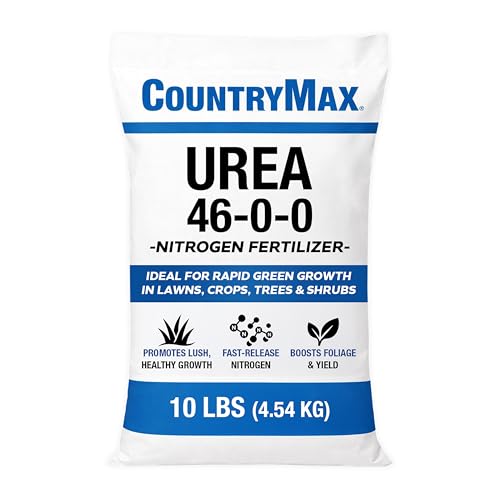
Straight nitrogen for the grower who knows exactly what their tree is missing.
This is not a product for the casual gardener. The 46-0-0 analysis is essentially pure nitrogen — no phosphorus, no potassium — making it a targeted corrective tool rather than a complete meal. It delivers 46% nitrogen to stimulate rapid leaf and stem growth, ideal for correcting a known nitrogen deficiency or pushing a grass-heavy lawn green. The uniform granules spread easily with any broadcast or drop spreader, and the economical 10-pound bag provides significant coverage.
The owner feedback skews toward experienced users: one mixes it as a custom liquid fertilizer with separate phosphorus and potassium sources, which is an advanced method that requires careful measurement and timing. Another warns that “improper mixing harms plants” and that the method is not for beginners. A simpler use case comes from a customer who applied it as a side-dress to lawn and shrubs: “grass is dark green and spreading excessively.” The key instruction from owners is universal: water heavily right after applying, and follow the label rate exactly — too much will burn foliage fast. This is a specialist’s tool, not a grab-and-go solution.
When you need it
- Highest nitrogen concentration (46%) for rapid correction of deficiency
- Uniform granules work with any spreader for consistent coverage
- Excellent value for large area applications
The honest trade-off
- Zero phosphorus or potassium — it is a single-nutrient product
- Improper application burns plants quickly; not for beginners
Who this is for: An experienced grower or landscaper who can diagnose a nitrogen deficiency and wants a pure, economical nitrogen source to fix it.
Not for: A first-time tree owner, or anyone looking for a balanced, complete tree fertilizer — this is a scalpel, not a multitool.
9. TPS Granular Lemon Tree Fertilizer (16 oz)
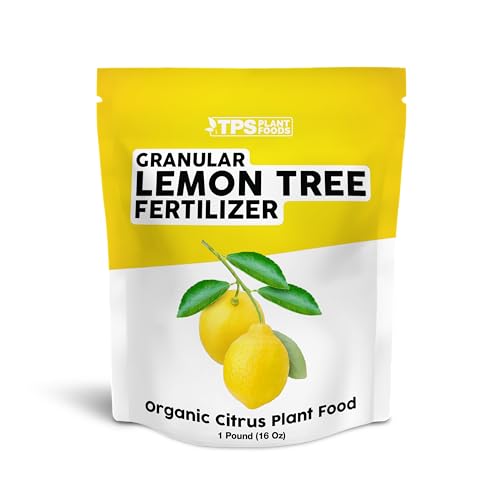
The tiny bag that packs enough power to double a lemon tree in a single season.
Citrus trees are heavy feeders, and this granular formula is specifically designed to support their unique demands — healthy foliage, consistent fruit production, and strong root systems. The slow-release mechanism meters out nutrients gradually through the soil, which is critical for potted citrus where the roots are confined and sensitive to salt buildup. Suitable for in-ground and container-grown plants, it is a compact 16 ounces that should last a backyard grower a full season on a few small trees.
An owner from Buffalo, NY — a notoriously poor climate for citrus — reported that a lemon tree “doubled in size and flowered twice” after starting this product in early spring. Another gardener saw yellow spots on leaves disappear within a week of application, followed by “multiple new leaf buds.” The message is consistent: even a small, consistent dose produces visible results. The trade-off is the size and price — 16 ounces does not go far if you have a grove of citrus, and the per-ounce cost is higher than bulk alternatives. But for a couple of cherished lemon trees in pots, it is perfectly measured.
Why it works
- Formulated specifically for lemon and citrus nutritional needs
- Slow-release granules prevent root burn in confined containers
- Proven to produce fast results: new leaf buds within a week in some cases
The honest trade-off
- Small 16 oz bag limits use to a few trees per season
- Higher per-ounce cost compared to general-purpose fertilizer
The perfect match: A hobbyist with a single potted lemon, lime, or citrus tree who wants a species-specific food that is gentle, slow, and reliable.
Skip it for: A full orchard of in-ground citrus trees — you will run out fast and the economics favor a larger bag.
Understanding the Specs
NPK Ratio (the three big numbers)
The first number (nitrogen) drives leafy green growth and overall vigor. The second number (phosphorus) is the engine for root development, flowers, and fruit. The third number (potassium) builds disease resistance and helps the tree weather drought and cold. A high nitrogen ratio like 21-6-8 pushes quick green-up; a balanced ratio like 6-2-4 nourishes the whole tree slowly.
Slow Release vs. Fast Release
Slow release granules are coated or made from organic proteins that break down over weeks or months. This feeds the tree steadily and prevents the nitrogen spike that burns feeder roots. Fast release granules dissolve immediately when watered in and give a quick surge of green — but the effect fades fast, and you must be precise with the dosage to avoid damaging the tree.
Organic vs. Synthetic
Organic fertilizers rely on natural ingredients like bone meal, feather meal, and beneficial microbes. They build the soil biology over time, so the tree gets food when it needs it. Synthetic fertilizers are refined mineral salts that deliver exact NPK numbers instantly. Organics are slower and safer; synthetics are faster but carry a higher risk of burn if misapplied.
Bag Size and Coverage
Bag size is measured in pounds, but coverage depends on the labeled application rate. A 4-pound bag covering 1,000 square feet at standard rates is plenty for a mulched bed around a mature tree. A 36-pound bag is for large properties with many trees. Calculate your total drip-line area before buying — a single 10-pound bag often covers a typical suburban yard’s worth of trees.
FAQ
How often should I apply granular tree fertilizer?
Can I use lawn fertilizer on my trees?
Should I water after applying granular fertilizer?
Is organic granular fertilizer better than synthetic?
What does the NPK ratio actually mean for my tree?
Can I over-fertilize a tree with granular fertilizer?
How close to the trunk should I spread the granules?
Will granular fertilizer work for potted fruit trees?
Can I mix different granular fertilizers together?
How long does a bag of granular fertilizer last in storage?
Final Thoughts: The Verdict
Across the board, the best granular tree fertilizer is the Espoma Organic Tree-Tone 6-3-2 because it is the rare true all-rounder: a large, organic bag with a proven history across shade trees, fruit trees, and ornamentals that builds the soil instead of depleting it. If you want a formula tuned specifically for fruit production and strong winter recovery, grab the Down To Earth Organic Fruit Tree 6-2-4. And for a quick, reliable green-up on a few struggling shrubs or evergreens, the Nelson NutriStar 21-6-8 is the one to reach for.
How We Picked
We do not accept paid placement. Every pick is matched to a real buyer and a real use-case; we do not hands-on test units.
Sources & Methodology
Specifications: manufacturer listings and product documentation. Review insights: verified customer reviews, as of July 2026. Pricing: not shown on this page (it changes often); check the current price via the retailer link.
As an Amazon Associate, Lawn Gear Lab earns from qualifying purchases. This does not affect which products we feature.