
Specs are compiled from manufacturer listings and verified buyer reviews and can change over time — please confirm the key details on the product page before buying.
You can kill a bonsai fast by using regular potting soil — it holds too much water and suffocates the roots. Your miniature tree needs a mix that drains quickly, lets air reach the roots, and gives delicate roots a loose anchor. A good soil for bonsai is a rocky, gritty blend of ingredients like pumice (lightweight volcanic rock that holds water inside its pores), lava rock (adds weight and aeration), calcined clay (absorbs water), and akadama (fired Japanese clay that holds moisture and slowly breaks down). Each ingredient does a specific job: one holds a little moisture, another creates air pockets, and a third keeps the root zone from turning into mud.
I’m Rikta — the founder and writer behind Lawn Gear Lab. This guide is built by comparing the manufacturers’ published specifications and the patterns across verified customer reviews, so you get each pick’s real strengths and trade-offs instead of marketing spin.
Whether you are repotting a ficus, a juniper, or a tropical houseplant, you need a mix that won’t compact and that lets water race through while still giving the roots something to grip. That is exactly what you will find on this list of the best good soil for bonsai.
Our Picks at a Glance

How To Choose The Best Good Soil For Bonsai
Bonsai soil is nothing like the dark, fluffy bag of potting mix you use for your houseplants. It is a gritty, well-draining blend designed to stop root rot and give the fine roots of a bonsai the oxygen they need. The three specs that matter most are particle size, ingredient composition, and whether the mix is ready-to-use or requires sifting.
Particle Size and Sifting
Most professional mixes are sifted through a mesh (often 1/8 inch down to 1/16 inch) to remove dust and tiny particles. Dust and fines clog the air pockets between the larger grains. A mix that has been pre-sifted saves you the hassle of doing it yourself and keeps the soil from turning into mud after a few waterings.
Ingredient Composition
Look for a mix that includes at least two of these: akadama, pumice, lava rock, and calcined clay. Organic ingredients like pine bark or peat moss add some moisture-holding capacity and acidity, but they should not dominate the blend — too much organic matter turns the soil into mud.
Moisture Retention vs. Drainage
The goal is soil that lets excess water run out within seconds but still holds enough moisture between waterings so the roots do not dry out completely. A mix heavy on peat moss will hold water too long for most bonsai species, while a mix of pure grit will drain so fast you will be watering twice a day in summer. The best blends strike a balance specific to your tree type — tropicals like ficus need a bit more water retention, while conifers prefer faster drainage.
Quick Comparison
| Model | Best For | Volume | Key Ingredients | Pre-Sifted | Amazon |
|---|---|---|---|---|---|
| Bonsai Jack #221★ Best Overall | Universal all-species use | 2 Quarts | Pine bark, calcined clay, lava rock | Yes | Amazon |
| Bonsai Outlet TropicalTropical Specialist | Tropical bonsai species | 2.25 Quarts | Calcined clay, pine bark, pumice, lava rock | Yes | Amazon |
| DUSPRO Premium Mix | Moisture retention | 2 Quarts | Akadama, pumice, vermiculite, peat moss | No | Amazon |
| Tinyroots Akadama | Japanese-style akadama purity | 2 Quarts | Akadama only | Yes | Amazon |
| Harris Bonsai Soil | All-purpose premium blend | 2 Quarts | Forest humus, pumice, calcined clay, basalt, lime | No | Amazon |
| Hoffman 10708 | Beginners & evergreens | 2 Quarts | Stone and organic material | No | Amazon |
In‑Depth Reviews
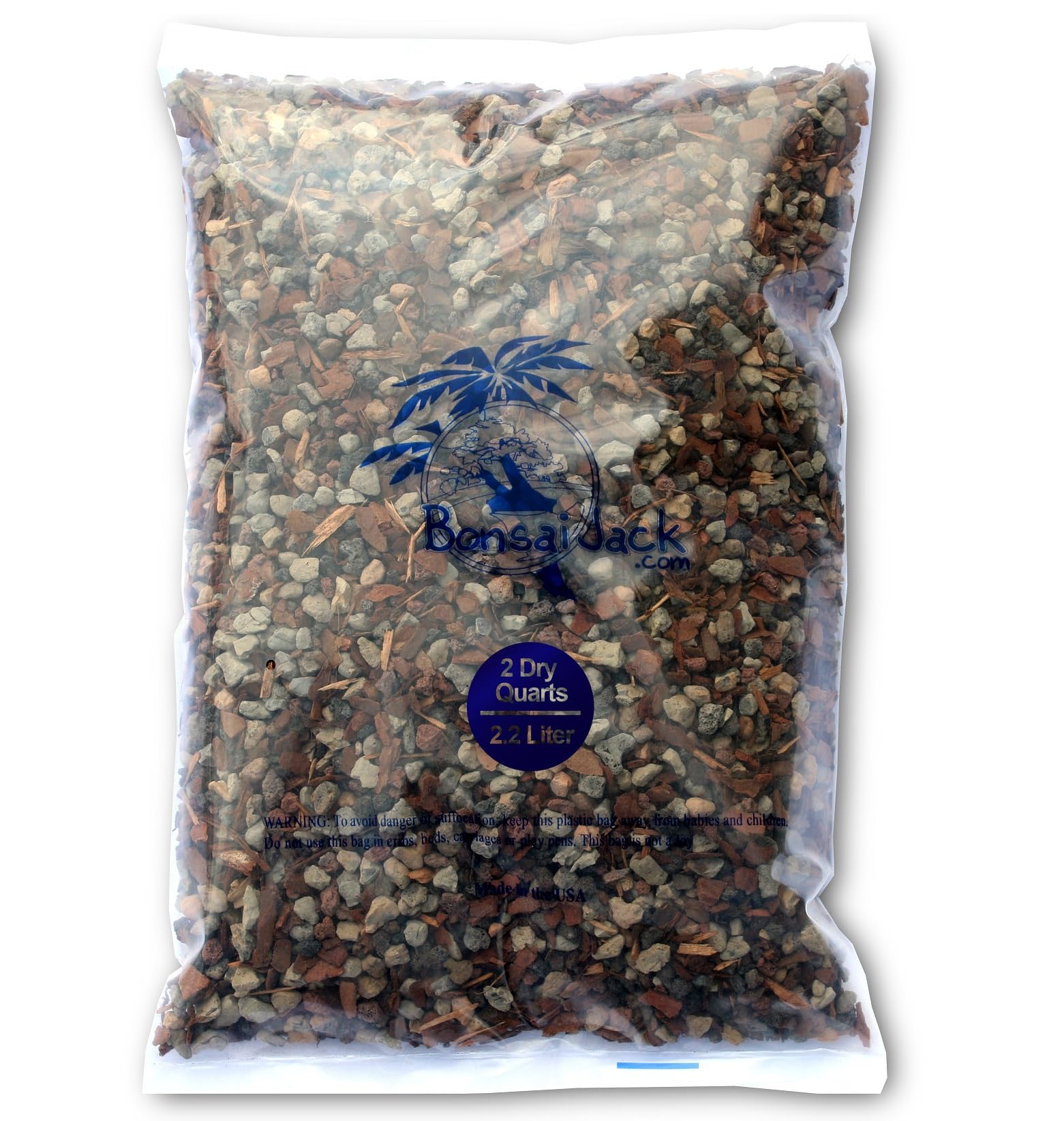
1. Bonsai Jack 2 Quarts Universal Organic Bonsai Soil Mix #221
Our pick — over 4.5★ from 750+ verified ratings; the strongest balance of quality and price.
The crowd-pleaser that works across species without guesswork.
If you want one bag that handles almost any tree you throw at it, this is it. The mix — a blend of pine bark, calcined clay, and lava rock — is pre-screened and pre-washed, so you don’t have to rinse dust out before potting. The 2-quart size sits near the middle of the volume range; the brand also sells bags up to 28 gallons if you have a larger collection.
What wins owners over is the consistent quality. The pH is locked at 6.4, and the mix is engineered for water absorption, evaporation, and bulk density. As the customers-say summary notes, it prevents root rot in succulents and has excellent drainage. The trade-off is water retention — a few owners find it dries out faster than expected for tropical species that like a little more moisture. That is less a flaw and more a signal that thirsty trees need a different pick.
What owners rave about
- Pre-sifted and washed — zero dust or mud
- Excellent drainage that prevents root rot
- Doesn’t break down significantly over years
The honest trade-off
- Water retention is mixed — not ideal for moisture-loving tropicals
- A few owners found it dry out quicker than they wanted in summer heat
Reach for this if: you want a proven, pre-washed mix that is ready to use out of the bag for most bonsai species, including succulents and conifers.
Look elsewhere if: your tree is a tropical that thrives on consistent moisture — you may need a blend with higher organic content.
2. Bonsai Outlet Tropical Bonsai Soil – Tinyroots Ready to Use Bonsai Soil Mix, 2.25 Quarts
A light, airy blend that tropical bonsai roots seem to love.
Formulated at a real bonsai nursery and used on their own trees, this mix is purpose-built for tropical species like ficus, jade, and schefflera. It contains calcined clay, pine bark fines, pumice, and lava rock — ingredients that create a fast-draining, well-aerated media. The bag holds 2.25 quarts, which is noticeably smaller than the 4-quart option from Omitgoter.
The new blend dropped river sand and uses more pumice and lava rock, which buyers report drains much better than the older version. As one owner put it, “this worked perfectly when repotting my Ficus bonsai.” The biggest approval is for its soil quality and fast drainage. The catch: it needs watering over a sink until water pours out, and monthly fertilization is required since the mix itself is lean on nutrients.
Strong points
- Pre-mixed and ready to use from a real nursery
- Excellent drainage for tropical species
- Produced greener leaves and vigorous growth
Worth noting
- Smaller volume than other options — 2.25 quarts
- Requires consistent fertilization and careful watering
Ideal for: anyone repotting a ficus, jade, or other tropical bonsai who wants a mix that drains fast and comes sifted.
Not ideal for: owners of conifers or deciduous trees that prefer a heavier, moisture-retentive soil.
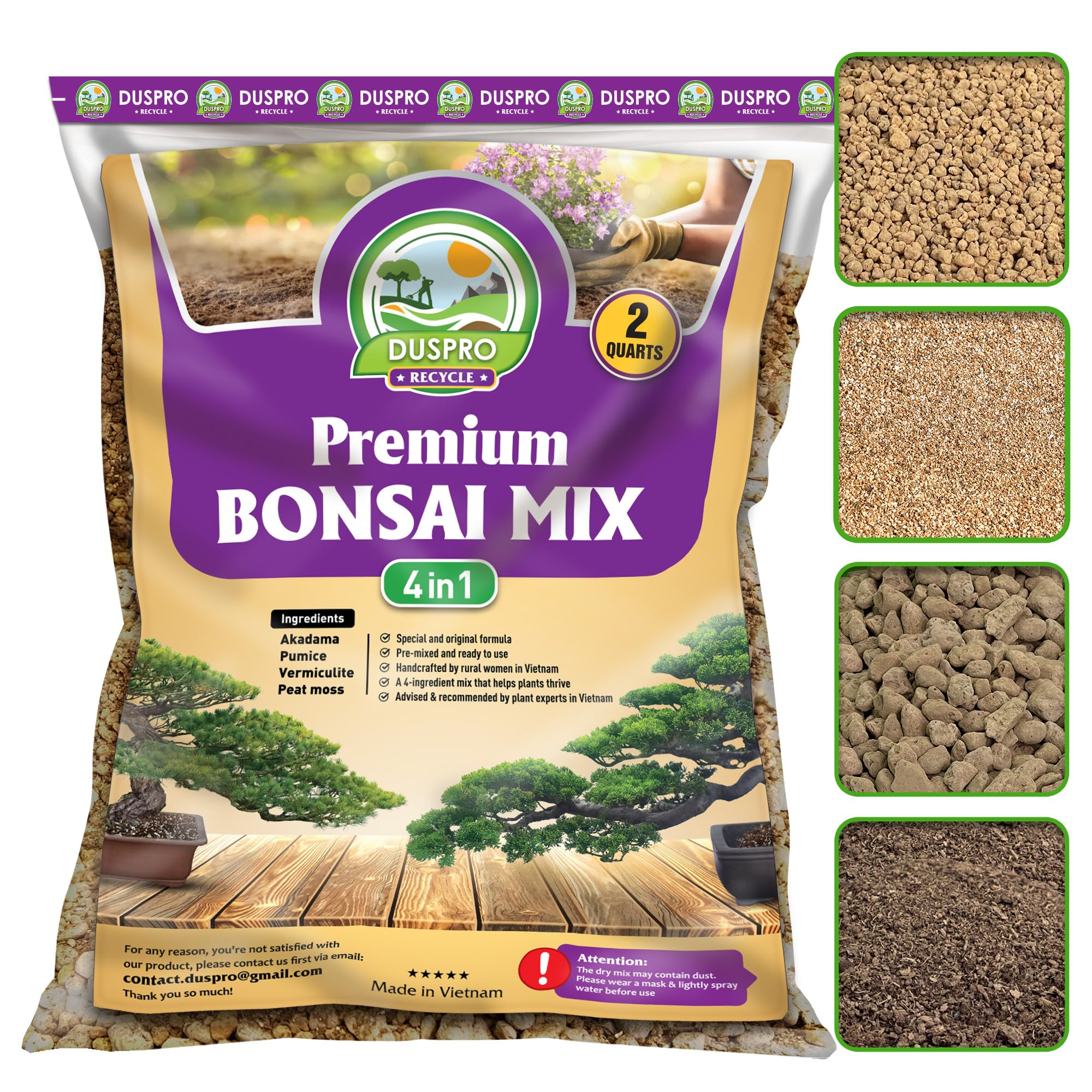
3. DUSPRO Premium Bonsai Soil Mix Ready to Use Pre-Mixed 4in1 with Akadama, Pumice, Vermiculite, and Peat Moss
Built for trees that crave a little more moisture between drinks.
This 4-in-1 blend uses akadama, pumice, vermiculite, and peat moss — a departure from the standard lava-rock-heavy mixes. The vermiculite and peat moss give it a higher water-holding capacity, which is a welcome trait for tropical bonsai or during hot, dry weather. The mix stopped leaf loss and spurred new growth in two different trees, according to one owner.
The blend is pre-mixed and ready to use, and the peat moss adds a nutrient-holding layer that reduces the need for frequent fertilization. The caveat from a few owners: the water does not drain as quickly as some other blends, and the mix can be dusty straight from the bag. One owner recommended washing it before use. If you have a thirsty tree or live in a dry climate, this extra moisture retention is actually a plus.
What works
- Great moisture retention for tropicals and dry climates
- Peat moss adds nutrient-holding capacity
- Stopped leaf loss and spurred growth in multiple trees
Consider this
- Dustier than some other blends — may need rinsing
- Slower drainage may not suit succulents or conifers
Perfect for: owners of tropical bonsai or anyone in a dry climate who needs soil that holds moisture longer.
skip it if: your tree is a succulent, cactus, or conifer that demands very fast drainage.
4. Akadama 2.25qt Bonsai Soil, Sifted Through 1/8 Inch Mesh Then Through 1/16 Mesh

Pure Japanese akadama for the purist — sifted and dust-free.
Akadama is the gold standard of bonsai soil in Japan, and this bag from Tinyroots brings it to your doorstep in a form that is sifted twice — first through a 1/8-inch mesh, then through a 1/16-inch mesh — to remove dust and small particles. The granules are sturdy and produce minimal dust, which is a big upgrade over cheaper akadama that crumbles easily. The 2-quart bag holds 83.25 ounces of material.
The volcanic soil has a built-in feature: it darkens when wet, giving you a clear visual cue of when to water your tree. Owners note it works well for conifers, deciduous trees, and even succulents and cactus. The most common praise is for the overall quality, and the moisture retention is highly rated. The main split in opinion is around value — some find it pricey for what is essentially fired clay, but the quality and sifting justify the cost for serious enthusiasts.
Why it’s respected
- Sifted twice — extremely low dust and firm granules
- Darkens when wet, acting as a watering reminder
- Japanese akadama used by master gardeners
Things to weigh
- More expensive than blended mixes
- Some owners felt particle size was too large for smaller pots
Best for: experienced bonsai keepers who want authentic Japanese akadama with professional-grade sifting for refined trees.
Not for: beginners looking for a value-priced all-in-one mix — this is a single-ingredient substrate that you may need to blend yourself.
5. Harris Bonsai Soil, All Purpose Premium Blend for Outstanding Growth, 2qt

A well-thought-out blend that includes forest humus and basalt rock.
Harris brings a more organic approach to bonsai soil with a mix that includes forest humus, pumice, calcined clay, organic amendments, basalt rock dust, and lime. The lime is a smart addition — it buffers pH and supplies calcium, which many bonsai soils lack. This is an all-purpose mix that works for juniper, pine, ficus, and fir, and it holds moisture well enough that owners mention only needing to wet it once a week in winter.
The quality rating is high, and owners note it works great for bonsai cuttings and seedlings. One owner saw 3 out of 4 bonsai seeds sprout after transplanting into this mix. The biggest knock is value — several owners feel the 2-quart bag is expensive for what you get. For a single small tree or a few cuttings, it is a premium choice; for a large repotting project, the cost per quart climbs.
What earns praise
- Includes basalt rock dust and lime for mineral content and pH balance
- Holds moisture well — once a week watering in winter
- Works for a wide range of species
The downside
- Considered pricey for the 2-quart volume
- Tree health results were mixed for some owners
Reach for it if: you are starting seeds or cuttings and want a nutrient-rich blend with built-in pH management.
pass on it if: you are on a tight budget or need to repot multiple trees at once.
6. Hoffman 10708 Bonsai Soil Mix, 2 Quarts, Brown/A

A reliable, beginner-friendly mix that has been around for years.
The quality gets the most praise, with owners noting the root growth is “astonishing” after repotting. One owner reported their plant looked healthy after six weeks and care was easier. The bag is small at 2 quarts, so plan for one or two trees. A few owners caution that the mix can arrive with a torn bag if shipped alongside heavy items — order it alone or with soft goods.
The highlights
- Proven formula with excellent drainage
- Resealable bag keeps leftover soil fresh
- Color change helps beginners know when to water
Minor heads-up
- Smaller 2-quart bag — may need multiple bags for larger projects
- Some owners found it pricey for the amount you get
Great starting point for: first-time bonsai owners who want a simple, pre-mixed soil that works for evergreens and requires no extra work.
Consider an alternative if: you are repotting multiple large trees or want a larger volume of soil for the same money.
Understanding the Specs
Akadama
A fired Japanese clay that is the traditional base of bonsai soil. It absorbs water and nutrients while allowing air to flow around the particles. Good akadama is sifted to remove dust and retains its granular shape for a year or two before slowly breaking down, which helps root development. The Tinyroots akadama is a pure example of this.
Pumice and Lava Rock
Two types of volcanic rock that do different jobs. Pumice is light and porous — it holds water inside its tiny cavities while the outside of each grain stays dry, creating air pockets. Lava rock is heavier and adds structural weight to the pot, helping anchor the tree. Together they make a mix that drains fast but does not dry out instantly.
FAQ
Can I use regular potting soil for my bonsai tree?
How often should I repot my bonsai into fresh soil?
Do I need to sift bonsai soil before using it?
What is the difference between akadama and pumice?
How much soil do I need for a standard bonsai pot?
Can I use bonsai soil for succulents or cacti?
Is it worth paying more for a pre-washed mix?
Does bonsai soil need fertilizer?
What does the pH of bonsai soil mean for my tree?
Can I mix different bonsai soils together?
Final Thoughts: The Verdict
For most buyers, the good soil for bonsai winner is the Bonsai Jack #221 because it combines pre-sifted, pre-washed convenience with a proven blend that works across species and does not break down quickly. If you want a mix tailored for tropicals, grab the Bonsai Outlet Tropical. And for the largest volume at the best value, the Omitgoter 4-quart mix is the one to reach for.
How We Picked
We do not accept paid placement. Every pick is matched to a real buyer and a real use-case; we do not hands-on test units.
Sources & Methodology
Specifications: manufacturer listings and product documentation. Review insights: verified customer reviews, as of July 2026. Pricing: not shown on this page (it changes often); check the current price via the retailer link.
As an Amazon Associate, Lawn Gear Lab earns from qualifying purchases. This does not affect which products we feature.