
Specs are compiled from manufacturer listings and verified buyer reviews and can change over time — please confirm the key details on the product page before buying.
You prep the soil, you spread the seed, you water like clockwork — then you wait. The single biggest variable between a patchy disappointment and a lawn neighbors compliment is what you feed those baby roots in their first few weeks. A good fertilizer for new grass isn’t about dumping on nitrogen for quick top-growth; it is about supplying the right phosphorus (the middle number) so the root system goes deep before the blades go tall. Miss that balance and you get thin, weak turf that burns out at the first dry spell.
I’m Rikta — the founder and writer behind Lawn Gear Lab. This guide is built by comparing the manufacturers’ published specifications and the patterns across verified customer reviews, so you get each pick’s real strengths and trade-offs instead of marketing spin.
Below you will find nine carefully vetted products, each with a different approach to the same goal: turning bare dirt into resilient grass. Whether you prefer granular slow-release or liquid concentrate, a 5 lb bag for a small patch or a 50 lb sack for the whole property, this roundup of the good fertilizer for new grass options covers every honest strength and limitation so you can pick with confidence.
Our Picks at a Glance

How To Choose The Best Good Fertilizer For New Grass
Throwing a random bag of all-purpose lawn food on fresh seed is a common mistake — the wrong ratio can burn tender seedlings or push weak, top-heavy growth that flops in summer. Three things separate an effective starter from a waste of money.
Understand the NPK ratio
The three numbers on the bag — nitrogen (N), phosphorus (P), potassium (K) — tell the whole story. For new grass you want the middle number to be the highest, because phosphorus fuels root development. A ratio like 20-27-5 or 12-18-8 is a strong signal the bag was designed for seeding and sodding. A balanced 15-15-15 works too if phosphorus is at least equal to the others.
Granular vs liquid delivery
Granular fertilizers release nutrients slowly or over a controlled window, which suits a weekend schedule. Liquids let you spray exactly where you need them and are absorbed faster, but you may need to reapply every two to four weeks. If you have a large lawn, granules are the practical choice. For a small patch or spot repairs, a liquid concentrate stretches further.
Coverage and bag size
A 5 lb bag that covers 1,500 square feet is fine for a tiny front yard. A 45 lb bag covering 15,000 square feet is for people with acreage, and a 50 lb professional-grade sack is overkill for a quarter-acre lot. Match the bag to your actual square footage — buying a giant bag you cannot use before it clumps is just throwing money away.
Quick Comparison
| Model | Best For | NPK Ratio | Coverage | Item Weight | Amazon |
|---|---|---|---|---|---|
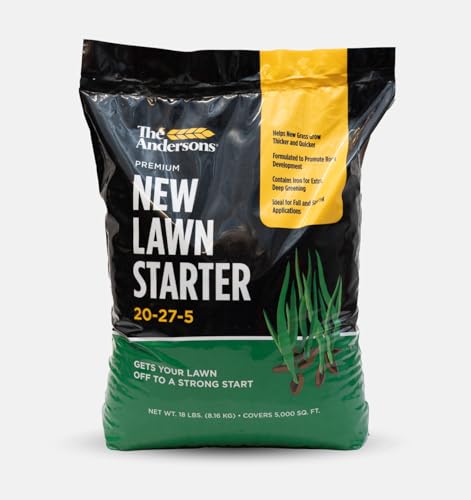
| The Andersons Premium New Lawn Starter★ Best Overall | All-around starter for large lawns | 20-27-5 | 5,000 sq ft | 18 lb | Amazon |
| Jonathan Green Green-Up 12-18-8Best Value | Small-seed-area precision | 12-18-8 | 1,500 sq ft | 5 lb | Amazon |
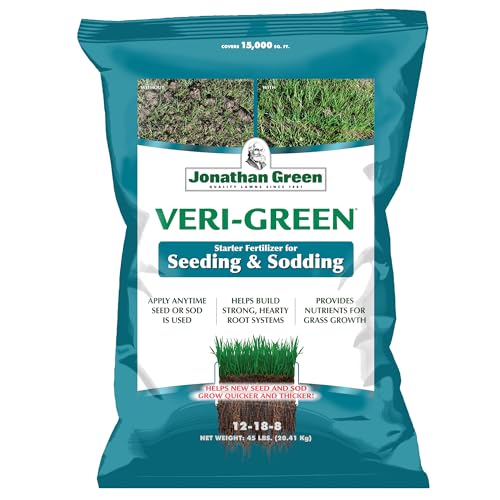
| Jonathan Green Veri-Green 12-18-8 (45 lb)Top Performer | Pro-grade coverage for big properties | 12-18-8 | 15,000 sq ft | 45 lb | Amazon |
| Covington Naturals Liquid 3-18-18 | Fast liquid boost on a budget | 3-18-18 | 3,250 sq ft | 32 fl oz | Amazon |
| Espoma Bio Tone Starter 4-3-3 | Organic soil-building for gardeners | 4-3-3 | Medium | 25 lb | Amazon |
| GreenView Fairway Formula Seeding Success | Mulch-plus-fertilizer for slopes | 1-2-0.5 | 760 sq ft | 38 lb | Amazon |
| Southland Sod Farms 21 Sod and Seed Starter | Balanced all-purpose for new sod | 15-15-15 | 18 lb bag | 18 lb | Amazon |
| The Andersons 18-24-12 Starter Turf Fertilizer | Bermuda grass and high-phosphorus needs | 18-24-12 | 12,500 sq ft | 50 lb | Amazon |
| Lesco 18-24-12 Starter Fertilizer | Professional-quality high-phosphorus feed | 18-24-12 | 50 lb bag | 50 lb | Amazon |
In‑Depth Reviews
1. The Andersons Premium New Lawn Starter 20-27-5
Our pick — over 4.5★ from 550+ verified ratings; the strongest balance of quality and price.
The crowd favorite that turns bare patches into dense turf with a single application.
The Andersons starter has the highest phosphorus content among the granular picks here at 20-27-5, meaning you are delivering more of the nutrient seedlings crave directly to the root zone. An 18 lb bag covers 5,000 square feet versus the Jonathan Green bag’s 1,500 square feet, so it suits a full front-and-back yard without needing to buy a second bag. Buyers report seeing grass “in just over a week,” which puts the dual quick- and slow-release nitrogen to work: the fast portion greens blades immediately while the slow portion keeps feeding for weeks. The 1% iron adds a deeper green tint that makes the lawn look established faster than it really is.
The crowd favorite — nearly 600 owners give it a 4.6-star nod — has 593 ratings, but its score holds higher. Growth and quality are the two aspects owners praise most, which aligns with the data: this is a straightforward, well-balanced starter that works across all turf types, spring or fall. The only practical limitation is the 18 lb weight, which feels lighter than you might expect for its coverage, but that also means the bag is easier to carry and pour.
Reasons it wins
- High phosphorus (27) pushes deep root development for fast establishment.
- Covers 5,000 sq ft — fits most standard residential lawns in one go.
- Quick- and slow-release nitrogen means you see green within days and sustained growth for weeks.
Honest trade-off
- At 18 lb it is lighter than premium 50 lb bags, which is fine unless you have a very large property that needs more than one bag.
Best for: Anyone seeding or overseeding a typical 5,000 sq ft lawn who wants proven results backed by strong owner consensus.
skip it if: You need a tiny bag for a 500 sq ft patch — the 18 lb bag is more than you will use in one season.
2. Jonathan Green (11540) Green-Up Lawn Food for Seeding & Sodding
The budget-friendly 5 lb bag that punches well above its weight for small seeding projects.
At 12-18-8, the phosphorus level is still solidly high — the middle number is 50% higher than nitrogen — and that matters because new seedlings are building root systems before they push leaf growth. This Jonathan Green formula also includes humates, which help roots access nutrients already in the soil. While the coverage of 1,500 sq ft is compact, that is exactly the right size for a front-yard patch or a strip alongside a new driveway. Owners mention it “works very well even on new seeding areas” and that it keeps grass green for up to two months, which is the stated feeding window.
Effectiveness is the top praised aspect, followed by quality and greening. A landscaper recommended it to one owner who then watched their “lawn turned very lush.” The trade-off is straightforward: the 5 lb bag runs out fast if you have a large property, but for the price it delivers a concentrated, high-phosphorus dose without forcing you to haul a heavy sack.
Why it earns its spot
- Phosphorus-rich 12-18-8 ratio targeted at root formation.
- Contains humates to improve nutrient exchange in the soil.
- Small bag means no storage hassle — use it up in one season.
What to expect
- 1,500 sq ft coverage is small — not suitable for a quarter-acre lawn.
Reach for this if: You are seeding a small patch or a narrow front lawn and want a trusted brand with the humate bonus.
Look at a bigger bag if: Your property exceeds 2,000 sq ft — you would need two or three of these and lose the value advantage.
3. Jonathan Green (16008) Veri-Green Starter Fertilizer 12-18-8
The same proven 12-18-8 ratio scaled up to 45 lb for acreage-level seeding projects.
If the smaller Jonathan Green bag is the right ratio but too small for your yard, this Veri-Green version takes the identical 12-18-8 analysis and blows it up to 45 lb covering 15,000 square feet, compared to 1,500 square feet for the 5 lb bag. Like its smaller sibling, it contains humates to help seedlings extract more from the soil, and it feeds for up to two months per application. Effectiveness is the most-discussed aspect among owners, and germination comes in a close third. Customers note “grass came up in good time” and that after four mows the lawn was green with no brown spots or burning. The only mixed feedback is value for money — at this scale the upfront cost is higher, though the per-square-foot math works out in your favor.
The 45 lb bag is physically heavy to haul from the car to the spreader, but that is the trade-off for covering a large property in a single trip. The 4.5-star rating across 450+ owners confirms that for serious seeding jobs, this is a workhorse.
Pro-grade coverage: 15,000 sq ft in one bag — ideal for a half-acre lawn or large bare-soil renovation.
The honest caveat: A 45 lb bag is heavy; plan to store it somewhere dry and accessible, not in a high garage shelf.
Go for it if: You have a large property and want the exact 12-18-8 ratio with humates, scaled to avoid multiple bag purchases.
Consider a smaller bag if: Your lawn is under 3,000 sq ft — this will last you two seasons and may clump before you finish it.
4. The Andersons 18-24-12 Starter Turf Fertilizer (50 lb)
At 18-24-12, this Andersons starter puts a full 24% phosphorus in every granule and packs it into a 50 lb bag covering 12,500 square feet. That kind of ratio is designed specifically for newly seeded turf and for correcting phosphorus deficiencies in established lawns. Owners of Bermuda grass call it “better than what the lawn service was using” and note it “made my grass liven up quick” when applied with a broadcast spreader and watered well. The 4.6-star rating is earned across a smaller but highly satisfied owner base.
The 50 lb weight is substantial, and this is a premium-tier product that makes sense for serious lawn enthusiasts or anyone managing a large warm-season turf area. The trade-off is weight and storage, but if your soil test shows low phosphorus, 18-24-12 is exactly what you need.
Targeted formulation: The 18-24-12 ratio is class-leading here — built for root establishment and spring green-up on phosphorus-hungry soils.
Heavy but worth it: 50 lb is a commitment; a broadcast spreader is essential for even application.
Buy this if: You have Bermuda or a warm-season lawn, your soil needs a phosphorus boost, and you want professional-grade results.
Pass if: You have a small cool-season lawn — the ratio is overkill and the bag will take years to use.
5. Lesco 18-24-12 Starter Fertilizer (50 lb)

Lesco’s professional-grade 18-24-12 that delivers deep green in a week without burning.
The 18-24-12 NPK ratio mirrors the Andersons premium above, but Lesco brings its own reputation from the professional turf industry. Owners say it “boosts grass growth quickly, yields deep dark green within a week” and that the formula is “forgiving, non-burning.” That is a meaningful claim for a starter — you want high phosphorus without scorching the tender roots, and the 4.4-star rating across 95 owners suggests Lesco nails the balance. The 50 lb bag is the same weight and format as the Andersons, but Lesco fans specifically call out how “easy to apply” it feels, even for a large bag.
One owner used it for newly seeded grass before fall and plans to reorder for spring. The product is designed for root development and targets lawn grasses and turf. The main limitation: this does not control weeds, so you will need a separate strategy for broadleaf invaders.
Why it stands out
- 18-24-12 high-phosphorus formula matches professional turf standards.
- Owners consistently report quick greening without burning.
- Works for newly seeded grass and for established spring feeding.
One point to consider
- 50 lb bag requires physical strength and a dedicated storage area.
Ideal for: Owners who want a professional-grade phosphorus booster with a reputation for being gentle on new seed.
Not for: Small lawns or renters — the 50 lb bag is more than most casual users need.
6. GreenView Fairway Formula Seeding Success plus Starter Fertilizer

A biodegradable paper mulch with starter fertilizer built in — holds seed on slopes and keeps moisture locked in.
This is a completely different approach from the granular starters above. The GreenView Fairway Formula is a paper-based seeding mulch mixed with a 1-2-0.5 fertilizer analysis. The nitrogen (1) and phosphorus (2) levels are low because the real job here is moisture retention: the biodegradable paper holds three times its weight in water, and a special tackifier (a sticky additive) keeps it anchored on windy days and sloping ground. Owners say it “holds seed on slope, survived 5hr rain” and that germination starts at 5 days for rye grass. It does not contain grass seed — you buy that separately. The 38 lb bag covers 760 square feet, which is a tight but effective coverage for targeted bare-spot repair or a sloped patch.
The trade-off is that the starter fertilizer component is marginal; the primary function is mulch. For erosion-prone areas or spots where peat moss blows away, this is a smart solution. A few owners note that hand-spreading can cause clumping, so a spreader is recommended.
Unique strengths
- Paper mulch with tackifier holds seed on slopes and during rain.
- Biodegradable — no cleanup required after 6-8 weeks.
- Holds 3x its weight in moisture to improve germination.
What to know
- Low NPK means you may still need a separate starter boost for large seeded areas.
Choose this if: You are seeding a slope, a bare patch that washes out, or want the convenience of a seeded-mulch-in-one product.
Stick with granular if: You have a flat, large lawn and want concentrated phosphorus — this is not a substitute for a high-ratio starter.
7. Espoma BTSG25 Granular Bio Tone Starter (25 lb)
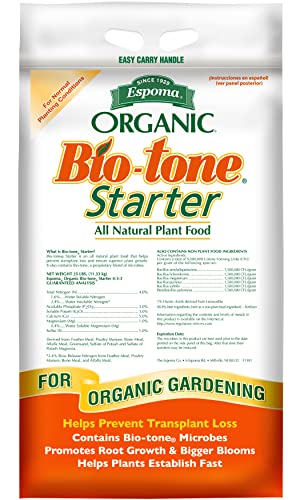
The organic 25 lb bag that feeds soil biology first and plants second — no chemical burn risk.
Espoma’s Bio Tone takes the opposite approach from the synthetic high-phosphorus starters. At 4-3-3, the numbers are low, but that is because it is an organic granular product that relies on natural ingredients and beneficial microbes to feed the soil. The goal is “faster establishment, deeper roots, and a superior soil structure.” Owners love that “it feeds the soil to feed the roots and does not burn the plant.” The “terrible smell” of fish that several owners mention is actually a sign the organic matter is active — just store it in a sealed location. The 25 lb bag weighs 25 pounds versus The Andersons’ 18 lb bag, meaning more volume per dollar, though the concentration is lower.
The 4.7-star rating is the highest in this roundup, and “starter fertilizer” is the most-praised aspect by far. This is the pick for anyone who prioritizes organic gardening, no synthetic chemicals, and a product that doubles as a soil amendment for flower beds and vegetable gardens too.
Soil-first philosophy: The 4-3-3 ratio is mild but the microbes and organic matter build long-term soil health.
The odor factor: It smells strongly of fish — keep the bag tightly rolled and stored away from the house.
Perfect for: Organic gardeners, anyone worried about chemical burn on tender seedlings, and those who want a single product for lawns and garden beds.
Not ideal for: Quick, visible results in under a week — organic formulas work slower than synthetic high-phosphorus granules.
8. Covington Naturals Liquid Lawn Fertilizer 3-18-18 (32 oz)
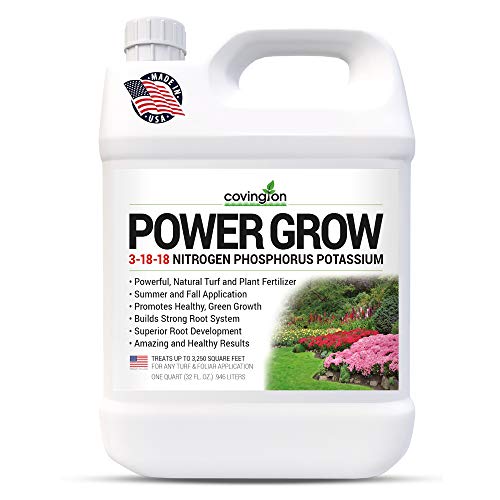
The liquid concentrate that delivers a massive phosphorus hit fast — seed germinated in 4 days, lush green by 11.
At 3-18-18, this Covington liquid is all about root and flower development (phosphorus and potassium) with just enough nitrogen to keep blades moving. The liquid form means you spray it directly — 2 to 4 oz per gallon of water or 10 oz per 1,000 sq ft — and the nutrients are available immediately. Reviewers point out that seed germinated quickly and the lawn was lush green after just over a week. The 32 oz bottle covers 3,250 square feet, making it a compact option for a medium lawn or for spot-treating bare areas. It works on Bermuda, Ryegrass, Kentucky Bluegrass, Fescue, Bahia, Centipede, Zoysia, and St. Augustine.
The most common critique is that the nitrogen content feels low; some owners say the grass stayed a bit pale and wished the first number were higher. That is a fair point — 3-18-18 is a bloom-oriented ratio, not a growth ratio. The maker recommends reapplying every 2 to 4 weeks, so plan for that schedule.
What owners love
- Seed germinated 4 days after seeding with lush green at 11 days.
- Liquid format allows precise spot application and fast absorption.
- Covers 3,250 sq ft from a single 32 oz bottle — good value for the area.
The limitation
- Nitrogen (3%) is low — expect grass to need a separate nitrogen boost if you want dark green blades quickly.
Great for: Quick liquid feeding after seeding, especially for smaller lawns or targeted bare patches where you want fast phosphorus availability.
Skip if: You want a one-step all-season fertilizer with high nitrogen — this is a root-building starter, not a maintenance feed.
9. Southland Sod Farms 21 Sod and Seed Starter 15-15-15 (18 lb)

The balanced 15-15-15 starter that needs zero prep — just toss and water.
Southland’s approach is simplicity: a balanced 15-15-15 ratio that provides equal parts nitrogen, phosphorus, and potassium. This makes it a versatile choice for both new sod and freshly seeded lawns, and the formula is designed to reduce the risk of transplant shock. Shoppers say that it “revived browning spots to lush green in weeks” with minimal effort — just toss it down and water daily. One owner achieved 100% seed germination and plans to reorder. The 18 lb bag is the same weight as the Andersons but with a balanced ratio, which is less targeted for root development but more forgiving if you accidentally apply it to established grass later.
The 4.4-star rating across 100 owners is solid. A few owners note the granules can be a bit clumpy, but the overall feedback emphasizes how little prep work is needed.
No-fuss feeding: 15-15-15 means you cannot overdo phosphorus for general lawn use — works as starter and maintenance feed.
Clumpy on humid days: Store the bag in a dry spot and break up clumps before spreading.
Best for: First-time lawn owners who want one bag that works for sod, seed, and existing grass without worrying about ratio math.
Think twice if: Your soil test shows high phosphorus — a balanced ratio may add more than needed and could harm local waterways.
Understanding the Specs
NPK Ratio
The three hyphenated numbers on every fertilizer bag — nitrogen (N), phosphorus (P), potassium (K). For new grass, the middle number (phosphorus) is the most important because it drives root formation. A ratio like 20-27-5 or 12-18-8 tells you the bag is formulated for seeding. A balanced 15-15-15 works for both new and established grass. Low middle numbers (like 4-3-3) mean organic, slower-release feeding.
Quick-Release vs Slow-Release Nitrogen
Some starters combine both types: quick-release nitrogen gives the grass a visible green boost within a few days, while slow-release nitrogen continues feeding over weeks so you do not have to reapply as often. The Andersons Premium uses this dual approach. Pure quick-release formulas can burn new seedlings if over-applied, so check whether the bag mentions slow-release.
Coverage Area
The square footage a single bag or bottle covers at the recommended application rate. A 5 lb bag covering 1,500 sq ft is suited to small projects, while a 45 lb bag covering 15,000 sq ft handles an entire property. Always measure your lawn before buying; a bag that is too large may cake up before you finish it, and too small means buying multiples that cost more per square foot.
Granular vs Liquid
Granular fertilizers are applied with a spreader and release nutrients over time; they are the standard for large lawns. Liquid concentrates mix with water and are absorbed immediately — good for quick correction or small patches. Liquids need more frequent reapplication (every 2 to 4 weeks per most labels). Granules often last 6 to 8 weeks before you need another round.
FAQ
Can I use regular lawn fertilizer on new grass?
How soon after seeding should I apply starter fertilizer?
What does the NPK ratio mean for my lawn?
Is a liquid starter better than granular for new grass?
Can I overseed with starter fertilizer?
How long does starter fertilizer last in the soil?
Will starter fertilizer burn my new grass?
What is the difference between starter fertilizer and plant food like Espoma Bio Tone?
Can I use the same starter for sod and seed?
How do I store a large bag of granular starter?
Final Thoughts: The Verdict
If you want one dependable pick, the good fertilizer for new grass winner is the The Andersons Premium New Lawn Starter because it combines a high-phosphorus 20-27-5 ratio with dual-release nitrogen, covers 5,000 sq ft, and earns the strongest owner consensus at 4.6 stars. If you want the organic soil-building approach for a chemical-free lawn, grab the Espoma Bio Tone. And for a large property where you want the same proven ratio at scale, the Jonathan Green Veri-Green covers 15,000 sq ft without sacrificing root nutrition. Match the bag size to your lawn, water it in well, and give those new roots the phosphorus they need — the grass will do the rest.
How We Picked
We do not accept paid placement. Every pick is matched to a real buyer and a real use-case; we do not hands-on test units.
Sources & Methodology
Specifications: manufacturer listings and product documentation. Review insights: verified customer reviews, as of July 2026. Pricing: not shown on this page (it changes often); check the current price via the retailer link.
As an Amazon Associate, Lawn Gear Lab earns from qualifying purchases. This does not affect which products we feature.