
Specs are compiled from manufacturer listings and verified buyer reviews and can change over time — please confirm the key details on the product page before buying.
Walking into a room filled with glossy, deep-green leaves that look like they belong in a conservatory rather than a living room is the real goal here. The wrong fertilizer torches roots, stinks up your space, or just sits in the soil doing nothing. Getting it right means choosing a formula that actually matches how you water, what you grow, and how much effort you want to put into feeding day after day.
I’m Rikta — the founder and writer behind Lawn Gear Lab. This guide is built by comparing the manufacturers’ published specifications and the patterns across verified customer reviews, so you get each pick’s real strengths and trade-offs instead of marketing spin.
You want your houseplants to grow strong leaves and steady roots, so the best good fertilizer for houseplants for you depends on three things: the N-P-K ratio (the three numbers on the label that show nitrogen, phosphorus, and potassium levels), whether it is liquid or slow-release, and how often you are willing to apply it.
Our Picks at a Glance

How To Choose The Best Good Fertilizer For Houseplants
Houseplants live in a closed pot with limited soil, so they rely entirely on you for nutrients. Pick a fertilizer that suits your watering style, the type of plant you own, and how much time you have for mixing and measuring.
The N-P-K numbers tell you the job
The three numbers on the label — Nitrogen (N), Phosphorus (P), and Potassium (K) — describe what the fertilizer emphasizes. A higher first number, like 20-20-20, pushes leafy green growth. A higher middle number, like 15-30-15, supports flowers and roots. A balanced ratio like 5-5-5 or 9-3-6 works for general all-purpose feeding.
Liquid, powder, or tablet changes the routine
Liquid fertilizers are fast-acting and easy to mix, but you apply them more often. Powders are more concentrated per dollar but require dissolving and measuring. Tablets are the easiest for forgetful owners — drop one in water and go — but they release slowly. Your daily habit matters more than the label.
Synthetic vs. organic
Synthetic water-soluble formulas deliver nutrients instantly, so you see a quick green-up within days. Organic options, like those containing sea kelp or fermented plant extracts, feed the soil microbes along with the plant. They are gentler and less likely to burn roots, but they work a little slower. There is no wrong choice — it depends on if you want speed or long-term soil health.
Quick Comparison
| Model | Best For | N-P-K Ratio | Form | Yield (Gallons) | Amazon |
|---|---|---|---|---|---|
| Miracle-Gro All Purpose★ Best Overall | Ultimate volume & speed | 24-8-16 | Water-Soluble Powder | ~96 gallons | Amazon |
| HiThrive All PurposeBudget Champion | Budget liquid for many plants | 6-2-4 | Liquid | 85+ gallons | Amazon |
| Grow Queen OrganicOrganic Power | Organic, gentle daily feeding | 5-5-5 | Liquid | 50 gallons | Amazon |
| Instant Biologics Tablets | Mess-free, forgetful owners | 4-3-6 | Tablet | 4 tablets | Amazon |
| Jack’s Classic 15-30-15 | Blooms & flowering plants | 15-30-15 | Water-Soluble Powder | ~8 gallons | Amazon |
| Dyna-Gro Foliage Pro | Professional-grade all-in-one | 9-3-6 | Liquid | ~64 gallons | Amazon |
| Foliage-Pro 9-3-6 | Foliage-heavy collections | 9-3-6 | Liquid | ~64 gallons | Amazon |
| GS Plant Foods 20-20-20 | Balanced all-purpose with kelp | 20-20-20 | Water-Soluble Powder | ~96 gallons | Amazon |
In‑Depth Reviews
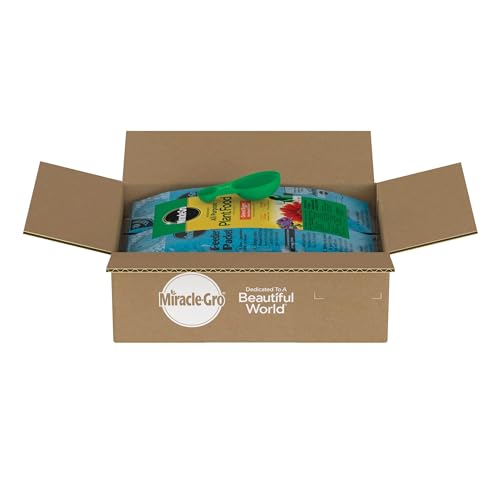
1. Miracle-Gro Water Soluble All Purpose Plant Food, 6.25 lb
Our pick — over 4.5★ from 30,000+ verified ratings; the strongest balance of quality and price.
The 6.3-pound bag
This is the big one — 6.3 pounds of blue granules that promise instant feeding for everything from your fiddle leaf to your tomatoes. Mix 1/2 teaspoon per gallon for indoor plants and apply every one to two weeks. Buyers report plants doubling in size and leaves turning visibly greener within a week, calling it the best they have used across vegetables, flowers, and houseplants. The granules dissolve quickly, carry no smell, and the formula claims to be safe and non-burning when used as directed. It is a full-spectrum powerhouse that works for indoor, outdoor, roses, shrubs, and trees alike.
The sheer volume here completely changes the math. At roughly 6.3 pounds versus the 1.2 pounds of the HiThrive liquid, this bag gives you over five times the material for a similar investment. It is the crowd favorite for a reason — tens of thousands of owners agree. The only real friction is the fine blue powder, which owners mention can blow in a breeze and stain hands or clothing, so mix carefully and keep the bag sealed. It also officially excludes orchids and Venus fly traps, so picky species still need a dedicated formula.
If you want one bag to feed every plant in your house and garden without hesitation, this is the longest-lasting, highest-value option on the shelf. For tiny collections, the 6.25-pound bag may outlast your enthusiasm — consider a smaller bag or a liquid alternative if you only have a few pots.
What wins people over
- Massive 6.3-pound bag feeds dozens of plants for months
- Visible results in one week — greener leaves and doubled plant size
- Safe for all listed plant types, no burn when measured correctly
- Dissolves instantly and leaves no smell behind
The honest trade-offs
- Fine blue powder can drift in wind and stain skin or fabrics
- Not recommended for orchids or Venus fly traps
- Granules need thorough mixing to avoid residue
Winner’s circle: Anyone with a mix of indoor and outdoor plants who wants the biggest bag, fastest results, and strongest owner consensus on the market.
Look elsewhere if: You own only a handful of houseplants — the bag will last years past its prime.
2. HiThrive 16oz Houseplant Fertilizer, All Purpose Indoor Plant Food
One bottle stretches to 85 gallons of feed — a penny-per-plant play
This liquid concentrate uses a 6-2-4 NPK ratio, which leans slightly toward foliage growth while still supporting roots and resilience. Mix just one teaspoon (half a capful) per gallon of water, or a quarter teaspoon for water propagation setups. Owners consistently report that their houseplants grow faster and look much healthier after the first application. The formula is odorless, which matters a lot when you are mixing indoors near your kitchen or workspace. It works for fiddle leaf figs, pothos, monsteras, peace lilies, and most common houseplant species.
At 1.2 pounds total, this bottle is lighter than the Miracle-Gro bag at 6.3 pounds — but the 16-ounce volume still yields over 85 gallons of finished feed. That makes it a perfect entry point for a collection of a dozen or so pots. The brand packs in nitrogen for green leaves, potassium for stress resistance, and phosphorus for root strength. The most common praise from owners centers on plant health — the top aspect by a wide margin.
For a new plant owner or someone with a moderate indoor collection, this is the cheapest way to get a concentrated liquid that really works. If you need to feed a large outdoor garden alongside your houseplants, the Miracle-Gro bag will serve you better on volume alone.
Bottom line value: The best liquid starter for houseplant lovers on a budget — effective, odorless, and lasts ages. skip it if your collection extends outdoors or you prefer a single all-in-one for everything.
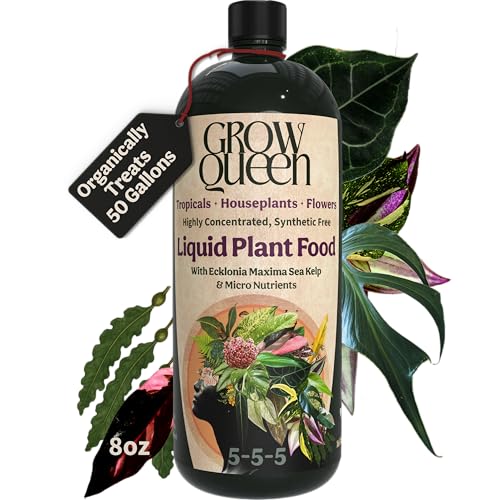
3. Grow Queen Organic Liquid Indoor Plant Food, 5-5-5 with Sea Kelp, 8oz
Botanist-developed organic feed that growers call “amazing” for 150+ plants
This 8-ounce bottle treats up to 50 gallons, which is remarkable concentration for an organic liquid. The 5-5-5 NPK is balanced, meaning it supports foliage, roots, and blooms without over-emphasizing any one direction. The secret weapon is cold-processed Ecklonia maxima sea kelp, rich in auxins and trace minerals that fuel explosive root expansion and deeper green color. Owners with big collections — some with over 150 houseplants — report no fertilizer burn, no smell, and visible growth within days. It works for soil, hydroponics, and even water propagation.
One owner with roughly 300 plants confirmed the bottle lasts a while and makes plants grow like crazy. The formula is 100% biodegradable and safe for use around pets and kids. It also nourishes beneficial soil microbes rather than just dumping synthetic salts, which improves soil structure and nutrient retention over time. The only aspect that gets mixed treatment is the odor — a few customers note a light natural smell, though most say it is essentially odorless. This is the cleanest way to feed large organic collections without worrying about chemical burn.
If you are an eco-conscious grower with a substantial indoor jungle, the Grow Queen delivers pro-grade organic results in a tiny bottle. For someone who only feeds a couple of pothos once a month, a simpler budget liquid makes more sense.
Why growers love it
- True 5-5-5 organic formula with sea kelp for root and leaf growth
- One 8oz bottle feeds up to 50 gallons — extremely concentrated
- No burn risk, safe for pets and kids, biodegradable
- Works in soil, hydroponics, and water propagation
The catch
- Some owners detect a light natural smell, though most find it clean
- Higher upfront cost per ounce compared to synthetic options
Best for organic collectors: The top pick for anyone with a large indoor garden who wants gentle, living-nutrition results without synthetic chemicals.
Think twice if: You need maximum speed for a quick green-up — synthetics like Miracle-Gro act faster.
4. Instant Biologics Houseplant Fertilizer Self-Dissolving Tablets (4 Tablets)
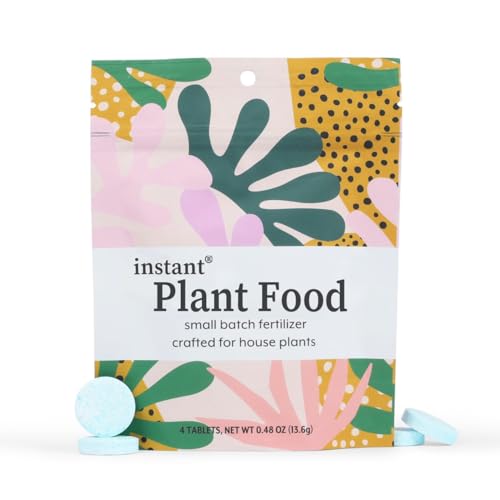
Drop a tablet in water and you are done — no measuring, no dust, no mess
These self-dissolving tablets use a 4-3-6 NPK ratio with trace micronutrients derived from naturally occurring minerals and a live fermentation process. Each tablet can feed a large houseplant or several small ones for up to three months. Reviewers point out reviving withering plants within days — leaves greening and stems strengthening — and the tablets dissolve quickly in water with no residue or odor. The formula works for all types of houseplants including tropical, desert, and air plants, as well as self-watering containers.
The biggest selling point is convenience. You do not touch powder, measure spoons, or risk spilling liquid. Just drop one tablet into your watering can, let it dissolve, and water. For forgetful plant owners, this is a lifesaver — monthly use keeps plants healthy for two months without needing to reapply. The tablets can be broken in half to avoid over-fertilizing small pots. The brand is certified vegan, cruelty-free, and donates 1% of sales to environmental organizations.
If you want to feed a few houseplants with zero effort and zero mess, this is the perfect solution. For bigger collections, the four-tablet pack runs out quickly, and you will want a liquid or powder concentrate instead.
What works
- No measuring, mixing, or mess — just drop in water
- Visible results in days, even on withering plants
- Certified vegan and cruelty-free
- Each tablet lasts up to 3 months for a large plant
The limitation
- Only 4 tablets per pack — expensive per feed for large collections
- Instructions on water-to-tablet ratio could be clearer for beginners
Ideal for low-maintenance owners: The easiest way to feed a small indoor garden without any measuring or cleanup. Skip if you have dozens of plants — you will burn through the pack fast.
5. Jack’s Classic 15-30-15 Houseplant Special Water-Soluble Fertilizer, 8oz

The high-phosphorus specialist that makes flowering plants burst with blooms
This 8-ounce powder uses a 15-30-15 analysis, with the middle number (phosphorus) nearly double the others. That is the recipe for increasing the quality and quantity of blooms in flowering houseplants. It can be used as a foliar spray on leaves or as a root drench. Mix one teaspoon per gallon of water — the included measuring spoon makes it simple. Shoppers say that their plants grow quickly with green, shiny leaves, and one noted their fiddle leaf fig “took off like a rocket” after just two applications. The formula includes added micronutrients, so no additional feeding is needed.
The 8-ounce bag makes about 8 gallons of fertilizer, which is far less volume than the Miracle-Gro 6.25-pound bag or the HiThrive liquid. That makes it a specialist, not a workhorse. It is pricier per gallon than all-purpose options, but owners consistently say it is worth it for the results on blooming plants. One experienced grower recommends using 1/4 teaspoon per watering every other watering to keep plants looking beautiful. Avoid leaf contact with the undiluted powder to prevent burns.
If your houseplant collection is built around African violets, peace lilies, or any flowering species, this is your best bet for maximizing blooms. If you grow mostly foliage plants like pothos or snake plants, a balanced or nitrogen-heavy formula suits them better.
The specialist’s choice: Jack’s Classic leads on bloom production thanks to its high-phosphorus ratio. The trade-off is the small bag size and higher per-feed cost. Perfect for flowering plants only.
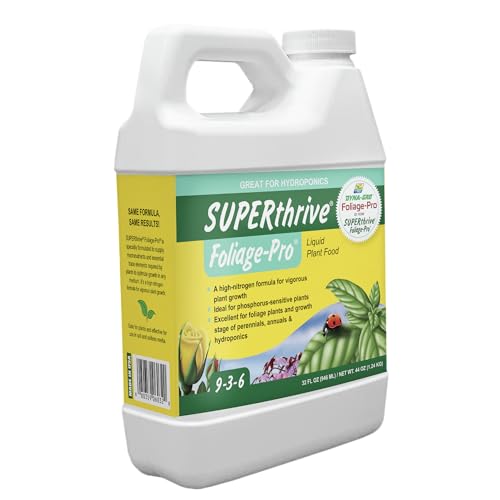
6. Dyna-Gro Foliage Pro 32oz Liquid Plant Fertilizer, 9-3-6
The professional-grade formula that indoor growers call “better than Miracle-Gro”
Dyna-Gro Foliage Pro uses a 9-3-6 NPK ratio (a 3:1:2 balance), which is widely considered the gold standard for foliage plants. It supports healthy foliage, root growth, and vibrant color in low-light indoor environments. The liquid mixes easily with water and works in both soil and hydroponic systems. Buyers report fast, abundant new growth within days, with plants thriving for years. One review notes that “only a small amount is needed” — and the 32-ounce bottle yields approximately 64 gallons of feed depending on your dilution. Professional growers recommend this formula, and the owner consensus backs it up with a near-perfect rating.
The 32-ounce bottle is a step up from the 16-ounce HiThrive in both price and concentration. While HiThrive is 6-2-4, Dyna-Gro is 9-3-6, offering more nitrogen for leaf production and a tighter ratio for foliage-focused care. It is designed as a sole nutrient source, so you do not need to add anything else. The bottle seals well and lasts a long time because you use so little per gallon.
This is the best pick for serious indoor gardeners who want a proven, professional formula that works in hydroponics too. If you only water a couple of potted plants once a month, the lower-concentration liquid options are more forgiving.
Pro-level strengths
- Balanced 9-3-6 NPK ideal for foliage and low-light plants
- Small dose per gallon — one bottle goes very far
- Works in soil and hydroponics equally well
- Owners mention dramatic new growth within days
What to note
- Higher upfront cost than budget liquids
- Requires careful measuring for best results
Built for dedicated collectors: Dyna-Gro delivers pro results for indoor foliage and tropical plants. Skip if you want a cheaper, simpler option for a few basic houseplants.
7. Foliage-Pro 32 oz. 9-3-6 Plant Food
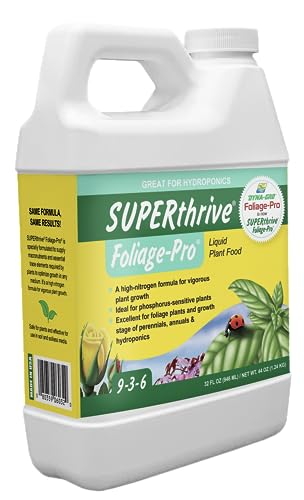
One application and every single plant shows new growth — not an exaggeration
Foliage-Pro delivers the same 9-3-6 ratio as Dyna-Gro, tune for foliage plants. The mixing ratio is 1/4 to 1/2 teaspoon per gallon, making it extremely concentrated. Customers note that after just one application, every single plant in the house shows new growth. The formula stopped yellowing leaves on philodendrons and monsteras and promoted healthy new growth. Users with large collections of leafy houseplants say the difference was “hard to ignore” after switching from a balanced fertilizer. The high concentration means excellent value per use despite the upfront cost.
This is practically a twin to the Dyna-Gro Foliage Pro in ratio and performance, with the same 9-3-6 focus on foliage. The main difference between the two is branding and packaging — both target the same use case. Owners praise the long-lasting bottle and the immediate greening effect on leaf-heavy plants. Use it at every watering for consistent results, or as a weekly supplement.
If you own a collection of pothos, philodendrons, monsteras, or any plant you grow for its leaves, this formula is perfectly tuned for you. It is a very similar pick to the Dyna-Gro, so choose whichever is cheaper or more available at the time of purchase — the results are the same.
Leaf lover’s liquid: The perfect match for foliage-heavy collections looking for a concentrated, professional 9-3-6 feed. Nearly identical to Dyna-Gro in function, so buy whichever is in stock.
8. GS Plant Foods All Purpose 20-20-20 Fertilizer with Kelp, 3 lbs
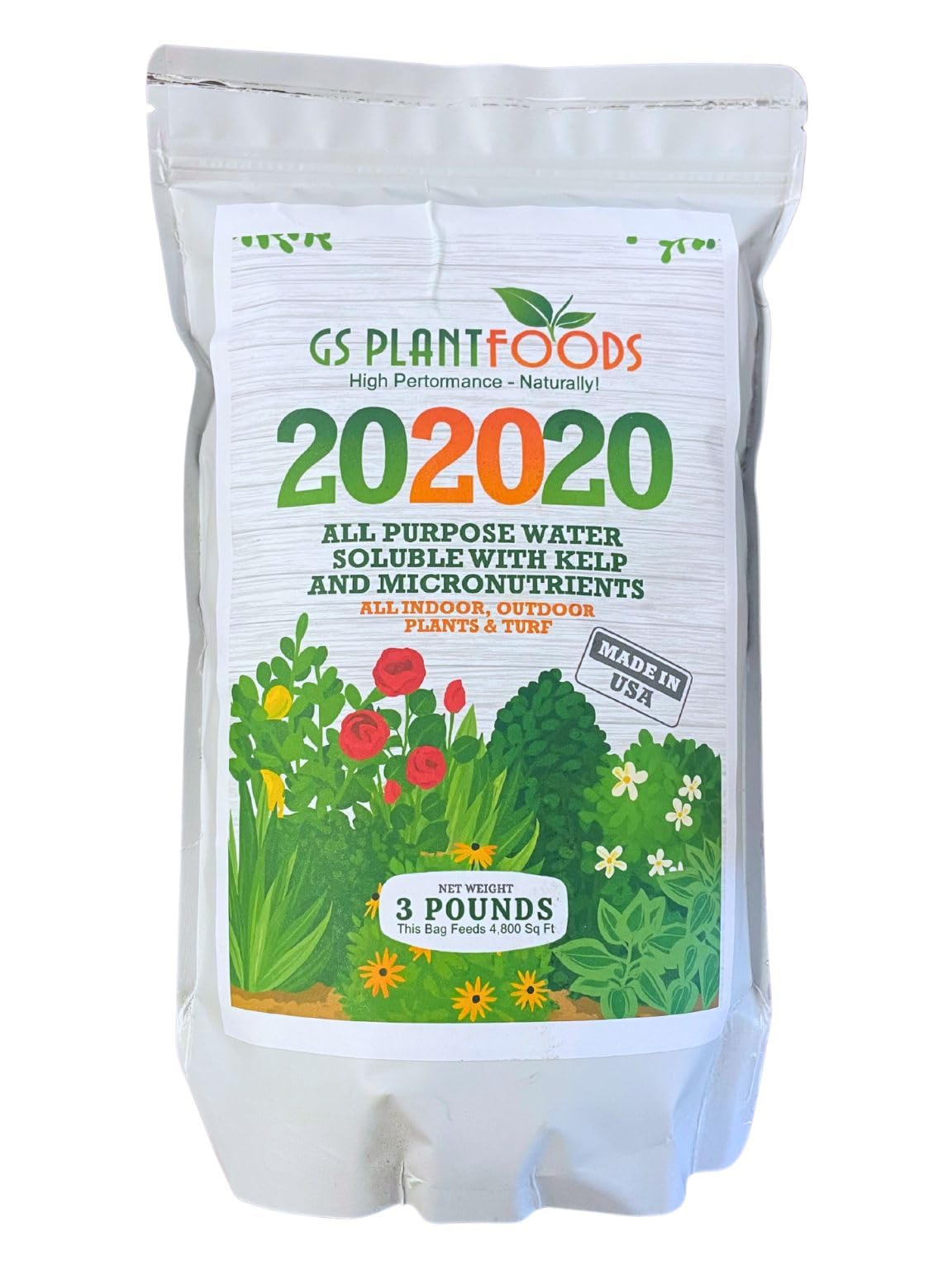
A balanced 20-20-20 with kelp added, feeding 4,800 sq ft of turf or a shelf of houseplants
This powder uses a true 20-20-20 NPK ratio, meaning equal parts nitrogen, phosphorus, and potassium. It also contains kelp (Ascophyllum nodosum) plus a full suite of micronutrients including iron, manganese, copper, and zinc. The powder dissolves completely in water for use with watering cans, hose-end sprayers, or backpack sprayers. Reviewers point out that fig trees, berry plants, and houseplants all respond strongly — one owner treated sick purple orchid trees and saw dark green leaves and shoots within a week, while the untreated tree stayed yellow. The 3-pound bag feeds up to 4,800 square feet of turf when used as directed, making it incredibly versatile.
At 20-20-20, this is a higher nitrogen concentration than the Grow Queen or HiThrive liquids. That makes it faster-acting for foliage growth but also easier to overdo — the instructions say it will not burn plants if used correctly, but beginners should measure carefully. The kelp adds a natural element that supports soil biology, though the base fertilizer is synthetic. Owners mention a slight organic odor from the kelp, but it is insignificant outdoors. This bag is heavier than the Jack’s Classic 8oz bag and much more versatile across indoor and outdoor use.
It is a strong all-around choice for anyone who wants a single bag for houseplants, vegetable gardens, lawns, and flowers. If you only feed indoor houseplants, the 3-pound bag is more than most will ever need, and a smaller liquid might be more convenient.
What makes it versatile
- Balanced 20-20-20 NPK suits almost every plant type
- Contains kelp and full micronutrient profile
- Feeds up to 4,800 sq ft of turf — great for lawns too
- Dissolves completely, works with multiple applicators
The downside
- High nitrogen requires careful measuring for houseplants
- Slight organic smell from kelp, though most find it mild
Best for mixed-use growers: Ideal if you feed houseplants, a garden, and a lawn all from one bag. Overkill if you only have a few indoor pots — go with a small liquid instead.
Understanding the Specs
N-P-K Ratio
The three numbers on any fertilizer label stand for Nitrogen, Phosphorus, and Potassium. Nitrogen (the first number) drives leafy green growth — higher numbers like 20-20-20 mean more leaf production. Phosphorus (the middle number) supports roots and blooms — 15-30-15 is high-phosphorus and great for flowering plants. Potassium (the last number) helps overall plant health and stress resistance. A balanced ratio like 5-5-5 works as a general feed for most houseplants.
Water-Soluble vs. Liquid vs. Tablet
Water-soluble powders (like Miracle-Gro or Jack’s Classic) are dry granules you mix with water yourself. They are the most concentrated per dollar but require measuring. Liquid fertilizers (like HiThrive or Dyna-Gro) are pre-dissolved and ready to mix — convenient and fast-acting but heavier to ship. Tablets (like Instant Biologics) are the simplest: drop one in water and go. Powders give you the most feed per bag; tablets give you the least mess. Your choice depends on whether you prioritize speed, convenience, or value.
Organic vs. Synthetic
Synthetic fertilizers (like the 20-20-20 or 24-8-16 formulas) deliver nutrients in a form plants can use immediately. They produce fast visible results but do little for long-term soil health. Organic formulas (like the Grow Queen 5-5-5 with sea kelp) feed the microbes in the soil, which in turn feed the plant. They work slower but improve soil structure over time and are gentler, with less risk of burning roots. Many owners choose organic for indoor use because the smell is usually neutral and the safety margin is wider around pets and kids.
Concentration and Yield
A fertilizer’s concentration determines how many gallons of finished feed you get from one bottle or bag. The HiThrive 16oz bottle makes 85+ gallons; the Grow Queen 8oz bottle makes 50 gallons. The Miracle-Gro 6.25-pound bag makes roughly 96 gallons at the indoor rate. Higher concentration means a smaller bottle lasts longer, but you have to measure more carefully — a tiny miscalculation in a high-concentration liquid can burn plants. Lower concentration formulas are more forgiving for beginners.
FAQ
What does 20-20-20 mean on a fertilizer label?
How often should I fertilize my houseplants?
Can I use outdoor plant fertilizer on my houseplants?
Is liquid fertilizer better than powder for indoor plants?
Will organic fertilizer smell bad in my house?
How do I know if I am over-fertilizing my plants?
Can I use houseplant fertilizer in a self-watering pot?
Do I need a different fertilizer for flowering houseplants?
Final Thoughts: The Verdict
For most people, the good fertilizer for houseplants winner is the Miracle-Gro All Purpose Plant Food because it combines the highest owner rating, the most volume per dollar, and visible results within a week across every plant type. If you prefer a mess-free organic approach, grab the Grow Queen Organic Liquid. And for the easiest, most convenient feeding routine on a small collection, the Instant Biologics Tablets are the one to reach for.
How We Picked
We do not accept paid placement. Every pick is matched to a real buyer and a real use-case; we do not hands-on test units.
Sources & Methodology
Specifications: manufacturer listings and product documentation. Review insights: verified customer reviews, as of July 2026. Pricing: not shown on this page (it changes often); check the current price via the retailer link.
As an Amazon Associate, Lawn Gear Lab earns from qualifying purchases. This does not affect which products we feature.