
Specs are compiled from manufacturer listings and verified buyer reviews and can change over time — please confirm the key details on the product page before buying.
The damp soil in your houseplant pots is a perfect nursery for fungus gnats. These tiny black flies are more than annoying — their larvae munch on roots, leaving plants weak and yellowing. The solution isn’t a single product; it’s knowing which approach (sticky trap, spray, predator bugs, or soil drench) matches your gnat problem’s severity.
I’m Rikta — the founder and writer behind Lawn Gear Lab. This guide is built by comparing the manufacturers’ published specifications and the patterns across verified customer reviews, so you get each pick’s real strengths and trade-offs instead of marketing spin.
From instant-kill contact sprays to long-lasting soil granules and live predatory mites, these are the best methods you can use right now to find your ideal gnat killer for indoor plants and give your houseplants a fighting chance.
Quick Picks
- Bonide Systemic House Plant Insect Control Granules — Best Overall
- Mighty Mint Peppermint Oil Plant Protection Spray — Peppermint Fresh
- Dr. Killigan’s Doom & Bloom House Plant Pest Spray — Fast Knockdown
- Safer Brand 5026 Houseplant Sticky Stake Insect Traps — Trap + Monitor
- Trifecta Crop Control Maximum Strength Natural Pesticide — Maximum Strength
- 12,500 Live Hypoaspis Miles (Predatory Mites) by NaturesGoodGuys — Biological Army
How To Choose The Best Gnat Killer For Indoor Plants
Fungus gnats love wet soil. Before buying any product, you have to match the treatment to how many adults you see and whether larvae are eating the roots. Here are the three main routes.
Sticky Traps vs. Sprays vs. Systemic Killers
A sticky trap catches the flying adults, breaking the egg-laying cycle. A contact spray (like peppermint oil or soybean oil) kills both adults and larvae on contact — but you have to spray directly. A systemic product goes into the soil and is absorbed by the plant, turning the whole plant toxic to pests. For a heavy infestation you often need two methods in parallel.
Quick Comparison
On smaller screens, swipe sideways to see the full table.
| Model | Best For | Type | Active Ingredient | Coverage / Count | Amazon |
|---|---|---|---|---|---|
| Bonide Systemic Granules | Best Overall | Soil Granules | Imidacloprid | 8 oz (8 weeks protection) | Amazon |
| Mighty Mint Spray | Plant-Based Contact | Spray | Peppermint Oil | 16 oz | Amazon |
| Dr. Killigan’s Spray | Fast Knockdown | Spray | Soybean Oil | 16 oz | Amazon |
| Safer Brand Stakes | Non-Toxic Monitoring | Sticky Stake | Glue | 7 stakes | Amazon |
| Trifecta Crop Control | Maximum Strength | Spray | Plant-Based Oil | 32 oz | Amazon |
| Predatory Mites | Biological Control | Live Beneficials | Stratiolaelaps scimitus | 12,500 mites | Amazon |
In‑Depth Reviews
1. Bonide Systemic House Plant Insect Control Granules

Granules you sprinkle into the soil that protect every new leaf from gnats for two months.
Bonide’s systemic granules contain imidacloprid, a chemical that the plant absorbs through its roots. As the plant grows, every new leaf and stem carries the protection inside its tissues. Any insect that feeds on the plant gets a lethal dose. This is different from a spray, which only coats the surface you hit. You shake 8 ounces of ready-to-use granules onto the soil of your houseplants and water them in — a few minutes of work for up to 8 weeks of protection.
Buyers report this is the “best product I tried” after failing with sticky stakes, cinnamon, and other pesticides. One reviewer noted a single treatment eliminated gnats from an affected plant and kept it gnat-free for 2 months. The granules are nearly odorless and require no mixing, making it a genuinely mess-free option. The catch is that a single 8 oz bottle costs more than most sprays, and the packaging has been criticized as wasteful — the product fills less than half the container. If you have several plants, you’ll likely use the whole bottle in one round.
Two-Month Shield
- Systemic action protects new growth
- Single water-in application lasts 8 weeks
- Kills fungus gnats, mealybugs, whiteflies, thrips, and aphids
Potential Drawbacks
- Imidacloprid is a synthetic chemical (not for organic growers)
- Packaging contains a lot of air; product volume is less than container size suggests
- Requires treating every plant simultaneously or gnats return
low-maintenance pick: Best for anyone who wants a single treatment to handle the problem across many plants. Reach for it if you are tired of repeat spraying.
Not for organic gardeners: The active ingredient is synthetic and is not labeled for organic use, so skip this if you avoid all synthetics.
2. Mighty Mint Peppermint Oil Plant Protection Spray

A peppermint-scented spray that kills gnats on contact without harsh chemicals.
Mighty Mint uses peppermint oil as its active ingredient. It is a contact spray — you must spray directly onto the gnats, aphids, or spider mites for it to work. The ready-to-use formula is safe for use around people and pets when used as directed, according to the manufacturer. Owners mention that spraying 20 houseplants twice a day eliminated 90% of gnats within a week, with no damage to the plants themselves. They also mentioned the strong peppermint scent dissipates in about 1 hour, and one buyer mentioned the sprayer nozzle broke after a week, causing leakage when shaken.
This is a good option if you prefer a plant-based solution and want a pleasant minty smell in your home — customers note it leaves leaves clean and shiny. For a heavy infestation, you will need to spray consistently every day, and you still need to address the larvae in the soil. The product also handles mealybugs, soil mold, and some fungal issues, so it is more versatile than a pure gnat trap.
Plant-Based and Pleasant
- Peppermint oil formula kills on contact
- Safe for people and pets when used as directed
- Leaves a fresh minty scent that fades within 1-2 hours
Frequent Application Needed
- The sprayer can break after a week of use
- Must spray twice daily for best results; labor intensive for many pots
- A few reviewers point out it does not kill gnats effectively
Best for a light, natural approach: Choose this if you have a small collection of houseplants and want a pleasant-smelling, non-toxic spray.
Heavy infestations need backup: If your pots are swarming, you will likely need a soil treatment alongside this spray.
3. Dr. Killigan’s Doom & Bloom House Plant Pest Spray
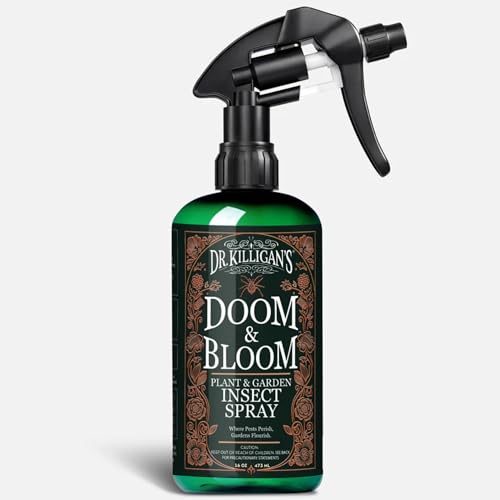
A soybean oil spray that kills fungus gnats on contact by physically breaking down their outer shell.
The active ingredient is soybean oil — not a nerve poison. It works by coating the gnat’s body and breaking down its protective outer layer, causing dehydration and suffocation. This mechanical mode of action means pests cannot build resistance to it over time. The adjustable trigger sprayer can switch between a fine mist for broad coverage and a stream for direct hits. Shoppers say it eliminated a severe fungus gnat infestation in one week, noting zero bugs on sticky traps after spraying the leaves, stems, and soil. They also mention a slight, fast-fading scent.
Unlike the Mighty Mint spray above, Dr. Killigan’s is specifically formulated to target small-bodied insects like aphids, spider mites, and thrips. It only works on gnats if you spray them directly; the product does not kill larvae in the soil. A few buyers report it did not work for gnats at all, suggesting that direct contact is critical. For best results, combine it with a soil drench or sticky stakes for full lifecycle control.
Resistance-Proof Action
- Physical mode of action (mechanical, not chemical)
- Adjustable mist/stream nozzle for full coverage
- Owners mention immediate reduction in gnat activity
Contact-Only Limitations
- Does not kill gnat larvae in the soil
- Some customers note it fails on gnats entirely
- Requires repeat application every 3 days during active infestations
Best contact spray for immediate action: Grab this if you see adult gnats and want to knock them down fast with a non-toxic spray.
skip it if you want a complete solution: This spray works on contact only; you will still need a soil treatment for the eggs and larvae.
4. Safer Brand 5026 Houseplant Sticky Stake Insect Traps

Non-toxic yellow stakes that lure adult gnats in and trap them without any pesticides.
These are the simplest weapon: a yellow sticky surface that is visually attractive to fungus gnats, fruit flies, whiteflies, and thrips. The stakes are 5.5 inches long and weigh only 1.01 ounces. You push them into the soil, and the adhesive holds the gnats instantly. Reviewers point out that one stake caught “100+” gnats in a weekend after a plant brought gnats indoors. Unlike the Bonide granules, there is no chemical involved — the “special formula” is just the color and a glue-like surface.
Shoppers say a quirk: you have to fold the stake and tape the bottom strip closed so it fits on the included plastic holder. Some buyers place the strip flat, sticky-side down, on the soil for maximum surface area. These stakes are a great early warning system — if you see them filling up, you know a soil treatment is needed. They will not kill the larvae, so combine them with a soil drench like the Bonide granules if you have a real infestation. A pack comes with 7 stakes, enough for a small collection.
Non-Toxic Monitoring
- Zero pesticides — safe for all households
- Discreet design hides behind plant leaves
- Catches adults quickly, breaking the breeding cycle
Larvae Untouched
- Does not kill eggs or larvae in the soil
- Stake must be assembled (fold and tape) before use
- 7 stakes — not enough for a large plant collection
Best for prevention and monitoring: Use these as a first line of defense — catch adults before they lay more eggs.
Heavy infestations need more: Add a soil treatment (like Bonide granules or a peroxide water mix) to kill the larvae these stakes can’t reach.
5. Trifecta Crop Control Maximum Strength Natural Pesticide

A commercial-grade, plant-based concentrate that tackles both pests and fungal diseases like powdery mildew.
Trifecta is a broad-spectrum natural spray that functions as a pesticide, fungicide, and miticide. It suffocates and dehydrates soft-bodied pests while also treating powdery mildew and botrytis. The 32-ounce bottle is ready to use, though some buyers report they use 2 to 4 ounces per gallon and it requires frequent reapplication (every 3 days for mites). The maker says it is suitable for edible crops without chemical residues, and owners mention it effectively cleaned spider mites from indoor tomatoes and peppers.
Unlike the Mighty Mint spray, which uses a single oil, Trifecta uses a proprietary blend of plant-based oils. A few buyers criticize it as “not cost effective” because a single bottle does not go far for weekly treatments. Reviewers also caution not to spray in direct sunlight to avoid leaf burn. While it kills fungus gnats on contact, it works best as part of a broader Integrated Pest Management (IPM) routine — especially if you also have mildew or mold problems.
All-in-One Power
- Kills fungus gnats, spider mites, aphids, whiteflies, and soft-bodied insects
- Treats powdery mildew and mold
- Natural, biodegradable formula for edible crops
Heavy User Cost
- Requires frequent reapplication (every 3 days for mites)
- At 2-4 oz per gallon, one bottle goes fast
- Strong essential oil smell; spray at sundown to avoid leaf burn
Best for the serious gardener: Reach for Trifecta if you juggle multiple pest types and have a larger collection of edible plants or ornamentals.
Casual houseplant owners, look elsewhere: The fast pour rate and repetitive spraying schedule is overkill if you just need to handle gnats on a few pots.
6. 12,500 Live Hypoaspis Miles (Predatory Mites) by NaturesGoodGuys
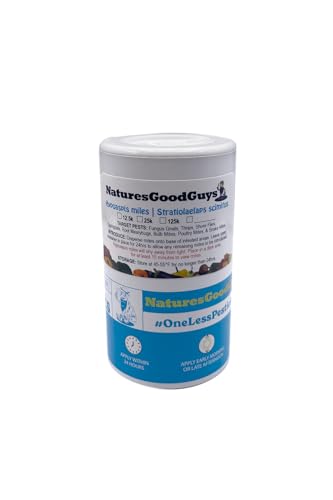
A container of 12,500 live predatory mites that hunt and eat gnat larvae in the soil with zero chemicals.
These are Stratiolaelaps scimitus (formerly known as Hypoaspis miles), tiny soil-dwelling mites that eat fungus gnat larvae, root aphids, thrips pupae, and even snake mites. You simply open the cardboard cylinder and sprinkle the contents onto the soil of your plants. The mites do the rest — they hunt through the top few inches of soil, eating the larvae before they become adults. The label says they are safe for people, pets, and the planet. Customers note they “eliminated snake mites and fungus gnats in a bioactive enclosure” and that the mites disappeared on their own once the pest supply ran out.
Unlike the Safer Brand sticky stakes, this is a living treatment. You need patience — it takes about a week for the mites to establish. A few reviewers point out the count may be lower than advertised and that the mites can also eat beneficial springtails and introduce unwanted bugs. At 1.5 pounds, the container is small, and the recommended rate is 10 to 30 mites per square foot for small areas. This is the only 100% chemical-free option in the list and is ideal for bioactive or terrarium setups.
Chemical-Free Control
- Live mites hunt and consume gnat larvae in the soil
- People-, pet-, and planet-safe
- Self-regulating — population declines when pests are gone
Living Organism Limitations
- Mites need 50-96°F; must be stored at 45-55°F for up to 24 hours only
- May eat beneficial springtails in bioactive setups
- Some reviewers report the count is overstated and had minimal impact on gnats
Best for bioactive and terrarium keepers: A perfect match for exotic enclosures where chemical sprays would harm sensitive inhabitants.
Skip for quick results: If you want adult gnats gone in 24 hours, get a sticky trap or spray — living mites take time to work.
Understanding the Specs
Systemic vs. Contact
A systemic product (like Bonide granules) is absorbed into the plant’s tissue. When a gnat or aphid feeds, it ingests the chemical and dies. A contact spray (like Dr. Killigan’s or Mighty Mint) kills only what it directly touches on the surface. Neither approach alone handles both adult flies and soil-dwelling larvae — you often need one of each.
Biological Control
Live predatory mites are a “set and forget” method. They do not harm your plants, but they need the right temperature (50-96°F) and time to establish. They die off once their food source (larvae) is gone. This is the most eco-friendly option, but the least immediate — you won’t see results for days to a week.
FAQ
Does a sticky trap alone solve a fungus gnat infestation?
Can I use a plant-based spray like Mighty Mint on edible herbs or vegetables?
Will Dr. Killigan’s Doom & Bloom kill the gnat larvae in the soil?
How long do Bonide systemic granules last after I apply them?
Do predatory mites work on snake mites or only fungus gnats?
Will the Safer Brand sticky stakes damage my plant’s leaves if they touch?
Is Trifecta Crop Control safe for beneficial insects like ladybugs?
What is the ideal temperature to store live predatory mites?
Final Thoughts: The Verdict
Across the board, the gnat killer for indoor plants winner is the Bonide Systemic Granules because it kills larvae in the soil and protects new growth for two months with one application. If you want a plant-based contact spray that smells great, grab the Mighty Mint Spray. And for a chemical-free, hands-off solution in a bioactive or terrarium setup, the standout is the 12,500 Live Predatory Mites.
How We Picked
We do not accept paid placement, and we did not hands-on test every unit. Instead, we match each pick to a real buyer and use-case by comparing the manufacturers’ published specifications against the patterns in verified customer reviews — so you get each pick’s real strengths and trade-offs instead of marketing copy.
Sources & Methodology
Specifications: manufacturer listings and product documentation. Review insights: verified customer reviews, as of July 2026. Pricing: not shown on this page (it changes often); check the current price via the retailer link.
As an Amazon Associate, Lawn Gear Lab earns from qualifying purchases. This does not affect which products we feature.