
Specs are compiled from manufacturer listings and verified buyer reviews and can change over time — please confirm the key details on the product page before buying.
Rose thorns don’t just prick — they scratch, snag, and dig into your forearms every time you reach into a bush. A good rose glove changes that by pairing puncture-proof palms with a gauntlet cuff tall enough to shield your arms to the elbow, so you can prune, deadhead, and pull without bleeding. This guide breaks down the three best pairs for the job — one for tough all-day wear, one for flexible comfort, and one that balances premium leather with a smarter price.
I’m Rikta — the founder and writer behind Lawn Gear Lab. This guide is built by comparing the manufacturers’ published specifications and the patterns across verified customer reviews, so you get each pick’s real strengths and trade-offs instead of marketing spin.
Whether you are wrestling with climbing roses, blackberry canes, or cactus spines, the right pair of gloves for rose gardening keeps your hands safe without turning every movement into a wrestling match.
Quick Picks
- Freicheza Long Gardening Gloves — Premium Pick
- WORKPRO Gardening Gloves, Long Leather — Best Value
- Professional Rose Pruning Thorn Proof Gardening — Budget Champion
How To Choose The Best Gloves For Rose Gardening
Rose gloves are a specialized tool — you do not just need a thick work glove. You need a gauntlet that climbs past your wrist, a palm that stops a point, and a material that breathes enough to let you work an hour without soaking. Here’s what separates a great rose glove from one that leaves you picking spines out of your forearm.
Gauntlet length — elbow-high is the benchmark
Short cuffs leave an inch of exposed wrist where thorns love to grab. Look for a glove with a sleeve length of at least 8 inches above the palm — that gets you forearm coverage to the mid-forearm or elbow. Every one of the three gloves below hits this range.
Palm material — puncture resistance vs. dexterity
Full-grain cowhide stops thorns cold and softens with wear, but it runs tighter and costs more. Synthetic leather is lighter and cheaper but wears faster against repeated snagging. For weekly rose pruning, synthetic is fine. For heavy bramble clearing, genuine leather holds up longer.
Fit — snug enough to tie a boot, loose enough to move
A loose glove robs you of grip and makes tools slip. A glove that is too tight cramps your hand inside an hour. Rose gardening requires finger dexterity — you need to snip a single stem or untangle a vine. Check size charts that give hand circumference ranges, and pay attention to reviewer notes about sizing running small.
Quick Comparison
| Model | Best For | Palm Material | Gauntlet Length | Thorn Resistance | Amazon |
|---|---|---|---|---|---|
| Freicheza Long Gardening Gloves | Premium leather & long sessions | Full-grain cowhide | ~9.4 in (sleeve XL) | Puncture-resistant leather | Amazon |
| WORKPRO Leather Garden Gloves | Tough durability at a fair price | Heavy-duty leather | Long (forearm) | Thorn-proof, cut-resistant | Amazon |
| Professional Rose Pruning Gloves | Lightweight & breathable budget pick | Synthetic leather | Elbow-length gauntlet | Puncture-resistant palms | Amazon |
In‑Depth Reviews
1. Freicheza Long Gardening Gloves
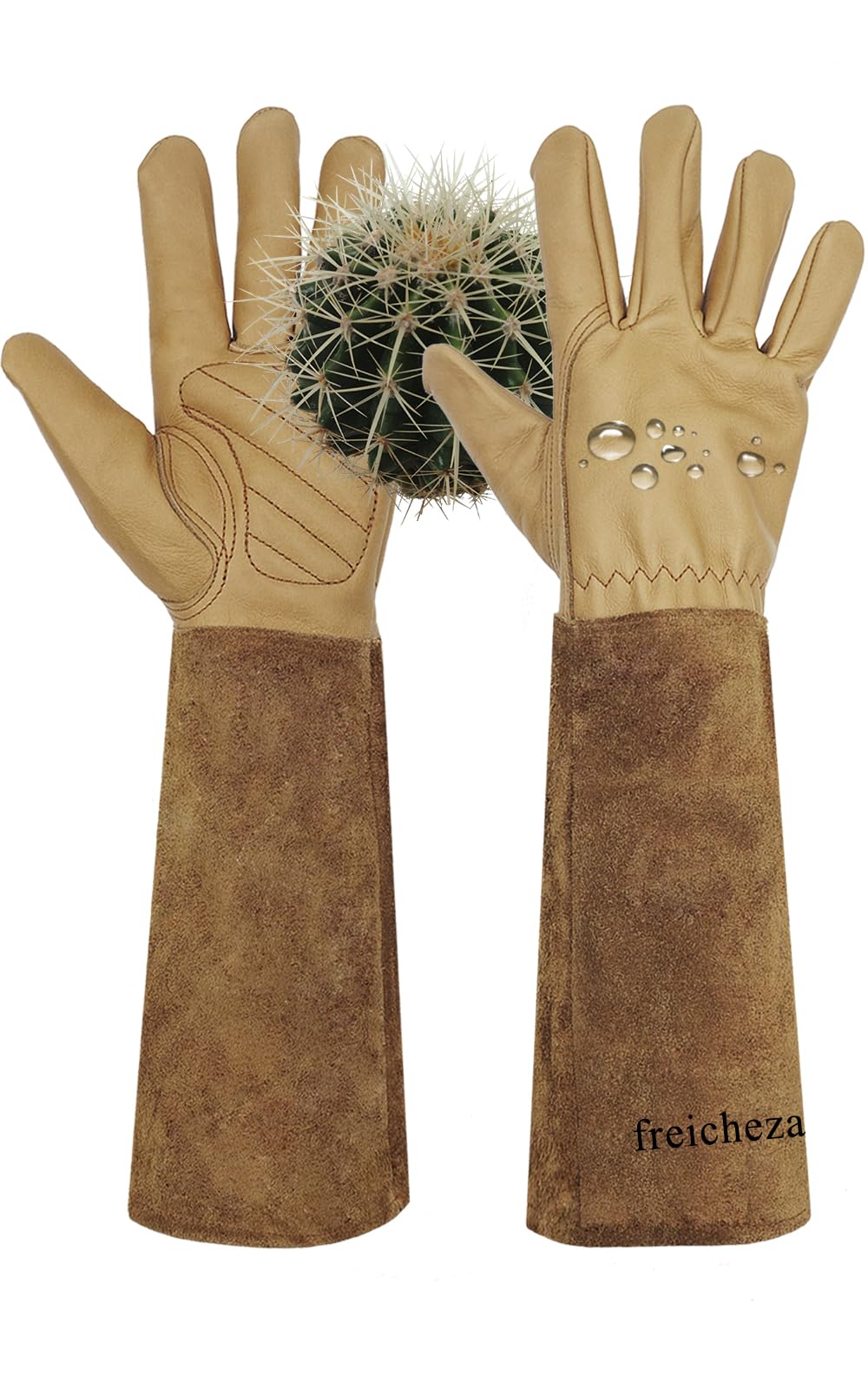
Full-grain leather that softens with every wear and stops rose thorns cold.
This is the glove for anyone who spends hours in the rose garden and wants a pair that will last past a single season. The palm and sleeve are made from full-grain cowhide — the top layer of leather that keeps its natural fiber strength, making it tougher than split leather or synthetic alternatives. Buyers report that “the thorns never came through,” and the puncture-resistant design means you can grab a thick cane without flinching. Unlike the synthetic leather of the budget glove below, this material ages well: it softens, molds to your hand, and still blocks spines.
The elbow-length gauntlet reaches about 9.4 inches on the XL size, offering full forearm coverage even if you are reaching deep into a bush. The cowhide is also water-repellent, so working with morning dew or light rain won’t soak your hands through. One reviewer noted the gloves are difficult to pull over a thick winter coat sleeve — a reminder that these fit best over a shirt or light jacket.
Measurement is precise: the size L has a palm length of 8.07 inches and a sleeve of 9.05 inches for a total of 17.12 inches. The soft, breathable leather and independent adjustable thumb design help you keep grip on secateurs and pruners without the stiffness that cheaper gloves cause after an hour. Owners mention that the wide gauntlet stays up on a narrow wrist too, so there is no annoying slippage mid-task.
what separates it
- Full-grain cowhide wears longer and resists punctures better than synthetic
- Water-repellent finish keeps hands dry in damp conditions
- True-to-size fit — one reviewer wearing a 7.5 glove found the large comfortable
- Gauntlet stays up on both narrow and average forearms
What to watch for
- Runs true to size but snug — order one size up if you plan to wear a liner in cold weather
- Soft leather may darken if you apply waterproofing oil (as noted by a reviewer who used mink oil)
- Not ideal over a heavy winter coat sleeve — best for spring through fall
Who this glove fits: The gardener who prunes several times a week and wants a pair that molds to their hand, stops thorns, and survives a full season without tearing.
Who might skip it: Anyone gardening in thick winter coats — the gauntlet is snug over a heavy sleeve — or those on a strict budget who only need gloves for occasional deadheading.
2. WORKPRO Gardening Gloves, Long Leather
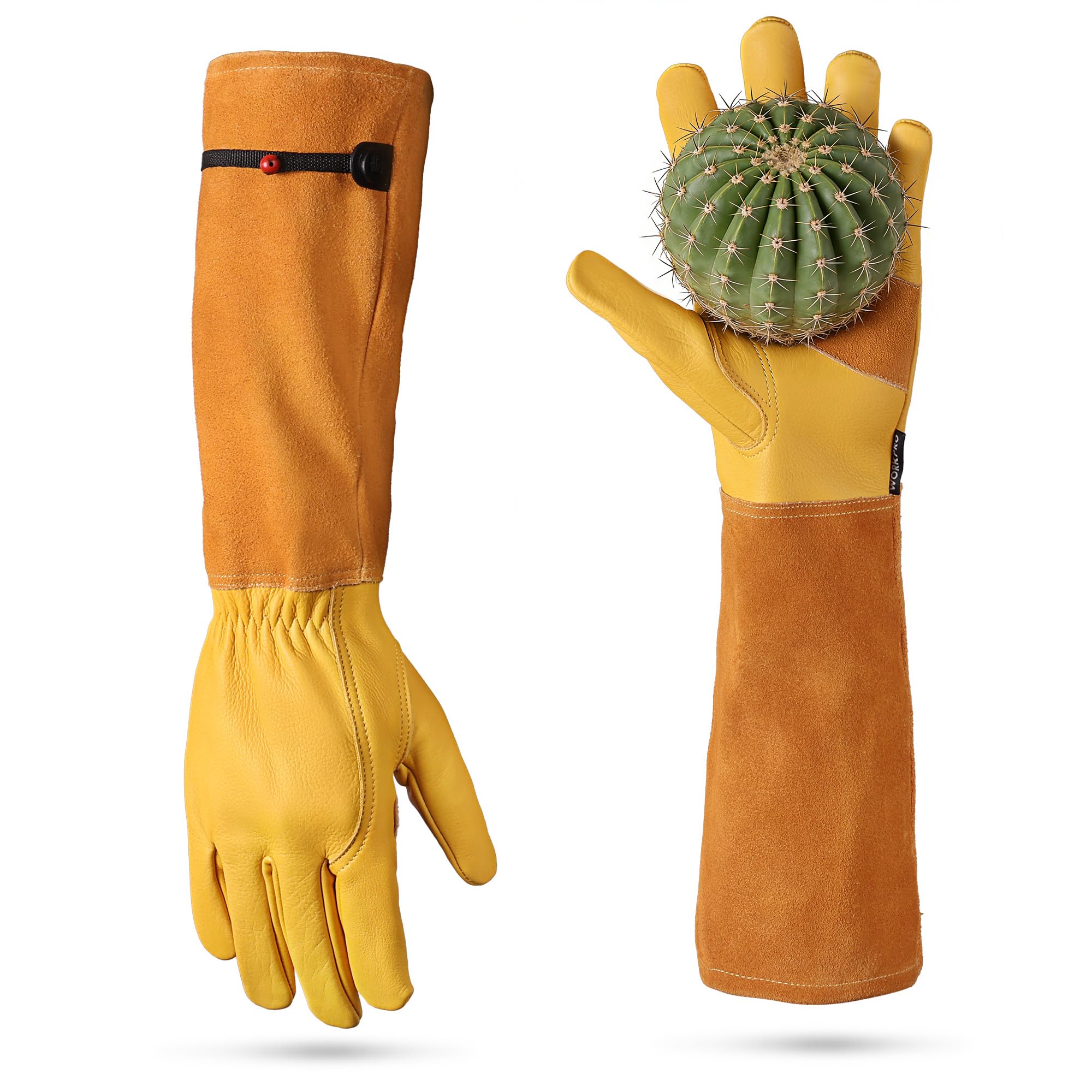
Premium leather at a mid-range price that blocks cactus and rose thorns equally well.
You get genuine leather palms with reinforced stitching that block rose thorns and cactus spines — one buyer called them “great price, very tough, comfortable, durable material; blocks cactus, rose thorns; easy to work in.” The palm is genuine leather with a heavyweight fabric weight class, so it is noticeably thicker than the synthetic Freicheza pair below. Reach for these WORKPRO gloves when you are not just pruning but pulling blackberry vines, yanking stubborn weeds, or handling rough bark.
The long forearm protection stays up during work — one buyer mentioned “arms no longer scratched up doing yard work” — and the cut-resistant material adds safety when you grab sharp debris buried in the soil. Unlike the Freicheza pair, the WORKPRO uses a stiffer, heavyweight leather that feels tougher from the first wear but needs a short break-in period to soften. The yellow color makes them easy to spot if you drop them in the garden. Skip these if you want a glove that is soft right from the start; the Freicheza pair is more flexible immediately.
One clear trade-off: the fit runs small. Multiple buyers warn that the small size was almost uncomfortable for women with smaller hands, so consider sizing up if you are between sizes. The no-stretch fabric means there is zero give — your fingers will be snug, which is great for grip but punishing if you guess the size wrong. Some users also note that the material lets brush bits cling to it, so expect to knock off debris before putting them away.
The strong points
- Genuine heavy-duty leather stops thorns, cactus spines, and blackberry snags
- Cut-resistant and reinforced stitching add durability for heavy yard work
- Stays up on the arms — no slipping mid-task
- Affordable enough to buy a spare pair
Caveats from reviewers
- Runs noticeably small — order one full size larger than your normal glove
- Zero stretch fabric means no give if the fit is off
- Heavyweight leather is stiff initially and needs break-in time
Reach for these if: You need a tough, thick leather glove for aggressive pruning, bramble clearing, and cactus handling without paying premium prices.
Look elsewhere if: You have wide hands or are between sizes — the snug fit can be uncomfortable — or if you prefer a glove that is soft and flexible from day one.
3. Professional Rose Pruning Thorn Proof Gardening Gloves

A lightweight, breathable synthetic glove that still stops rose thorns on a budget.
If you prune roses only a few times a month or want a spare pair to keep on a hook by the garden door, this is the glove to grab. Made from synthetic leather with a puncture-resistant padded palm and reinforced fingertips, it stops most thorns from roses and blackberries — even with rough grabbing. One reviewer who used them in a dense forest full of poison ivy and bramble said they “did amazing,” noting good dexterity and decent water resistance during light rain. The form-fitting spandex back keeps the glove from ballooning, so your hand stays cool and you keep a feel for the pruners.
The elbow-length gauntlet covers your forearms just like the higher-priced options, protecting against cuts and scratches. This is the most affordable pair in the lineup, and it shows in the material: synthetic leather lacks the puncture resistance of full-grain cowhide. Reviewers point out that the gloves will not stop small sharp spikes like cactus or foxtails, and they would not survive heavy work like moving rocks or logs. For average rose pruning and yard clearing, however, they are thin and light enough to avoid getting hot and sweaty — a real advantage in summer.
In a direct comparison to the WORKPRO leather glove, the synthetic palm is less durable against repeated snagging, so expect a shorter lifespan if you are tackling bramble weekly. That said, customers note the pair holding up well for over two years of regular rose and mesquite work. The medium size runs roomy — one reviewer with smaller hands found it big but still workable for tying boots. The main complaint is that the material tends to let brush bits cling to it and there is no hanging loop for storage.
Where it shines
- Lightweight and breathable — less hand sweat in hot weather than leather gloves
- Elbow-length gauntlet protects forearms at the lowest price in this guide
- Reinforced fingertips add an extra layer over the high-wear areas
- Quick-drying material — works fine after getting wet in light rain
Limitations to know
- Synthetic leather is less puncture-resistant than genuine cowhide and wears faster
- Will not stop fine cactus or foxtail spikes — only medium-to-large thorns
- No hanging grommet or clip for storage — brush bits cling to the fabric
Ideal for: Occasional rose pruning, light bramble clearing, and gardeners who prioritize breathability and cost over maximum puncture resistance.
Not for: Heavy weekly work with cactus, blackberry thickets, or rough logs — the synthetic leather will wear through faster than a full-grain option.
Understanding the Specs
Gauntlet (Sleeve) Length
This is the measurement from the base of your palm up the forearm to the edge of the glove. A short gauntlet leaves your forearm exposed. A good rose-glove gauntlet measures at least 8 inches — enough to cover the area thorns reach when you push your arm into a bush. The Freicheza XL sleeve is about 9.41 inches, the WORKPRO and the budget synthetic glove both land in the “elbow-length” zone.
Leather vs. Synthetic leather
Full-grain leather is the top layer of cowhide — stronger, more breathable, and more puncture-resistant than synthetic (man-made) leather. Synthetic leather is lighter and cheaper but wears faster and offers less protection against fine cactus spines. For weekly rose pruning, full-grain or heavy-duty leather is worth the extra cost. For light, occasional use, synthetic works fine.
FAQ
Will rose gardening gloves stop cactus spines?
How long should a rose gardening gauntlet be?
Can you use rose gardening gloves for blackberry vines?
Do rose gloves need to be waterproof?
How do I know what size rose glove to buy?
How long do rose gardening gloves last?
Can I wear rose gloves for other yard work?
Are rose gardening gloves washable?
What is the difference between cut-resistant and puncture-resistant gloves?
Final Thoughts: The Verdict
For most buyers, the best gloves for rose gardening winner is the Freicheza Long Gardening Glove because its full-grain cowhide stops thorns reliably, the gauntlet stays up, and the leather softens with wear. If you want tough protection at a fair mid-range price, grab the WORKPRO Leather Garden Glove. And for occasional pruning or a lightweight summer backup, the Professional Rose Pruning Glove keeps your arms safe without breaking your budget.
How We Picked
We do not accept paid placement. Every pick is matched to a real buyer and a real use-case; we do not hands-on test units.
Sources & Methodology
Specifications: manufacturer listings and product documentation. Review insights: verified customer reviews, as of July 2026. Pricing: not shown on this page (it changes often); check the current price via the retailer link.
As an Amazon Associate, Lawn Gear Lab earns from qualifying purchases. This does not affect which products we feature.