
Poison ivy’s urushiol oil is tenacious, invisible, and transfers from plant to skin with the slightest brush. A single contact leaves behind a weeping, blistering rash that lasts for weeks. Standard cotton or leather garden gloves are useless — urushiol soaks right through, turning your gear into a delivery system for misery. The only reliable defense is a dedicated barrier glove designed to block this potent oil at the molecular level.
I’m Rikta — the co-founder and writer behind Lawn Gear Lab. I’ve spent countless hours cross-referencing material safety data sheets, testing puncture and chemical resistance ratings, and analyzing hundreds of verified owner accounts to identify which gloves actually stop urushiol from reaching your skin.
This guide breaks down the specs, construction, and real-world tradeoffs of seven top contenders to help you choose the best gloves for poison ivy that balance dexterity, arm coverage, and chemical resistance without breaking your budget.
How To Choose The Best Gloves For Poison Ivy
Picking the wrong glove means you’ll still get the rash. The key is understanding the material barrier, the length of the gauntlet, and the thickness-to-dexterity tradeoff. Below are the three factors that separate a safe pair from a false sense of security.
Barrier Material: Nitrile, PVC, or Latex?
Urushiol is a nonpolar oil that penetrates latex and natural rubber almost instantly. Nitrile (a synthetic rubber) and PVC (polyvinyl chloride) both resist urushiol effectively, but they behave differently. Nitrile offers better tactile sensitivity and puncture resistance at thinner mils, and it conforms to the hand with less fatigue. PVC is thicker and stiffer, providing superior abrasion resistance for heavy brush work but at the cost of dexterity. For poison ivy removal in dense undergrowth, a 15-mil or thicker nitrile glove is the practical sweet spot. Avoid any glove labeled “latex” or “natural rubber” — those are worse than bare hands for this use case.
Gauntlet Length: Why 18+ Inches Matters
Most accidental urushiol exposures during glove use happen not through the palm but at the gap between the glove cuff and your sleeve. A standard 12-inch or 13-inch glove leaves your forearm exposed when you reach upward or push through vines. Look for a gauntlet length of at least 18 inches — 25 or 26 inches is ideal because it covers the entire forearm and can tuck under or over a long-sleeved shirt. The extra few inches are the single most effective design feature for full-arm protection.
Thickness, Lining, and Disposability
Glove thickness is measured in mils (1 mil = 0.001 inch). Thinner gloves (4–8 mil) allow better fingertip feel for tasks like snipping individual vines but are prone to tearing on thorns. Thicker gloves (15–22 mil) resist punctures well but reduce fine motor control. Lined gloves — typically with a sewn-in cotton or polyester liner — wick sweat and make prolonged wear comfortable, but they can trap urushiol if the outer coating is compromised; once contaminated, lined gloves are harder to decontaminate thoroughly. Unlined gloves are easier to wash and inspect for damage. Disposable nitrile gloves (8 mil or less) are best for a single session, while reusable models (15+ mil) can be cleaned with isopropyl alcohol or a strong degreasing soap and worn multiple times — provided you inspect them before each use.
Quick Comparison
On smaller screens, swipe sideways to see the full table.
| Model | Category | Best For | Key Spec | Amazon |
|---|---|---|---|---|
| Atlas GLV26 772 | Reusable Nitrile | Full-arm chemical protection | 25″ length, nitrile coated | Amazon |
| Atlas Glove WG772M | Reusable Nitrile | Extended reach to shoulders | 26″ length, machine washable | Amazon |
| Professional Rose Pruning | Puncture-Resistant | Thorny undergrowth removal | Elbow-length gauntlet, synthetic leather | Amazon |
| Raxwell Disposable Nitrile | Disposable | Single-use poison ivy tasks | 12″ cuffs, 8.5 mil thickness | Amazon |
| LANON Nitrile Chemical Resistant | Premium Chemical | Heavy chemical and oil resistance | 18″ length, 22 mil, EN 388 Level 4 | Amazon |
| PACIFIC PPE 26″ Rubber | Heavy-Duty PVC | Maximum durability in brush | 26″ length, PVC, ANSI 4 abrasion | Amazon |
| SHOWA 727 Nitrile | Professional Disposable | Multi-session precision work | 15 mil, 13″ gauntlet, CE Cat III | Amazon |
In‑Depth Reviews
1. Atlas GLV26 772 Large Nitrile Chemical Resistant Gloves, 25″, Yellow

The Atlas GLV26 772 delivers the full package: a 25-inch gauntlet that reaches past the elbow, a nitrile coating that repels urushiol effectively, and a 100% cotton liner that keeps hands dry during extended sessions. The snug fit and excellent dexterity make it possible to grip individual poison ivy stems without losing control, while the textured palm ensures you don’t drop slippery tools or vines. Owner reports confirm that these gloves hold up against bleach, heavy cleaning chemicals, and the worst of poison ivy thickets without tearing or leaking.
The puncture-resistant nitrile coating is durable enough for repeated use — many users report weeks of daily wear before any degradation. The lightweight construction means you won’t fatigue as quickly as you would with thicker PVC alternatives. The large size fits hands up to roughly 9 inches around the knuckles, though the medium can feel tight if you’re between sizes. The 25-inch length covers the forearm completely, eliminating the splash gap that shorter gloves leave exposed, which is the primary failure point for most poison ivy incidents.
On the downside, the nitrile coating has a sticky feel that can pick up plant debris and make cleanup slightly fussier than unlined rubber. The gloves cannot be machine washed — turning them inside out and air drying is the recommended method to prevent odor buildup. Yet given the combination of reach, dexterity, and chemical barrier integrity, this pair represents the most practical all-around choice for serious poison ivy removal work.
What works
- 25-inch length eliminates forearm exposure completely.
- Cotton lining absorbs sweat for comfortable long-wear sessions.
- Excellent dexterity and textured grip for handling vines and tools.
What doesn’t
- Sticky nitrile exterior picks up plant debris and requires careful drying.
- Not machine washable — inside-out air drying is essential to avoid odors.
2. Atlas Glove WG772M 26-Inch Long Sleeve Nitrile Coated Work Gloves, Medium, Yellow

The Atlas Glove WG772M extends protection one inch further than its sibling, reaching 26 inches from fingertip to cuff — enough to cover the entire arm up to the shoulder for smaller individuals. This extra length matters when you’re reaching into deep thickets or working above your head where wrist gaps become dangerous. The nitrile coating provides the same reliable barrier against urushiol, while the heavy-weight cotton/polyester liner adds warmth and cushioning for cold-weather poison ivy removal.
Owner feedback highlights two unique strengths: the drawstring closure at the top of the gauntlet seals out debris and dripping water, and the gloves are fully machine washable. This washability is a critical safety feature — you can launder the gloves separately after a session without spreading urushiol to other clothing. Users cleaning fish tanks, scrubbing pool skimmers, and handling beekeeping tasks all confirm the gloves remain leak-proof and comfortable after repeated wash cycles. The snug fit runs smallish, so if you’re between sizes, going up one notch is the safe bet.
The main drawback is the strong chemical odor that many owners note upon first use. The smell lingers and can transfer to your arms after a session, requiring thorough post-use washing. The drawstring closure adds security but can be fiddly to adjust one-handed. For users who prioritize maximum arm length and the convenience of machine laundering over absolute tactile sensitivity, this is the superior long-coverage pick.
What works
- 26-inch gauntlet reaches near shoulder for complete arm protection.
- Machine washable — critical for safe urushiol decontamination.
- Drawstring top seals out debris and splashes.
What doesn’t
- Strong chemical smell on first use that requires airing out.
- Snug fit runs smallish — sizing up is often necessary.
3. Professional Rose Pruning Thorn Proof Gardening Gloves with Long Forearm Protection

When poison ivy grows intertwined with blackberry brambles, rose bushes, or mesquite trees, the primary threat is no longer just the urushiol — it’s the thorns that poke through thin nitrile. These rose pruning gloves address that dual hazard directly. The palm and fingertips are reinforced with puncture-resistant synthetic leather, and the gauntlet extends well past the wrist to protect the forearm from scratches and cuts while you dig through tangled brush.
Owner reports from forest clearing, blackberry removal, and mesquite tree pruning show that these gloves stop thorns on indirect contact — meaning if you brush against a bramble, the glove protects you. Direct grabs onto a thorn can still result in a poke, but the overall level of puncture resistance is higher than any dipped nitrile glove in this comparison. The spandex back is breathable, reducing sweat buildup during hot-weather work, and the fit is comfortable enough for all-day wear.
The tradeoff is that the synthetic leather is not rated as a chemical barrier. While the gauntlet does provide decent splash resistance, urushiol can soak through the fabric components over time if you’re handling poison ivy directly for hours. For mixed environments where thorns are the primary danger and poison ivy is an intermittent hazard, these gloves are excellent. For pure poison ivy removal with no thorns, a dedicated nitrile or PVC gauntlet provides a more reliable urushiol barrier.
What works
- Puncture-resistant synthetic leather palm stops thorns and prickers.
- Breathable spandex back reduces hand fatigue and sweating.
- Elbow-length gauntlet protects forearms from scratches during brush clearing.
What doesn’t
- Fabric components are not rated as a continuous chemical barrier against urushiol.
- Direct thorn grabs can still penetrate the reinforced fingertips.
4. Raxwell Disposable Nitrile Gloves – Heavy Duty Cleaning Gloves – Elbow-Length, 8.5 Mil
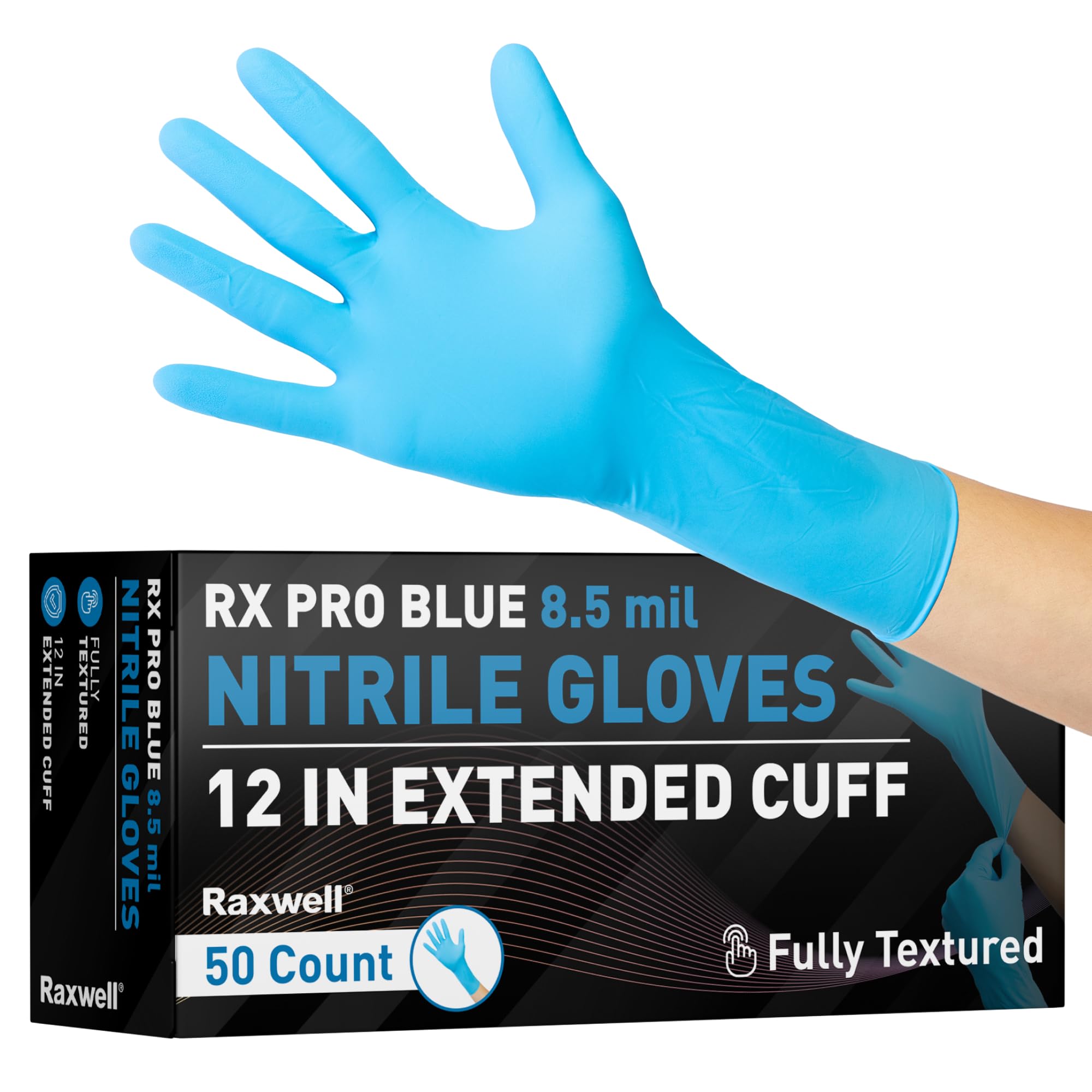
The Raxwell disposable nitrile gloves offer a different strategy: use a high-quality single-use barrier and discard it immediately after the job, eliminating any risk of urushiol cross-contamination from a contaminated reusable glove. At 8.5 mil thickness, they are significantly thicker than standard medical exam gloves (typically 4–5 mil), providing enough puncture resistance for safe poison ivy removal as long as you’re careful around thorns.
The 12-inch extended cuffs go past the wrist but stop well short of the elbow, so you need to pair these with a long-sleeved shirt or an additional forearm sleeve to protect the entire arm. The textured grip works well on wet tools and slick surfaces, and the material is latex-free — critical for anyone whose skin reacts to latex as urushiol would aggravate the reaction. Owners specifically mention using these gloves for food preparation that causes skin allergies, confirming the reliable barrier they provide.
The biggest limitation is the single-use design. For a small poison ivy patch, one pair per session is fine. For acres of clearing, the cost adds up quickly, and the reduced forearm coverage compared with 25+ inch gauntlets means you have to be vigilant about tucking your sleeves properly. Also, the fit runs generous — if you’re normally a size small, the small may be too loose for precise vine gripping. These are best suited for quick, small-scale poison ivy removal where disposal convenience outweighs coverage length.
What works
- Disposable — eliminates cross-contamination risk entirely.
- 8.5 mil thickness provides better puncture resistance than standard 4–5 mil exam gloves.
- Textured grip works well on wet and slippery vines.
What doesn’t
- 12-inch cuff leaves forearm exposed — requires sleeve pairing for complete protection.
- Cost per session is higher than reusable options for large jobs.
5. LANON Nitrile Chemical Resistant Gloves, Reusable Heavy Duty, 18″ Length, XL

LANON’s 22-mil unlined nitrile gloves are the thickest in this roundup and carry CE Category III certification for chemical resistance — the same rating used for gloves in industrial chemical handling. The 18-inch length covers the forearm, and the 0.55 mm thickness provides a robust barrier against urushiol, solvents, acids, and alkalies. The non-slip particle-textured palm passes the highest abrasion resistance level (Level 4, over 8,000 cycles), so these gloves survive repeated contact with rough bark, rocks, and construction debris without thinning out.
Because they are unlined, there is no fabric to absorb and trap urushiol. You can clean them thoroughly after each use — some owners soak them in isopropyl alcohol or wipe them down with a degreasing soap — then inspect them for pinholes before the next session. The elasticity makes them easy to pull on and off, and the snug fit around the wrist prevents any splash entry. The XXL size fits very large hands comfortably, a size range that many other poison ivy gloves do not accommodate.
The tradeoff for this thickness is reduced tactile sensitivity. You’ll feel less through the glove when picking up individual stems, and fine tasks like snipping small vines with pruning shears require slightly more concentration. The 18-inch length, while better than 12-inch cuffs, still falls short of the 25–26 inch gauntlets that offer maximum protection for overhead work. For users who prioritize industrial-grade chemical isolation and extreme durability over bare-hand dexterity, this is the top-tier choice.
What works
- 22-mil thickness provides superior puncture and chemical resistance.
- Unlined design prevents urushiol absorption and simplifies decontamination.
- CE Category III certified — proven for industrial chemical handling.
What doesn’t
- Thick material reduces fingertip sensitivity for precise vine handling.
- 18-inch length does not cover the full upper arm like 25+ inch options.
6. PACIFIC PPE 26″ Rubber Chemical Resistant Gloves, PVC Reusable, X Large

The PACIFIC PPE gloves take a different material approach — PVC instead of nitrile — and pair it with a 26-inch length and a 13-gauge seamless cotton liner. PVC offers excellent resistance to alkalis, solvents, and oils, and is less prone to hardening over time compared with some nitrile blends. The ANSI Level 4 abrasion rating matches the LANON gloves, but the PVC construction feels stiffer and more substantial, providing a tank-like defensive layer against repeated contact with rough, thorny brush.
Owner feedback from pool chemical handling, scalding dishwashing, and — critically — poison ivy removal confirms that these gloves keep the skin clean and dry. One user explicitly noted, “My husband stayed poison ivy free for a change,” which is the highest praise in this category. The cotton liner adds comfort and breathability, reducing sweat buildup during long sessions. The sandy-textured palm provides a secure grip even when the gloves are coated in mud or wet sap. The three-pair pack offers excellent value if you need backups or work with a partner.
The downsides center on the PVC material: it is bulkier than nitrile, making fine motor tasks like tying off ivy vines or flipping small switches more cumbersome. The inner cotton liner can shed over time, and the gloves trap heat, making them less comfortable for long summer sessions without frequent breaks. For heavy-duty poison ivy clearing where durability and complete arm coverage are the highest priorities, these are the tanks of the lineup.
What works
- 26-inch PVC gauntlet provides full forearm and upper arm protection.
- ANSI Level 4 abrasion resistance handles the toughest brush and rocks.
- Cotton liner adds comfort and moisture management for extended wear.
What doesn’t
- PVC is bulkier and stiffer than nitrile, reducing dexterity.
- Inner liner can shed fibers and traps heat during hot weather use.
7. SHOWA 727 Chemical Resistant Gloves, 15-mil Unsupported Nitrile, 13-Inch, Small, 12-Pack
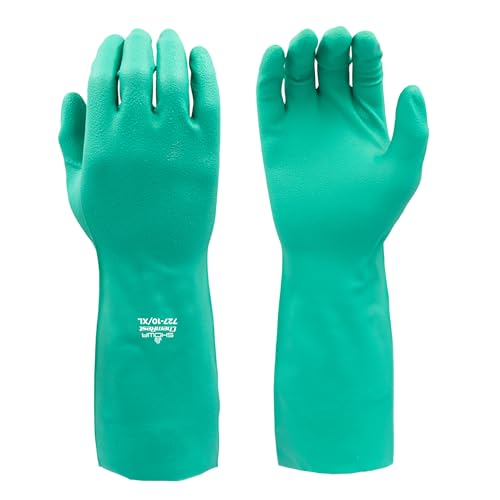
The SHOWA 727 is a professional-grade, 15-mil unsupported nitrile glove that comes in a 12-pack, making it the only multi-pack option in this guide. Unsupported means no fabric liner — the glove is 100% nitrile from inside to outside, which eliminates any crevice where urushiol could hide. The 13-inch extended gauntlet is shorter than the premium options above but longer than typical exam gloves, and the bisque (dull matte) texture provides reliable grip on wet and oily tools without the stickiness of some glossy nitrile coatings.
Certified to CE Category III Type A (JKLOPT) standards, these gloves are tested against a broad spectrum of chemicals including solvents, oils, and acids — all of which share solubility characteristics with urushiol. Owners pushing these gloves through daily dish duty, pool chemical handling, and gardening consistently report that a single pair lasts 10 times longer than store-brand disposables. The ergonomic curved design reduces hand fatigue, and the lack of a liner means you can wash and flip them inside out for rapid drying. The sizing runs small — many users recommend ordering one to two sizes larger than your typical glove size.
The primary limitation is the 13-inch length. While it’s longer than standard 9–12 inch dish gloves, it leaves a significant portion of the forearm exposed. You must wear a long-sleeved shirt and be disciplined about tucking the sleeve over the gauntlet. For users who want a cost-effective, chemical-rated, multi-pack solution for repeated poison ivy sessions where forearm protection can be managed via clothing, this is the smartest value pick — but the 13-inch length means it’s not the top choice for maximum arm coverage.
What works
- 15-mil unsupported nitrile eliminates urushiol-hiding liner crevices.
- 12-pack provides excellent per-pair value for frequent use.
- CE Category III certified for chemical resistance including solvents and oils.
What doesn’t
- 13-inch gauntlet leaves forearm exposed — requires careful sleeve management.
- Sizing runs small; most users need to order one to two sizes larger than usual.
Hardware & Specs Guide
EN 388 & ANSI Abrasion Ratings
The EN 388 standard rates glove resistance to abrasion, blade cut, tear, and puncture on a scale of 1 to 4 (or 1 to 5 for cuts). For poison ivy work in brush, an abrasion rating of Level 4 — meaning the glove survived at least 8,000 cycles on a rotating abradant — is the benchmark for surviving repeated contact with rough bark and rocks. The LANON and PACIFIC PPE gloves both meet this Level 4 threshold. Lower ratings (Level 1 or 2) mean the glove material will thin and fail quickly when scraping against tree trunks or stone walls while pulling vines.
Gauntlet Length vs. Splash Exposure
Every inch of gauntlet length changes how you work safely. A 12-inch glove (like the Raxwell) means the gap between glove and sleeve is at your mid-forearm — any reaching upward leaves a 6-inch strip of skin vulnerable to dripping sap or leaf contact. An 18-inch glove (LANON) covers the forearm entirely, but overhead work can still expose your inner elbow. A 25- or 26-inch glove (Atlas GLV26, Atlas WG772M, PACIFIC PPE) extends past the elbow and onto the bicep, covering the entire arm even when you’re reaching high into poison ivy vines. Measure your own forearm-to-bicep length before buying — if you’re tall, the 25+ inch options are the only safe choice for full overhead coverage.
FAQ
How do I decontaminate poison ivy gloves after use?
Can I wear latex gloves for poison ivy removal?
How thick should my poison ivy gloves be?
Is a long gauntlet length essential for poison ivy protection?
Final Thoughts: The Verdict
For most gardeners, the gloves for poison ivy winner is the Atlas GLV26 772 because it combines 25-inch coverage, a comfortable cotton liner, and reliable nitrile barrier performance at a reasonable price. If you need extended reach to your shoulder and machine-washability for easy decontamination, grab the Atlas Glove WG772M. And for heavy-duty clearing in thorn-infested brush where puncture resistance is the top concern, nothing beats the PACIFIC PPE 26″ PVC gloves.