
Specs are compiled from manufacturer listings and verified buyer reviews and can change over time — please confirm the key details on the product page before buying.
Walking down the fertilizer aisle can feel like trying to read a chemistry exam. Between the three-number codes, the bags of blue powder, the jugs of liquid that smell like a fishing dock, and the pellets that promise everything — making the wrong choice is easy. The good news is that a solid general purpose fertilizer covers almost everything in your yard and home: your tomatoes, your roses, your ficus in the corner, even your lawn. The trick is knowing which form and which ratio actually fit your routine.
I’m Rikta — the founder and writer behind Lawn Gear Lab. This guide is built by comparing the manufacturers’ published specifications and the patterns across verified customer reviews, so you get each pick’s real strengths and trade-offs instead of marketing spin.
You need something that feeds everything without burning anything, and this breakdown of the best general purpose fertilizer options gets you straight to the right bag or bottle for your garden.
Our Picks at a Glance


How To Choose The Best General Purpose Fertilizer
Picking a fertilizer is not about grabbing the cheapest bag. It is about matching the food to the plant and matching the form to your schedule. Get these two things right and everything green in your care will thank you.
Understand the NPK Code
Every bag has three numbers, like 24-8-16 or 10-10-10. The first number is Nitrogen (N) for leafy growth. The second is Phosphorus (P) for roots and flowers. The third is Potassium (K) for overall health and disease resistance. A balanced fertilizer like 10-10-10 gives a little of everything, while a high-first-number mix like 24-8-16 pushes green growth hard. Match the number to what your plants are doing.
Water-Soluble vs. Granular vs. Liquid
Your choice here dictates your feeding habit. Water-soluble powders dissolve instantly and feed your plants right away — you mix them into a watering can every week or two. Granular organic options break down slowly over weeks, feeding the soil microbes as well as the plant. Liquid concentrates, like fish emulsion, are easy to pour but often smell strong. If you are forgetful, choose a slow-release granular. If you enjoy a weekly ritual, go with a water-soluble powder.
Check Your Growing Medium
Most general purpose fertilizers work for soil and potting mix. But if you are growing in a hydroponic system or using coco coir, you need a fertilizer that is specifically designed for those soilless mediums. A standard outdoor granular will not dissolve properly and will clog your system. Look for labels that mention “hydroponic” or “coco coir” compatibility.
Quick Comparison
| Model | Best For | NPK Ratio | Item Form | Coverage / Size | Amazon |
|---|---|---|---|---|---|
| Miracle-Gro All Purpose 12.5 lb★ Best Overall | Rapid green growth on everything | 24-8-16 | Water-soluble powder | 200 oz, 5,000 sq. ft. | Amazon |
| Jack’s Professional 20-20-20 25 lbPremium Pick | Commercial and hydroponic heavy feeding | 20-20-20 | Water-soluble powder | 400 oz | Amazon |
| GreenView 10-10-10 33 lbBest Value | Large garden areas and beds | 10-10-10 | Granules | 33 lb, 3,300 sq. ft. | Amazon |
| Peter’s 20-20-20 2 lb | Indoor houseplants and orchids | 20-20-20 | Water-soluble powder | 32 oz | Amazon |
| GS Plant Foods 20-20-20 3 lb | General use with kelp booster | 20-20-20 | Water-soluble powder | 48 oz, 4,800 sq. ft. | Amazon |
| Jobe’s Organics 4-4-4 16 lb | Organic granular slow-feeding | 4-4-4 | Granules | 16 lb | Amazon |
| The Grow Co Fish Fertilizer 1 Gal | Organic liquid feeding for fruiting plants | 2-3-1 | Liquid | 128 fl oz, 160+ gallons | Amazon |
| VIVOSUN A & B Bundle 2×32 oz | Hydroponic and coco coir systems | — | Liquid | 64 fl oz | Amazon |
| Espoma Plant-Tone 5-3-3 50 lb | Large-scale organic gardening | 5-3-3 | Granules | 50 lb | Amazon |
In‑Depth Reviews
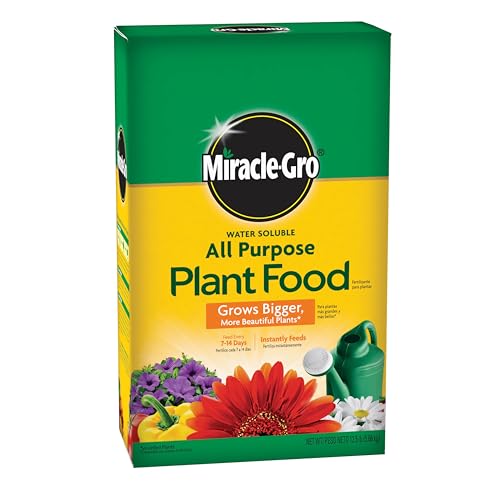
1. Miracle-Gro Water Soluble All Purpose Plant Food 12.5 lb
Our pick — over 4.5★ from 30,500+ verified ratings; the strongest balance of quality and price.
The crowd-tested powerhouse that turns a garden around in a week flat.
This is the fertilizer that nearly every gardener has used at some point, and for good reason. The 24-8-16 ratio is heavy on nitrogen — the number that pushes leaves and stems to get big and green fast. You mix it with water: half a teaspoon per gallon for indoor plants, or one and a half tablespoons per gallon and a half for outdoor beds. The blue powder dissolves without clumping and has no smell, which matters if you are mixing it in the kitchen sink.
The 12.5-pound bag covers roughly 5,000 square feet of garden space, making it among the most economical options per square foot. Buyers report that “plants doubled in size, greener leaves in 1 week,” which is the kind of result that keeps people loyal for years — many owners mention using it for a decade or more. The only real caution is that the fine blue powder can blow in the wind on breezy days, so mix it carefully or do it indoors.
What wins people over
- Instant results — visible greening in days, not weeks.
- Massive 200 oz unit count feeds a very large garden.
- Works on houseplants, vegetables, flowers, trees, and shrubs without separate mixes.
The honest trade-off
- Fine powder can stain clothes and hands if you are not careful.
- Not suitable for acid-loving plants like orchids or Venus flytraps.
Reach for this if: you want a single, fast-acting fertilizer that can handle your entire garden and houseplant collection with zero fuss. It is the crowd favorite for a reason — 4.8 stars across tens of thousands of owners.
Look elsewhere if: you are strictly organic or need a slow-release option that builds soil over time, because this is a synthetic quick-feed formula.
2. Jack’s Professional 20-20-20 General Purpose Fertilizer 25 lb
The commercial-grade powder that makes every gallon of water count twice.
Jack’s Professional is the fertilizer that greenhouse operators and serious hobbyists reach for when they want precise control. The 20-20-20 ratio is perfectly balanced — equal parts nitrogen, phosphorus, and potassium — so you can use it from seedling to harvest without ever worrying about burning your plants, as long as you stick to the recommended quarter to half teaspoon per gallon. The 25-pound bag yields about 400 ounces of dry powder, which is about six times the dry weight of Peter’s 2-pound bag, making this the far more economical pick for anyone feeding a large collection.
It dissolves instantly in water, works as both a root drench and a foliar spray, and contains fully chelated micronutrients — meaning the iron, zinc, and manganese are in a form plants can absorb right away. Owners who grow vegetables indoors report that their kale and collards have flourished for over 15 years with this exact formula. A single bag can last a heavy user well over six months, and at this volume it works out far cheaper per gallon than any liquid concentrate. The color of the powder may vary from bag to bag due to raw material dye, but the performance does not change.
Why it stands out
- Massive 25 lb bag at a 400 oz unit count is the most economical per-feed option here.
- Fully chelated micronutrients prevent deficiencies without extra bottles.
- Works in soil, soilless mixes, and hydroponic continuous feed systems.
The honest trade-off
- The bag is heavy and the scoop is not included — you need your own measuring spoon.
- Not an organic product, so it will not feed the soil microbiome.
Best for: the gardener with dozens of plants and a desire to mix a single, precise solution for every watering. This is your value king if you think in terms of cost per gallon.
skip it if: you only have a few houseplants — a 25 lb bag would take years to finish and the powder may cake over time.
3. GreenView Multi-Purpose Fertilizer 10-10-10 33 lb
The no-fuss granular that greens up a whole yard without the mixing.
If you hate mixing powders and carrying a watering can around the yard, granular is your answer, and this 33-pound bag from GreenView is one of the biggest bangs for your buck. The 10-10-10 ratio is a thoroughly balanced blend — it is not too hot on nitrogen and not too weak on phosphorus — so you can scatter it around vegetables, flowers, trees, shrubs, and even ornamental gardens without worrying about burning anything. A single 33-pound bag covers about 3,300 square feet.
Owners praise the non-dusty, well-formed granules that do not clump together, making it easy to spread with a hand spreader or by gloved hand. Many note that their grass greened up noticeably after just a few days, and that vegetables in the garden responded with vigorous growth throughout the season. The biggest appeal here is the sheer coverage for the price — this is the cheapest way to feed a large property if you are not particular about organic certification.
Why it wins: Massive 33 lb bag at a 10-10-10 ratio covers 3,300 sq ft of garden or lawn. Customers note it is “cheaper alternative to 16-16-16” and greens plants “quickly and effectively.” The non-clumping granules make for easy, mess-free application.
Grab this for: the big yard or community garden where you need to cover ground fast and keep costs low. It is a classic balanced feed that works everywhere.
Think twice if: you need a fast-acting liquid feed for container plants or want organic ingredients, because this is a standard synthetic granular.
4. Espoma Organic Plant-Tone 5-3-3 50 lb

The original organic feed that builds soil while feeding the plant.
Espoma has been making organic fertilizers since 1929, and Plant-Tone is their flagship all-purpose formula. The 5-3-3 analysis is gentle — deliberately low — because the nutrients are locked inside natural organic ingredients that must be broken down by soil microbes. This means you cannot burn your plants even if you are generous with the application. It contains 5% calcium, which is a nice bonus for tomatoes and peppers that often suffer from blossom-end rot.
The 50-pound bag is a serious investment in your garden’s long-term soil health. Owners use it on everything from annual flowers to established trees, applying it in spring and fall for perennials or monthly during the growing season for vegetables. The honest catch is the smell: it has a barnyard odor for a few days after application, which is the trade-off for using real organic matter. But the results, as one owner put it, are plain — they harvested about 20 pounds of squash and zucchini from plants fed with this stuff.
The standout stat: 46 owners rate the effectiveness as the top quality, with many noting it is “the best way for us to fertilize the yard” and that it “works well” for organic gardening. The 50 lb bag lasts a very long time even in a large garden.
Choose this if: you are serious about organic gardening and want a single, proven product that feeds your soil as much as your plants. It is OMRI-listed and meets organic production standards.
Pass on this if: you need fast results or are sensitive to manure-like smells near your living areas.
5. GS Plant Foods All Purpose 20-20-20 with Kelp 3 lb
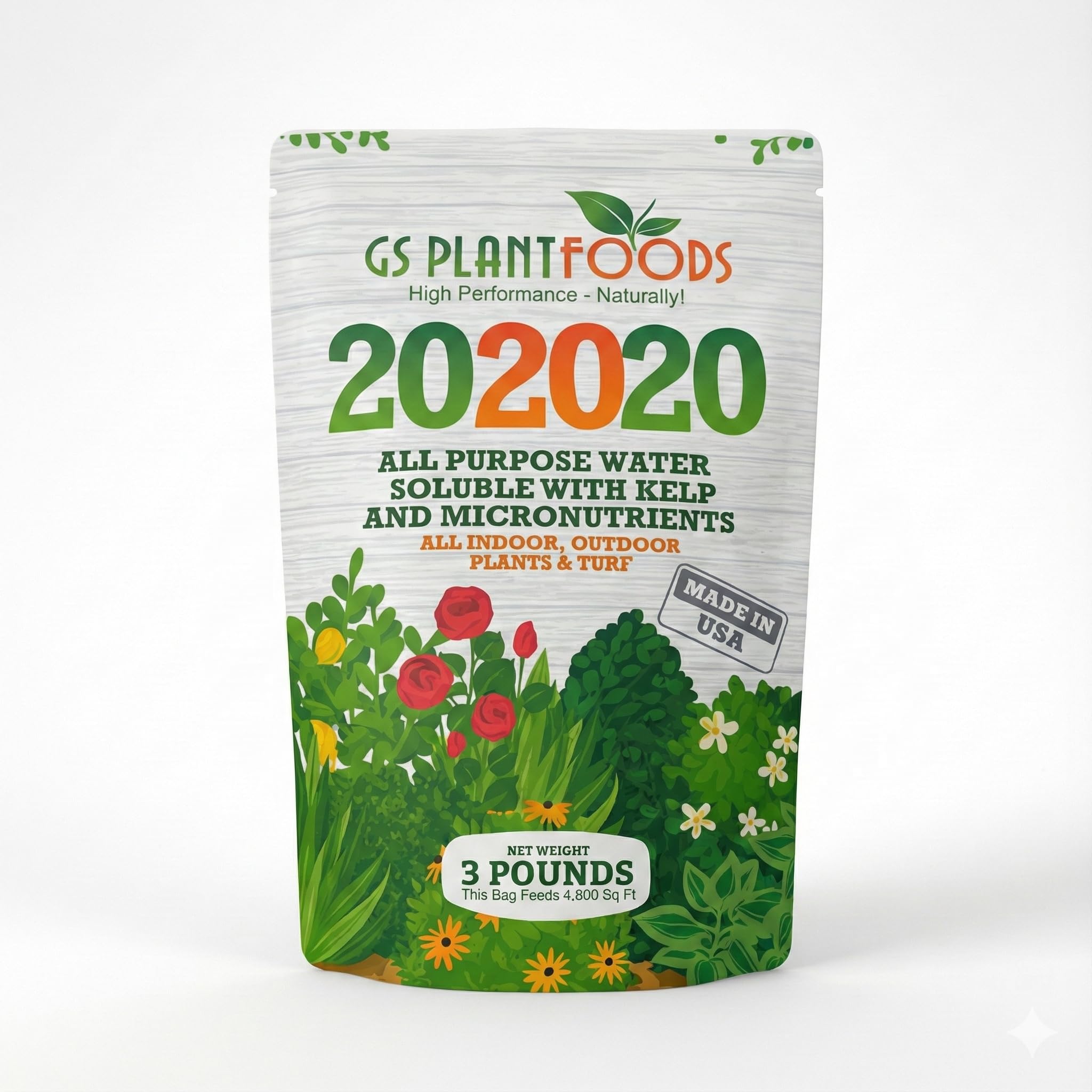
A balanced 20-20-20 with kelp added for a natural boost.
GS Plant Foods takes the classic 20-20-20 water-soluble formula and adds Ascophyllum nodosum kelp into the blend. Kelp is a natural source of growth hormones and trace elements that many gardeners swear by for reducing transplant shock and encouraging root development. The dry powder dissolves fully in water and can be applied through a watering can, hose-end sprayer, or backpack sprayer. A 3-pound bag feeds up to 4,800 square feet of turf, which is impressive for its relatively compact size.
The most striking owner report comes from a gardener with unhealthy Purple Orchid trees: after one week, the treated tree developed dark green leaves and new shoots, while the untreated tree stayed yellow and brown. After a second application, both trees had “darker, larger leaves than in three years.” The formula is not organic — it is a blend of kelp and industrially produced fertilizer — so it will not build long-term soil biology, but it delivers fast, visible results for both houseplants and garden plants.
What gets owners talking
- Kelp inclusion provides natural micronutrients and growth stimulants.
- 3 lb bag covers a huge 4,800 sq ft of turf when used as directed.
- Will not burn plants if instructions are followed, even on sensitive varieties.
The honest trade-off
- Not a certified organic product, despite the kelp content.
- Slight organic odor when mixed, though it fades quickly outdoors.
Reach for this if: you want a balanced water-soluble feed with the added natural boost of kelp for a reasonable price. It is a great middle-ground between synthetic speed and natural ingredients.
Look elsewhere if: you need a fully organic solution or prefer a granular slow-release format.
6. The Grow Co Organic Fish Fertilizer 1 Gallon

The stinky stuff that plants absolutely love for fruiting and blooming.
This is a concentrated, undiluted hydrolyzed fish emulsion with a 2-3-1 NPK ratio. Notice the middle number — phosphorus — is the highest, which makes this a smart choice for flowering and fruiting plants. The nitrogen is low enough that you will not get giant leafy plants with no flowers, which is the classic mistake with high-nitrogen fertilizers. One gallon of concentrate makes over 160 gallons of feed when diluted at a 1:100 ratio with water.
Let us be honest about the smell: it smells exactly like fish, because it is made from fish. The company is upfront about it, saying “if it doesn’t smell, then it’s not real fish.” Experienced gardeners recommend using it outdoors and watering it in well to reduce the odor. Reviewers point out that their avocado and persimmon trees “threw new shoots” and that the higher phosphorus content “works great” for blooms. A 50-year-plus gardener noted it is “great value as little needed” and that it works well in combination with kelp and tomato-specific formulas.
The takeaway: A high-phosphorus organic liquid that delivers fast results for fruiting plants. The 2-3-1 NPK ratio is unusual and ideal for bud set and fruit development. The smell is the price of admission, but the plant response is undeniable.
Best for: organic gardeners growing tomatoes, peppers, squash, and fruit trees who want a phosphorus boost during the flowering stage. The 1-gallon jug is very economical at 160+ gallons of mixed feed.
pass on it if: you are growing indoors or have a low tolerance for fishy smells near your living space.
7. VIVOSUN Liquid Nutrients A & B Bundle 2×32 oz

The two-bottle system that covers the entire grow cycle from start to finish.
This is not a general purpose fertilizer in the traditional sense — it is a two-part liquid nutrient system designed for hydroponics, coco coir, and aquaponics. Bottle A and Bottle B contain separate macro and micronutrients that must be diluted in water separately before combining. The formula provides nitrogen, phosphorus, potassium, calcium, magnesium, and more, and it supports both the vegetative stage and the flowering stage without needing a third bottle.
The convenience is that you only need these two bottles from start to finish. Owners note that 5 ml per gallon of tap water is the typical starting dose, and that the plants respond with “stronger stems and fuller leaves.” It works in soil as well, but it really shines in soilless systems where the nutrients must be in an immediately available form. The bottles are compact — two 32-ounce bottles — but a little goes a long way. The only real nuisance is that you cannot mix A and B in concentrated form; they must be added to the water separately or they will cloud and lock out.
What stands out: 37 owners call out its effectiveness and 28 praise the plant growth results. The two-part system eliminates the need for separate grow and bloom formulas. Compatible with “soil, hydroponics, aquaponics and coco coir cultures.”
Choose this if: you run a hydroponic, coco coir, or aquaponic setup and want a complete, no-guesswork nutrient system from veg to flower. The bundle is straightforward and effective.
Pass on this if: you only grow in soil and prefer a one-step granular or powder that does not require measuring two bottles.
8. Peter’s 20-20-20 General Purpose Fertilizer with Micro Nutrients 2 lb

The indoor plant specialist that keeps African violets blooming continuously.
Peter’s 20-20-20 is a smaller, more targeted option than the bulk bags above — a 2-pound bag (32 oz unit count) that is ideal for houseplant collections and indoor gardens. The 20-20-20 ratio is perfectly balanced, and the formula includes micronutrients that many general-purpose fertilizers skimp on. The mixing ratio is 1:1:1, meaning you use equal parts of each nutrient for a balanced feed. At its size, it is the lightest and most manageable option for apartment dwellers.
Devoted owners have used this fertilizer for decades. As one longtime buyer put it: “My African violets bloom continuously, my sufficient grow and propagate profusely, and my green house plants grow lushly and flourish.” Another owner compares it directly to the bigger brand, saying it “works much better than Miracle Grow and at a lesser rate.” The small bag is the trade-off — the Jack’s 25 lb bag holds over 12 times the powder by weight — but for anyone with a modest collection of houseplants and orchids, this is the perfect size that will not go stale before you finish it.
The standout fact: 36 owners highlight the quality as the top aspect, with effectiveness close behind at 30 mentions. The micro-nutrient package is the secret to its “won’t burn roots” reputation, making it safe for regular weekly feeding.
Grab this for: the houseplant enthusiast with a dozen or so indoor plants, orchids, and bromeliads who wants a reliable, gentle balanced feed that will not burn roots. The 2 lb size is just right for a small collection.
Think twice if: you are feeding a large vegetable garden or lawn — the bag will run out quickly, and a bulk option like Jack’s or GreenView would be more economical.
9. Jobe’s Organics Granular All Purpose Fertilizer 4-4-4 16 lb

The affordable organic granular that feeds the soil, not just the plant.
Jobe’s Organics is the entry-level organic granular that comes in a 16-pound bag with a 4-4-4 NPK analysis. It is OMRI-listed for organic gardening, meaning it contains no synthetic chemicals and is approved for use in organic production. The granules are applied directly to the soil every 2-3 weeks during the growing season, where they break down gradually to provide a steady supply of nutrients. The formula includes a mix of natural organic ingredients that also feed the beneficial microorganisms in the soil.
The most creative application owners have found is steeping one cup of the granules in a gallon of dechlorinated water for 24 hours to make a liquid tea. This liquid feed, applied weekly, produced “budded flowers on squash within 48 hours” and “abundant harvest of squash, cucumbers, eggplant.” The honest downside is the odor: owners consistently note it smells like a chicken coop for a couple of days after application. It is a short-lived smell, but it is real. The granules do need to be watered in thoroughly to start the breakdown process, and they can attract animals if left on the surface.
What owners rave about: The effectiveness — 32 owners highlight it, with the plants responding “quickly” and producing “abundant” yields. It is also praised for being “super easy to mix in soil” and for building long-term soil health.
Choose this if: you want an affordable organic granular that builds soil health over time and works for vegetables, flowers, and shrubs. The 16 lb bag is a solid mid-size for a medium garden.
Pass on this if: you are sensitive to manure-like smells or need an indoor-friendly fertilizer that will not bring in a farmyard odor.
Understanding the Specs
NPK Ratio — The Three Numbers
Water-Soluble vs. Granular vs. Liquid
The form of the fertilizer dictates how you feed. Water-soluble powders (Miracle-Gro, Jack’s, Peter’s) dissolve instantly in water and provide immediate nutrition — you mix a small amount into a watering can every 1-2 weeks. Granular fertilizers (Jobe’s, Espoma, GreenView) are sprinkled onto the soil and break down slowly over weeks or months, releasing nutrients gradually. Liquid concentrates (The Grow Co, VIVOSUN) are pre-dissolved and pour directly into water, but they tend to be more expensive per feeding and often smell stronger. Pick based on how much time you want to spend mixing.
FAQ
What does 20-20-20 mean on a fertilizer bag?
Can I use the same fertilizer for indoor and outdoor plants?
Will a high-nitrogen fertilizer burn my plants?
How often should I apply water-soluble fertilizer?
Is organic fertilizer better than synthetic?
Can I use a general purpose fertilizer on my lawn?
What is the difference between Peter’s 20-20-20 and Jack’s 20-20-20?
How do I store leftover water-soluble fertilizer powder?
Will fish fertilizer attract animals to my garden?
Can I mix two different fertilizers together?
Final Thoughts: The Verdict
For most gardeners, the best general purpose fertilizer is the Miracle-Gro All Purpose 12.5 lb because it offers instant results, a large 200 oz unit count covering 5,000 sq. ft., and a proven track record across tens of thousands of owners. If you want the most economical bulk option for heavy feeding, grab the Jack’s Professional 25 lb — its 400 oz unit count and 20-20-20 balance make it the cost-per-gallon champion. And for organic gardeners building long-term soil health, the Espoma Plant-Tone 50 lb is the one to reach for.
How We Picked
We do not accept paid placement. Every pick is matched to a real buyer and a real use-case; we do not hands-on test units.
Sources & Methodology
Specifications: manufacturer listings and product documentation. Review insights: verified customer reviews, as of July 2026. Pricing: not shown on this page (it changes often); check the current price via the retailer link.
As an Amazon Associate, Lawn Gear Lab earns from qualifying purchases. This does not affect which products we feature.