
The smell of fresh-cut grass and the roar of a four-stroke engine are the hallmarks of a proper Saturday morning. But choosing the wrong gas walk-behind mower means fighting a machine that won’t start on a slope, leaves a ragged strip down the center, or clogs every time the grass is damp. You need a machine that pulls hard, cuts clean, and keeps its carburetor dry season after season.
I’m Rikta — the co-founder and writer behind Lawn Gear Lab. I’ve spent hundreds of hours cross-referencing engine displacement, deck construction, wheel bearing quality, and real owner experiences to separate the machines that earn their keep from those that end up on the curb.
Whether you’re managing a steep quarter-acre or a flat half-acre, finding the right gas walk-behind lawn mower comes down to matching engine torque to grass density, deck width to terrain, and drive system to your walking pace.
How To Choose The Best Gas Walk-Behind Lawn Mower
Selecting a gas walk-behind mower means prioritizing raw torque over battery anxiety and component durability over convenience features. Here are the three non-negotiable spec categories you need to evaluate before buying.
Engine Displacement and Torque Output
The 144cc class (3.0–3.5 HP) is fine for flat, well-mainched lawns of a quarter-acre or less. For thicker grasses like zoysia or for slopes that bog down a small motor, step up to a 170cc or 201cc engine (4.0–6.0 HP). Torque (measured in ft-lb) tells you how much rotational force the crankshaft delivers at low RPM — a higher torque number means the blade keeps spinning when you hit a dense patch, without stalling.
Deck Construction and Width
Stamped steel decks (the industry standard for budget to mid-range mowers) are formed from a single sheet of metal. They are light and cheap to replace but can warp or crack if you routinely bang into rocks or tree roots. Fabricated decks (welded together from multiple steel pieces) are heavier, stiffer, and last through years of abuse. A 21-inch deck is the sweet spot for residential yards — wide enough to finish quickly but narrow enough to fit through most gates.
Drive System and Wheel Size
Rear-wheel drive (RWD) provides superior traction on hills because the weight of the engine sits over the drive wheels. Front-wheel drive (FWD) is lighter and turns more easily on flat ground. For mowers without self-propel, large rear wheels (10-inch or bigger) with double ball bearings reduce rolling resistance significantly — you do not want to be pushing a 70-pound mower on 7-inch wheels through damp grass. CVT transmissions let you vary speed infinitely, while single-speed or 6-speed gear drives offer fixed pace options.
Quick Comparison
On smaller screens, swipe sideways to see the full table.
| Model | Category | Best For | Key Spec | Amazon |
|---|---|---|---|---|
| BILT HARD 201cc | Premium Push | Thick grass, large yards | 201cc / 9.0 ft-lb torque | Amazon |
| YARDMAX YG2860 | Self-Propelled CVT | Hills, variable pace | 201cc / 6-speed CVT | Amazon |
| SENIX 22″ 201cc | Self-Propelled RWD | Medium-large lawns | 201cc / 8.8 ft-lb torque | Amazon |
| PowerSmart 22″ 170cc | Self-Propelled RWD | Slopes, uneven ground | 170cc / RWD traction | Amazon |
| SENIX 21″ 144cc | Mid-Range Push | 1/3 acre, light-duty | 144cc / 3.4 HP | Amazon |
| PowerSmart 21″ 144cc | Value Push | Budget-conscious buyers | 144cc / 21″ steel deck | Amazon |
| BILT HARD 144cc | Value Push | Medium yards, tight budget | 144cc / 10-position height | Amazon |
| AMERISUN 144cc | Budget Push | Entry-level, small yards | 144cc / 1.4 bushel bag | Amazon |
| Greenworks 24V 13″ | Cordless (Not Gas) | Tiny, flat lawns | 13″ deck / 4.0Ah battery | Amazon |
| WORX Nitro WG752 | Cordless (Not Gas) | ½ acre, no gas storage | 20″ deck / 40V dual battery | Amazon |
| EGO POWER+ LM2134SP-2 | Premium Cordless | Large yards, premium features | 21″ Select Cut / 100 min runtime | Amazon |
In‑Depth Reviews
1. BILT HARD 21 Inch 201cc 4-Cycle Engine Push Lawn Mower
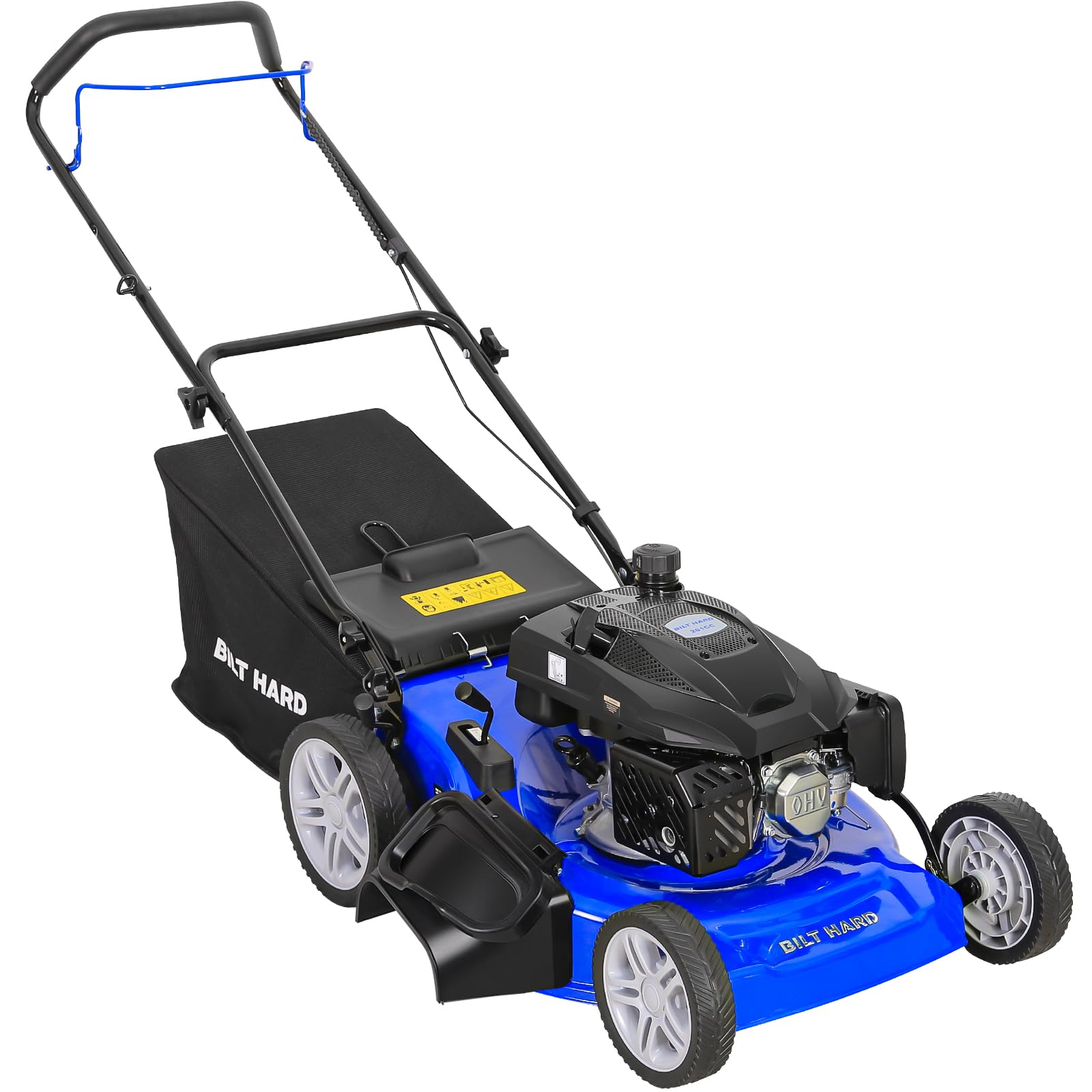
The 201cc engine on this BILT HARD push mower outputs 9.0 ft-lb of torque — enough to chew through overgrown Bahia without the blade stalling. The no-choke, no-primer starting system eliminates the guesswork of a manual primer bulb: pull the rope and the auto-choke does the rest. Owners report consistent first- or second-pull starts even after storage, a sign that the carburetor design resists varnish buildup better than budget 144cc units.
With 10 cutting positions ranging from 1.2 to 3.75 inches, you can scalp a winter lawn in early spring and leave a full 3-inch cut during summer heat. The 21-inch alloy steel deck is a stamped unit, but the gauge feels thicker than the entry-level AMERISUN or PowerSmart decks — less flex under load means a cleaner cut with fewer missed blades. The 9.5-inch rear wheels with double ball bearings roll smoothly over packed dirt and moderate bumps.
The only complaint thread centers on isolated defects: a bent drive shaft on one unit caused vibration that cracked plastic covers. BILT HARD’s support is responsive, but you may want to run the first tank of gas through the mower while the return window is still open to confirm alignment. For the torque-to-dollar ratio, this is the most capable push mower in the sub-premium tier.
What works
- 9.0 ft-lb torque handles very thick grass
- No-choke starting is genuinely reliable
- 10-position height range suits year-round use
What doesn’t
- Stamped deck, not fabricated — less abuse tolerance
- Inconsistent QC on first units; inspect promptly
- Heavy at 74 pounds for a push mower
2. YARDMAX 22 in. 201cc Select PACE 6 Speed CVT High Wheel FWD

The YARDMAX YG2860’s defining feature is its continuously variable transmission (CVT), which lets you dial in a precise walking speed from a crawl to a brisk march without clutching or shifting gears. The 201cc engine starts reliably (auto choke, no priming needed) and the aggressive spiked tread on the 11-inch rear tires provides serious grip on damp slopes — a rare advantage over the standard ribbed tires most mowers ship with.
The 22-inch stamped steel deck paired with the deck cleanout port makes post-mow cleanup simple: attach a garden hose to the port and the water jet blasts clippings from the underside before they harden into a corrosion layer. Single-lever height adjustment gives six positions, and the 1.7-bushel bag is adequate for a ¾-acre lot, though the bag attachment process is not the slickest design on the market.
Where the YARDMAX loses ground is in its front-wheel-drive configuration. On wet, steep slopes, FWD loses traction as weight shifts off the front axle. The mower is also heavy at 85 pounds, and the bag removal requires lifting the bag over the rear wheel fenders, which some owners find awkward. For flat-to-gently-sloped lawns where CVT speed matching is a priority, this is a standout performer.
What works
- CVT lets you match exact walking pace
- Aggressive tire tread grips wet grass well
- Deck cleanout port reduces maintenance time
What doesn’t
- Front-wheel drive struggles on steep hills
- Bag removal is awkward and heavy
- Speed lever can slip out of position during use
3. SENIX 22 Inch 201cc Rear Wheel Single Speed Self-Propelled Mower
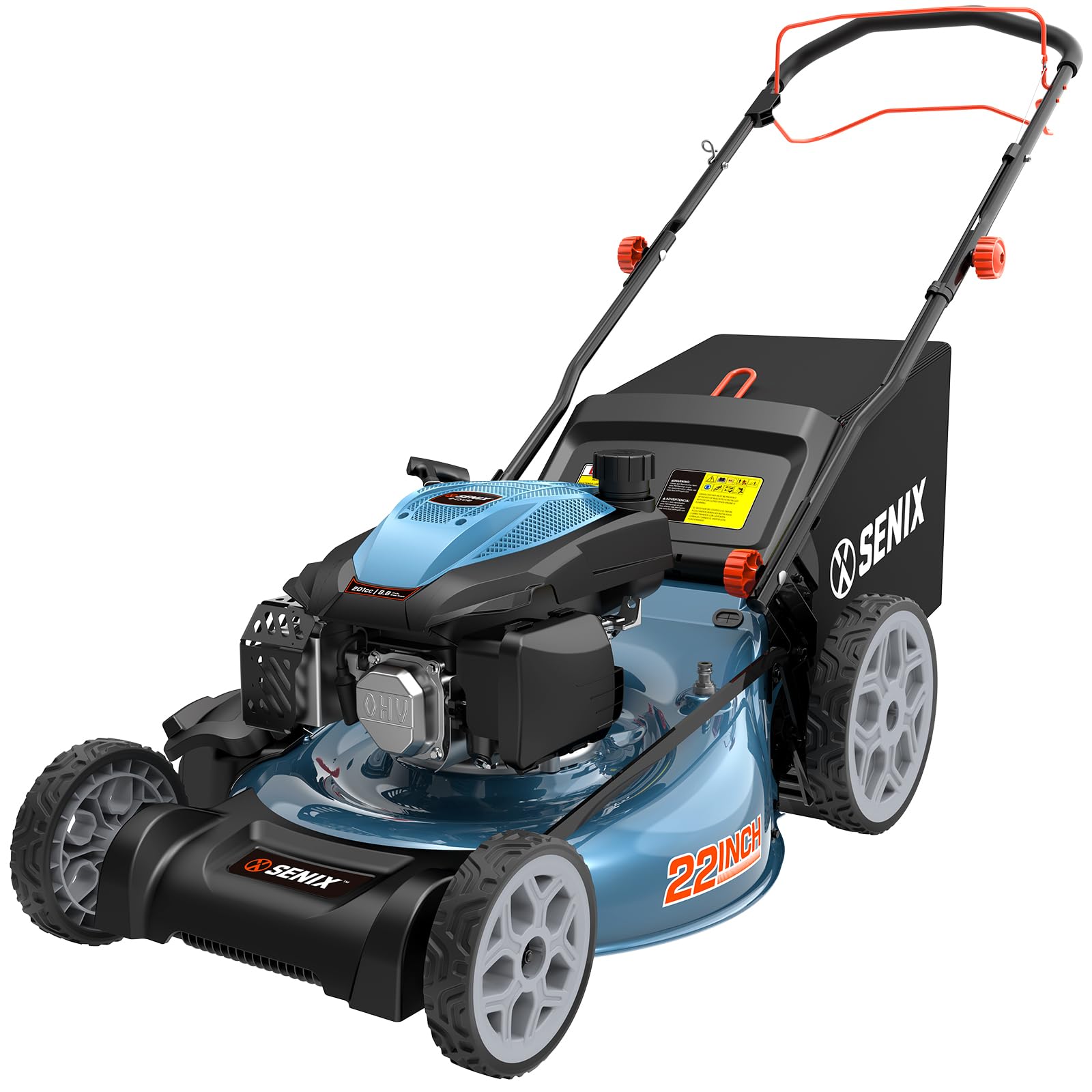
The SENIX 201cc self-propelled mower uses a single-speed rear-wheel drive that pushes at 2.9 MPH — a deliberate pace that suits large, moderate slopes without the complexity of variable speed controls. The 201cc engine generates 8.8 ft-lb of torque, and owners consistently report first-pull starts after winter storage when treated with fuel stabilizer. The 22-inch manganese steel alloy blade (45–50 HRC hardness) stays sharper longer than standard SAE 1070 blades.
SENIX uses a DC04-06 high-strength steel deck (a low-carbon grade with excellent impact resistance) bent into a vortex tunnel shape. This design keeps clippings suspended in the airflow rather than accumulating under the deck, which directly reduces the need to stop and scrape. The 6-position central height lever is intuitive and moves through the full 1.25-to-4-inch range smoothly, even with the engine running.
The main trade-off is the single-speed drive — you cannot slow down for thick patches or speed up on flat stretches, which limits efficiency on varied terrain. Some owners also report that the included manual lacks oil capacity specs, requiring a separate lookup online. For a buyer who wants a no-fuss, fixed-pace RWD mower that punches above its price bracket in build quality, this SENIX delivers.
What works
- RWD provides excellent hill traction
- Vortex tunnel deck reduces clipping buildup
- Manganese alloy blade stays sharp longer
What doesn’t
- Single-speed drive limits pace flexibility
- Manual lacks basic engine capacity info
- Some units shipped with loose wheel hardware
4. PowerSmart 22-Inch Self Propelled Gas Lawn Mower, 170cc
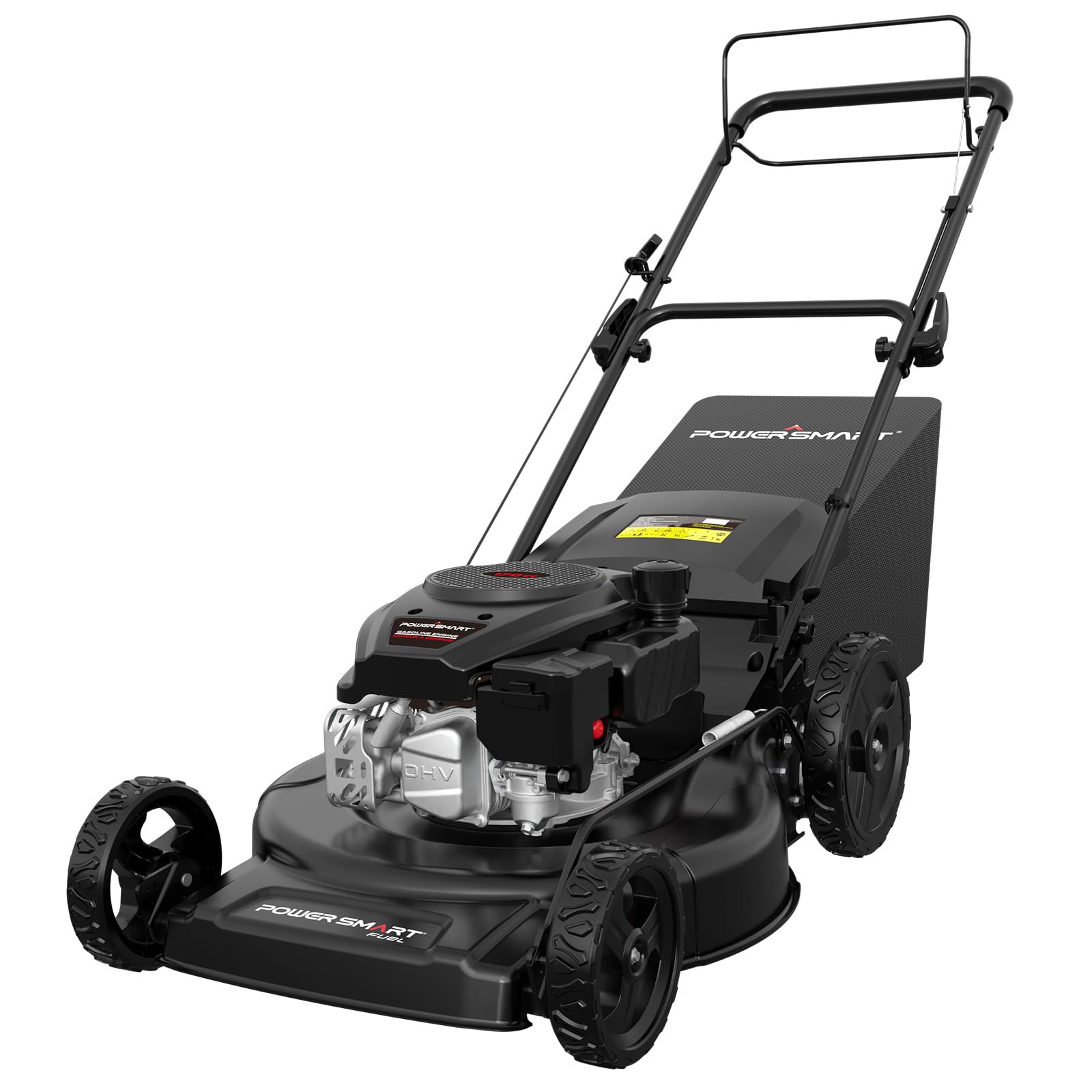
The PowerSmart DB8622S splits the difference between a 144cc and a full 201cc class — its 170cc engine is strong enough for thick St. Augustine but light enough to keep the mower at a manageable 68 pounds. The rear-wheel drive system pulls reliably up moderate inclines where FWD units spin, and the 22-inch all-steel deck covers ground 1 inch wider per pass than a standard 21-inch deck, shaving time off a half-acre lot.
Assembly is minimal (attach the handle and add oil/gas), and owners note that the mower starts within two pulls even after sitting for a few weeks. The 6-level rear-wheel height adjustment is not the fastest to change — you have to adjust each rear wheel individually — but the range from 1.5 to 3 inches covers most seasonal needs. The 60-liter grass bag is generously sized, reducing trips to the compost pile.
The plastic rear skirt (commonly called a rubber flap) has a tendency to detach and get chewed up by the blade, which is a known design weak point. Replacing it with a stiffer aftermarket flap resolves the issue permanently. If you can live with that minor mod, the PowerSmart offers the best RWD self-propel value in its displacement class.
What works
- RWD climbs slopes that would bog a FWD mower
- 22-inch deck finishes large lawns faster
- Lightweight for a self-propelled unit at 68 lbs
What doesn’t
- Rear flap detaches and can be chewed by blade
- Individual wheel height adjustment is tedious
- No oil included in the box
5. SENIX 21-Inch Gas Lawn Mower, 144cc
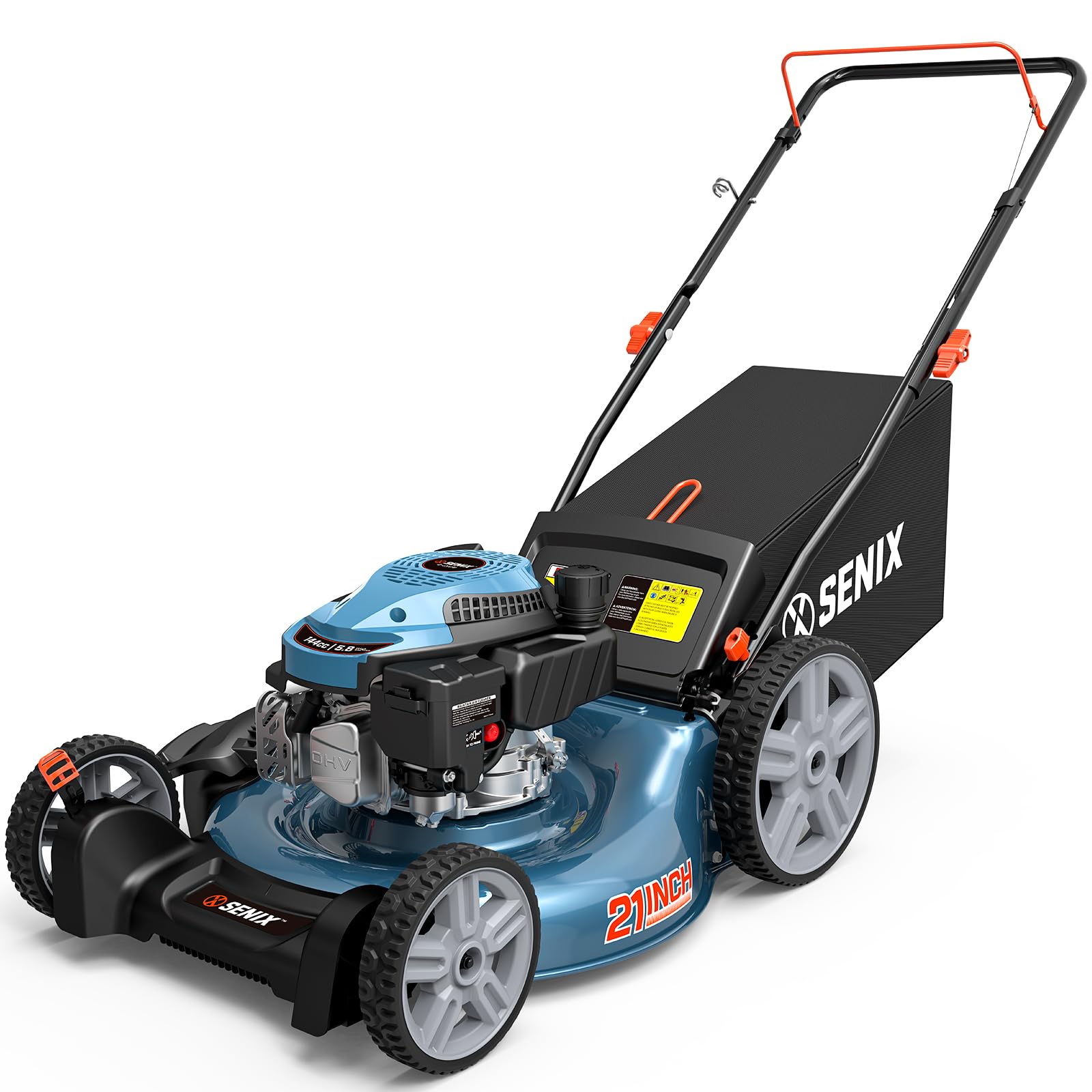
SENIX re-enters the lineup with a 144cc push mower that punches noticeably above its displacement class, largely thanks to the DC04-06 steel deck and the pre-filled engine oil that makes first-time setup a five-minute job. The 3.4 HP engine delivers 5.8 ft-lb of torque, enough to handle St. Augustine in a single pass without bogging, and the auto-choke system delivers consistent first-pull starts.
The 21-inch vortex tunnel deck is the same airflow engineering found on the premium SENIX model — it forces clippings upward and rearward, keeping the underside clear during extended wet-grass sessions. The 1.7-bushel bag is the largest in its price tier, and the bag frame uses thicker wire gauge than the AMERISUN equivalent. The 11-inch rear wheels and 8-inch fronts with ball bearings roll smoothly over uneven terrain.
Customer support responsiveness is a concern: one owner reported weeks of delay getting a replacement grass catcher frame under warranty. The height adjustment lever is a dual-lever design (one per side), which is slightly less convenient than a single central lever but not a dealbreaker for most users. For a budget-friendly push mower that delivers premium deck engineering, the SENIX 144cc is a smart pick.
What works
- Vortex tunnel deck resists clogging in wet grass
- 1.7-bushel bag reduces emptying frequency
- Pre-filled oil makes first setup effortless
What doesn’t
- Dual-lever height adjustment adds a step
- Customer support can be slow for warranty claims
- Light-duty build; not for rocky or rough terrain
6. PowerSmart EasyGlide 21-Inch Gas Lawn Mower, 144cc
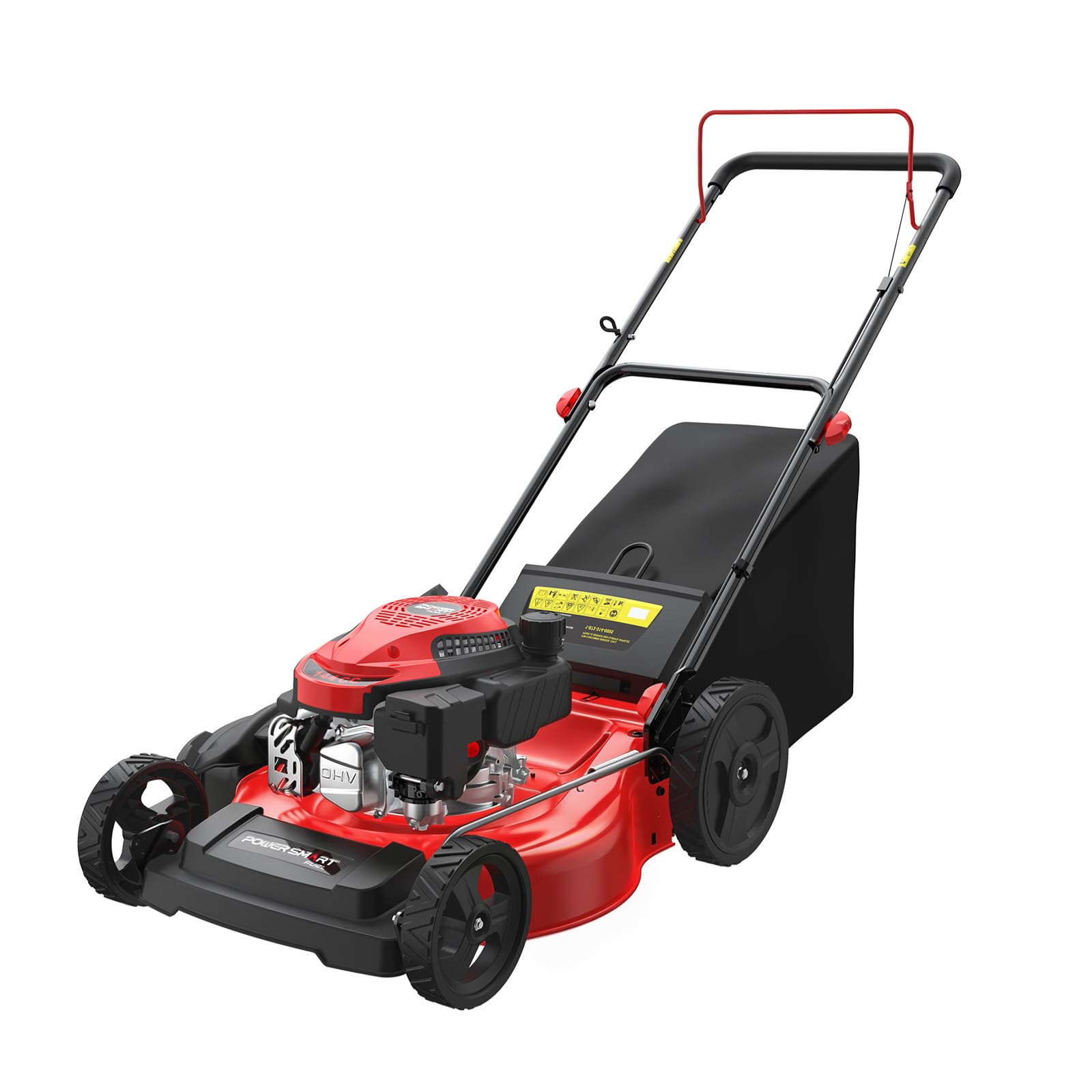
The PowerSmart DV8621P is a 144cc push mower that achieves a near-perfect balance of price and reliability. The engine starts on the first pull (the primer bulb requires just three pushes, not the five or six some competitors demand), and the 21-inch steel deck delivers a consistent cut depth across 6 positions from 1.5 to 3.9 inches. The dual ball-bearing wheels — 7-inch front, 10-inch rear — roll easily even when the grass catcher is full.
Assembly takes under 20 minutes, and the included 3-in-1 capabilities (bag, mulch, side discharge) cover all common mowing scenarios. Owners consistently mention that this mower handles thick bermudagrass and even some light kikuyu without losing speed or leaving skipped strips. The 1.4-bushel grass bag is smaller than the SENIX’s bag but is easier to empty and reattach.
The foam grip on the handle is known to arrive damaged on some units (cosmetic only), and the fuel tank is small (roughly 27 oz) — expect to refill during a full half-acre mow. For a buyer who wants a straightforward, reliable gas push mower that starts every time and cuts evenly without fuss, the PowerSmart DV8621P is the standard-bearer in its price bracket.
What works
- Reliable first-pull start with minimal priming
- Lightweight at 62 lbs for easy maneuvering
- Even cut quality even in thick grass
What doesn’t
- Small fuel tank requires mid-yard refill
- Handle foam grip can arrive damaged
- Grass bag capacity is adequate but not generous
7. BILT HARD 21 Inch Lawn Mower Gas Powered, 144cc
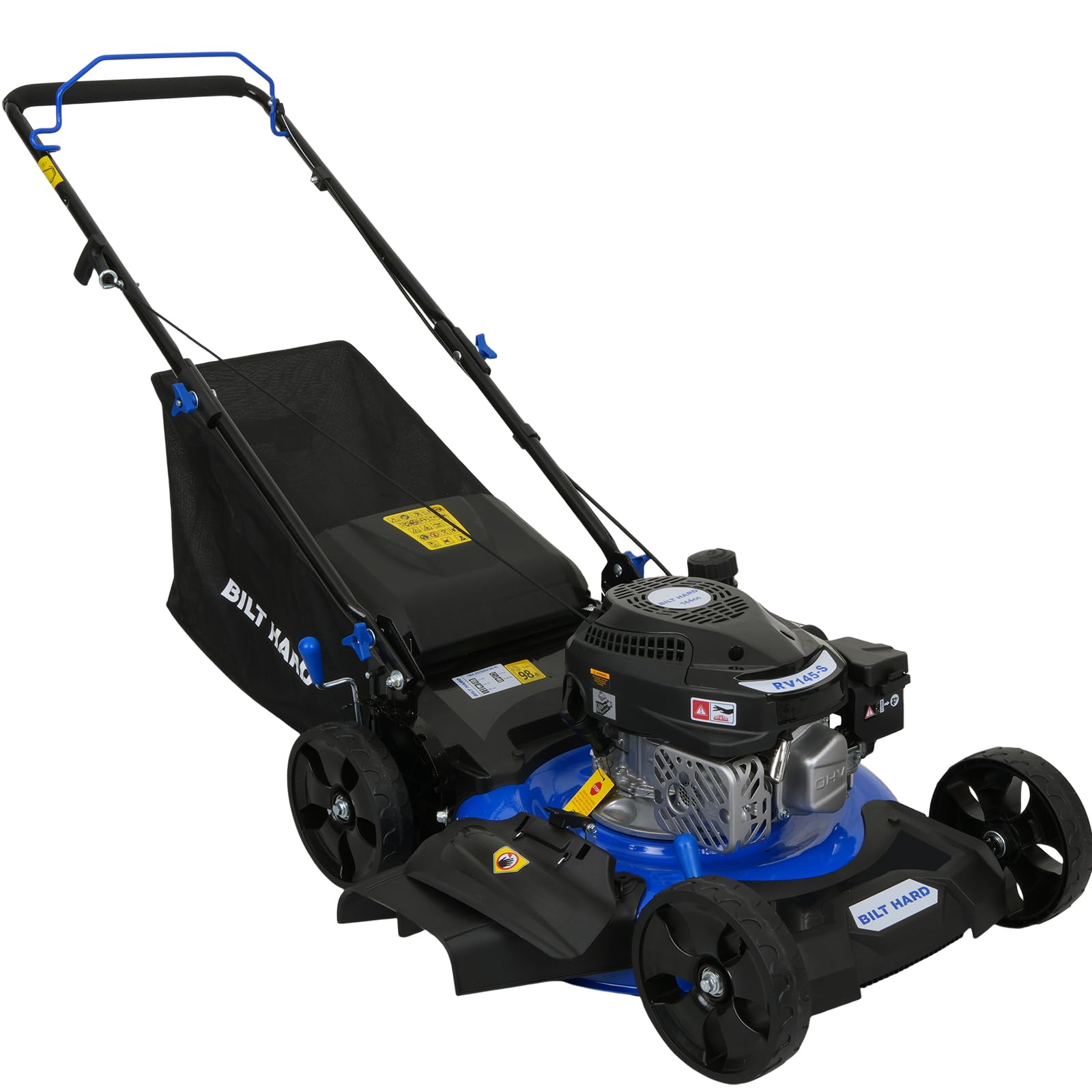
BILT HARD’s 144cc push mower (model TMA-0561) arrives with oil included, a thoughtful touch that eliminates one trip to the hardware store. The 144cc 4-stroke engine is the same basic platform as the PowerSmart but tuned slightly differently — owners report that it starts easily and runs reliably through tall, damp grass without the blade slowing. The 10-position height adjustment range spans 1.2 to 3.75 inches, giving you finer granularity than the standard 6-position setups.
The 21-inch steel deck feels adequately reinforced for a stamped unit, and the 9.5-inch front and rear wheels with ball bearings provide good flotation on soft turf. The 3-in-1 system swaps easily between modes, and the mulching plug seats securely without excessive force. Owners who have used this mower for several months report consistent performance with routine oil changes and fuel stabilizer.
The most significant concern is a known defect: the single-lever height adjustment mechanism can slip under vibration, gradually lowering the deck on one side. Several owners solved this with a zip-tie fix on the lever pivot. There are also isolated reports of bent drive shafts causing vibration — as with the 201cc BILT HARD, inspect the unit and run it before the return window closes.
What works
- 10 height settings allow very precise cut adjustment
- Engine starts reliably even after storage
- Oil included in the box for first fill
What doesn’t
- Height adjustment lever can slip without a zip-tie fix
- Occasional QC issues with drive shaft alignment
- Not built for frequent commercial use
8. AMERISUN 21″ Steel Deck Gas Lawn Mower, 144cc
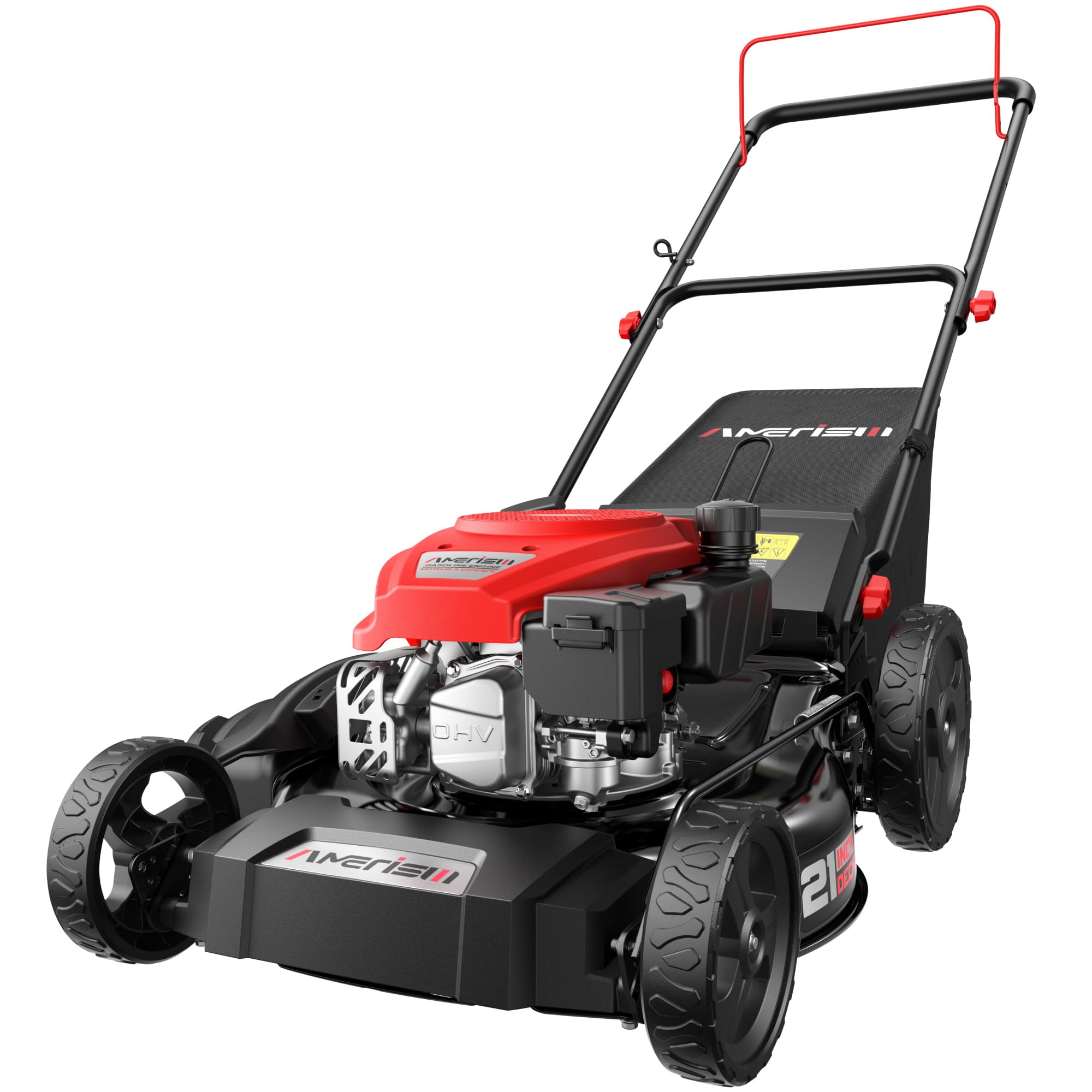
The AMERISUN AV8621P1 enters the market as a price-conscious push mower with enough spec to handle a quarter-acre yard reliably. The 144cc 4-stroke OHV engine is a familiar platform (shared with other budget brands), and the forced air-cooling system helps it avoid overheating during extended summer mows. The 21-inch steel deck is reinforced at the weld points, though the steel gauge is visibly thinner than the PowerSmart or SENIX equivalents.
Six cutting heights range from 1.5 to 3.9 inches, controlled by a single lever that moves smoothly. The 1.4-bushel grass bag collects well in dry conditions but tends to load unevenly — you may need to shake it mid-mow for full capacity. Owners consistently note the value proposition: the mower performs comparably to machines costing more, with the biggest caveat being long-term durability of the stamped deck and the plastic rear flap.
The major complaint centers on reliability: a number of owners report the mower stopping permanently after one or two uses, often due to a factory carburetor issue or a defective ignition coil. The plastic rear flap design (held by four plastic notches) is fragile and can detach, exposing the operator to the blade path. If you buy, test thoroughly on the first tank and consider reinforcing the flap with a metal bracket.
What works
- Excellent price-to-performance for small lawns
- 10-inch rear wheels roll well over uneven ground
- Single-lever height adjustment works smoothly
What doesn’t
- Fragile plastic rear flap is a safety concern
- Reliability is inconsistent; some units fail early
- Thin stamped steel deck may dent on rocks
9. Greenworks 24V 13″ Brushless Push Cordless Lawn Mower
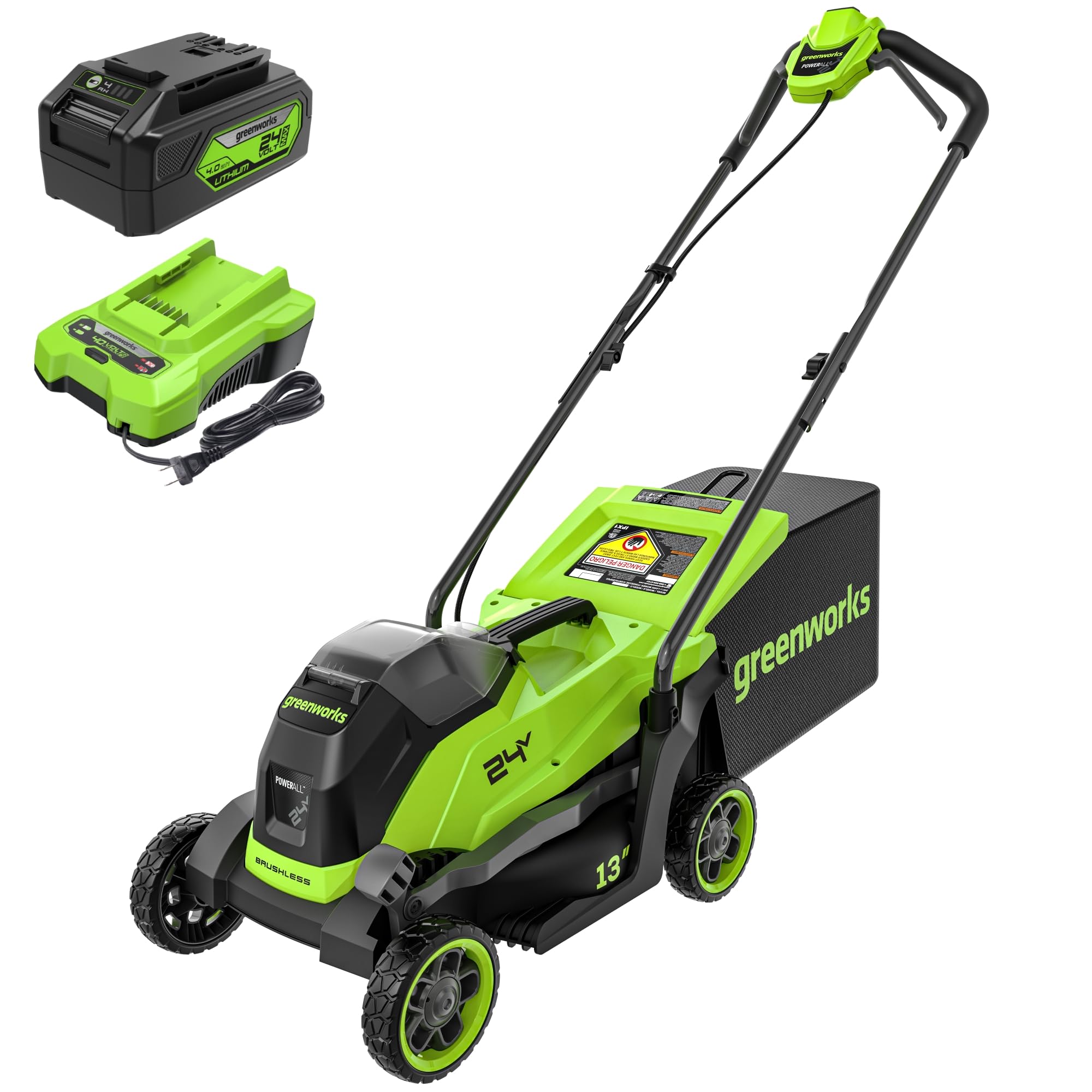
This Greenworks is not a gas mower, but it occupies an important category: the ultra-lightweight alternative for tiny city lots where dragging a gas engine feels like overkill. The 13-inch cutting deck is only 44% of the width of a standard 21-inch mower, making it ideal for narrow strips, garden paths, and yards under 1,000 square feet. The brushless motor runs silently and starts instantly with the push of a button.
The 24V 4.0Ah battery provides roughly 30 minutes of runtime in normal conditions, and owners report that this is enough to finish a small front and back yard on a single charge when the grass is dry. The 2-in-1 design (mulch or bag) covers the basics, and the 5-position height adjustment handles most grass types. Weighing only 17.6 pounds, this mower can be carried up stairs or lifted into a car trunk without strain.
The downsides are significant for anyone accustomed to gas power: the 13-inch deck makes this mower impractically slow for anything larger than a 0.1-acre lot, and the battery lifespan degrades noticeably after 2–3 seasons. The plastic deck will flex if you hit a rock or tree root. Buy this only for the smallest of lawns where the primary benefit is weight and quiet operation.
What works
- Extremely light at just under 18 lbs
- Near-silent operation and instant push-button start
- Battery runtime meets claims for small flat yards
What doesn’t
- 13-inch deck is too narrow for anything over 0.1 acre
- Plastic deck flexes on impact with hard objects
- Battery capacity declines noticeably after a few seasons
10. WORX Nitro Cordless Lawn Mower, 21″ 40V WG752

The WORX WG752 is a strong electric alternative for buyers who want gas-like coverage without the carburetor maintenance. The 20-inch AeroDeck uses a vented design that lifts cut grass into the airflow, preventing the clogs that plague enclosed-deck electrics. The brushless motor 2.0 delivers 40% more power than WORX’s first-gen motors, and the IntelliCut sensors automatically boost blade speed when the mower encounters heavy grass.
The kit includes two 20V 5.0Ah PowerShare Pro batteries (wired in series for 40V output) and a dual charger. Runtime is approximately 50 minutes under normal conditions, enough for a half-acre lot if the grass is dry. The batteries are cross-compatible with 140+ WORX tools — a genuine ecosystem advantage. The 7-position height adjustment ranges from 1.5 to 4 inches, and the foldable handle enables vertical storage that takes up minimal garage space.
This is not a gas mower, so the torque curve is not directly comparable to a 144cc or 201cc engine. In thick, wet grass, the WORX will bog sooner than a similar-displacement gas unit. The batteries are also mildly difficult to remove from the mower due to tight tolerances. If you are willing to trade absolute peak power for zero emissions, quiet operation, and instant start, the WORX WG752 is the best cordless alternative to a gas walk-behind.
What works
- AeroDeck design prevents clogs in damp grass
- Two batteries provide sufficient runtime for ½ acre
- Foldable handle enables compact vertical storage
What doesn’t
- Not as powerful as a 144cc gas engine in wet thick grass
- Battery removal requires firm pressure
- Single-tool packaging; no extra batteries included
11. EGO POWER+ Self-Propelled Cordless Mower LM2134SP-2
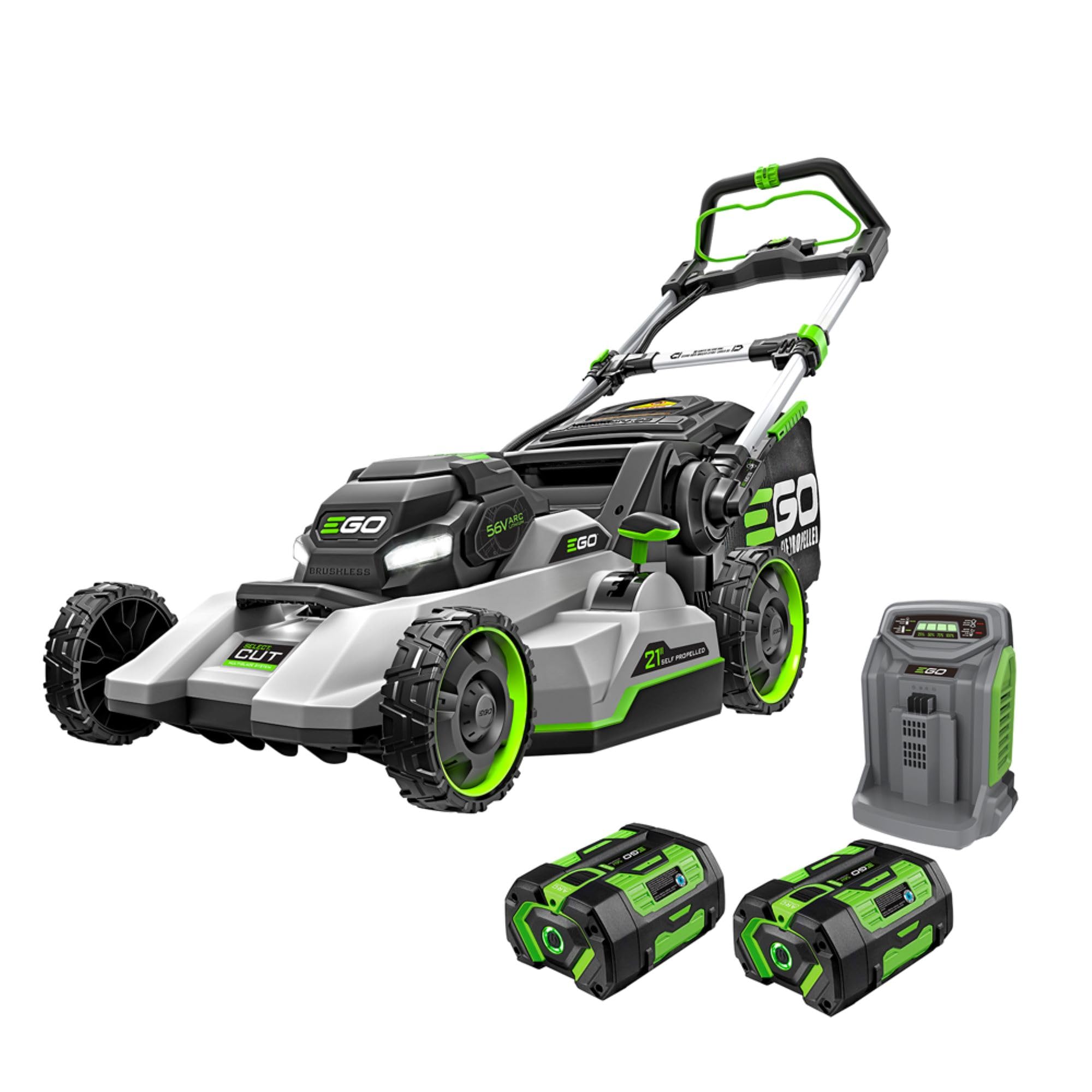
The EGO LM2134SP-2 is the benchmark for premium cordless mowers, offering performance that rivals or exceeds entry-level gas mowers. The Select Cut multi-blade system uses one blade for mulching and a second blade for bagging or side discharge — a design that actually produces a finer cut than most single-blade gas mowers. The Touch Drive self-propel system uses a pressure-sensitive bar: squeeze harder for faster speed, release for neutral, with a range of 0.9 to 3.1 MPH.
Two 56V 6.0Ah ARC Lithium batteries provide up to 100 minutes of runtime. Owners with ¼-acre lots report completing the mow on 1.5 batteries with self-propel engaged, and the rapid charger brings a depleted battery to full in under an hour. The 8-position height adjustment (1–4 inches) and 21-inch deck mirror a premium gas spec sheet. LED headlights extend usability into twilight hours, and the mower stores vertically using a folding handle.
The primary limitation is cost — this is the most expensive unit on the list by a wide margin. The thumb-operated forward buttons can be accidentally triggered during tight turns, and the mower’s weight (96 pounds with batteries) makes it heavier than a typical gas push mower. For the buyer who wants to eliminate gas and oil entirely without sacrificing cut quality or self-propel traction, the EGO LM2134SP-2 is the definitive choice.
What works
- Select Cut dual-blade system delivers exceptional cut quality
- 100-minute runtime covers large lawns on one charge
- Touch Drive self-propel is intuitive and responsive
What doesn’t
- Significantly more expensive than any gas option
- Heavier than many gas mowers at 96 lbs
- Thumb buttons can be pressed accidentally in tight spaces
Hardware & Specs Guide
Engine Displacement (cc) and Torque
Displacement measures the total volume of the engine’s cylinders. A 144cc engine displaces 144 cubic centimeters. More cc generally means more torque, but the relationship is not linear — a 201cc engine may produce 8.8 ft-lb while a well-tuned 170cc unit can produce 7.0 ft-lb. Higher torque means the blade maintains rotational speed when the grass load spikes (tall, wet, or thick patches). For yards under ¼ acre with moderate grass, 144cc is sufficient. For any yard with dense grass or slopes over 10°, step up to 170cc or 201cc.
Deck Material: Stamped vs. Fabricated Steel
Stamped steel decks are formed by pressing a single sheet of steel into shape under a hydraulic press. They are cheaper and lighter but more prone to warping after repeated impacts with rocks or hidden sprinkler heads. Fabricated decks are made by welding several pieces of steel together, resulting in a stiffer structure that resists bending and cracking. Most residential mowers in the budget-to-mid tiers use stamped decks (typically 16 to 14 gauge steel). Premium and commercial mowers use fabricated decks (12 gauge or thicker).
Self-Propelled Drive: FWD vs. RWD
Front-wheel drive (FWD) pulls the mower from the front axle. It is lighter, turns more easily on flat ground, and is cheaper to produce. The trade-off is reduced traction on hills — as the mower tilts backward, weight transfers off the front wheels, causing them to spin. Rear-wheel drive (RWD) pushes from the back, where the engine and operator weight sit. RWD climbs steeper slopes and pushes through thicker grass without losing traction. For any property with a notable slope, RWD is the correct choice.
Grass Collection: Bag Capacity and Mechanism
Bag capacity is measured in bushels (1 bushel = 8 gallons of volume). A 1.4-bushel bag holds roughly 12 gallons of clippings. A 1.7-bushel bag holds 14 gallons. The real difference is not the volume but how the bag attaches: clip-on bags are faster to remove but may leak clippings at the joint; latch-lock bags are more secure but require two hands to detach. If you mulch (leave clippings on the lawn), bag capacity is irrelevant. If you bag frequently, a bag with a chute that does not collapse under its own weight is worth prioritizing.
FAQ
What engine size do I need for a half-acre lawn?
Should I choose a stamped or fabricated steel deck?
Why does rear-wheel drive matter for hills?
Final Thoughts: The Verdict
For most gardeners, the gas walk-behind lawn mower winner is the BILT HARD 201cc because its 9.0 ft-lb of torque handles thick grass and slopes without self-propel complexity, and the no-choke starting eliminates frustration. If you want RWD self-propel for a large sloped yard, grab the SENIX 22″ 201cc. And for the best value push mower that punches above its displacement, nothing beats the PowerSmart 144cc EasyGlide.