
Specs are compiled from manufacturer listings and verified buyer reviews and can change over time — please confirm the key details on the product page before buying.
If you have a big yard with heavy leaf cover or wet debris, a gas-powered leaf blower is still the only tool that gets the job done without stopping to recharge. The question is not whether to go gas — it is which engine size, air volume, and form factor (backpack versus handheld) is the right match for your property. This guide cuts through the noise by comparing the real specs that matter: CFM (cubic feet per minute of air volume), MPH (miles per hour of air speed), and engine displacement in cc.
I’m Rikta — the founder and writer behind Lawn Gear Lab. This guide is built by comparing the manufacturers’ published specifications and the patterns across verified customer reviews, so you get each pick’s real strengths and trade-offs instead of marketing spin.
Whether you are managing a handful of acres or just a half-acre lot with mature trees, this breakdown of the top gas-powered leaf blower options helps you match the right machine to the workload without wasting money on more power than you need — or less.
Our Picks at a Glance


How To Choose The Best Gas-Powered Leaf Blower
The two numbers that matter most are CFM (cubic feet per minute — the total volume of air moving) and MPH (miles per hour — the speed of that air). A high CFM number pushes a wide blanket of air that sweeps a large area, while high MPH helps dislodge wet, stuck, or heavy debris. A backpack blower also shifts the weight of the engine to your back and shoulders rather than your wrist, making longer sessions realistic.
CFM vs MPH — Which Matters More?
CFM is the workhorse spec. A blower with 600+ CFM moves a wall of air that clears a path through deep leaves, while the MPH number determines how well it breaks apart dense piles or moves wet material. Don’t fixate on one number; a balanced high-CFM / moderate-MPH combination usually beats a high-MPH / low-CFM unit in real leaf cleanup.
Backpack vs Handheld — The Fatigue Factor
A backpack blower puts the engine on a padded frame against your back, distributing the weight so your arms handle only the lightweight nozzle tube. Handheld blowers are simpler and cheaper but load all the weight and vibration into one arm, which becomes tiring after 20-30 minutes of continuous use. If your yard takes more than a quick once-over, the backpack design is the way to go.
2-Cycle vs 4-Cycle Engines
2-cycle engines (the most common in backpack blowers) are lighter and produce more power per cc, but you must mix oil into the gasoline. 4-cycle engines (like the SENIX 4QL) have a separate oil sump, so you fill gas and oil separately — no mixing — and they tend to run quieter with less vibration. The trade-off is that 4-cycle engines are typically less powerful for the same displacement.
Quick Comparison
| Model | Best For | Air Volume (CFM) | Max Speed (MPH) | Engine (cc) | Amazon |
|---|---|---|---|---|---|
| Echo PB-9010T★ Best Overall | Maximum power for large properties | 1110 | 220 | 79.9 | Amazon |
| PRORUN PBB2884Power-to-Value | High airflow at a mid-range price | 1020 | 240 | 75.6 | Amazon |
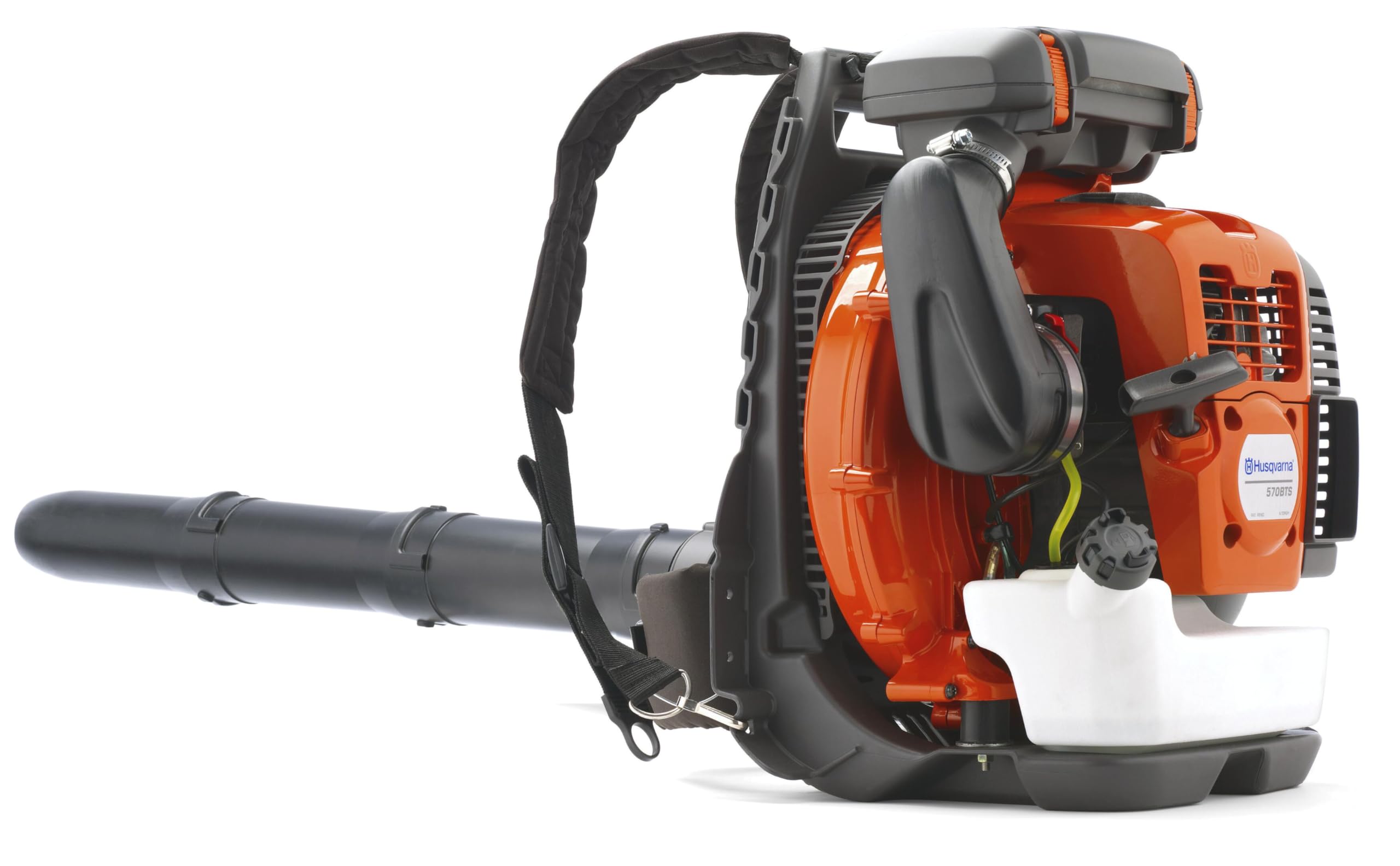
| Husqvarna 570BTSPro Grade | Commercial-grade clearing performance | 972 | 236 | 66 | Amazon |
| Echo PB-770T | Strong power in a manageable package | 756 | 234 | 63.3 | Amazon |
| HTK 63CC | Comfortable backpack with big value | 665 | 205 | 63 | Amazon |
| Husqvarna 560BTS | Professional blow force in a reliable platform | 631 | 232 | 65.6 | Amazon |
| Echo PB-580T | Lightweight daily driver for homeowners | 510 | 215 | 58.2 | Amazon |
| SENIX 4QL | No-mix 4-cycle handheld for small yards | 410 | 125 | 26.5 | Amazon |
In‑Depth Reviews
1. Echo PB-9010T 79.9 cc Backpack Blower
Our pick — over 4.5★ from 900+ verified ratings; the strongest balance of quality and price.
The beast that moves a landscape’s worth of leaves in a single weekend session.
This is the Echo X Series PB-9010T, and it holds the highest air volume in the guide at 1110 CFM paired with a top speed of 220 MPH — both driven by a 79.9 cc 2-stroke engine. That means you are not nudging leaves; you are pushing a solid wall of air that clears wet oak leaves, small sticks, and even light snow without needing a second pass. One reviewer noted finishing their whole yard — a pile of leaves from 14 large oak trees — in about 2 hours, which gives you a real sense of the clearing speed this machine brings.
Unlike the Echo PB-580T’s 510 CFM, the PB-9010T delivers 1110 CFM, so your walking pace sets the speed, not the blower’s output. The trade-off is weight and bulk: the 28″L x 20″W x 24″H dimensions are compact for an 1100+ CFM machine, but at full fuel and with the tube-mounted throttle, it is unmistakably a pro-grade piece of gear. One buyer mentioned that half-throttle alone blows harder than they can walk.
Buyers consistently praise the comfort of the padded backpack straps and the easy-start system, though several mention the assembly instructions are confusing. It is a premium investment upfront but built for longevity, and the 5-year consumer warranty backs that claim.
Why it dominates
- 1110 CFM — highest air volume in this lineup — clears deep leaves fast
- 79.9 cc engine provides the torque for wet and heavy debris
- Tube-mounted throttle for easy control without taking your hand off the tube
The significant weight
- Heavy enough that it demands a good backpack harness (included, padded)
- Assembly instructions described as “abysmal” by a verified buyer
- Overkill for properties under one acre
Reach for this if: you have a multi-acre property, thick wet leaves, and want the maximum clearing speed in a single tool — the 1110 CFM makes it the fastest sweep in this guide.
Think twice if: you want a lighter machine for quick sidewalk passes; the PB-580T or HTK will handle that with less bulk.
2. PRORUN PBB2884 75.6 cc Backpack Blower
A 75.6 cc workhorse that delivers 1020 CFM without the premium price tag.
PRORUN’s PBB2884 steps in as the second-most powerful blower in the guide by air volume (1020 CFM) and the highest by speed (240 MPH), yet it comes at a noticeably lower price than the top Echo. That 240 MPH figure means it is especially good at breaking apart wet, matted leaves that lower-speed blowers just slide over. The 75.6 cc 2-cycle engine is only 4 cc smaller than the Echo PB-9010T, so you get comparable power for a meaningful savings.
Another buyer noted that the pull start is short and easy, firing up on the second pull after priming. The primary concern mentioned across reviews is the starter switch, which feels thin and tight; several owners advise handling it carefully. The backpack straps also take some effort to get on without a raised surface to rest the unit on.
For buyers who want near-flagship air volume (1020 CFM) and the highest speed in the guide (240 MPH) without jumping to the top of the budget, this PRORUN is the smart middle ground.
Standout specs
- 1020 CFM and 240 MPH — highest speed in this group; handles wet debris
- 2-hour max-throttle runtime reported by a long-term owner
- 3-year residential warranty included
Known quirks
- Starter switch described as thin and tight; some buyers worry about breaking it
- Straps are hard to put on without a table or raised surface
- Weighs 32.8 pounds — noticeably heavier than many backpack blowers
Best for: the buyer who wants a commercial-grade CFM/MPH combo (1020 CFM at 240 MPH) and is willing to manage a heavier machine and the switch’s feel.
Look elsewhere if: you want a lighter backpack blower; the Echo PB-580T at 22.6 pounds or the HTK are easier to wear for long sessions.
3. Husqvarna 570BTS 66 cc Backpack Blower
Commercial-grade airflow (972 CFM) packed into a well-balanced 66 cc platform.
The Husqvarna 570BTS is built for the most demanding tasks, according to the maker, and the numbers back that up: 972 CFM of air volume and 236 MPH from a 66 cc X-Torq engine. That X-Torq design (the maker’s patented low-emission technology) boost power even at low RPMs, so you are not running the engine wide open just to keep leaves moving. One long-term owner who has used the blower for about 5 years without a single problem reports it still works like the day it was purchased, which speaks to its durability.
The 570BTS also has a spring-assist start — the first part of the pull loads a spring, which then releases to give the pull more speed, making starting noticeably easier. Buyers report that it starts on the first or second pull from the start. The trade-off is weight: at 24.5 pounds, it is among the heavier models, and one experienced owner mentioned that the combination of weight and air volume makes it something of a workout to use for extended periods.
It is also loud at a tested 71 decibels (and one owner measured it at 110 db during use), so hearing protection is mandatory. For someone who needs maximum clearing force and expects years of daily use, this Husqvarna is a proven commercial companion.
Built to last
- 972 CFM and 236 MPH — top-tier clearing performance
- X-Torq engine with a 5-year track record of trouble-free use from verified owners
- Spring-assist start makes pull-starting much easier
Heavy and loud
- 24.5 pounds — feels heavy after a full cleanup session
- Very loud (71 db on spec, 110 db reported by owner); hearing protection essential
- Large fuel tank adds more weight when full
Reach for this if: you need 972 CFM of clearing power for daily professional use or a very large property, and you value the proven 5-year longevity owners mention.
Consider another if: you want a quieter, lighter machine for quick weekend chores — the Echo PB-770T or PB-580T offer strong performance with less heft.
4. Echo PB-770T 63.3 cc Backpack Blower

Strong 756 CFM power in a lighter, more manageable package than the top-end Echo.
The Echo PB-770T sits in a balance: 756 CFM and 234 MPH from a 63.3 cc engine, all wrapped in a frame that is lighter than you might expect. One reviewer who compared it directly to the 9010 model (1110 CFM, 79.9 cc) chose the 770T specifically because it offered excellent power without the extra weight and bulk of the top-tier machine. The 756 CFM is still more than enough to clear wet leaves and small sticks from several acres, and the 234 MPH speed ensures deep penetration in piles.
A buyer with over 20 years of landscaping experience said this is the best blower he has used among all brands — and he has used many. Another owner mentioned it has been “a little hard to pull” to start but that it seems to be getting easier with use. The unit runs at 73 decibels on the spec sheet, which is moderate for this class of blower. It also benefits from Echo’s 5-year consumer warranty, adding confidence for the investment.
For the buyer who wants pro-level power (756 CFM) but does not need the maximum 1100+ CFM or 79.9 cc displacement, the PB-770T is the just-right choice — strong enough for the biggest jobs, comfortable enough for longer sessions.
Just-right power
- 756 CFM and 234 MPH handle almost any residential or light commercial job
- Lighter than expected, according to multiple buyers
- 5-year consumer warranty
Minor starting stiffness
- Some customers note the pull cord is stiff initially
- At 73 db it is not the quietest option
- No cruise control feature mentioned in the specs
Best for: the homeowner or landscaper who wants strong clearing power (756 CFM, 234 MPH) without jumping to the heaviest, most expensive model — it is the most balanced Echo in this lineup.
Pass if: you need the absolute maximum air volume of the PB-9010T for a large commercial property.
5. HTK 63CC Backpack Blower
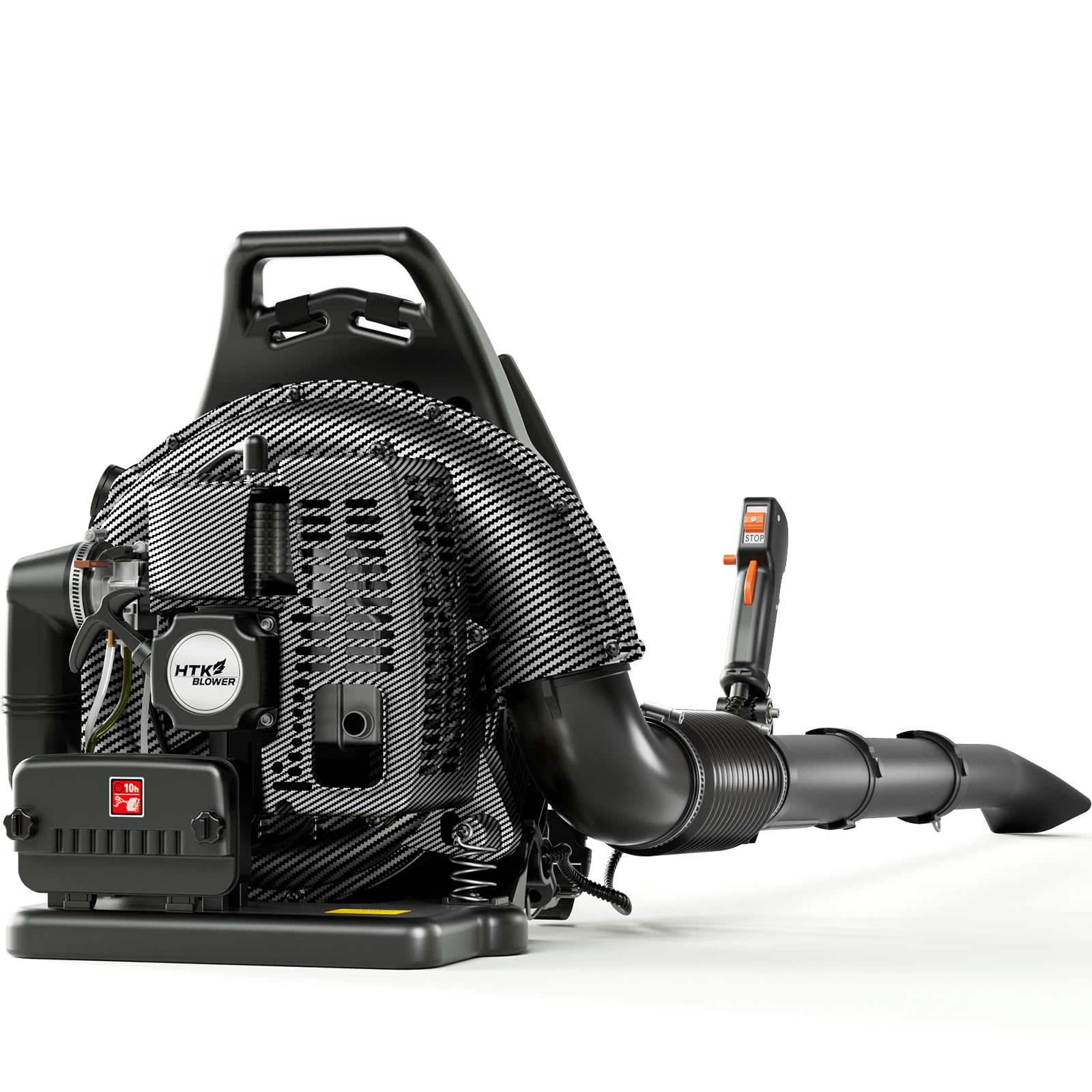
A 63 cc backpack blower that delivers 665 CFM without emptying your wallet.
The HTK 63CC brings solid mid-range power (665 CFM, 205 MPH) in a comfortable backpack design that has earned repeat purchases — one owner reported they bought a second unit and were just as happy with it as the first. The 1.7L fuel tank is larger than many in this guide, which means fewer refueling stops during a full property cleanup. Owners consistently describe it as “very powerful” and “easy to start” with an air purge system that removes the typical pull-start frustration.
Compared to the Echo PB-580T (510 CFM), the HTK holds a 155 CFM advantage, yet it comes at a notably lower entry point. The trade-off is that it is extremely loud — one reviewer warned, “Wear hearing protection” — and the weight distribution, while padded, may require a Velcro strap across the chest for a more secure fit, as one owner mentioned. Assembly is straightforward, and the 2-year warranty covers any manufacturing defects.
For a homeowner with a medium to large lot who wants backpack-level power without spending into the premium tier, this HTK is the value pick that still moves serious air.
High value, solid power
- 665 CFM and 205 MPH — strong enough for heavy debris and large yards
- 1.7L fuel tank provides extended runtime without refueling
- Repeat buyers confirm long-term satisfaction
Loud and not the lightest
- Extremely loud — hearing protection is non-negotiable
- Chassis dimensions are large (70.8″L x 17.7″W x 21.2″H)
- Some users add a chest strap for better harness fit
Perfect for: the budget-conscious homeowner with a large yard who wants a full backpack blower (665 CFM) and does not mind the noise in exchange for a low price.
Not for: noise-sensitive neighborhoods or anyone wanting a compact storage footprint; choose the Echo PB-580T for a quieter, more compact option.
6. Husqvarna 560BTS 65.6 cc Backpack Blower
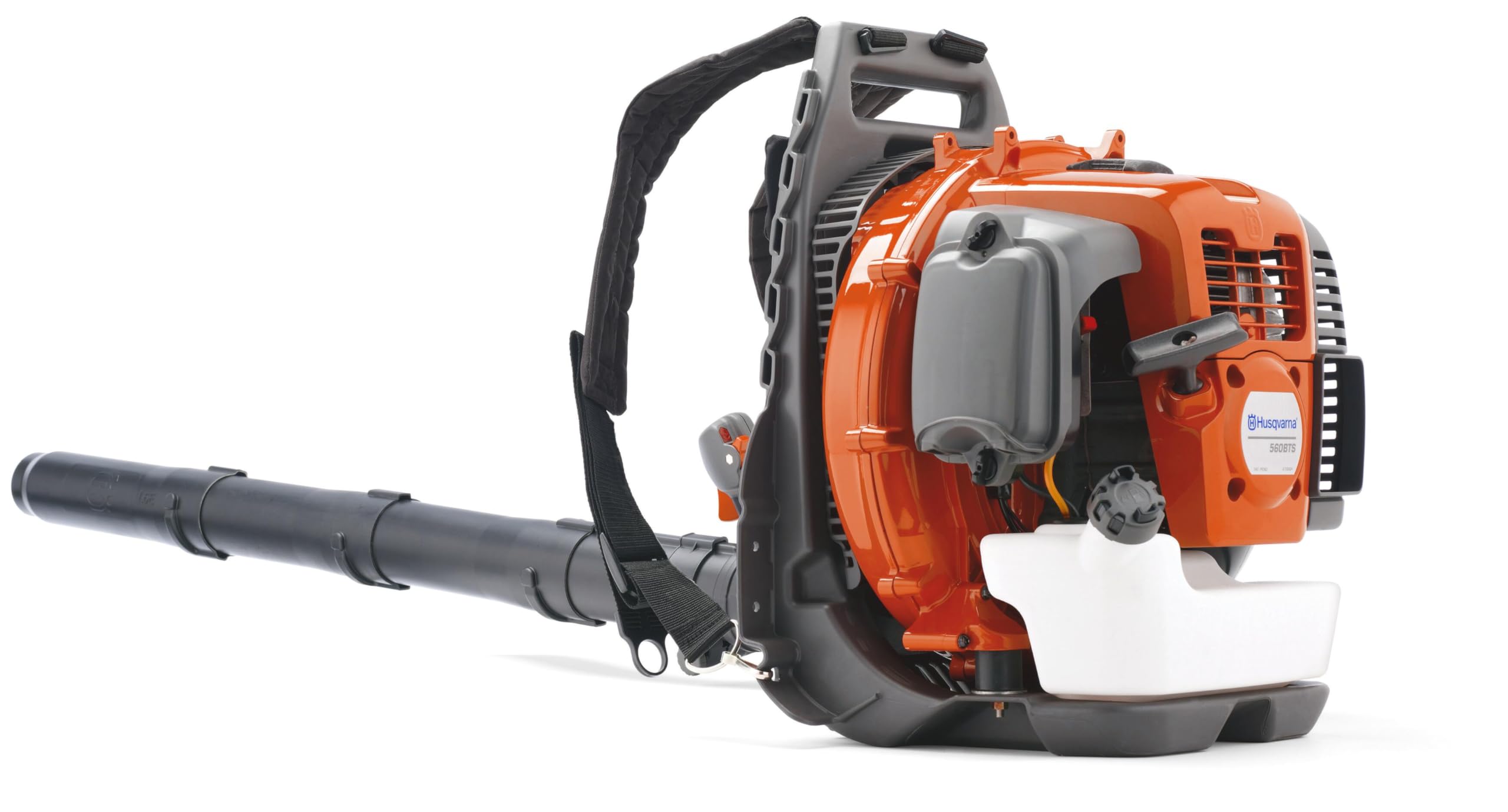
A professional-grade 65.6 cc blower that delivers 30 N of raw blow force.
The Husqvarna 560BTS brings a different kind of spec into the conversation: blow force measured in Newtons (30 N), alongside 631 CFM of air volume and 232 MPH top speed. Newtons measure the concentrated striking power of the air stream, so a 30 N rating means it can move compacted wet leaves, small rocks, and even powdery snow, as one owner confirmed. The 65.6 cc X-Torq engine (a low-emission design) combines strong output with a commercial-grade air filter that features 2-stage intake for maximum filtration of fine debris.
One buyer who owns over 10 acres chose the 560BTS over the lower-tier 350BT and said the extra money was worth it — the blower starts on the third pull and has more than enough power to handle sticks, wet leaves, and a quarter-mile driveway. Another owner noted that it makes fast work of leaves and is comfortable on the back thanks to the load-reducing harness (which has wide shoulder straps). It is not a lightweight at 23.2 pounds, and several reviewers describe it as “a bit heavy” compared to consumer-grade units.
If you want a blower that is built to commercial standards (with the hose-mounted throttle and comfortable ergonomics) and has the blow force to dislodge the tough stuff, the 560BTS is a reliable workhorse that has earned a strong following among pros and serious homeowners.
Blow force focus
- 30 N of blow force — measured striking power for wet, compacted debris
- Commercial-grade 2-stage air filter for extended engine life
- Hose-mounted throttle with comfortable grip for all-day use
Heft and cost
- 23.2 pounds — heavier than consumer models; fatigue builds over long sessions
- Premium price point reflects the commercial construction
- Loud enough that hearing protection is a must
Ideal for: the professional landscaper or owner of a very large property who needs concentrated blow force (30 N) to move wet snow and compacted leaf piles.
Choose the Echo PB-770T if: you want more air volume (756 CFM vs 631 CFM) and a lighter frame for general leaf blowing without the professional price premium.
7. Echo PB-580T 58.2 cc Backpack Blower

The 22.6-pound backpack blower with 510 CFM that homeowners have trusted for years.
The Echo PB-580T is a staple in the homeowner backpack blower category: 510 CFM of air volume and 215 MPH top speed from a 58.2 cc 2-stroke engine. One owner who had borrowed a neighbor’s Echo unit found it so impressive that he bought his own PB-580T, and it cut his cleanup time from 3+ hours with an electric blower to less than 30 minutes. The 22.6-pound weight is comfortable for most users, and the tube-mounted throttle keeps your hand in a natural position. Several reviewers with over 20 years of experience with Echo products (chainsaws, weed eaters) say the brand’s reliability is exceptional — one owner mentioned a previous Echo blower lasted 20 years before needing replacement.
While the 510 CFM is less than half of the top-tier Echo PB-9010T, it is still plenty for a typical half-acre to one-acre yard with moderate leaf cover. The Echo PB-580T delivers strong performance in a physically smaller and lighter frame (24″L x 24″W x 24″H) that is easier to store and handle. Buyers praise its power and reliability but note that the instruction manual is not well organized since it covers multiple models in one document.
For the daily homeowner job — post-mow cleanup, fall leaves, grass clippings — this Echo is the balance of light weight, proven reliability, and enough air to get the work done fast.
Daily driver appeal
- 22.6 pounds — one of the lightest backpack blowers in the lineup
- 510 CFM with 215 MPH handles typical yard debris easily
- Proven long-term reliability; many reviewers point out 10-20 years of service
Not for big properties
- 510 CFM versus the top-tier Echo’s 1110 CFM
- May require multiple passes with deep wet leaves
- Instruction manual is confusing because it covers multiple models
Best for: the homeowner with a medium-sized yard who wants a light, comfortable backpack blower (22.6 lbs, 510 CFM) with a decades-long reputation for reliability.
Upgrade if: you have several acres or heavy wet leaves regularly — the Echo PB-770T (756 CFM) or the HTK (665 CFM) will save you time per session.
8. SENIX 4QL 26.5 cc Handheld Blower
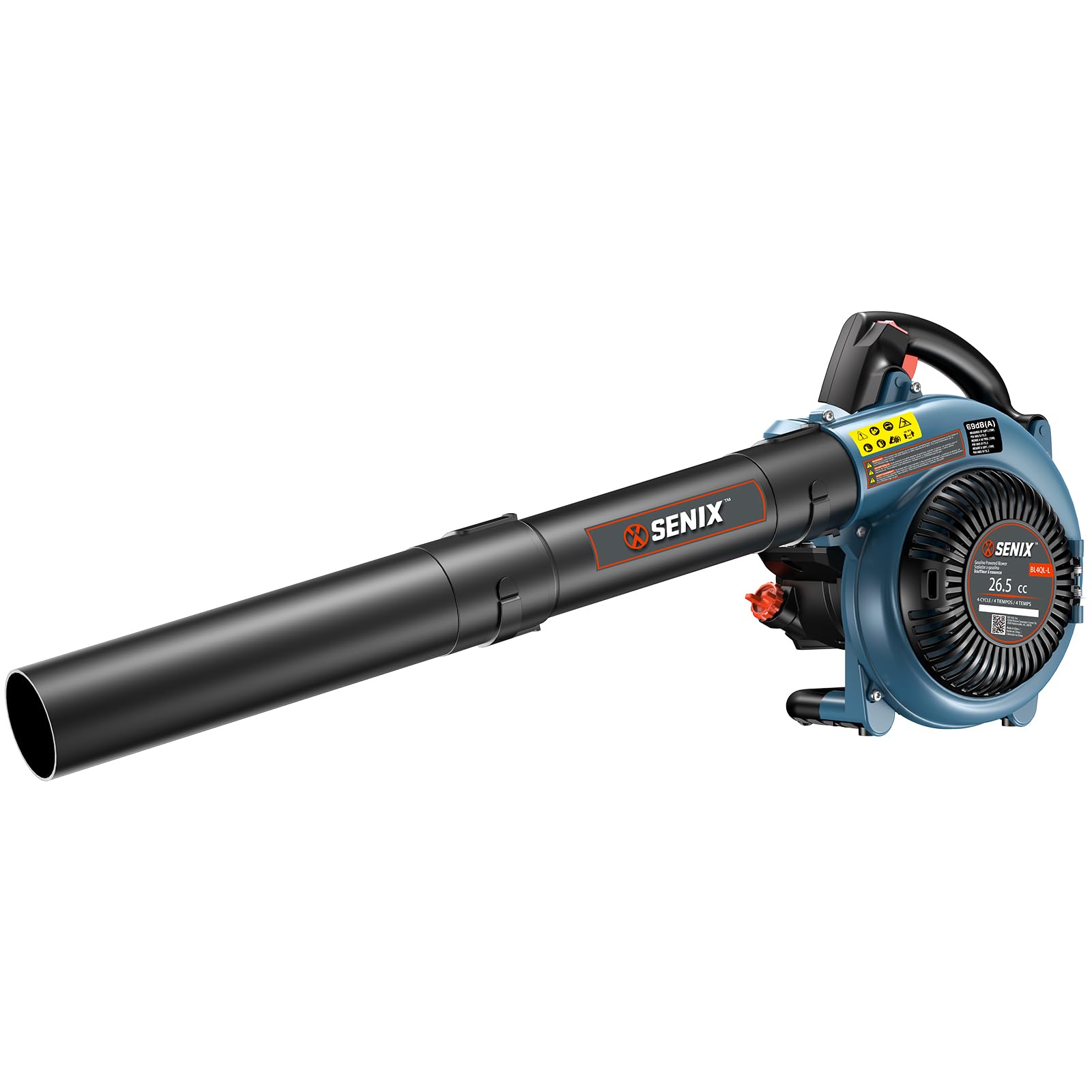
A 4-cycle handheld that skips the oil mixing and weighs just 9.48 pounds.
The SENIX 4QL is the only 4-cycle (4-stroke) blower in this guide, which means you pour gas and oil into separate compartments — no pre-mixing required. Its 26.5 cc engine delivers up to 410 CFM and 125 MPH, which is a fraction of the power of the backpack blowers above (by comparison, the Echo PB-9010T delivers 1110 CFM versus 410 CFM and 220 MPH versus 125 MPH). But the trade-off is a dramatically lighter tool: at 9.48 pounds, you can carry it comfortably with one hand for quick cleanups around the driveway and sidewalks.
Shoppers say that it starts every time on the second pull and does not use much gas. The patented 4QL technology (the maker’s low-emission 4-cycle design) also means low vibration, making it more comfortable for longer handheld sessions. One reviewer switched from a 2-stroke Stihl handheld and said the SENIX was much easier to start and quieter. However, several owners note an important limitation: the gas tank is small and requires refilling often during extended use. A couple of negative reviews describe carburetor issues after a few months, though some of those buyers received replacement units from customer service.
If you dislike mixing oil into gas and want a simple, lightweight handheld for small yards or quick post-mow passes, this SENIX is the right tool. It is not built for large properties or deep leaf piles.
Simple, light, quiet
- 9.48 pounds — very light for a gas blower; one-hand operation is easy
- 4-cycle engine — no mixing oil and gas; separate fill ports
- Low vibration and starts on the second pull, per owners
Small tank, modest power
- 410 CFM and 125 MPH is light-duty compared to any backpack model
- Gas tank is small — needs frequent refills during longer sessions
- Some durability complaints about carburetors after a few months
Ideal for: the homeowner with a small to medium yard who wants a simple handheld gas blower (no mixing oil) and a very light 9.48-pound tool for quick driveway and patio cleanup.
Move to a backpack blower if: you need to clear an acre or more of leaves; the lightweight design runs out of fuel too fast for big jobs.
Understanding the Specs
CFM (Cubic Feet per Minute)
CFM measures the total volume of air the blower moves each minute. Think of it as the width of the air stream: higher CFM means you can sweep a wider path and push more leaves at once. This is the number that determines how quickly you can clear a large area. Most powerful backpack blowers fall in the 500-1100 CFM range.
MPH (Miles per Hour)
MPH measures how fast the air exits the nozzle. High MPH is what breaks apart wet, stuck, or compacted leaf piles and dislodges debris from crevices. While CFM moves the volume, MPH provides the penetrating force. A balanced combination (600+ CFM with 200+ MPH) is the balance for most real-world leaf cleanup.
FAQ
What does cc mean in a leaf blower?
What is the difference between a 2-cycle and a 4-cycle gas leaf blower?
Is a backpack leaf blower better than a handheld?
How much CFM do I need for a large yard?
Can I use a gas leaf blower in the snow?
How loud is a gas leaf blower?
What is cruise control on a leaf blower and do I need it?
Why does the SENIX 4QL say “not available in California”?
Is an air purge system important on a gas blower?
How long does a gas leaf blower last?
Final Thoughts: The Verdict
Across the board, the undisputed top gas-powered leaf blower winner is the Echo PB-9010T because its 1110 CFM and 79.9 cc engine clear the largest properties faster than anything else in the guide. If you want a powerful value alternative with impressive 1020 CFM and the highest speed in the lineup, grab the PRORUN PBB2884. And for the homeowner who needs a lightweight, no-mix 4-cycle handheld for small yards, the SENIX 4QL is the simple, 9.48-pound solution that skips the fuel mixing entirely.
How We Picked
We do not accept paid placement. Every pick is matched to a real buyer and a real use-case; we do not hands-on test units.
Sources & Methodology
Specifications: manufacturer listings and product documentation. Review insights: verified customer reviews, as of July 2026. Pricing: not shown on this page (it changes often); check the current price via the retailer link.
As an Amazon Associate, Lawn Gear Lab earns from qualifying purchases. This does not affect which products we feature.