
Specs are compiled from manufacturer listings and verified buyer reviews and can change over time — please confirm the key details on the product page before buying.
The real test of a garden bed liner isn’t the day you install it — it’s a year later, when you flip a shovelful of mulch and find clean soil beneath instead of a mat of crabgrass roots. A well-chosen liner is the difference between spending your weekends picking weeds and actually enjoying the harvest you planted. Most liners fail at the seams or degrade after one season of sun and rain, turning your tidy raised bed into a mess you have to dig out and replace.
I’m Rikta — the founder and writer behind Lawn Gear Lab. This guide is built by comparing the manufacturers’ published specifications and the patterns across verified customer reviews, so you get each pick’s real strengths and trade-offs instead of marketing spin.
The list below zeroes in on the best gardening bed liner for different priorities — from a heavy-duty woven that stands up to foot traffic and gravel, to value rolls that cover a massive vegetable patch while staying affordable.
Our Picks at a Glance


How To Choose The Best Gardening Bed Liner
Choosing a bed liner sounds simple — just something to block weeds — but the wrong pick can block water, rot your plant roots, or break down in a single season. Here are the three factors that separate a one-season fix from a liner you can leave in the ground for years.
Fabric Weight — why 3.2 oz is the balance
The most common weight you will see in this category is 3.2 ounces per square yard (3.2 oz). That number tells you how densely the material is woven. A 3.2 oz fabric is thick enough to block most sunlight (stopping weed seeds from germinating underneath) while still letting water and air pass through. Thinner fabrics around 1 oz tend to tear easily under gravel or foot traffic. Heavier fabrics, like 3.7 oz, are tougher but can be harder to cut and more expensive. For most raised beds and flower gardens, 3.2 oz is the reliable middle ground.
Woven vs. non-woven — which structure works for you
Woven fabric is made by interlacing polypropylene threads, which creates a strong, tear-resistant sheet. This type works best under heavy loads like gravel pathways, driveways, or raised beds you walk on. Non-woven fabric looks and feels more like felt or thick paper and is created by bonding fibers together with heat or chemicals. Non-woven materials excel at water filtration (they let moisture pass through at a higher rate), making them a smart choice for flower beds where soil health is the top priority. Check the product description for “woven” or “non-woven” — it directly tells you whether the liner prioritizes strength or permeability.
UV stabilizers — what keeps the sun from eating your liner
A bed liner that sits in direct sunlight for months needs UV stabilizers — a chemical treatment that prevents the polypropylene from becoming brittle and cracking under ultraviolet rays. Without UV resistance, a fabric can start breaking down after a single summer, leaving you with a crumbly mess. Most quality liners advertise “UV-stabilized” or “UV-treated” explicitly. If a product does not mention UV resistance at all, treat it as a short-term solution that will likely need replacement within a year or two.
Quick Comparison
| Model | Best For | Fabric Weight | Dimensions | Weave Type | Amazon |
|---|---|---|---|---|---|
| Dewitt 12-Year 12YR3100★ Best Overall | Long-term permanent beds | 3 oz | 3 x 100 ft | Non-woven | Amazon |
| Winisok 2-PackBest Value | Budget-covered large areas | 3.2 oz | 4 x 100 ft | Woven | Amazon |
| UWIOFF PremiumTop Performer | Flower beds & vegetable gardens | 3.2 oz | 4 x 100 ft | PE Fabric | Amazon |
| Rohuis Geotextile | Gravel paths & driveways | 3.2 oz | 4 x 100 ft | Woven | Amazon |
| Land Guard 4 x 300 ft | Massive coverage on a budget | Woven | 4 x 300 ft | Woven | Amazon |
| Vanver Heavy Duty | Paths and decomposed granite | 3.2 oz | 3 x 300 ft | Woven | Amazon |
| Grassclub Premium | Driveways & heavy traffic areas | 3.2 oz | 4 x 300 ft | Woven | Amazon |
| TUFFIOM 125gsm | Harsh sun and long-term durability | 3.7 oz / 125 gsm | 4 x 300 ft | Woven | Amazon |
| Dewitt Sunbelt | Greenhouse floors & commercial rows | 3.2 oz | 4 x 200 ft | Woven | Amazon |
In‑Depth Reviews
1. Dewitt 3-Foot by 100-Foot Non Woven 12-Year Landscape Fabric 12YR3100
Our pick — over 4.5★ from 650+ verified ratings; the strongest balance of quality and price.
Non-woven fabric engineered to let air and nutrients pass while blocking light for over a decade.
If you are setting up a permanent bed that you do not want to touch again for years, this is the fabric to buy. The non-woven polypropylene material is treated with a hydrophilic (water-attracting) coating, so rain and irrigation move through easily instead of pooling on the surface. The trade-off in weight — 3 oz rather than the standard 3.2 oz — is deliberate: the non-woven structure allows higher water permeability while staying thick enough to suppress weeds. Buyers report it lasting three years and more under heavy gravel and even a fire pit area, with one buyer calling it “effective for 3+ years under pea gravel and fire pit area.” The 12-year claim sits on UV treatment that protects the fibers from sunlight degradation, and the material minimizes light penetration to stop weed seeds from germinating underneath.
At 3 feet wide by 100 feet long, this roll is narrower than most competitors (which are often 4 feet), so factor that into your coverage math if your beds are standard 4-foot widths. The quality is the top recurring praise by a wide margin, and the straightforward install — cut with scissors and pin down — makes it a no-fuss project.
Built to Last
- Non-woven fabric allows excellent water and nutrient flow without puddling
- UV-stabilized treatment resists sunlight degradation for multi-year use
- Does not unravel at cut edges, unlike some woven fabrics
Before You Buy
- 3-foot width is narrower than the standard 4-foot rolls, requiring more seams for wider beds
- Higher price per foot compared to budget options like the Winisok
The 12-year bet: Reach for this Dewitt if you are covering a permanent flower bed or gravel path where you want to install once and forget about weeding for years.
The fit check: If your raised beds are exactly 4 feet wide, the extra 1-foot seam may annoy you — measure your space first.
2. Winisok 4FT x 100FT Weed Barrier Landscape Fabric, 3.2oz (2 Pack 4FT x 50FT)
A budget-friendly woven fabric that holds up to five years and arrives as two manageable 50-foot sheets.
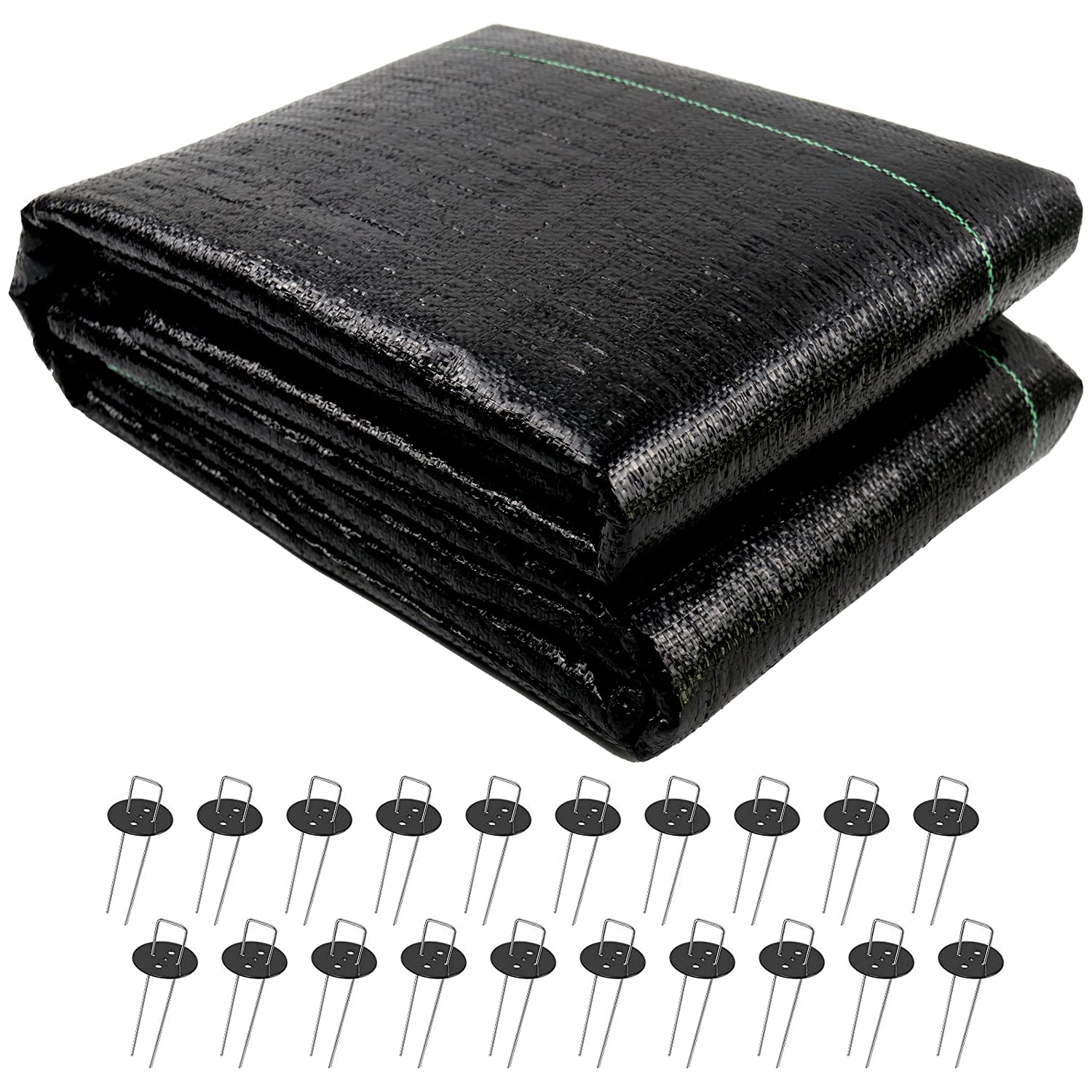
The big selling point here is convenience: instead of wrestling a single 100-foot roll, you get two 4-by-50-foot sheets that are far easier to maneuver in a backyard. The tightly woven polypropylene is rated for more than five years of weed control, and the green stripes printed on the surface help you cut straight lines and align rows. Water passes through the weave freely — as owners put it, “this landscape fabric is strong, but the water still gets through” — so your soil stays hydrated without runoff. The tear-resistant construction means you can kneel and walk on it without punching holes through the material.
The mixed feedback centers on the edges: some owners found that the fabric frays when cut, leaving plastic fibers in the soil. That makes it a better fit for permanent installations (under gravel or a long-term bed) rather than seasonal gardens you pull up each year. It is also 7.59 pounds for the set, compared to the UWIOFF’s 7.34 pounds for the same 4×100 coverage — a negligible difference when both are easy to carry.
Two-sheet advantage: The split roll format makes installation genuinely easier for one person — unroll one sheet, pin it, then overlap the second.
Budget-friendly workhorse: Choose the Winisok for large beds or pathways where you want solid weed suppression without spending premium money, and you do not mind managing cut edges with tape or staples.
3. UWIOFF 4ft x 100ft Garden Weed Barrier Landscape Fabric, Premium Ground Cover
Made from flexible PE fabric that bends around curves without cracking — ideal for flower beds with irregular shapes.
Unlike the woven polypropylene most competitors use, this liner is made from 3.2 oz PE (polyethylene) fabric, which the manufacturer says is more flexible and aging-resistant than standard PP material. The flexibility is immediately noticeable when you try to wrap it around a curved flower bed border or a retaining wall — it contours without fighting you. The UV resistance is built into the material itself, so it holds up under full-sun conditions without becoming brittle. Owners who laid it in cut flower gardens and vegetable beds report excellent weed prevention and note that daily foot traffic in the veggie patch did not cause any wear. The green alignment stripes make row spacing simple, and the fabric lays flat once pinned.
The catch is the cut edges. Multiple owners mention the fabric unravels when cut, with one buyer suggesting using black duct tape to seal the edges or simply avoiding cuts altogether. If you need to trim it to fit a complex shape, budget a few extra minutes to tape each cut edge. At 7.34 pounds, it is a shade lighter than the Winisok but offers the same overall coverage area.
Flex and Forget
- PE fabric is more pliable than standard PP, making it easier to fit around curves
- UV-resistant construction stands up to full-sun exposure without degrading
- Water seeps through quickly, preventing soil erosion during heavy rain
Install Note
- Cut edges unravel; plan to seal with tape or overlap seams generously
- Initial setup is cumbersome due to the sheer length — have a helper or clear a large workspace
For the shapely garden: Grab the UWIOFF if your beds have curves, angles, or retaining walls where a stiff woven fabric would buckle or gap.
4. Rohuis Weed Barrier Landscape Fabric 4ft x 100ft, Geotextile 3.2OZ
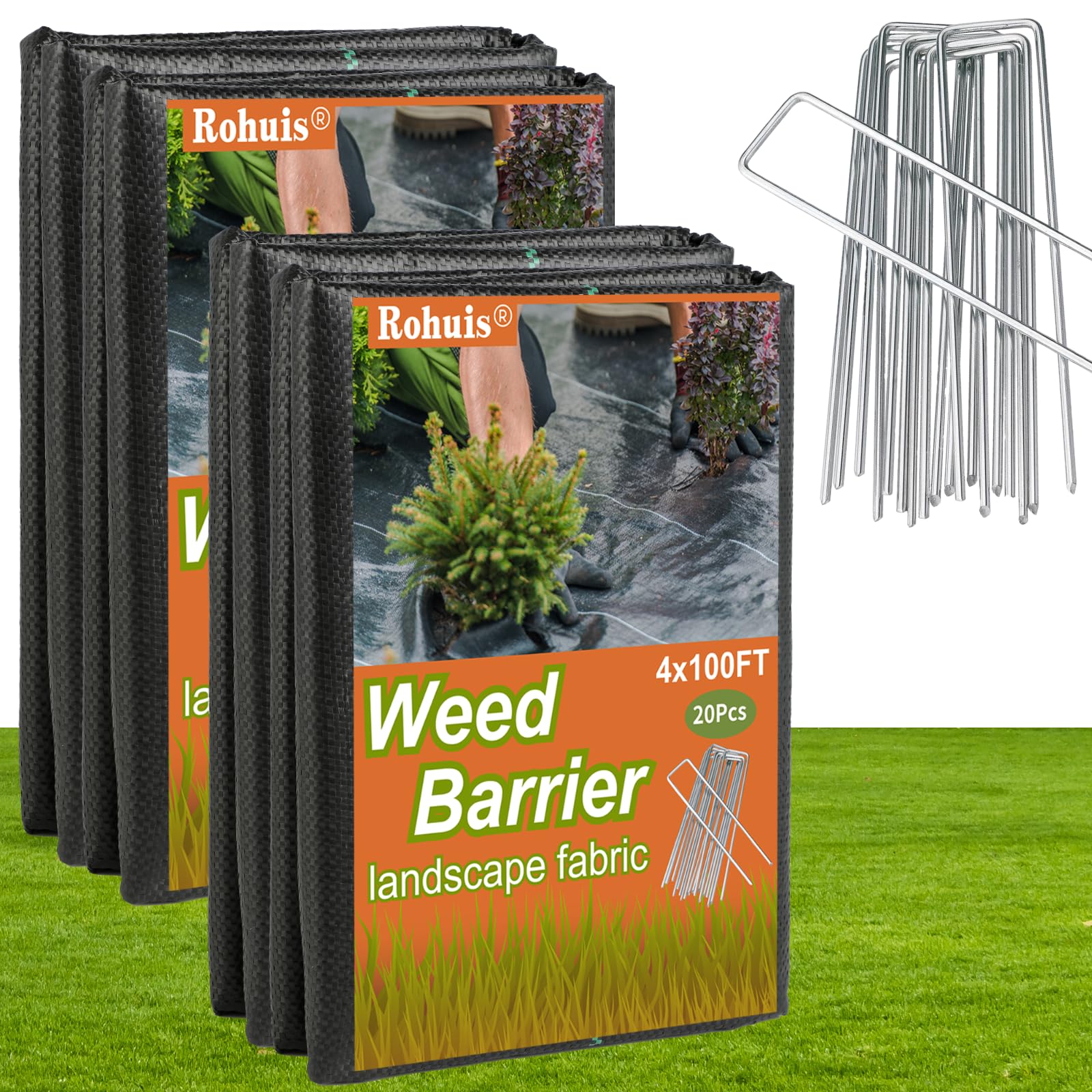
Heavy-duty woven polypropylene that handles foot traffic, slopes, and hot sun without tearing.
This liner is built for spots where most fabrics give up: gravel pathways, driveways, and sloped side yards where wind and rain try to shift the material. The woven polypropylene is engineered with UV-stabilized fibers that hold up to intense heat and sunlight, and the tear-resistant structure resists punctures from rocks and roots. The 10-20 L/m²/s permeability rate (a measurement of how fast water passes through the fabric) ensures that a heavy rainstorm drains through rather than washing your mulch away. It comes with 20 U-shaped pegs, which saves you a separate trip to the hardware store for securing the edges.
As with several woven fabrics in this class, cutting creates frayed edges that leave plastic shreds in the soil — owners recommend using a hot knife or burning the cut edges with a butane torch to seal them. One reviewer noted the fabric smelled unusual when first unrolled, though the smell dissipated after installation. The weight is 6.96 pounds, slightly lighter than the Winisok and UWIOFF, making it a practical choice if you are hauling the roll across a yard yourself.
Built for traffic: The 3.2 oz woven construction takes daily foot traffic and gravel weight without sagging or tearing.
Slope and gravel specialist: Go with the Rohuis if you are lining a pathway, driveway border, or sloped area where the fabric needs to stay put and handle weight without ripping.
5. Land Guard 4ft x 300ft Weed Barrier Fabric Heavy Duty Woven
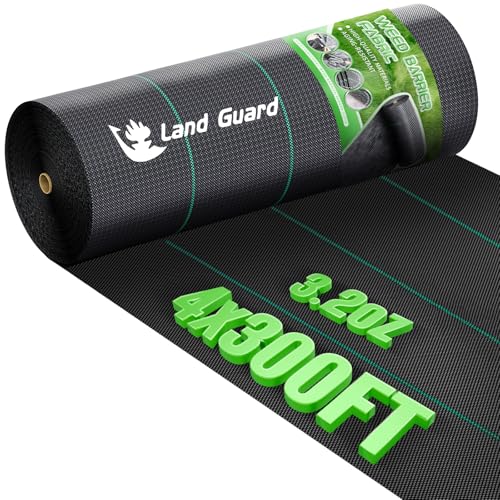
A 300-foot roll that covers a massive vegetable patch or farm row without needing multiple orders.
If you are measuring your garden in rows, not beds, this is the roll that makes sense. The 4 x 300 foot dimensions give you 1,200 square feet of weed barrier in one package — enough to line a half-dozen large raised beds or a long row of commercial planting strips. The woven construction is high-density and tear-resistant, and owners consistently describe it as thick enough to stand up to tools and foot traffic. The green stripes help you keep rows straight during installation, and the material promotes water drainage and air circulation through the weave.
The caveat is handling: a 300-foot roll is heavy and can be folded or creased during shipping, which means you will need to let it flatten out under the sun before pinning it down. Some owners noted that the roll arrives folded rather than in a continuous tube, requiring extra work to lay it flat without wrinkles. At this price point, however, the cost per square foot lands noticeably lower than smaller rolls, making it the clear choice for anyone covering a large area on a budget.
Economy of Scale
- 300-foot length covers large areas with fewer seams and less overlap waste
- High-density woven fabric resists tearing even under heavy use
- Green alignment stripes simplify straight-row planting layouts
Handling Heads-Up
- Roll often ships folded, requiring time to flatten out before installation
- Woven material can shred at cut edges if not sealed
The acreage answer: Reach for the Land Guard if you need to cover rows of vegetables or a community garden plot and want the lowest cost per foot.
6. Vanver 3ft x 300ft Garden Landscape Fabric, Heavy Duty Weed Barrier
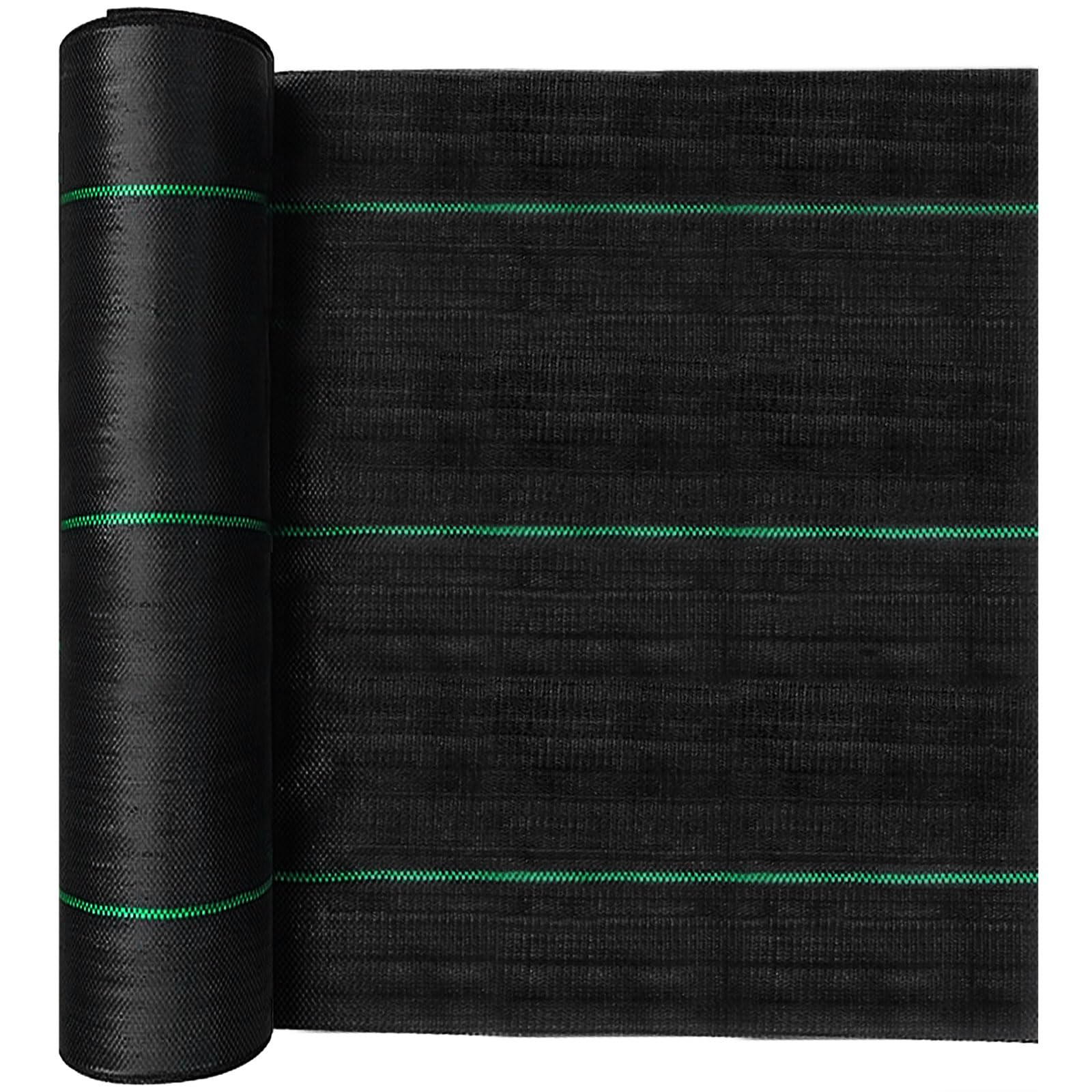
Woven 100% polypropylene that lets water and air exchange slowly while blocking all light underneath.
This Vanver liner targets the pathway builder — someone laying down decomposed granite, gravel, or stepping stones who needs the fabric to survive foot traffic and occasional wheelbarrow runs. The 3.2 oz woven construction is made from 100% polypropylene woven in warp and weft (the standard criss-cross pattern that gives woven fabric its strength). The slow air and water exchange the manufacturer describes means it breathes just enough to keep soil healthy underneath without letting enough light through for weeds to germinate. Owners mention it works well under decomposed granite and stays sturdy with just a few landscape stakes holding it in place.
The woven fabric frays when cut — multiple buyers mention that scissors work better than a knife to control the unraveling. A few owners noted that after a month in place, some growth still appeared, suggesting that very aggressive weeds (like nutgrass or bindweed) may push through if the fabric is not overlapped properly at seams. At 3 feet wide, it is a good match for standard walkways, but you will need to seam two runs together for wider beds.
Feels sturdier than the price suggests: Owners say it beats what the big-box stores sell at a similar or lower cost.
Walkway workhorse: Choose the Vanver for gravel paths, garden walkways, or any area where you need a strong woven layer under foot traffic, and you are comfortable sealing cut edges.
7. Grassclub 4ft x 300ft Weed Barrier Landscape Fabric, Heavy Duty Premium

A commercial-grade liner with 400 LBS tensile strength — tough enough to support a driveway loaded with gravel.
This is the fabric you use when the project is more construction than gardening. The 3.2 oz high-density woven PP material carries a 400 LBS tensile strength rating (the force required to tear a strip of fabric), which means it can bear heavy loads like gravel, flagstone, and even vehicle traffic on a driveway without tearing. The 4 x 300 foot size delivers 1,200 square feet of coverage, and the woven structure allows air and water to pass through while preventing soil erosion underneath. Customers note it stays in place over a year later with no weed breakthrough, and describe the material as tough and wide enough for large spaces.
The weight is 20.7 pounds — roughly three times heavier than a standard 100-foot roll — so you will want a helper or a large clear area to unroll it. The eco-friendly claim in the listing refers to its ability to reduce chemical herbicide use (the fabric blocks weeds without spraying), not that the material itself is biodegradable. This is a permanent installation liner; you do not pull it up at the end of the season.
Heavy Hauler
- 400 LBS tensile strength supports driveway gravel, stones, and heavy loads without tearing
- 1,200 sq ft of coverage reduces seams and installation time
- Water-permeable design prevents soil washout under heavy rain
Weight Consideration
- 20.7 pounds makes manual unrolling difficult for one person
- Premium cost — not the budget choice for small flower beds
For the driveway and beyond: The Grassclub earns its spot if you need a structural-grade weed barrier under gravel, stone, or parking areas where tensile strength and load-bearing matter more than price.
8. TUFFIOM Weed Barrier 4 x 300 FT, 125gsm/3.7OZ Heavy Duty Ground Cover

The heaviest standard fabric on this list at 3.7 oz — thick enough to feel almost like a tarp under your feet.
At 125 gsm (grams per square meter, which equals 3.7 oz), this TUFFIOM fabric is noticeably denser than the 3.2 oz competition. That extra heft translates directly to durability: the woven polypropylene resists tearing and UV degradation, even under the brutal Gulf Coast sun where one owner reported it survived months of direct exposure “without fading or degrading.” The fabric is breathable and water-permeable, so you are not trapping moisture against your soil, but the tight weave does an excellent job blocking light from reaching weed seeds below. Owners say it saves them hours of weeding and that nothing grows through or around it after a year in place.
The flip side is that the material is heavy — 4 feet by 300 feet requires careful handling during unrolling, and you will need strong landscape staples to pin it down because the fabric is stiff enough to shift if not secured well. Top-rooted plants can occasionally push through the weave, so pulling any sprouts early is recommended. The cost per square foot is higher than the 3.2 oz options, but if you are in a high-sun area or plan to leave the liner down for years, the extra thickness may save you a replacement cycle.
Tough as a Tarp
- 3.7 oz / 125 gsm fabric is the thickest standard option, resisting tears and punctures
- UV-stabilized material survives prolonged sun exposure without becoming brittle
- Breathable weave allows good drainage while blocking all light to weeds
Work Factor
- Heavy fabric requires strong staples and may shift if not anchored well
- Aggressive deep-root plants can still push through the weave over time
Maximum sun protection: Buy the TUFFIOM if your garden sits in relentless direct sunlight and you want the thickest, longest-lasting woven fabric available — ideal for permanent beds in hot climates.
9. Dewitt Sunbelt Weed Barrier Fabric 3.2 oz, 4 x 200 Feet
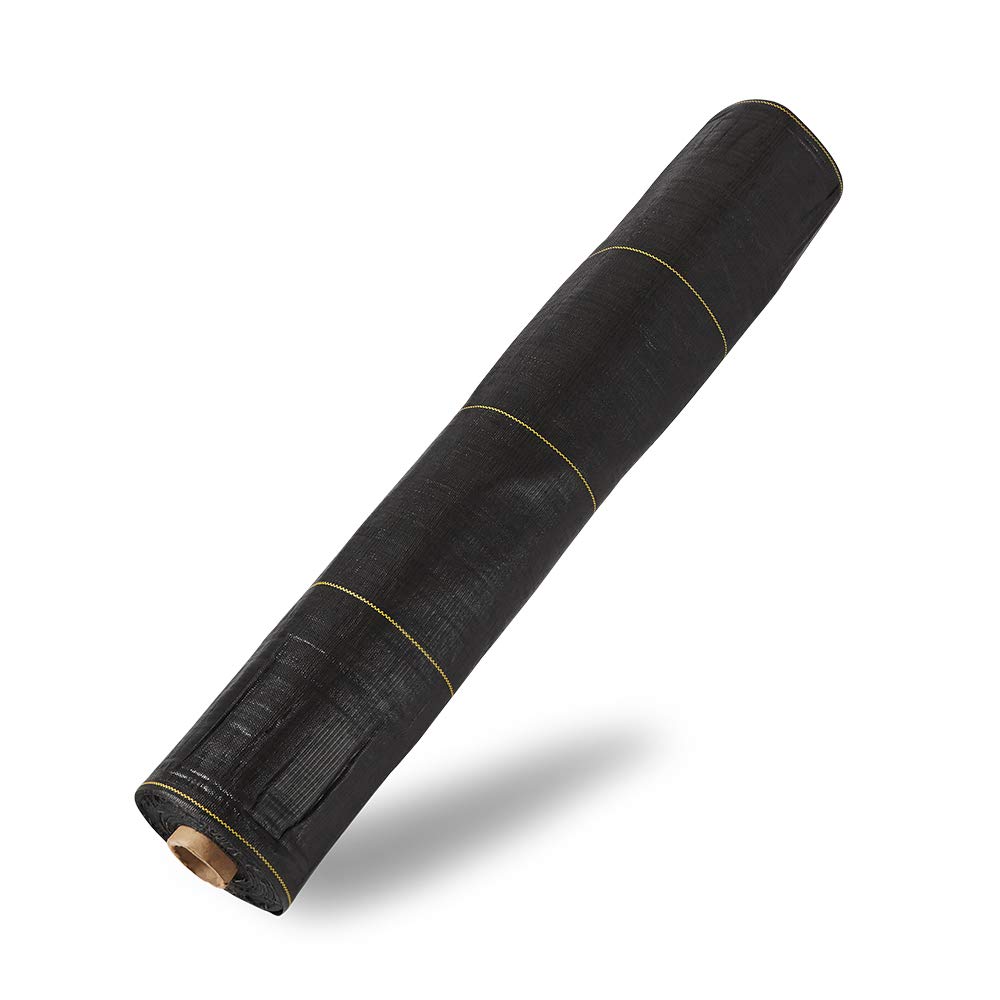
Dewitt’s own woven fabric with golden stripes every 12 inches for precise row spacing in greenhouses and farms.
This is a sister product to the top-ranked Dewitt 12YR3100, but where that liner is non-woven, this one is woven polypropylene designed for greenhouse floors, commercial nursery rows, raised beds, and high tunnels. The golden stripes printed every 12 inches are a practical touch for anyone planting long rows — you line up your transplants or seeds against the stripe and get perfectly straight spacing without measuring. The 3.2 oz fabric stands up to foot traffic, tools, and repositioning without tearing, and the UV-stabilized formula handles full-sun conditions in open fields. Owners describe it as phenomenal for keeping weeds away and note that it retains soil moisture, reducing the need for frequent watering.
The woven construction means weeds can occasionally root on top of the fabric (not through it) if organic debris builds up on the surface — a quick sweep or hose-off solves it. Johnson grass, a notoriously aggressive rhizome weed, has been known to push through the weave, so heavy-duty pre-treatment may be needed for problem patches. The 4 x 200 foot size splits the difference between small rolls and the massive 300-footers, making it manageable for a single person to install while still covering substantial ground.
Row-Perfect
- Gold stripes at 12-inch intervals enable precise row spacing without measuring
- UV-stabilized woven fabric holds up under full-sun exposure in open fields
- Retains soil moisture underneath, cutting down on watering frequency
Surface Weeds
- Weeds can root in debris on top of the fabric — sweep or blow it clean periodically
- Aggressive rhizome weeds like Johnson grass may penetrate the weave over time
Straight-row specialist: Choose the Dewitt Sunbelt if you are planting long vegetable or flower rows in a greenhouse, raised bed, or nursery and want built-in alignment guides to speed up the job.
10. Dewitt Sunbelt Weed Barrier Fabric 3.2 oz, 4 x 200 Feet
Dewitt’s own woven fabric with golden stripes every 12 inches for precise row spacing in greenhouses and farms.
This is a sister product to the top-ranked Dewitt 12YR3100, but where that liner is non-woven, this one is woven polypropylene designed for greenhouse floors, commercial nursery rows, raised beds, and high tunnels. The golden stripes printed every 12 inches are a practical touch for anyone planting long rows — you line up your transplants or seeds against the stripe and get perfectly straight spacing without measuring. The 3.2 oz fabric stands up to foot traffic, tools, and repositioning without tearing, and the UV-stabilized formula handles full-sun conditions in open fields. Owners describe it as phenomenal for keeping weeds away and note that it retains soil moisture, reducing the need for frequent watering.
The woven construction means weeds can occasionally root on top of the fabric (not through it) if organic debris builds up on the surface — a quick sweep or hose-off solves it. Johnson grass, a notoriously aggressive rhizome weed, has been known to push through the weave, so heavy-duty pre-treatment may be needed for problem patches. The 4 x 200 foot size splits the difference between small rolls and the massive 300-footers, making it manageable for a single person to install while still covering substantial ground.
Row-Perfect
- Gold stripes at 12-inch intervals enable precise row spacing without measuring
- UV-stabilized woven fabric holds up under full-sun exposure in open fields
- Retains soil moisture underneath, cutting down on watering frequency
Surface Weeds
- Weeds can root in debris on top of the fabric — sweep or blow it clean periodically
- Aggressive rhizome weeds like Johnson grass may penetrate the weave over time
Straight-row specialist: Choose the Dewitt Sunbelt if you are planting long vegetable or flower rows in a greenhouse, raised bed, or nursery and want built-in alignment guides to speed up the job.