
Gardenias are notoriously finicky. They demand acidic soil with a specific pH range, a constant supply of iron to prevent chlorosis, and a balanced nutrient profile that doesn’t burn their shallow roots. Picking the wrong fertilizer can leave you with yellow leaves and no blooms, turning an otherwise rewarding shrub into a frustrating project.
I’m Rikta — the co-founder and writer behind Lawn Gear Lab. I’ve spent countless hours analyzing NPK ratios, micronutrient profiles, soil acidification mechanisms, and verified owner feedback to separate the formulas that actually correct chlorosis and trigger blooming from those that just promise it.
After comparing granular slow-release blends, water-soluble concentrates, and liquid feed options, I’ve narrowed the field to the best performers for every growing style. This is my complete analysis of the best gardenia fertilizer on the market right now.
How To Choose The Best Gardenia Fertilizer
Gardenias are acid-loving plants that thrive in soil with a pH between 5.0 and 6.0. If the pH drifts above that range, the plant cannot absorb iron, leading to yellow leaves (chlorosis) and poor blooming. The right fertilizer must correct both nutrition and pH.
N-P-K Ratio vs. Micronutrients
Most gardenia fertilizers emphasize a balanced N-P-K ratio, but the real secret is the micronutrient package. Look for formulas with added iron, sulfur, and manganese — these prevent chlorosis and deepen leaf color. A moderate nitrogen level (5-8%) is ideal; too much nitrogen pushes foliage at the expense of flowers.
Granular vs. Liquid vs. Water-Soluble
Granular slow-release fertilizers (like Espoma Holly-Tone) feed the soil microbiology and provide a steady nutrient supply over months. They are ideal for pre-planting and spring/fall feeding. Water-soluble powders (like Jack’s Classic) offer precise control and fast uptake, best used every 7-14 days during the growing season. Liquid concentrates (like the TPS Nutrients Gardenia formula) work fastest for correcting acute deficiencies but require more frequent application.
Organic vs. Synthetic
Organic options (Dr. Earth, Espoma) are derived from plant and mineral sources, feeding the soil food web and reducing the risk of salt burn. Synthetic options (Miracle-Gro) provide immediate nutrients but can build up salts over time. For gardenias in containers, organic blends are safer; for quick correction of chlorosis, a water-soluble synthetic with chelated iron acts fastest.
Quick Comparison
On smaller screens, swipe sideways to see the full table.
| Model | Category | Best For | Key Spec | Amazon |
|---|---|---|---|---|
| Espoma Organic Holly-Tone | Granular Organic | Long-lasting feeding | 4-3-4 NPK; 5% sulfur | Amazon |
| GARDENWISE 8-4-8 | Granular Slow-Release | Vibrant blooms & iron correction | 8-4-8 NPK; iron-rich | Amazon |
| Jack’s Classic Acid Special | Water-Soluble Powder | Precise feeding & pH control | 17-6-6 NPK; chelated iron | Amazon |
| Miracle-Gro Water Soluble | Water-Soluble Powder | Fast greening & convenience | NPK 30-10-10; dissolves instantly | Amazon |
| Dr. Earth Acid Lovers | Granular Organic | Non-GMO organic purity | 0.3-0.4-3 NPK; people & pet safe | Amazon |
| Earth Science Fast Acting Sulfur | Soil Acidifier | Lowering soil pH | Elemental sulfur; 5 lb bag | Amazon |
| TPS Nutrients Gardenia Fertilizer | Liquid Concentrate | Quick chlorosis correction | 1 gallon; balanced for gardenias | Amazon |
In‑Depth Reviews
1. Espoma Organic Holly-Tone 4-3-4

Espoma’s Holly-Tone is the original organic fertilizer dedicated to acid-loving plants, and it remains the benchmark for long-term gardenia health. The 4-3-4 analysis is deliberately moderate — it won’t push excessive foliage growth like high-nitrogen synthetics do. The secret weapon here is the 5% sulfur content, which actively helps lower soil pH around the root zone, making iron and manganese more bioavailable. The 18-pound bag covers up to 2,500 square feet, making it ideal for multiple shrubs or a large garden bed.
The granular form breaks down slowly, releasing nutrients over several months without the risk of salt burn. Users report reviving rhododendrons that hadn’t bloomed in four years after just two seasonal applications. The exclusive Bio-tone formula adds beneficial microbes that improve soil structure and nutrient cycling over time — a genuine advantage for clay-heavy or compacted soils where gardenias often struggle.
Holly-Tone is OMRI-listed and meets organic production standards, meaning it’s safe for edible acid-loving plants like blueberries and strawberries growing near your gardenias. The only operational downside is the 18-pound bag size — it’s a lot of material for a single container plant, but for anyone with multiple acid-loving shrubs, the cost-per-feeding is well below other organic options.
What works
- Slow-release organic formula feeds for months without burning
- 5% sulfur content actively lowers soil pH for better iron uptake
- Bio-tone microbes improve long-term soil health
- Covers up to 2,500 sq. ft. per bag
What doesn’t
- Large bag is overkill for a single potted gardenia
- Factory seal can occasionally leak during shipping
2. GARDENWISE 8-4-8 Acidic Fertilizer
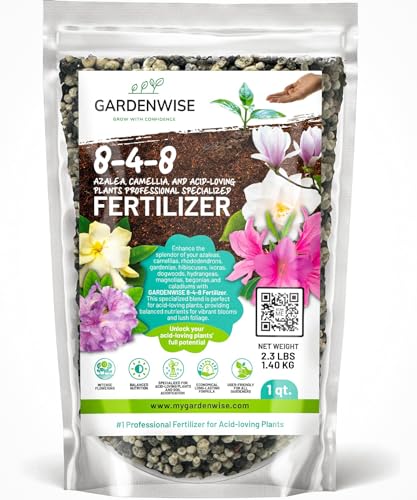
GARDENWISE takes a different approach from the low-and-slow organics — the 8-4-8 NPK provides a higher dose of nitrogen and potassium for pushing vigorous vegetative growth and heavy flowering. The critical addition is the iron, magnesium, and manganese package designed to prevent chlorosis in gardenias and acid-loving shrubs. Users report that magnolias doubled in leaf density within a week and rhododendrons that were on the brink of death produced blossoms after a single application.
The slow-release granules are designed for just three feedings per year, making it one of the lowest-maintenance options on this list. It incorporates bio-solid technology that adds live bacterial microbes to the soil — a feature usually found only in premium organic blends. The 1-quart bag covers a full growing season for multiple shrubs, and the formula is safe for azaleas, camellias, hydrangeas, and blueberries as well.
One trade-off: the 8-4-8 ratio means this is not an organic fertilizer in the strict sense, despite the microbial additives. The nitrogen content is high enough that over-application can cause leaf burn on sensitive gardenia varieties. Stick to the recommended rate and water thoroughly after application to avoid salt concentration at the roots.
What works
- Iron-rich formula corrects chlorosis quickly
- Slow-release granules require only 3 feedings per year
- Added bacterial microbes improve soil vitality
- Works on a wide range of acid-loving plants
What doesn’t
- High nitrogen content can burn if over-applied
- Not certified organic despite microbial content
3. Jack’s Classic 17-6-6 Acid Special

Jack’s Classic Acid Special is a water-soluble powder that gives you total control over feeding frequency and concentration. The 17-6-6 ratio is relatively high in nitrogen, but the inclusion of chelated iron and sulfur means the nitrogen is balanced to support deep green leaves rather than just pushing soft growth. The 1.5-pound container mixes into multiple gallons of liquid fertilizer — a single teaspoon per gallon is all you need for weekly feedings during the growing season.
The major advantage of this powder over granulars is speed. Users report visible greening within days of the first application, making it the best choice for correcting chlorosis that has already set in. It can be applied as a root drench or a foliar spray, giving you two tools to address deficiencies. Blueberry growers specifically prefer this over Miracle-Gro Acid Mix because the lower nitrogen concentration (17-6-6 vs. 30-10-10) reduces the risk of over-fertilization in container plants.
The included measuring spoon is a nice convenience, but the real value is the micronutrient package — Jack’s adds manganese, copper, and zinc alongside the iron and sulfur. This comprehensive profile addresses multiple deficiency types that gardenias commonly show, not just chlorosis. The powder form does require mixing and careful storage — moisture exposure can clump the product.
What works
- Fast-acting chelated iron corrects chlorosis in days
- Low NPK (17-6-6) reduces burn risk vs. 30-10-10 mixes
- Can be used as foliar or root drench
- Comprehensive micronutrient profile
What doesn’t
- Requires mixing and weekly application schedule
- Powder clumps if exposed to moisture
4. Miracle-Gro Water Soluble Azalea, Camellia, Rhododendron Plant Food

Miracle-Gro’s acid-loving formula is the most widely available option on this list, and for good reason — the 30-10-10 ratio delivers a strong nitrogen punch that turns yellowing gardenias deep green within a week. The powder dissolves instantly in water and can be applied with a watering can or a Miracle-Gro Garden Feeder, making it the most convenient option for quick feeding sessions. The 5-pound bag (80 ounces) treats a large number of plants across multiple feedings.
The formula is designed to feed every 7-14 days during the active growing season. Users consistently report rapid recovery for struggling rhododendrons and azaleas, with visible new growth and bud formation after just two applications. It’s also formulated to not burn foliage when used at the recommended dilution, which is a common concern with high-nitrogen synthetics.
Where this product falls short is the bag closure design — multiple users note that the resealable zipper is ineffective, forcing you to store the powder in a separate container. The high nitrogen content also means it pushes leaf growth at the expense of flowers if over-applied, and the synthetic salts can accumulate in container soil over time. For in-ground gardenias with good drainage, this is a capable workhorse; for potted shrubs, the organic granulars are a safer long-term bet.
What works
- Instant dissolution and fast visible greening
- High nitrogen corrects yellow leaves rapidly
- Compatible with hose-end feeders for large gardens
- Safe for foliage when diluted correctly
What doesn’t
- Bag closure doesn’t reseal properly
- 30-10-10 ratio can over-push foliage and reduce blooms
- Synthetic salts may accumulate in container soil
5. Dr. Earth Acid Lovers Azalea, Camellia, Rhododendron & Maple Fertilizer

Dr. Earth’s Acid Lovers formula is the only Non-GMO Project Verified fertilizer available in the U.S., and it carries OMRI, OIM, CCOF, and NOP organic certifications. The 0.3-0.4-3 NPK is extraordinarily low compared to everything else on this list — this is not a quick-green fix but a soil-building amendment. It’s handcrafted from human-grade and feed-grade ingredients, fortified with multi-minerals, proteins, carbohydrates, humic acids, and trace elements that feed the soil food web.
Users report that gardenias bloomed “the best they ever have” after switching to Dr. Earth, and azalea bushes that hadn’t flowered in years produced blooms within a season. The secret is the microbial activity this fertilizer stimulates — the humic acids chelate nutrients in the soil, making iron and zinc more available without the risk of salt accumulation. It’s people-and-pet safe, meaning you can apply it around children and dogs without concern.
The trade-off is twofold. The 4-pound bag covers significantly less area than Espoma’s 18-pound option at a higher per-pound cost. And the low NPK means you won’t see the immediate greening effect that high-nitrogen water-solubles deliver. This is a long-term soil health play — if you want fast results, pair this with a chelated iron supplement during the first growing season.
What works
- Highest organic purity certification available
- Safe for people and pets with no toxic ingredients
- Humic acids and trace elements improve long-term soil health
- Non-GMO Project Verified
What doesn’t
- Very low NPK won’t show quick greening results
- Small bag size at a higher per-feeding cost
6. Earth Science Fast Acting Sulfur Granules

Earth Science’s Fast Acting Sulfur is not a complete fertilizer — it’s a soil acidifier designed to lower pH when your gardenias are suffering from alkaline soil lockout. Gardenias need a soil pH between 5.0 and 6.0 to access iron and manganese. If your soil tests above 6.5, no amount of fertilizer will fix chlorosis until the pH drops. This product delivers elemental sulfur that begins oxidizing within days, releasing hydrogen ions that gradually lower soil pH.
The 5-pound bag treats a substantial area, and the patented Nutri-Bond Technology helps the granules stay in the root zone rather than washing away with rain or irrigation. Users report that hydrangeas perked up within a week and strawberry plants grew larger than untreated neighbors. It’s safe for people and pets, so you can apply it to lawn areas and garden beds without restrictions.
The “fast acting” label is relative — several users note that the granules require multiple waterings to fully dissolve, so the pH shift is gradual over 2-4 weeks. This is actually safer for plants than a rapid pH crash, but if you need immediate pH correction, a liquid sulfur product would work faster. Use this as a pre-season amendment in early spring or fall for best results.
What works
- Effectively lowers soil pH for acid-loving plants
- Nutri-Bond technology reduces nutrient runoff
- Safe for people and pets with no re-entry restriction
- Works on lawns, shrubs, and garden beds
What doesn’t
- Granules dissolve slowly despite “fast acting” label
- Not a complete fertilizer — must pair with nutrient feed
7. TPS Nutrients Gardenia Fertilizer – Liquid Plant Food
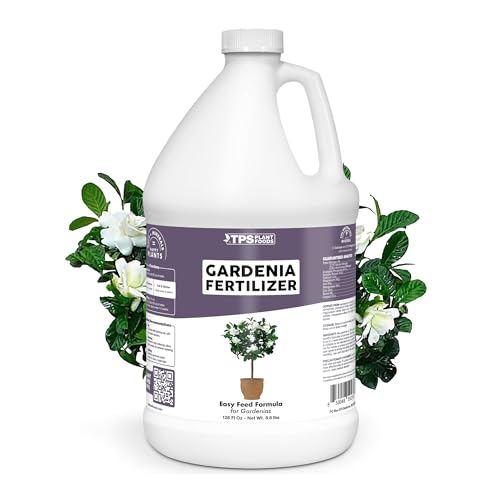
TPS Nutrients has formulated a liquid fertilizer specifically for gardenias — not just a general acid-loving blend. The 1-gallon ready-to-use liquid is the fastest way to deliver nutrients to a chlorotic gardenia, because the nutrients are already dissolved and immediately available to the roots. Users report that yellow leaves turned deep green after just two applications, and white blooms appeared within a week of the first feeding.
The formula is balanced for acid-loving shrubs like gardenias, camellias, and rhododendrons, with a specific focus on supporting bloom development alongside foliage health. It’s suitable for both outdoor garden beds and container-grown plants, which is important because container gardenias are especially prone to nutrient lockout from pH drift. The liquid form eliminates mixing errors and is as simple as pouring the recommended amount around the base of the plant.
The main consideration is cost per feeding. A 1-gallon jug at this price point is one of the most expensive options per ounce on this list. Users who compared it directly with cheaper alternatives noted that the results were visibly better, but conceded the price premium. For a single prized gardenia plant, the convenience and speed justify the expense; for a large bed of acid-loving shrubs, a granular organic like Espoma will deliver similar results at a lower total cost.
What works
- Immediate nutrient availability for fast chlorosis correction
- Ready-to-use liquid eliminates mixing and measurement errors
- Safe for container-grown and in-ground gardenias
- Visible results in days, not weeks
What doesn’t
- High cost per feeding compared to granular options
- Frequent reapplication needed for sustained feeding
Hardware & Specs Guide
N-P-K Ratio
The three numbers on a fertilizer bag stand for nitrogen (N), phosphorus (P), and potassium (K). For gardenias, a moderate nitrogen level (5-10%) is ideal — too much pushes leaves instead of blooms. Phosphorus supports root and flower development, while potassium aids overall plant health. The micronutrient package (iron, sulfur, manganese) is more important than the exact ratio for chlorosis-prone gardenias.
Iron Content & Form
Yellow leaves with green veins (interveinal chlorosis) indicate iron deficiency. The most effective gardenia fertilizers use chelated iron (EDTA or DTPA), which remains available to the plant even in slightly alkaline soils. Sulfur is often added to lower pH, which in turn makes naturally occurring soil iron more bioavailable. Look for both chelated iron and sulfur in the guaranteed analysis.
FAQ
How often should I fertilize my gardenia during the growing season?
Will high-nitrogen gardenia fertilizer prevent blooming?
Can I use standard plant food if my gardenia soil pH is already 5.5?
Final Thoughts: The Verdict
For most gardeners, the gardenia fertilizer winner is the Espoma Organic Holly-Tone 4-3-4 because it provides steady, organic nutrition that feeds the soil while actively lowering pH — the two things gardenias need most. If you want fast chlorosis correction with precise control, grab the Jack’s Classic Acid Special. And for a premium liquid option that shows results in days for a single prized shrub, nothing beats the TPS Nutrients Gardenia Fertilizer.