
For anyone with a yard, the weekly battle against dandelions, crabgrass, and thistles usually ends in a sore back or skinned knees. The right tool makes this chore fast, clean, and satisfying — pulling the entire root in one motion instead of leaving broken fragments to regrow. This guide breaks down the six best manual weeders on the market to help you choose the one that fits your soil, your stamina, and your garden’s layout.
I’m Rikta — the co-founder and writer behind Lawn Gear Lab. I built this guide after comparing blade steel compositions, handle lengths, claw configurations, and eject mechanisms across dozens of models, reading hundreds of verified owner reports to separate the functional tools from the gimmicks.
Whether you want a hand trowel for close work or a long-handled stand-up puller to save your back, this review of the best garden weeding tool options will help you find a durable, effective solution for your specific yard conditions.
How To Choose The Best Garden Weeding Tool
Choosing between a hand weeder and a stand-up puller comes down to the type of weeds you face, the soil texture in your yard, and how much bending your body can tolerate. These three factors will guide your decision.
Stand-Up Pullers vs. Hand Trowels: Know Your Reach
A stand-up weeder with a 43- to 60-inch handle lets you work upright, transferring your body weight into the ground through a foot pedal. These excel on lawns and open beds where dandelions, thistles, and deep taproots are the main targets. A hand trowel or weeding knife, by contrast, gives you precise control in densely planted flower beds, vegetable rows, and containers where a long claw might damage neighboring roots. If your garden mixes open turf with tight planting areas, owning both types covers all scenarios.
Claw Count and Head Design: Root Grip Matters
A 4-claw head is the standard for stand-up pullers because it surrounds the weed stem and bites into the soil at four points, increasing your chance of extracting the entire root. Two-pronged fork tips on hand trowels work better for slicing under a root mass and prying upward. The claw geometry also matters — curved tines that converge when squeezed hold roots tighter than straight, parallel prongs. For rocky or clay-heavy soil, look for thicker-gauge steel heads that resist bending when you apply downward force.
Eject Mechanism and Soil Conditions
Some stand-up pullers include a sliding ejector or foot-triggered release that pushes the pulled weed out of the claws without touching it. This speeds up repetitive work and keeps your hands clean. However, eject mechanisms add moving parts that can jam if soil is wet and sticky. On loose, sandy loam they work reliably; on heavy clay you may prefer a simpler fixed-claw model you can tap against a bucket to release. For hand trowels, a serrated edge for cutting roots and a measuring scale for planting depth add utility beyond simple weeding.
Quick Comparison
On smaller screens, swipe sideways to see the full table.
| Model | Category | Best For | Key Spec | Amazon |
|---|---|---|---|---|
| Grampa’s Weeder | Stand-Up Puller | Classic, chemical-free lawn weeding | 45-inch bamboo handle | Amazon |
| Allsetool Weed Puller | Stand-Up Puller | Frequent weeding with clean release | Dual eject mechanism | Amazon |
| Garden Guru Hand Weeder | Hand Trowel | Precision weeding in beds & pots | Rust-resistant stainless steel | Amazon |
| BellaJoyz Weed Puller | Stand-Up Puller | Seniors or users with bending restrictions | 46-inch length, 4-claw head | Amazon |
| CKLT 2-in-1 Hoe & Rake | Multi-Tool | Slicing weeds & clearing debris | 60-inch adjustable handle | Amazon |
| BUIGNDG Stand Up Weeder | Stand-Up Puller | Budget buy for basic lawn weeds | All-metal frame, 4-prong head | Amazon |
In‑Depth Reviews
1. Grampa’s Weeder

Grampa’s Weeder has been in continuous production since 1913, and the design has earned its reputation by removing the whole root in a single, satisfying motion. The 45-inch bamboo handle is lightweight — just 2.3 pounds — yet stiff enough to transmit downward force through the foot pedal without flexing. The 4-claw alloy steel head surrounds the weed stem, and when you tilt the handle backward, the claws converge to grip the taproot so tightly that even deep dandelions come out intact.
The tool performs best when the soil is damp; after a rain or irrigation session, the claws sink in with minimal effort. On hard clay or rocky ground, it struggles to penetrate fully, so you may need to water first or choose a different approach. There is no eject mechanism — weeds usually fall out when you tap the head against a bucket or the ground. The lack of moving parts contributes to the tool’s legendary durability: owners report decades of use from a single unit.
Grampa’s Weeder is made by an American company based in the Pacific Northwest and carries a lifetime guarantee. It works best on single-stem, wide-base weeds like dandelions and thistles; tiny, shallow-rooted weeds may slip between the claws. If your property has mostly soft soil and you value a tool that will outlast you, this is the one to buy.
What works
- Removes entire taproot in one pull with proper technique
- Bamboo handle is light, strong, and comfortable to grip
- Lifetime guarantee from a company that has been making them for over a century
What doesn’t
- Struggles in hard, dry, or rocky soil without pre-watering
- No ejection feature, so weeds must be knocked free manually
- Less effective on tiny, multi-stem weeds that don’t center in the claws
2. Allsetool Weed Puller Tool
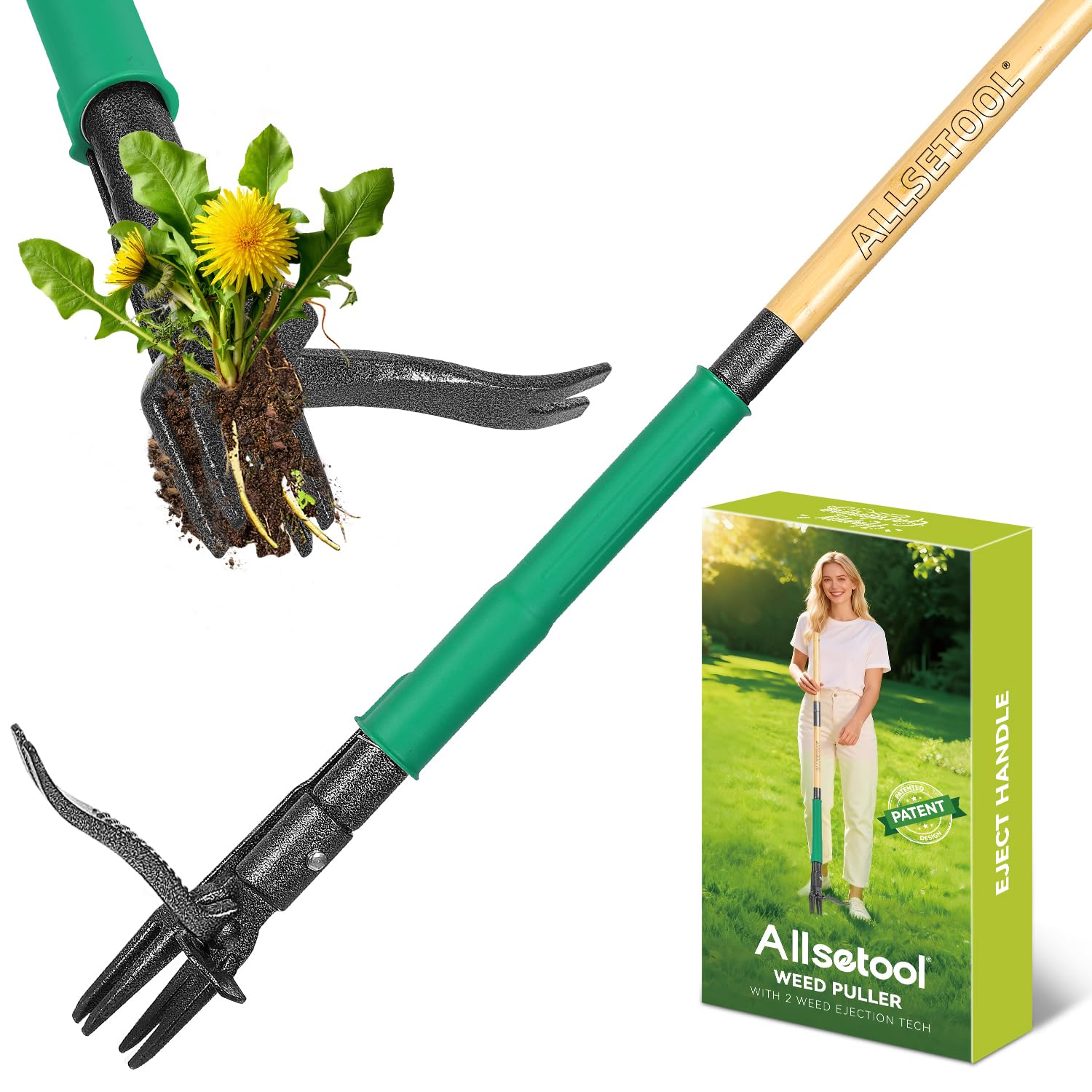
The Allsetool Weed Puller distinguishes itself with a dual-eject system that lets you clear the claws without bending over. A sliding handle mechanism pushes the weed out from above, and a separate foot pedal ejects it from below — whichever is more convenient for your current rhythm. The 4-claw steel head is identical in concept to Grampa’s, but the added ejection hardware makes repetitive weeding significantly faster and cleaner, especially when tackling large patches of dandelions.
The tool weighs 3.61 pounds, making it heavier than simpler pullers, but the extra mass helps drive the claws into drier soil. The metal foot pedal features a non-slip textured pattern that provides secure footing even with muddy boots. Assembly is straightforward, and the tool breaks down into sections for compact storage. The 43.7-inch handle is long enough for most users to stand fully upright while working.
Owner feedback highlights the satisfaction of the ejection mechanism — it works smoothly most of the time, though a small percentage of users report that the sliding release can jam if the soil is very wet and sticky. When that happens, a quick tap on the ground usually frees the weed. For gardeners who weed in volume and want to minimize manual handling, this is the most efficient mid-range stand-up puller available.
What works
- Two ejection paths (hand lever and foot pedal) keep you moving fast
- Heavier head helps penetrate moderately compacted soil
- Non-slip foot pedal provides secure stomping surface
What doesn’t
- Eject mechanism can bind in wet, sticky clay
- Heavier than pullers without ejection features
- Release handle may require two hands to operate smoothly
3. Garden Guru Hand Weeder Trowel
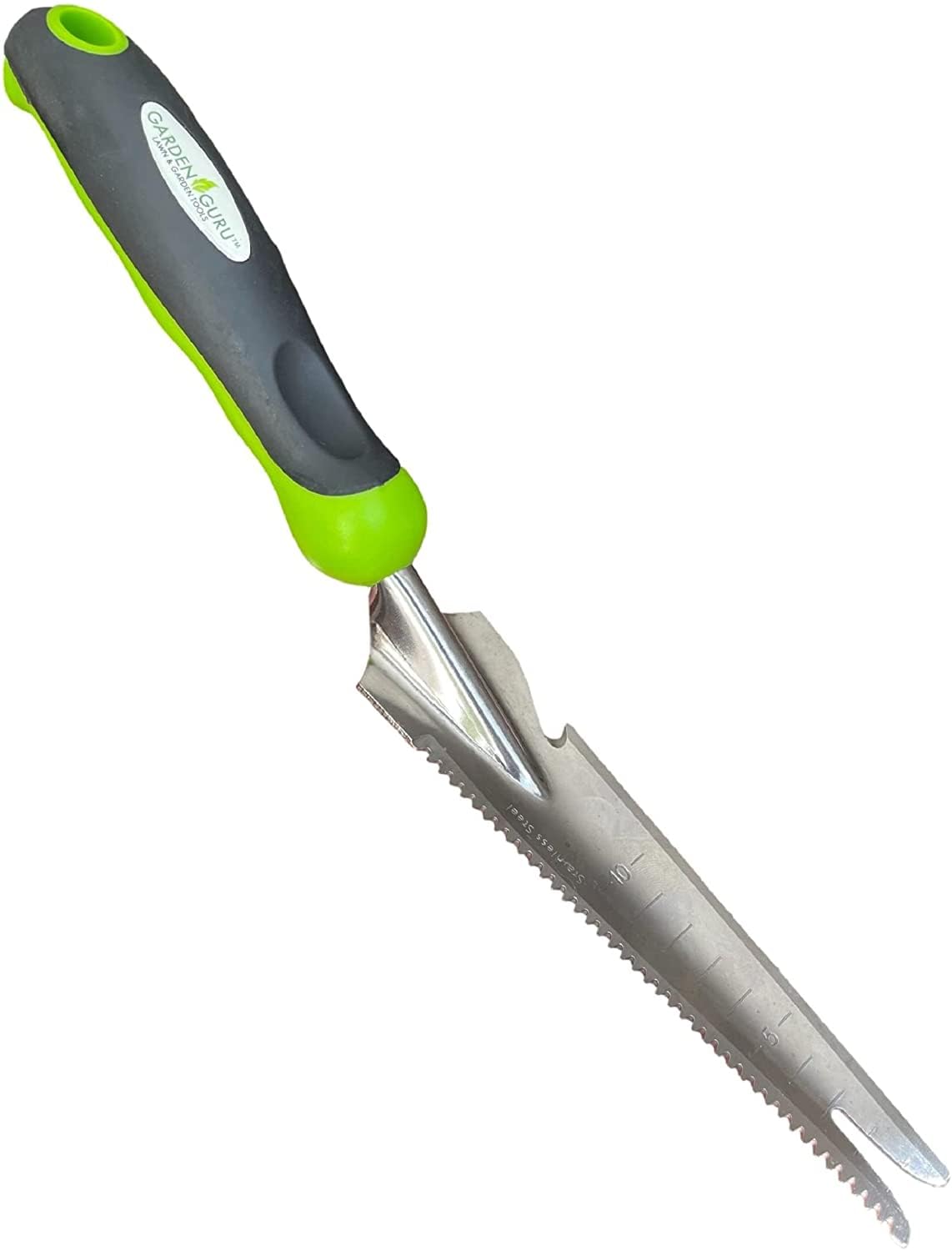
The Garden Guru Hand Weeder is a stainless steel 5-in-1 trowel that replaces a weeder, digger, saw, scraper, and measuring tool. The rust-resistant blade is thick enough for prying out compacted root balls yet wide and concave for scooping soil. A sharp flat edge slices through surface weeds, while the serrated edge saws through thick roots up to half an inch. A notch in the blade even cuts twine and doubles as a bottle opener — a quirk that owners genuinely appreciate during long days in the garden.
The ergonomic soft-grip handle features contoured finger ridges that reduce hand fatigue and make the tool usable for gardeners with arthritis or limited grip strength. At 6.3 ounces, it is featherlight, which matters when you are squatting and reaching into tight spaces for an hour. The included depth markings in both millimeters and inches let you plant bulbs and transplants at consistent depths without reaching for a ruler.
Garden Guru backs this tool with a lifetime warranty and a 90-day satisfaction guarantee. The company uses recycled materials where possible and is certified carbon neutral, including 1% For The Planet membership. Owner reviews consistently note that the blade is robust enough for small roots but should not be used as a pry bar — one user admitted breaking the blade while trying to lever out an iris, calling it a fair outcome for abusive use. For precision weeding, transplanting, and cutting in flower beds and containers, this is the most capable hand tool in the roundup.
What works
- Serrated edge saws through thick roots that plain blades cannot cut
- Ergonomic handle is genuinely comfortable for arthritic hands
- Lifetime warranty with carbon-neutral manufacturing
What doesn’t
- Blade can snap if used aggressively as a crowbar on heavy roots
- Short handle requires consistent bending or kneeling
- Not designed for deep taproots in hard-packed soil
4. BellaJoyz Weed Puller Tool
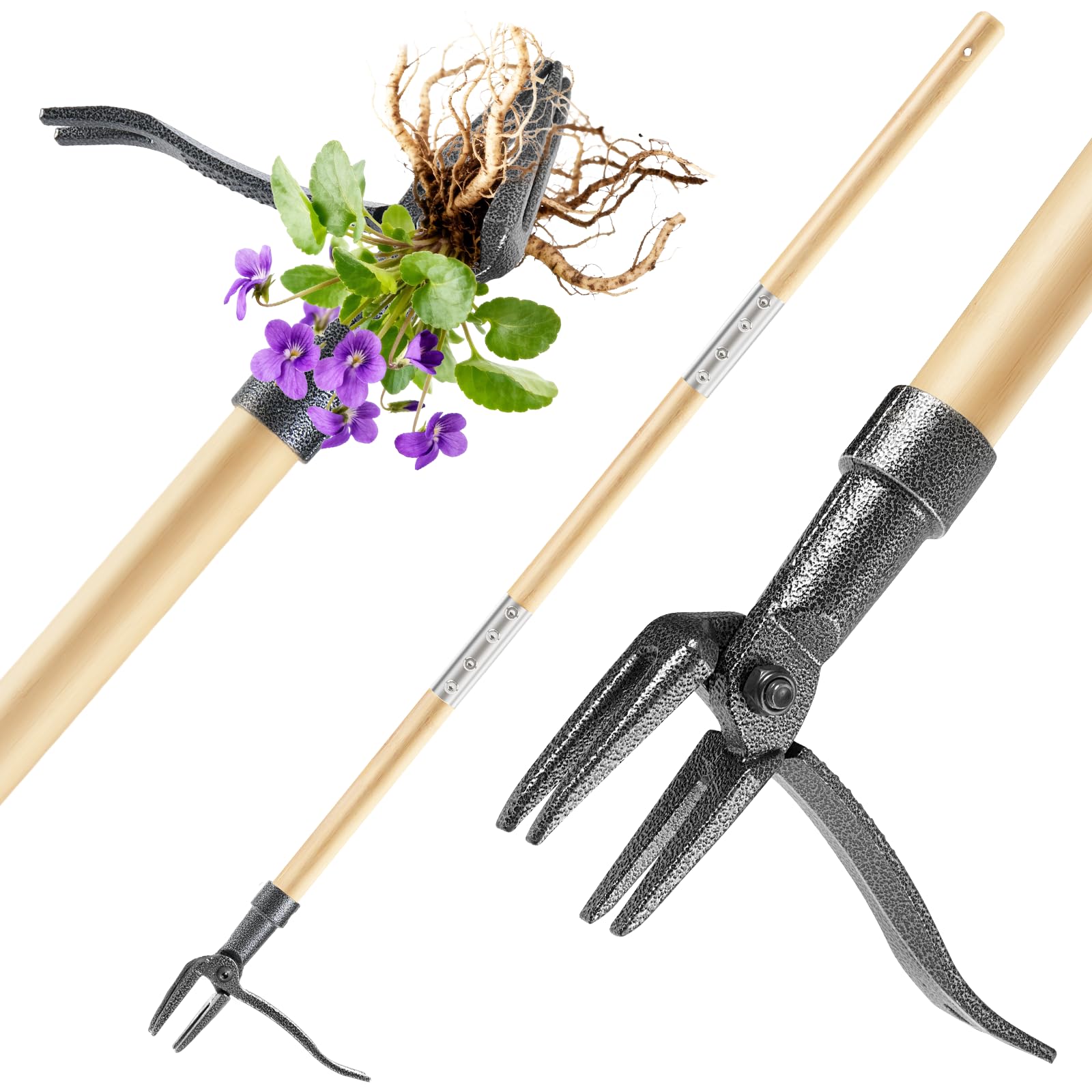
The BellaJoyz stand-up weeder delivers the same 4-claw, step-and-pull action as premium models at a noticeably lower cost. Its 46-inch handle lets you work upright, and the head is made from heavy-duty stainless steel with a rust-resistant finish. The foot pedal is wide enough to accommodate most shoe sizes, and the claws are spaced to grip dandelion and crabgrass root systems firmly without excessive soil disturbance.
A practical feature for gardeners with limited storage space is the tool’s ability to disassemble into three sections. Each section locks together securely with threaded collars, and built-in hanging holes let you mount the pieces on a pegboard or shed wall. Assembly takes less than two minutes, and the tool feels solid once assembled — there is no wobble at the connection points.
Owner feedback emphasizes how much faster the tool makes lawn weeding compared to hand-pulling, with many users reporting that they cleared large patches in under 30 minutes with no back strain. The main limitation is that the BellaJoyz works best in soft, loamy soil; in very hard ground the foot pedal may not drive the claws deep enough to grab the full taproot. For gardeners with average soil conditions who want a capable stand-up puller without paying top dollar, this is the smartest value choice.
What works
- Disassembly makes it easy to store in small sheds or apartments
- Price-to-performance ratio is excellent for standard lawn weeds
- Rust-resistant stainless steel head should last several seasons
What doesn’t
- Claws struggle to penetrate hard, dry, or clay-heavy soil
- No weed ejection mechanism — must tap out by hand
- Best suited for upright single-stem weeds, not creeping vines
5. CKLT 2-in-1 Garden Hoe and Weed Puller Rake
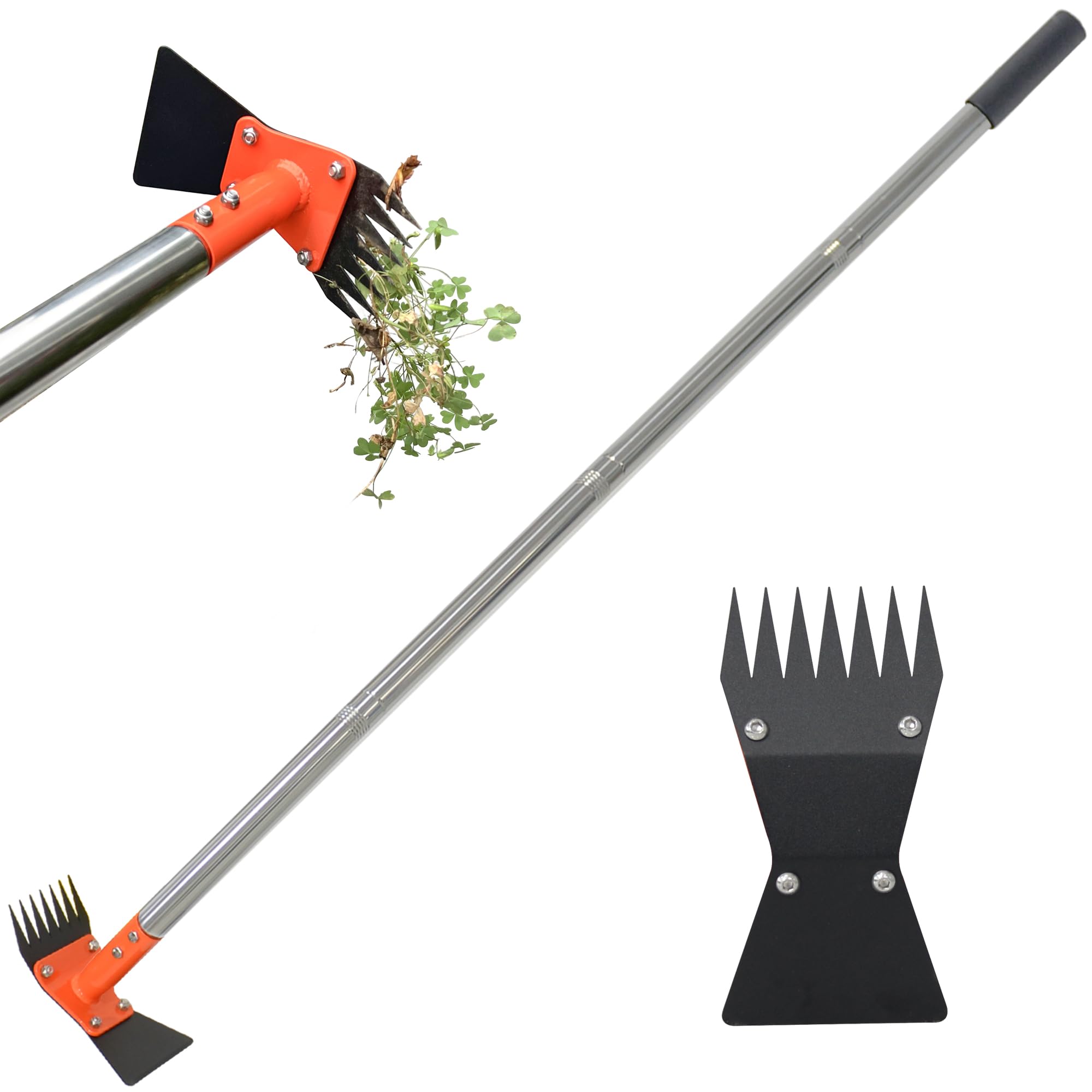
The CKLT 2-in-1 combines a sharp trapezoid hoe on one side and a 9-centimeter rake on the other, giving you a single tool for slicing through weed stems and then raking out debris. The heads are made from tempered spring steel, which resists bending and snaps back to shape better than standard carbon steel. The sand-texture finish on the steel heads provides a better grip on the soil and resists rust far better than painted or bare metal surfaces.
The handle is the standout feature here: four stainless steel sections lock together with screws to let you adjust the length from about 30 inches to a full 60 inches. At maximum length, you can stand fully upright while hoeing large beds or clearing weeds along a fence line. Shortened, the tool works comfortably in raised beds and containers where a long handle would be unwieldy. Assembly requires an included Allen wrench, and the sections feel rigid once tightened.
Owner feedback is generally positive, though a few users noted that the rake teeth can bend if you strike rocks or concrete edges. One owner bent a prong when testing on a rocky patch, replaced by the seller at no charge, and reported that the hoe side remained sharp and effective afterward. The hoe excels at cutting small to medium weeds just below the soil surface, while the rake is better for sweeping debris from between pavers or out of brick joints. For gardeners who want both a weeding hoe and a cleanup rake in one handle, this is a practical space-saver.
What works
- Adjustable handle length adapts to standing work and raised-bed use
- Tempered spring steel heads resist bending better than budget hoes
- Rake side clears debris from tight gaps between paving stones
What doesn’t
- Rake teeth can bend on hidden rocks if you apply heavy force
- Hoe side is less effective on very thin, threadlike weeds
- Handle sections add weight and assembly time compared to one-piece tools
6. BUIGNDG Weed Puller Tool 45-Inch
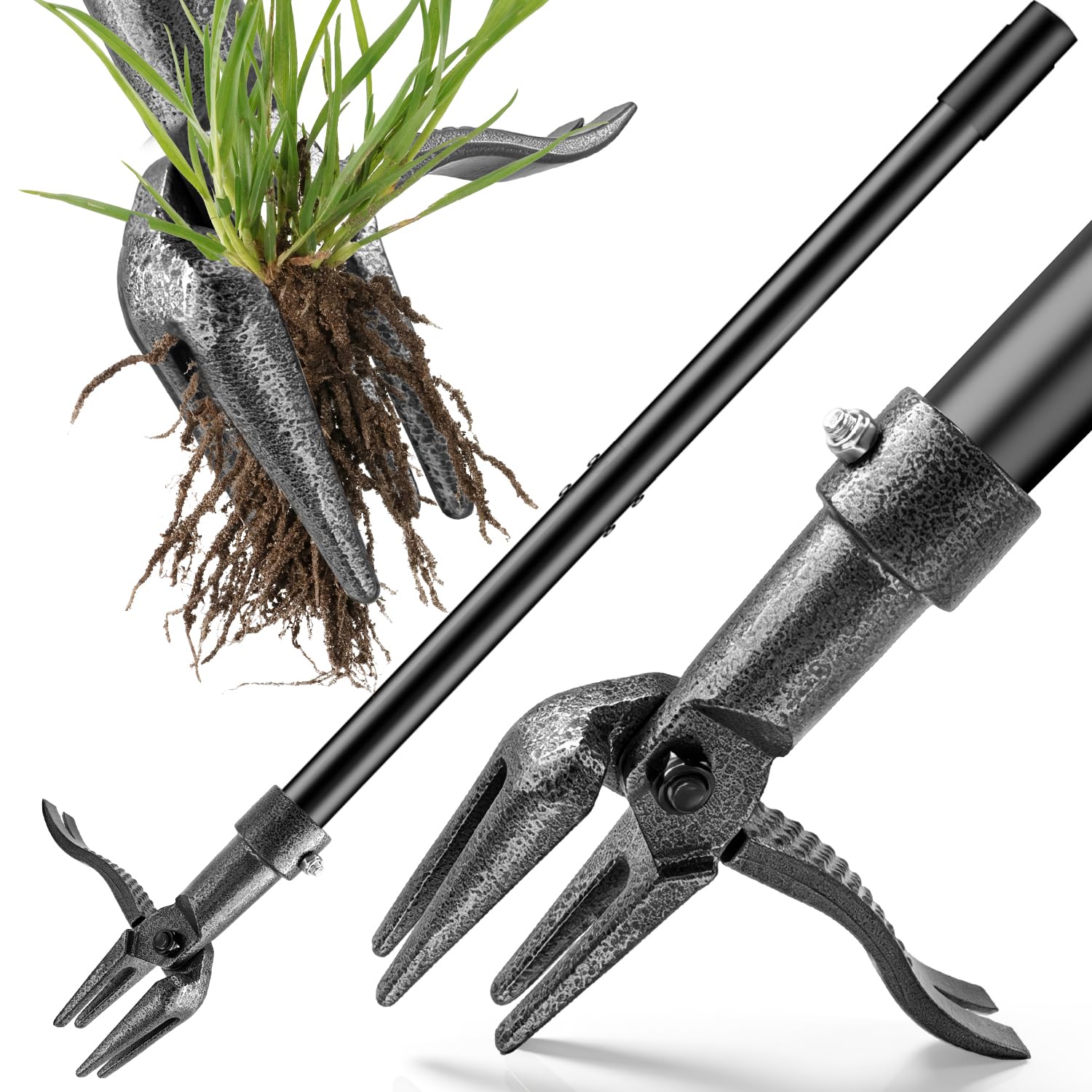
The BUIGNDG stand-up weeder is the most affordable long-handled puller in this roundup, but it does not cut corners on basic structural integrity. The entire frame is all-metal, from the heavy-duty tubing that forms the handle to the stainless steel 4-prong head. Rubberized foam on the top handle reduces vibration and hand fatigue during extended sessions, and the rust-resistant nuts and bolts arrived in a well-packed box with clear assembly instructions.
The step-and-tilt operation is identical to the higher-priced models: position the claws over the weed, stomp the foot pedal to drive the prongs into the root zone, and lean the handle back to lever the weed out. The claws are spaced and angled to grip typical lawn weeds like dandelions and plantains. The tool works best when the ground is moist; in bone-dry soil, the claws may not sink deeply enough to extract the entire root on the first attempt.
Owner reviews emphasize that this weeder is a significant upgrade from using a hand fork or just pulling weeds manually. Several users with limited mobility reported that the BUIGNDG eliminated their back pain during yard work. The main compromise is that the metal handle lacks the warmth and shock absorption of bamboo or wood, and larger users (over 200 pounds) have noted that the foot pedal feels less robust than that of premium models. For entry-level buyers who want to test the stand-up weeding experience without a big commitment, this is a solid, functional starting point.
What works
- All-metal construction feels sturdy and should hold up to regular use
- Rubberized top handle reduces hand fatigue during long sessions
- Lowest price point makes it an easy entry to stand-up weeding
What doesn’t
- Metal handle transfers more shock than bamboo or wood
- Foot pedal feels less solid under heavy, repeated stomping force
- Claw depth is limited in dry, compacted ground
Hardware & Specs Guide
Handle Material & Length
The handle is your primary lever. Bamboo (Grampa’s Weeder) combines light weight with natural shock absorption and a warm, slip-resistant grip. All-metal handles (BUIGNDG, BellaJoyz) are durable and affordable but transmit more vibration. Adjustable handles (CKLT) offer the most versatility — you can go from 30 inches for raised beds to 60 inches for standing work. The ideal length depends on your height and whether you are weeding lawns or flower beds. Most stand-up pullers land between 43 and 46 inches, which works for average-height users. Taller gardeners may prefer a 50-plus-inch option to avoid stooping.
Claw Configuration & Head Material
A 4-claw design is the gold standard for stand-up pullers because it surrounds the weed stem and grips the root from four sides. The claw spacing and curvature determine how well the tool holds different weed sizes: tighter-curved claws (Grampa’s) excel on single-stem dandelions, while wider-spaced claws (Allsetool, BellaJoyz) handle slightly larger root balls. Head material matters — stainless steel resists rust and stays sharp longer than painted carbon steel. Look for heat-treated or tempered spring steel (CKLT) if you regularly work rocky soil that would bend softer metal.
FAQ
Why does my stand-up weed puller leave the root behind?
Can I use a stand-up weeder on ground covers or creeping vines?
How often should I sharpen the claws on a weeding tool?
Does a weed eject mechanism add value or just complexity?
Final Thoughts: The Verdict
For most gardeners, the best garden weeding tool winner is the Grampa’s Weeder because its simple, time-tested four-claw design reliably removes whole taproots with no moving parts to break. If you want a faster workflow with built-in weed ejection, grab the Allsetool Weed Puller. And for precision weeding in flower beds, containers, and tight planting areas, nothing beats the multifunction Garden Guru Hand Weeder Trowel.