
Specs are compiled from manufacturer listings and verified buyer reviews and can change over time — please confirm the key details on the product page before buying.
If your garden soil feels more like concrete than earth, you are not alone. The right hand tool turns that hard-packed ground into loose, airy beds your plants will love, and it doesn’t take a gas-powered tiller to get there. This guide picks the standouts among a sea of hoes, claws, and rakes to save you the guesswork.
I’m Rikta — the founder and writer behind Lawn Gear Lab. This guide is built by comparing the manufacturers’ published specifications and the patterns across verified customer reviews, so you get each pick’s real strengths and trade-offs instead of marketing spin.
Whether you are planting a vegetable patch, tending a rose border, or simply tired of wrestling with clay, you’ll find the right garden tool to loosen soil here — everything from a heirloom-quality hand cultivator to a long-handled no-bend tiller.
Our Picks at a Glance


How To Choose The Best Garden Tool To Loosen Soil
The best tool depends on the size of your garden, the type of soil you have, and your own physical comfort. A heavy clay bed needs a different approach than a soft raised trough. Here are the key factors to weigh before you buy.
Match the Tine Count to Your Soil
A 3-tine tool works fine for breaking up loose topsoil and mixing in fertilizer. A 5-tine tool covers more ground per pass and pulls more weeds in one go. For hard-packed or clay-heavy soil, more tines — especially if they are sharpened — will save you repeated passes.
Handle Length Defines Your Posture
Short hand tools (around 11 to 14 inches) keep you close to the work, which often means kneeling or bending. Long-handled tools (45 inches and up) let you work standing upright, saving your back. An adjustable handle is a middle ground: you can lengthen it for broad beds or shorten it for detail work in containers.
Material Tells You How Long It Will Last
Tempered boron steel and forged steel resist bending and hold an edge across seasons of heavy use. Stainless steel resists rust but can be more brittle. A coating or powder finish adds extra protection against moisture. The handle material also matters — ash hardwood is strong and ergonomic, while fiberglass absorbs shock and stands up to weather.
Quick Comparison
| Model | Best For | Handle Length | Tines | Material | Amazon |
|---|---|---|---|---|---|
| DeWit 5-Tine Hand Cultivator★ Best Overall | Raised beds & precise weeding | 11″ | 5 | Tempered Boron Steel | Amazon |
| Garden Guru Hand RakeDetail Specialist | Detail work & delicate plants | — | — | Stainless Steel | Amazon |
| WORKPRO Hoe & CultivatorBest Value 2-in-1 | Switching between hoeing & clawing | 14″ | 3 (plus hoe blade) | Metal | Amazon |
| COCONUT 45-Inch Hoe | Standing work in beds | 45″ (adjustable) | 3 (plus hoe blade) | Alloy Steel | Amazon |
| Nisaku NJP555 | Small hands & container work | 6″ | 5 | Japanese Carbon Stainless Steel | Amazon |
| YEELOR 55-Inch Tiller | Elderly & back-friendly gardening | 55″ (adjustable) | 3 | Iron | Amazon |
| BlumeTrec Bow Rake | Heavy-duty soil & thatch removal | 68″ | 17 | Manganese Steel | Amazon |
| Altdorff Hand Tiller | Quick, continuous loosening | 17.7″ | 4 | Alloy Steel | Amazon |
| Truper Rapid Tiller | Tough clay & dandelion removal | 14″ | 3 (plus digging blade) | Forged Steel | Amazon |
In‑Depth Reviews
1. DeWit 5-Tine Hand Cultivator
Our pick — over 4.5★ from 400+ verified ratings; the strongest balance of quality and price.
The heirloom claw that makes hard soil feel like loose cake.
This is the tool owners keep coming back to, and the numbers back it up — a near-perfect rating from hundreds of buyers, many of whom call it their “favorite” garden tool. The secret is in the steel. Forged from tempered boron steel, the five sharpened tines are both tough enough to yank out Bermuda grass roots and precise enough for raised beds and borders. At 11 inches long and just 8 ounces, it disappears into your hand, yet it exerts real force when you need it.
The ash hardwood handle — sourced from FSC-certified forests — is smooth and ergonomic. Buyers report that it “digs better than straight-pronged cultivators” and works “easily in clay and sand.” The only honest caveat is the handle length: a few owners wish it were longer to reduce bending, but for kneeling work in containers and flower beds, it is tough to top. The tool carries a lifetime guarantee. It is pricier than the plastic-handled options, but as one review put it, “pricey but worth it.”
Why it wins
- Five sharp, tempered boron steel tines tackle compacted clay and crabgrass with ease.
- Heirloom quality — ash hardwood handle and a lifetime guarantee.
- One buyer called it “excellent for removing crabgrass clumps with roots.”
The trade-off
- Short 11-inch handle means you will be kneeling or bending close to the ground.
- Higher upfront cost than most hand cultivators, but owners say it lasts.
Reach for this if: you want one hand tool that will outlast your garden gloves and genuinely enjoy breaking up tough soil.
Look elsewhere if: you prefer working upright — in that case, pair this with a long-handled tiller for the full picture.
2. Garden Guru Stainless Steel Hand Rake
The little rake that clears the tight spots a big rake cannot reach.
This hand rake excels at the kind of detail work that drives gardeners crazy — clearing pine needles from between shrubs, getting under low-hanging plants, and raking small pebbles off the lawn without bending. Its stainless steel tines are “solid and close together,” as one buyer put it, meaning they do not bend or warp even when dragged across rocks. The ergonomic grip is designed to reduce pressure on your palm, and owners praise it as “easy to use one-handed.”
If you have a large vegetable plot that needs constant tilling, this is not your primary tool — the handle is short, and its width is modest. But as a secondary rake for flower beds, trimming around headstones, or pulling leaves out of ornamental grasses, it is a staple. The brand backs it with a lifetime warranty and a no-questions 90-day guarantee. It also comes with a carbon-neutral certification and donates 1% of sales to environmental causes.
Verdict for detailers: this is the perfect companion for cleaning up after the big tools — nimble, rust-resistant, and built to last.
Best for: precision raking in tight garden beds and around delicate plants where you cannot swing a full-size rake.
Not ideal for: breaking up hard-packed clay or large-scale tilling.
3. WORKPRO Hoe and Cultivator
Two tools in one head and a glow-in-the-dark handle you will not lose.
The WORKPRO combines a sharpened hoe blade on one side with a 3-tine claw on the other. A simple flip of the handle switches you from breaking up hard soil to loosening and weeding. The blade is thickened to 0.17 inches, giving it the strength to chop through roots. The 14-inch beechwood handle is comfortable and features a “dayglo” paint job — as one buyer put it, “the dayglo handle is helpful! I have lost similar tools before.”
One buyer summed up the daily experience: “Weeds do not stand a chance.” The build quality score is mixed among owners — some find it well-made while others wish it were more sturdy — but the overall rating is strong, and most owners agree it is easy to assemble and nice in the hand. It weighs just 1 pound, so fatigue is not an issue during long weeding sessions. The handle also has a hanging hole for easy shed storage.
Smart features
- 2-in-1 head saves you from carrying two separate tools — hoe and rake in one.
- Bright green paint means you won’t leave it in the garden overnight.
Watch for
- The 4-star overall rating is solid but not flawless; a few owners mention the metal connection could feel more premium.
Grab this for: a budget-friendly way to cover both hoeing and clawing without buying two tools.
skip it if: you need a tool for heavy, rocky soil — the 3-tine side is best for already-loosened beds.
4. COCONUT 45-Inch Hoe Garden Tool

The stand-up hoe that saves your lower back from hours of bending.
At 45 inches long, this 2-in-1 hoe and cultivator lets you work garden beds while standing upright. The head pairs a sharp blade for cutting roots and chopping dirt with a 3-prong tiller for stirring and weeding. The handle is made of three screw-together sections, so you can adjust the length for different jobs or user heights. Buyers called it a “perfect adaptive tool for arthritis/back issues” because the long reach keeps the spine straight.
The material is alloy steel with a gray finish, and the head is lightweight enough to maneuver into tight spots but sturdy enough to “dig holes easily.” The catch, as some owners note, is that the handle length is mixed — a few wish it were a few inches longer, while others find it just right. It also comes with a clear note: it is not designed for hard soil, so if your ground is compacted clay, use it after initial breaking. Assembly is tool-free, and the three-section pole breaks down for compact shed storage.
Ideal for: gardeners with back or knee issues who want to avoid stooping. The adjustable length makes it a versatile choice for both flower beds and vegetable patches.
Best for: standing work in medium-sized beds — especially if you have arthritis or simply hate kneeling.
Think twice if: your soil is hard-packed clay; the manufacturer explicitly says not for hard soil.
5. Nisaku NJP555 Kumade 5-Tine Claw Rake

A hand-crafted claw that feels like an extension of your own fingers.
This small cultivator — only 4.75 inches wide with a 6-inch hardwood handle — is a precision instrument for weeding and soil aerating. It is forged from high-quality Japanese carbon stainless steel, and the five sharpened tines slice through compacted dirt with surprising ease.
Unlike the DeWit above, the Nisaku has a noticeably shorter handle — 6 inches versus 11. That is great for container gardening and for slipping into a tool belt, but a few buyers with large hands wish it were an inch longer. The rating is outstanding, and the “quality” and “effectiveness” are the top-cited aspects. It is also hand-crafted by Japanese artisans. If you work in raised beds or flower boxes, this may be the most nimble tool you own.
Why it stands out
- 5 sharp tines cut through hard dirt better than any 3-tine tool.
- Hand-crafted Japanese carbon steel for long-lasting edge retention.
The fine print
- The 6-inch handle is very short — perfect for kneeling work but can feel small for larger hands.
- Not designed for wide, sweeping soil loosening; it is a detailer.
Reach for this if: you do most of your gardening kneeling beside a raised bed or flower box and want a cultivator that fits in your palm.
Pass if: you need to cover large ground quickly — the 4.75-inch head takes many passes to cover a bed.
6. YEELOR 3-Tine Long Handle Tiller

The telescoping tiller a 71-year-old owner called “perfect for me.”
This 3-tine tiller stands out for its handle: it telescopes from 15.5 inches up to 55 inches, which means you can use it as a short hand tool for flower pots or extend it fully to work large vegetable beds without bending. The tines are made from high-quality steel with an anti-rust coating, and owners say they are “very large and nice.” The modular handle screws together in sections, and the attachment of the claw to the pole is described as “very rugged.” One 71-year-old buyer wrote that it is “strong, not flimsy and light weight.” Another noted that her 92-year-old mother “fell in love with it.”
The handle’s screw-together sections need to be tightened periodically during heavy use to prevent spinning, which a few owners flagged. It is best suited for light weeding and cultivating in flower beds and vegetable gardens — not for heavy breaking of new ground. The 3-tine design is efficient for mixing soil and fertilizer but covers less ground per pass than a 5-tine claw.
The verdict: an excellent choice for older gardeners or anyone who wants to stand while working. The adjustable length makes it flexible from container to plot.
Best for: gardeners who need to avoid bending and want one tool that works both near and far.
pass on it if: you have very hard, undisturbed soil; the 3-tine iron head is best on already-tended ground.
7. BlumeTrec 68-Inch Bow Rake
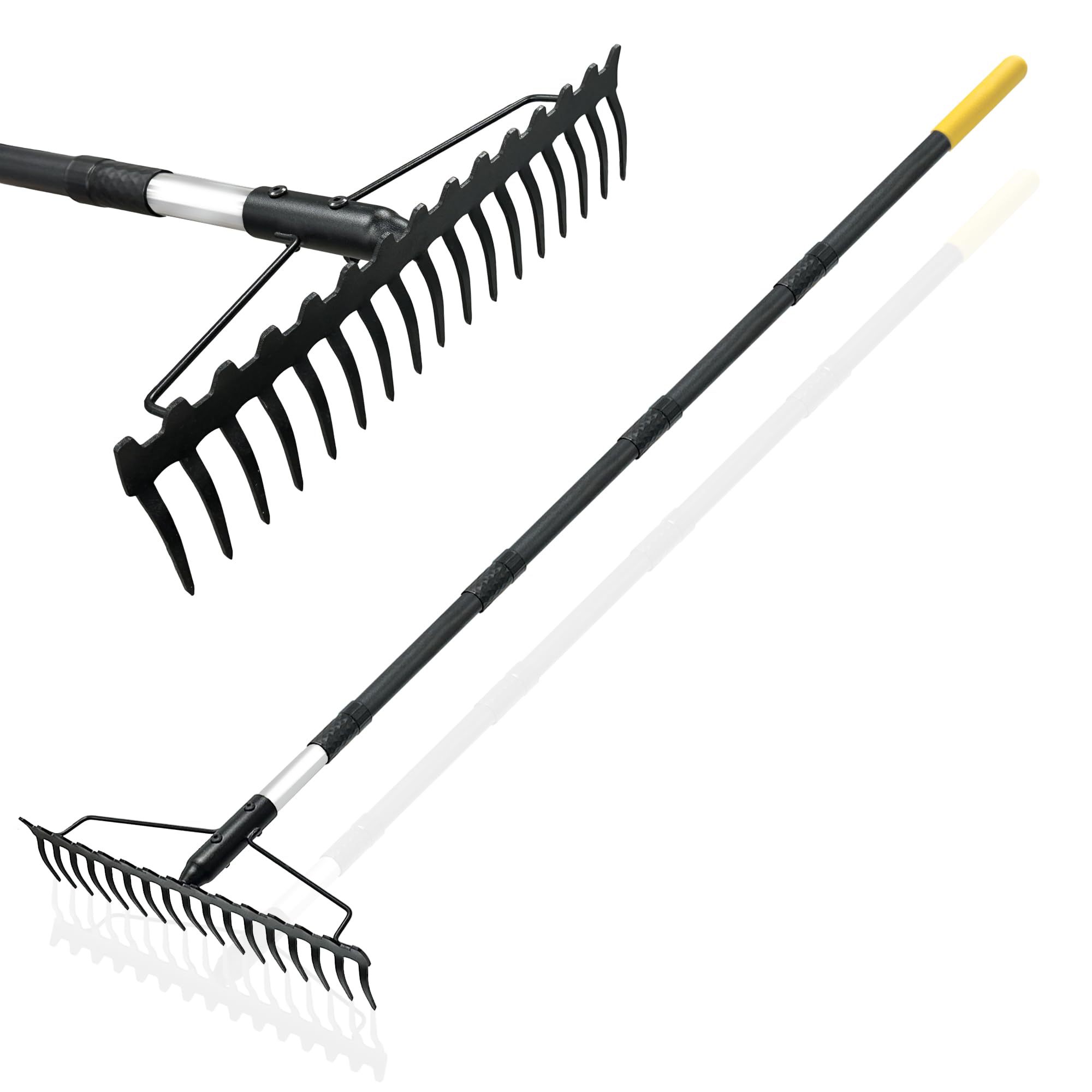
A 68-inch bow rake built for the serious ground-level work.
This is not a hand tool — it is a full-size bow rake with a 17-inch head and 17 manganese steel tines. The tines are 4 inches long, so they penetrate deep into compacted soil, thatch, and gravel. The dual-sided head gives you long tines for breaking ground and short tines for leveling and spreading, all in one flip. The handle extends to 68 inches, keeping you fully upright, and a soft non-slip grip adds comfort for long sessions. Assembly takes minutes with a threaded connection and included tools.
Buyers call it “a great rake for tough dirt” and note it is ideal for removing rocks, mulch, and debris from flowerbeds. A few owners mention durability concerns — an occasional tine may bend on very rocky ground — but the overall rating is strong, and the steel construction is praised as “well built.” It is heavier than the hand tools on this list, but that weight gives you momentum for deep penetration.
What it does best
- 17 tines cover maximum ground per pass — far more efficient than a hand claw for lawns.
- Adjustable 68-inch handle eliminates back strain during heavy raking.
Heads up
- Not a precision tool; it works best on open ground, not between delicate plants.
- Durability is mixed — most units are sturdy, but a small number of owners received bent tines.
Choose this for: large lawns, garden beds, and breaking up thatch without getting on your knees.
Skip it for: tight raised beds or container gardening where you need a smaller, lighter touch.
8. Altdorff Hand Tiller

A twist-action tiller that uses your body weight, not just your arms.
Instead of a traditional straight handle, the Altdorff uses a 17.7-inch arc handle. You push down and twist, and the four arrow-tipped tines rotate into the soil for continuous loosening and aerating. Owners say it is “much easier than shoveling or hoeing” and works even in dense soil. The tool assembles with four bolts and butterfly nuts, and the total length extends to over 30 inches. The alloy steel construction is sturdy, though some owners describe it as “a little flimsier than anticipated” for heavy compost turning.
A clever bonus: a few units ship with a pair of honey-bumblebee-themed gloves, which buyers delight in. The tool excels in raised beds and flower boxes, and its twisting motion is gentler on the wrists than a standard cultivator. Just take care to wipe it dry after use, as the manual suggests, and avoid rocky or cement-like ground.
The twist mechanic works: if you struggle with traditional pulling and pushing, this tool turns downward force into effective soil aeration with less effort per move.
Best for: gardeners who want a different mechanic than a standard rake — especially for turning compost and aerating soft beds.
Not ideal for: heavy clay or breaking new ground; the tines are sharp but the tool feels lighter than a solid forged-steel option.
9. Truper Rapid Tiller
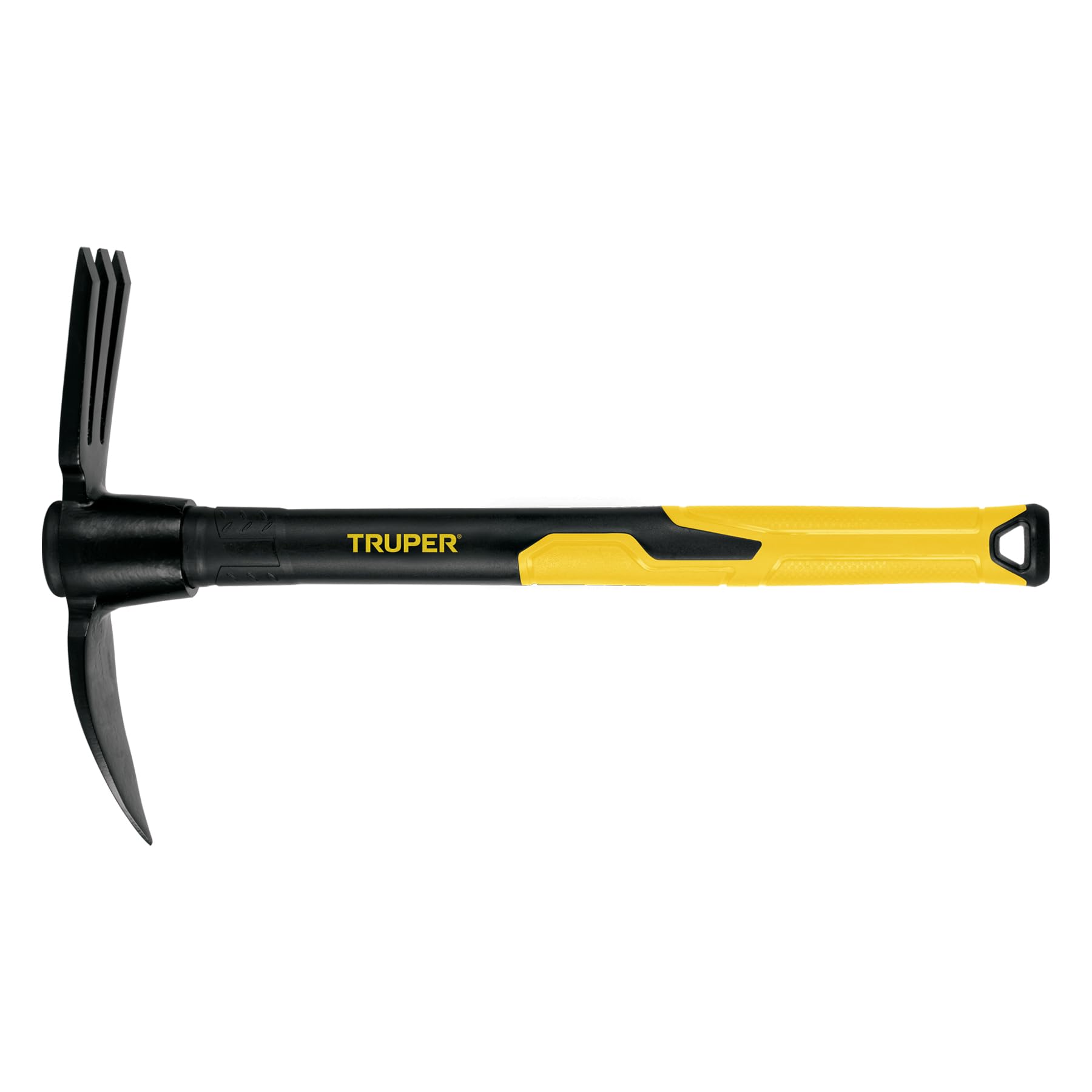
The heavyweight that tears through red clay like a plow.
The Truper Rapid Tiller is a dual-head digger and cultivator with a forged steel head — one side is a sharp digging blade, the other a 3-tine cultivator. The 14-inch fiberglass handle includes a comfort cushion grip that absorbs shock and reduces fatigue. Buyers who work in “heavy red clay” say it “tears through” the soil with accuracy. One owner has used the same tool for 6 years to remove dandelions, saying it “outlasted big-box store versions.”
The weight is a mixed bag — some love the heft because it provides momentum to dig deep, while others find it heavy after a few hours. One owner noted, “if you use it for a few hours you’ll have Popeye arms.” The handle length is comfortable for swinging and the well-balanced design makes it easy to twirl to switch between the blade and tines. If your garden is built on clay or you fight dandelions regularly, this is a professional-grade weapon.
Its strengths
- Forged steel head holds an edge and resists rust even when left in the rain.
- Pointed blade is excellent for dandelion root removal; 3-tine end clears clumps.
Consider this
- It is noticeably heavier than a standard cultivator — great for momentum but tiring over long sessions.
- Best for strong soil, not for delicate container work.
Reach for this if: you battle heavy clay, dandelions, or need a multi-year tool that stands up to abuse.
Pass if: you want the lightest possible tool for a raised bed — the weight will feel like overkill for soft soil.
Understanding the Specs
Tine Count (3-Tine vs 5-Tine)
The number of tines on a cultivator or rake head determines how much ground you cover in a single pass. A 3-tine tool is lighter and works well for mixing fertilizer into already-loose soil or weeding between delicate plants. A 5-tine tool spreads your effort over a wider area, so you break up more compacted earth and pull more weeds per motion. For hard clay or clay-loam mix, more tines with sharpened edges save you time.
Handle Length and Posture
Short handles (6 to 14 inches) keep you close to the soil, which works well when you are kneeling beside a raised bed or container. Long handles (45 inches and up) let you stand upright, protecting your lower back and knees. Adjustable handles offer both — you can collapse them for detail work or extend them for broad raking. If you have arthritis or chronic back pain, a long-handled option is worth prioritizing. The trade-off is control: a shorter handle gives you more precision around shallow-rooted plants.
Material: Steel vs Forged vs Tempered
Stainless steel resists rust best but can bend under extreme force. Forged steel is denser and tougher — it holds a sharp edge and handles rocky soil without deforming. Tempered boron steel is heat-treated for maximum hardness and edge retention; it is the material you find on heirloom-quality Dutch tools. Manganese steel (often used in bow rakes) combines wear resistance with flexibility, so the tines absorb shock rather than snapping. A protective coating or spray finish adds corrosion protection in rainy climates.
Dual-Purpose Heads (Hoe + Cultivator)
Some tools combine a flat hoe blade on one side and curved cultivation tines on the other. A single flip switches you from cutting roots and chopping dirt (the hoe side) to stirring, aerating, and weeding (the cultivator side). This saves you carrying two tools and speeds up transitions between tasks. The catch is that a dual head is usually heavier than a dedicated tool, and each side may be slightly less specialized than a single-purpose head.
FAQ
What is the best tool to break up hard-packed clay soil?
Can I use a hand cultivator in a raised bed?
How long does a good soil-loosening tool last?
Is a 3-tine cultivator enough or do I need 5 tines?
What is the difference between a hoe and a cultivator?
Will a hand tool work on soil that has never been turned?
How do I clean and store my cultivating tools?
Are long-handled tillers harder to control than short ones?
Can a garden tool to loosen soil also remove weeds?
What is the best tool for elderly or arthritic gardeners?
Final Thoughts: The Verdict
For the majority of shoppers, the garden tool to loosen soil winner is the DeWit 5-Tine Hand Cultivator because its tempered boron steel and five sharp tines make short work of hard soil without breaking your budget or your back — and it comes with a lifetime guarantee. If you want a long-handled option that lets you stand while you work, grab the COCONUT 45-Inch Hoe. And for those battling heavy clay and stubborn roots, the Truper Rapid Tiller is the forged-steel tank that will outlast your garden shed.
How We Picked
We do not accept paid placement. Every pick is matched to a real buyer and a real use-case; we do not hands-on test units.
Sources & Methodology
Specifications: manufacturer listings and product documentation. Review insights: verified customer reviews, as of July 2026. Pricing: not shown on this page (it changes often); check the current price via the retailer link.
As an Amazon Associate, Lawn Gear Lab earns from qualifying purchases. This does not affect which products we feature.