
Specs are compiled from manufacturer listings and verified buyer reviews and can change over time — please confirm the key details on the product page before buying.
Every drooping leaf or faded patch in your garden tells you the soil is off-balance, but without numbers you are just guessing at the right bag of fertilizer. That is where a real test kit hands you a read on your pH (acidity or alkalinity), nitrogen, phosphorus, and potassium — the four measurements that tell you exactly what your soil needs and nothing else.
I’m Rikta — the founder and writer behind Lawn Gear Lab. This guide is built by comparing the manufacturers’ published specifications and the patterns across verified customer reviews, so you get each pick’s real strengths and trade-offs instead of marketing spin.
You need a kit that is accurate enough to trust and simple enough to use without a chemistry degree. Here is the best garden soil test kit for every level of gardener, from the weekend warrior to the data-driven enthusiast.
Our Picks at a Glance


How To Choose The Best Garden Soil Test Kit
The right kit depends entirely on what you want to know. A simple pH check lets you adjust soil for acid-loving blueberries, but a full NPK (nitrogen, phosphorus, potassium) panel is what you need when a lawn looks pale or a vegetable bed underperforms. Here are the three most important factors to think about before you buy.
Test Type: Reagent vs. Probe vs. Lab
Reagent kits mix a soil sample with a chemical powder or liquid, then you compare the color change (called a colorimetric read) to a chart. They give you real numbers for pH, nitrogen, phosphorus, and potassium — the nutrients your plants actually eat. Probe meters (the one-prong or two-prong stick-style) are great for quick moisture checks and a rough pH read, but they cannot tell you about NPK, which is the whole point of feeding. Mail-in lab kits are the gold standard for accuracy — they measure a dozen or more elements and send back custom fertilizer plans — but they cost more and you wait about a week for the results.
Number of Tests
If you are testing one veggie bed and a few pots, a kit that gives you 10 tests per element is plenty for a season. If you manage a large property, multiple garden zones, or plan to test every new planting area, look for something offering 40 or more tests per parameter. Running out of reagent halfway through the season forces you to either skip tests or buy a whole new kit.
Ease of Reading the Results
Colorimetric kits rely on your eyes to match a colored liquid to a chart. Good kits use laminated cards with clear color bands and readable labels that make the match obvious even in lower light. Kits that have you squint at subtle pastel shades produce frustration rather than decisions. Some brands now include digital guides or quick-reference instruction sheets that simplify the process, which matters a lot when you are holding a dirty test tube and a sieve.
Quick Comparison
| Model | Best For | Test Type | Total Tests | Parameters | Amazon |
|---|---|---|---|---|---|
| LaMotte 5679-01★ Best Overall | Serious gardeners & educators | Chemical reagent | 75 | pH, N, P, K | Amazon |
| Luster Leaf 1601Best Value | Budget-minded beginners | Capsule reagent | — | pH, N, P, K | Amazon |
| Dewilde 140 TestHigh-Volume Pick | High-volume / classroom use | Liquid reagent | 140 | pH, N, P, K, Ammonia | Amazon |
| Auduto 7-in-1 | Quick instant-read checks | Digital probe meter | Instant | Moisture, pH, Light, Temp, Fertility | Amazon |
| Premium Soil Test Kit | Value-focused home gardeners | Tablet reagent | 40 | pH, N, P, K | Amazon |
| EDGEVEIL HG01 | Wireless multi-plant monitoring | Wireless TDR probe | Continuous | Moisture, Temp, Light, Clock | Amazon |
| NewTest 4 Parameter | DIYers wanting lab-like results at home | Reagent strip/liquid | 40 | pH, N, P, K | Amazon |
| YINMIK Digital pH | Focused pH monitoring | Digital probe (Bluetooth) | Instant continuous | pH, Temperature | Amazon |
| MySoil PRO Pack | Lab-accurate custom analysis | Mail-in lab | 2 kits | 13 plant-available nutrients | Amazon |
In‑Depth Reviews
1. LaMotte Model EL Turf & Garden Soil Test Kit 5679-01
Our pick — over 4.5★ from 300+ verified ratings; the strongest balance of quality and price.
The chemistry-lab-grade kit delivers 75 tests you can trust — far more than the Luster Leaf’s unnamed capsule count.
You reach for the LaMotte Model EL 5679-01 when a flimsy meter has let you down one too many times. It uses real chemical reagents — the kind you mix with a measured soil sample and watch change color in a test tube — to give you 15 tests each for nitrogen, phosphorus, and potassium, and 30 tests for pH. The laminated color charts are crisp and easy to read, so you are not squinting at a muddy gradient trying to decide if your phosphorus is low or medium.
What owners praise most is that it is genuinely easy to use once you get the hang of the numbered parts and the diagrammed instructions. The quality of the case and the glassware inside is noticeably better than anything in the budget realm. That said, there is a real quirk: the phosphorus test requires a double extraction to get a clear color separation, which effectively halves the number of phosphorus tests you get. A few owners also note that the recommendation charts are written for acre-scale applications, meaning you will need to do some math for a small backyard bed. Still, the reason this kit holds the highest rating among all the reagent-based options is simple — it delivers truth about soil chemistry in a way cheaper meters simply cannot.
Lab-grade performance: At 2.9 pounds with a rugged carrying case and enough reagents to test a half-acre property over several seasons, this is the kit you buy once and refill. The trade-off is preparation time — you need to dry your soil sample the day before, and the instructions say to do only three tests at a time because of the tube setup.
Best for: Mid-sized to large gardens, serious vegetable growers, and anyone who wants actual NPK numbers instead of a dial reading.
Think twice if: You want a 5-minute instant answer — this kit demands patience, a kitchen sieve, and a clean workspace.
2. Luster Leaf Rapitest Soil Test Kit 1601
For the price of a bag of premium potting mix, you get a capsule-based system that answers the basics.
You fill a chamber with soil and water, drop in a powder capsule, shake, and compare the color to a built-in comparator (a small, clear plastic window with color references). The results for pH, nitrogen, phosphorus, and potassium come out clearly color-coded, and buyers report that the readings are close enough to professional lab tests for practical decision-making. One reviewer noted it helped them identify low nitrogen on their lawn, which is exactly the kind of actionable data a home grower needs.
What makes this kit a repeat-purchase for many is its simplicity. Owners say the instructions are clear and the process is straightforward enough that even kids can help. The honest catch is that the nitrogen test sometimes fails to show any reading at all, even in soil known to be enriched with fertilizer — a few owners have reported that particular test seems unreliable. The broader consensus is that if you take your time and follow the steps exactly, this kit works admirably for the price, and it has earned enough trust from buyers that many are on their second or third unit.
Real-world verdict: A reliable first kit that will tell you if your soil is severely out of whack. It is not as precise as the LaMotte, but at a fraction of the cost it removes the guesswork for a typical front lawn or a raised vegetable bed.
Reach for this if: You are new to soil testing and want to confirm that your garden is on the right track without spending a lot of money or time.
Look elsewhere if: You need pinpoint accuracy for a specialized crop or you are managing multiple distinct garden zones.
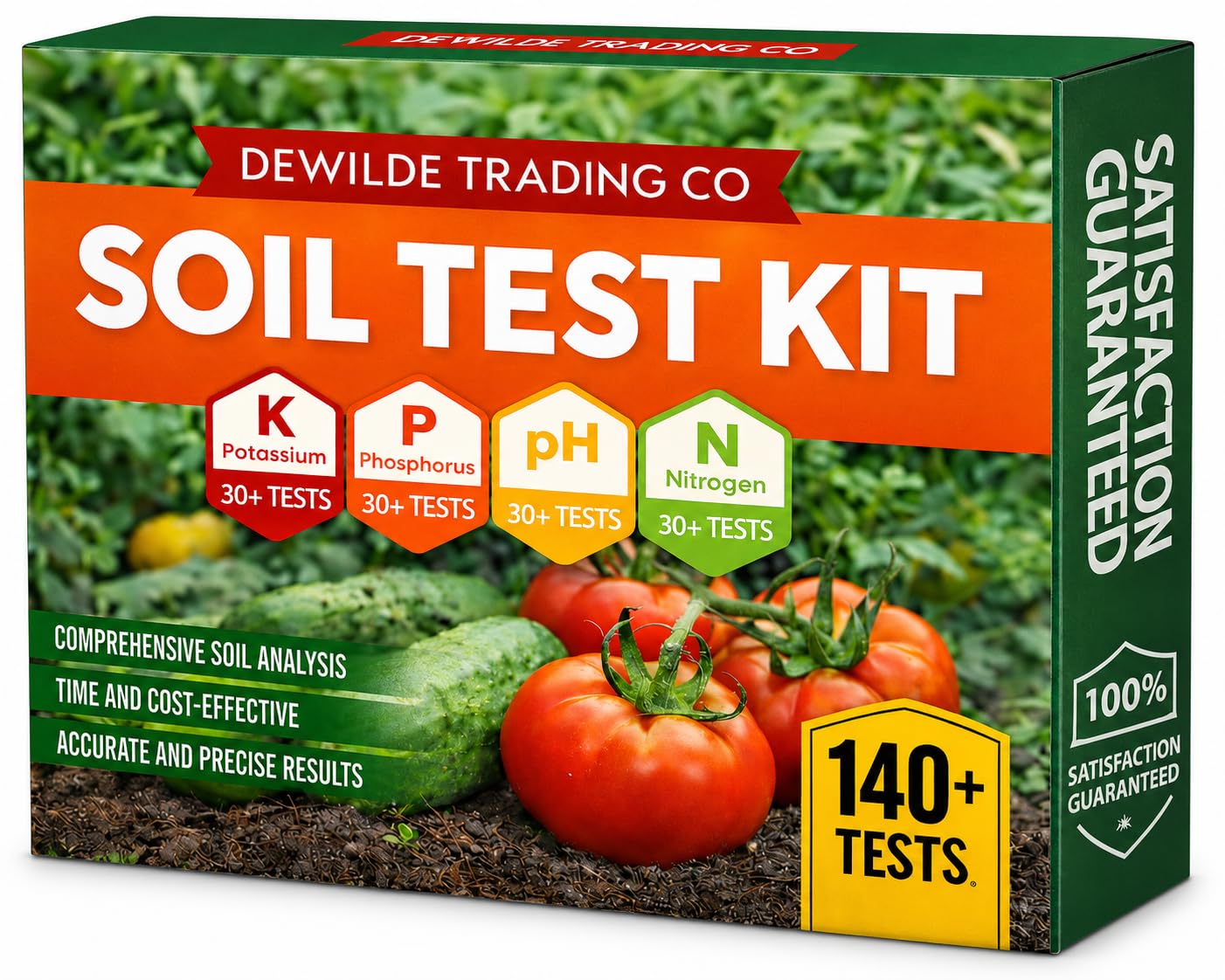
3. Dewilde Trading 140 Test Soil Kit
140 tests — roughly 40 per main parameter — so you can test every bed, every compost pile, and still have some left over.
If you have a sprawling property, multiple garden beds, a compost pile, and a few houseplant collections, this kit from Dewilde Trading is built to last through the entire growing season. It measures pH, nitrogen, phosphorus, potassium, and ammonia — an extra parameter most kits skip — giving you a holistic look at your soil’s fertility. The instruction booklet claims 2026 updated procedures, which means the steps are written for clarity and the color chart is better differentiated than older versions.
The big practical catch is that the beakers are quite small. A few owners note they had to run the test in two stages because the sample container could not hold enough soil-and-water mix for a clean read. The instruction chart also lacks a direct “high / optimal / low” interpretation for NPK, so beginners may need to research what a given color means for their specific crop. On the plus side, the sheer number of tests — roughly 40 for each main parameter and about 20 for nitrogen — means you can test before every fertilizer application and track changes through the season.
Perfect for classrooms: The colorful, easy-to-read results make this a natural fit for teaching kids about soil science. For a home gardener, the value-per-test is tough to top, but expect to work around the small beaker size.
Best for: Large properties, community gardens, and educators who need a bulk supply of tests that cover ammonia in addition to standard NPK.
skip it if: You want a streamlined, one-container process with immediate clear-cut recommendations.
4. Auduto 7-in-1 Soil Tester
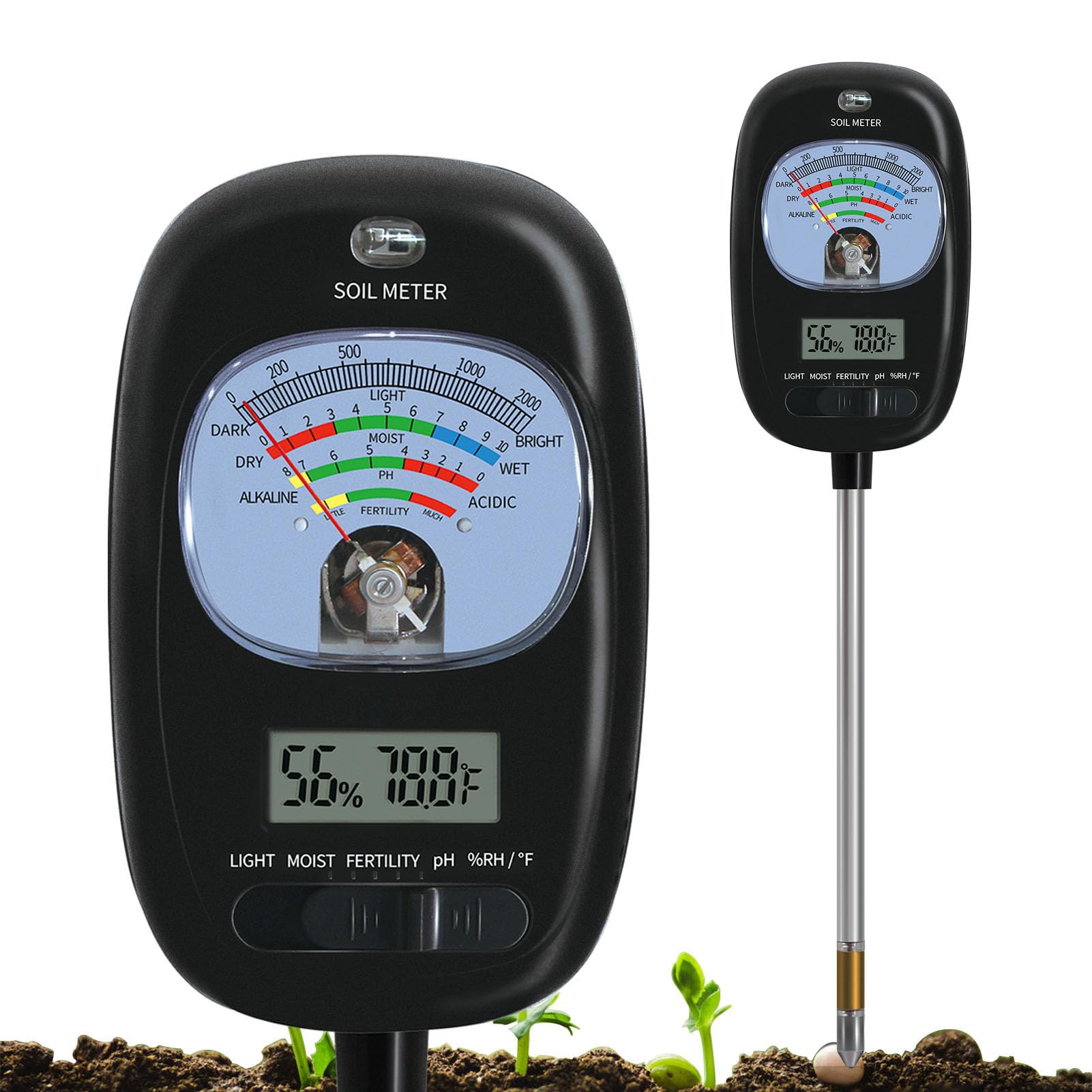
You get seven readings — moisture, pH, light, fertility, air humidity, air temperature, and soil temperature — in one single plunge.
This is not a chemical reagent kit — it is a 7-in-1 digital probe that measures soil moisture, pH, sunlight intensity, fertility, air humidity, air temperature, and soil temperature all on one big LCD screen. For the plant parent who keeps a mix of indoor pots and a small outdoor bed, this eliminates the need for three separate tools. The metal probes are corrosion-resistant and deliver fast readings, so you get a moisture check in seconds and a stable pH read in about a minute.
The caveats are important: this tester is designed for soil only — never for water or liquids — and it cannot measure nitrogen, phosphorus, or potassium individually. The “fertility” reading is a relative index, not a breakdown. It also struggles in sandy or very loose soils, and the manufacturer recommends inserting the probe two-thirds of the way in, which can be tough in compacted clay. That said, owners consistently call this a “lifesaver” for houseplants, and the clear LCD takes all the guesswork out of watering and light placement.
One device, many answers: For the gardener who values convenience over granular data, this probe covers moisture, pH, light, and temperature in one go. The patent-pending design combines a standard meter with an air-and-soil thermometer, which is a rare combo at this price.
Best for: Houseplant enthusiasts, container gardeners, and anyone who just wants a quick soil health snapshot without mixing chemicals.
Not for: Gardeners who need specific NPK numbers to formulate a fertilizer blend.
5. Premium Soil Test Kit (40 Tests)
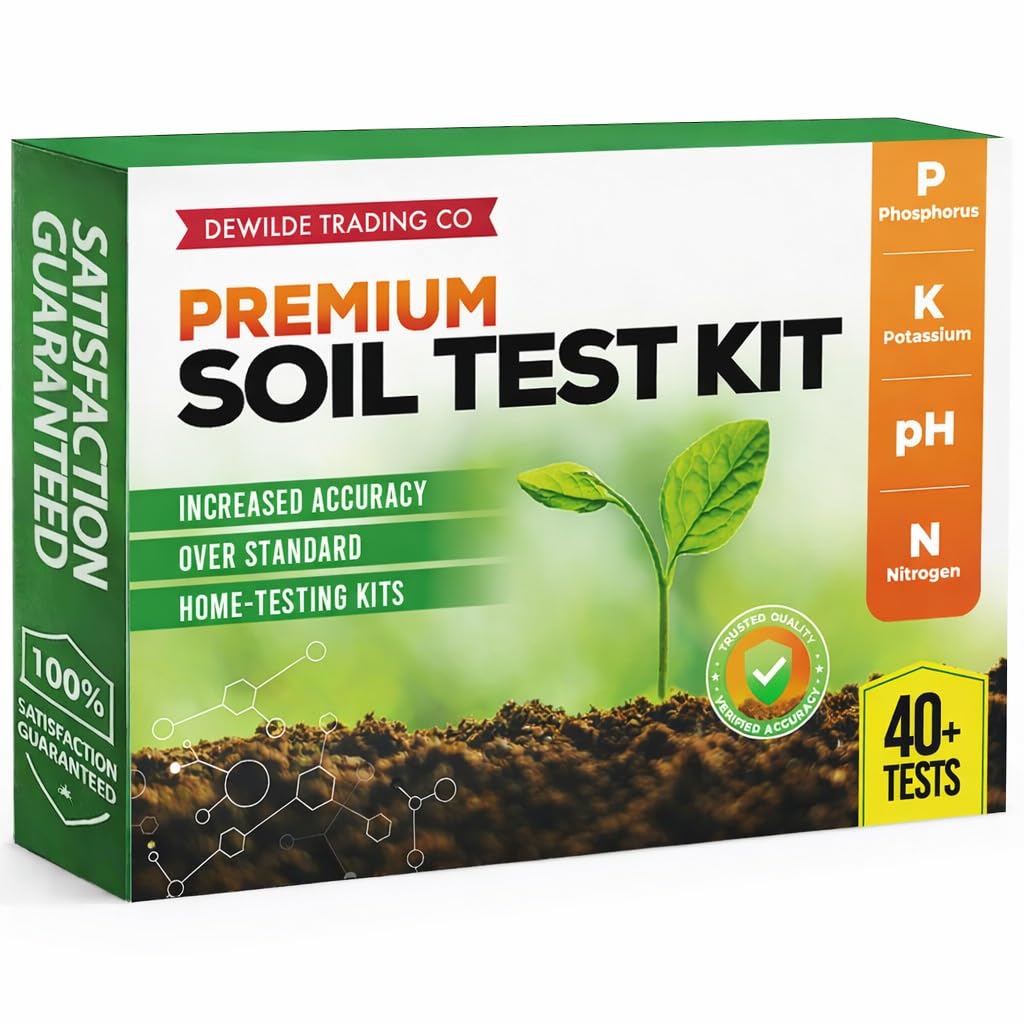
10 tests per parameter in a compact box that fits in a garden tote — no complex mixing steps needed.
Sometimes you just need to confirm a hunch — “is my nitrogen low here?” — without dedicating a whole afternoon to the endeavor. This 4-in-1 kit packs 10 tests each for pH, nitrogen, phosphorus, and potassium into a compact box that is easy to carry to the garden. It uses a tablet reagent system: you drop a tablet into your soil-and-water solution, wait for the color to develop, and compare it to the included color card. Buyers consistently say the tests are simple to perform and that the results are accurate enough to guide their fertilizing decisions.
The thing that owners praise most is the value — at this price, you get a complete testing setup with two test tubes, a dropper, and 40 tablets, so you can test across multiple areas or across the season. One gardener noted it helped them identify low nitrogen on their lawn, which is exactly the kind of actionable data a home grower needs. There are no unnecessary extras here, and no false promises of professional-lab precision. It is a straightforward, honest kit that does exactly what it says on the box.
Smart and economical: The kit covers all four major parameters in a format that is small enough to fit in a garden tote. The lack of any complex mixing steps makes it a low-friction option for a quick Saturday test.
Best for: The home gardener who needs a dependable backup kit or wants to test a few specific spots without buying a massive set.
Consider skipping if: You need to test dozens of samples in a single session — 10 tests per parameter will run out quickly on a large property.
6. EDGEVEIL HG01 4-in-1 Wireless Soil Tester
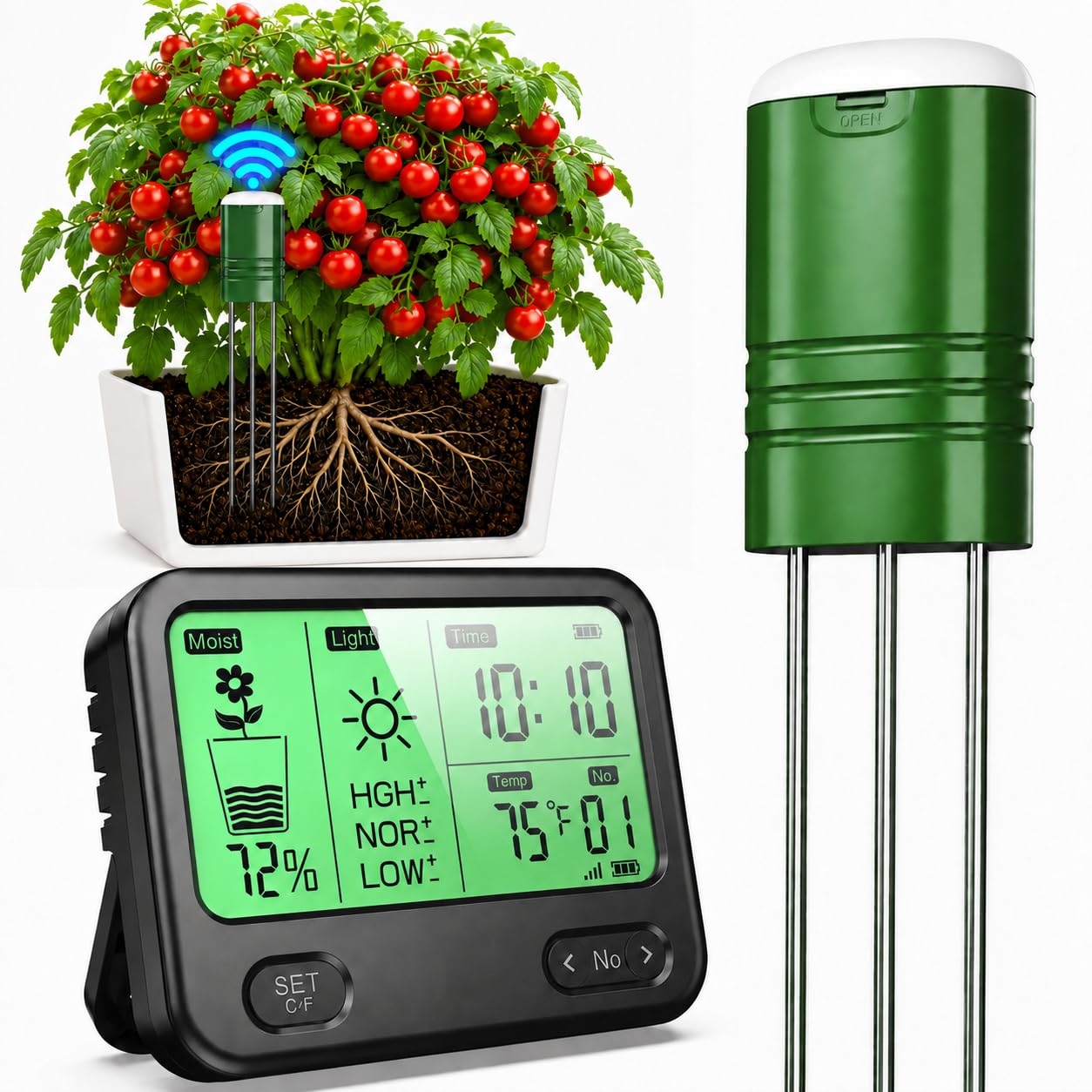
You leave this wireless sensor in the soil and check moisture, light, and temperature from up to 328 feet away.
Imagine you are inside on a rainy evening and you want to know if your raised bed needs watering without stepping outside. The EDGEVEIL HG01 makes that real. The wireless sensor sits permanently in the soil and transmits data up to 328 feet to a large, clear display. It measures moisture, temperature, light intensity, and even shows a real-time clock. The triple-probe TDR (time-domain reflectometry) technology delivers stable readings by sensing the soil from multiple points, so you are not fooled by a dry pocket near a single prong.
What owners here call out most is the functionality — the sensor gives accurate moisture levels across different plants, and the light meter is a genuinely useful addition for adjusting pot placement. One display can connect with up to 12 sensors, meaning you can monitor every corner of your garden from one screen. The honest caveat is that this is a moisture-and-environment tool, not a nutrient analyzer. It cannot tell you about nitrogen or phosphorus, so you will still need a reagent kit for feeding decisions. But for keeping your plants alive between feedings, this wireless system removes virtually all the daily guesswork.
Set-and-forget convenience: The probe is waterproof and corrosion-resistant, and the unit runs on 2 AAA batteries that come included. Owners mention the wireless works reliably through walls at around 15 feet, and the display is bright enough to read in daylight.
Best for: The tech-friendly gardener with multiple houseplants or a medium-sized garden who wants continuous data without constant hands-on testing.
Not for: Anyone who needs specific NPK values — this monitor handles water, light, and warmth only.
7. NewTest 4 Parameter Soil Test Kit

NewTest Labs designed this kit to solve a specific problem: cheap at-home tests often return unreliable results because the reagents degrade or the instructions skip critical steps.
NewTest Labs set out to fix that. This kit comes with a quick guide and a detailed instruction booklet that even a beginner can follow to accurately measure pH, nitrogen, phosphorus, and potassium. Each of the 40 tests includes its own reading method so you compare the right color chart to the right solution, reducing the margin for human error that plagues generic kits.
The reviews reveal a split that is worth understanding. Several owners — including a Master Gardener and a former lab technician — say this kit is simple and accurate, and that the results match what they expected from their soil. But a vocal minority finds the process complicated, with too many manipulations and a final color readout that feels subjective. This is the kit for someone who wants to treat soil testing like a small science project — follow the steps carefully, and you get reliable data. Rush through it, and the results will feel vague.
Designed for precision: The kit includes a separate reading method for each nutrient, which means more individual steps but also more trustworthy outcomes for each element. The package also supports any soil type, including soilless media and hydroponics.
Best for: The methodical gardener who is willing to read instructions carefully and appreciates a kit designed with lab-level detail.
Think twice if: You want the fastest possible test with the fewest moving parts — this one asks for patience.
8. YINMIK Digital pH Meter for Soil

This Bluetooth-connected pH meter logs readings with time stamps automatically, so you can track soil acidity trends over 24 hours or across weeks.
If your gardening obsession is getting blueberries, azaleas, or potatoes to thrive in soil that is slightly too alkaline, this YINMIK meter is the perfect specialist tool. It uses a tapered stainless-steel dibber to protect a fragile glass pH electrode as you push the probe into the soil. Stick it in, and you get an accurate digital pH reading in seconds. Remove the steel protector, and the same meter tests the pH of your hydroponic solution or watering well.
The headline feature here is the Bluetooth connectivity. You download the YINMIK App and the meter logs pH readings with time stamps automatically, so you can monitor trends over 24 hours or across weeks. Several owners confirm that the readings match lab results within a 0.1 margin, which is impressive for a home device. The caveat is durability — a handful of customers note the meter stops communicating via Bluetooth after several months, or gets stuck on one pH value. The maker includes a calibration kit and a cleaning brush, and following the care instructions to the letter seems to extend the lifespan. If you accept that a digital probe is not a buy-it-for-life tool, the performance while it works is excellent.
Smart and sharp: The stainless dibber protects the glass electrode from breakage in rocky soil, and the Bluetooth logging is genuinely useful for tracking how a soil amendment changes pH over a week. The meter comes with 3 LR44 batteries, 6 calibration buffer powders, and a cleaning brush.
Best for: pH-obsessed growers who want digital precision and the ability to track soil acidity changes over time without writing anything down.
pass on it if: You need NPK data — this meter does pH and temperature only.
9. MySoil Test Kit PRO Pack

You take a small soil sample using the included 8-inch soil probe and mail it off — about a week later you get a report measuring 13 plant-available nutrients with a personalized feeding plan.
When you are done fiddling with probes and color charts and you just want the definitive answer, MySoil’s PRO Pack is the endgame. You take a small soil sample using the included 8-inch soil probe, drop it in the prepaid envelope, and in 6-8 days you get a professional lab analysis of 13 plant-available nutrient levels — including nitrogen, which many state-run labs skip. The report does not just give you numbers; it gives you a feeding plan: what to apply, how much, and when, with both organic and synthetic recommendations.
What owners keep coming back to is the ease of use. You follow the simple instructions, push the probe into the soil (owners warn that it struggles if your ground is pebbly), and mail it off. The results arrive quickly — often in under a week — with clear charts and specific suggestions. The honest trade-off is cost: the PRO Pack includes two test kits and the soil probe, and each kit is a one-time use, so repeat testing across the season gets expensive. A few owners also note that the recommendations can feel generic if your soil shows a very specific micronutrient deficiency — one report suggested an expensive all-purpose micronutrient product rather than targeting the single missing element.
Total clarity, total cost: You pay a premium for the convenience and accuracy of a real lab, but you get a complete soil roadmap that no home kit can match. For the first-time tester on a new property, this is the smartest money you can spend.
Best for: The serious gardener establishing a new lawn or garden from scratch, or anyone who has tried home kits and wants a definitive answer before investing in soil amendments.
Not for: The budget-conscious grower who needs to test multiple spots every season — the cost per test adds up quickly.
Understanding the Specs
Reagent vs. Meter vs. Lab
Reagent kits use a chemical reaction to change the color of your soil solution, and you match that color to a chart. They are the only home-usable method that gives real numbers for nitrogen, phosphorus, and potassium. Meter probes measure electrical conductivity or light refraction — great for a fast pH and moisture check, but they cannot tell you how much nitrogen your soil holds. Mail-in lab kits send your sample to a testing facility and return a full report; they are the most accurate but require planning and a postage stamp.
Color Chart Readability
Not all color charts are created equal. Laminated, well-lit charts with high-contrast color bands make matching easy even in morning or evening light. Cheaper kits often print on matte paper that absorbs water and smudges, or use pastel shades that are almost impossible to distinguish. A good kit gives you a clear reference card with distinct color blocks and labels that tell you “low,” “medium,” or “high” directly, so you do not need to guess.
Test Count and Shelf Life
A kit’s test count tells you how many individual measurements you can perform before the reagents run out. A 10-test-per-parameter kit is fine for a single garden bed. A 40-test kit lasts a full season on a larger property. Reagents have a finite shelf life, usually printed on the packaging — old reagents can produce inaccurate colors, so always check the expiration date before you buy a kit you plan to store for next season.
FAQ
What is the difference between a pH meter and a full soil test kit?
How accurate are at-home soil test kits compared to a lab?
How often should I test my garden soil?
Can I use a soil test kit in my vegetable garden?
What is the best time of year to test soil?
How do I take a soil sample for a reagent kit?
Do soil test kits expire?
Can I test my soil for heavy metals with these kits?
Is a wireless soil moisture meter worth it?
What does NPK stand for?
Final Thoughts: The Verdict
Across the board, the best garden soil test kit is the LaMotte Model EL 5679-01 because it combines professional-grade chemical reagent testing with a durable carrying case, clear instructions, and the highest owner satisfaction among all the at-home kits — a true crowd-favorite for serious growers. If you want instant digital convenience for everyday plant care, grab the EDGEVEIL HG01. And for ultimate lab-tested precision with a personalized feeding plan, the MySoil PRO Pack is the one to reach for.
How We Picked
We do not accept paid placement. Every pick is matched to a real buyer and a real use-case; we do not hands-on test units.
Sources & Methodology
Specifications: manufacturer listings and product documentation. Review insights: verified customer reviews, as of July 2026. Pricing: not shown on this page (it changes often); check the current price via the retailer link.
As an Amazon Associate, Lawn Gear Lab earns from qualifying purchases. This does not affect which products we feature.