
Specs are compiled from manufacturer listings and verified buyer reviews and can change over time — please confirm the key details on the product page before buying.
You want a hose that delivers water where you aim it without kinking, leaking, or wearing you out. The difference between a hose that fights you and one that works quietly depends on three things: the rubber itself, the fittings, and how thick the walls are. This guide covers only real rubber hoses — no vinyl blends that crack in the sun — so your water actually gets where you point it.
I’m Rikta — the founder and writer behind Lawn Gear Lab. This guide is built by comparing the manufacturers’ published specifications and the patterns across verified customer reviews, so you get each pick’s real strengths and trade-offs instead of marketing spin.
After sorting through the burst pressures, wall thicknesses, and buyer reports, these four hoses stand out as the most reliable options for a range of budgets and yard sizes. This is your plain‑English walkthrough to finding the garden rubber hose that actually fits how you water.
Quick Picks
- Wiseflow Garden Hose 50FT x 3/4″ — Premium Pick
- Heavy Duty Garden Hose 5/8″ x 100ft — Top Performer
- SPECILITE 5/8″ Hot/Cold Rubber Garden Water Hose 50 ft — Best Versatility
- Eden 94051 Rubber Garden Hose 1/2 in. x 50 ft — Budget Champion
How To Choose The Best Garden Rubber Hose
Not all hoses labeled “rubber” are built the same. The thickness of the wall, the material of the connector, and the pressure the hose can handle before bursting are what separate a season‑long performer from a frustration on the spigot. Here is what actually matters when you shop.
Burst Pressure vs. Working Pressure
The working pressure (measured in PSI, or pounds per square inch) is what the hose handles during normal use — think of it as the cruising speed. The burst pressure is the breaking point. A garden spigot typically delivers 40 to 60 PSI, so a hose with a 300 PSI working pressure and a 1200 PSI burst pressure leaves a huge safety margin so you never have to worry about a rupture during a hot afternoon watering session.
Fitting Material: Brass vs. Plastic
The connector at each end of the hose is where most leaks begin. Solid brass fittings resist corrosion, hold a tighter seal on the faucet, and handle accidental drops without cracking. Plastic or zinc fittings cost less but often strip or crack after a season of sun and tightening, forcing you to cut and replace the end.
Wall Thickness and Layering
A thicker hose wall resists punctures from rocks and garden tools. Some hoses use three‑layer or even five‑layer braided construction between the inner tube and outer cover. More layers generally mean the hose stays round and doesn’t collapse when bent, so you get consistent water flow even when the hose snakes around a corner.
Quick Comparison
| Model | Best For | Length | Burst Pressure | Outside Diameter | Amazon |
|---|---|---|---|---|---|
| Wiseflow Garden Hose 50FT | High‑pressure tasks & durability | 50 ft | 1200 PSI | 0.98 in | Amazon |
| Heavy Duty Garden Hose 5/8″ x 100ft | Long reach & extreme temps | 100 ft | 650 PSI | 0.63 in | Amazon |
| SPECILITE 5/8″ Hot/Cold Hose 50 ft | Hot & cold water versatility | 50 ft | 600 PSI | 0.63 in | Amazon |
| Eden 94051 Rubber Garden Hose 50 ft | Budget‑friendly & lightweight | 50 ft | — | 0.5 in | Amazon |
In‑Depth Reviews
1. Wiseflow Garden Hose 50FT x 3/4″
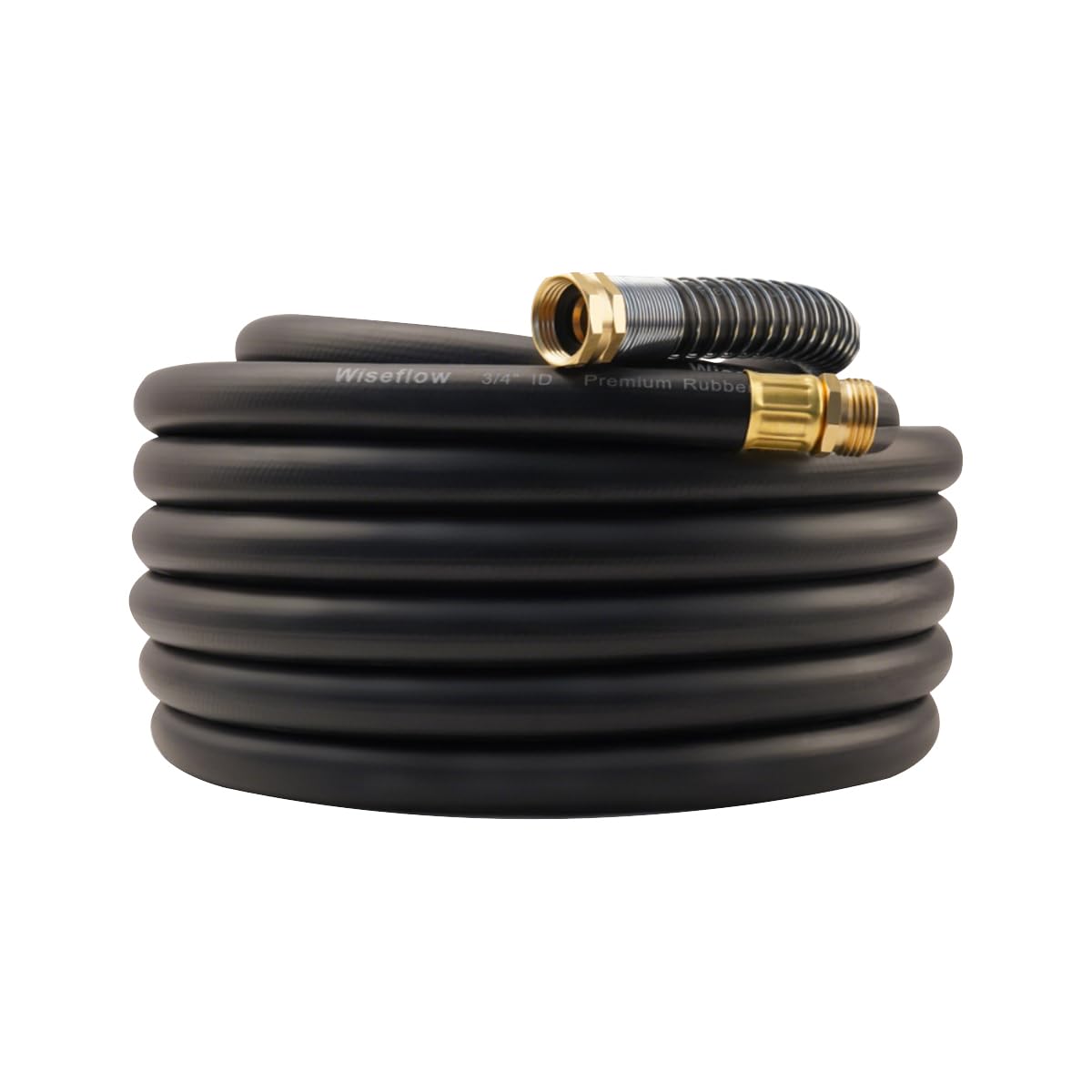
The tank of the category, built to shrug off sharp rocks and high pressure without flinching.
This is the hose you reach for when you need real water volume and zero drama. It has a 3/4-inch inner diameter — noticeably wider than the 1/2-inch of the Eden hose — so more water flows through every minute. That extra flow matters when you are running a sprinkler across a large lawn or filling a bucket fast.
The five-layer braided construction includes double-layer braided wire inside the rubber. That is why the working pressure sits at 300 PSI and the burst pressure hits 1200 PSI — compared to the SPECILITE’s 600 PSI burst pressure. The outside diameter measures 0.98 inches, making it the thickest hose here, and reviewers confirm it shrugs off sharp objects and even pets chewing on it. Buyers specifically note that “the brass fittings are very well made and believe it or not, the hose does actually seem to resist kinking which is a first for me!”
At 0.14 inches nominal wall thickness, this hose stays flexible down to -40°F. The trade-off is weight: at 3/4-inch diameter with that heavy braiding, it is less nimble than the thinner 1/2-inch options. If most of your watering stays within a small flower bed, this may be more hose than you need.
What makes it stand out
- Five-layer braided design with wire reinforcement for puncture resistance
- 1200 PSI burst rating leaves a massive safety margin
- Solid brass 3/4-inch GHT fittings with 360-degree swivel
The one caveat
- Heavier and bulkier than a 1/2-inch hose — not ideal for threading through tight beds
Grab this if: You need a rugged workhorse for high-volume watering, car washing with a pressure washer, or rough terrain where a thinner hose would get torn.
Think twice if: Every ounce counts on your hose reel and you mainly water potted plants on a small patio.
2. Heavy Duty Garden Hose 5/8″ x 100ft
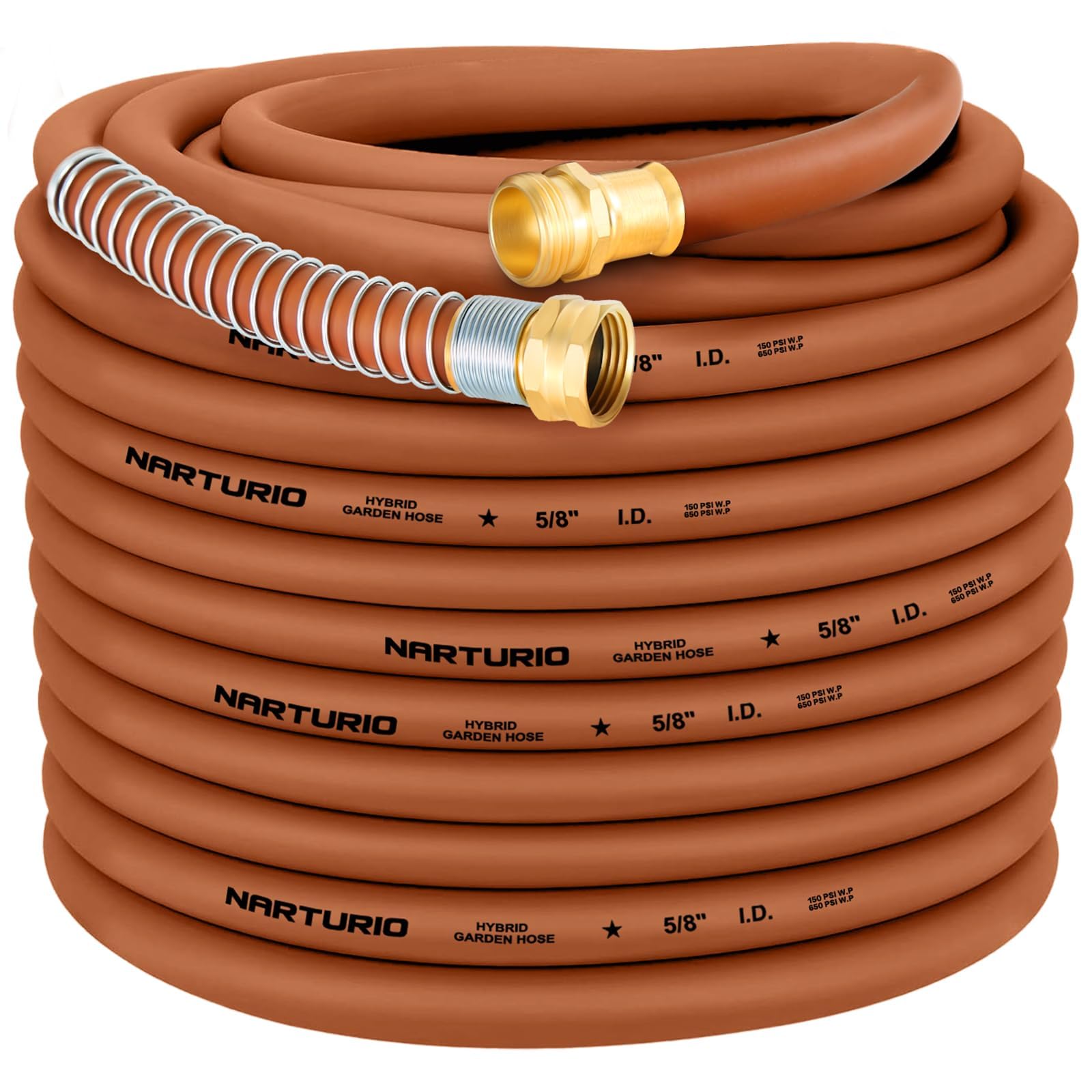
The 100-foot runner that bridges the far corner of the yard without springing a leak.
A 100-foot hose is a specific tool — you do not buy it unless you need that extra reach. This one stretches the full distance while staying a manageable 5/8-inch diameter. It covers at 100 feet, compared to 50-foot options like the Wiseflow and Eden, giving you access to the back garden or driveway from a single spigot connection.
The three-layer encrypted braided construction is designed to fight kinks, and reviewers report that “this hose awesome! Doesn’t kink and feel late super heavy duty.” The burst pressure of 650 PSI and solid brass 3/4-inch GHT fittings give you leak‑free connections across the full run, even when the water is on full blast. The temperature tolerance of -40°F to 176°F is also second only to the SPECILITE’s 190°F upper limit, so it stays pliable in deep winter.
Because it is 100 feet long, you will notice more weight when coiling than a 50-footer. Some early buyers reported that the design can loosen the connector if twisted incorrectly during use, so keeping the swivel fittings straight when you pull matters.
The defining trade-off: The 100-foot length is a lifesaver for large properties but introduces more hose to manage — it kinks less than a typical vinyl 100-footer, but you still need to coil it mindfully to avoid the connector loosening.
Ideal for: Long straight runs across a lawn or driveway where a 50-foot hose forces you to move the spigot connection.
Not for you if: Your watering stays within a small city lot — the extra length becomes a tangle you will drag through flower beds.
3. SPECILITE 5/8″ Hot/Cold Rubber Garden Water Hose 50 ft
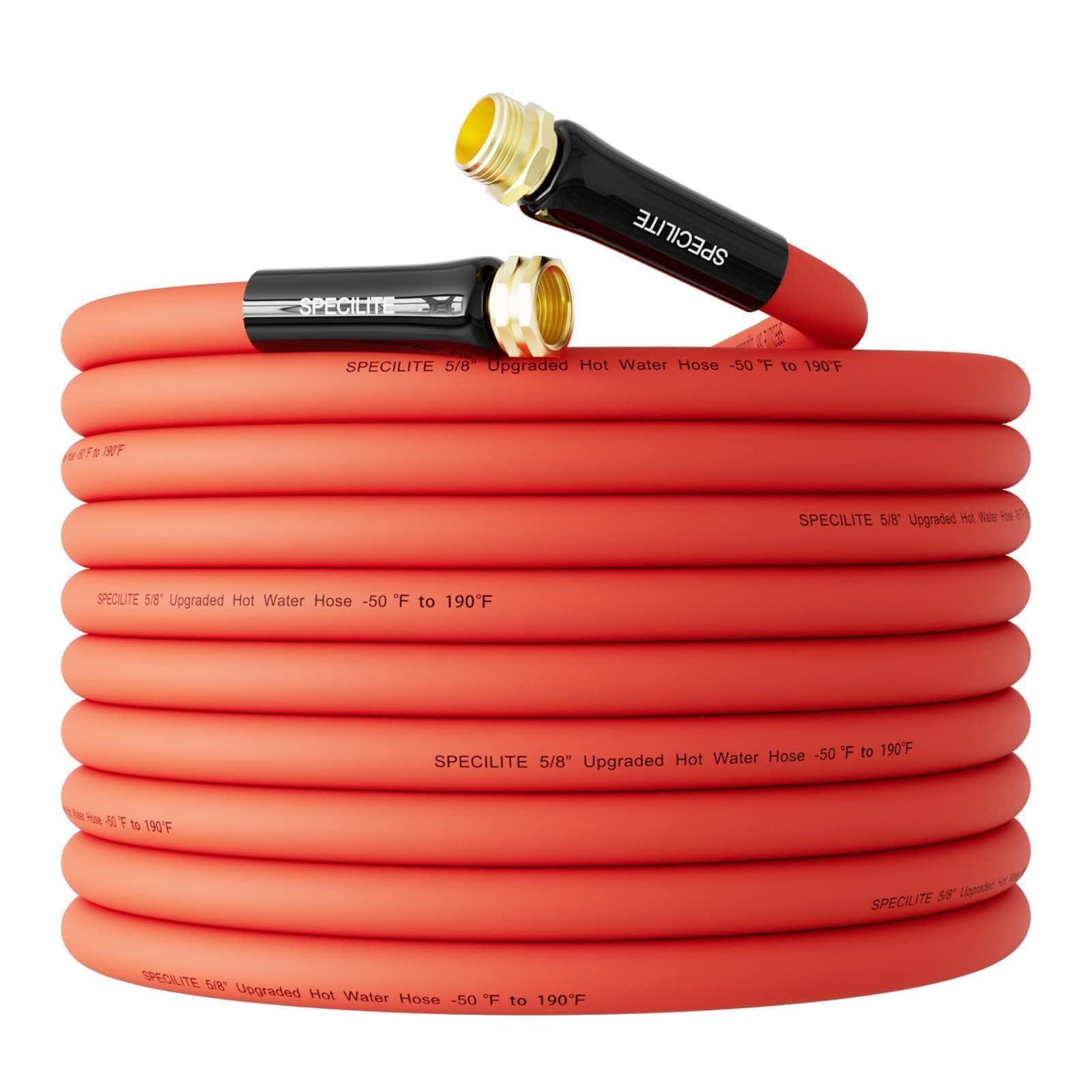
A dual‑temperature hose that handles boiling water and freezing winters in one package.
This is the only hose in this lineup that is explicitly rated for hot water use — up to 190°F. That means you can use it to drain a water heater, wash the car with hot water, or leave it in direct summer sun without worrying about the rubber softening. The cold tolerance of -50°F is also the lowest here, beating the Wiseflow’s -40°F, so if you live in a deep‑freeze climate it stays flexible when you uncoil it on a January morning.
The three-layer reinforced rubber carries a working pressure of 200 PSI and a burst pressure of 600 PSI, compared to the Wiseflow’s 1200 PSI burst rating. The brass fittings are solid and the package includes extra gaskets and Teflon tape in the box. Buyers do appreciate the vivid red color — “bright and cheery,” as one reviewer put it — and find it easy to roll up without twisting.
The catch, and it is a real one, is that a small number of buyers had the hose fail at the nozzle fitting quickly. One owner stated plainly: “Leaked at nozzle fitting after 5 days of normal use.” That is a risk to weigh against its otherwise impressive temperature range.
What sells it
- Wide temperature range (-50°F to 190°F) for hot water draining or cold‑weather use
- Lighter than traditional rubber hoses according to the manufacturer
- UV-resistant additives to prevent sun cracking
The weak point
- QC issues on nozzle fitting reported by several buyers; test immediately on arrival
Choose it for: A dedicated hot‑water hose or a lightweight runner that needs to survive harsh winters.
Hesitate if: You want a no‑fuss hose you can hook up and forget — the fitting issue means you will want to inspect it closely right away.
4. Eden 94051 Rubber Garden Hose 1/2 in. x 50 ft

A no‑fuss entry‑level rubber hose that weighs half as much as the premium contenders.
At 3.75 pounds and a 1/2-inch outside diameter of just 0.5 inches, this Eden hose is the lightest and slimmest option here. That makes it easy to carry, coil, and store, especially if you are not a fan of wrestling with a heavy hose after every watering session. The 3-ply braided rubber construction gives it decent durability for moderate use — garden beds, flower pots, and lawn‑edge watering — without the weight of a thick-walled hose.
One of its hidden strengths is compatibility with the Eden drip‑system accessories. The hose is made to be cut with scissors and connected to Eden sprinklers and fittings without tools, making it a flexible building block for a custom irrigation setup. A reviewer described how they “used the Eden hose and sprinkler heads to create a nearly invisible system” that ran along a stone wall, confirming its versatility for permanent landscape installations.
The weak spot, and it is a well‑documented one, is the included plastic connectors. Multiple buyers reported leakage at the fittings, with one engineer saying the connector deformed and “blew off the end of the hose” after being stepped on. The simple fix is swapping the stock fittings for standard 1/2-inch barbed brass fittings, which turns this into a dependable lightweight hose.
The real value: A 3.75-pound rubber hose that costs less than most vinyl options but needs an immediate fitting upgrade to be leak‑free.
Best for: A short‑run hose for pots and light garden watering, especially if you plan to cut it for a drip system.
skip it if: You need full pressure right from the start and are not willing to replace the connectors.
Understanding the Specs
Burst Pressure (PSI)
This is the maximum pressure the hose can withstand before it bursts open — measured in pounds per square inch. A garden spigot typically delivers 40–60 PSI, so a hose with a 600 PSI burst rating gives you a safety cushion of 600 PSI versus the spigot’s 40–60 PSI. Higher burst pressures (like the Wiseflow’s 1200 PSI) mean the hose can handle a sudden pressure spike from a kink or a hot day without rupturing.
Layers & Braiding
The number of layers between the inner water tube and the outer cover dictates how puncture‑ and kink‑resistant the hose is. A standard three‑ply hose has an inner tube, a braided reinforcement layer, and an outer jacket. A five‑layer construction (like the Wiseflow) adds a double layer of braided wire, which makes the hose spring back to shape even after a severe pinch. More layers generally add weight but drastically improve durability against rocks and thorns.
FAQ
Is a rubber hose better than a vinyl hose?
What is the difference between working pressure and burst pressure?
Will a 5/8-inch hose fit my standard faucet?
How long does a rubber garden hose typically last?
Can I leave a rubber hose connected to the faucet all winter?
What does “kink memory” mean?
Are brass fittings really worth the extra cost over plastic?
Is a 3/4-inch hose always better than a 1/2-inch hose?
How do I fix a leaking hose connector?
Final Thoughts: The Verdict
For the majority of shoppers, the best garden rubber hose is the Wiseflow Garden Hose 50FT x 3/4″ because its five‑layer braiding and 1200 PSI burst rating give you the highest durability and safety margin in this lineup. If you need the longest reach for a large property, grab the Heavy Duty Garden Hose 5/8″ x 100ft. And for budget‑conscious buyers wanting a lightweight rubber hose for small gardens, the Eden 94051 Rubber Garden Hose 50 ft is a solid foundation plan that just needs a fitting upgrade.
How We Picked
We do not accept paid placement. Every pick is matched to a real buyer and a real use-case; we do not hands-on test units.
Sources & Methodology
Specifications: manufacturer listings and product documentation. Review insights: verified customer reviews, as of July 2026. Pricing: not shown on this page (it changes often); check the current price via the retailer link.
As an Amazon Associate, Lawn Gear Lab earns from qualifying purchases. This does not affect which products we feature.