
Specs are compiled from manufacturer listings and verified buyer reviews and can change over time — please confirm the key details on the product page before buying.
You grab a garden rake expecting to break up soil, spread mulch, or smooth a bumpy patch. But one pull with a cheap rake and the tines fold like paper clips. The difference between a tool that works and one that frustrates depends on three things: the head size (how wide it cuts), the tine count (how many teeth grab the ground), and what the head is made of. This guide compares seven proven rakes, from narrow heads for flower beds to wide bow rakes for leveling a whole lawn.
I’m Rikta — the founder and writer behind Lawn Gear Lab. This guide is built by comparing the manufacturers’ published specifications and the patterns across verified customer reviews, so you get each pick’s real strengths and trade-offs instead of marketing spin.
You need a rake that won’t bend on the first rocky patch. That is exactly what this guide to the best garden rake delivers — a head-to-head look at seven proven tools, from precision narrow heads for flower beds to wide bow rakes for leveling an entire lawn.
Quick Picks
- DIIG 63″ Bow Rake — 17 Tines — Best Overall
- Corona Tools GT 3234 Reach 7-Tine Extended Rake — Precision Pick
- YEELOR Garden Rake — 16-Tine Bow Rake — Best Value Bow
- Oliynedy Leaf Rake — Adjustable 30″ to 60″ — Compact & Portable
- Feblomst Leaf Rake — 9″ Head, 11 Tines — Sturdy & Light
- Dremmt Lawn Leveling Rake — 30″ x 10″ — Professional Grade
- Bully Tools 24-Tine Thatching Rake — American Made
How To Choose The Best Garden Rake
Every garden rake is built for a specific kind of work. Pick the wrong one and you fight your tool all afternoon instead of finishing the job fast. Think about the ground you work on most and how big the area is.
Bow Rake vs. Leaf Rake: The Single Most Important Choice
A bow rake (sometimes called a garden rake) has short, stiff tines set into a curved metal frame. It breaks up compacted soil, spreads mulch, levels dirt, and pulls out rocks and roots. A leaf rake has long, flexible tines that fan out — it gathers leaves and light debris without gouging the ground. Decide between these two first. Using a bow rake on leaves is overkill; using a leaf rake on soil bends its tines.
Tine Count and Head Width
More tines and a wider head mean you cover more ground with each pass. That helps when leveling a large bed or breaking up soil across a whole yard. A narrow head — around 7 to 9 inches — is better for working between plants, along fences, and in tight flower beds where you cannot risk damaging roots. Bow rakes often have 16 or 17 tines, while leaf rakes can have 11 tines or more depending on the design.
Handle Length and Adjustability
A handle that is too short forces you to stoop, and that strains your back fast. Look for a handle that reaches at least up to your chin when you stand straight. Adjustable handles — common on many modern rakes — let you change the length for your height. You can switch between close work and full-reach passes without buying a second tool. Several models in this guide also collapse for easy storage.
Build Materials That Matter
The head should be made of tempered steel (hardened metal) so the tines resist bending under pressure. Stainless steel handles are rust-resistant and feel solid, while fiberglass handles are lighter and reduce vibration. Avoid plastic heads or thin stamped metal if you plan to break real ground. The connection between the head and the handle is the most common failure spot, so look for welded or triple-welded joints over simple screw attachments.
Quick Comparison
On smaller screens, swipe sideways to see the full table.
| Model | Best For | Head Size | Handle Length | Weight | Amazon |
|---|---|---|---|---|---|
| DIIG 63″ Bow Rake | Heavy soil breaking & leveling | 17 tines | 63″ | 3.86 lbs | Amazon |
| Corona Tools GT 3234 | Precision cleanup in tight spaces | 7 tines | 40.16″ | 1.6 lbs | Amazon |
| YEELOR 16-Tine Bow Rake | Versatile yard work & leveling mulch | 15.85 inches | 53″ | 2.43 lbs | Amazon |
| Oliynedy Leaf Rake | Portable leaf cleanup & narrow beds | 9 inches | 30″ to 60″ | 1 lb | Amazon |
| Feblomst Leaf Rake | Light leaf & debris gathering | 9 inches | 37″ to 65″ | 2.0 lbs | Amazon |
| Dremmt Lawn Leveler | Professional lawn smoothing | 30 inches x 2mm | 72″ | 10.3 lbs | Amazon |
| Bully Tools 24-Tine Thatching Rake | Heavy dethatching & debris collection | 24 tines | 68″ | 3.85 lbs | Amazon |
In‑Depth Reviews
1. DIIG 63″ Bow Rake — 17 Tines

Seventeen tempered steel tines ready to pierce dry clay and pull rocks the size of a cantaloupe.
This bow rake is the one to reach for when you have to break new ground or level a whole bed. Its 17 tines (the number of metal teeth that dig into soil) pierce compacted dirt easily. Reviewers report handling dry clay and rocks up to cantaloupe size without any damage. Unlike the narrow precision rakes below, this one covers wider areas fast — it has 2.4 times the tine count of the Corona 7-tine model for serious ground work. The 63-inch stainless steel handle adjusts in length by connecting different numbers of pole sections, so you can set it for your height or collapse it for storage. The triple-welded connection (the joint between head and handle is welded three times for strength) prevents the most common failure point on cheaper rakes. One reviewer called it a “must-have” for its double-sided design — short claw tines on one side for breaking and a deeper rake on the other — making it effective for both heavy and light yard chores.
What It Excels At
- Head is triple-welded to the frame for heavy-duty reliability
- Adjustable stainless steel handle fits different heights and stores compactly
- Two-in-one tine design (short claw and regular rake) handles both breaking and leveling
The Trade-Offs
- Assembly requires a tool (a nut needs tightening per instructions)
- At 3.86 pounds it is noticeably heavier than leaf-style rakes
Who This Fits: The gardener who needs one heavy-duty tool for breaking soil, pulling rocks, spreading mulch, and leveling — and wants the tine count and build quality to back it up.
skip it if: You only need to gather light leaves from a small lawn; a lighter leaf rake will be easier to swing all afternoon.
2. Corona Tools GT 3234 Reach 7-Tine Extended Rake
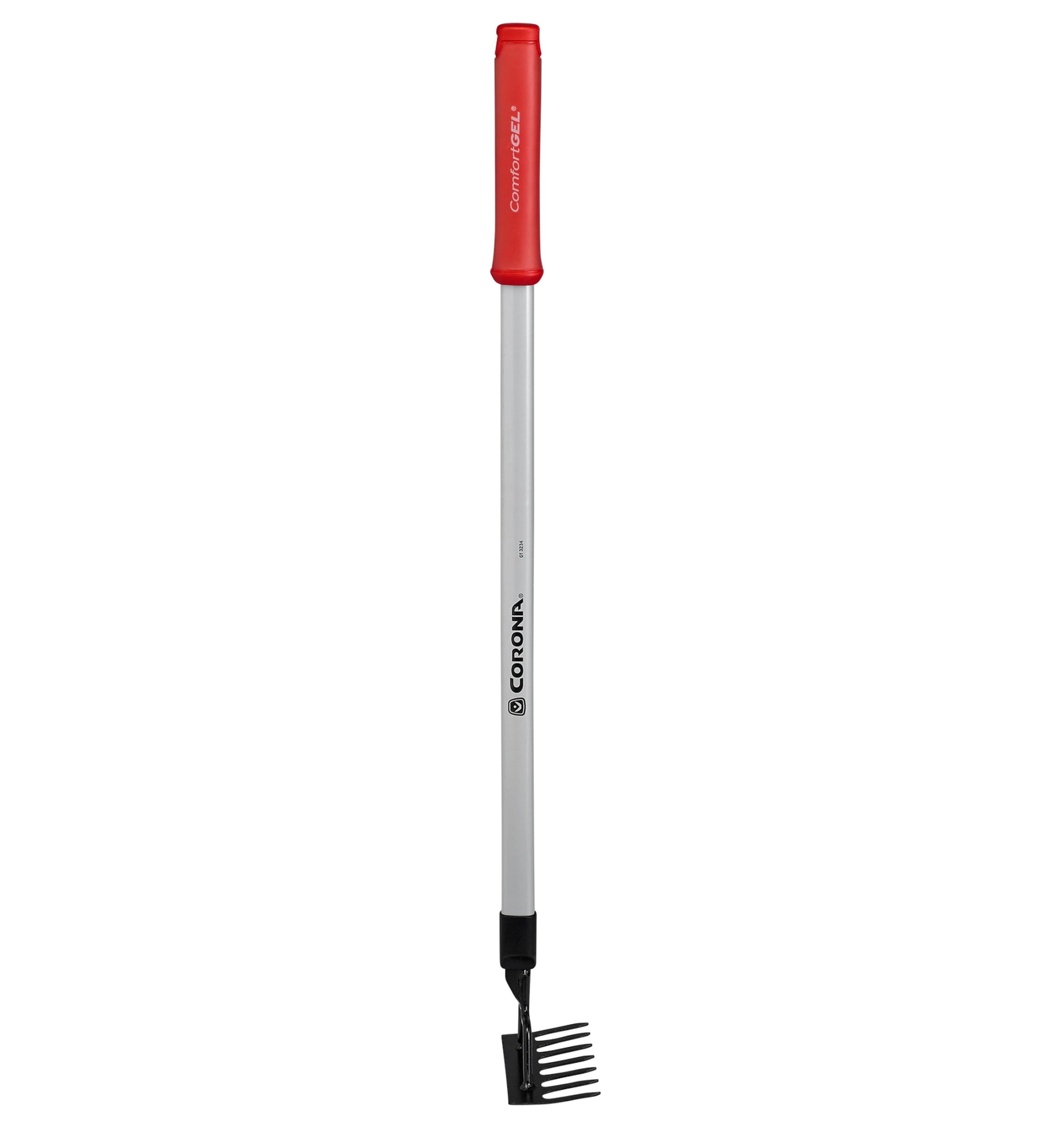
A narrow steel head that slips between shrubs without damaging the plants you want to keep.
This is the rake for detailed cleanup work where a wide head is simply too clumsy. Its 7 steel tines are narrow enough to pull leaves, mulch, and grass clippings from under bushes and along fence lines without uprooting your flowers. It is the lightest bow-style rake here at 1.6 pounds, which makes one-handed maneuvering easy. It stands 40.16 inches tall — a comfortable length for reaching into garden beds without stepping on the soil. The trade-off in tine count (7 tines versus the DIIG’s 17) is by design: this tool trades coverage area for precision. One customer review noted that the “plastic handle popped off under hard pull; should be unremovable,” which is the single real weak point on an otherwise well-built tool. The ComfortGEL grip (a soft rubber-like covering) reduces hand fatigue during extended weeding sessions. Multiple verified buyers call it “mighty” for its size.
Smallest Head, Biggest Control: If you garden in tight spaces — raised beds, narrow borders, between established shrubs — this 7-tine rake reaches where wider models cannot. The catch is the plastic handle connection, which a buyer said popped off under hard pulling; keep that in mind if you plan to really yank on thick roots.
3. YEELOR Garden Rake — 16-Tine Bow Rake

A 15.85-inch wide bow head that levels mulch and loosens soil without breaking your budget.
The YEELOR bow rake sits in a balance between the narrow precision rakes and the heavy 17-tine DIIG. Its 16-tine head measures 15.85 inches wide — a 76% wider coverage than the 9-inch leaf rakes in this list — so you move soil and spread compost faster without needing a full-size landscape rake. The head is fastened with screws (not just friction-fit), and the stainless steel handle resists rust well. At 2.43 pounds it is noticeably lighter than the DIIG’s 3.86 pounds, making it easier to lift for leveling jobs, but still sturdy enough to scrape and smooth dirt. One owner said it is a “good sturdy rake that works great for leveling dirt and cleaning up the yard,” noting the handle feels solid and comfortable. Assembly is tool-free — the handle comes in four sections that you simply screw together. The 53-inch total length is a middle ground that suits most average-height users without needing adjustment.
Great All-Arounder: For anyone who wants a bow rake that can handle soil breaking, leveling, and leaf gathering without paying a premium, this is the one. The 15.85-inch head is wide enough for efficiency but still fits between garden rows.
4. Oliynedy Leaf Rake — Adjustable 30″ to 60″

A collapsible leaf rake that stows in a car trunk and adjusts from kid height to adult height in seconds.
The Oliynedy is built for portability first. Its four-section handle screws together to span from 30 inches up to 60 inches. That makes it a rare rake that works equally well for a child helping in the garden and a tall adult doing serious cleanup. The 9-inch wide head with 11 tines is narrow enough to clean under hedges and inside flower beds without damaging roots, yet sturdy enough for light raking on patios and in chicken coops. The weight difference between this and the Corona rake is notable: at 1 pound, the Oliynedy is 0.6 pounds lighter (a 60% gap), making it the easiest to handle for long sessions. One reviewer noted the “adjustable handle sections allow 5’6″ user to work without bending.” The tines are made from alloy steel (a strong metal mix) and reviewers confirm they do not bend under normal leaf raking pressure. Assembly takes about a minute, and the whole thing collapses into a compact bundle for camping trips or small storage closets.
What Stands Out
- Adjustable from 30″ to 60″ suits every family member
- Weighs just 1 pound — easy to use one-handed for long periods
- Collapses into a small package for camping, car trunks, or tight storage
The Trade-Off
- 9-inch narrow head is not ideal for covering large open lawns quickly
Perfect for Campers & Small Yards: If you need a rake that disappears into a bag and fits multiple users, this is the most adjustable option here. It is not built for breaking hard soil, but for leaves, pine needles, and light debris it is excellent.
5. Feblomst Leaf Rake — 9″ Head, 11 Tines

So light you can hold it at arm’s length, yet stiff enough to move wet oak leaves without flexing.
This Feblomst rake hits the ideal balance for leaf cleanup. The 9-inch wide head with 11 steel tines slides under shrubs and between plants. The handle extends all the way to 65 inches so you do not have to stoop. The coated steel handle resists rust, and the TPE grip (a soft, rubbery material) stays comfortable even when your hands are damp. One reviewer put it simply: “It’s light enough to be held at arms length with one hand, yet feels stiff & strong,” even when raking heavy wet oak leaves. The handle adjusts to three lengths (37, 51, and 65 inches), giving you more range than the Oliynedy’s 30- to 60-inch sweep. At 2 pounds it is heavier than the Oliynedy but still noticeably lighter than any bow rake. The head attaches firmly to the handle with no wobble, and each section screws together tightly without play. Reviewers consistently call it “sturdy” and praise its performance on dead grass, dog cleanup, and general garden debris.
Best for Back-Friendly Raking: The 65-inch extended handle lets you stand upright while gathering leaves, and the 11 tight-spaced tines catch debris without letting it stick between them. It is a straightforward, well-built tool for anyone whose main job is leaf and light debris collection.
6. Dremmt Lawn Leveling Rake — 30″ x 10″

A 30-inch steel plate that glides over bumps and fills low spots like a professional-grade tool.
This is not a rake in the traditional sense — it is a leveling drag that solves one specific problem: bumpy lawns. The 2mm thick stainless steel plate measures 30 inches wide. You pull it across the soil to flatten clumps and fill hollows in one pass. At 10.3 pounds, the weight is a feature, not a flaw — the mass presses the plate into the ground so it does not skip over dirt clods the way a lightweight rake would. The ergonomic 72-inch handle lets you walk upright, which saves your lower back during long leveling sessions. One buyer mentioned that the weight “aids leveling” and that the wide head “covers ground quickly,” spreading soil, sand, and compost mix evenly. The plate works in both directions (push and pull), which speeds up the job significantly. The handle is adjustable for user height and the kit includes a pair of work gloves. It is the most expensive tool in this guide, but for anyone serious about getting a carpet-smooth lawn before seeding or sodding, it is the right tool for the job.
Why It Is Worth It
- 30-inch wide plate covers large areas fast without bouncing over clumps
- 72-inch handle keeps you standing upright, reducing back fatigue
- Works both forward and backward, doubling efficiency on big jobs
The Catch
- At 10.3 pounds it is heavy, and pulling it for hours will tire your arms
- Not useful for weeding, leaf gathering, or any non-leveling task
Reach for This If: You are leveling a whole yard, prepping for sod, or filling in low spots after aeration. It is a specialized tool that does one thing perfectly — pass on it if you just need a general-purpose rake.
7. Bully Tools 24-Tine Thatching Rake

A 24-tine steel head with an overwelded connection that survived clearing five trash cans of debris without a single issue.
The Bully Tools rake is built for the toughest yard cleanup jobs: dethatching (pulling up the thick layer of dead grass and roots called thatch), pulling up thatch, and gathering heavy debris like branches and pine cones. The 24-tine head is the widest and most aggressive in this comparison, measuring 23.5 inches across. The tines are made from USA-melted tempered steel. The company claims they are up to 30% more durable than foreign-made competitors. The fiberglass handle is coated with a polyester veil (a protective layer) to prevent splintering, and the overwelded head-to-handle connection is reinforced beyond standard construction. One wildland firefighter reviewed the rake and said it outperforms big-box store rakes for heavy-duty fire mitigation work at 8,000 feet elevation. Another owner noted that clearing “5-10 trashcan loads of debris” caused no damage to the tool. The trade-off is weight and effort: at 3.85 pounds with a 68-inch handle, it is heavy enough to double as a core workout. One owner reported the handle “could be 6-12 inches longer” for better leverage and less back strain. This rake is single-purpose — it is not for precision weeding or light leaf gathering, but for deep thatch removal and heavy seasonal cleanup it is the most durable option here.
what separates it
- 24 tines on a 23.5-inch head cover large areas with each pass
- Overwelded connection is the strongest head-to-handle joint in this guide
- 100% USA-made steel tines resist bending under heavy pressure
Consider Before Buying
- At 3.85 pounds with a 68-inch handle, it is heavy — expect arm fatigue
- Too aggressive for light leaf cleanup; best reserved for dethatching and thick debris
Buy This For: Thick lawns with deep thatch, heavy branch collection, or any cleanup that has broken cheaper rakes in the past. It is a commercial-grade tool that will outlast several seasons of heavy use.
Look Elsewhere If: You only do light leaf raking on a small lawn — the 24 tines and wide head are overkill for occasional use.
Understanding the Specs
Tine Count & Head Width
The number of tines on a rake and the width of the head determine how much ground you cover with each pass. A bow rake with 16 or 17 tines (like the YEELOR or DIIG) breaks soil and spreads mulch efficiently. A leaf rake with 7 to 11 tines on a narrow 9-inch head (like the Oliynedy or Feblomst) is better for precise work between plants. For dethatching, the Bully Tools’ 24-tine head (23.5 inches wide) clears thatch and heavy debris from large lawns fast.
Handle Material & Construction
The handle transfers every bit of force you pull from your arms into the head. Stainless steel handles (DIIG, YEELOR) are rust-resistant and sturdy but heavier. Fiberglass handles (Bully Tools) are lighter and dampen vibration. The connection between the head and handle is the most common failure point — look for welded or triple-welded joints (DIIG, Bully Tools) over simple screw attachments. Adjustable handles (Oliynedy, Feblomst) let you change length for different users or storage.
FAQ
What is the difference between a bow rake and a leaf rake?
How many tines do I need on a garden rake?
Can I use a garden rake for leveling my lawn?
How long should a garden rake handle be?
Are stainless steel rake handles better than fiberglass?
Will a 9-inch wide rake work for a large lawn?
Can I adjust the handle length on any of these rakes?
How do I assemble a garden rake that comes in pieces?
What is the best garden rake for dethatching a lawn?
Are these rakes rust-resistant?
Final Thoughts: The Verdict
If you want one dependable pick, the best garden rake winner is the DIIG 63″ Bow Rake because it combines a high 17-tine count, a triple-welded stainless steel frame, and an adjustable handle into a single tool that handles breaking soil, leveling, and spreading mulch. If you need a lightweight and portable rake for leaf cleanup in tight spaces, grab the Oliynedy Leaf Rake. And for the heavy dethatching and debris removal that destroys lesser tools, the standout is the Bully Tools 24-Tine Thatching Rake.
How We Picked
We do not accept paid placement, and we did not hands-on test every unit. Instead, we match each pick to a real buyer and use-case by comparing the manufacturers’ published specifications against the patterns in verified customer reviews — so you get each pick’s real strengths and trade-offs instead of marketing copy.
Sources & Methodology
Specifications: manufacturer listings and product documentation. Review insights: verified customer reviews, as of July 2026. Pricing: not shown on this page (it changes often); check the current price via the retailer link.
As an Amazon Associate, Lawn Gear Lab earns from qualifying purchases. This does not affect which products we feature.