
Specs are compiled from manufacturer listings and verified buyer reviews and can change over time — please confirm the key details on the product page before buying.
You want bigger tomatoes, more roses, and a vegetable patch that actually delivers. But the fertilizer aisle is a wall of numbers, mysterious acronyms, and bags claiming to do everything. The real trick is picking the one natural formula that matches exactly what your plants are hungry for — and avoiding the stuff that smells like a crime scene or makes your soil worse.
I’m Rikta — the founder and writer behind Lawn Gear Lab. This guide is built by comparing the manufacturers’ published specifications and the patterns across verified customer reviews, so you get each pick’s real strengths and trade-offs instead of marketing spin.
Whether you are feeding a row of container tomatoes or a full orchard, these are the best picks right now. Read on to find your own perfect garden natural fertilizer match.
Our Picks at a Glance


How To Choose The Best Garden Natural Fertilizer
Picking a natural fertilizer is simpler than the numbers suggest. Every bag has an NPK ratio (Nitrogen, Phosphorus, Potassium), and each number tells you what the fertilizer prioritizes. Nitrogen (N) drives leafy green growth — great for lettuce, spinach, and lawns. Phosphorus (P) fuels root development, flowers, and fruit — essential for tomatoes and peppers. Potassium (K) helps overall plant health, disease resistance, and fruit quality. A balanced formula like 4-4-4 works for everything, while a higher middle number (like 3-4-4) pushes blooms and harvests.
Granular vs. Liquid
Granular fertilizers are the workhorses. You sprinkle them on the soil, water them in, and they release nutrients slowly over weeks. They build long-term soil fertility with less effort. Liquids act fast — great for giving a struggling plant an immediate boost or feeding containers weekly. The trade-off is that liquids need more frequent applications and often smell stronger (think fish emulsion).
Organic Certification
Look for the OMRI (Organic Materials Review Institute) listing on the bag. It means the product meets USDA organic standards. It also tells you the ingredients are natural — feather meal, bone meal, kelp, and rock minerals — not synthetic chemicals. If you are gardening for clean, chemical-free food, OMRI is the stamp you need.
Quick Comparison
| Model | Best For | NPK Ratio | Form | Bag Size | Amazon |
|---|---|---|---|---|---|
| Espoma Rose-Tone★ Best Overall | Roses & flowering plants | 4-3-2 | Granules | 128 oz (2-pack) | Amazon |
| Back to the Roots Worm CastingsSoil Builder | All-purpose soil health | — | Granules | 5 lb | Amazon |
| Espoma Garden-ToneVegetable Champ | Vegetables & herbs | 3-4-4 | Granules | 64 oz (2-pack) | Amazon |
| Down To Earth All Purpose | Versatile all-purpose feeding | 4-6-2 | Granules | 5 lb | Amazon |
| FoxFarm Happy Frog | Containers & picky plants | 6-4-5 | Granules | 4 lb | Amazon |
| Down To Earth Fruit Tree | Fruit trees & shrubs | 6-2-4 | Powder | 5 lb | Amazon |
| Great Big Roses Liquid | Roses & quick bloom boost | — | Liquid | 32 oz | Amazon |
| Alaska Fish Fertilizer | Gentle weekly nitrogen feed | 5-1-1 | Liquid | 115 oz | Amazon |
| Jobe’s Organics All Purpose | Budget-friendly large gardens | 4-4-4 | Granules | 16 lb | Amazon |
In‑Depth Reviews
1. Espoma Organic Rose-Tone 4-3-2
Our pick — over 4.5★ from 700+ verified ratings; the strongest balance of quality and price.
The rose whisperer that turns 30 bushes into a front-yard spectacle.
This is the fertilizer that rose lovers swear by — and with good reason. Its 4-3-2 NPK ratio is designed to push out vigorous green growth and then channel that energy into abundant blooms. The secret weapon is Espoma’s Bio-tone formula, a proprietary blend of beneficial microbes that helps roots grab hold of nutrients more efficiently. You apply the granules dry around the drip line of each plant once a month from May through September, then water them in. That is it — no mixing, no measuring cups to rinse out.
What wins people over is the sheer effectiveness. Owners with large rose collections — the kind who casually mention “around 30 rose bushes” — report their plants look stellar after switching to this. The 4-3-2 analysis also includes 5% calcium, which strengthens cell walls and helps prevent blossom-end rot in nearby tomatoes if you are mixing ornamentals and edibles. The one note you should know is that opinions on the odor are mixed; some find it smells like rich earth, others find it unpleasant. Either way, it dissipates quickly after watering.
Rose-specific nutrient blend
- Effectiveness is the most-discussed feature, with owners seeing immediate improvement in leaf color and bud count
- Slow-release granules feed plants gently for weeks with no risk of chemical burn
- Works on more than roses — viburnum, bougainvillea, and clematis also respond well
Slow-release needs patience
- The odor is polarizing — some find it pleasant, others call it strong
- You apply monthly, so you need to stay on schedule for best results
Rose lovers: You have roses, bougainvillea, clematis, or other flowering ornamentals and want a proven, no-mix granular feed that brings out more blooms than a general-purpose mix.
Quick fix seekers: You are primarily feeding cool-season vegetables like lettuce and kale — the 4-3-2 ratio is tilted toward flowers rather than leafy growth.
2. Back to the Roots Organic Worm Castings
The gentlest way to feed everything — with zero smell and zero burn.
Worm castings (which is simply worm manure) are the gold standard of natural soil amendments because they do not have a high NPK number that can scorch roots. Instead, they deliver slow-release nutrients plus beneficial microbes that actually improve your soil’s structure over time. This 5-pound bag from Back to the Roots is pure vermicompost with no filler, which means you can sprinkle it directly onto the root zone of seedlings, mature plants, or even herbs without worrying about over-fertilizing.
Owners use it on everything — milkweed for monarch butterflies, chunky soil mixes indoors, and established garden beds. As buyers put it: “I use a ton of this for my garden.” The quality is what gets the most praise; it is noticeably better than the dry castings you find at big-box stores. And unlike many organic fertilizers, this one has almost no detectable odor — just a clean soil smell. The only occasional issue is an odd bit of debris (a thin piece of steel cable has been found in one batch), so a quick glance before use is sensible.
Pure worm castings: If you want a no-brainer, no-odor amendment that improves your soil every time you use it, this is the one. skip it if you need a quick-hit NPK boost for heavy feeders like tomatoes in peak season — castings are gentle, not a power feed.
Soil builders: Anyone who wants a reliable, safe, and odor-free organic foundation for their entire garden — vegetables, flowers, citrus, and houseplants included.
Heavy feeders: Because it is a natural, unprocessed product, an occasional organic fragment (like a small twig or wire) can slip through — inspect before applying.
3. Espoma Organic Garden-Tone 3-4-4
The 3-4-4 ratio built for tomatoes, peppers, and record-breaking harvests.
Where the Rose-Tone above focuses on flowers, this Garden-Tone shifts the balance toward fruit and root production. The middle number — phosphorus — is the highest at 4, which is exactly what your tomatoes, peppers, and squash need to set heavy fruit. The analysis includes 5% calcium to prevent blossom-end rot and the same Bio-tone microbial boosters that make Espoma’s whole line so effective. You get two 4-pound bags per order, making this a solid value for a full-season feeding.
One gardener in zone 10b reported that annuals and vegetables fertilized with this outperformed previous yields, producing 400 pounds of tomatoes and 100 pounds of carrots that kept producing longer into the late season. The effectiveness is the standout trait — it is the most-discussed aspect among owners by a wide margin. The smell is present (it is an organic product), but as one owner put it, “has a smell but overall good.” For the results it delivers, most gardeners happily put up with a few days of earthy odor.
High nitrogen formula: If you want a granular, slow-release option that specifically targets fruit production in warm-season vegetables, this beats a general 4-4-4 mix. It is a less versatile all-purpose feed than the Down To Earth below, but it is more specialized for the veggie patch.
Leafy greens: Gardeners growing tomatoes, peppers, squash, melons, and any vegetable where you want a bigger, longer harvest.
Fruiting plants: The phosphorus boost is great for fruiting but less ideal for leafy greens (lettuce, kale) that prefer higher nitrogen — keep a balanced feed handy for those.
4. Down To Earth All Natural Fertilizers Organic All Purpose 4-6-2

The all-in-one box that replaces a shelf full of separate amendments.
Down To Earth has built a loyal following with blends that read like a shopping list of premium organic ingredients — fish bone meal, blood meal, feather meal, rock phosphate, langbeinite, greensand, humates, and kelp meal. This 4-6-2 all-purpose mix simplifies organic gardening by packing everything a plant needs into one box. It is listed by the Organic Materials Review Institute (OMRI) for organic production, and it is designed to feed soil microbes as well as the plants themselves. That means healthier soil structure over time, not just a quick green-up.
At 5 pounds, it is a compact box that covers a surprising amount of ground. Avid gardeners report that the larger 15-pound bag lasts nearly a full season. The quality is what buyers praise most — it is a genuinely well-formulated product. The catch is the smell: it has a noticeable fishy odor when first applied (thank the fish bone meal for that). It fades within a few days, but you will want to work it into the soil and water it in well to avoid attracting curious raccoons or neighborhood dogs. Some owners also find the price per pound steep, though the results keep them coming back.
Versatile organic mix
- Quality is the most praised feature — the ingredient list is clean and potent
- Effectiveness is close behind, with owners seeing revivals in just two weeks
- OMRI listed, so it meets organic certification standards
Strong smell outdoors
- The fishy smell is real and lingers for a few days after application
- Opinions on value for money are mixed — some find it expensive for the box size
General garden: You want a single, high-quality organic blend that covers vegetables, flowers, containers, and even houseplants without needing a separate bag for each.
Indoor plants: The smell is a deal-breaker for you, or if you need a bigger bag to feed a large garden acreage.
5. FoxFarm Happy Frog All Purpose Fertilizer 6-4-5

The Monstera’s best friend — and a secret weapon for container veggies.
FoxFarm’s Happy Frog line is legendary among indoor plant enthusiasts and container gardeners. This all-purpose formula carries a 6-4-5 NPK, which is notably higher in nitrogen than most natural fertilizers. That makes it excellent for pushing lush, green foliage — why Monstera owners love it — but it also works beautifully on vegetables and ornamentals when used sparingly. The key differentiator is its live microbiology: the granules contain beneficial soil microbes and mycorrhizal fungi that help roots absorb more water and nutrients.
Buyers report explosive growth after switching to Happy Frog, especially when combined with worm castings in the soil mix. One gardener saw yellow tomato and zucchini plants turn dark green and productive within a week. For picky tropical plants like Thai Constellation Monsteras, it is reportedly safe and effective when mixed right into the potting medium. The catch is the smell — this stuff has a strong, manure-like odor that lingers for days after watering. You will know you used it. It is also easy to over-apply in small containers, so measure by the tablespoon, not the handful.
Pot-friendly formula: The live microbes and balanced 6-4-5 ratio make it a standout for containers where soil biology is harder to maintain. pass on it if you are scent-sensitive or growing outdoors in large beds — the Down To Earth or Jobe’s options are better for open ground.
Container gardens: Container gardeners, houseplant enthusiasts (especially Monsteras and aroids), and anyone who wants a biologically active fertilizer that boosts root health.
Large beds: The strong manure smell lingers — use it in a well-ventilated area and let it water in thoroughly before you spend time near the plants.
6. Down To Earth Organic Fruit Tree 6-2-4

The revival formula for wind-battered, frost-damaged, and just-stubborn fruit trees.
Fruit trees have different nutritional demands than vegetable beds, and this 6-2-4 blend is built specifically for them. The higher nitrogen supports leafy canopy growth while the potassium promotes fruit quality and disease resistance. The added calcium carbonate is a thoughtful touch — it supports proper fruit development and prevents issues like bitter pit in apples. The ingredient list is similar to Down To Earth’s all-purpose mix but with a few key swaps: feather meal and fish bone meal for nitrogen, plus alfalfa meal and kelp meal for micronutrients and growth hormones.
Owners mention this fertilizer revived a crabapple tree that had been uprooted by wind and produced no leaves or berries for two seasons — it came back with healthy leaves, abundant berries, and roots strong enough to remove the support stakes. Another reviewer says their trees bounced back after a cold frost that had them looking bleak. One owner uses it as part of a larger pest-control strategy (bed bugs), but for its intended purpose — fruit-bearing trees — customers note steady growth and improved leaf color over a season. The powder form blends into soil quickly and does not have the harsh smell of synthetic options.
Fruit tree focus: If you have apple, pear, plum, cherry, peach, or tropical fruit trees, this is more targeted than an all-purpose feed. It is less ideal for container plants or flower beds, where the high nitrogen may push too much leaf at the expense of blooms.
Home orchards: Anyone with established fruit trees, canes, or shrubs who wants an organic, calcium-rich formula that supports both growth and fruit quality.
Vegetable gardens: The 5-pound box is modest — if you have a large orchard, you will be ordering multiple boxes per season.
7. Great Big Roses and Flowers Liquid Fertilizer Booster
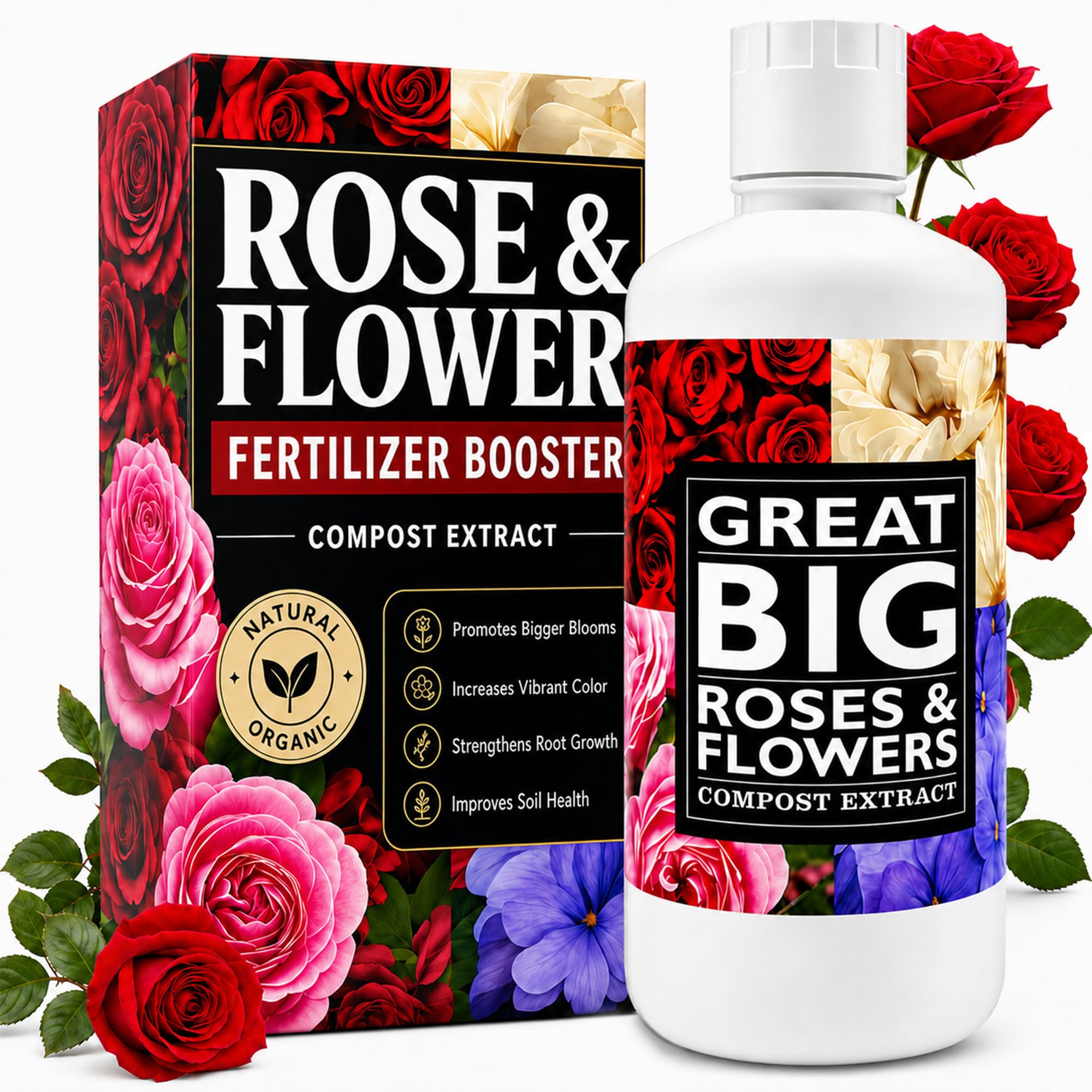
The liquid miracle that makes non-blooming roses explode with color within weeks.
While most of the picks on this list are granular, this liquid concentrate fills a different role: immediate root-zone activation. It delivers humic acids, seaweed, chelated iron, and what the maker calls over 70 chelated trace minerals directly to the soil. The idea is not just to feed the plant but to open up nutrients already present in your soil that the plant cannot normally access. Reviewers point out rose bushes that had not bloomed in years producing big flowers within weeks of the first application. That is the kind of turnaround that builds a loyal following.
The effectiveness is the most-mentioned aspect, followed closely by quality. Owners describe it as the “best rose fertilizer” they have ever used, with noticeable differences in weeks — vibrant colors, deep green foliage, and continuous blooms even during heat stress. You mix 4 ounces of concentrate with a gallon of water and pour it around the base. One 32-ounce bottle makes over 30 gallons of feed, so it covers a full growing season for most gardens. The glaring trade-off is value for money — it is the most frequently noted negative aspect of this product at 26 mentions. You pay a premium for the concentrated mineral blend, and some gardeners feel the price is steep compared to bulk granular options.
Liquid boost for blooms
- Effectiveness is the #1 most-mentioned aspect — shoppers say flowers on previously barren bushes
- Works as a soil activator, making existing fertilizers and soil nutrients more available
- Easy to use — just mix with water and pour; no digging or tilling
Frequent use required
- Value for money is the most-discussed negative — it costs more than granular options per season
- You need to reapply monthly, which adds up in both cost and labor
Flower shows: You have roses, hydrangeas, or citrus that look healthy but refuse to bloom — this liquid booster is designed to fix exactly that problem.
Low-maintenance: You are on a tight budget or feeding a large vegetable garden — the per-season cost is higher than granular alternatives.
8. Alaska Fish Fertilizer OMRI Listed 5-1-1

The ten-year staple that feeds greens and grasses without the chemical burn.
Alaska Fish Fertilizer is a classic for a reason: it is a gentle, OMRI-listed liquid feed that provides a steady supply of organic nitrogen (5-1-1) for lush foliage and strong stems. It is made from cold-pressed fish, which preserves the bioavailable micronutrients that synthetic processes destroy. The low phosphorus and potassium numbers mean it is not your go-to for flowering or fruiting, but for leafy vegetables (lettuce, kale, spinach), herbs, and lawns, it is outstanding. You mix it with water and apply every three weeks during the growing season.
One owner has been using this for over ten years on hundreds of plants, calling it the “garden staple I don’t grow plants without.” The results they report are consistent: stronger stems, deeper green leaf color, and faster growth visible within one to two weeks. The concentrated bottle at 115 fluid ounces covers a large garden for months. The smell is famously pungent — think dead fish. Even the deodorized formula is strong. It does dissipate within a day after watering, but you will want to apply it when the windows are open and the neighbors are not eating lunch on their porch. It can also burn leaves if applied undiluted, so follow the mixing instructions carefully.
Gentle fish emulsion: The 5-1-1 ratio is ideal for vegetables grown for their leaves and for reducing transplant shock. Skip it for flowering plants like roses or for fruiting crops that need more phosphorus and potassium.
Seedlings: Organic gardeners who want a proven, gentle liquid nitrogen source for vegetables, herbs, and soil microbes — and who can tolerate a few hours of fishy aroma.
Mature trees: The odor is real and strong — apply in a well-ventilated outdoor area and water it in immediately to speed dissipation.
9. Jobe’s Organics Granular All Purpose Fertilizer 4-4-4

The 16-pound bag that makes neighbors ask how your garden got so big.
Jobe’s Organics 4-4-4 is the sensible choice for anyone who needs to cover a lot of ground without spending a lot of money. It is a balanced, slow-release granular fertilizer that works on vegetables, flowers, shrubs, and trees. The 16-pound bag is the largest in this lineup, giving you the best volume-to-cost ratio of all nine picks. It is OMRI listed for organic gardening, contains no synthetic chemicals, and is formatted as small, friable granules that break down into humus in the soil over about a week. You apply it every two to three weeks or as needed during the growing season — just measure, sprinkle, and water.
One owner had so much squash from their garden fertilized with this that they joked their family “got really sick of eating squash last summer.” Neighbors kept asking how they did it. The effectiveness is the most-discussed positive aspect, with quality and plant health close behind. The big trade-off is the odor — 19 owners mention the smell, making it the most-discussed negative aspect. It has a strong chicken manure smell that can linger for a couple of days after application. The granules also produce a white, mold-like appearance on the soil surface at first — do not worry, that is beneficial mycorrhizal fungi doing its job. It is not mold; it is a sign the biology is active.
Balanced granular feed
- Effectiveness is the #1 positive aspect — owners see visible results in 1-2 days
- The 16-pound bag covers a large garden for a full season at the best per-pound value in this guide
- Can be used both as a top-dress and brewed into a liquid tea for faster uptake
Not for acid lovers
- The chicken manure smell is strong for the first couple of days after application
- White mycorrhizal fungus on the soil surface can alarm first-time users (it is normal and beneficial)
All-purpose: You have a large vegetable garden or landscaping beds and want the biggest bag of organic fertilizer you can buy for the money.
Specialized needs: You are gardening in a small, enclosed space or have a sensitive nose — the barnyard smell will be intense for a couple of days.
Understanding the Specs
NPK Ratio
This is the three-number sequence on every fertilizer bag (like 4-3-2 or 6-4-5). The first number is Nitrogen (N) for leaf growth. The second is Phosphorus (P) for roots, flowers, and fruit. The third is Potassium (K) for overall health and disease resistance. A balanced 4-4-4 works for everything, while a higher middle number (3-4-4) pushes blooms and harvests. A higher first number (5-1-1) is for leafy greens and lawns.
Granular vs. Liquid
Granular fertilizers are dry pellets you sprinkle on the soil and water in. They release nutrients slowly over weeks, building long-term soil fertility with less frequent work. Liquids are concentrates you mix with water — they act fast and are great for giving a struggling plant an immediate boost or feeding container plants weekly. The trade-off is that liquids need more frequent applications and often smell stronger.
FAQ
What NPK ratio is best for tomato plants?
Can I use rose fertilizer on vegetables?
How often should I apply granular organic fertilizer?
Will worm castings burn my plants?
What does OMRI listed mean?
Why does organic fertilizer smell so bad?
Which fertilizer is best for fruit trees?
Can I use liquid fish fertilizer on houseplants?
How long does granular fertilizer last in the soil?
Is it safe to mix different organic fertilizers?
Final Thoughts: The Verdict
For most gardeners, the garden natural fertilizer winner is the Espoma Organic Rose-Tone because it delivers proven, concentrated results for the most passionate segment of home gardeners — rose lovers — while being versatile enough for other ornamentals. If you want a single bag for your entire vegetable patch, grab the Espoma Organic Garden-Tone 3-4-4. And for large-scale organic feeding on a budget, the Jobe’s Organics 16-pound bag is the one to reach for.
How We Picked
We do not accept paid placement. Every pick is matched to a real buyer and a real use-case; we do not hands-on test units.
Sources & Methodology
Specifications: manufacturer listings and product documentation. Review insights: verified customer reviews, as of July 2026. Pricing: not shown on this page (it changes often); check the current price via the retailer link.
As an Amazon Associate, Lawn Gear Lab earns from qualifying purchases. This does not affect which products we feature.