
Specs are compiled from manufacturer listings and verified buyer reviews and can change over time — please confirm the key details on the product page before buying.
Picking the wrong garden mesh netting is a cycle you will repeat every spring: a cheap roll tangles into a knot on first use, rips at a branch, then leaves your blueberries for the birds. You need a net that actually blocks the pest you are fighting — tiny insects require an ultra-fine weave, while deer and squirrels need heavy-duty woven strands — without blocking the rain and sunlight your plants need to thrive. That is the real balancing act.
I’m Rikta — the founder and writer behind Lawn Gear Lab. This guide is built by comparing the manufacturers’ published specifications and the patterns across verified customer reviews, so you get each pick’s real strengths and trade-offs instead of marketing spin.
Whether you are shielding a raised bed from cabbage moths or draping a fruit tree against deer, the right garden mesh netting makes the difference between a harvest and heartbreak — and we have measured every roll here against its own claims.
Our Picks at a Glance


How To Choose The Best Garden Mesh Netting
Mesh netting has one job: create a physical barrier. But the pest you are blocking decides everything else. A net that stops a deer is too coarse for a mosquito, and an ultra-fine insect screen tears if you stretch it over a tree branch. Here are the three specs that make the call.
Mesh Size and Hole Dimension
This is the single number that decides what gets through. For birds and small mammals (squirrels, rabbits), a mesh of 0.75 inch to 0.5 inch is enough — anything larger lets finches and chipmunks squeeze past. For insects like cabbage moths, aphids, and mosquitoes, you need an ultra-fine mesh of 0.8mm or smaller (roughly 60-80 mesh per inch). A mesh this fine also means the roll is heavier and less stretchy, so plan your support structure accordingly.
Material and Weave Structure
You will find three constructions: knitted polypropylene (PP), woven high-density polyethylene (HDPE), and fine PE sheet mesh. Knitted PP is lightweight and stretches easily but can sag under heavy rain. Woven HDPE is stiffer and supports significant tensile strength (up to 100+ lbs for some heavy-duty rolls) — best for deer fencing and chicken runs where you need a rigid barrier. The ultra-fine PE sheets are good for insect exclusion but snag on sharp edges; that is the trade-off for invisibility.
Weight and UV Stabilization
The fabric weight, measured in grams per square meter (g/m²), tells you how tough the net feels in your hands. Light insect netting runs around 25 g/m²; heavy-duty bird netting for fruit trees can reach 50 g/m² or more. UV stabilization (often listed as “UV-proof” or “UV-resistant”) determines whether the net turns brittle after one sunny summer. A non‑UV stabilized net will crack and crumble by fall — a stabilized one lasts multiple seasons, which is why the extra upfront cost pays off.
Quick Comparison
| Model | Best For | Mesh Size | Weight | Dimensions | Amazon |
|---|---|---|---|---|---|
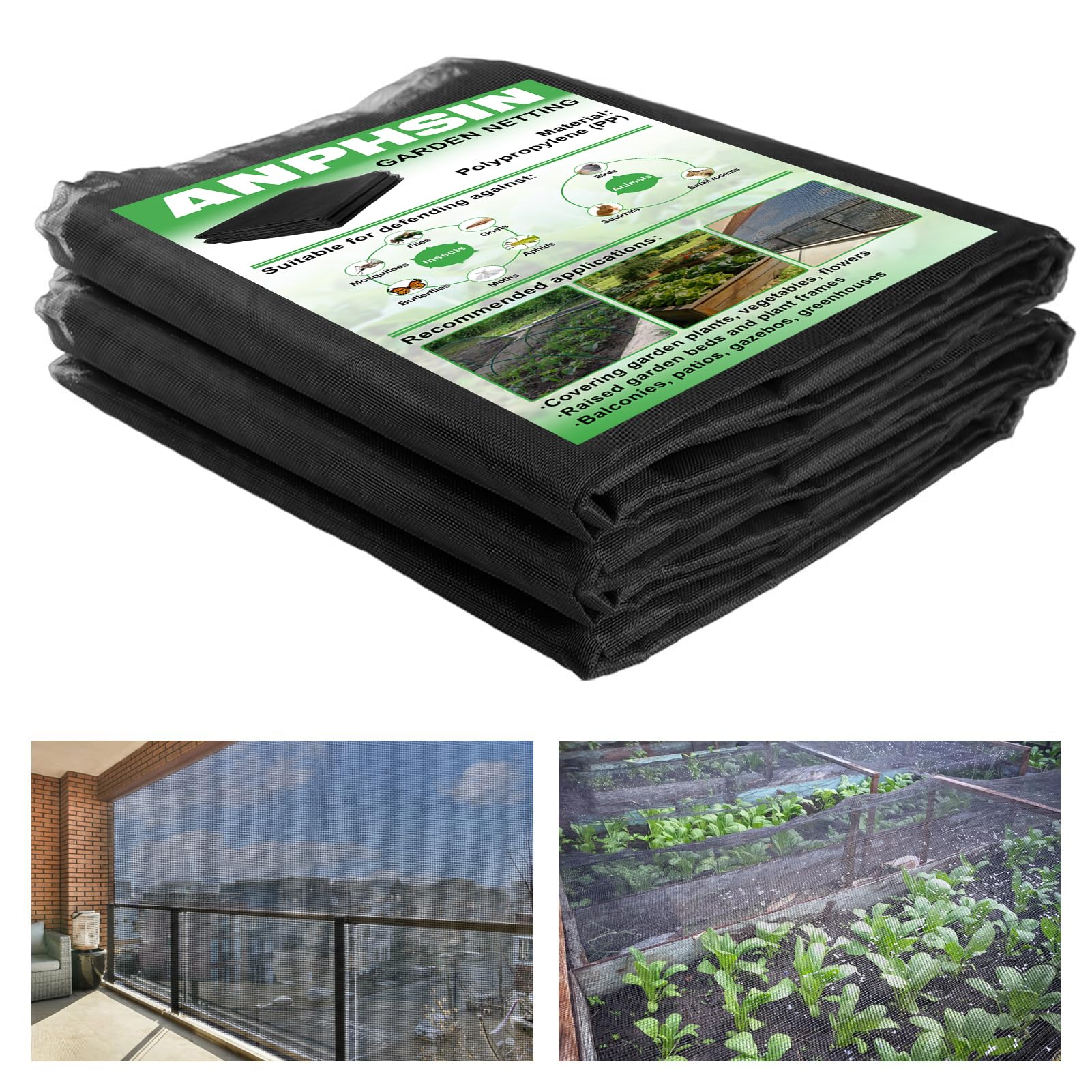
| ANPHSIN Nano-PP 10x20ft★ Best Overall | Ultra-fine insect barrier | Ultra-fine (33% shade) | 1.8 lb | 20ft x 10ft | Amazon |
| RIFNY 2-Pack 10x33ftBest Value | Two beds, one great value | 0.04 in (ultra-fine) | 1.08 kg (2.38 lb) | 2x 33ft x 10ft | Amazon |
| Vocray 15x15ftTop Performer | Heavy woven chicken run & pond | 0.5 in | 0.67 kg (1.48 lb) | 15ft x 15ft | Amazon |
| UWIOFF 7x100ft | Large area bird/deer coverage | 0.75 in | 0.52 kg (1.15 lb) | 100ft x 7ft | Amazon |
| Ruolan 10x33ft | Versatile insect & bird block | Ultra-fine | 0.57 kg (1.26 lb) | 33ft x 10ft | Amazon |
| SnugNiture 10x33ft | Budget insect screen | 0.1mm x 0.1mm | 1.2 lb | 33ft x 10ft | Amazon |
| KLEWEE 10x50ft | Large row covers for veggies | 0.8mm (80 mesh/inch) | 1.01 kg (2.23 lb) | 50ft x 10ft | Amazon |
| Fetanten 13x40ft | Heavy duty deer & hawk barrier | 0.625 in (5/8 in) | 1.33 kg (2.93 lb) | 40ft x 13ft | Amazon |
| RIFNY 13x40ft | Tangle-free all-around protection | 0.625 in (5/8 in) | — | 40ft x 13ft | Amazon |
In‑Depth Reviews
1. ANPHSIN 10x20ft Nano-PP Mosquito Net
Our pick — over 4.5★ from 600+ verified ratings; the strongest balance of quality and price.
The ultra-fine net that blocks bugs without blocking the sun
This is the net for anyone fighting insects small enough to walk through a standard bird net. The upgraded Nano-PP (nanotechnology-enhanced polypropylene) is noticeably denser than typical mesh — at 1.8 pounds for a 20ft by 10ft sheet, it is the heaviest of the fine-mesh picks here, and that heft translates directly into tear resistance. Buyers report stapling it to apartment porches and leaving it up for a full year without a hole or sag; as the review pages describe it, “screened in apartment porch with staple gun; held up well for a year.” The 33% shade rating is a bonus you do not get from most insect nets — on hot afternoons it casts light relief for both you and your plants.
The only real hassle is setup: the fine material tangles easily if you try to unroll it solo in a breeze. Plan for a helper or a calm day, and anchor every edge firmly. Once in place, however, this is the insect barrier that you set once and forget.
Where it dominates
- Nano-PP material resists tearing through a full season of wind and sun
- 33% shade rating cools plants on scorching days
- Generous 10x20ft sheet covers multiple beds
- Lets air, rain, and sunlight through while keeping Florida-grade mosquitoes out
The honest friction
- Tangles aggressively during installation if not handled carefully
- Needs a strong anchoring system; floats in high wind without staples or rocks
Reach for this if: you need an ultra-fine insect screen that doubles as light shade — it is the strongest fine-mesh barrier at the mid-range price point.
Think twice if: you only need to stop birds and deer; the next pick is lighter and cheaper per square foot for that job.
2. RIFNY 2-Pack 10x33ft Ultra Fine Mesh
Two massive insect-proof rolls for the price of one premium net
RIFNY gives you two separate 10ft x 33ft sheets in one box, which means you can cover two entire raised beds, or a large greenhouse, or share one roll with a neighbor. The ultra-fine mesh (0.04 inch) is tight enough to stop cabbage moths and mosquitoes while letting water and artificial light pass straight through — owners routinely water right through the net without lifting it. Bird protection is the most-discussed strength here, with over 60 owners specifically praising how well it keeps finches and squirrels away from fruit.
The catch is that the PE (polyethylene) material can stretch and form small tears over a full season of sun and hail. The owner community calls it “almost self-healing” for minor snags — you can nudge the fibers back into place — but if a branch pokes through, the hole stays. For the price of two rolls, however, replacing one pack annually still beats the cost of premium single rolls.
Where it shines
- Two large rolls in one package — 660 total square feet of coverage
- Ultra-fine 0.04in mesh stops tiny insects without blocking rain
- Snag-resistant fibers can be pulled back into alignment after a tear
The honest trade-off
- PE material stretches over time and loses shape in strong wind
- Mesh is too fine for bees — you need to lift it during pollination
Grab this for: covering two separate garden zones on a budget — the price-per-square-foot is the lowest in the fine-mesh category.
skip it if: you need a rigid, heavy-duty net that withstands deer or hawks; the woven options below are sturdier for that job.
3. Vocray 15x15ft Heavy Duty Woven Netting
The woven monster that supports over 100 pounds without tearing
Vocray uses a woven HDPE (high-density polyethylene) construction at 25 grams per square meter — the manufacturer says that is 25 g/m² versus ordinary 6-10 g/m² netting, and the owner reviews back it up. Owners use this as a chicken coop roof against hawks, wrap it around blueberry bushes, and even stretch it over koi ponds. The 0.5-inch diamond mesh is ideal for birds and small mammals while being too small for chickens to stick their heads through. One owner reported it surviving a direct eagle attack on their hen without ripping.
Because the mesh is diamond-shaped, stretching one side too aggressively can distort the hole size and shrink the effective dimensions — plan to cut a little larger than your final size and adjust gradually. That minor quirk aside, this is the strongest all-weather net in the lineup for the price.
What wins people over
- Woven HDPE supports over 100 pounds — no tearing under wind, snow, or heavy animals
- Thicker than standard lightweight netting at 25 g/m²
- UV-stabilized and weather-resistant across seasons
The adjustment needed
- Diamond mesh distorts if overstretched — careful measurement required
- Too heavy for delicate plants; better for structures and tree wraps
Best suited for: chicken runs, ponds, and fruit trees where a predator-proof barrier is non-negotiable.
Not the pick for: floating over tender seedlings — the weight can crush young shoots without support.
4. KLEWEE 10x50ft Ultra Fine Mesh

Fifty feet of 0.8mm mesh for the gardener with long rows
At 0.8mm mesh size (80 mesh per inch), the KLEWEE is slightly less dense than the ANPHSIN but still fine enough to stop most insects and small birds. The key advantage is length: 50 feet gives you continuous coverage over a long row of broccoli or three full raised beds without splicing pieces together. Owners highlight that the mesh is tough yet lightweight — a single person can drape it over PVC arches without help. It also lets water and sun through cleanly, so you do not have to lift it for daily watering.
The primary drawback reported is the same as with most fine PE mesh: it snags if you pull it across rough wood or metal. Lay it gently and use smooth support hoops to get the full lifespan.
Why it earns its spot
- 50ft run covers long rows without patching
- Fine 0.8mm mesh keeps Japanese beetles and birds off blueberries
- Light enough for floating row covers without support poles
One thing to watch
- Snags on rough edges — avoid dragging across untreated lumber or wire
Ideal for: large vegetable gardens with long, straight rows — the continuous 50ft sheet saves setup time.
Consider another if: you are threading it through trees with sharp bark; the woven netting below handles abrasion better.
5. Fetanten 13x40ft Bird Netting Kit

A 13ft-tall barrier that stops deer and hawks with hardware included
Most garden nets top out at 7 to 10 feet wide, but this one stands 13 feet tall — that is the height you need to actually keep deer from stepping over the top. The 0.625-inch woven HDPE mesh is thick (1.33 kilograms for the roll) and UV-proof, and the kit comes with steel landscape staples and twist ties so you can start installing the moment the package opens. Owners use it for chicken runs with zero hawk issues through fierce storms, and it has held up over strawberries and black raspberries across multiple seasons without rips or holes.
The 5/8 inch mesh is too large for mosquitoes or cabbage moths — this is strictly a bird and mammal barrier. Also, the netting changes dimension slightly when you pull it tight, so cut a foot extra to account for that stretch.
Its strongest suits
- 13ft height creates a true deer-proof fence for tall shrubs and trees
- Woven HDPE is rot-resistant and reusable year after year
- Includes staples and ties — no extra trip to the hardware store
The fine print
- Mesh too large for insect exclusion
- Dimensions shift under tension — cut longer than your actual measurement
Reach for this if: deer or hawks are your primary threat and you want hardware included for same-day installation.
Pass if: you need an insect barrier — the narrower openings on the ANPHSIN or RIFNY picks are correct for bugs.
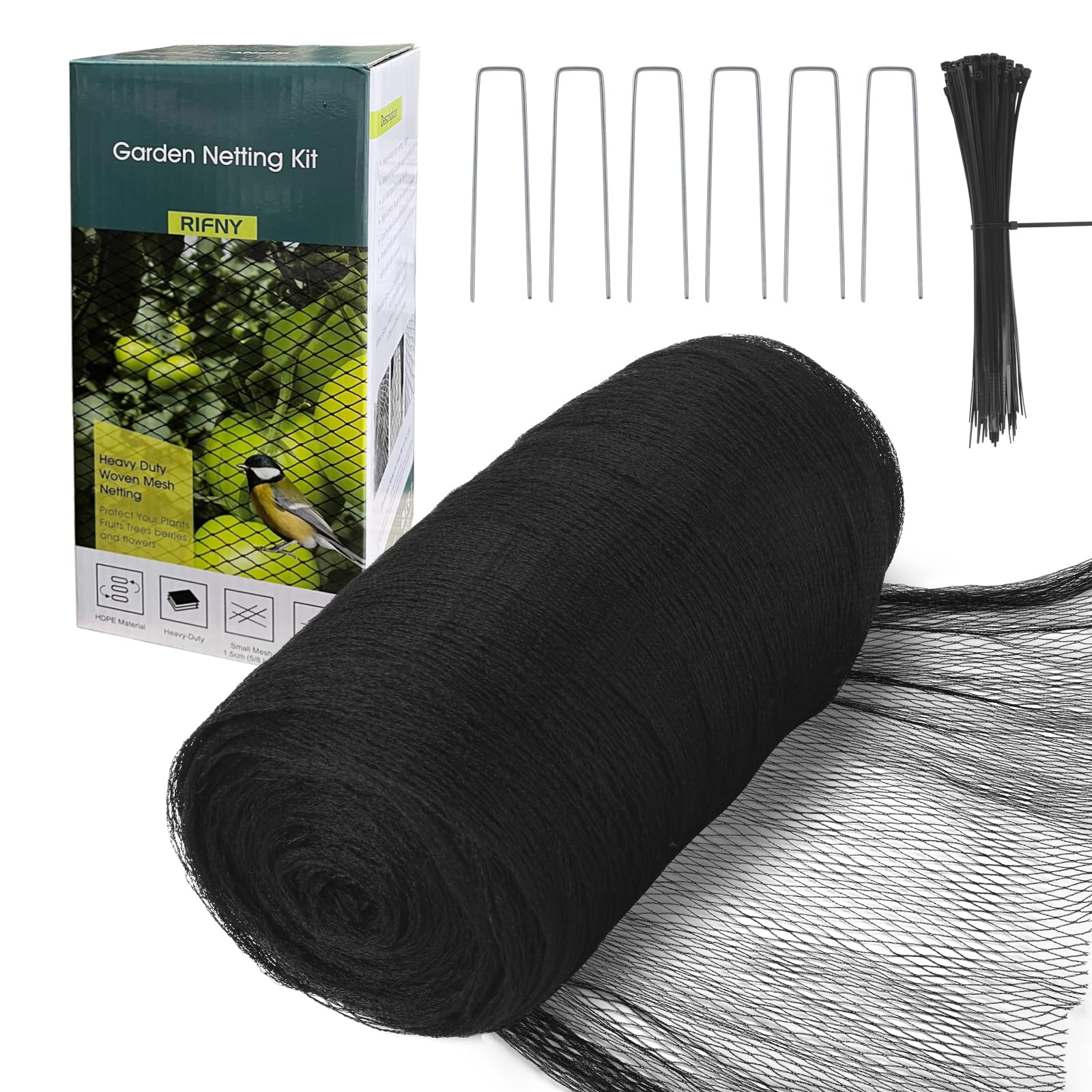
6. RIFNY 13x40ft Heavy Duty Bird Netting
The crowd favorite that buyers reorder four times — no tangles, no tears
This 13ft by 40ft net from RIFNY has amassed the most owner feedback in the heavy-duty category, and the pattern is remarkable: buyers repeatedly describe it as “fabulous” and mention they have reordered it multiple times. The 5/8 inch woven mesh stops birds, deer, and poultry without entangling them, and the fabric rolls out without the infuriating knot that cheap diamond-net often forms. Owners drape it over grape arches, attach it to trellises with clothespins, and wrap it around blueberry bushes — one even uses it as a toddler-and-dog barrier for raised beds.
The only consistent note is that the included ground staples are insufficient for hard soil; you will likely need to buy longer stakes separately. The net itself, however, is durable in direct sun and holds up through major wind and rain storms.
what separates it
- Non-tangling material unrolls easily and stores wound into clean bundles
- Withstood major wind and rain storms without fraying, per owner reports
- Stretches without tearing — forgiving for irregularly shaped trees
The shortfall
- Needs separate ground staples for firm anchoring in dense soil
- Mesh is bird-rated, not insect-rated — 5/8in holes let small bugs through
Best for: a gardener who wants a reliable, frustration-free install and is willing to buy better stakes separately.
Look elsewhere if: you are fighting cabbage moths — the mesh is too wide for insect exclusion.
7. UWIOFF 7x100ft Bird Netting

One hundred feet of net that buyers bury underground to stop diggers
The UWIOFF is the longest single roll in this lineup at 100ft by 7ft, and its 0.75-inch square mesh is specifically designed for birds, deer, and rabbits rather than insects. Owners mention burying the edges 5 inches deep to stop squirrels from tunneling under, and using the tight weave at the top to prevent digging from the inside. The green color blends into foliage better than black or white, which matters if you are netting a front-yard blueberry bush. At just 0.52 kilograms, it is also the lightest of the large-format nets — easy to handle alone even over a long row.
The polypropylene material is thin and some owners note it can tear if stretched sharply over a thorny branch. Bird protection is the top-rated aspect, but durability carries a mixed verdict: handle it gently and it lasts multiple seasons; pull too hard and it may rip.
Why it belongs here
- 100ft roll covers a massive area economically — 7ft wide handles most bush heights
- Square mesh design stays open without the retracting curl of diamond nets
- UV and rot resistant for multi-year reuse
The caution
- Thin strands can tear under sharp tension or against thorns
- Not fine enough for insect exclusion
Ideal for: covering a long row of fruit trees or a full vegetable plot where birds and deer, not bugs, are the problem.
Choose another if: you need a mesh fine enough to block mosquitoes or cabbage moths.
8. Ruolan 10x33ft PE Insect Netting

A balanced mid-tier net that handles deer, rabbits, and bugs equally well
The Ruolan sits in a useful middle ground: its ultra-fine mesh is tight enough to stop cucumber beetles and cabbage moths, yet the polyethylene material is thick enough that customers note it holding back deer and rabbits from sweet potatoes and beans. At 10ft by 33ft, it is a versatile size for a medium garden. The net is cuttable to exact dimensions without fraying, and because the mesh lets rain and light through, you can water straight through it — a convenience that owners highlight repeatedly. Plant protection is the most-praised aspect here, followed closely by overall quality.
The trade-off is the same one that affects nearly every fine PE net: the thin material can snag on rough edges, and in high wind it needs secure pinning. One reviewer noted it is “very large and unwieldy to unfold alone in wind,” so a second pair of hands helps.
Strengths
- Fine enough for insects yet durable enough for rabbits and deer
- 33ft length covers medium beds without waste
- Cuttable without fraying — custom sizing is simple
Weaknesses
- Unfolding solo in windy conditions is frustrating
- Snags on branches and rough posts
Pick this if: you need one roll that covers both insects and small mammals for a medium garden — it is the best all-rounder in the mid-tier.
pass on it if: your main pest is deer large enough to push through lightweight mesh; you need the heavier woven Fetanten or RIFNY nets.
9. SnugNiture 10x33ft Ultra Fine Mesh

The entry-level insect screen that outperforms pricier rivals
SnugNiture offers a 0.1mm x 0.1mm ultra-fine mesh at the lowest price in the lineup, making it an easy entry point for new gardeners or those covering temporary beds. At just 1.2 pounds for 33 feet, it is genuinely lightweight — you can drape it directly over plants without crushing them. The fine weave blocks worms, aphids, and caterpillars effectively, and reviewers point out it keeps a bunny enclosure bug-free all summer. Water and sunlight pass through the square mesh without pooling or scorching.
The light weight is also the limitation: the net snags easily on sharp objects and branches can rub small holes over time. Owners note that minor damage doesn’t ruin the usability — it still works for years — but you cannot treat it roughly. For the price, it is an honest budget performer that overdelivers on insect exclusion.
Where it delivers
- 0.1mm mesh stops worms, aphids, and caterpillars completely
- Ultra-light at 1.2 lb — floats over plants without support frames
- Water penetrates easily for no-lift watering
Where it falls short
- Snags easily on rough surfaces and branch stubs
- Best for insect protection, not deer or heavy bird pressure
Reach for this when: you need a quick, low-cost insect barrier for raised beds or a bunny run and you are careful with the material.
it’s not for you if: your garden has sharp thorns or you need a multi-year barrier against large animals.
Understanding the Specs
Mesh Size and What It Stops
Hole size is the single most important spec. A 0.75-inch mesh stops birds and chipmunks but lets cabbage moths through. A 0.1mm ultra-fine mesh stops those moths but also blocks large pollinators. If you need to exclude both birds and insects, you may need two layers — a coarse net over a fine one — or schedule pollination windows where you lift the fine net for a few hours. Always match the hole dimension to your smallest pest.
Material Weight vs Durability
Netting weight is measured in grams per square meter (g/m²) or total roll weight. Light nets under 1 pound (like the 0.52 kg UWIOFF) are easy to handle and cheap but tear under stress. Heavy nets over 1.8 pounds (like the 1.33 kg Fetanten) are stronger but harder to drape over delicate plants. The practical rule: for floating row covers use light PE mesh (0.8-1.2 pounds for 33ft); for permanent tree wraps or predator barriers use woven HDPE over 1.3 pounds for a 40ft roll.
FAQ
What is the difference between knitted and woven garden netting?
Will ultra-fine mesh netting block pollinators from my plants?
How do I stop squirrels and rabbits from digging under the netting?
Can I cut garden netting to a custom size without it fraying?
How long does garden mesh netting last outdoors?
What mesh size do I need to keep out deer?
Is black or white netting better for the garden?
Does garden netting protect plants from frost as well?
How do I store netting so it doesn’t tangle for next season?
Final Thoughts: The Verdict
Across the board, the garden mesh netting winner is the ANPHSIN Nano-PP 10x20ft because its dense nano-enhanced polypropylene stops even Florida-sized mosquitoes while also casting 33% shade — a rare combination of insect-proof and plant-friendly that no other fine mesh matches at this level. If you need two full beds covered for the price of one, grab the RIFNY 2-Pack. And for a predator-proof barrier that stands 13 feet tall and comes with staples and ties from the start, the Fetanten 13x40ft is the one to reach for.
How We Picked
We do not accept paid placement. Every pick is matched to a real buyer and a real use-case; we do not hands-on test units.
Sources & Methodology
Specifications: manufacturer listings and product documentation. Review insights: verified customer reviews, as of July 2026. Pricing: not shown on this page (it changes often); check the current price via the retailer link.
As an Amazon Associate, Lawn Gear Lab earns from qualifying purchases. This does not affect which products we feature.