
Specs are compiled from manufacturer listings and verified buyer reviews and can change over time — please confirm the key details on the product page before buying.
You water, you weed, you wait — and then Japanese beetles or cabbage moths take what you grew. A garden mesh cover is the simplest barrier between your harvest and everything that wants it first, but not all meshes keep tiny aphids out or survive a summer storm. The covers below actually seal, stay put, and last beyond one season.
I’m Rikta — the founder and writer behind Lawn Gear Lab. This guide is built by comparing the manufacturers’ published specifications and the patterns across verified customer reviews, so you get each pick’s real strengths and trade-offs instead of marketing spin.
Whether you are shielding a raised bed from deer or wrapping a blueberry bush from squirrels, the right garden mesh cover stops pests without stopping sunlight, rain, or your ability to harvest without a wrestling match.
Our Picks at a Glance


How To Choose The Best Garden Mesh Cover
Picking the wrong mesh usually means bugs still get through or the fabric tears after one windy week. Here are the three decisions that matter most.
Mesh Density: The Single Number That Predicts Success
Mesh count tells you how many openings per inch the fabric has. A standard 40-mesh netting (like the Garden Tailor pick) stops most aphids and carrot flies. Ultra-fine meshes around 0.8mm x 0.8mm (like the KLEWEE) go a step further, keeping out thrips and tiny caterpillars. For birds and deer alone, a wider weave works fine — but if you have ever lost a broccoli head to cabbage worms, you want the tighter option. The trade-off is airflow: an extremely dense mesh can trap heat on hot days, so a 30% shade black mesh can help keep plants cooler.
Material and UV Resistance: What Determines Lifespan
Most garden meshes are made from polyethylene (PE) that has been UV-stabilized to resist sun damage. A cover that lacks UV treatment will become brittle and crack within a single season. Look for the words “UV-stabilized” or “UV-resistant” in the specs. The thickest options, like the Nanometer PPT material used in the Thicker Garden Mesh Netting, are engineered to be more tear-resistant than standard PE and can even deflect hail. If you plan to reuse the cover for multiple years, thicker material and a higher weight (measured in ounces per square yard or pounds per roll) are worth paying for.
Size and Anchoring: The Part Nobody Talks About Enough
A 10×33 foot roll gives you plenty of slack to drape over hoops or trees, but the way you secure the edges makes the difference between a working barrier and a wind-tossed mess. Most owners bury the edges with soil, stones, or landscape pins. If you are covering a raised bed, a cover that lies directly on the plants can bend stems — especially with heavier fabrics. Using hoops, PVC arches, or stakes to lift the mesh off the foliage prevents physical damage and improves air circulation. Before buying, measure your garden area and add at least a foot of overhang on each side for anchoring.
Quick Comparison
| Model | Best For | Mesh Density | Material | Dimensions (LxW) | Amazon |
|---|---|---|---|---|---|
| Garden Tailor 10×20★ Best Overall | Tight-weave insect barrier | 40 Mesh | HDPE / PE | 10′ x 20′ | Amazon |
| Thicker Garden Mesh Netting 10×33Toughest Build | Durability + 30% shade | Ultra-fine Nano PPT | Nanometer PPT | 10′ x 33′ | Amazon |
| KLEWEE 10×50Big Coverage | Large-scale bird & bug coverage | 0.8mm x 0.8mm (80/in) | PE | 10′ x 50′ | Amazon |
| WiMas 10×50 | Frost & pest dual-purpose | Ultra-fine mesh | PE | 10′ x 50′ | Amazon |
| Hyxanons 10×50 | All-around raised bed protection | 0.8mm x 1mm | UV-resistant PE | 10′ x 50′ | Amazon |
| RIFNY 2-Pack 10×33 | Two beds at once | 0.04in oblong mesh | PE | 10′ x 33′ (2 rolls) | Amazon |
| FEED GARDEN 8×33 | Deer & rabbit defense | 0.7mm x 0.8mm | UV-stabilized PE | 8′ x 33′ | Amazon |
| SnugNiture 10×33 | Budget-friendly large coverage | 0.1mm x 0.1mm | PE | 10′ x 33′ | Amazon |
| GonLei 10×50 | Night-pest & insect exclusion | Ultra-fine nylon mesh | Nylon | 10′ x 50′ | Amazon |
In‑Depth Reviews
1. Garden Tailor Garden Netting Pest Barrier (10’x20′)
Our pick — over 4.5★ from 300+ verified ratings; the strongest balance of quality and price.
The 40-mesh weave that stops the tiniest aphids without a single chemical.
This is the cover for the gardener who has lost one too many brassica heads to small insects. The 40-mesh HDPE weave is noticeably tighter than standard pest barriers — buyers report it keeps “very small aphids” out of broccoli, Brussels sprouts, and cabbage, which is exactly what a standard bird netting fails to do. At 50 grams (about 1.8 ounces), it is lightweight enough to drape directly over hoops or raised beds without crushing tender plants. The UV-stabilized treatment and the 3-year warranty give you confidence it will hold up through more than one season.
Quality is what owners praise most — 22 buyers single it out, and another 20 specifically call out its insect protection. The mesh lets air, water, and light pass freely, so you never have to lift it during watering. The tight selvedge edges resist unraveling, and you can cut it to any size with a razor blade (scissors struggle, as several owners note). It covers 200 square feet, enough for several raised beds or a medium-sized fruit cage.
The one honest trade-off is that this density is overkill if you are only fighting birds or deer — a wider mesh would work fine and cost less. But for the gardener battling cabbage moths, carrot flies, and aphids specifically, the tighter weave is exactly why this netting outperforms the cheaper alternatives.
What owners love
- Tighter 40-mesh weave blocks very small insects that standard nets miss — buyers confirm aphids and carrot flies stay out.
- UV-stabilized HDPE material resists tearing and sun damage; backed by a 3-year warranty.
- Light enough (50g) to place directly on plants without crushing them; allows rain and sunlight through.
A realistic note
- Hard to cut with household scissors — requires a sharp razor blade or box cutter.
- Over-built for bird-only protection; a wider mesh would be cheaper if tiny insects are not your problem.
Who it fits: The veggie gardener who has watched aphids and cabbage worms decimate a crop and wants a physical barrier that actually matches the hole size of the pest.
Think twice if: You are only keeping squirrels and deer out — a wider, cheaper mesh will do the same job without the density premium.
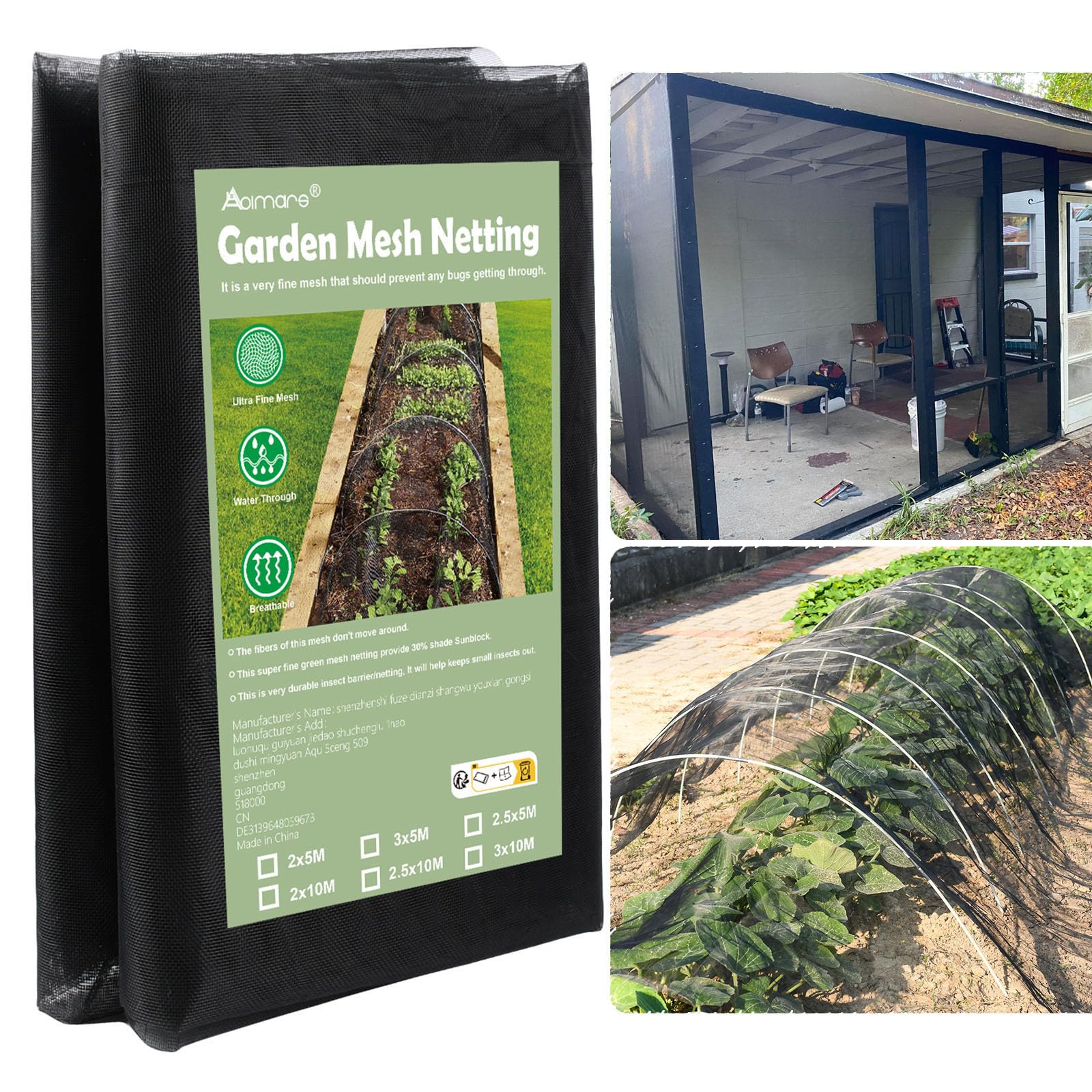
2. Thicker Garden Mesh Netting (10’x33′ Black)
The black mesh that doubles as a shade cloth and survived 60 mph hail.
This is the cover you reach for when your garden faces triple threats: insects, scorching sun, and hail. The Nanometer PPT material is noticeably thicker and more tear-resistant than standard PE, and owners confirm it held up through a hail storm with 60+ mph winds without a single rip or tear. The 30% shade factor is a genuine bonus in hot climates — it helps keep plants cooler, reduces watering frequency, and prevents bolting in sensitive greens like lettuce and spinach.
Durability and mosquito prevention are the two most-praised aspects, each cited by 37 owners. The ultra-fine mesh stops Japanese beetles, caterpillars, and the tiniest bugs while the fixed cross-threads mean the weave does not shift or gap when you pull it taut. You can cut it cleanly without fraying, and at 1.33 oz/yd² it is light enough not to crush plants — but the manufacturer recommends using a support system (hoops or stakes) to keep the mesh from bending stems. As owners put it: “the fibers do not move around” — every wire is fixed in place.
The catch is that the black color makes it harder to spot insects on the fabric, and the 30% shade means it is not the best choice for full-sun crops that need every photon (corn, tomatoes in cooler climates). But if your summers bring both pests and punishing heat, this dual-purpose cover earns its premium tag.
Real-world verdict: Abimars delivers on its promise of strength — owners mention it surviving hail, wind, and concrete contact without fraying. The 2-year warranty backs a material that genuinely feels different from standard PE netting.
3. KLEWEE 10×50 Ultra Fine Garden Mesh Netting
500 square feet of fine mesh that keeps birds off cherries and bugs off brassicas.
At 10 by 50 feet, this roll covers as much ground as the biggest blueberry patch or a long row of raised beds with plenty left over for fruit trees. The 0.8mm x 0.8mm mesh (80 openings per inch) is finer than many competitors, and customers note it stops birds, Japanese beetles, and even cats and chickens from reaching their plants. The PE material is lightweight enough to lay directly over crops without crushing them, yet tough enough to be reused year after year.
The thing owners love most is how well it keeps pests out while letting rain and sun through — you water right through the netting without removing it. Several buyers mention using PVC arches or clips to create a tunnel over raised beds, and the mesh cuts cleanly with scissors. It is a straightforward, no-gimmick solution for anyone with a large garden who wants a single roll to cover everything from broccoli to blueberries.
Compared to the Abimars above, this one lacks the shade factor and the extreme tear resistance of Nano PPT — it is standard PE (polyethylene), so it will last a few seasons but may need replacement sooner in harsh sun. For the price, though, the coverage per dollar is tough to top.
Who it fits: The gardener with multiple beds, fruit bushes, or a long row who wants one roll to cover everything. The 0.8mm mesh is fine enough for most insects and wide enough to wrap around trees.
4. WiMas Garden Netting Pest Barrier (10x50FT)
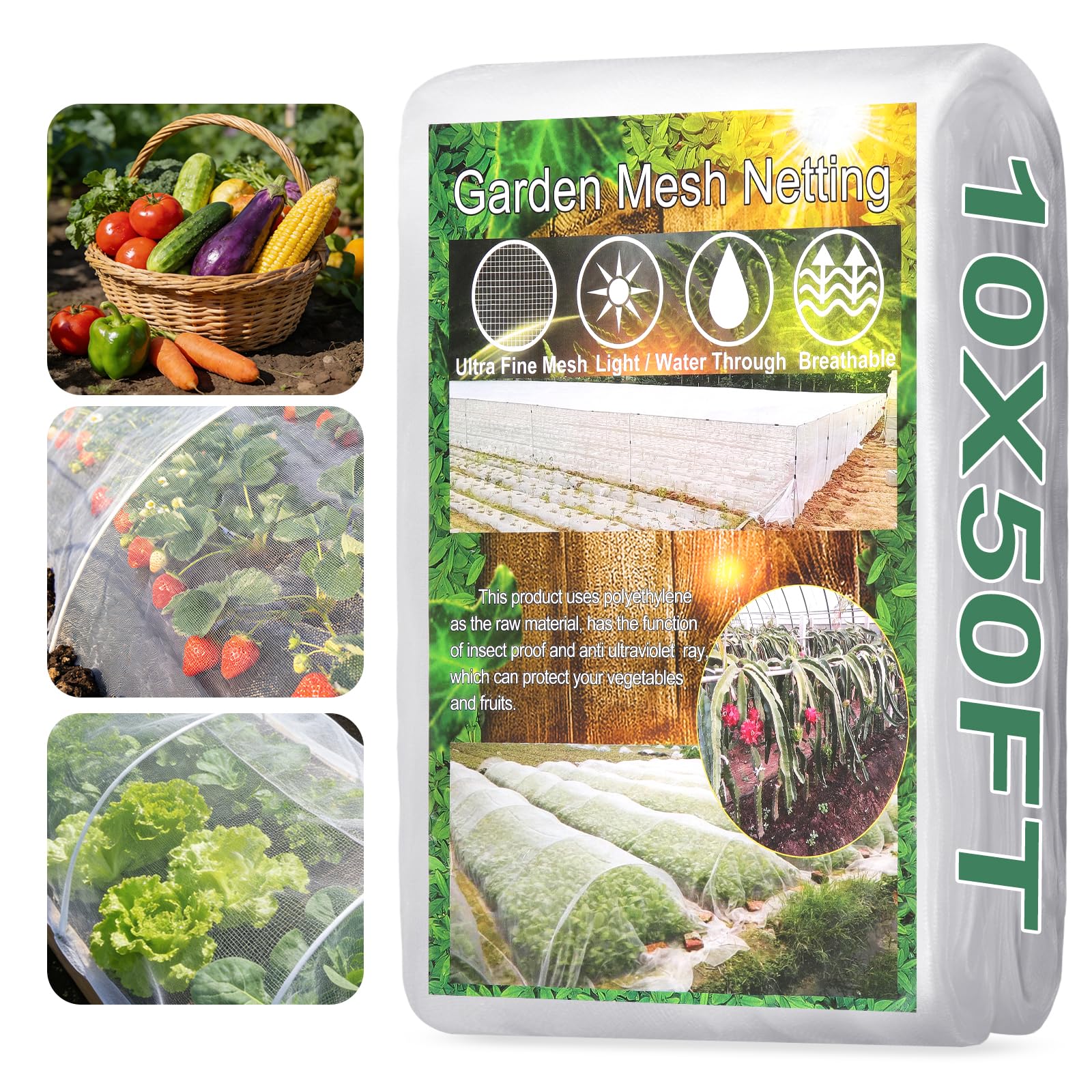
A dual-purpose barrier that protects against both pests and freezing temperatures.
This cover gets serious praise for its frost protection — reviewers point out plants stayed healthy through a hard freeze while the mesh allowed enough light through to charge a solar lantern beneath it. The ultra-fine PE mesh is breathable, preventing rot and moisture buildup, and it cuts cleanly with ordinary scissors. At 0.76 kg (about 1.7 pounds), the 10×50 foot roll is easy to handle and drape over hoops, raised beds, or fruit trees.
Effectiveness (28 mentions) and pest protection (26 mentions) lead the owner feedback. The material is treated for UV and weather resistance, so it holds up in wind and rain without tearing or becoming brittle. The flexible nature of the fabric means you can tailor it to any garden layout, and the non-toxic construction makes it safe for edible crops. Buyers also appreciate using it as a barrier against banana slugs and other ground-level pests.
The mixed feedback on durability (25 mentions) suggests that while the fabric performs well initially, very sharp objects or rough handling can cause snags. The 10×50 size is generous, but some owners found it almost too large for small spaces — a consideration if you are covering just a single 4×8 foot bed.
Best use case: The northern gardener who needs a single cover that stretches from late-summer pest protection through early-autumn frosts. The breathability and light transmission set it apart from solid frost cloth.
5. Hyxanons 10×50 Ultra Fine Garden Mesh Netting

A thicker, heavier PE mesh that resists deformation even under forceful tearing.
This cover tips the scales at 3.3 pounds for the 10×50 roll, making it noticeably denser and more durable than most standard options. The 0.8mm x 1mm mesh is designed to withstand prolonged sun exposure without deforming, and the UV-resistant PE (polyethylene) material is advertised as reusable “for many years.” Shoppers say it effectively keeps deer and critters off tomatoes and peppers, and it has saved entire crops from being eaten down to the stem.
The mesh is easy to cut without unraveling — you can trim it to exact dimensions for raised beds, tunnels, or fruit cages. Buyers also use it as a pond cover or a patio screen. The ultra-fine weave blocks insects up to birds while keeping airflow and light penetration high. Several owners specifically praise its quality and versatility, noting it serves multiple purposes across the garden.
The thick material means it is less prone to wind damage but also slightly heavier to drape over delicate seedlings without a support frame. If you plan to cover low-growing crops directly, use hoops or stakes to lift the fabric off the plants. The weight is a trade-off for the long-term reusability.
What stands out
- Thicker PE material resists deformation and sun damage better than lightweight alternatives.
- Ultra-fine mesh (0.8mm x 1mm) blocks everything from insects to deer while allowing air and light through.
- Can be cut to size without fraying; holds up to repeated use across seasons.
What to know
- Heavier than standard netting — support hoops recommended for delicate plants.
- Some owners note the string strength is less sturdy than smaller-sized versions from the same brand.
Reach for this if: You want a single, heavy-duty cover that will survive multiple seasons in full sun without turning brittle. The extra weight gives you confidence against wind and tearing.
Look elsewhere if: You need an ultra-light mesh to lay directly on fragile seedlings without any support structure.
6. RIFNY Garden Netting 2-Pack (10x33FT Each)

Two full rolls in one package to cover separate beds without buying twice.
This is the most practical solution if you have two distinct garden areas — a raised bed and a blueberry patch, for example — because the package contains two separate 10×33 foot rolls, not one double-length roll. The 0.04in ultra-fine oblong mesh is designed to keep birds and squirrels out while allowing sunlight, rain, and air to pass through. Buyers report it works effectively against cabbage moths and insects on brassicas and lettuce, and the material is lightweight enough not to burden plant buds.
Bird protection is the top-praised feature (67 mentions), followed closely by overall quality (42 mentions). The mesh is self-healing to some degree — owners note that if something snags it, the fibers shift apart but can be tugged back into place rather than ripping. It has held up through hail and high winds in testing. The oblong hole construction also provides some dust-blocking effect, which is a nice bonus in windy areas.
The trade-off is that the material stretches and can tear over time — several owners suggest treating it as an annual replacement if you want absolutely bug-free vegetables. It also blocks bees from pollinating, so you will need to lift the netting manually during flowering periods if your crops depend on pollinators.
Why it wins
- Two 10×33 rolls give you coverage for separate areas without buying a second package.
- Oblong mesh design provides insect, animal, UV, and frost protection while remaining breathable.
- Self-healing fibers shift rather than rip at snag points.
The fine print
- Stretches over time; best treated as a long-lasting seasonal cover rather than a multi-year investment.
- Blocks pollinators — must be lifted during flowering for crops that need bees.
7. FEED GARDEN Garden Netting (8x33FT)
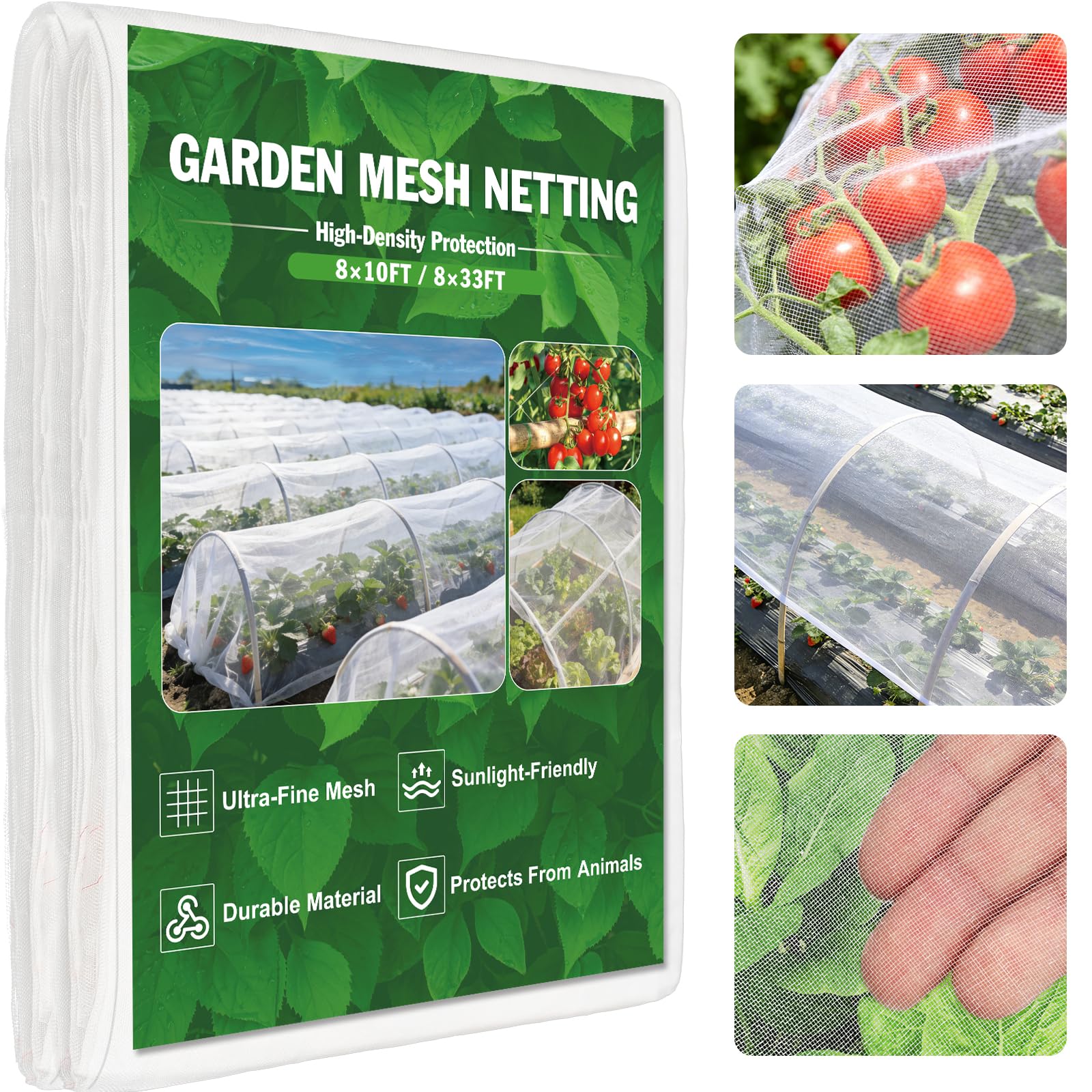
Deer coverage is its superpower — 50 owners single it out for stopping hungry herbivores.
If your garden problem is four-legged and tall enough to reach over a fence, this is the cover to consider. The 0.7mm x 0.8mm high-density mesh is specifically praised by 50 owners for its deer coverage, and another 36 confirm its overall effectiveness. Owners mention it keeps deer and rabbits off peppers and tomatoes, and the material is durable enough that it “doesn’t tear easy” when cut. The UV-stabilized PE construction resists sun damage across a full growing season.
The mesh is easy to roll out and install — several owners used it with T-posts to create a safe zone for fruit trees and tomatoes, noting it is much cheaper than chicken wire. It also lets sunlight, rain, and airflow pass through freely, so you never have to remove it during watering. The 8-foot width is slightly narrower than the 10-foot rolls, which can be an advantage for fitting standard raised beds without excessive overhang.
Durability gets mixed feedback (27 mentions), with some owners finding it sturdy while others describe it as flimsy. The thickness and weight also divide opinions. This is a cover that works best when anchored securely and not subjected to extreme pulling force — think of it as a reliable seasonal barrier rather than an indestructible fortress.
Who this suits: The gardener whose primary frustration is deer or rabbits eating tomatoes and peppers at night. The coverage-to-cost ratio is excellent for large perimeters.
8. SnugNiture Garden Netting (10x33FT)

The budget-friendly giant that protects a bunny enclosure or a whole vegetable patch.
At 10 by 33 feet and only 1.2 pounds, this is the lightweight value option that still manages to deliver real pest protection. The 0.1mm x 0.1mm ultra-fine mesh is effective against worms, bugs, and aphids, and owners confirm it kept a fall brassica garden pest-free for over 7 months. The PE material is waterproof and sun-proof, so it holds up to outdoor conditions without deforming. Buyers particularly appreciate the huge size for the price — one used it to cover a bunny enclosure, another for multiple raised beds and fig trees with leftover material.
The top feedback points are its ease of use and the fact that water and sunlight pass through freely. Several owners specifically note it is “better than traditional bird netting” because it does not tangle. The lightweight design means you can lay it directly over plants, but it also means the material is prone to snagging on sharp objects — blueberry branches rubbed small holes in one owner’s test, though the netting remained usable.
Versus the Garden Tailor pick at the top, this one has a higher owner count (nearly a thousand ratings) and a slightly lower star rating. The Garden Tailor holds the higher score at 4.6 stars, but this one wins on pure volume of happy owners and unbeatable value per square foot.
Best for: The budget-conscious gardener who needs to cover a large area now and is willing to handle the mesh gently. The huge size makes it a great first cover to experiment with before investing in thicker material.
9. GonLei Garden Netting (10x50FT)

Nylon construction gives this cover a different feel — flexible, fine, and effective against night pests.
This is one of the few options made from nylon rather than PE, which gives it a slightly different texture and flexibility profile. Customers note it stopped something from eating sweet potato vines at night and works well for strawberries, keeping June bugs off. The ultra-fine dense mesh allows air, water, and light to flow freely while blocking insects and birds. Several buyers use it to cover blueberry bushes, confirming it keeps both bugs and birds off the berries.
The 10×50 foot size provides generous coverage, and the mesh is easy to cut to any shape. Some owners use it as a protective barrier against hail, noting the fine weave offers an extra layer of defense. The nylon material is durable but lighter than expected — some owners found it prone to tearing in the wind if not anchored well, so securing the edges with U-pins or bricks is essential.
The main durability concern is that a few owners found it tears too easily, particularly if it contacts sharp objects or experiences strong gusts. This is a cover that rewards careful handling and secure anchoring. If you have a protected garden space or are willing to use a support frame, the nylon flexibility can be an advantage for wrapping oddly shaped plants or trees.
What works
- Nylon construction offers flexibility for wrapping around irregular shapes like blueberry bushes.
- Ultra-fine mesh stops night pests (June bugs, unknown nibblers) effectively.
- Allows full sunlight and rainwater penetration — no need to remove for watering.
What to watch for
- Material can tear in high winds if not anchored thoroughly with pins, soil, or bricks.
- Some reviewers point out it tears too easily on sharp edges — handle with care during installation.
Reach for this if: You want a nylon-based mesh for wrapping bushes and trees where flexibility matters more than brute tear resistance.
Think twice if: Your garden is exposed to constant strong wind and you cannot anchor the edges with heavy materials.
Understanding the Specs
Mesh Density (Openings Per Inch)
This is the most important number for stopping power. Standard 40-mesh netting (like the Garden Tailor) has 40 openings per inch and blocks most aphids, carrot flies, and small insects. Ultra-fine meshes at 0.8mm x 0.8mm (roughly 80 openings per inch) go a step further, stopping thrips and tiny caterpillars. The denser the mesh, the better it blocks tiny pests — but the trade-off is slightly reduced airflow, which can trap heat on very hot days. For birds and deer alone, you do not need ultra-fine mesh; a wider weave works fine and costs less.
UV Stabilization and Material Type
A garden mesh cover sits in full sun all day, every day. Without UV stabilization, the material becomes brittle and cracks within a single season. Look for “UV-stabilized” or “UV-resistant” in the specs — it means the polyethylene (PE) includes additives that block ultraviolet degradation. Standard PE is the most common material: lightweight, inexpensive, and good for 1-3 seasons. Nanometer PPT (used in the Thicker Garden Mesh Netting) is a newer composite that is more tear-resistant and can deflect hail, but it costs more. Nylon offers flexibility but can degrade faster in direct sun if not stabilized.
Weight and Thickness
Heavier mesh (measured in pounds per roll or ounces per square yard) generally means more durability. A 1.2-pound roll like the SnugNiture is lightweight and easy to drape but more prone to snags. A 3.3-pound roll like the Hyxanons feels substantial and resists tearing, but requires support hoops to avoid crushing delicate plants. Very lightweight mesh (1.33 oz/yd² like the Abimars) will not damage plants but needs anchoring in wind. There is no universally “correct” weight — it depends on whether you prioritize drape-ability or tear resistance.
Dimensions and Coverage
Common sizes range from 8×33 feet to 10×50 feet. The width determines how easily you can cover a raised bed (standard beds are 4 feet wide, so a 10-foot width gives generous overhang on both sides). The length determines how many beds or trees you can cover with one roll. A 10×33 roll covers 330 square feet — enough for several raised beds or a small fruit cage. A 10×50 roll covers 500 square feet. Always add at least 12 inches of extra material on each side for anchoring with soil, stones, or pins. If you have multiple separate garden areas, a 2-pack (like the RIFNY) may be more practical than one very long roll.
FAQ
Can I water my plants without removing the garden mesh cover?
Will a garden mesh cover block sunlight from my plants?
How do I anchor a garden mesh cover so it does not blow away?
What is the difference between garden mesh and bird netting?
How long does a garden mesh cover last outdoors?
Can I cut a garden mesh cover to a smaller size?
Will a garden mesh cover protect against frost?
Does garden mesh block bees and other pollinators?
Can I use garden mesh to cover a pond or pool?
What is the best way to store garden mesh when not in use?
Final Thoughts: The Verdict
For most buyers, the best garden mesh cover is the Garden Tailor 10×20 because its 40-mesh HDPE weave stops tiny insects that cheaper nets miss, backed by a 3-year warranty and a 4.6-star crowd consensus. If you need maximum durability with a shade bonus for hot climates, grab the Thicker Garden Mesh Netting 10×33 — it survived a hail storm with 60 mph winds and doubles as a 30% shade cloth. And for covering a large area on a budget, the SnugNiture 10×33 gives you nearly a thousand happy owners worth of proof that fine mesh does not have to cost a lot.
How We Picked
We do not accept paid placement. Every pick is matched to a real buyer and a real use-case; we do not hands-on test units.
Sources & Methodology
Specifications: manufacturer listings and product documentation. Review insights: verified customer reviews, as of July 2026. Pricing: not shown on this page (it changes often); check the current price via the retailer link.
As an Amazon Associate, Lawn Gear Lab earns from qualifying purchases. This does not affect which products we feature.