
Specs are compiled from manufacturer listings and verified buyer reviews and can change over time — please confirm the key details on the product page before buying.
Compacted soil starves grass roots of air, water, and nutrients. A manual garden lawn aerator punches through that crust by pulling soil plugs so air, water, and fertilizer reach the root zone. Spike tools compact hole edges; core tools extract plugs that break down as natural topdressing. Tine shape, depth, and whether they are hollow or solid decide if aeration truly relieves compaction.
I’m Rikta — the founder and writer behind Lawn Gear Lab. This guide is built by comparing the manufacturers’ published specifications and the patterns across verified customer reviews, so you get each pick’s real strengths and trade-offs instead of marketing spin.
Whether you are nursing a patchy back lawn or restoring a whole front yard after a dry season, picking the right garden lawn aerator boils down to three things: core extraction vs. solid spikes, tine depth and material, and how much of your body weight you need to put into each step.
Our Picks at a Glance

How To Choose The Best Garden Lawn Aerator
The first choice is between a spike tool that pokes holes and a core tool that extracts soil plugs. Spike aerators are quicker and lighter but can compress soil around holes, counteracting aeration on heavy clay. A core aerator removes a plug of soil (often around three inches long), giving roots a real pocket to expand into, and the plugs break down over time as natural topdressing. For most lawns that see foot traffic or have clay-heavy soil, a core aerator delivers better long-term results — but it demands more effort per plunge.
Tine Count, Depth, and Diameter
More tines per plunge means fewer steps across the lawn, but each tine needs to sink deep enough to reach below the surface compaction layer, which is typically two to three inches down. A spike aerator with fifteen, sharp spikes covers ground fast, but each spike is thin and does not remove any soil; a core aerator with three or four hollow tines, each about half an inch in diameter, pulls out a real plug that leaves an open channel. Tine length matters: a three-inch spike or a three-point-five-inch hollow tine gives you the depth to break through that hardpan, while a shorter tine barely scratches the topsoil.
Handle Height and Foot Plate Design
You will be stepping onto a foot plate hundreds of times in a session, so the height of the handle determines whether your back stays happy. A handle around 38 inches lets you stand upright while pushing, while a shorter handle forces you to hunch. The foot plate should be wide and long enough to fit your whole boot without slipping off. Some designs add a T-handle with foam padding for extra push leverage; others use a crossbar that you press with your foot. If you have large feet or prefer wearing work boots, look for a plate that is at least 6 inches wide and has an anti-slip surface.
Quick Comparison
| Model | Best For | Tine Type | Weight | Handle Height | Amazon |
|---|---|---|---|---|---|
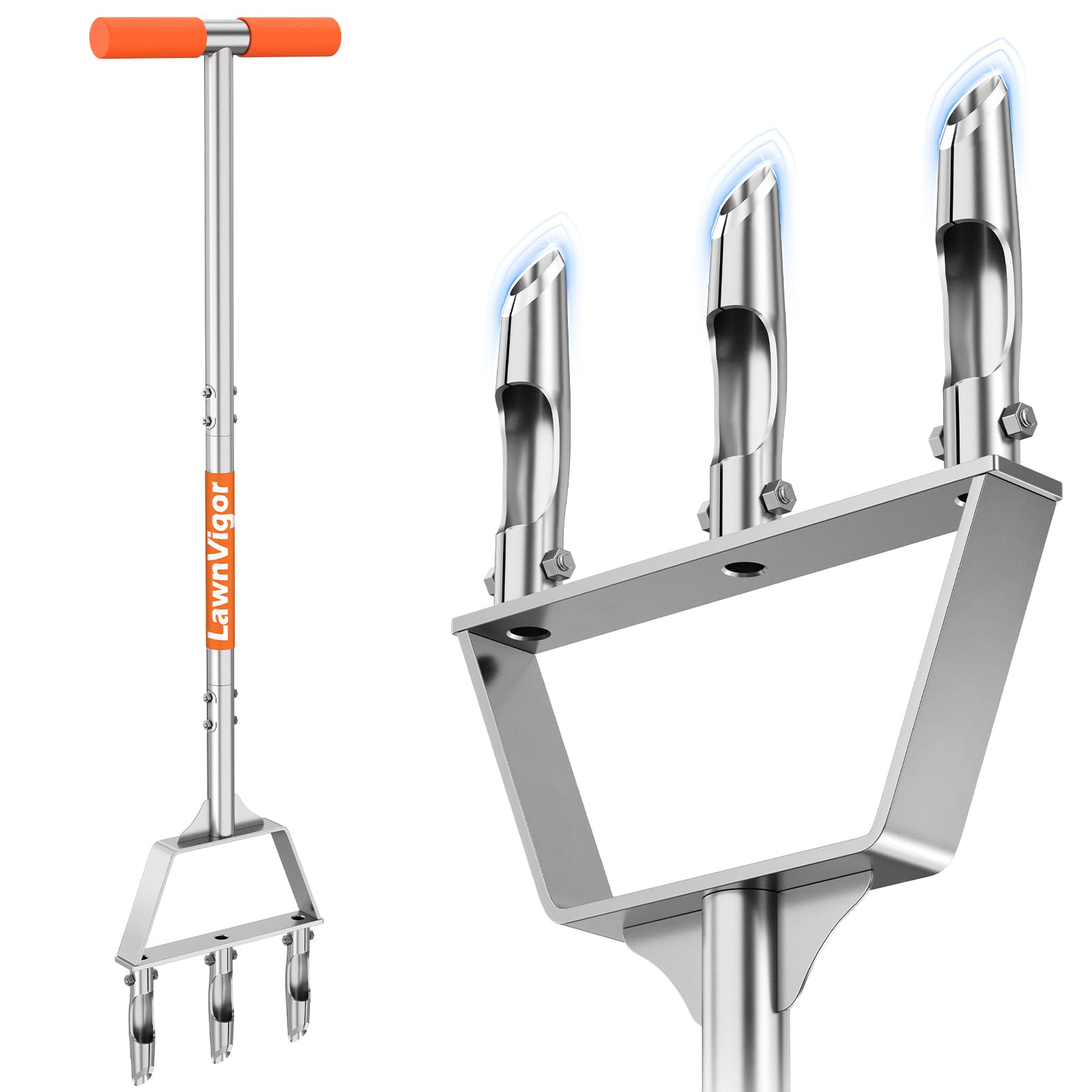
| Manual Core Aerator Lawn Tool★ Best Overall | Small to medium lawns needing real core extraction | 3 hollow tines (3-inch plugs) | 3.52 lb | — | Amazon |
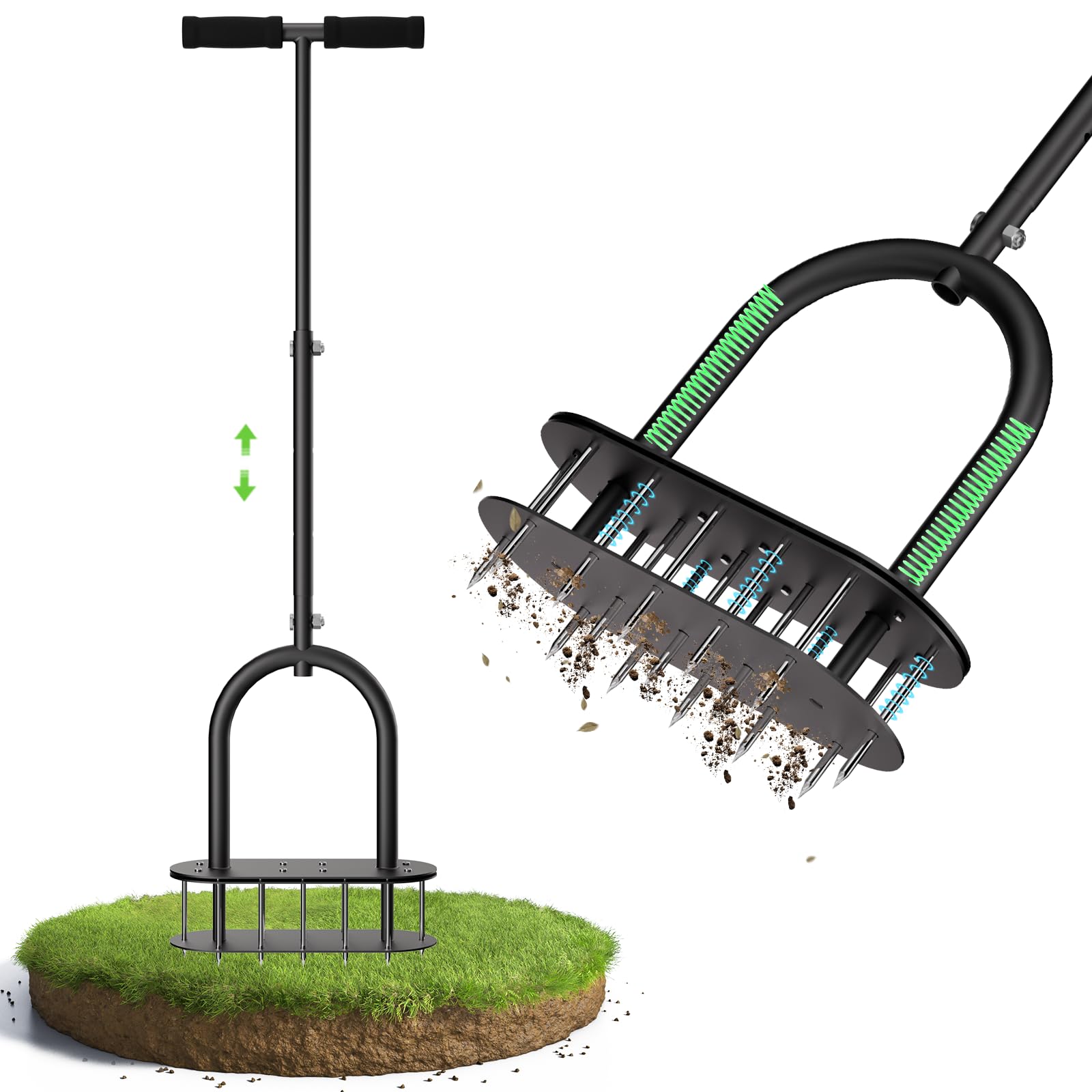
| seasky Lawn AeratorSpring-Assist | Quick spike aeration with spring-assist lift | 15 solid spikes (3-inch) | 5.35 lb | 28–38 in. adjustable | Amazon |
| Colwelt Lawn Aerator ToolDeep Spike | Heavily compacted soil needing thick, deep spikes | 4 solid spikes (3.5-inch, 0.4-inch dia.) | 4.31 lb | 38 in. | Amazon |
| Jardineer Lawn Aerator Tool | Residential lawns with clay, sand, or loam | 12 solid spikes (2.75-inch) | 5.02 lb | 36 in. | Amazon |
| 15 Steel Spikes Lawn Aerator (Onadak) | Hard soil where you want spring-assisted penetration | 15 solid spikes (3-inch) | 5 lb | 38 in. | Amazon |
| Dolibest Lawn Coring Aerator | Precision plugging in clay or loam | 4 hollow tines (3.5-inch, 0.5-inch dia.) | 5.54 lb | — | Amazon |
| Yard Butler Spike Aerator | Small gardens and spot-aeration projects | 4 solid spikes (3-inch) | 2.25 lb | 37 in. | Amazon |
| Seeutek 23Inch Rolling Lawn Aerator | Large open lawns (walk-behind style) | Star-shaped spikes (2-inch) | 24 lb | Adjustable | Amazon |
| Landzie Hollow Tine Lawn Aerator | Professional-level core work on tough clay | 3 stainless steel hollow tines (4-inch plugs) | 5.6 lb | 42.38 in. | Amazon |
In‑Depth Reviews
1. Manual Core Aerator Lawn Tool — 3 Hollow Tines
Our pick — 4.5★ from 250+ verified ratings; the strongest balance of quality and price.
Pulls actual three-inch plugs so your lawn breathes deep, not just poked on the surface.
This is the only tool in the mid-range that reliably yanks out soil cores instead of just making spike holes — and owners with compacted clay and Bermuda grass swear by the result. The three hollow tines are heat-treated steel, and the design includes large dirt-release slots so plugs come out without manual poking. Where the spike-heavy seasky below covers ground faster, this one gives each hole real volume: a consistent three-inch plug that lets water and air reach the root zone.
Owners mention the wide T-handle with foam grips and the foot bar that gives good leverage, even on dry-ish soil after a light watering. At 3.52 pounds versus the seasky’s 5.35 pounds, the repetitive step-and-plunge motion is less tiring over a small lawn. The crowd favorite aspect here is how smoothly the whole unit extracts soil — owners mention that it feels like it was engineered to be used, not just assembled.
The recurring trade-off is the handle foam sleeves: a few owners note they spin loose during use and need a dab of adhesive to stay still, and the footstep can fatigue skin through gloves on a long session. The tool is built for small to medium areas — nobody wants to do a full acre with a three-tine manual core aerator.
Why owners reach for this
- Extracts true ~3-inch soil plugs, which reduces compaction more effectively than spike-only tools
- Heat-treated hollow tines are replaceable; the frame feels solid without wobble
- Large dirt-release holes in the tine body prevent clogging during a session
The honest downsides
- Handle foam covers can spin; a few owners fix them with a bit of glue
- Not designed for large lawns — the three-tine pattern means a lot of steps per square foot
Reach for this if: you want real core extraction on a small to medium lawn and you are willing to trade step count for better soil relief.
Look elsewhere if: you need to cover a full acre or you prefer a spike tool for speed — this one is all about depth, not pace.
2. seasky Lawn Aerator — 15 Spikes with Dual-Layer Spring
Fifteen spikes stamp a grid of holes fast, and the spring lifts them out for you.
If your soil is moderately compacted and you want to cover ground quickly, the seasky is the spike-style workhorse of this list. Its defining feature is the built-in dual-layer spring that retracts the 15 solid spikes after each step — you do not bend down to pull the tool out. Owners confirm that the spring part works great and that stepping into the wide foot plate and moving to the next spot without removing your boot is noticeably faster than a fork-style aerator.
The handle adjusts from 28 to 38 inches, so a taller user can stand without stooping. The entire unit weighs 5.35 pounds versus the Manual Core Aerator’s 3.52 pounds — the extra heft comes from the spring mechanism and the large spike panel. It is not a core aerator (the spikes are solid, so they poke holes rather than extract plugs), but for patch repair, overseeding prep, and breaking a light crust, owners find it does the job well. The consensus calls it a good tool for small areas where you need quick aeration without renting a machine.
The catch: a few owners find the handle build slightly lacking for heavy-duty work, with some wobble reported during intense use. It is not built for a full-lawn assault on deep clay; it works best when the soil is damp (not bone-dry or muddy). The spikes also retract into the panel for safe storage, a nice touch if you keep it in a shed with bare hands reaching around.
Bottom line for the seasky: a solid spike option with a spring-assist that reduces fatigue, but its handle assembly feels less premium than the Colwelt or Jardineer offerings.
3. Colwelt Lawn Aerator Tool — 4 Thick, 3.5-Inch Spikes
Where other spike tools skimp, Colwelt sends in four spikes that are thicker and deeper than the norm.
Most spike aerators use thin prongs around a quarter-inch in diameter, but the Colwelt steps up to 0.4-inch diameter spikes that reach 3.5 inches into the ground. That is 3.5 inches deep versus the Jardineer’s 2.75 inches, with a 0.4-inch diameter. What that means in practice: each hole is wider, which lets water and air reach a larger volume of root zone, and the thicker steel resists bending when you hit a patch of compacted clay. Owners describe it as an easy tool to use on a 1,000-square-foot area, with one person finishing in about 90 minutes.
The T-handle has a cushioned grip and the 38-inch height lets you stand fairly upright. The foot plate is 6 inches wide — roomy enough for large work boots — with an anti-slip surface that prevents your foot from sliding off mid-plunge. At 4.31 pounds, it sits between the featherlight Yard Butler (2.25 pounds) and the hefty seasky, a weight that feels solid without being a backbreaker to carry across the yard.
One honest limitation: four spikes per plunge means you need more steps than a 12-spike or 15-spike tool, so covering a large lawn takes time. The tool is best for small to medium patches, spot aeration around trees, and narrow flower beds where a rolling aerator cannot reach. Owners also recommend watering the lawn 15 minutes before use if the soil is hard — a universal tip that applies to every manual aerator here.
What owners appreciate
- Spikes are 3.5 inches long and 0.4 inches thick — noticeably deeper and wider than typical spike tools
- 38-inch handle with cushioned grip reduces back strain during extended use
- Wide foot plate (6 inches) accommodates large boots without slipping
The pacing trade-off
- Only four spikes means more steps per square foot than a multi-spike tool
- Not ideal for large lawns; best reserved for small areas or compacted patches
4. Jardineer Lawn Aerator Tool — 12 Spikes with Rubber Grip
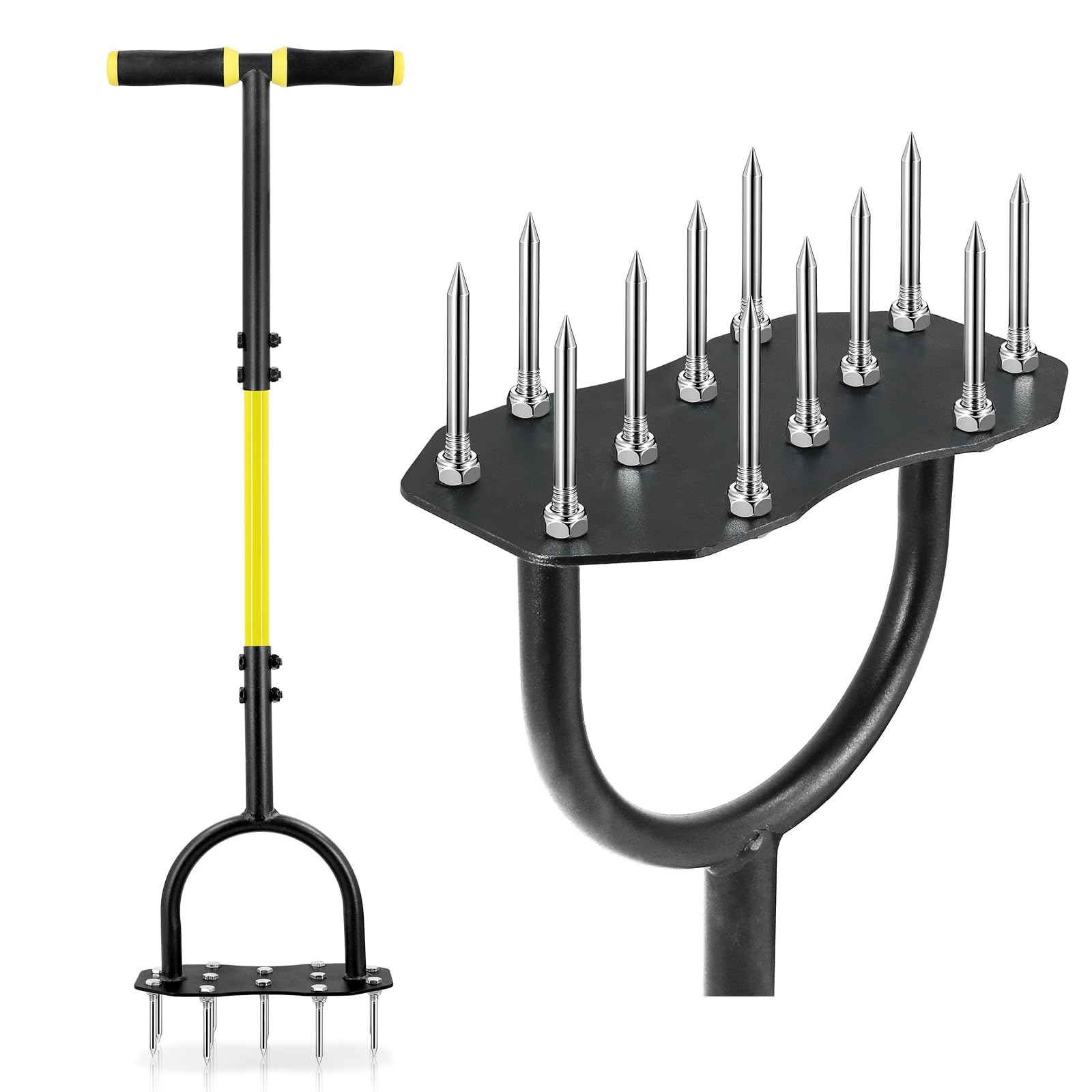
Twelve spikes per stamp means you cover ground fast, and the pre-assembled build gets you started in minutes.
The Jardineer targets the homeowner who wants a simple walk-on, step-off rhythm without arming themselves with a wrench. The unit ships mostly assembled — just attach the handle and you are ready, which owners consistently call a relief compared to tools that arrive as a bag of bolts. Each step sinks 12 heat-treated steel spikes about 2.75 inches deep, and the wide foot plate accepts your full weight without wobbling. At 5.02 pounds, it is heavy enough to feel substantial but not so heavy that carrying it to the front yard feels like a chore.
The rubber T-grip is a genuine comfort upgrade over bare metal handles, especially after 20 minutes of repetitive motion. Owners note that the spikes handle clay, sand, and loam without bending unless you hit a buried rock or pipe — in that case the included replacement spikes save the day. The crowd sees this as a solid tool for weekly or seasonal aeration, not a one-use device that ends up in the corner of the garage.
Where it falls short of the Colwelt: the spikes are only 2.75 inches long (almost an inch shorter than the Colwelt’s 3.5-inch spikes), so they may not punch through a thick thatch layer or a deep compaction zone. A few owners also mention that spikes can bend if you strike something hard, though the fact that the tool comes with spares softens that blow.
Best for: the home lawn enthusiast who values quick assembly and a comfortable grip over maximum tine depth. Not for: seriously compacted clay where only a deeper spike or a hollow tine will do.
5. Onadak 15 Steel Spikes Lawn Aerator with Spring Assist
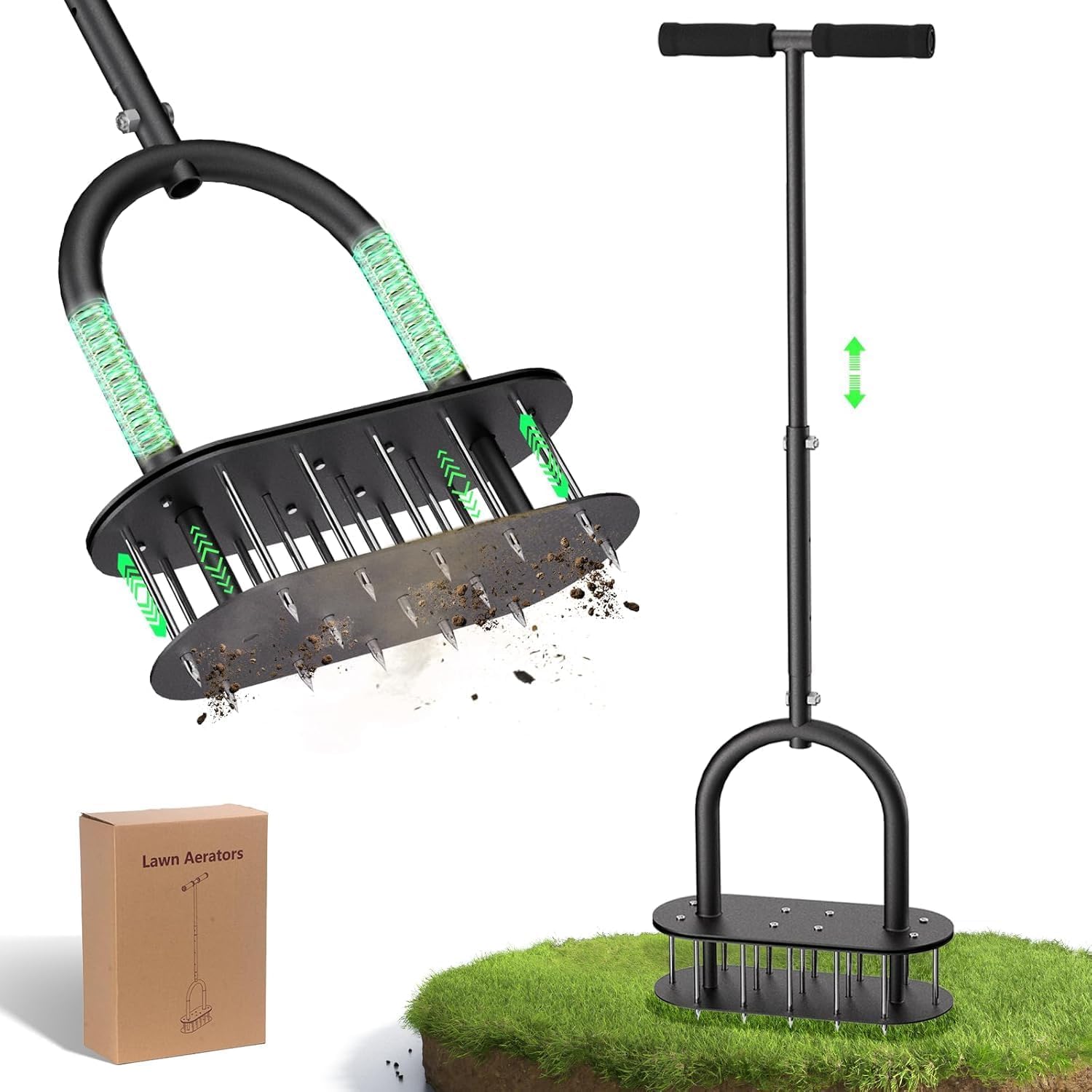
Like the seasky above, but with a padded T-handle and a wider foot plate for more leverage.
The Onadak is a near-twin to the seasky in concept — fifteen 3-inch spikes, a spring-assisted retraction, and a baked enamel finish for rust resistance — but with a couple of details that push it a fraction ahead for some buyers. The foot plate is 10.6 inches wide and 0.8 inches thick, which gives you a stable platform even in bulky work boots. The T-handle is padded to reduce hand fatigue, and the overall weight is right at 5 pounds, similar to the seasky.
Where the Onadak distinguishes itself is the spring action: multiple owners confirm that stepping down on compacted soil drives the spikes in without needing to rock or twist, and the spring lifts them cleanly on the upstroke. It is described as particularly good for an older gardener — one 74-year-old owner says he uses it comfortably with boots on and that it does the lawn good. That is a strong real-world endorsement for any manual tool.
The downside is the same spring-mechanism fragility that affects the seasky: if you hit a large root or stone, the spikes can flex, and the assembly instructions require careful attention to the tube connection alignment (a concave interface must be oriented correctly or the tool will not sit straight). It is also a spike tool, not a core extractor, so you are poking holes, not pulling plugs.
Highlights
- Spring assist makes the upstroke easy — one step, one lift, no bending
- Extra-wide foot plate (10.6 inches) provides stable footing for all shoe sizes
- Padded T-handle reduces vibration and blister risk during extended sessions
Watch points
- Assembly alignment matters — the concave connector must be installed correctly or the tool will feel crooked
- Spikes bend if they hit rocks; the tool is best on soil that has been watered and cleared of debris
6. Dolibest Lawn Coring Aerator — 4 Stainless Steel Corers
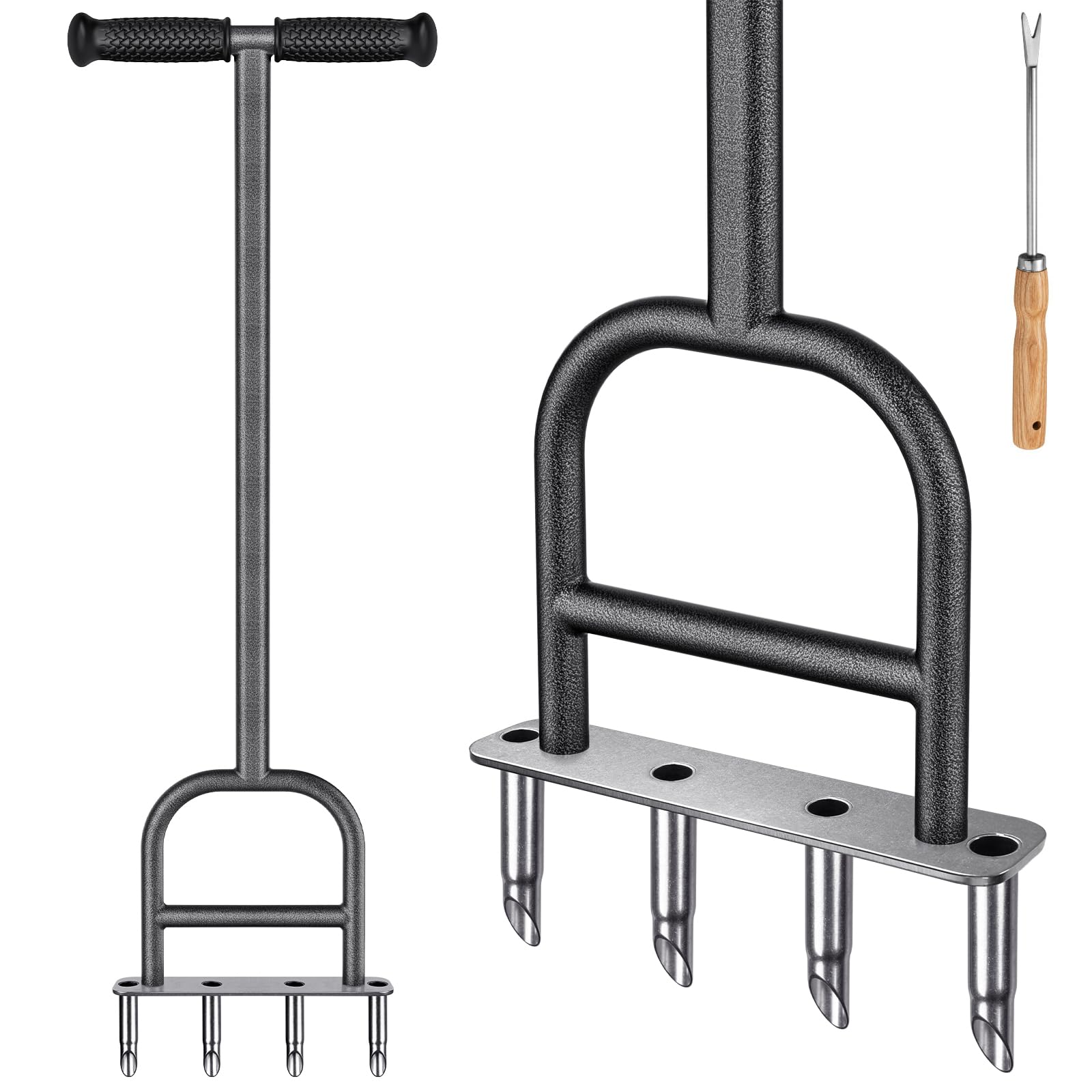
Stainless steel hollow corers that carve out clean plugs from clay without rust worries.
The Dolibest is a pure core aerator with four stainless steel hollow tines, each 3.5 inches long and half an inch in diameter. That is the same length as the Colwelt spikes but with an open center, so you actually remove a plug of soil instead of just displacing it. The stainless steel bottom section resists rust and stays sharp, and the black powder-coated upper frame gives it a clean, durable finish. Owners point out that the single welded construction feels rock-solid — no wobble between the tine frame and the handle.
The rubber grip handle is comfortable, and the addition of a foot bar prevents your shoe from interfering with the plug ejection path (a problem on some cheaper core tools where the boot heel blocks the top of the tubes). The tool is best on moist soil; buyers report that on properly damp clay, it extracts plugs cleanly with minimal clogging. It also comes with a separate 12-inch weeding tool that doubles as a cleaner for the tines, a thoughtful extra.
The honest knock against the Dolibest is the rounded foot step, which reduces downward leverage slightly compared to a flat plate. Some owners find that it only sinks about 2 inches deep unless they add weight or rock the tool side to side. The clogging aspect is also the most-mentioned negative: when the clay is too dry, the plugs stick inside the tubes and need manual clearing, which slows down the work.
Standout: stainless steel means no rust, and the 0.5-inch tine diameter pulls generous plugs. Trade-off: the curved foot plate demands a bit more body weight to get full depth.
7. Yard Butler Spike Aerator — 4 Three-Inch Spikes
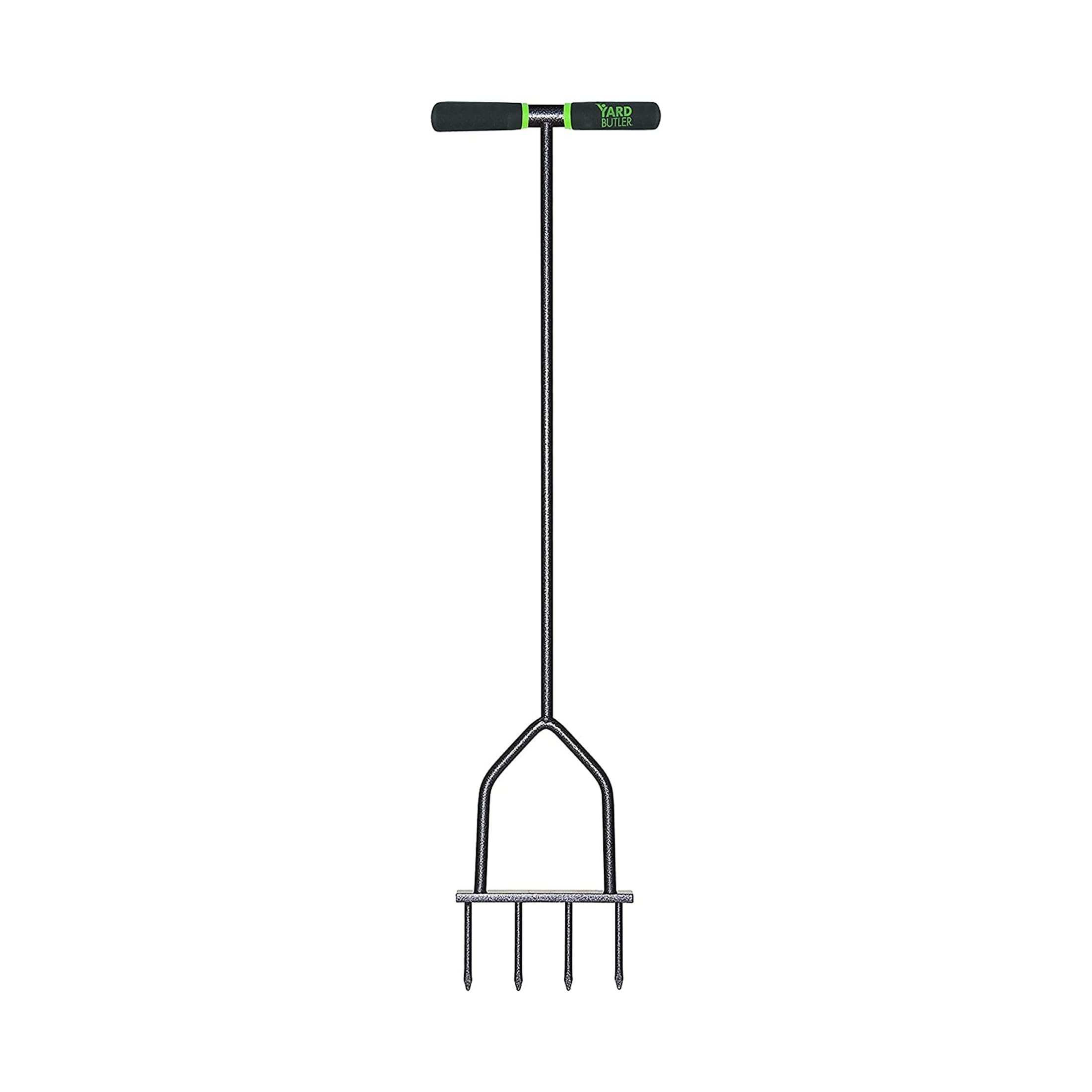
A cult-favorite spike tool that weighs almost nothing and has been in sheds for years.
The Yard Butler IM-7C is an old-school spike aerator that abandons all the spring mechanisms and multi-spike arrays in favor of a simple, welded steel frame with four 3-inch spikes. At 2.25 pounds, it is the lightest tool in this entire list (the Colwelt is 4.31 pounds, the Manual Core is 3.52 pounds) — you can carry it in one hand without thinking. The long handle, about 37 inches, gives you leverage, and the powder-coated steel construction is meant to outlive the plastic-handled alternatives you find at big-box stores.
Owners describe it as easy to use after a light rain, working well in moist clay soil. It is not a fast tool (the four-tine pattern covers about 325 square feet per hour), but for a small garden or a section of the yard where a rolling aerator cannot reach, it gets the job done without back strain. The company says the tool is designed to last a lifetime, and the reviews reflect that — many owners have had theirs for years with no bending or rust.
The catch: a subset of owners have noticed that newer production units use a softer steel that bends more easily than the earlier version. If you are stomping into rocky or root-filled soil, the tines can curl. The handle height also causes some back strain for taller users (those over 6 feet) because the crossbar forces a slight hunch. It is best kept for moderate soil conditions and smaller patches.
Best for: the gardener who wants a no-fuss spike tool for occasional use on small areas and values lightweight portability. Not for: heavy clay containing rocks, or for very tall users who need a 38-inch-plus handle.
8. Seeutek 23Inch Rolling Lawn Aerator

You walk behind it like a push mower, and you can add water or sand for deeper penetration.
The Seeutek is the only rolling-style aerator in this list, and it serves a completely different use case than the step-and-plunge tools above. Instead of stamping holes one footprint at a time, you push a 23-inch-wide drum covered in star-shaped spikes across the lawn. The drum itself weighs 24 pounds empty, but there is a small filler hole on the side where you can pour in water or sand to increase the weight, driving the 2-inch spikes deeper into the soil.
The handle adjusts to three heights, accommodating different user statures, and the padded T-bar adds comfort during a long walk. The laser-welded star spikes are designed to last, and the tripod connection between the handle and the roller stays firm without wobbling — a point the owners emphasize as a key difference from cheaper rolling aerators. For large, relatively flat lawns, this is far less tedious than a handheld tool because each full pass covers a wide strip.
The reality check: pushing a weighted drum through thick grass is physically demanding. Owners mention that with a 60-pound concrete block added, the tool barely moves on wet, tall grass. the balance is a scalped or short lawn with moderate soil moisture. Assembly also takes about an hour, and a few owners found the instructions confusing, with missing washers or shims that required extra hardware. It is not a grab-and-go tool, but it covers ground faster than any step-style aerator once you have it set up.
Why choose the rolling style
- Wider coverage per pass (23 inch drum) — faster for large lawns than step aerators
- Can add water or sand for variable weight, adjusting penetration depth
- Adjustable handle height and padded T-bar reduce fatigue during long walks
What to expect effort-wise
- Heavy to push, especially on tall grass or with added weight — expect a serious workout
- Assembly can take an hour with vague instructions; have spare washers handy
9. Landzie Hollow Tine Lawn Aerator — 3 Stainless Steel Tines
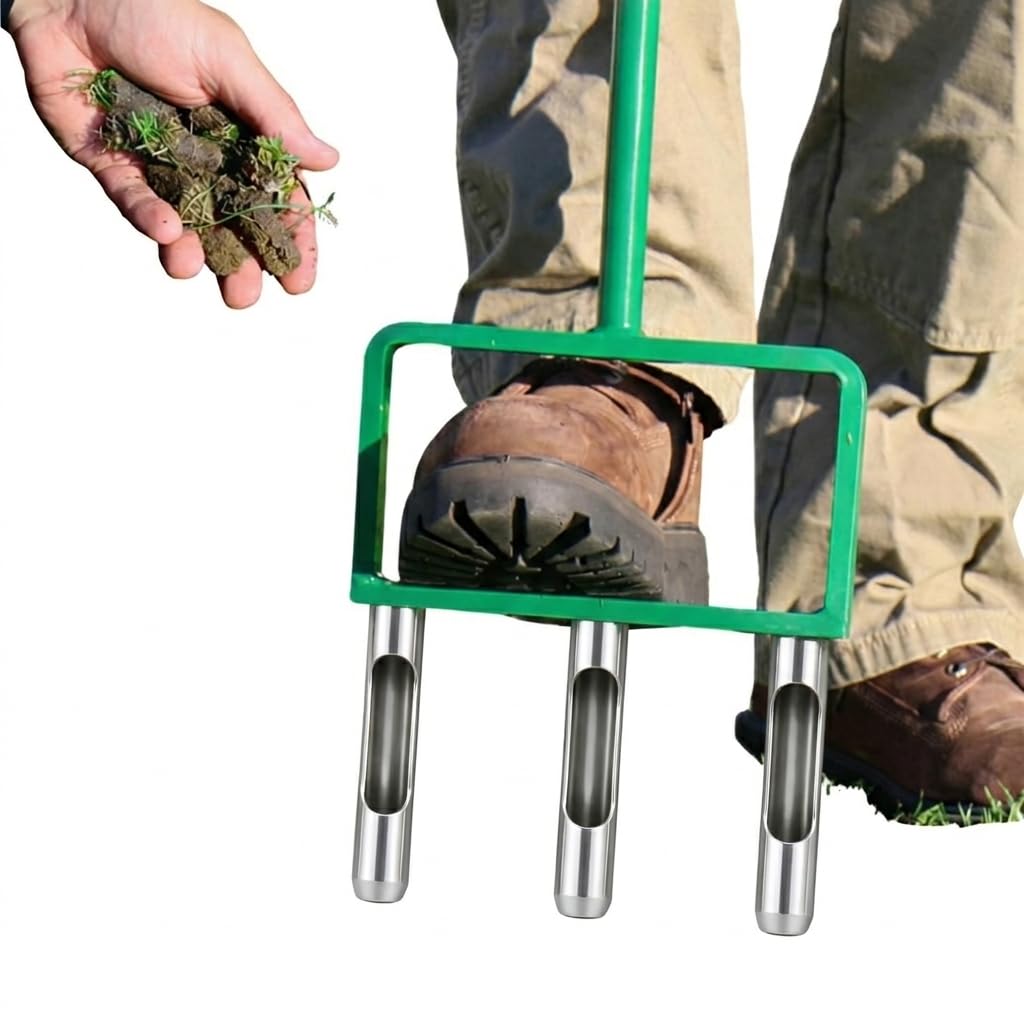
A buy-it-for-life core aerator that arrives fully assembled and uses clog-free beveled tines.
Landzie has built a reputation among lawn care enthusiasts, and this three-tine core aerator is their flagship manual tool. The key feature is the clog-free beveled design of the stainless steel tines: the opening is angled so that soil enters smoothly and exits the top without jamming. Owners consistently report that the self-cleaning action works well on damp soil, producing clean 4-inch plugs with each plunge. The tines are also replaceable when they eventually dull.
The frame is powder-coated steel, the handle stands at 42.38 inches (the tallest in the lineup, meaning even a 6-foot-2 person can stand straight), and the unit weighs 5.6 pounds. There is zero assembly — you open the box and the tines are already fitted to the frame. For a core aerator, that is a massive time saver. The construction is so solid that owners call it a lifetime tool, and the company backs it with a satisfaction guarantee.
The honest truth: this is the most expensive manual aerator in the list, and it demands physical effort. One owner reports covering 2,200 square feet in four hours with no clogging — proof of the self-cleaning design, but also a reminder that manual core aeration is slow work. The foot bar can be slippery when wet, and on extremely compacted soil the tines may still clog if the soil is too dry. It is a professional-grade tool for the homeowner who wants to do core aeration properly and is willing to sweat for it.
Why owners love it
- Beveled, stainless steel tines rarely clog — owners confirm the self-cleaning design works on damp soil
- No assembly required; the stout frame and 42-inch handle make for a comfortable stance
- Replaceable tines and lifetime build quality; many owners consider it a one-time purchase
The price and effort reality
- Premium price tag — costs roughly twice as much as a mid-range spike tool
- Manual core aeration is labor-intensive; a large lawn will take multiple sessions
Understanding the Specs
Core vs. Spike Aeration
Core aerators (also called plug aerators) use hollow tines to cut and remove a small cylinder of soil, typically 0.5 to 0.75 inches in diameter. The removed plug leaves an open channel that relieves compaction directly. Spike aerators simply push solid prongs into the ground, displacing soil sideways. On heavy clay, spike aeration can actually increase compaction around the hole. If your soil is dense or your lawn sees heavy foot traffic, a core aerator is the better investment. Spike tools work best on sandy or loamy soil that already drains reasonably well.
Tine Depth and Diameter
The most common tine length in spike tools is 2.75 to 3 inches; core tools often reach 3.5 to 4 inches. A deeper tine penetrates the compaction layer that forms just below the surface, usually 2 to 3 inches down. The diameter of a solid spike is typically 0.2 to 0.4 inches, while a hollow tine for core extraction is usually 0.5 inches. A wider tine removes more soil volume per hole, which means better relief but also more work per plunge.
Handle Height and Leverage
Handle height determines whether you can stand upright while aerating. A tool with a 36-inch handle works fine for someone around 5’8″, but taller users will want 38 to 42 inches to avoid hunching. The leverage also comes from the foot plate: a wider plate (6 inches or more) distributes your weight and prevents your foot from slipping off. Some tools add a padded T-handle for hand-push assistance; others rely entirely on stepping down onto a foot bar.
Weight and Material
Manual aerators range from just over 2 pounds (ultra-light spike tools) to over 5 pounds (sturdy core aerators and multi-spike units). Heavier tools need less downward force from your body because their own mass carries the spikes into the soil, but they are more tiring to carry and reposition. The material of the tines and frame matters for longevity: heat-treated steel, stainless steel, and powder-coated carbon steel all resist rust and bending. Avoid tools with thin, unpainted steel that will rust after one season.
FAQ
What is the difference between a spike aerator and a core aerator?
How deep should the tines be for my lawn?
Can I use a manual aerator on wet soil?
How many tines should I look for?
Is a rolling aerator better than a step aerator?
Will a manual aerator work on clay soil?
How often should I aerate my lawn?
Do I need to water after aeration?
Why are some aerator handles only 36 inches tall?
Can I replace the tines if they wear out?
Final Thoughts: The Verdict
If you want one dependable pick, the best garden lawn aerator is the Manual Core Aerator Lawn Tool because it extracts real soil plugs at a reasonable weight and a price that does not scare off a homeowner. If you want the speed of a spike tool but with a spring assist to save your back, grab the seasky. And for the person who demands a buy-it-for-life core aerator that arrives fully assembled and uses clog-free stainless steel tines, the Landzie is the one to reach for.
How We Picked
We do not accept paid placement. Every pick is matched to a real buyer and a real use-case; we do not hands-on test units.
Sources & Methodology
Specifications: manufacturer listings and product documentation. Review insights: verified customer reviews, as of July 2026. Pricing: not shown on this page (it changes often); check the current price via the retailer link.
As an Amazon Associate, Lawn Gear Lab earns from qualifying purchases. This does not affect which products we feature.