
Specs are compiled from manufacturer listings and verified buyer reviews and can change over time — please confirm the key details on the product page before buying.
High municipal water pressure can silently damage your garden hose, RV plumbing, or irrigation system — the fix is a small valve that steps the force down to a safe level. A good regulator keeps your setup running without burst fittings or wasted water, and the right one depends on if you need an RV-friendly inline unit, a gauge-equipped model for fine-tuning, or a tool-free adjustable knob for quick campsite hookups.
I’m Rikta — the founder and writer behind Lawn Gear Lab. This guide is built by comparing the manufacturers’ published specifications and the patterns across verified customer reviews, so you get each pick’s real strengths and trade-offs instead of marketing spin.
Here is the breakdown of the best garden hose pressure regulator models available, from simple plastic protectors to premium brass gauged units.
Our Picks at a Glance


How To Choose The Best Garden Hose Pressure Regulator
Picking the right regulator depends on where you use it, how much flow you need, and if you want to dial in the pressure or low-maintenance.
Fixed vs. Adjustable Pressure
A fixed regulator locks your water pressure at one safe level — usually 40-50 PSI (pounds per square inch) or 50-55 PSI — so you just screw it on and go. This is ideal for RV owners who want one less thing to think about at every campsite. An adjustable regulator, on the other hand, lets you turn a knob to raise or lower the output pressure, which is handy if you sometimes need a gentle trickle for a garden drip line and a stronger flow for a campground shower.
PSI Range and Flow Reality
Most regulators step pressure down to between 40 and 60 PSI, which is safe for standard RV plumbing and garden hoses. If you need more flow for a decent shower, look for a “hi-flow” model — the data shows some deliver 15% to 20% more water than standard regulators by keeping the pressure slightly higher at 50-55 PSI instead of 40-50 PSI. Just make sure the range matches your setup: a regulator rated for 50-55 PSI may still burst an older RV hose rated for 40 PSI.
Brass vs. Plastic Construction
Brass regulators generally last longer and resist cracking in cold weather, but they cost more. Plastic models are lighter and much cheaper, but the review data shows they can fail within a year due to calcium deposits or internal parts that fall out. Lead-free brass is the safer choice if you use the water for drinking, as it meets the NSF standard of less than 0.25% lead content. If you just need a cheap backup for occasional use, a plastic regulator can work fine.
Gauge vs. No Gauge
A built-in pressure gauge tells you exactly what your output pressure is at a glance, which is useful if you need to dial in a specific number — say 45 PSI for a touchy plumbing system. Models without a gauge are simpler and take up less space, but you won’t know if the regulator has drifted or failed until a hose bursts. Most adjustable units include a gauge; most fixed units do not.
Quick Comparison
| Model | Best For | PSI Output | Material | Gauge | Amazon |
|---|---|---|---|---|---|
| Valterra A01-2222VP★ Best Overall | RV & Garden (Best Overall) | 50-55 | Brass | No | Amazon |
| Camco 40143Budget Champion | Budget RV Protection | 40-50 | Plastic | No | Amazon |
| CircleCord TYF-IL-CDHi-Flow Pick | Hi-Flow RV Setup | 50-55 | Brass | No | Amazon |
| Gickbusus RW001 | Precision Adjustable | Adjustable | Brass | Yes | Amazon |
| Kohree HY1730 | Dual-Filter Protection | Adjustable (0-160) | Brass | Yes | Amazon |
| Hourleey RV Regulator | Tool-Free Rugged Use | Adjustable (0-160) | Brass | Yes | Amazon |
| MEASUREMAN MA102 | Long-Term Durability | Adjustable (0-160) | Lead-Free Brass | Yes (Glycerin-filled) | Amazon |
| Oppsiue 6002D | Color-Coded Gauge | Adjustable (14.5-87) | Lead-Free Brass | Yes (Oil-filled) | Amazon |
| Boltigen AH45 | Kit with Sealing Tape | Adjustable (0-160) | Lead-Free Brass | Yes | Amazon |
In‑Depth Reviews
1. Valterra A01-2222VP Water Regulator 50-55 PSI with 90 Degree Hose Saver
Our pick — over 4.5★ from 650+ verified ratings; the strongest balance of quality and price.
The smart-angle brass regulator that protects your plumbing and eases hose connection.
The Valterra tackles the two real headaches of campsite water hookups: burst fittings and awkward hose bends. Its 90-degree design points the hose straight down instead of sticking straight out from your RV inlet, which reduces strain on plastic fittings — a smart detail that the brass body backs up with real durability. The regulator keeps output at 50-55 PSI and delivers 15% to 20% more flow compared to standard regulators, so your camper shower actually has some push behind it.
Buyers praise how it locks in consistent pressure without any drift. The gripper surface lets you hand-tighten it — no tools needed — which makes setup at a new site as fast as screwing on a garden hose. The one trade-off the data flags: some units develop leakage after about 6 months of use, though most buyers report no issues at all. It is not recommended for older RVs, so check your inlet before buying.
Real-world fit: If you want to protect your Airstream or newer RV without thinking about pressure every time you hook up, this is the one. The angle alone saves your plastic inlet from cracking over a long season.
Reach for this if: You own a modern RV and want the combination of higher flow, hand-tighten ease, and the strain-relief angle.
Look elsewhere if: Your RV inlet is older or you need a built-in gauge to read the pressure — this model has none.
2. Camco Camper/RV Water Hose Pressure Regulator (40143)
The cheapest reliable way to stop high-pressure city water from trashing your RV plumbing.
The Camco is the plastic workhorse that thousands of RV owners reach for when they just need pressure cut down to a safe 40-50 PSI range. It screws onto any ¾-inch garden hose thread in seconds, and because it is made of lead-free plastic, it is light enough to toss in a glovebox. The data shows that many buyers actually prefer it over brass because brass fittings can chemically react with aluminum hose connectors and weld themselves in place.
The trade-off is built right into the price: internal components can fall out if you take it apart, making the whole unit useless. Reviews also note that it lasts roughly a year before performance drops, but at this price point, owners just replace it. It is essential for any RV — dropping 95 PSI marina pressure down to 50 PSI saves your hoses from bursting every season.
The catch: Plastic construction means it will break if yanked hard. Secure your hose to avoid damage, and consider this a seasonal consumable rather than a lifetime buy.
Best for: Budget-minded RVers who want one less thing to worry about at the campsite and don’t mind replacing a part every year or two.
Not for: Anyone who needs a precise reading or plans to leave the regulator outside year-round in freezing weather.
3. CircleCord RV Hi-Flow Water Pressure Regulator 50-55 psi
The brass inline regulator that boosts flow 15-20% while locking pressure at 50-55 psi.
If your camper shower trickles and you want more push without blowing a line, the CircleCord is built for exactly that balance. It uses C46500 lead-free brass processed through hot casting, keeping lead content below 0.13% — well under the NSF requirement of 0.25%. The 3/4-inch garden hose threads fit every standard American water source, and the built-in screened filter catches particles before they reach your plumbing.
Buyers consistently report stable, non-adjustable pressure that stays where it should — unlike adjustable units that can drift from 45 PSI all the way up past 100 PSI over time. Contrast this with the Valterra above: both hold 50-55 PSI, but the CircleCord is a straight inline design without the 90-degree angle, making it a better fit if you have room to spare. One reviewer noted that after 6 months of use it still worked just as advertised, though durability reviews are mixed, with some units failing within 4 months.
Why it stands out: It is one of the few fixed hi-flow regulators that does not sacrifice safety for flow. Your RV gets 15%-20% more water without the risk of overpressure.
Grab this for: A straightforward, no-dial setup that gives you noticeably better shower pressure than a standard 40-45 PSI regulator.
Skip if: You need adjustable pressure or expect it to survive a hard freeze — brass can still crack if water freezes inside it.
4. Gickbusus RV Water Pressure Regulator with Pressure Gauge

A heavy brass regulator that lets you dial in your exact PSI and read it on the gauge.
This Gickbusus regulator is the first on the list where you are not stuck with a single pressure setting. The top-mounted adjustable handle lets you set output pressure anywhere you want, and the glycerin-filled gauge (the silicone oil inside cushions the needle from vibration) shows you exactly where it is at. The leadless brass body tested below 0.13% lead content, and the 3/4-inch threads fit all standard American water systems.
Buyers find it easy to install with quick-connect fittings and appreciate being able to set the pressure to 25 PSI for a small camper or crank it up for a larger rig. The downside is size: at 1.3 pounds and roughly 4 inches across, it is noticeably bigger and heavier than a simple inline regulator. A freezing incident (left connected during a Texas cold snap) knocked the gauge out by 20 pounds, though the glycerin-filled replacement reportedly handles cold better. The manufacturer offers only a 30-day warranty, which is short compared to others.
Honest read: If you want to read your exact pressure and adjust on the fly between campsites with wildly different water supplies, this is the best tool for the job. Just be careful with winter storage.
Choose this if: You have a small camper and want to dial down to a safe 20-25 PSI when needed, or you just like knowing your number at a glance.
Move on if: You have limited space at your hose connection or you want a longer warranty period.
5. Kohree Adjustable RV Water Pressure Regulator with Gauge & 2 Inlet Screened Filters

An adjustable brass regulator with dual inlet screens to stop sediment before it reaches your plumbing.
The Kohree stands out for its two-layer inlet screened filter, which catches sand, rust flakes, and other particles that can gunk up your RV’s valves. The lead-free C46500 brass body keeps lead content under 0.13%, and the factory pressure is set at 45 PSI, but you can adjust it from 0 up to the gauge’s maximum of 160 PSI by pulling up the knob and turning it by hand.
The catch is that a small number of units arrived defective, with a jammed knob that stuck at 80 PSI. The vendor reportedly offered refunds in those cases, and the 1-year warranty adds some confidence. Compared to the CircleCord above, the Kohree gives you adjustable pressure plus filtration but costs more and adds bulk. The gauge is a real help for verifying campground pressure before you even connect your hose.
The edge: Two inlet filters mean less sediment in your water heater and faucets. If your campground water is gritty, this is the regulator that keeps things clean.
Best for: RV owners who want adjustable pressure, water filtration, and the ability to fine-tune without tools.
Think twice if: You just want a low-maintenance fixed regulator — the extra features add cost and complexity that you may not use.
6. Hourleey RV Water Pressure Regulator, Adjustable Handle Brass
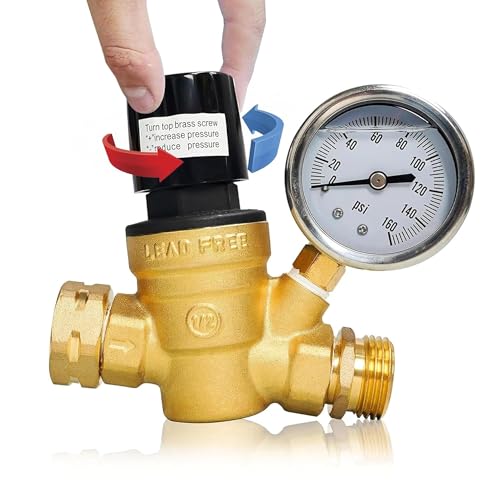
A solid brass regulator with an easy-grip handwheel that replaces the screwdriver method.
The Hourleey uses an upgraded handwheel — pull it up, turn it, and the pressure changes — instead of the old-school slot that needs a screwdriver. The body is lead-free brass with less than 0.13% lead, and the pressure gauge covers a 0-160 PSI range, so you can see exactly what is coming out. It fits standard 3/4-inch hose female inlet and male outlet threads, and the built-in screened filter catches debris.
Buyers consistently praise the build quality and adjustability. One RV owner reported using it for two seasons without any issues, and others note that it holds set pressure (for example, 50 PSI) reliably even when the incoming pressure varies. The main complaint in the data is that some units stop regulating properly after about 5 uses, with the gauge failing to return to zero and showing inaccurate readings. Durability is the most-discussed negative aspect, which is note if you plan to use it daily for a full camping season.
What you get: A well-built brass unit that is very easy to adjust on the fly. The handwheel design is genuinely better than tool-dependent alternatives.
Reach for this if: You want tool-free adjustability in a brass body that fits standard American hoses.
Hold off if: You need absolute reliability every day — the durability complaints suggest buying a backup if you rely on it for your full-time RV setup.
7. MEASUREMAN Adjustable Lead-Free Brass RV Water Pressure Regulator
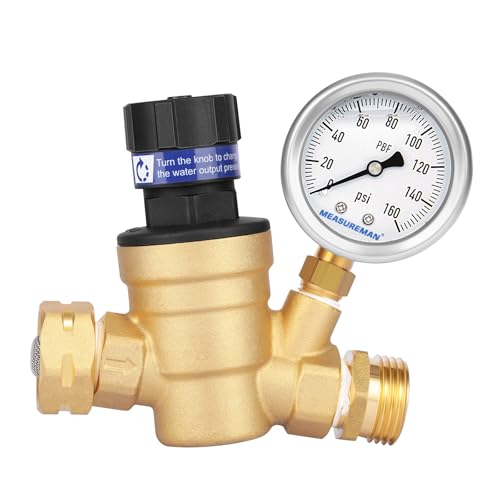
The long-haul regulator that comes with a protective bag and a glycerin-filled gauge that shrugs off vibration.
The MEASUREMAN is the most complete kit on this list: a 2-inch glycerin-filled pressure gauge (the silicone oil cushions the needle against water hammer and pulsation), a lead-free brass body that meets California AB 1953 and the 2014 U.S. Safe Drinking Water Act, a stainless steel filter screen, Teflon tape, and a portable canvas bag. The 0-160 PSI gauge is filled with glycerin to resist corrosion and vibration, and the 304 stainless steel casing paired with a PC lens is built to last. Multiple owners mention zero leaks after one year of use, and one owner stated it is still going strong after more than 4 years — an impressive track record in this category.
The price is higher than most competitors, and the data shows mixed durability reviews — some units reportedly failed within two weeks. The 1-year warranty is decent, and the included carry bag makes it easy to store when not in use. Compared to the Gickbusus, this one adds glycerin filling and a full accessory kit for about a few dollars more, making it the strongest bet if you want a regulator that will survive multiple seasons.
The standout spec: Customers note 4+ years of reliable service, which is rare in this product category. The glycerin gauge and canvas bag are genuinely useful additions, not just filler.
Buy this for: Long-term RV use where you do not want to replace your regulator every season. The included bag keeps it clean and protected in storage.
Pass if: Your budget is tight or you only need a regulator for a single weekend trip — the extra cost does not pay off for occasional use.
8. Oppsiue RV Water Pressure Regulator with Colorful Gauge
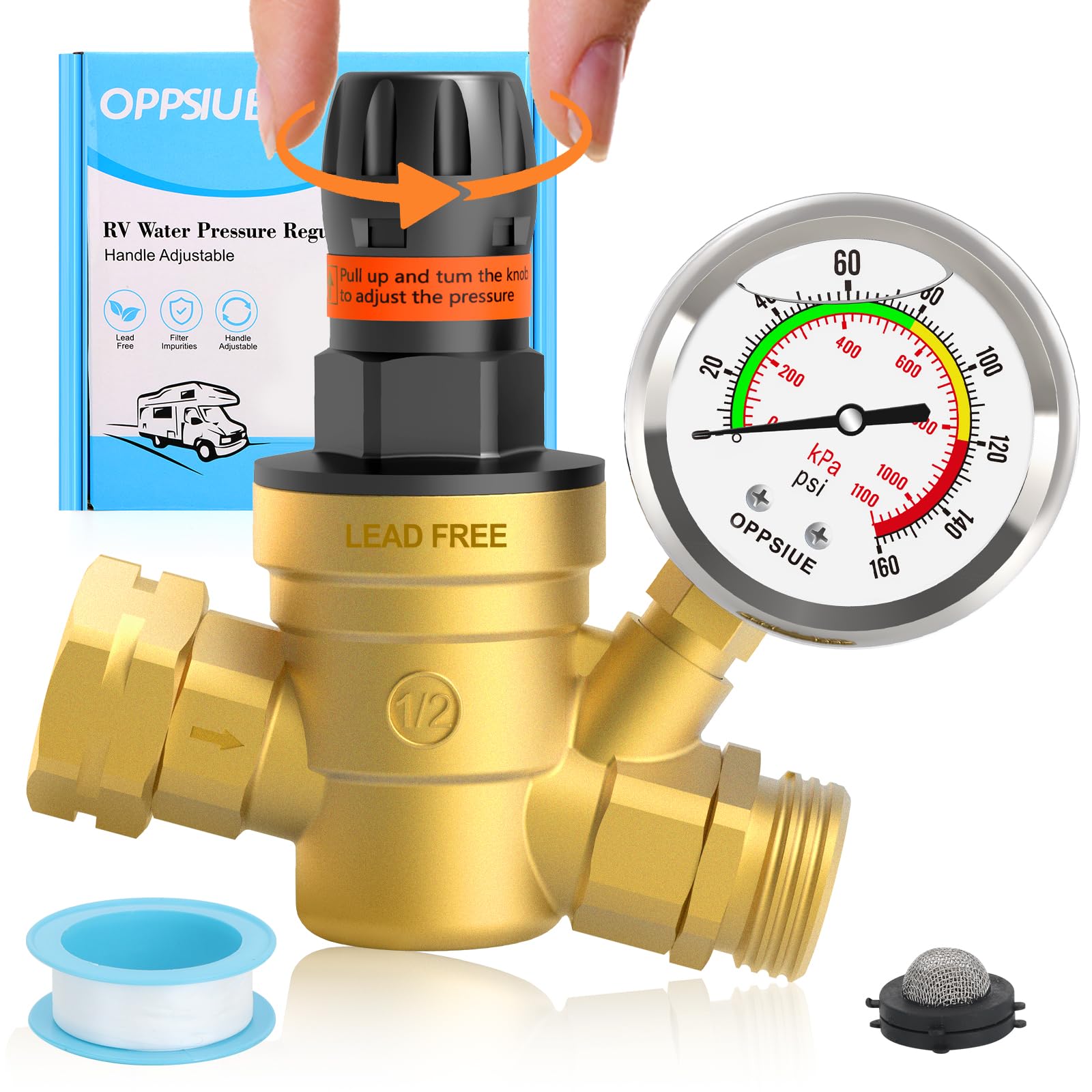
The adjustable regulator with a green-yellow-red gauge that makes reading pressure instantly obvious.
The Oppsiue makes checking pressure easier than any other model here: the dial is color-coded with green, yellow, and red zones, so you see at a glance whether you are in the safe range. The adjustable pressure handle can be set anywhere from 14.5 PSI (100 Kpa) to 87 PSI (600 Kpa), and the inlet can handle up to 232 PSI (1600 Kpa) before the regulator steps in. The body uses C46500 lead-free brass with lead content below 0.13%, and the gauge is filled with hydraulic silicone oil to resist freezing and vibration.
Buyers find it easy to install and appreciate the stainless steel construction. The unit comes with extra water inlet cartridges and sealing tape, plus a sturdy box for storage. A one-year warranty backs it up. The downside is that some units reportedly break within the first two weeks, and pressure regulation performance has mixed feedback. Compared to the MEASUREMAN, this one has a wider adjustable range (down to 14.5 PSI) and the color-coded dial, but its reliability track record is shorter given it is a newer model.
Why it stands out: The color-coded gauge is genuinely beginner-friendly. If you have ever wondered “is this too much pressure?” the green zone tells you instantly.
Pick this if: You want visual clarity and a wide adjustable pressure range, or you are new to RV water systems and want a gauge that simplifies the numbers.
Skip if: You need guaranteed long-term reliability from day one — the early failure reports suggest buying from a seller with a good return policy.
9. Boltigen RV Water Pressure Regulator with Gauge Lead-Free Brass Knob Adjustable

An every-season adjustable brass regulator that comes with spare filters and sealing tape from the start.
The Boltigen delivers everything you need in one package: the adjustable brass regulator, two spare inlet screened filters, and a roll of thread sealing tape. The C46500 lead-free brass body tested below 0.13% lead, and the 0-160 PSI gauge lets you set your pressure anywhere from a gentle 25 PSI for a small camper up to 60 PSI for a strong shower. The upgraded handwheel means you do not need a wrench or screwdriver to adjust it — just turn it by hand. One buyer mentioned that the 25 PSI fixed regulators would not work for their high-pressure situation, but this adjustable one solved the problem.
The recurring caution in the data is durability: several reviewers point out the regulator breaking within 90 days, often with the gauge leaking oil or failing. Others have used it for one season without issues. The Boltigen kit offers good value at its price point, especially with the spare filters included, but the short lifespan reports mean it may not be the best choice for full-time RVers who need absolute dependability.
The kit advantage: Two extra inlet filters and sealing tape mean you are ready for multiple seasons or a quick gasket swap without a trip to the store.
Best for: Seasonal campers who want an adjustable knob, a pressure gauge, and spare parts included — all in lead-free brass.
Think twice if: You need a regulator that will survive daily use for years without attention — the 90-day failure rate is real enough to plan for a backup.
Understanding the Specs
PSI (Pounds per Square Inch)
PSI measures the force of the water coming out of your hose. Most residential water supplies push between 60 and 80 PSI, which is too high for RV plumbing — it can burst lines and damage faucets. A regulator steps that down to a safer range, usually 40-55 PSI. Fixed regulators lock at one number, while adjustable ones let you set any value within their range. The number you choose depends on your equipment: older RVs may need 25-40 PSI, while newer ones and garden hoses can handle 50-60 PSI.
Lead-Free Brass vs. Plastic
Brass regulators are heavier and more durable, and “lead-free” brass (C46500 is the common alloy) keeps the lead content below 0.25% as required by NSF standards. This matters if you are drinking the water from the hose. Plastic regulators are much cheaper and lighter but tend to crack in freezing weather or degrade after a year. The choice depends on budget versus longevity — brass can last five years or more, while plastic is often replaced annually.
Gauge vs. No Gauge
A pressure gauge shows you the actual PSI coming out of the regulator, which is helpful for fine-tuning and for verifying that the regulator is still working correctly. “Glycerin-filled” or “oil-filled” gauges have silicone oil inside that cushions the needle from water hammer and vibration, making the reading more stable and the gauge more durable. A simple dry gauge costs less but can bounce erratically and fail sooner. If you never need to know the exact number, a regulator without a gauge saves space and cost.
Inlet Screen Filter
This is a small mesh screen built into the inlet of many regulators. It catches sand, rust flakes, and other debris from the water supply before they enter your hose or RV plumbing. Some models include one filter, others include two or even three. If your water source is known to be gritty (well water, older campgrounds), a multi-filter regulator can save your water heater and faucet aerators from clogging. The screens can be removed and cleaned, but they eventually wear out — having spares in the box is a nice bonus.
FAQ
Do I really need a pressure regulator for my garden hose?
What PSI should I set my RV water pressure regulator to?
Will a brass regulator react with my aluminum hose fittings?
How long does a garden hose pressure regulator typically last?
Can I use an RV water pressure regulator on a regular garden hose?
What does “lead-free brass” mean and why does it matter?
Why does my regulator’s pressure gauge show a reading even when no water is flowing?
Should I get a fixed or an adjustable regulator for my garden?
Can I leave my pressure regulator connected all the time?
What is the difference between 40-50 PSI and 50-55 PSI regulators?
Final Thoughts: The Verdict
For most people, the garden hose pressure regulator winner is the Valterra A01-2222VP because it combines a durable brass body, a strain-relieving 90-degree angle, and 15% to 20% more flow than standard regulators at a reasonable price. If you want adjustable pressure with a built-in gauge, the Gickbusus is the best mid-range choice for fine-tuning your setup. And for long-term RV use where you do not want to replace your regulator every season, the MEASUREMAN with its glycerin-filled gauge and portable case is the one to reach